Categories
Fieldcraft Gear & Stuff Gun Info for Rookies

The Stylish Man’s Guide to Concealed Carry

Antonio | September 26, 2012

StyleStyle & Grooming

concealed carry style blazer handgun showing jacket open

How to arrange good-looking clothing around the decidedly non-standard bulge of a handgun is a topic worth looking at. It’s something that a whole range of men need to think about: police detectives, security guards, entrepreneurs in dangerous countries, and even your average American civilian who prefers to be armed.
“Concealed carry” exists for a number of reasons. When you’re doing it, you want to be living up to both parts of the phrase: you want to be carrying, and have access to, a firearm, and you want it to be discreetly hidden until such time as you need it.
For some men, any jacket long enough to hide a holster is sufficient. But for most men, concealed carry needs to fit other societal expectations:

  • Most plainclothes peace officers will have specific dress needs — either a respectable suit or blazer to give them out-of-uniform authority, or in some cases a disguise to help them blend into their environment.
  • Security guards are almost always expected to dress professionally, as much for the comfort of their employer’s clients as anything else. Banks and government buildings need high security, but prefer a discreet man in a blazer as opposed to a uniformed, paramilitary-looking trooper looming over their customers.
  • An armed civilian gets less hassle if he doesn’t fit the stereotype of an armed threat. A trenchcoat and combat boots conceal a weapon, but it doesn’t really conceal the likelihood that you’ve got a gun under there. Bringing a little men’s style into the equation makes the “concealed” part of “concealed carry” a lot more effective. Plus, it’s the law in most states that if you’re carrying heat, you conceal it. Editor’s Note: If you’re a civilian, be sure to check with your local and state laws before you begin carrying a firearm. Most states require citizens who wish to carry a firearm to obtain a concealed carry license; there also may be restrictions on where you can carry your firearm.

There are many reasons to think about both concealed carry and style in the same picture. This article lays out the quickest and best steps to making your concealed carry experience both practical and stylish:

  • Step 1: Choose Your Weapon
  • Step 2: Choose Your Method of Carry
  • Step 3: Choose Your Outfit
  • Step 4: Talk to Your Tailor

So let’s take it step by step:

Step 1: Choose Your Weapon

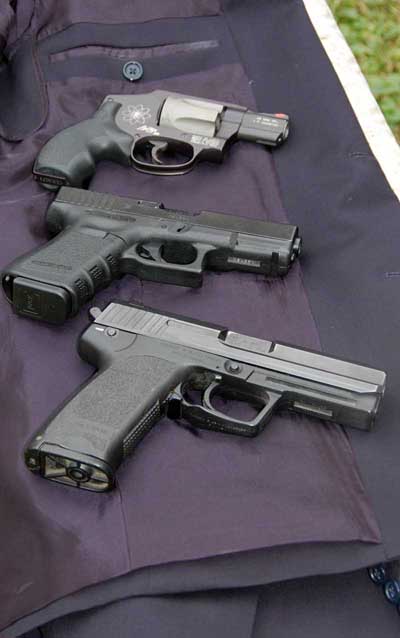
Concealed carry means striking a balance between firepower, ammunition, and size. You inevitably end up making a sacrifice in one area or the other — it’s more a question of personal needs and tastes than it is a matter of which is the “best” weapon.
handguns lying on blazer concealed carry weapon
But for choosing a handgun, which is what most men will be carrying when they carry a firearm in public, here are a few factors worth thinking about:
Magazine Size and Shape
single stack vs double handgun magazine diagram
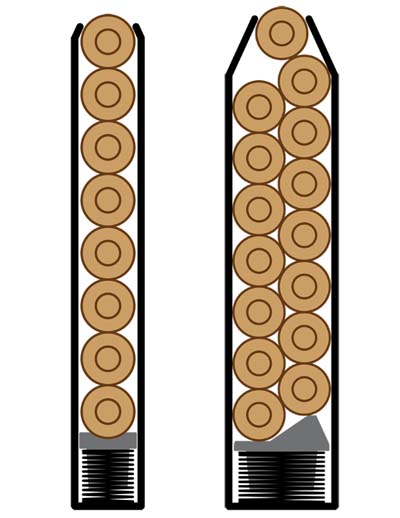
A single-stack magazine is always easier to conceal than a double-stack.
The most important dimension of a pistol for concealment purposes is the width — how fat the barrel and the grip are. That’s what’s going to make a bulge under your clothing, more than the length or even the weight of the gun.
As a result, it’s better to have a single-stack magazine of relatively low caliber, at least in terms of concealment purposes. If that’s just not going to meet your needs in terms of firepower or ammunition, you get a slightly thicker magazine and cope as best you can.
The disadvantage of a smaller grip/magazine (aside from limiting your shots) is that a powerful handgun with a small grip has a ton of kick. The shorter the grip, the less leverage you have, making aiming trickier (especially follow-up shots after the first). A heavier frame can help compensate for a smaller magazine, and won’t alter the concealment in most holster types (though it will create more of a sag if you’re carrying it in your pocket or by another non-holstered method).
Look for a balance that suits your needs, but from a concealment standpoint do be aware that a longer grip/magazine is harder to hide, and may end up poking you depending on your carry method.
Caliber
This is one that some people have very strong feelings on. Some people will swear that you always want the maximum firepower you can carry; other people are comfortable with the idea that no bullet is a bullet anyone wants to take, and therefore even a tiny holdout pistol is plenty for self-defense.
You’ve got to make that call yourself. But the reality is, smaller caliber handguns are easier to conceal both because of the magazine size and the barrel width and length.
It’s not a universal scale — a .45 could be more concealable than a .38 depending on the shape and size of the grip and magazine — it’s just something you need to be thinking of as a firepower/concealability trade-off.
handguns in holster concealed carry style choices
Exterior Construction
To use a very untechnical term, some guns are made with lots of “fiddly bits.”
You know what I’m talking about — everything from sighting notches to bulky safety catches to raised lettering on the barrel. Any of those is going to make the gun harder to conceal.
Weapons that are purpose-designed for concealed carry (and a number of manufacturers do have models specifically for the CC market) tend to be smooth-sided and streamlined. Look for designs with minimum “fiddly bits.” It’ll help both your concealment and your draw.
Barrel and Magazine Length
It’s a secondary consideration next to width, but the length of the pistol (in both directions) does matter. Extended magazines are hard to hide, and tend to poke you while you carry them.
Longer barrels give you range and accuracy, and longer magazines give you more shots without reloading, but the reality for most of us is that neither of those is a huge consideration. Unless you’re in an active military or paramilitary kind of situation, you — hopefully — won’t ever need more than a shot or two, even in the very worst-case scenario. Most of the time you won’t even need that.
So when possible, err on the side of a smaller weapon and magazine for the sake of concealability and comfort. It’s one of those trade-offs where you have to know your own needs, but don’t just default to the biggest magazine and longest barrel available for your handgun of choice.
mosquito gun with leather holster tiny gun in hand

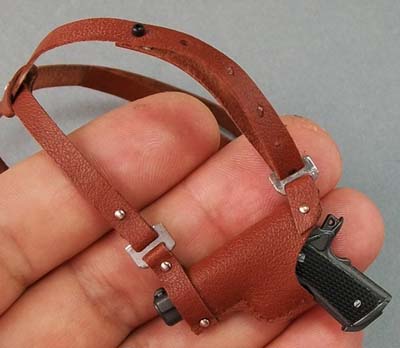
Although easy to conceal, the mosquito gun is ineffective against anything larger than a squirrel.

So Which Gun is the Right One?
There’s no single right answer to that question. But, most men with concealed carry experience will recommend something along the same basic lines:

  • low to mid-caliber ammunition
  • single-stack magazine (or very slim-profiled revolver)
  • slim grip
  • short barrel
  • smooth exterior
  • light weight

Here are a few of the more popular models that get tossed around in discussions of concealed carry — this is by no means an exhaustive list, nor should any of these be taken as strong recommendations, but they’re good examples of the relatively broad range of options you have:

  • Glock Model 19
  • NAA .22 Magnum Mini-Revolver
  • Kahr PM9
  • Smith & Wesson M&P series
  • Walther PPS
  • Springfield XD

There are many more beyond these. But the important step here — and this is key — is to know which one you carry (or will be carrying) before you start planning your wardrobe around it, and especially before you have any tailor-made adjustments. You get the maximum benefit when you can have clothes tailored specifically for your gun and holster of choice.
Which brings us to our next step:

Step 2: Choose Your Method of Carry

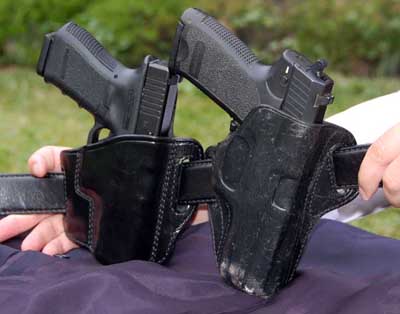
Just like handguns, holsters come in every style imaginable. You might own one, or you might own a dozen. Depends on your needs. But for purposes of deciding what to wear and how to conceal your gun, you’ll want to know where you’re going to wear it, and in what kind of holster.
Regardless of your method of carry, one key piece of equipment is a very sturdy belt. This not only helps keep the gun in place and prevents your trousers from sagging, it’s also an important safety feature. You don’t want the holster shifting and you certainly don’t want the belt buckle popping open because of the extra weight or the jerk of your draw. Invest in something broad and made of sturdy leather or ballistic nylon. Most stores that sell holsters will also sell belts designed for them.
Paddle Holster, Hip Carry – OWB (Outside the Waistband)
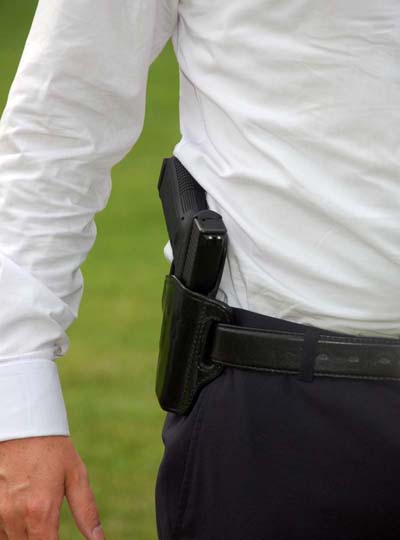
paddle holster hip carry outside the waistband handgun

  • Advantages: Simple, cheap, and quick to draw
  • Disadvantages: Bulky and hard to conceal

This is the most typical way for peace officers and soldiers to carry their primary handgun: a “paddle” style holster (basically the outline of the gun, with a flat “paddle” backing that rests against your body) worn at the belt line, with the pistol pointed down the thigh. The magazine points toward the rear of your body, and the grip is typically angled a bit forward.
The disadvantage for concealed carry should be obvious: it’s going to be very easy to accidentally reveal a gun that’s worn up by your front pockets. A long, loose jacket will do the trick, but as soon as you unbutton/unzip the front it only takes a stiff breeze to expose your holster.
It’s also hard to conceal the bulge if you wear a buttoned suit or sports jacket, even one tailored for the holster. You can pull it off with a small holster and a small gun, but expect to look pretty heavy around the hips when you do it.
Paddle Holster, Behind the Back – OWB (Outside the Waistband)

  • Advantages: Simple, cheap, and still fairly quick to draw
  • Disadvantages: Still bulky; still requires at least a jacket to conceal

An obvious solution to the hip-carry problem is to keep the same simple holster but move it to the small of your back.
This removes the problem of an unbuttoned jacket brushing back to expose the pistol. The whole back of your coat/jacket would have to flip up to reveal your firearm. It makes a suit or sports jacket much more effective concealment, especially if it’s cut a bit long in the rear. A little looseness also looks more natural on the back of your jacket than it does at the sides.
Drawing a pistol from behind your back is a bit slower than off the hip, but still not too cripplingly inconvenient. There is growing concern, however, that a gun in the small of your back can cause back injuries if you fall or are struck hard where the gun rests — many police departments mandate that nothing except soft items (gloves, CPR kits, etc.) be carried directly in the center of the back for this reason.
So while the simple paddle holster worn behind the back is an effective method of concealment, and still a favorite for a lot of concealed carriers, it comes with some safety cautions. And, of course, it requires you to sit down pretty gingerly, if at all.
Shoulder Holster
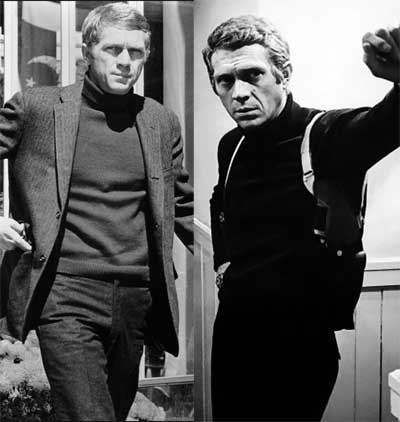
  • Advantages: Decent concealment, faster draw than behind the back
  • Disadvantages: Uncomfortable, easy to accidentally expose

The shoulder holster, which keeps the handgun tucked under your armpit and against your upper ribs, is a popular one with law enforcement (and one made famous by Hollywood and television cops). It’s a good choice for easy access, and only slightly slower to draw from than a holster on your hip.
Unfortunately, it’s also not that great for concealment. A suit jacket or blazer angles back toward the shoulder — you’ve usually only got a few inches between the butt of your pistol and the opening of your jacket. Unbuttoned, it’s very easy for the jacket to slide back far enough to reveal your weapon.
Typically, your draw with a shoulder holster also has to cross your body, with the barrel sweeping in almost a full semi-circle. They’re not allowed on many firing ranges for this reason — instructors and managers don’t want to risk other people being placed within the line of fire as you draw. It’s important to have very good trigger control and be careful with your safety when you’re drawing from a shoulder holster.
Due to the concealment drawbacks and need for trained habits, shoulder holsters tend to be best for people like plainclothes detectives and security guards who are being discreet, but don’t need to effectively disguise the fact that they’re carrying a weapon, and tend to have more firearms training than your average civilian.
Sheath Holster IWB (Inside-the-Waistband)

  • Advantages: Good concealment, doesn’t require a jacket
  • Disadvantages: Requires tailored trousers

IWB holsters (the most common name) carry the gun tucked into the trousers rather than worn outside them. They make special holsters for this, which are worth investing in. Whatever you may see on TV, don’t go tucking guns into your pants without a holster unless you absolutely have to. Most IWB holsters can be positioned anywhere on your back, allowing for basic behind-the-back carry or for something shifted to one hip or the other.
The advantage here is that you only have to hide the handle of the gun, rather than the whole thing. A smooth holster inside custom-widened trousers conceals most of the bulk for you. Just a loose T-shirt will do to hide an inside-the-waistband carry in a pinch.
The downside is that it’s an expensive and a fairly uncomfortable option. You need the tailored trousers, the specific holster, and the willingness to stand and sit with a gun barrel pointed down your rear end.
Pocket Carry
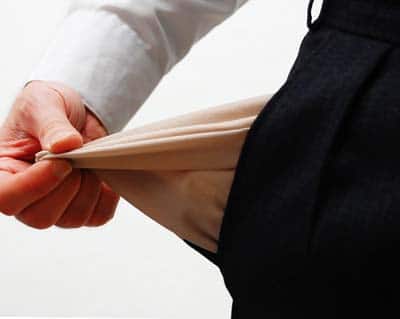
  • Advantages: Good concealment, flexible positioning
  • Disadvantage: Requires a small gun, concealment can vary; gun may shift

Pocket carry is what it sounds like — sticking a gun in your pocket. How effective the method is at concealment depends on how large your pockets are, how thick their lining is, and what style they are — big patch pockets with thick lining and a closing flap will hide a gun fairly effectively, while the back or hip pockets of your jeans will not.
The biggest disadvantage of carrying your gun in your pocket is that, unless you have an internal holder sewn into the pocket (which we recommend if you plan on pocket carrying regularly), the gun will shift around as you move. This can slow your draw, make the gun more likely to “print” (show its outline through the fabric), and even be a safety hazard.
If you wear a garment with large, easily-accessed pockets low on your midsection, you can position a gun for off-hand draw as well. A side-slit pocket near where your off-hand naturally falls is about as easy access as you’re going to get for emergency off-hand draw if your primary arm is incapacitated.
Many people prefer to use pocket carry for a back-up or holdout weapon, paired with another method of concealed carry for a primary weapon. If you do pocket carry, be sure that the gun is snug in the pocket, and have a tailor sew a holder into the interior if necessary. You don’t want your gun falling out, or to go to draw it and find it upside down and backwards in your pocket.
Ankle Holster
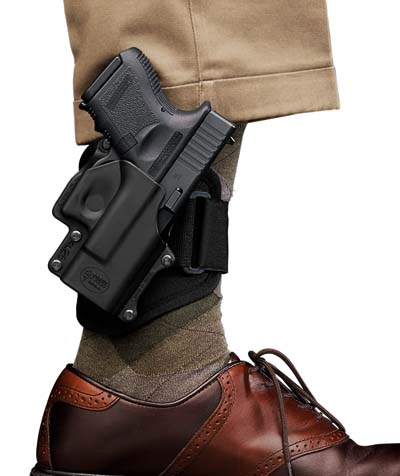
ankle holster for small handgun dress pants shoes

  • Advantages: Excellent concealment
  • Disadvantages: Very slow draw, limited to the smallest handguns

An ankle holster is a traditional holdout option for very small handguns. It requires nothing fancier than boot-cut jeans to conceal, and may even be missed by careless pat-downs. But it limits you to little more than a derringer (though some police carry sub-compacts, usually in specially-tailored trousers), and takes several seconds to draw from, making it a backup option rather than a primary method of carry for most men.
Holdout holsters can also be strapped to a forearm, inner thigh, or other unusual point for maximum concealment. Again, however, these are difficult to draw from and can only conceal the very smallest handguns out there.

Step 3: Choose Your Outfit

Once you know what gun you’re going to carry and where you’re going to carry it, you’re ready to plan an outfit that both conceals the weapon and looks sharp on you.
Different men have different sartorial needs, just as they have different firearm needs. The good news is, there’s a concealing outfit for every standard of dress from James Bond’s tuxedo all the way down to cargo pants and a T-shirt.
Business Concealed Carry
Suit-and-tie concealed carry is more common than you might think. Businessmen who travel frequently like to take personal protection along with them, and some politicians actively advertise their habit of carrying a weapon as a matter of principle as well as protection.

Can you spot the handgun’s print?

Happily for all of them, a business suit is a fairly effective method of concealment. It’s actually one of the better options out there, short of a full length coat. You can use pretty much every type of holster:

  • Paddle on the hip (with the jacket buttoned; jacket should be tailored for the bulge)
  • Paddle behind the back (a long jacket easily conceals the whole thing)
  • Inside the waistband (practically invisible under a jacket)
  • Shoulder/armband holster (concealed as long as the jacket’s buttoned)
  • Ankle holster

The biggest consideration for a man in a suit is usually whether he needs to be able to take the jacket off or wear it unbuttoned. An unbuttoned suit jacket can still conceal either kind of behind-the-back carry, and of course a holdout, but will probably reveal a holster on the hip or under the arm if the wearer moves much.
Men who need to be able to take their jacket off and still keep a weapon hidden should wear trousers tailored for inside-the-waistband carry and a shirt with a long, loose back that can be untucked or draped over the butt of the gun.
Three-piece suits are also popular with concealed carriers — the waistcoat can be cut deliberately long to hide an inside-the-waistband carry.
If you’re actually likely to be in any sort of combat situation, be sure to swap a clip-on tie with a breakaway clip for the hand-tied version. They’re not quite as nice-looking, but someone who’s working as a bodyguard or security officer doesn’t need to be offering a free chokehold to potential assailants.
Business-Casual Concealed Carry
A step down from the suit and tie look, business casual is the style preferred by most men who carry a handgun as part of their job — plainclothes cops, body guards, security guards, and so forth. A business casual outfit looks respectable and often includes a conveniently concealing jacket, making it all around useful for people in that sort of line.

Civilians should also take advantage of the blazer-and-slacks combination. It gives you plenty of places to conceal a weapon, and it has the added advantage of making you look well-dressed relative to the average guy on the street. People looking at you are going to be thinking, “Hey, he looks sharp,” not, “Hmm, I wonder if he’s carrying a gun.”
A sport coat or blazer jacket and long trousers of any kind offer basically the same concealment as a suit jacket. You also have the option of wearing either an unmatched “odd vest” or a longer sweater vest, either of which will hide the handle of a gun worn inside the waistband without the need for a jacket.
Dress-casual concealed carry can be made to look quite casual — think Dirty Harry, Miami Vice, or Steve McQueen in Bullitt, all of which feature shoulder-holstered policemen in jackets and sharp shirts.
Of course, if you’re planning on serious physical activity or movement, don’t expect a suit jacket or blazer to provide much concealment. But presumably at the point where you have to sprint, concealment is no longer the chief priority.
Casual Concealed Carry
If there’s no dress code to observe, you can wear almost anything that conceals a weapon. That said, don’t default straight to baggy jeans and an untucked T-shirt — it works, but it doesn’t do much to disguise the fact that you could be armed, and it’s neither as practical nor as attractive as some of your other options:

  • Concealment jackets – These are coats made by arms manufacturers (or affiliates) specifically for concealed carry. SIG makes one designed to look like your basic work jacket, similar to a Carhartt or Dickies, making it very unobtrusive almost anywhere in America. Concealment jackets have large internal pockets, usually Velcro-sealed, with loops or hooks for a handgun. They’re great for outdoors concealed carry, but get both uncomfortable and obviously out of place if you’re indoors for any length of time.

  • Leather jackets – A classic style and excellent concealment, opt for one that’s on the longer and looser side. Bomber-style jackets are perfect for concealed carry, since they have a padded lining that conceals bulges and a longer waist than moto-style jackets.
  • Denim or wool coats – Lightweight coats are comfortable most of the year and can conceal any style of holster except the paddle (longer coats will even cover that). Just be cautious of tight-fitted waists, typical on jean jackets, unless you know you’re going to be using a shoulder holster exclusively.

  • Safari/photographer’s vests – The thigh-length, multi-pocketed vest typical among journalists and photographers is an ideal concealed carry garment. It’s long enough to hide holsters at the waistband, thick enough to disguise bulges, and features plenty of pockets for ammunition or even a smaller holdout weapon. There’s a reason they’re popular with people traveling in rough countries — that said, they’re also the most recognizable “concealed carry” garments, and may draw attention from people looking for concealed weapons.
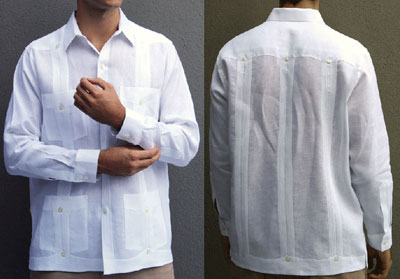
  • Casual shirts worn untucked – Just a plain white dress shirt is plenty of concealment if you’ve got an inside-the-waistband holster. Wear any sort of collared or uncollared shirt loose and untucked and you’ve got enough concealment to hide the grip of a handgun from casual observation. It’s a good option when you’re carrying in places where a jacket or blazer would be conspicuously overdressed. Remember the guayabera shirts we just wrote about?
  • Sweatshirts/hoodies – These are pretty much everywhere, and they add plenty of bulk around the waist that can hide even a large handgun. Just be aware that men over 30 wearing a hoodie look like they’re trying a little too hard. It’s good gun concealment, but it’s not magical urban camouflage that will make people think you’re from the streets if you’re not. To learn more about your options check out this classic AOM article on sweater styles for men.

Step 4: Talk to Your Tailor

Bizarrely, this is the step most men skip — even though the cost of alterations is usually less than the cost of a holster, and certainly less than a decent handgun.
Don’t skip it.
A single purpose-made garment is better concealment than any half-dozen layers of unaltered clothing. Tailors have their jobs for a reason.
The key here is to find a tailor who’s willing to work specifically on concealed carry issues. Always ask ahead of time — it’s very bad form to walk into a stranger’s shop and pull out a gun unannounced, even for demonstration purposes. Set up an appointment ahead of time and make it clear that you’ll be bringing a gun.

Some basic changes a tailor can make that go a long way in concealed carry include:

  • An extra layer of canvas and lining in the jacket increases stiffness, which reduces the “print” the gun makes through the outer fabric.
  • Extra length in the back (you can usually get away with up to an extra inch before it starts to look odd) helps keep a paddle holster concealed when you move or raise your arms.
  • Small armholes make the jacket rise less when you move your arms, making them good for paddle holsters. Large armholes, on the other hand, help hide a shoulder holster, and the hem of the jacket lifting doesn’t affect shoulder carry. Pick whichever you need for your holster.
  • Small pockets can be added inside the lining at the bottom front corners. You can slip a fishing weight or large coin into the pocket to help keep the jacket in place as you move, preventing any inadvertent holster-flashing.
  • If you’re planning on pocket-carrying, a small cloth sling or loop can be added inside the pocket to hold your pistol at the proper angle and keep it from sliding around.
  • Select a textured fabric to help break up lines, especially if you carry a bulkier gun. Herringbone, birdseye, and rough tweed all help reduce the visibility of the outline. Stay away from stripes, which emphasize any bulges.
  • A stiffened rod or strap can be sewn into the front edge of the jacket, making it easier to flip out of the way when you do draw but keeping it lightly weighted down at all other times.
  • Extra pockets can be added to any garment for spare ammunition. If you plan on carrying one specific type of magazine, bring an empty along and have the pocket made to fit it.
  • Get a tight-fitted shirt if you use a shoulder holster, to prevent the holster from tugging loose fabric into conspicuous wrinkles across the front of your body.

good tailor will always take the measurement of the gun itself and of you wearing the gun. Be sure to have all components in place, especially if it makes a difference in size.
Once you have a jacket and trousers (or other garment) tailored for concealed carry, the rest is in your personal style and mannerisms. Carry yourself calmly and with confidence, and dress tastefully but blandly, and you should be able to slip past everyone’s notice without the possibility that you’re armed ever crossing their mind.
The worst thing a concealed carrier can do is fiddle with his clothing, especially where the gun is hidden, so keep your hands at your side and try to look bored. In the ideal concealed carry situation, no one knows you have a gun until you’re using it — and if you’re lucky, that means no one ever knows you have a gun.

Thank You

I would like to extend a big thank to the many law enforcement professionals, military men, and citizens whom I consulted with on this article.
______________
Written by Antonio Centeno, Founder Real Men Real Style
Want to learn more about style? Watch my men’s style videos here. 
Categories
All About Guns Cops Dear Grumpy Advice on Teaching in Today's Classroom Fieldcraft

What to Do in an Active Shooter Situation

Brett and Kate McKay | November 30, 2015                               Manly SkillsTactical Skills

what to do in an active shooter situation

It’s a sad fact of life in the 21st century that active shootings have become a regular occurrence in the United States. In other parts of the world, terrorist groups are using active shootings to, well, terrorize. While the media focuses on the firestorm of political debate these events cyclically create, I’ve rarely seen them discuss what people are actually supposed to do in these situations.
According to the FBI, active shootings in public places are becoming increasingly common. Which means it would serve everyone to understand how to respond if they ever find themselves in the line of fire.
Over the years I’ve talked to a lot of military, tactical, and law enforcement professionals who’ve spent their careers training and dealing with violent individuals: U.S. marshals, SWAT officers, and special forces operators. And I’ve asked them all this same question: What’s an average joe civilian like me supposed to do when faced with a gunman who’s indiscriminately firing on people?
They’ve all answered the same way.
In today’s article, I share expert-backed advice on how best to react if you ever find yourself in a situation with an active shooter. Learning how to survive a shooting is much like learning how to survive an airplane crash: such an event is statistically unlikely to happen to you, and simple chance may make you a victim before you’re able to take any volitional action. But if there are things you can do to increase your odds of survival even slightly, you ought to know and practice them.

Something to Keep in Mind: You’re Probably On Your Own

In a study done by the FBI in 2014, it was discovered that most active shootings end in 2 minutes or less. That’s not enough time for law enforcement to arrive. So when you start hearing gunshots in places you shouldn’t be hearing gunshots, understand that you don’t have very much time to think about what you should do.
That’s why…

You’ve Got to Know What You’d Do Before It Actually Happens

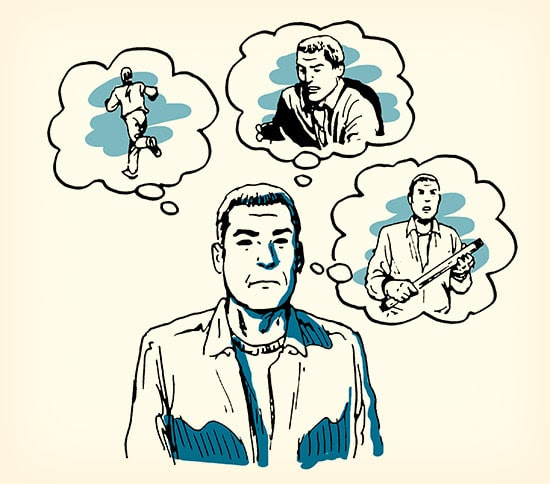
man contemplating actions for active shooter situation
When any sort of emergency situation strikes, be it an active shooter or even a fire, the natural response for most people, surprisingly enough, is not to do anything. We highlighted several of the reasons for this passivity in our article about why most people freeze up in emergency situations. For example, the “normalcy bias” causes victims to act like everything is fine even though things are far from it. Our brain is predisposed to assume that things will carry on in a predictable way. When the pattern is broken, it takes a long time for the brain to process this aberration. This is why many people who witness traumatic events report that it felt surreal, like they were watching a movie and it wasn’t really happening. They also often say that at first they thought the gunshots were fireworks or a car backfiring or a book falling — things that would fit better in their usual paradigm of daily life.
Another bias that keeps us from taking action is our natural tendency to follow the crowd. If we see that everyone else is cowering in fear or locked up by inertia, then our natural tendency is to act the same.
The way you overcome these inclinations towards passivity is deciding exactly what you’ll do in the event of a shooting — before one ever happens. You’ve got to have a plan.
I know it seems morbid, but you really should visualize what you would do in various situations were an active shooter to suddenly intrude upon the scene. What would your plan be if you were in the office and heard shots coming from the floor beneath you? Would you have time to run? If so, where would you go? If you heard the shots just down the hallway and there’s no place to run or hide, what would be your next step? Visualize your plan in as much detail as possible.
In an active shooter situation, seconds matter. You don’t have time to figure out what you’re going to do when a guy starts spraying a building full of gunfire. By having a general preconceived plan, you give yourself a head start. This all goes back to our article on the OODA Loop. Remember, in any conflict there are multiple loops going on. It’s your loop versus the shooter’s, and the first to complete their respective decision-making cycle usually wins the fight.
OODA Loops can begin way before an actual encounter starts. By coming up with a plan of what you would do in an active shooter situation before one ever happens, you’re already engaged in the second step: Orienting. Should you encounter a shooter, you can act immediately because you’ve already begun the cycle and already have a plan in place. Remember, ABO: Always Be Orienting.

Maintain Situational Awareness Wherever You Go

Besides having a general idea of what you’d do in an active shooter situation, another thing you must do to increase your chances of surviving is constantly maintaining situational awareness.
We’ve written in detail about situational awareness before, so rather than getting into the nitty gritty here, let’s review a few important principles as they apply to shootings:
Stay in condition yellow. Condition Yellow is best described as “relaxed alert.”There’s no specific threat situation, but you have your head up and you’re taking in your surroundings with all your senses. Most people associate situational awareness with just visual stimulation, but you can also learn a lot about a particular scenario from sounds. This is especially true for active shootings. If you hear gunshots — or something that sounds an awful lot like gunshots — that should be a sign that you need to start immediately preparing to take action. 
Though your senses are slightly heightened in Condition Yellow, it’s also important to stay relaxed. Staying relaxed ensures that you maintain an open focus, which allows you to take in more information about what’s going on around you. Research shows that when we get nervous or stressed, our attention narrows, causing us to concentrate on just a few things at a time. A narrow focus can therefore cause us to miss important details in our environment.
Bottom line: Don’t have your nose constantly in your smartphone and don’t zone out; rather, you should open your eyes, ears, and nose, and calmly and constantly scan your environment to take in what’s going on.
Establish baselines and look for anomalies. As Patrick Van Horne notes in his book Left of Bang, a key component of situational awareness is establishing baselines and looking for anomalies. A baseline is what’s “normal” in a given situation, and it will differ from person to person and environment to environment. A baseline in an office would be people working at their desks or chatting in a lobby. A baseline at a restaurant would be people in uniforms coming in and out of the kitchen and customers entering and exiting the restaurant through the front door.
We establish baselines so that we can look for anomalies. Hearing gunshots at a college campus is definitely out of the ordinary, and should immediately trigger your active shooter plan of action. But let’s take a look at a subtler anomaly. If you’re at a movie theater and you see a guy entering the theater from the exit near the screen, that should definitely put you on alert. It could just be a guy sneaking in for a free movie, but it could also be a gunman. You don’t need to go and immediately tackle the guy, but you’d certainly want to keep your eye on him and make sure you’re prepared to quickly move out.
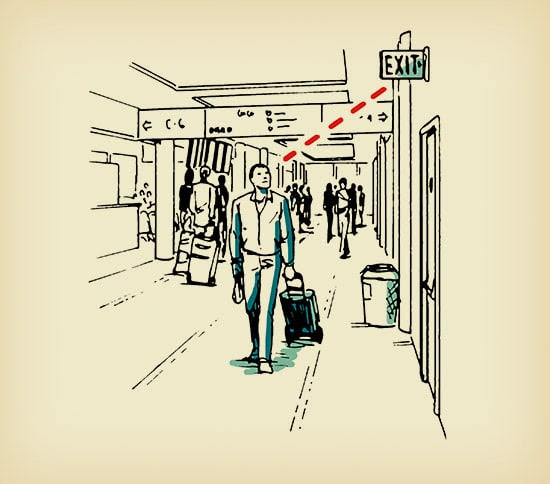
man looking at exit sign knowing environment active shooter
Know where all your exits are. If there’s one actionable takeaway you get from this article, let it be this. Wherever you are, always know the locations of the nearest exits. As we’ll see in a moment, running should be your first line of action in an active shooter situation. You want to get as far away from the gunman as possible and that often means getting out of the building where he’s shooting. So whenever you enter a building, the first thing you should do is look for exit signs and make mental notes of them.
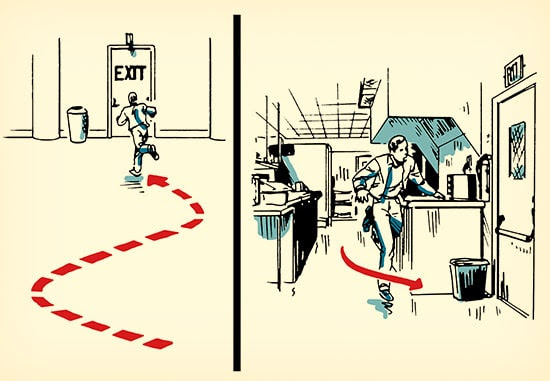
You also need to consider not-so-visible exits. For example, most grocery stores will have an exit door in the very back in the “employee only” section. If you’re near the back of the store and you hear gunshots from the front, you’ll want to head directly to this rear exit. Another example of not-so-obvious exits is in restaurants. Most restaurants will have an exit in the back of the kitchen. If you’re near the kitchen and you hear gunshots near the front of the place, you’d want to hightail it to this back door. Because these exits are in places considered “employee only,” people have been conditioned not to even consider using them. But in an active shooter situation, these kinds of norms obviously go out the window, and preparing yourself to disregard them is a must.

Your Active Shooter Triage: Run, Hide, Fight

So you’ve heard shots and screams. There’s an active shooting happening. What should you do? All the experts agree that you have three possible actions: run, hide, and fight.

Run

man running for exit active shooter situation illustration
Running away should always be your first line of action. As soon as you hear gunfire, leave the premises immediately using your preconceived escape plan and get as far away from the shooter as possible. Ideally, you’ll be able to escape without having to cross the shooter’s path.
Keep in mind that in an active shooter situation, most people won’t want to leave because 1) they’re cowed in fear, 2) they’ve let the normalcy bias take over, or 3) they think hiding should be their first recourse. But you need to run, regardless of what others are doing. Do all you can to convince them to come with you, but if they don’t comply, leave them, and get out of the building or danger area as soon as possible.
Don’t try to gather your belongings. You can replace your laptop; you can’t replace your life.
As you make your exit, tell others to come along with you. Once you’re out of the danger area, prevent others (except for law enforcement) from entering the premises.
When you’re running, keep your hands visible. Law enforcement will be checking you to decide if you’re a threat.
This may go against every humane compulsion you have, but don’t try to move or assist the wounded while you’re making your exit. It leaves you vulnerable to attack; turning one casualty into two won’t ultimately help things. Even the first law enforcement officers to arrive at the scene will initially ignore the wounded so they can take out the shooter. Just as their top priority is to stop the gunman, your top priority is to get to safety.
If you’re in an open area and there’s distance between you and the shooter, run as fast as you can in a zig-zag pattern. Shooting a moving target is hard even for experienced marksman, and many mass shooters have little or no experience with firearms. So move as much as possible and take cover behind barriers that can stop bullets (cement pillars, vending machines, etc.).
As soon as you get to safety, call 911. Don’t assume someone already has.

Hide

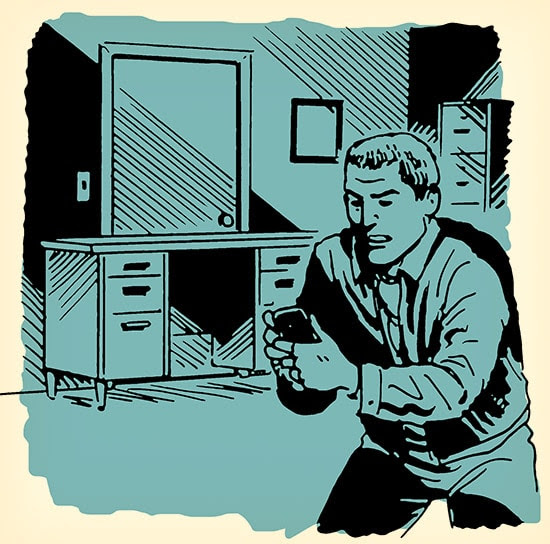
man hiding in dark room active shooter illustration
Sometimes running isn’t an option. Maybe the shooter is in front of the only exit and you can’t jump out the window because you’re on the fourth floor. If you can’t make an escape, the next best thing to do is to hide in a secure location.
You want to hide in a place that’s out of the shooter’s view and that can provide protection if shots are fired in your direction. If you’re in an office or school building, find a room that has a lockable door. If you can’t lock the door of the room you’re in, barricade it with a table and chairs. You want to make it as hard as possible for the shooter to enter; he’s often looking for easy victims, and will move on rather than bother pushing through the barrier.
Turn off the lights in the room and be as quiet as possible. Be sure to put your cell phone on silent. You don’t even want it on vibrate.
Stay away from the door and crouch behind items that could offer protection from bullets like cabinets or desks. Hide in a bathroom or closet if you can.
If possible, dial 911 and let the authorities know there’s an active shooter in your building. If you can’t speak because the shooter is nearby, leave the line open so the dispatcher can hear what’s going on.
Don’t open the door unless absolutely necessary or if you can confirm it’s the authorities who are knocking. According to Clint Emerson, Navy SEAL and author of the book 100 Deadly Skills, shooters will often knock on doors or yell for help in the hopes of convincing people who are hiding to show themselves.
If you can’t find a room in which to secure yourself, hide in a location that offers cover and concealment from the shooter, but still allows you to see him. If the shooter passes you, you can make a run for it. If he doesn’t, it puts you in a position to attack if necessary.

Fight!

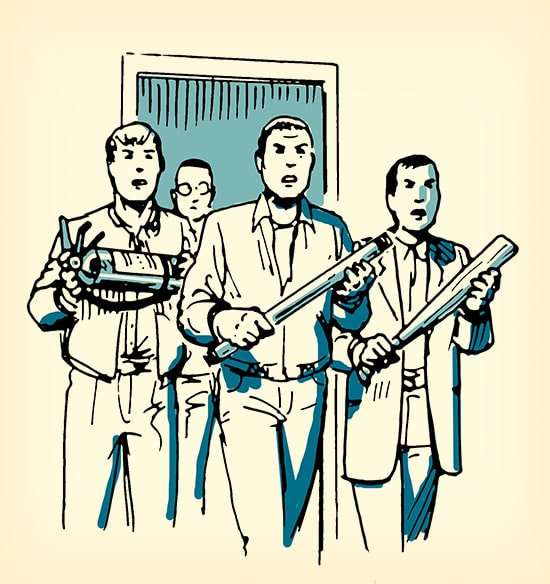
men with weapons ready to fight shooter illustration
When running or hiding have failed or aren’t viable options, it’s time to resort to plan C: Fight!
Most civilians don’t think they can take on an active shooter because, well, the shooter has a gun and they likely do not. But here’s the thing: it is possible for unarmed individuals to subdue or chase away an armed shooter. Anthony Sadler, Spencer Stone, and Alek Skarlatos — the 3 friends who rushed a terrorist aboard a train to Paris — did it, saving dozens of lives. So did Frank Hall, a football coach who ran down a shooter and chased him out of a high school in Ohio before he could wreak massive carnage.
Yes, some studies have suggested that armed civilians can reduce the number of fatalities in an active shooter situation compared to situations where there were no armed civilians. But what these same studies suggest is that just having civilians — armed or not — quickly take action against a shooter can reduce the number of victims too. So even if you don’t plan on carrying a firearm yourself, commit to the idea that if you absolutely have to (and, again, we’re talking last resort here), you’ll attack an active shooter quickly and devastatingly.
Will you get shot? Possibly. But it’s possible to survive multiple gunshot wounds, and doing nothing will probably get you killed anyway. Sadly, history has shown that many active shooters will unflinchingly shoot people begging for their lives while they’re curled up in the fetal position. As Chris Norman, a Briton who assisted the 3 Americans in their attack of the train terrorist described his reason for taking action:

“My thought was, ‘OK, I’m probably going to die anyway, so let’s go.’ I’d rather die being active, trying to get him down, than simply sit in the corner and be shot. Either you sit down and you die or you get up and you die. It was really nothing more than that.”

How to Fight an Active Shooter

So you’ve made the decision that running and hiding are no longer options and that fighting is your last recourse. What’s the best way to fight an active shooter?
If you’re armed yourself, there are certain techniques you should employ in returning fire. A tutorial on how to take down a gunman lies outside the purview of this post, and must be practiced in the real world.
If you’re not armed, real world practice in hand-to-hand fighting will be an enormous asset, not only in giving you concrete skills to employ, but in offering you a greater comfort level with violence and a confidence in taking action. It’s not a coincidence that Spencer Stone — a U.S. Airman who was the first of the 3 Americans to rush the train-bound terrorist and choked him out while his buddies gave him a beat down — was trained in Brazilian Jiu-Jitsu. Stone unequivocally attributed his training in martial arts to his survival, adding that even a cursory knowledge of self-defense is highly beneficial: “I 100% believe that Brazilian Jiu-Jitsu saved my life at that moment. Every move I used on him was very, very basic — you can learn in five minutes. If we had a course like that in the Air Force for people to learn basic moves, it could help anyone in a situation like that.”
But even if you’re the most average of average joes — you’ve got neither a gun nor a black belt — you should still attempt to take on a gunman as a last resort, keeping these principles in mind:
Understand your advantages. Most violent gunmen work under the assumption that because they have a gun, people will do what they want or just hide. They don’t expect someone to come charging after them. As we discussed in our article on the OODA Loop, an important part of winning any fight is resetting or disrupting your opponent’s loop. As former US Air Marshal Curtis Sprague told me, you want your opponent to have an “uhhhh…” moment. By doing the unexpected (attacking), Sprague argues that “you’re disrupting the gunman’s OODA Loop which slows him down — even if it’s just a few seconds — and gives you more time to complete your OODA Loop and win the battle.”
So simply charging your gunman puts you at an advantage because he’s definitely not expecting it.
In 100 Deadly Skills, Emerson notes another advantage to keep in mind: “a gun can only be shot in one direction at any one time.” If you approach the shooter from behind or from the side, it’s going to be very hard for him to shoot you. What’s more, if you attack the shooter as a team (which you should), he can’t shoot everyone at the same time. An attack by multiple people, from multiple angles, will be difficult for a lone gunman to fend off.
Be aggressive and violent. This isn’t the time for pussy footing. Once you decide to fight, attack with violence and aggression. Alek Skarlatos grabbed the train-bound terrorist’s rifle and pounded him repeatedly in the head with its muzzle. This kind of violence may not be pleasant to contemplate, but remember, old ingrained norms like never hurting others go out the window in a crisis; victory will go to the swift and relentless. Use lethal force, and don’t stop fighting until you’re dead or the shooter stops moving.
Control the weapon and then control the shooter. The sooner you can get the weapon out of the shooter’s hands, without endangering others, the better. Without his gun, he can’t shoot anymore. Once the weapon has been secured, turn your attention to completely containing the perpetrator. Keep in mind every fight is different. Sometimes you’re not going to be in a position to secure the weapon first, so your priority would be to inflict as much violence as possible on the shooter until you can get the gun away from him.
Even if you can’t get the gun completely out of the attacker’s hands, do what you can to control it. Grab the gun so that you can exercise some influence over where it’s pointed. If the shooter has a semi-automatic pistol, use this tip I picked up from UFC fighter and Army Ranger Tim Kennedy at the Atomic Athlete Vanguard. Grab the barrel as hard as you can. First, this allows you to control where the gun is pointed. And second, if the gun does fire, it will prevent the slide from going back and chambering another round, thus preventing the shooter from re-firing.
Use improvised weapons. Just because you don’t have a gun, doesn’t mean you don’t have a weapon. A weapon can multiply force and almost anything in your environment can be turned into one: chairs, fire extinguishers, umbrellas, belts, coffee mugs. Heck, even a pen can be used as an improvised weapon.
Throw stuff at the shooter. Even if it doesn’t disable him, you’re creating hesitation which will give you more time to get closer to end the fight. Remember, disrupt that loop!
If it’s available, use items that can blind the shooter: flash a high-beam tactical flashlight in his eyes, spray a fire extinguisher or chemicals in his face, or throw a pot of scalding hot coffee his way. Be creative! Once the shooter is disoriented, rush him and take him down.
Work as a team. The more people you can get to help you in attacking the shooter, the better your chances of ending the ordeal with fewer casualties. But remember, most people’s natural reaction in these sorts of situations is to not do anything. You’ll need to be assertive and take the lead. Courage is contagious.

Conclusion

While active shootings are increasing, they’re still rare. We shouldn’t be cowered in our homes in fear. But there’s no downside to being prepared. Sometimes there’s nothing you can do to survive a shooting; you’re in the wrong place, at the wrong time, and you’re killed without warning. But you may get a chance to act, and will only have seconds to figure out what to do. Your stress will be through the roof and the situation will be utter chaos. If you hope in that moment to be able to protect your life and the lives of others, ready yourself now and have a plan of action wherever you go.
_____________________
Sources:
100 Deadly Skills by Clint Emerson
Left of Bang by Patrick van Horne
How to Survive the Most Critical 5 Seconds of Your Life by Tim Larkin
Active Shooter: How to Respond by The Department of Homeland Security

Categories
Fieldcraft

Finding the Enemy(1/2)

Attachments area
Categories
Fieldcraft Gun Info for Rookies Well I thought it was funny!

I do this with every trigger

Categories
Dear Grumpy Advice on Teaching in Today's Classroom Fieldcraft

9 Ways to Open a Bottle Without an Opener

 Jeremy Anderberg | September 3, 2015
Manly Skills
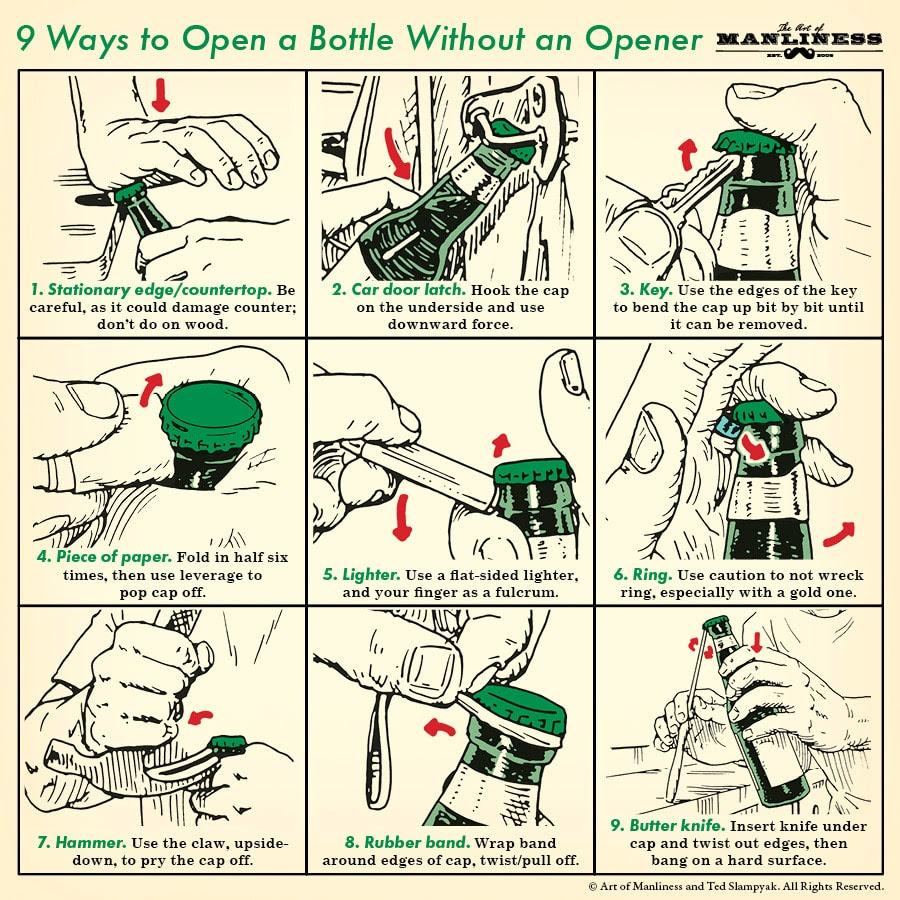
how to open a bottle without an opener

You’ve arrived at the campsite with your friends and some cold beer in the cooler, only to realize you left the bottle opener at home. Lucky for you, that’s no problem — you’re a master of improvisation.

Categories
Fieldcraft War

Well you do now know about Medieval stairs!

Inline image 1

Categories
All About Guns Fieldcraft Gear & Stuff

Some good words from Mr. Kim Du Toit

Eucalyptus Now

Over at Shooting Times, Rick Mann looks at what he considers to be the four best SHTF rifles — what he terms “Apocalypse-Ready Rifles” — and has devised a test to determine which one is best.
I’m not going to pick holes in his test — it seems quite adequate — and I actually agree with his rationale (e.g. “Granted, cataclysmic conditions of ruin can run the gambit from a camping trip gone bad to total anarchy.” )
As I’m unlikely ever to go on any camping trip which doesn’t include the words “Holiday Inn”, I’m not going to pick two of his choices (the .30-30 lever rifle and the .308 Win boltie), fine weapons though they may be.  No, from where I’m sitting, the most likely scenario is civil breakdown and disorder caused by natural disasters (which could likely cause prolonged power outages, food shortages and such), or else a truly bad situation like a BLM- / Antifa-inspired riot.  In both cases, what’s needed is something for home / property defense (if caught in a riot), and something which would also allow me to do things like pay a visit to a local supermarket for a little un-monetized food collection (the fancy term for looting).
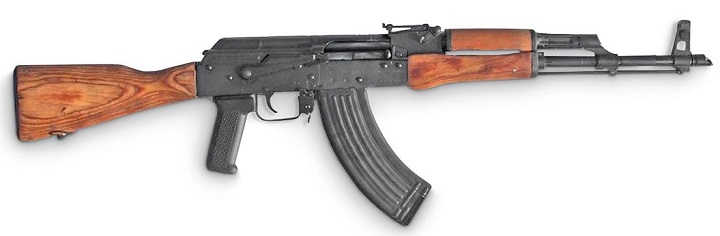
Well, you all know my first choice:

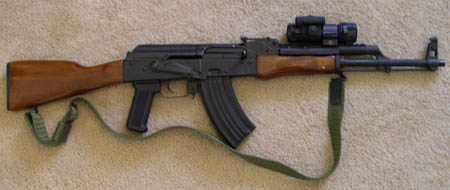
…and if I ever wanted to get fancy, I could always improve the crappy iron sights on the AK with some kind of red-dot sighting apparatus, thus:

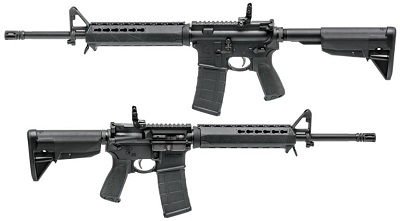
I know, some people are going to prefer the Waffen Durch Plastik  AR-15, and while I deplore the choice (I mean, all that plastic… think of the environment, people!), I’ve come to the point of view that you go with what you feel comfortable using — and as most gunnies of my acquaintance have served in the dot.mil (e.g. Doc Russia, Combat Controller etc.), the AR would be a logical choice for them.

(Over The Pond, and following his service in the Paras, Mr. Free Market’s rifle of choice would no doubt  be the FN-FAL — or whatever the Brits called it — but sadly, H.M. Government says that the icky things are Just Too Dangerous or some such nonsense, so he’d have to be content with picking off fuzzy-wuzzies from his rooftop with his trusty Blaser R8 .300 Win Mag.  I for one would pay money to be able to watch that.)
Where was I?  Oh yes, the SHTF rifle choices.
I have to say that for my Readers who live in rural areas, where one could forage for dinner amidst the wild beasties who frolic in the fields, the .308 bolt rifle would be an outstanding choice — although I’d probably choose a .300 Win Mag chambering instead — and if the terrain is heavily wooded, the .30-30 lever rifle would be equally effective.
Mann’s observation about ammo is, I think, quite on the mark:

Sustainment for months is unlikely, so being able to “pick up” ammo—while potentially important—is not a realistic necessity. What’s more important is how much ammo you can comfortably carry.

Here’s my take:  outside the scenario of actual guerilla warfare (ain’t gonna happen, not in this country, Red Dawn fantasies notwithstanding), you aren’t going to run out of ammo.  Seriously, if you think you’re going to need more than a couple-three magazines for your rifle, what you need is not more ammo but more people to support you.  Myself, I could not see myself taking the AK for an outing with any more than two 20-round magazines.  Ammo is heavy, Bubba, and I’m not young and fit anymore.  More than two, and I’d keep them in the car instead.  The amount of ammo on hand is another story, of course, but you all know my “500” rule — a minimum of 500 rounds per  gun (with an exception for exotic calibers like .375 H&H or 7mm Jap).
All this is fun to wargame out, isn’t it?  Even though it is an unlikely scenario, I try not to wander too deep into the Gun Dork Forest, because that’s like drawing up a comprehensive financial plan for when you win the $100-million lottery:  fun, but after a certain point it’s just wasting time.
I do think, however, that some planning is not only necessary, it’s prudent.  You don’t want to be like those morons in New Orleans who, when Hurricane Katrina was about to come calling, arrived at the shelters carrying nothing but a Pepsi Big Gulp.  In a dire SHTF situation, my plan involves staying in place and defending the apartment.  If that’s untenable, then I’ll be loading my Grab ‘n Go* tubs, emergency water cans and the necessary guns and ammo into the Tiguan, and making my way over to Doc Russia’s fortress house.
Call me unprepared if you will, but I’m not a dummy.


*Yes, I still have them, just with fresh supplies.  If anyone’s interested, I’ll post pics of them some other time, after I’ve moved.

Categories
Cops Dear Grumpy Advice on Teaching in Today's Classroom Fieldcraft Hard Nosed Folks Both Good & Bad

TELLS of a Violent Encounter

Stand Your GroundStand Your Ground
U.S.A. –-(Ammoland.com)- After being in the firearms self-defense instruction business for over 40 years, I have been asked many times what it the most important skill I could pass on to a new student. It made me think each time it was asked. And the answer has been and still is……. Awareness and mindset.
It never ceases to amaze me that most concealed carry permit holders have never been in a violent encounter or even a fist fight.
I have developed a syllabus that covers awareness and mindset in all our curriculum regardless of the platform. Pistol, shotgun or carbine.
We start with several issues, warrior mindset, both definition and application. Next the OODA Loop, history, and usage. Then on to Color Codes of Awareness of USMC and Jeff Cooper fame. The history and usage. How it applies to everyday use. Then on to the dynamics of a violent encounter or patterns of conflict.
The final piece of this puzzle is to know what the TELLS of a violent encounter with another person looks like. A TELL will give you an idea in advance of a violent encounter. A violent criminal does not start a violent encounter in a vacuum. There are many tell tale signs of the oncoming violent encounter, but you must know the signs or tells.
So here we go:

  1. Verbalization- “I am going to kick your ass” “So, you think you are a badass?” “You will be sorry” “. Those are easy ones. But they can be very offsetting also. “Hey, can you help me out?” “Have any spare change?” “I need some help” Those are meant to get you to lower your guard, gain sympathy and allow invasion of personal space.
  2. Visable overt awareness- Visible weapons, unusual nervousness, hidden hands.
  3. Asumption of a fighter stance or bladed stance.
  4. Looking around to see if they are alone, no witnesses. Looking for an escape route, a possible assistant assailant. Overall assessing their battle area.
  5. Invasion of personal space
.
  6. Change in Body Language
  7. Clenching of jaw muscles, clenching and unclenching of fists.
  8. Blinking eyes unnaturally or squinting. Eye movement changes from the normal 20 closures a minute. Staring hard at or through you.
  9. Aggression redirected to other objects or people. Kicking cans, kicking or shoving chairs. Smacking walls, breaking pencils, or glasses and inanimate objects. Yelling at others.
  10. Sweating
  11. Flared nostrils, heavier than normal breathing. Lips part showing teeth to intake more breath.
  12. Tensed up posture.
  13. Stretching back and arms. Opening and closing elbows. Head rolls and neck stretches.
  14. Removal of excess clothing.
  15. Pacing, finger pointing shaking fists, over exaggerated hand, and arm movements.
  16. Facial discoloration, normally to red.
  17. Dress, what they wear and how they wear it.

Most of these have been noted in a survey that was done by two researchers from University of Toledo, Richard Johnson and Jasmine Aaron in “Adults’ Beliefs Regarding Nonverbal Cues Predictive of Violence. Criminal Justice and Behavior.
When we notice these TELLs, we want to create space and time to make the attack easier to manage or to Avoid, Evade and Escape.
Always remember violent encounters are a mathematical equation of time and distance. The problem is we do not know the digits until the encounter is over.

Time and distance are your friends or your worst enemies.


About Bob HarveyBob Harvey
Bob is a veteran Marine Corps veteran firearms coach PMI, Marine Security Guard, PPSU Instructor, NRA Training Counselor and Instructor. Owner of both South Florida Gun School and SDK Security Consultants. Subject matter expert, an expert trial witness for firearms and their use.

Categories
Fieldcraft

What does the Term ‘EEFI’ mean? (I thought it was an interesting idea)

EEFI – THOSE WHO WANT YOU DEAD ABSOLUTELY LOVE THE GIFT YOU GIVE THEM….

EEFI – Those Who Want You Dead Absolutely LOVE the Gift You Give Them….

First, what IS ‘EEFI’?  As most things military, it’s an acronym, and stands for, ‘Essential Elements of Friendly Information,’ and allows an aggressor to piece together information that’s not secret or protected, to get a picture of what you’re about, what your plans are, what you may have, or what you’re thinking about.  Most folks don’t realize when they’re having a great conversation about various subjects that they’re giving away a treasure trove of essential information that will help an enemy out.
Enemies can include criminal home invaders, kidnappers targeting low hanging fruit (kids who’s parents tell everything about them on social media), communist organizations who don’t like you (ANTIFA, ISIS, BAMN, SPLC, etc), and so on.
Today most EEFI is provided by the owner on Social Media and in the commentary of countless blogs and forums.  Someone wanting to target a particular person only need find where they post items, and sit back and take notes.  Additionally, most EEFI is provided innocently with pure intent, in discussions between, ‘like minded people’ (mostly on-line, but FTF as well) when others are listening.  Examples could be a dinner at a local restaurant frequented by extreme liberals and conservatives.  Everyone’s having dinner at the same time, and the table next to yours has a few hard core libtards having tofu and hear you start to talk about your ‘armory’ to a good buddy who’s just waking up to what’s likely to go down.
Don’t think it isn’t happening?  Think again.
“But DTG,” you say, “It COULD be disinformation being put out!”  Sure it could.  Live and on-line. But most likely, it’s accurate information, because the people flat out discussing or posting the EEFI are looking for validation from their meat space or on-line ‘friends’ on what they’re doing, what equipment/weapons/preps they have, and so on, and most importantly, are not trained INTEL folks who know how to sew disinformation.
Example:  Someone wants you dead for whatever reason, or more realistically, someone wants to pin point those in their immediate proximity who might be able to provide re-supply of ammo, weapons, food, clothing and such, should things, ‘Go South.’  All that person has to do is find out what username or ‘nom de guerre’ the person of interest uses, and what blogs, web sites, and forums they frequent, and simply sit back and take notes.
The following image applies to those who cannot help ‘blabbing’ everything they have, know, and are doing to prepare for hard times.  The enemy follows this dictum closely:

Field exercise:  Go through comments here and you’ll see folks talk about how many and what type of weapons they have, how much ammo and what type, how much food, and so forth.  Then go to other like minded blogs and sites and read what people tell you about themselves.  It’s not hard to find them.  Really.
Bottom line?  When it comes to telling unknown people about what you could do to either survive a bad situation or repel marauders, there’s only one thing to say:
Not. A. Good. Idea.
It’s so prevalent and goes on so much, that when I was training a survival groups, I’d give homework assignments based on certain news articles on first responder organizations and ask them:  “What can you tell me about ‘X’ department’s capabilities based on what is in this news article?  For the next month, based on the first article, there should be at least two follow up news articles.  Whoever puts together the most complete capabilities description wins.”
In one department, we found out how many radios they had, what type they were, what the members thought about them, what a typical response time was, and so on.  If we had been ‘bad actors,’ we’d have had a great amount of information based on an ‘open source.’
I also gave an assignment for, “Predict the Probability of an Easy Home Invasion,” by people you know on Social Media who post everything in their lives on the various social media sites.  The group was able to find out who wasn’t home, who left their 17 year old daughter alone at home while they went on vacation, where certain families were going to be, when they would be leaving and when they’d return, who had dogs, who had dog sitters, etc, etc, etc, etc.
If you were a bad person, wouldn’t EEFI be your, “Bestie”?  Dang Skippy it would.
Now, I’m not an INTEL guy by any stretch of the imagination.  However, I was trained to observe, listen, and read what an OPFOR put out as ‘news releases.’
Consider doing a couple things:  1 – When someone posts an article or question on things you might want to have, DO NOT post comments on what you have compared to the article.  2 – When doing your own preps and observing your own AO, actively listen to what those around you say and do.  Write it down for future reference.  Should something bad happen, you’ll have a better picture of what the folks who might be like minded have to help you help them.  If they’re not like minded, and are basically OPFOR, you’ll have a better idea of their capabilities and intent.
Remember, “Trust, but Verify”?
That’s something we should all do before we start giving everything away.
FREE.
If bad people out there want information, make them at LEAST work for it.  Don’t make their jobs easier.  And make no mistake, there are people out there watching this and many, many, many other sites who wish everyone else in the readership very, very, very bad things, up to, and including death.
Remember that innocent discussions can be gleaned of valuable nuggets of information.  Essential information.  About you and yours.
Categories
Allies Fieldcraft Gun Info for Rookies Hard Nosed Folks Both Good & Bad

Another example of No Good deed shall go unpunished! (My condolences to the Family!!)

Man Killed By Armed PSU Officers Had Valid Concealed Carry Permit


Jason Erik Washington, the man killed by armed Portland State University officers early Friday morning, had a valid concealed carry permit at the time of his death.
Two of Washington’s colleagues and at least one witness say Washington, 45, was black.
Keyaira Smith, a witness who took video of the moments leading up to Washington’s death, told OPB that he was “trying to be a good Samaritan” by breaking up a fight.
Video footage shows what appears to be a black object attached to Washington’s right side as he’s seen pulling one man off another. Two PSU police officers can also be seen.
“The gun slipped out of the holster when he had fallen, and I think he may have tried to retrieve it,” Smith said. “Then they said ‘gun.’”
That’s when police fired, she said.

Sgt. Brent Laizure, a spokesman for the Multnomah County Sheriff’s Office, confirmed that Washington had a valid concealed carry permit.
Washington was a Navy veteran and an employee with the United States Postal Service since 1998. He worked with the collections unit as a letter carrier at the main office in downtown Portland, where he also served as the union shop steward.
Washington was married with three kids and one grandchild.
“He loved those kids, he was crazy about them,” said David Norton, president of the National Association of Letter Carriers, Branch 82. Norton knew Washington for seven years.
“He was a big personality. He always had a lot to say. He kind of had a larger-than-life personality. He was always very animated and exuberant. And if you ever worked with the guy or knew the guy, you would never forget him.”
Norton said Washington was with co-workers the day he was shot.
PSU officials are already preparing to defend the university against a lawsuit. Leaders convened a closed-to-the-public executive session Friday afternoon to discuss potential litigation. The session came even as leaders knew little about the victim, other than that he likely wasn’t a PSU student.
Multiple agencies, including the Multnomah County District Attorney’s Office and the Portland Police Bureau Homicide Detail, are conducting an investigation into the incident. PSU and PPB have not officially identified Washington or provided many details about the incident.
University President Rahmat Shoureshi said he’s asked the university’s Campus Public Safety Chief to conduct an internal assessment and evaluation of the incident.

The Portland State University Student Union is calling on the University to disarm campus officers with a rally scheduled for Sunday — the three-year anniversary of when the university first armed Campus Public Safety Officers.The university’s board of trustees cast a controversial vote in 2014 to employ sworn armed police officers on campus.
“Everyone who has expressed dissent over the years to the armament of CPSO and creation of a police force knew that one day this decision would result in deadly violence, and we know that it will continue to happen so long as campus security remain a deputized and armed police force,” PSUSU wrote on its Facebook page. “There’s no way around it – this is how policing works.”
Rob Manning and Amelia Templeton contributed to this report
Some of my thoughts
1. When you are under arms, one must think Tactical at all times.
2. I was not there. But unless the fight is totally out of control. I.E Use of say a use of rock or knife. Or that somebody is completely out of the fighting skill league. It is best to let the Cops handle it.
3. A sad fact is that a lot of Cops today are very trigger happy.
4. While it was admirable & honorable to want to help. One has to remember to weight the cost & risks AT ALL TIMES!
Bottom line-I really feel bad for the family. But later on they can take pride in this incontestable fact.  That they had a good man in their family. Who tried to do the right thing!
Grumpy