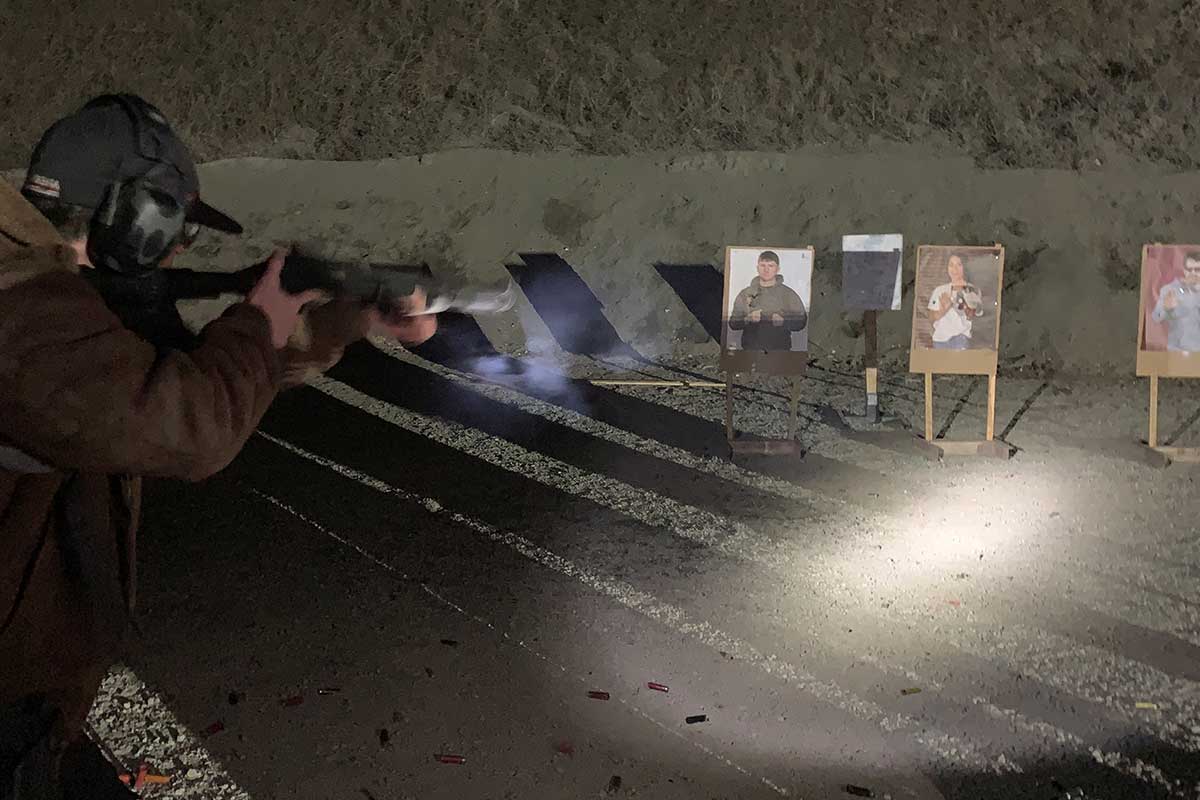
Rule #4 reads, “Be Sure of your target and what’s beyond it.” That’s easy on a square range with a two-dimensional target in front of a tall earthen berm. Too easy. Maybe you are moving. Far more often, the target is not moving; it is just static. And there is generally a lack of No Shoots downrange behind the targets we are shooting. As a result, there is not much opportunity to practice Rule #4 and the downrange problem.
If your instructor adds in “… and what is between you and the target as well as around it” that makes the downrange problem even more difficult.
How big of an issue is this downrange problem? How concerned do we, as armed professionals and armed citizens, need to be about this?
As groups, armed professionals and citizens have unfortunately shot uninvolved or non-hostile individuals, wounding or killing them with rounds that missed those whose actions justified deadly force. Those killed have included victims, bystanders, and uniformed, on-duty police officers.
This is an issue, and we need to be concerned about it.
The Four Safety Rules (photo courtesy of the Gunsite.com website). Always be sure of your target.
This past weekend was Tom Givens’ yearly Rangemaster Tactical Conference, also known as TacCon, at the Dallas Pistol Club in Carrollton, Texas.
Numerous presenters gave classroom and live-fire presentations on a broad spectrum of topics for the self-defense community. I was fortunate to have been invited to be a presenter. One of my classroom presentations was based on several research studies, including Tom Aveni’s 2008 work for the Police Policy Studies Council, titled “Critical Analysis of Police Shootings Under Ambiguous Circumstances. Numerous officers from six different agencies participated in the study that focused on decision-making driven by suspect behaviors. Each officer had multiple scenarios for the study.
A problematic finding in the study had to do with a mugging scenario that involved victims who were farther downrange than the suspects. The victim was positioned in the officer’s line of fire when the suspect drew on and then shot at the officers. Most officers in the study – though not all – returned fire at the suspect when shot at. Many of those officers had one or more rounds hit the downrange victim or bystander.
Unfortunately, the study only uses the words” most” and “many” as it did not capture the numbers of victims and bystanders that were hit.
While there are other lessons from that study, the downrange problem is one that trainers and instructors need to be aware of and address.
One large west coast agency has experienced a couple of these events in the last few years. These were cases where the suspects’ violent actions created the situations that led to the tragic outcome. Even though COVID has adversely impacted a lot of training over the past couple of years, it will not give us a pass.
What are some different ways of doing this?
Including bystanders and victims near or behind the suspects during force-on-force scenarios is one idea. Program the problem into the firearms training simulators like those from FATS and VirTra.
The percussive vibrations of each gunshot actually kill vital little hairs deep in your inner ear. And that can open the door to a high pitch ringing or humming noise that can last forever.
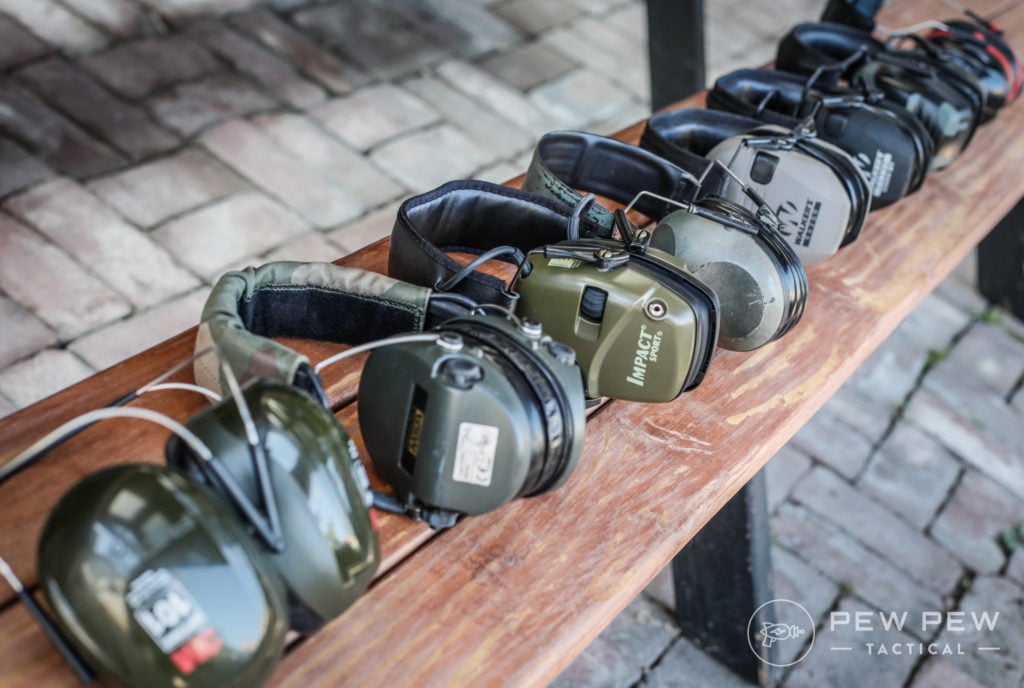
Best Shooting Ear Protection
We’ve got the 411 on the best shooting ear protection…from affordable passive ones to the top-of-the-line electronic earmuffs.
We’ve tried them all over hundreds of hours at the range as shooters and range officers.
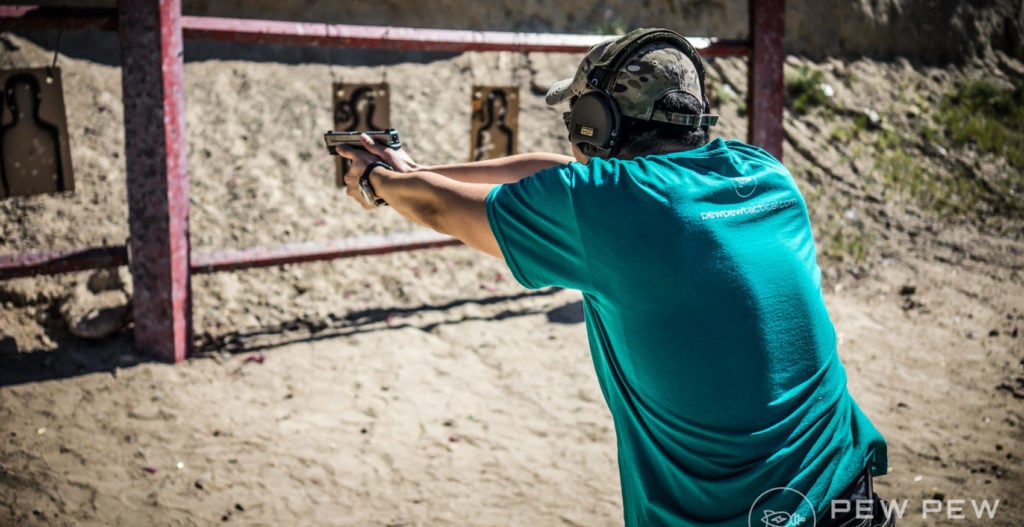
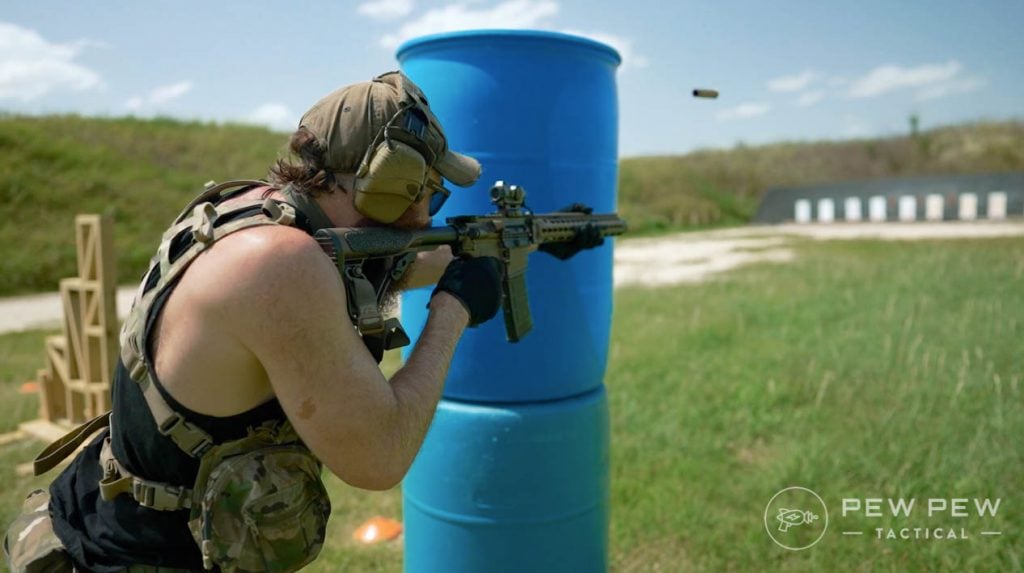
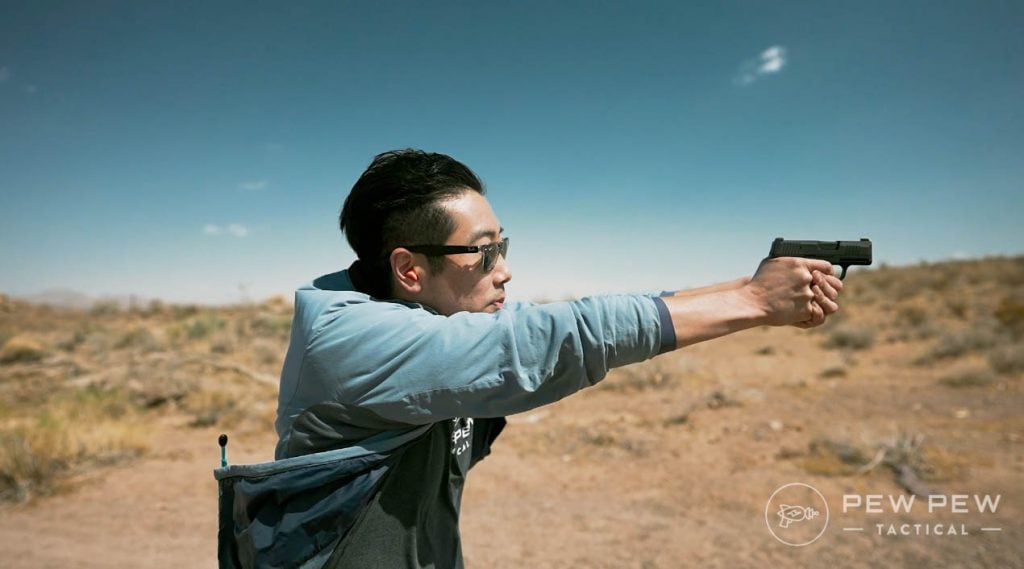
Me Shooting
We’ll go over some preliminary info but if you want the results right away…check out our table of contents.
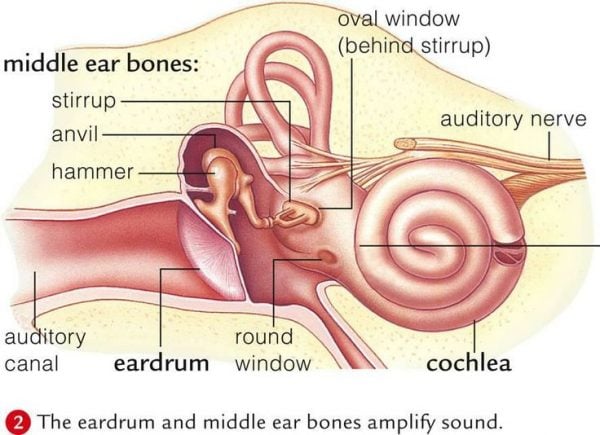
Everyone always talks about the middle ear. That’s mainly the eardrum and those three little bones with cool names: the hammer, anvil, and stirrup.
But what really causes hearing damage though is what happens in the inner ear.
Anatomy of the Ear
Inside, picture a spiral staircase. Only this passage is just 2 millimeters wide and maybe 30 millimeters long all coiled up.
Sound races along the outside of the staircase, but in the middle are the organ of Corti (yup, sounds ominous) and the basilar membrane. Both are long and thin, with the organ resting on the membrane. All along this little assembly are tiny little hairs. They register sound and transmit it through the auditory nerve to your brain.
Daniel Defense DDM4ISR Range Shooting
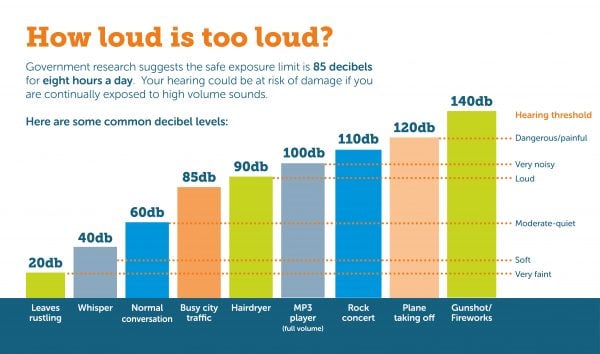
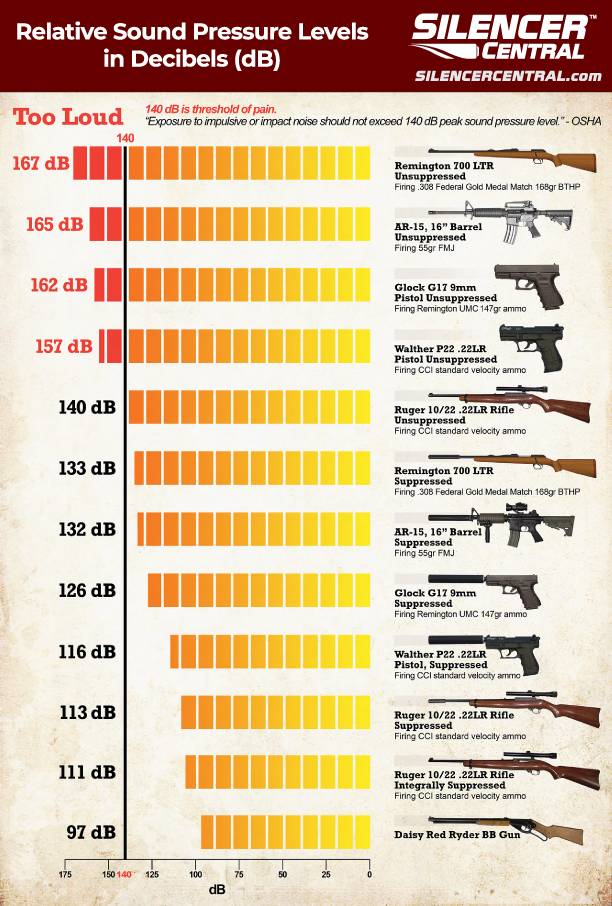
But — and here’s the kicker — exposure to an intense sound — that’s 140 dB or more — can make segments of the organ of Corti separate from the basilar membrane. Portions of it actually tear away and float around.
Sounds you hear all the time can have a huge effect your hearing.
So you end up with an inflamed lesion that causes an accompanying chemical reaction. Hairs die. Scar tissue forms, and even with rest, the tiny hairs typically continue to degenerate. A cascade effect takes over, and the entire auditory central nervous system goes deaf.
Researchers suspect that tinnitus—that high pitch noise inside your head that won’t go away—“begins as a result of the brain trying to regain the ability to hear the sound frequencies it has lost by turning up the signals of neighboring frequencies.”
One more thing: noise exposure is cumulative. Each loud sound is killing ear hairs, so you need to be thinking about total exposure over the course of days, weeks and years.
If you’re looking to go to the range while you’re pregnant, you might want to rethink that. There are some special considerations that you should know if before going.
First of all, forget cotton balls, tissue, packing peanuts, or my personal old-shooter favorite, cigarette filters.
While they are better than nothing, they are also next to nothing. At best, you’ll get a reduction of maybe 7dB.
Cotton Balls are Barely Better than Nothing
Effective choices for hearing protection come down to
earplugs
earmuffs
combinations of the two and
some techy alternatives with sound-circuit technology.
There are so many options, there’s no reason not to protect your ear hairs. From neon foam-on-strings to high-tech headphones, there’s something for everyone.
What you should be looking for is a minimum noise reduction of 15dB, but 30dB is preferable. Pair a good set of plugs with muffs and you might shut out another 10 to 15dB or so.
You know the load you like to shoot, but a conservative 140dB is a common figure for an average muzzle blast. A .22 will be less, a magnum more. With quality protection, you can start approaching a range that’s still loud—as in chainsaw- or sandblast-loud—but may be up to 1,000 times quieter.
Best Shooting Ear Protection
Circle of Shooting Ear Protection
Earplugs
Traditional earplugs fit inside the ear, forming a seal that blocks sound.
They come in a range of sizes, configurations, and materials — from foam to hypoallergenic rubber and moldable polymers. Earplugs tend to be more efficient at handling low-frequency noise.
Pros:
Least expensive option.
Highly effective.
Disposables available in bulk at pennies per pair.
Some rated 30dB or better.
Available strung or unstrung.
Reusable models washable.
Some models moldable for custom fit.
Compact for transport.
Good for tight spaces; no snagging.
Cons:
Fit constraints for narrow or wide ear canals.
Comfort varies widely.
Muffles all sound indiscriminately; works too well.
Foam models require proper roll-down insertion, removal and reuse.
Some models difficult to pair with muffs.
Moldables more expensive; may be difficult to alter.
Fumble-and-loss factor in dirty environments.
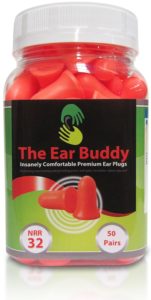
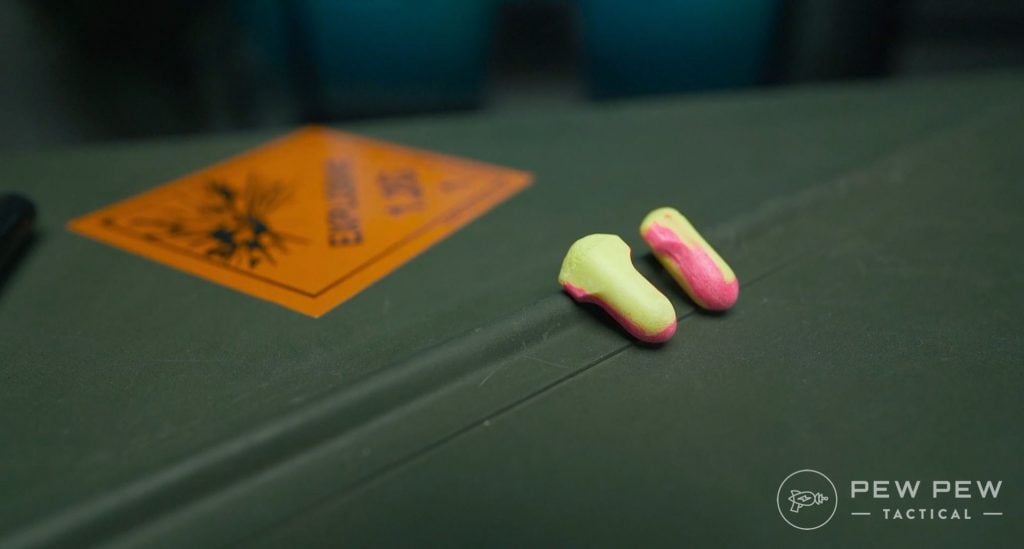
1. Disposable Foam Earplugs
The most affordable of the bunch and really protective at 32dB NRR (noise reduction rating).
Foam Earplugs
Remember to fully compress them before sticking them into your ears.
Shooting with Foamies
BEST FOAM EARPLUGS
There are tons of other foam options but I would stay away from cylindrical ones…those are not very comfy.
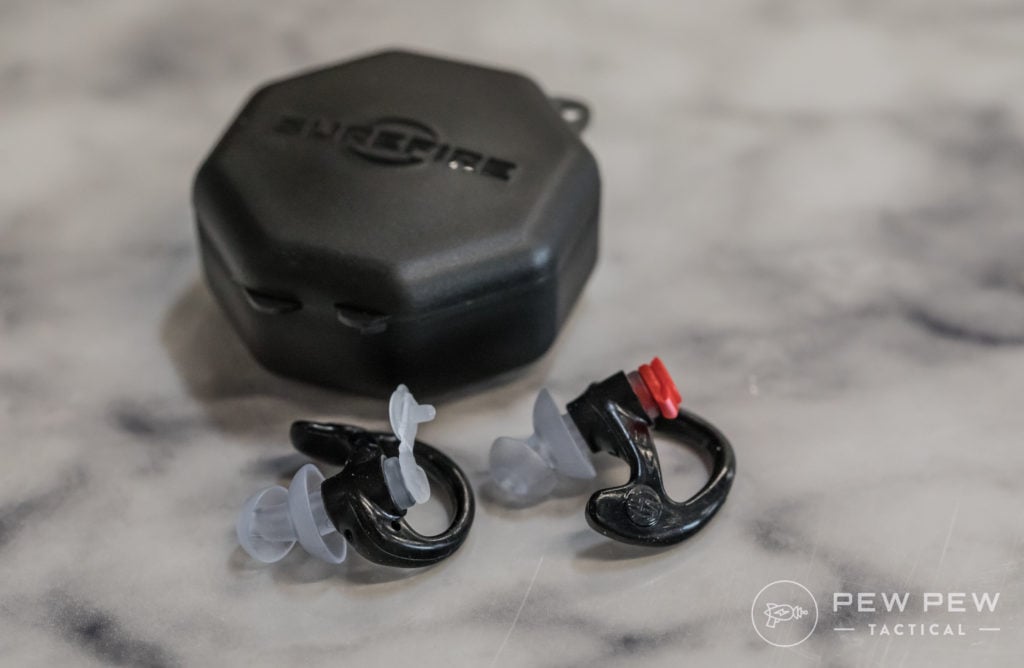
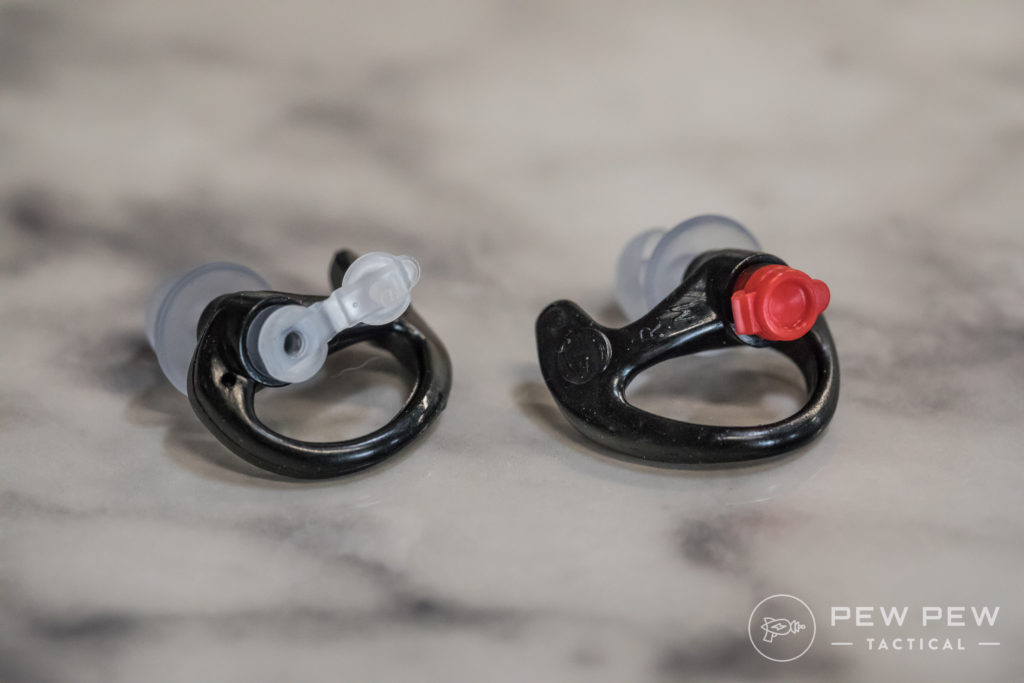
2. SureFire EP3 Sonic Defenders
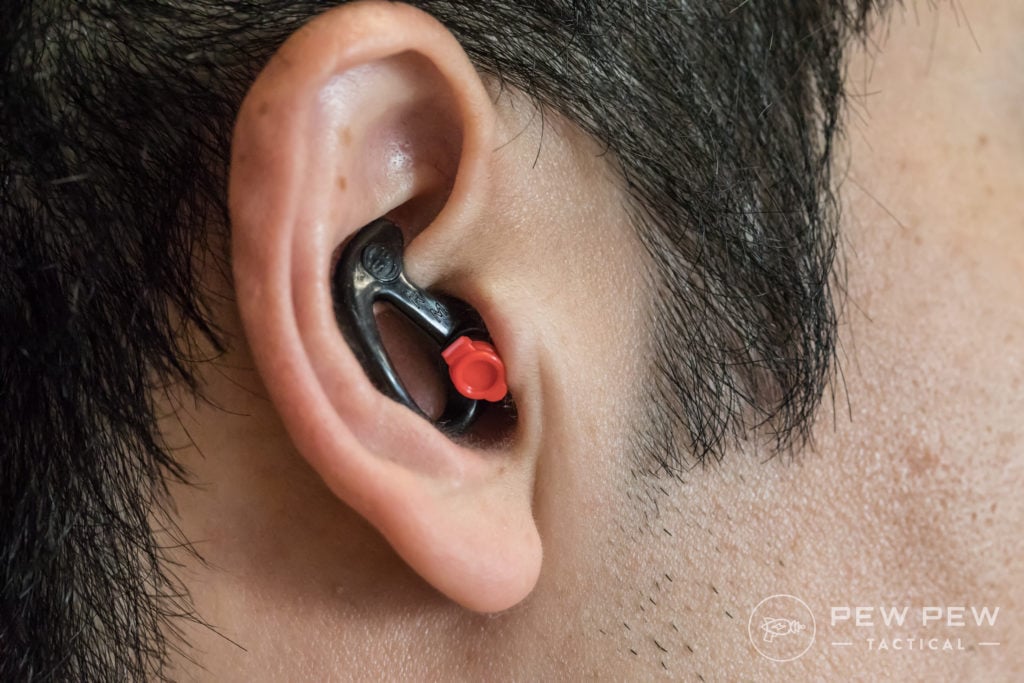
Want something reusable and gives you two levels of hearing protection?
Having it open gives you still decent protection against gun shots but allows you to hear range commands and regular talking.
They fit very well but keep in mind there are sizes…here I am comfy with Mediums.
Wearing Surefire EP3 Sonic Defenders
Great for outdoor ranges and “normal” calibers…but if you’re shooting indoors or shooting magnums…I’d double-up with these inside and then earmuffs over.
There are also EP4 Sonic Defenders which have a longer flange into your ears.
I prefer the EP3s though.
Passive Protection
Traditional earmuffs come on a headband and have foam pads that cover and form a seal around the entire ear.
For those who don’t like the over-the-head fit, a few versions have back-of-the-head wrap designs. Muffs typically are better at screening out higher frequency sounds.
Weak Hand Shooting Drills with Ear Muffs
Pros:
Convenient to put on and take off repeatedly.
Comfort level.
Easily paired with earplugs.
Relatively inexpensive.
Foldable models compact.
One size usually fits all.
Durable.
Cons:
Can be bulky, heavy.
May snag or bump in confined spaces.
Comfort issues, especially in humidity, hot or wet weather.
Can interfere with proper cheek weld.
Issues with safety or prescription glasses and proper ear seal.
May not provide as much noise reduction as earplugs; can require pairing with plugs.
Hats or long hair, anyone?
THE BEST GUN DEALS, COUPONS AND FINDS
Subscribe to Pew Pew Tactical’s sales and deals email.
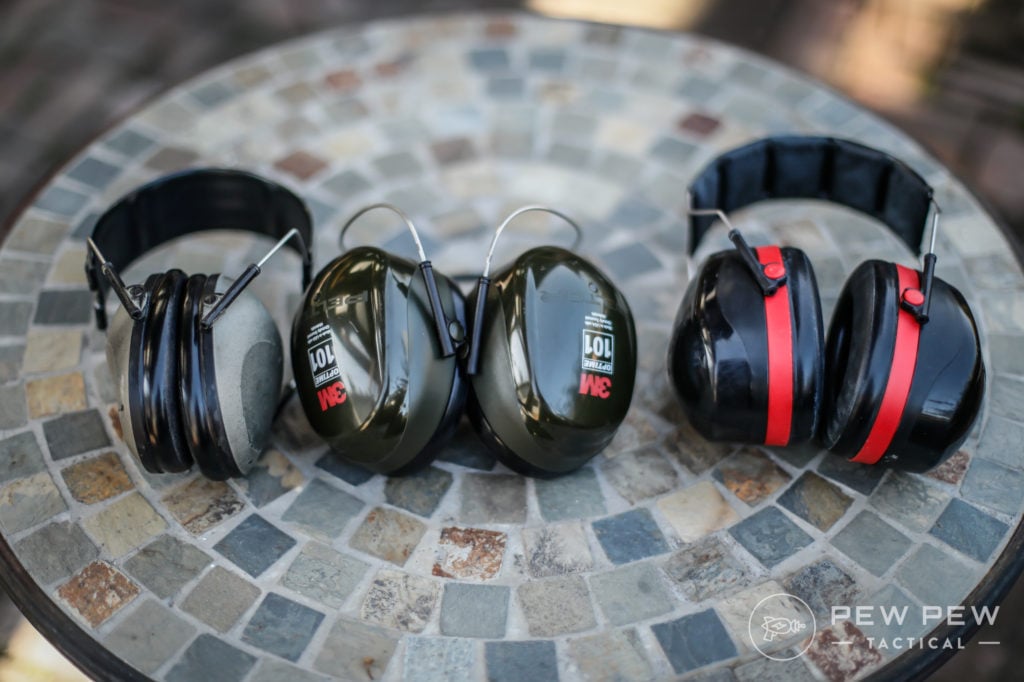
My favorites and what I wore for a long time are the 3M Optime model and Shotgunner model.
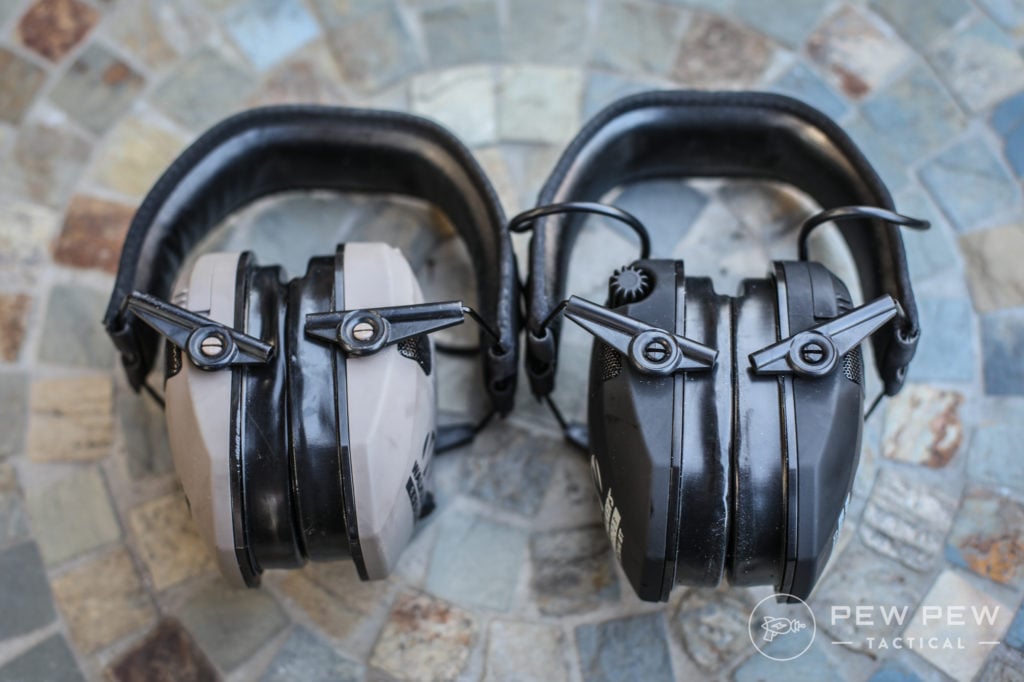
Shotgunner & Optime Ear Muffs
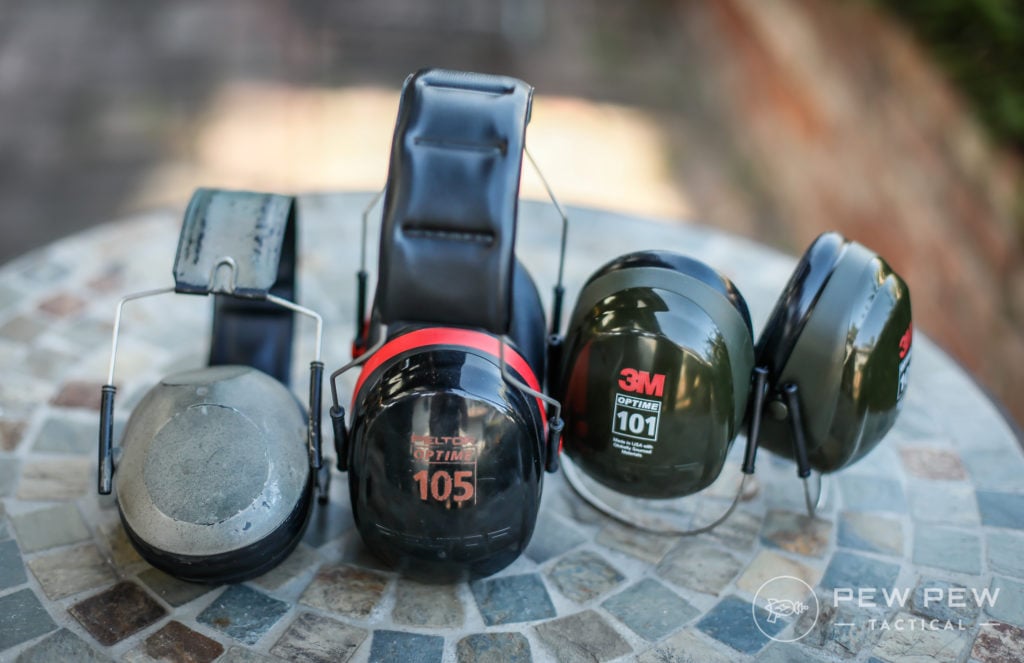
3. 3M Peltor Optime 105
The Optime 105 is super protective with 30dB NRR but is also quite bulky.
Passive Shooting Ear Protection
It’s not heavy but it will seriously cramp on your cheekweld situation for rifles and shotguns.
Use if you’re shooting handguns…and especially if you’re at an indoor range where the sound reverberates.
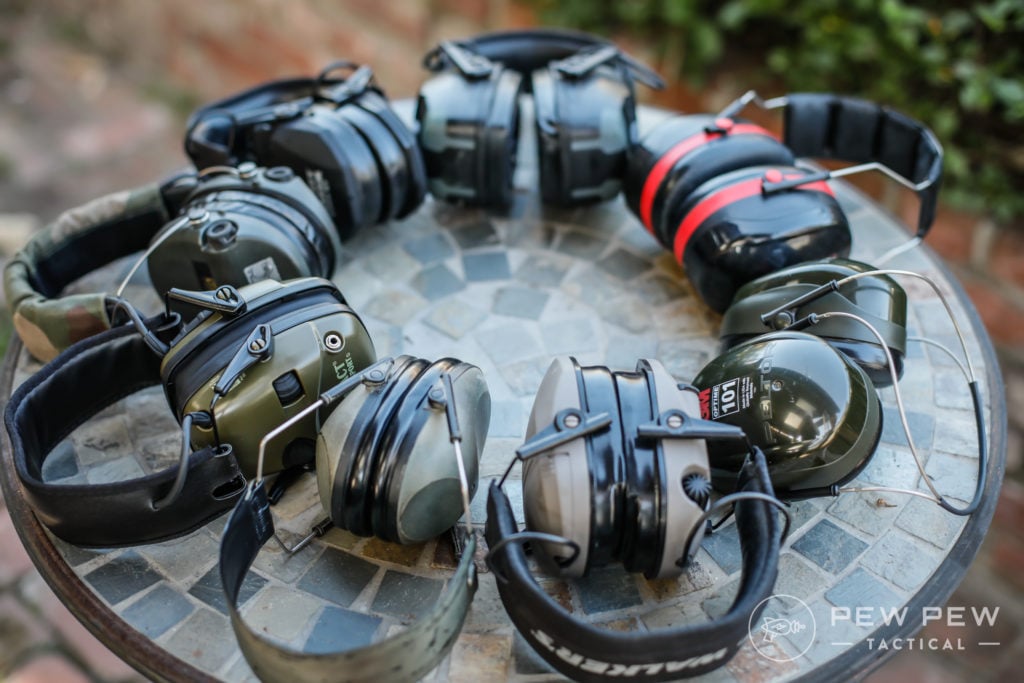
Passive Shooting Muffs, Side (L to R: Shotgunner, Optime 105, Optime 101)
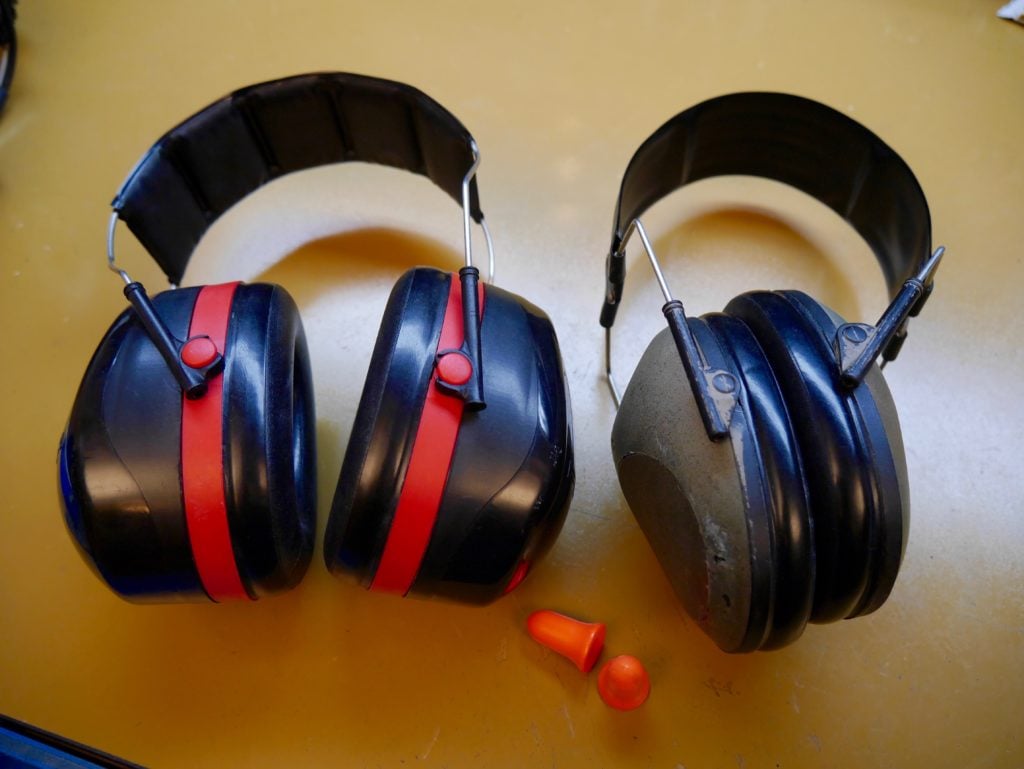
I painted mine over and it served me well for years. It’s less protection at 24dB but you can always double up if it gets really loud with compensated rifles. Comfort is average but I found it to be fine for a few hours if I can take it off my ears during downtime.
Now, let’s dive into electronic ear protection that cuts out harmful shooting sounds but amplifies regular sounds like people talking.
5. 3M Optime 101 (Behind the Ear)
One of my newer passive earmuffs is the Optime 101 Behind the Ear which allows you to wear a hat, helmet, or face mask unobstructed.
3M Optime 101
I’d try these out if the other earmuffs aren’t to your liking.
Now how about we move onto…
Electronic Protection
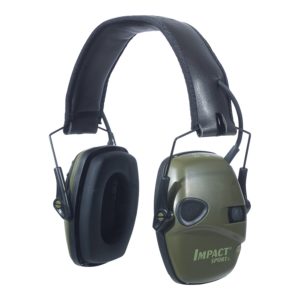
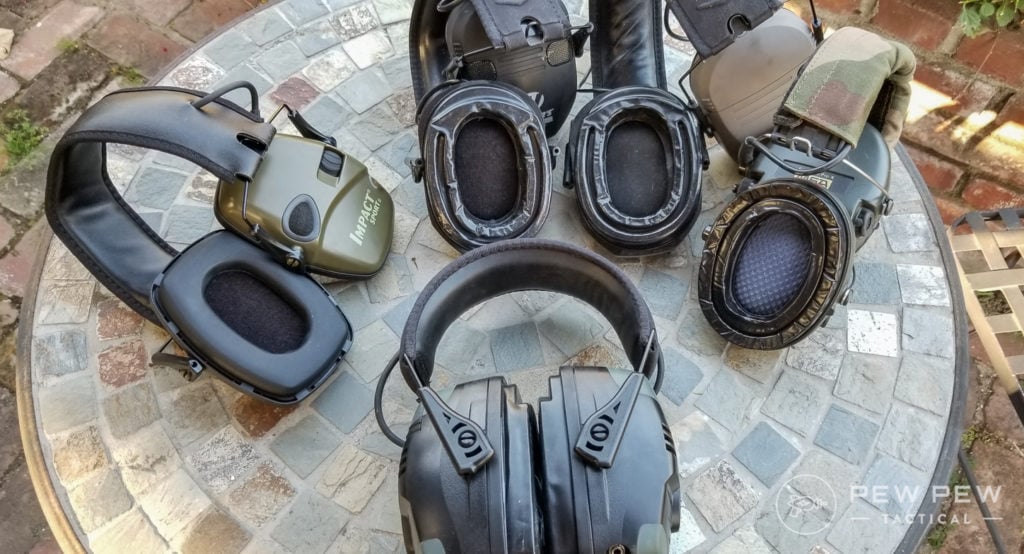
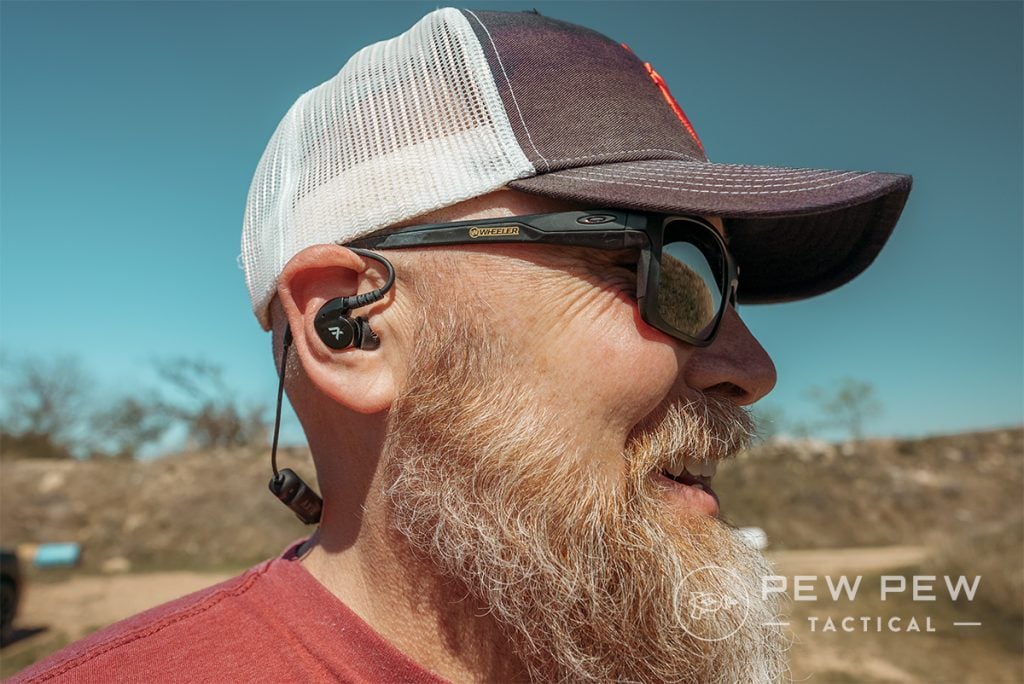
Electronic Shooting Protection, Open
High-tech electronics are stepping up the game for earplugs, ear cuffs, ear muffs, and every smart device in between.
These focus on screening out the loud booms while letting you still hear conversations and the sounds of the great outdoors.
Pros:
Noise filtering; loud noises muffled but conversation and subtle noises amplified.
Comfort.
Small, compact.
Lots of options, including Bluetooth to enable smartphones.
Available in stereo.
Variety of formats—muffs, earplugs, semis and cuffs.
Cons:
Price point—usually $50 and up, up, up.
Batteries required.
Not always water-resistant.
Expensive to lose; fallen electronic cuffs and earplugs hard to find in the field.
Comfort.
Some models are bulky, heavy.
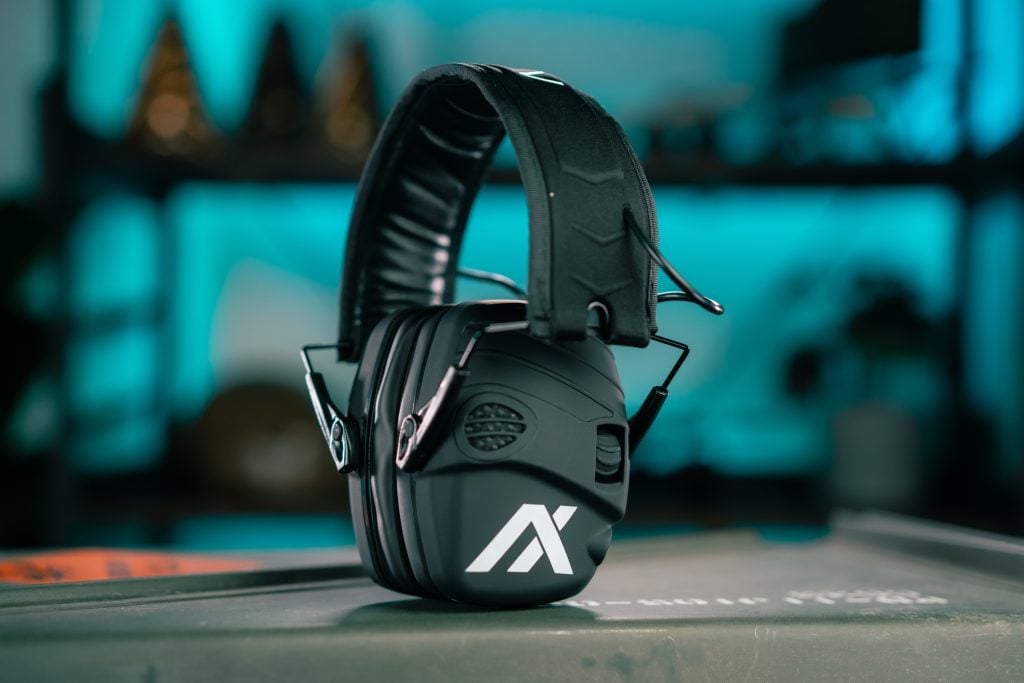
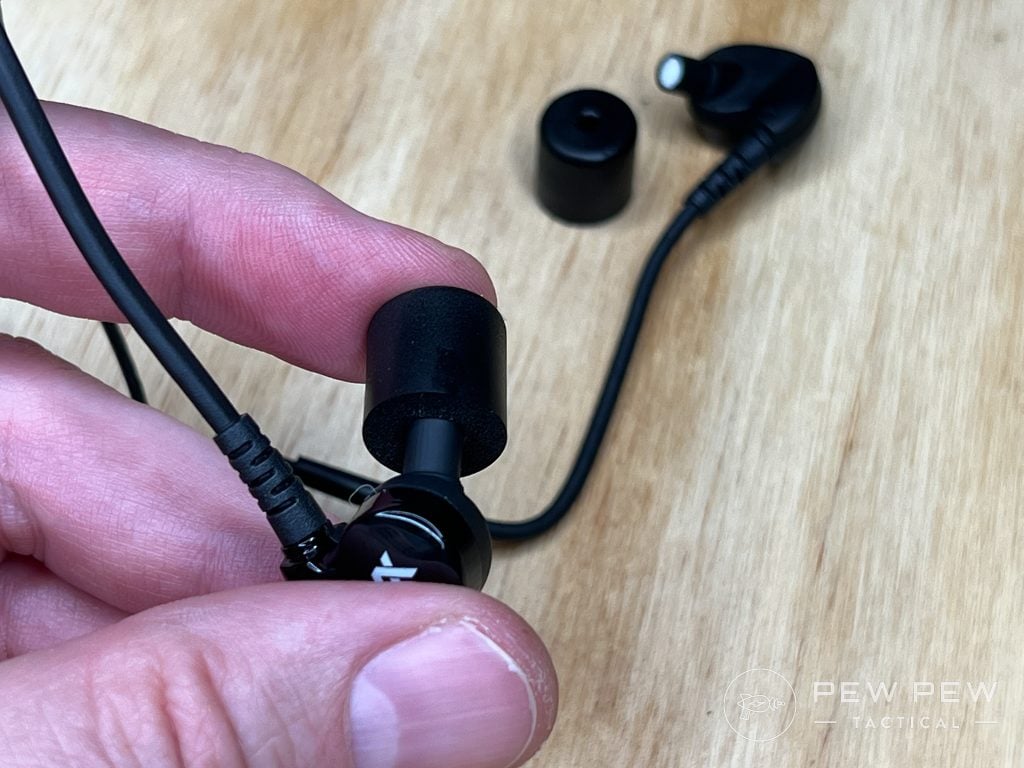
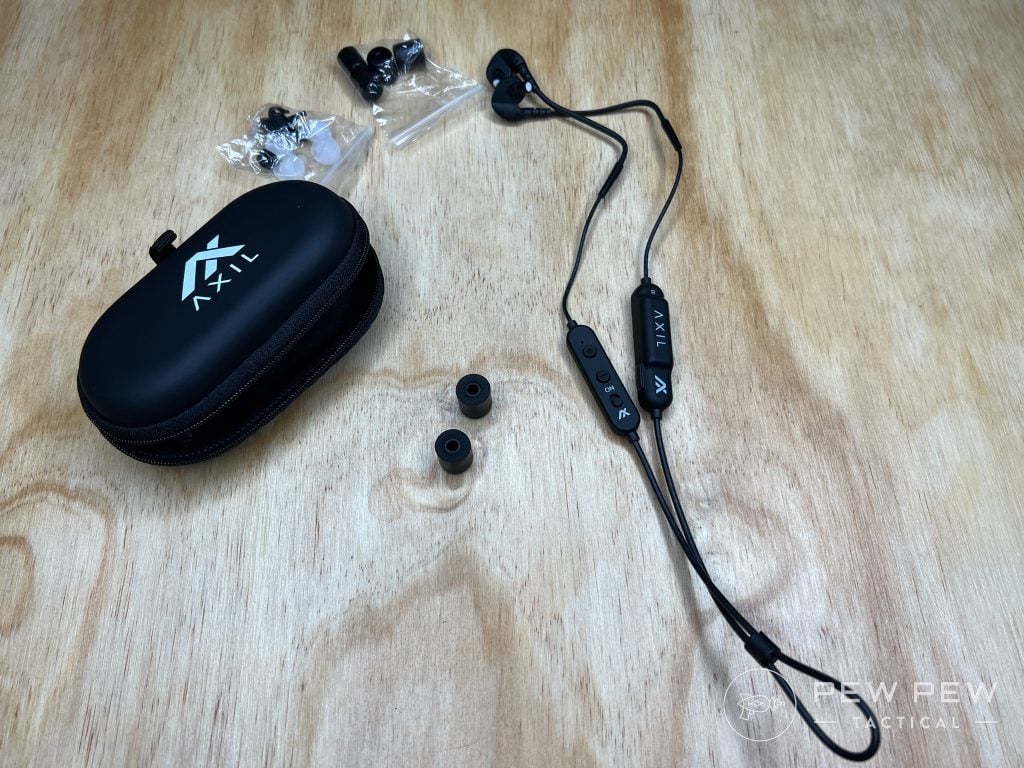
6. AXIL TRACKR
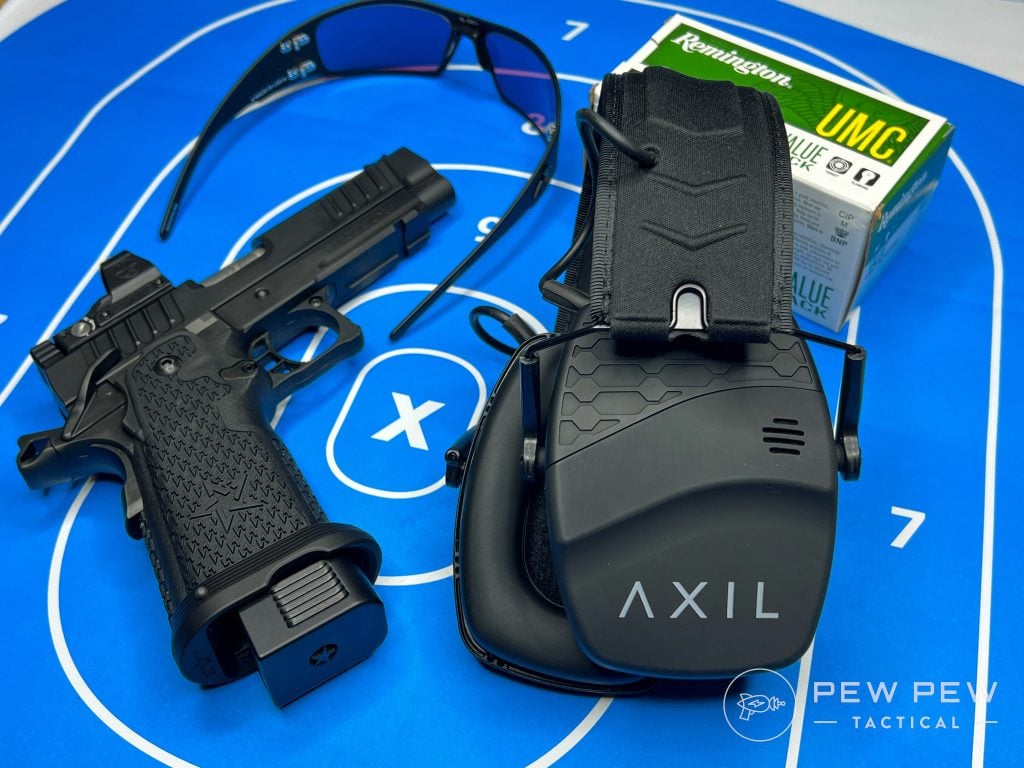
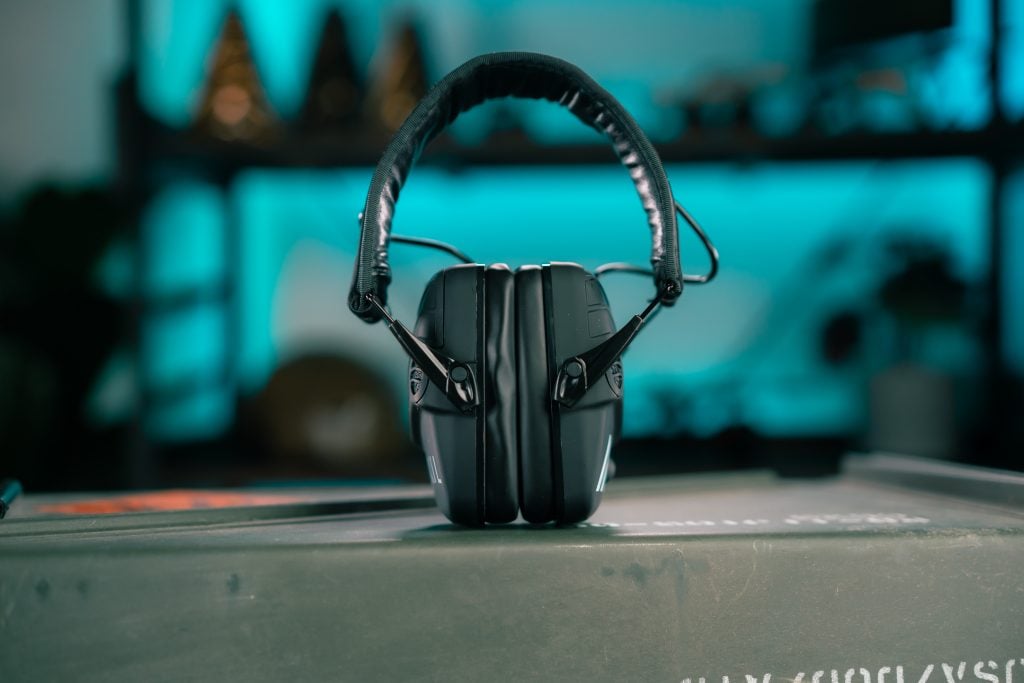
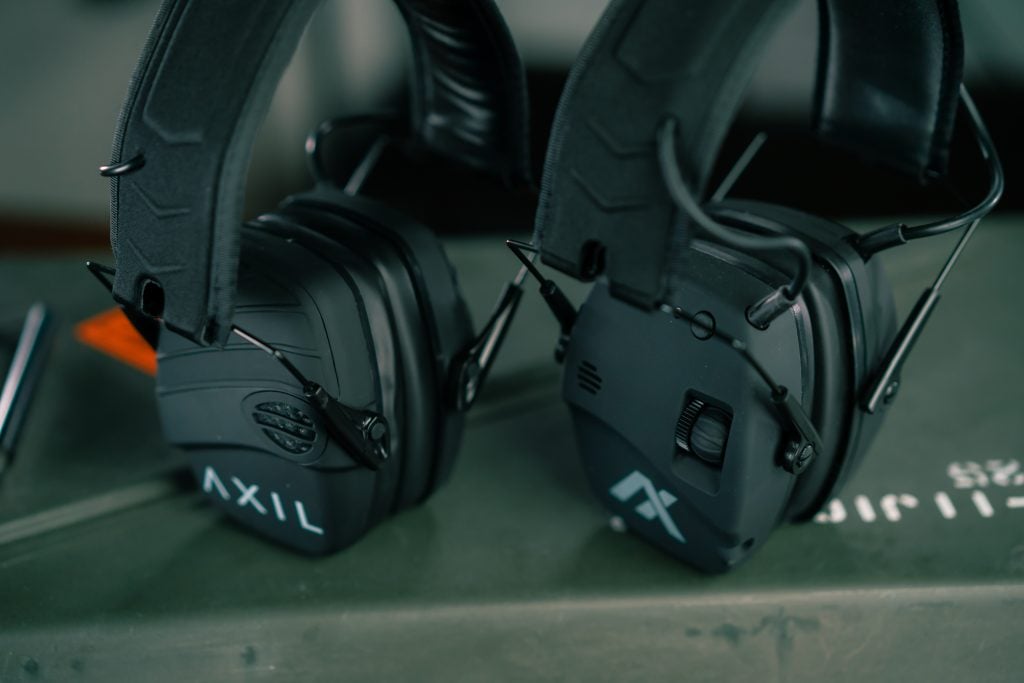
My current go-to Editor’s Pick for affordable electronic hearing protection is the AXIL TRACKR.
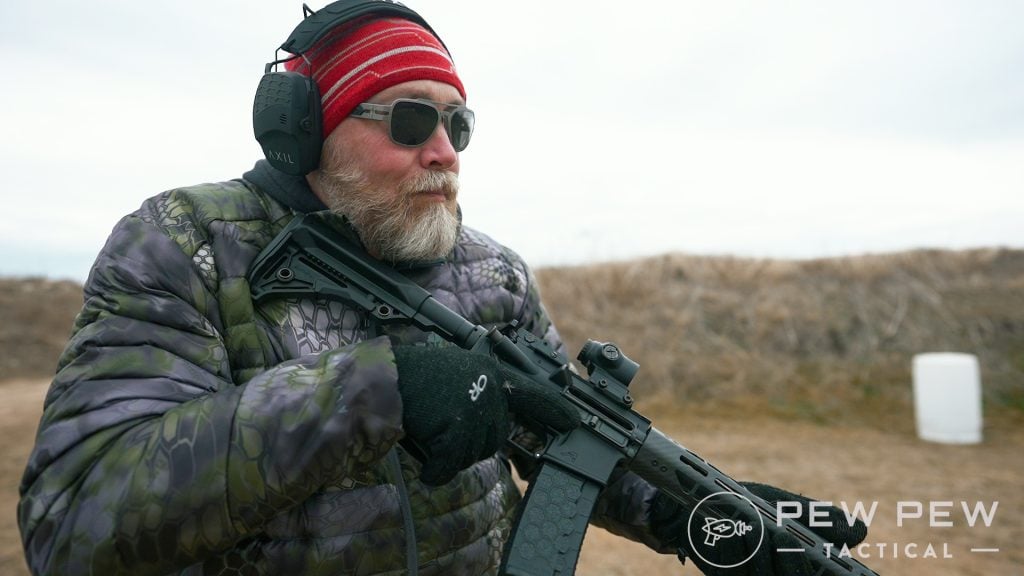
Range Ready with the AXIL TRACKR
AXIL started with manufacturing hearing aids and only recently moved into the hearing protection space…but they definitely know what they are doing.
Our entire team tested out the TRACKR and found the padding and strap to be a bit tight out of the box but very comfortable once you stretched them out a little bit.
Range tested
But the electronics were what really performed.
At the range they did a great job of blocking out shots and amplifying speech. When I tested them out in my home office, I was somewhat surprised.
AXIL TRACKR
I was able to hear a conversation in another room, a bird tweeting outside, and my own breathing. AXIL’s background in hearing aids shines through in the amplification.
NRR comes in at 25 dB which is great for thin profile electronic earmuffs and enough for a day at the range unless you go into really big boy caliber ranges.
AXIL TRACKR Side
Price is $64 which is slightly higher than other budget options but AXIL has a great deal of buying 2 for $99.
There’s also a Bluetooth version rated at 27 dB where you can also enjoy tunes with a paired device. Separate volume switches allow you to dial the ambient noise or music to your listening pleasure.
These feel like the pads used in my favorite $200+ earmuffs further down the list.
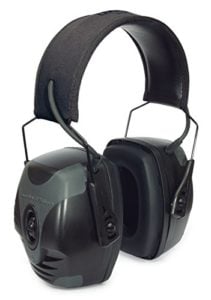
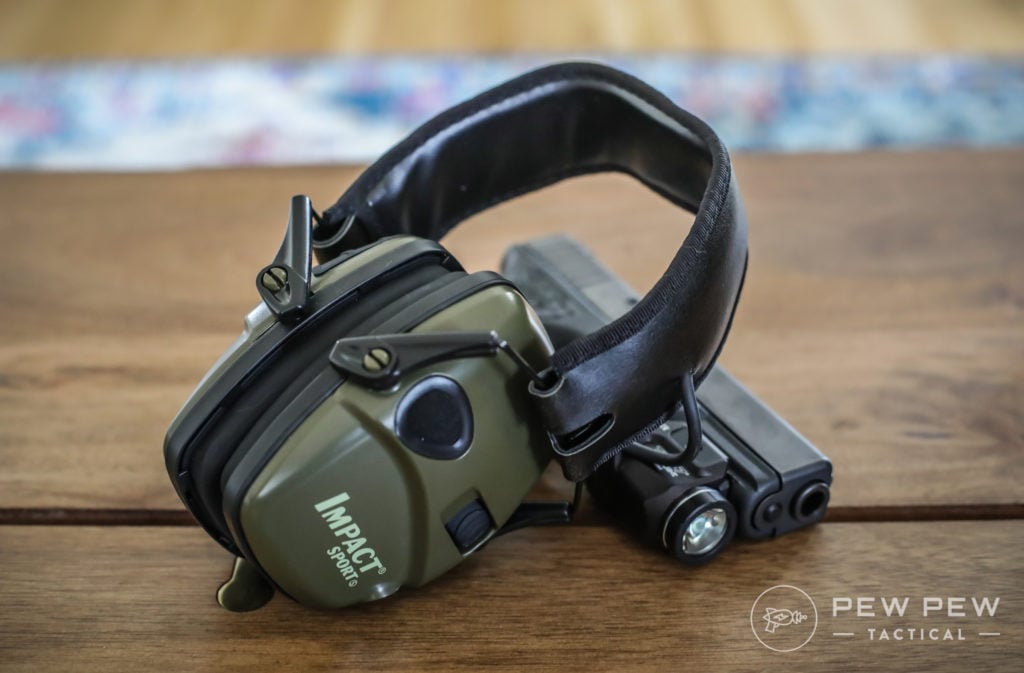
8. Howard Leight Impact Pro
If you’re ready to jump up a notch you get 30 dB of protection and ability to hear people around you and range commands.
Howard Leight Impact Pro with Noisefighters
They are large, bulky, but surprisingly light and comfy to wear even for longer range sessions and provide amazing noise reduction. I’d recommend these if you are shooting large caliber handguns or shoot at an indoor range.
Howard Leight, Side Profile
They are pretty thick and will mess up your rifle cheek weld.
For most, you’ll be well-served with any of the Howard Leights with the possibility of upgrading to gel caps.
Next up is a bigger jump in price.
But with that, you get much better cutoff and amplification. Pro Ears has a stellar reputation and I like their Pro Tac Slim Gold edition. They don’t make my Editor’s Pick because they fit a little tight for people and the ears aren’t as comfy as the MSA Sordins.
But if you want better sound quality and shutoff (plus the ability to change it for each ear), I like Pro Ears’ Pro Tac Slim Gold with 28dB NRR.
Most of my fellow competitors wear MSA Sordins for their comfort and sound quality.
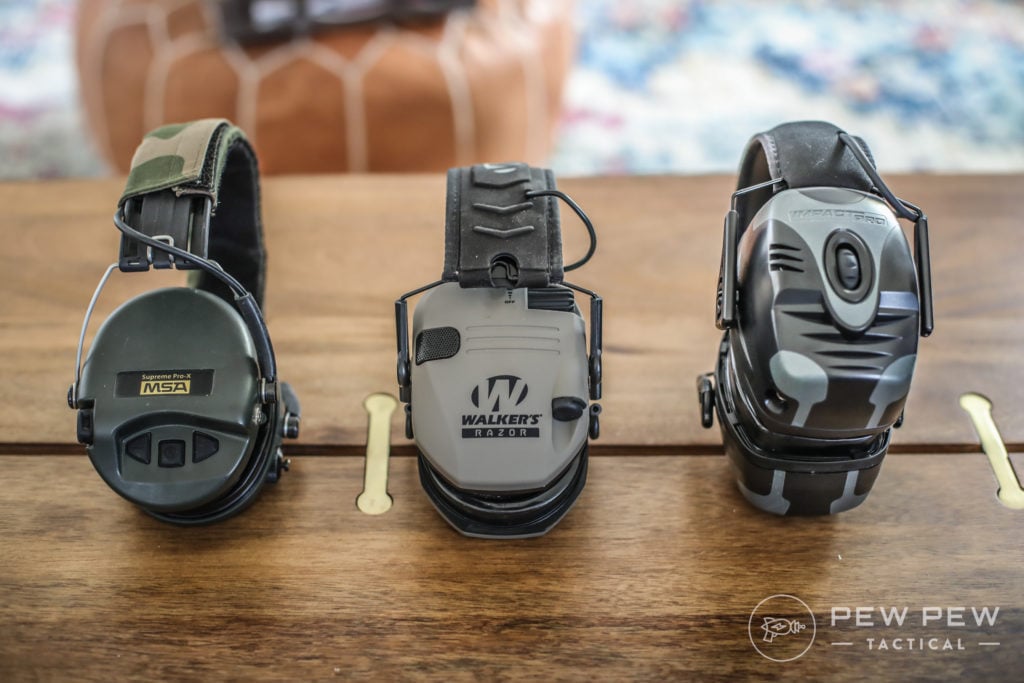
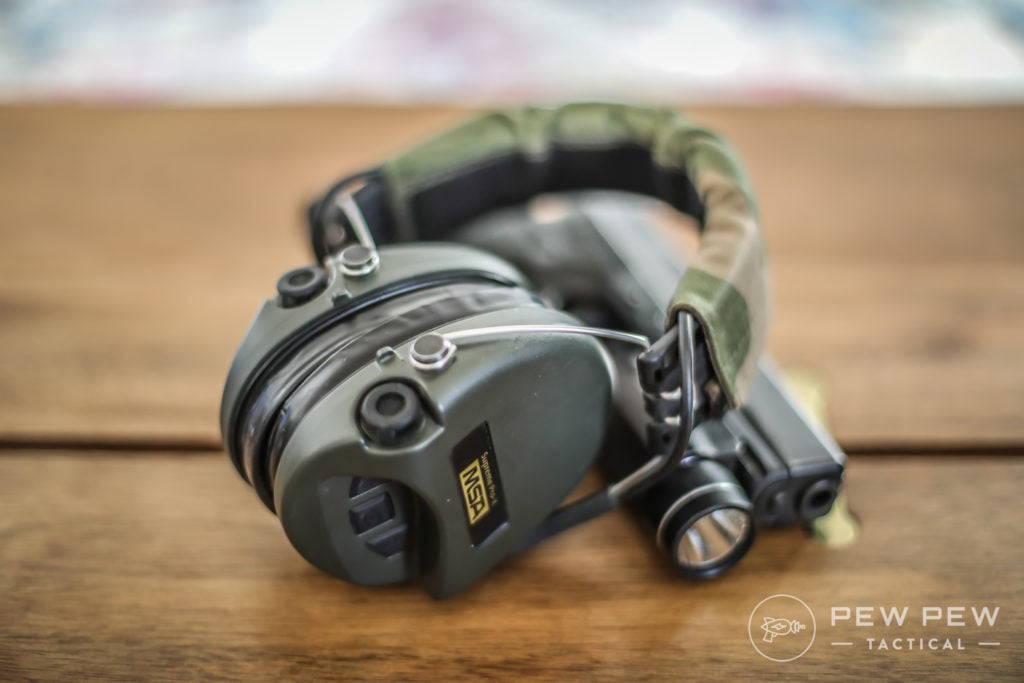
MSA Sordin Supreme Pro X
I finally caved after I became a range officer for a couple of competitions. That meant constant blasts for hours while still needing to hear everything.
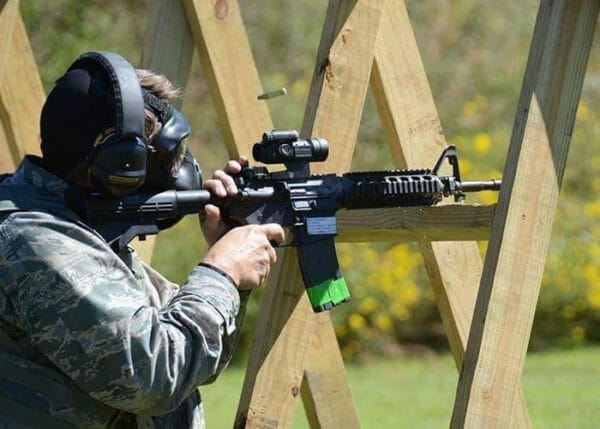
Me Shooting
I simply asked my competition buddies “what are the best electronic ear muffs” and the MSA’s got the majority of votes.
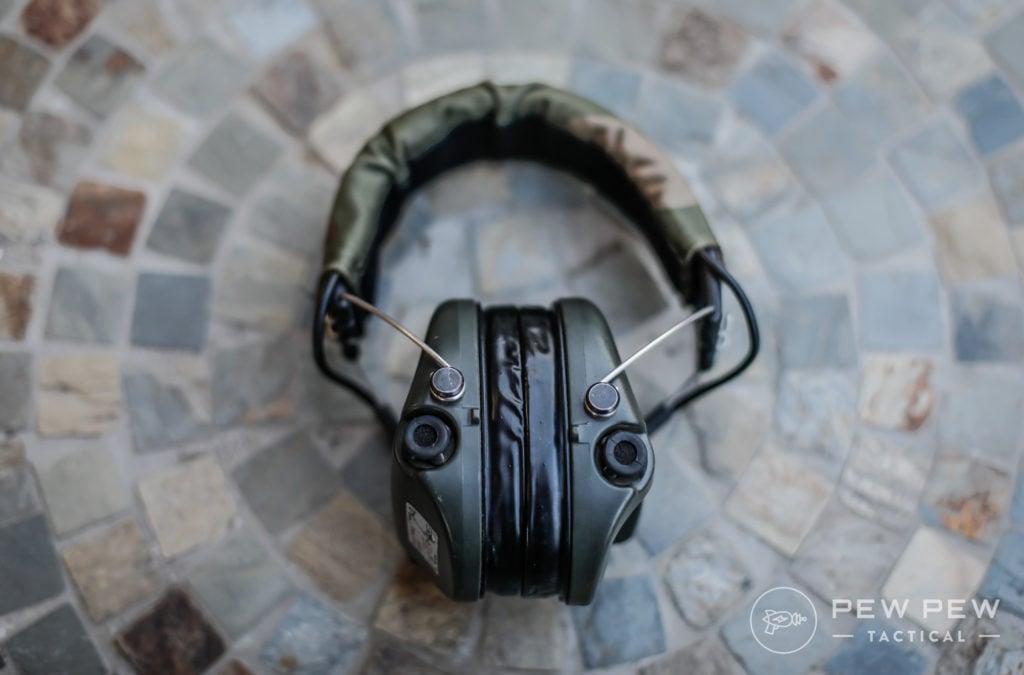
They already has built-in gel caps and there’s a couple colors. I of course went with the camo…
Supreme Pro-X Controls
They are comfy for hours with their gel caps, have easily accessible button controls, great sound cutoff and compression, and allow for earplugs if the decent 22db NRR doesn’t cut it.
MSA Supreme Pro-X, Side
Plus they can attach to ballistic helmets and comms if that’s your thing.
U.S.A. –-(AmmoLand.com)- Recently while I was at Petco, a man walked in, and he was quite a sight to see. This man was in his late 50’s to early 60’s, in decent shape. He wore green Condor BDU pants bloused on his black 511 Tactical boots, a black 2A moto tee was tucked into his BDU pants. On his hip was an openly carried Springfield XDS, with extended magazine, jammed into a Serpa holster. He was buying some dog food.
Immediately after paying, his head dives into his smartphone like his neck is a wet noodle. I watch him as he exits, and he remains like this all the way until he gets into his new Chevy Colorado. The man is almost is struck by two vehicles on his way through the parking lot, with him completely oblivious to the world around him. Bad gun, bad holster, bad outfit, bad mindset. Classic. I’ve seen guys like him dozens of times and it’s always something painfully similar to this.
Open Carry
Open carry is legal in my city. Open carry is your right in much of the country. For places where it isn’t, I think it should be. That being said, open carry is often a sign of incompetence, and I almost exclusively advise people against the practice. I’ve never seen anyone publicly open carry with good equipment, nor with any serious amount of awareness or training.
Time and time again it’s been proven that open carry does not deter threats, does not make you a good ambassador for our rights, and doesn’t give you an edge in a fight.
Open Carry As a Deterrent Against Crime
Open carry doesn’t deter people from attacking cops, and they actually have some level of training to defend against that on top of holsters designed to defeat a gun grab. In addition to training and quality retention holsters, police can call for backup in a jam. I doubt many of you, if any, can say the same thing.
Even this former USMC grunt found himself confused on the rifle range. Imagine the non-existent pistol skills. Every Marine a Rifleman, or something.
Most people struggle to make effective hits on a stationary target or simply operate their gun under no stress. Trying to incorporate weapons retention, in-fight weapons access, and other skills without training doesn’t go well for the average shooter. Your conceal carry class, “been shooting all my life”, or an enlistment as an 11B/0311/3P0 doesn’t guarantee your effectiveness. Do you have the skills and equipment necessary to fight back against someone trying to take your openly carried firearm?
Fighting on Whose Terms?
Open carry also presents issues outside of the gunfight. Now you’re alerting everyone to the presence of your firearm, threat or not. This means it is automatically in play in any defensive encounter, not something you can choose to reveal or continue hiding based on the situation at hand. With the gun openly displayed, you are now someone who can be dealt with quickly, instead of you waiting for your moment to counterattack.
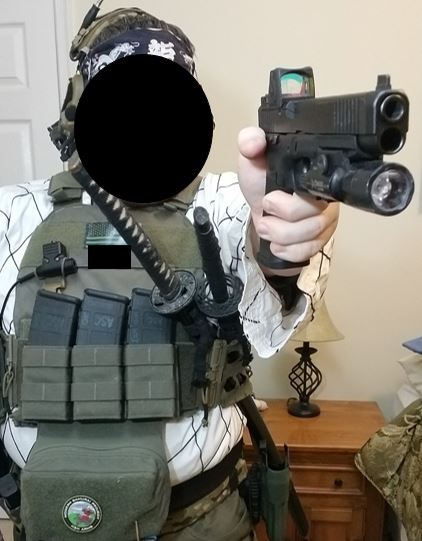
Most mall ninjas look more offensive than this Modern Samurai AND have a fraction of his training
Before someone says it, I know you’re talking out your ass when you say nobody would ever get the drop on you, or you never let anyone within XYZ distance of yourself. You and your Meal Team 6 ninja friends can go back to the land of Make-Believe to scare the children and soccer moms.
Man with a Gun
Don’t forget the potential for Karens or legitimately concerned citizens calling 911 with reports of “a man with a gun” at the sight of your openly carried pistol or long gun. That’s certainly not a situation I want to put myself in, and I live in a fairly gun-friendly area. Especially in light of recent mass casualty events, from movie theaters to grocery stores, schools, and more, concern for those armed in public continues to grow. Do you know what to do if someone were to call you in for a crime you didn’t commit?
Open Carry Exceptions
This piece is regarding open carry in public, occupied areas. Time spent hunting or on your private land is another matter, and not entirely relevant here. There are pros and cons to situations such as those, which is outside the scope of what we’re talking about today. I know someone would bring this up, which is why I’m addressing it here.
Parting Thoughts on Open Carry
Go get good training, read quality resources, and buy good equipment. If you don’t take my word for it, trust people like Greg Ellifritz, who has an awesome piece compiling over 60 recent examples of open carriers losing their guns or being killed due to carrying openly. He then goes on to link dozens of other articles where various experts like Massad Ayoob, Jeff Gonzales, and others give their opinions on the subject. You can read that >>HERE<<.
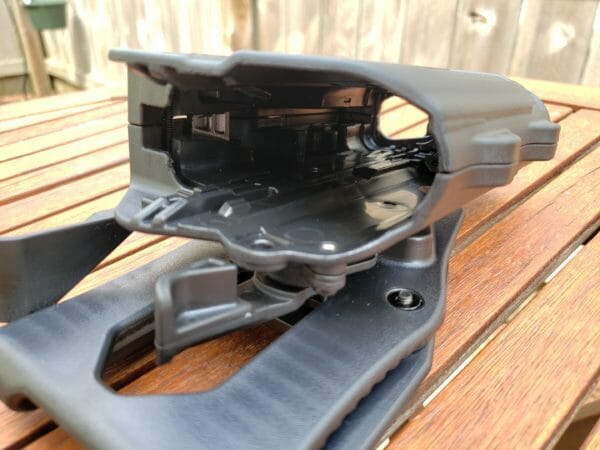
Here we can see the GMR lever and the retention device of the Rapid Force
If you decide to open carry, do it in a Level 2 or 3 retention holster like those from Safariland, with a service grade pistol, and have significant training under your belt. Go take Jiu Jitsu, jump into an ECQC class, and find ways to enhance your situational awareness. Better yet, continue to study and train, but carry concealed in a quality holster like those from JM Custom Kydex, Tenicor, Raven Concealment, and others.
About Dan Reedy
Dan is an Air Force veteran, avid shooter, and dog dad. With a passion for teaching, he holds instructor certifications from Rangemaster, Agile Training & Consulting, and the NRA. He has trained with Darryl Bolke, Mike Pannone, Craig Douglas, among several other instructors, amassing over 400 hours of professional instruction thus far. In his spare time you’ll find him teaching handgun, shotgun, and less lethal classes.
Dan’s work has been published by Primer Peak, and The Kommando Blog, and he has been featured as a guest on Primary & Secondary.