Categories
All About Guns Fieldcraft

YOUR GUN SPEAKS…

WHAT CAN IT TEACH YOU?  BY CLAYTON WALKER 

Sometimes, it’s the kit, not the gat. Gloves often make
big guns and very tiny guns more shootable.

I’m going to guess you’ve been in a similar situation to what I’m about to describe. First, you see a new gun — perhaps in our pages here, maybe in a consignment counter of a local shop. You initially tell yourself you don’t need it, but then you crack and find yourself reading reviews and browsing pictures on the internet. Willpower fully sapped, you head to the store and empty your wallet. You give it a good function check, racking slides or cocking hammers, and your head spins with just how cool this thing is going to be once you get to the range.

The days move slowly as you deal with the usual commitments and drudgery. The kids need to get dropped off or picked up from somewhere, projects need to be completed for work, dinner needs to be put on the table, and there’s no end of household chores that need to be put to bed. But at long last, you find yourself the beneficiary of unallocated time. Guns and ammo are collected, the jalopy is gassed up, and you make the trip to the range. Eye and ear protection is donned, your new acquisition is raised to the target, and your index finger begins to take up pressure on the trigger.

One minute later, you’re staring at a mediocre group. Maybe you’ve missed your target entirely. And just like that, it seems you’ve fallen entirely out of love.

On one hand, life is short, and if you sold off every firearm that didn’t bring you constant, unmitigated joy and 100% effortless shooting, I wouldn’t fault you! However, there have been more than a few pieces in my personal collection that I might not have appreciated fully the first time I shot them but have since taught me something and made me a better shooter in general.

In fact, I’d argue more people fall out of love with all of the handguns I’m about to mention than any other — they can make a very poor first impression. However, I’ve since learned to love them, and I’d be a far worse shot if I impulsively kicked a lot of these purchases to the curb.

Range and dry-fire practice with a magnum handgun can
really target recoil tolerance and anticipation!

The Magnum


Most men feel like they can drive fast, cook, make love and shoot magnum handguns without ever feeling like they need to put in the work to actually become proficient. Lots of people saw Dirty Harry back in the day and pined for what was then “the most powerful handgun on earth.” After about a few cylinders of big bore, full-power .44 Magnum out of S&W’s Model 29, no shortage of owners turned 180 degrees and marched that sixgun right back to the gun store — along with a half-full box of ammo.

I’m of the distinct opinion that shooting the magnum handgun requires more than just holding it in the general direction of one’s target, pulling the trigger and hanging along for the ride. I think you also need to hit what you aim at. Unfortunately, recoil has long been a detriment to realizing good accuracy, and our reptile brains are hard-wired through millions of years of evolution to freak out (if only a little bit) when we hear a gigantic boom.

Often, the fight-or-flight reflex that accompanies the first round of magnum handgunning produces an adrenaline dump that makes fine motor manipulations more challenging. Slow, careful trigger presses often turn into exaggerated mashes, particularly among novice and intermediate handgun shooters.

However, the magnum handgun is undoubtedly “expert mode” when it comes to teaching careful and deliberate trigger manipulations and learning to fight one’s way back through stress and adrenaline is immensely valuable. I’ve found the real-deal magnum handgun to be excellent when it comes to magnifying any bad habits one has in terms of recoil anticipation and providing an immediate opportunity to correct them.

Additionally, after one gets some trigger time on a .44 Magnum (or bigger!), it’s funny how the recoil of just about any other self-defense cartridge ceases to be a big deal. Once you know how a gun can bite, twist, or buck under heavy recoil, you become that much more appreciative of anything that makes a well-mannered pop and settles back down in the hand.

SIG’s P229 and Wilson Combat/Beretta’s 92G offer great
advantages to those who learn the DA trigger.

A small “TDA” design, the Beretta 84 requires dedication and patience to fully harness what it has to offer.

Another great take on the “Traditional”
Double-Action auto: CZ’s SP-01.

The “Traditional” DA


About 10 years ago, a lot of the common dogma on the internet seemed to favor striker-fired autos. There was a distinctively sour note when it came to those asking about the viability of the Beretta 92, S&W “Third Gen” autos, or even H&K’s USP series. “It doesn’t make sense to try to master two trigger pulls,” opined the self-appointed experts. “Just pick a platform where you only have to get good with one.”

A few people I knew competing in IDPA bought into that methodology fully — even problematically. If they did have to compete with a DA/SA auto, they saw the first shot almost as a throw-away. “Might as well just mash the trigger and get that first round over with,” said one shooter. It was a perspective that could, in some cases, work out okay in matches with lots of close targets, though I hope we all recognize how this could create a liability if one adopted the same philosophy with a CCW piece. As I heard it first from Clint Smith, “Every bullet has a lawyer behind it.”

In reality, it might surprise a few people to hear I’ve had fun mastering two separate trigger pulls. In most cases, the DA pulls of most autos are heavier in comparison to revolver triggers, a platform I was once far more familiar with. I couldn’t really “stage” a DA auto trigger. Instead, I had to learn better techniques to get the trigger moving and continue through the motion fluidly until the shot finally broke. Even a mediocre DA auto trigger often behaves fairly predictably: Don’t start and stop. Make a commitment to the pull and execute consistent, increasing pressure until the resistance seems to drop off the proverbial table.

Surprise, surprise: I now often shoot DA/SA autos better in the DA mode simply because of that surprise break. I also very much like the peace of mind that comes with employing these guns for CCW or home defense with the chamber loaded and the hammer down, ensuring that the first round can only be fired with care and deliberation. My DA familiarity has also made me a much better revolver shooter, to boot!

Double-challenging: S&W’s Model 34 is small and has
a stiff DA pull. Hits are earned!

The Mouse Gun

Perhaps no handguns produce more of a palpable difference between expectation and reality than itty-bitty guns. They look cute and unassuming — something, maybe, your wife, daughter, or grandma could handle and instantly start shooting like Annie Oakley, right? At the very least, shouldn’t a big, strapping man be able to wrangle something so Lilliputian with total ease?

The fantasy typically dies after a few presses of the trigger. Often, the mouse gun’s drawback is similar to that of the magnum handgun: They’re typically not easy to shoot due to aggressive, snappy recoil. Sure, the guns are small, but they’re often chambered for defense-capable rounds like .380 ACP and .38 Special. Some can be downright painful under recoil.

However, even if they’re comfortable to shoot, design constraints present their own challenges. They’re hard to grip, making them susceptible to point-of-aim variations due to grip inconsistency. They don’t have a lot of mass, so it’s easier to push the muzzle to and fro in the event of a mash. A majority of designs depend on tiny, hellaciously stiff springs to power slides, hammers and other working parts — as a result, their triggers tend to suck.

Getting good at shooting a mouse gun means adapting to a platform that is flat-out working against you. It requires more on all fronts: more attention to the light on both sides of the front post in the rear notch. More consciousness of pulling the trigger straight back, even through greater resistance. More mindfulness of how the dominant hand interfaces with the tiny grips and if one’s “natural” point of aim is actually pointing the firearm where you want it to.

But work through those idiosyncrasies and I guarantee you’ll feel like you’ll have well and truly earned your hits. The mouse gun accepts absolutely nothing less than excellence, and as a result, it can be a superb coach for a shooter who wants to push their abilities and get to know how solid (or shaky) their fundamentals truly are. “Not good enough,” the mouse gun often says. “Run it again.”

Small but well-made firearms like the GLOCK 42 and Beretta 70 nearly always outshoot their owners.

Tiny sights and a short sight radius complicate
(but don’t obviate) good hits!

Hard Fun?

I have many handguns in my collection that feel like an extension of my arm that seem to put bullets exactly where I want them. Many guns didn’t require any kind of warm-up, break-in period, getting to know their quirks, or whatever else: I just aimed them at the target, and they seemed to do my bidding! At the end of the day, I have to admit I like hitting more than missing.

However, there’s been a good 30% of my collection that I’ve had to come around on. Most fit one of the above three categories. Over a decades-long, getting-to-know-you period, they’ve shown me that as far as handgun accuracy goes, and in the overwhelming majority of contexts, “It’s the Indian, not the arrow.” I’m a better shot for not having ditched some guns that stymied me as a younger shooter, and today, I appreciate the extra level of challenge in having to work a little harder for a clean hit.

Again, some guns won’t meet you where you are. But before you angrily sell a seemingly non-compliant heater for less than you paid, ask yourself whether it can be a tool to get your skill set to where you want it to go. Its foibles might turn out to be features, after all.

Categories
All About Guns Fieldcraft Soldiering War

FIREPOWER VS. JAPANESE LOG PILLBOXES ” RESTRICTED WWII U.S. ARMY INFANTRY TRAINING FILM

Categories
California Fieldcraft

Some good advice from California that we at least don’t need

Categories
Fieldcraft

Jackle & Porcupine Hunting| Qabristan Mei Khoni Janwar| Murdakhor

Categories
All About Guns Fieldcraft

Benefits of The Mosin Nagant in SHTF

Categories
All About Guns Fieldcraft

A hunter in Virginia has died after a bear shot in a tree fell on him Story by Associated Press

AP — 

A man has died in the US state of Virginia after a bear in a tree, shot by one of his hunting partners, fell on him, state wildlife officials said.

The incident occurred on December 9 in Lunenburg County, which is between Richmond and Danville, Virginia’s Department of Wildlife Resources said in a statement.

A hunting group was following the bear when it ran up the tree, the department said. As the group retreated from the tree, a hunter shot the bear. The animal fell onto another hunter, who was standing about 10 feet (3 meters) from the bottom of the tree.

The department identified the dead man as Lester C. Harvey, 58, of Phenix, Virginia. A member of the group rendered first aid before Harvey was rushed to two different hospitals. He died from his injuries Friday, the wildlife department stated.

An obituary for Harvey, a married father of five with eight grandchildren, said he was a self-employed contractor and avid outdoorsman.

Similar incidents have occurred in recent years.

In 2018, a man in Alaska was critically injured after his hunting partner shot a bear on a ridge. The animal tumbled down a slope into the man, who was also struck by rocks dislodged by the bear.

Another man was injured in 2019 after his hunting partner shot a bear in a tree in North Carolina. The bear fell out of the tree and began biting the hunter. The man and the animal then tumbled off a cliff. The hunter was taken to a hospital, while the bear was later found dead.

Categories
All About Guns Allies Fieldcraft

I Broke My Hand

Categories
All About Guns Ammo Fieldcraft

How far is TOO FAR?!

Categories
All About Guns Cops Fieldcraft

Top 6 Home Defense with a Gun Myths by Tom McHale

Opinion

What is more frustrating than myths that get passed around with such regularity when no one pauses long enough to examine whether or not they are true? Maybe a case of the shingles, but other than that…

Here are some firearms and home defense myths that just won’t die.

It won’t happen to you:

“Who cares?” you might think. “It’ll never happen to me.” You’re right, it probably won’t. However, there are one heck of a lot of burglaries every year. Since “home invasion” isn’t a named crime, statistics are difficult to obtain. A “home invasion” can be a burglary. It can be an assault, It can be an armed robbery. It can be rape or murder. You get the idea. Since there is no specific tracking for violent home invasions, we have to look at the associated crimes. Depending on the year and source, consider these figures.

  • There are between two and nearly four million burglaries every year in the United States.
  • In about a million of these cases, someone is home when the intruder breaks in.
  • Over a quarter million people become victims of a violent assault associated with a home break-in.

That’s a lot of action. That’s as many as 10,958 self-serve home-entries each and every day. Or, you might think of it as almost eight per minute.

Oh, one more interesting tidbit. While most people assume that nighttime carries the highest risk of a home invasion, most incidents occur between the daylight hours of 10am and 3pm. Food for thought for your overall home security plan. Lock those doors during the day too!

A laser will just give away your position:

I can’t count how many times I’ve heard this myth repeated. I think it persists because there is a nugget of largely irrelevant truth to it. There are a few things to consider before discounting the value of a laser sight on your home defense firearm.

First, are you planning to play a game of “Ninja find the other ninja” in your home as part of a defense plan? If your primary use of a firearm involves sneaking through dark villages and buildings so you can kick down a door and kidnap someone, then this myth is valid. A laser probably will give away your position. If your use case involves defending yourself and family from someone breaking into your home, you might want to reconsider your tactical plan if it involves you sneaking around playing cat and mouse with a band of tactical commandos who are going room to room looking for you. I’m sure there’s an example of a highly trained Delta Ninja Seal Omega Sector Assault Team planning a nighttime attack on one of our suburban homes, but the vast majority of cases are better resolved by hiding in place, armed and ready, while calling the police for backup.

As an industry acquaintance once said, “A laser won’t give away my position. What will give away my position is me yelling something to the effect of, ‘Get out of my house before I shoot your sorry @ss!’”

Second, laser beams are largely invisible. Unless your home is full of smoke or fog, all that’s visible is the light on the firearm itself and the dot on the target. With rare exception, the beam in between doesn’t show. Give it a try.

The only reason you see this laser beam is because the cave is chock full of smoke. Otherwise it would be largely invisible except for the dot on the wall.

Fourth, before you pull a trigger in your home in the middle of the night, you’d better be darn sure of what you’re shooting at. That means either there’s enough light so you can see your target (which means they can see you) or you’re using a light of some sort. A laser isn’t going to be the thing that reveals your presence.

I poke some fun at this myth, but it’s a serious topic. I don’t care if you choose a laser or not. What I care about is the ability to get shots on target as fast as possible in poor light conditions and from unconventional positions that tend to happen in a self-defense scenario. I’ve not found anything more effective than a laser at making that happen. Your mileage may vary.

Racking a shotgun slide:

Is this one a myth or not? I’ve not yet found any volunteers to break into my house at night so I can rack an 870 to see if it freaks them out.

For the rest of the cases, I suspect we can also agree that it would be a great outcome if that racking sound ended the potential confrontation. Just don’t count on it. Be prepared for more, especially now that the intruder knows you’re home and armed.

Don’t use an AR-15 because it will over-penetrate:

An AR-15-type firearm can actually make a great home defense weapon. As with most things, the devil is in the details when considering penetration issues.

Shotgun loads may or may not penetrate like a hammer drill. It all depends on the ammo. Buckshot, for example, goes through many walls like butter.

I hear lots of people say things like, “I use a shotgun as I don’t want to worry about over-penetration.” That may or may not be a valid plan, depending on the choice of ammo. Having shot through lots of scrap drywall in range tests, I can tell you that buckshot penetrates walls just like handgun bullets. That means it’ll go through lots and lots of them. After all, a 00 buckshot pellet is more or less a .32 caliber handgun bullet but usually moves significantly faster at 1,500 or 1,600 feet per second. Of course, if you go to smaller shot sizes, like bird-appropriate pellets, penetration risk will be greatly reduced, as it will on human targets at ranges past a handful of yards. Don’t get me wrong, I’m not knocking shotguns for home defense. It’s hard to argue with terminal effectiveness. We’re only talking about over-penetration here.

Yes, I’ve actually tested this myth by doing weird stuff like this. Because you know.. science.

Surprisingly, standard 55-grain FMJ and varmint ammo penetrates less than almost all buckshot and handgun projectiles. Although those little buggers are fast at near 3,000 feet per second, they’re light and tend to break up and tumble after hitting barriers. Usually, the first and second drywall sheets start the upset and veering off course. By the third and fourth, things are getting wonky. Make no mistake, they’ll easily travel through multiple sheets of drywall, just fewer than other types of handgun and shotgun ammo.

Help is on the way in minutes:

As an AmmoLand News reader, you know the harsh reality of logistics. You’re the first responder to an event in your home. As committed as the local police may be, they’re always going to be the second responder.

Nationwide, the average police response time to arrive at the location of a call for help is about 10 minutes. Of course, that is the average of rural and urban environments. If you live in or near a city, your response times may get as low as four or five minutes. For example, in San Francisco, where you need a police response because you’re not to be trusted to protect yourself, it will take just under six minutes on average. Other big cities like Dallas, Los Angeles, and New York range from about six minutes to just under 10.

Here’s the problem. The average self-defense encounter goes from zero to “significant results” in about 90 seconds, again on average. So, no matter where you live, you’re not getting help in time to stop anything from happening. But you already knew that, right?

You’re more likely to get killed if you have a gun in the house:

We might as well end with a doozy. The anti-gun crowd loves to share a “statistic” like this one:

“If you have a gun in the home, you’re three times more likely to get killed.”

This little fake news tidbit that just won’t die comes from a study by Dr. Arthur Kellermann. After years of stonewalling his data and methodology, a couple of things came to light. First, he only counted homicides, where the homeowner died. He didn’t study how many lives were saved by the presence of a gun. Considering that 92% of defensive gun uses don’t involve a shot being fired, that’s a big deal. So, by not including no-shoot scenarios and those where the homeowner didn’t die, he cherry-picked about one percent of data to arrive at his conclusions. Oh, and then it was discovered that he also counted homeowners who were killed by guns that were NOT in their homes prior to the attack. Meaning if a home invader came in with his back street special and killed someone, that went into his tally.

Excellent science there, buddy.

Categories
Cops Fieldcraft

Kidnapping 101: Don’t Lock The Victim In A Trunk Full Of Guns By Commander Gilmore

Okay, boys and girls, this is one of those semi-complex scenarios where you can hardly tell the players without a scorecard, so let’s make up some names and jersey numbers right now. First, there’s Paul Brite, a 53-year-old Florida businessman.

Like a lot of law-abiding Americans, Paul doesn’t care for the idea of becoming a crime statistic, knows that food doesn’t really come from grocery stores, and safety doesn’t emanate like a forcefield from police stations.

He’s got a valid CCW permit but doesn’t even pack a roscoe on his person, preferring to simply keep a sidearm handy.

Second comes Carl Lee “Brains” Reese, a 21-year-old self-made punk with multiple arrests for carjacking in two states and a lonesome parole officer wondering where the heck ol’ Carl’s gone off to.

Third in the lineup is Mario Danele “Wheels” Sikes, Reese’s cousin and apparently his biggest fan. At 17 years old, Sikes’ juvenile record is protected from our prying eyes, but he’ll soon be batting in the big leagues, the “Big House” leagues, anyway.

Then you’ve got Jim Haire, owner of a painting and decking business, who probably never pictured himself as a traffic controller, especially in the middle of a gunfight. The rest of the mob can be introduced as we move along.

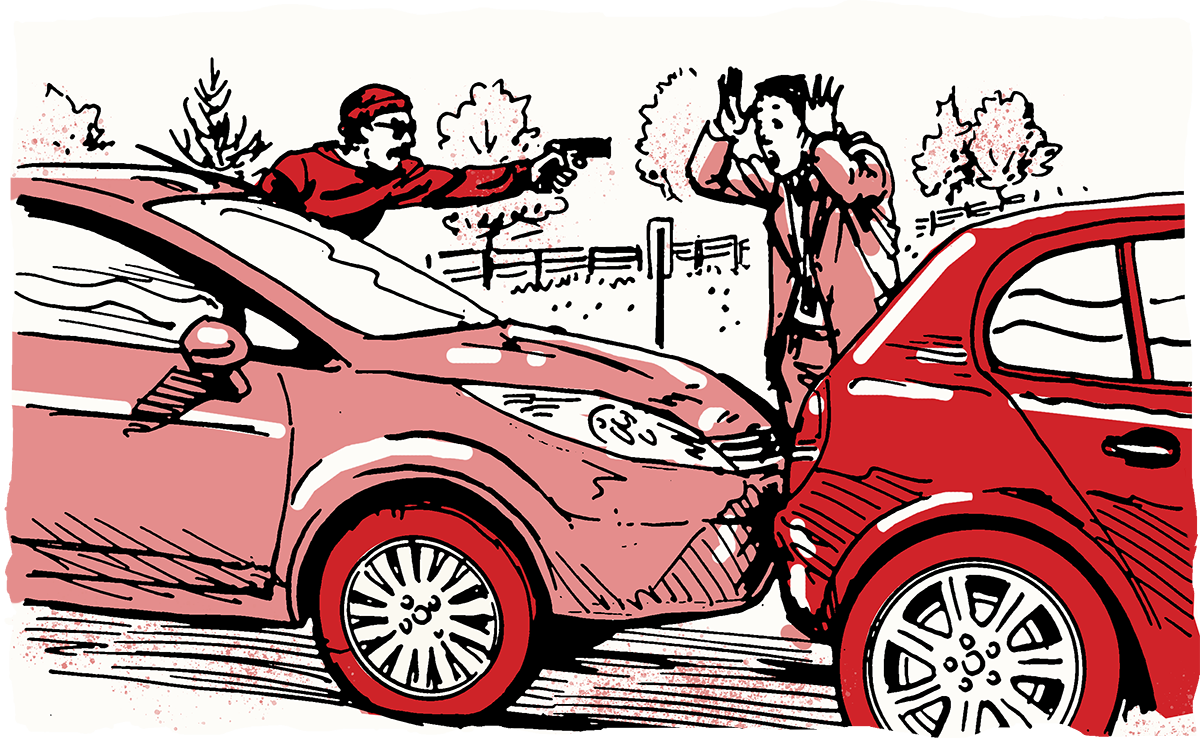
It’s your basic sunny morning in Coral Springs where one Paul Brite is showered, shaved, and just finished running his Lexus through the neighborhood car wash. All seems absolutely hunky-dory until he is engaged in intense conversation by Mssrs. Reese and Sikes, one of whom holds a handgun to Brite’s attentive head.

A short time later, having covered about a mile, Reese turns onto a quiet side street and stops, apparently voicing some concern to his cousin that they may have screwed up mightily and locked their victim in the trunk with a cellular phone.

They agree to open the trunk and investigate Brite’s communications potential. Reese makes the move while Sikes resumes his station wagon navigator spot.

It seems that, no, they didn’t lock Brite in with a carphone, but the briar patch they threw him into happened to be where he keeps a loaded revolver and an equally stuffed semi-auto pistol, which he now holds, one in each hand, as he exits the trunk like a jack-in-the-box.

Two-Gun Paul bursts out of the trunk, loudly ordering “Brains” Reese to the ground, punctuating his commands with a few shots fired in the air. This definitely gets attention throughout the neighborhood.

Reese, no rocket scientist, greets this edict by reaching for his pocket. Brite reluctantly but resolutely pops a cap in Reese’s abdomen, which, indeed, convinces him to get on the ground.

“Stay still! Stay still!” Brite shouts, “Somebody get the police!” Reese, mortally wounded, stays very still.

And then The Little Rascals arrive. A flock of residential ragamuffins starts circling the still-energized Brite and recumbent Reese on their bicycles. Enter Jim Haire, on the run.

Waving his arms and shouting at the TV-trained kids, Haire bravely tried to convey the message that this was not a video game, boys and girls, and real bullets may re-commence flying momentarily.

Meantime, “Wheels” Sikes fires up the geriatric wagon, puts the pedal to the metal, and tries to play Lawnmower Man on both Brite and Haire.

Brite, dancing around so as not to place the street urchins in the line of fire, responds with another fusillade of hot lead, ventilating the Vista Cruiser but missing Sikes, who then decides to exit rapidly stage right, weaving through the flying circus of bicycles.

As the credits roll, we find the kiddies miraculously okay, Reese declared dead at North Broward Medical Center, Sikes taken into custody a short distance away, Haire wondering how he ever got into this melee and Paul Brite, a law-abiding citizen, miraculously not charged with violating the rights of his carjacking kidnappers.

Brite and Haire take justified bows. Sikes takes the rap for theft, kidnapping, and felony murder — for participating in a felon.

Mark Moritz hung up his satirical spurs last issue to a collective sigh of relief from America’s gunwriters whom he had lampooned in “Friendly Fire” for two long, painful years. The 10 Ring is written by Commander Gilmore, a retired San Diego police officer who bases his humor, like Mark did, on actual occurrences. All the incidents described by the Commander are true.