Grandmother strapped to wheelchair was forced to watch grave being dug before ex killed her: cops
By
Olivia LandA Missouri man with an alleged history of domestic abuse is accused of strapping his ex into a wheelchair and forcing her to watch him and his new girlfriend dig her grave before killing her, investigators said.
Tony Charboneau, 36, was charged with the murder of his former girlfriend, Amy Hogue, 43, and other crimes related to her death after she vanished on June 20, Washington County Prosecuting Attorney John Jones announced last week.
Charboneau supposedly got into an argument with Hogue, which led to him punching and stomping on her as she was leaving his home on the day she went missing, according to the probable cause arrest affidavit.
Amy Hogue, 43, was murdered on June 20, 2024.GoFundMeTony Charboneau (left) had been accused of abusing Amy Hogue (right) at least twice in the past before allegedly killing her.Facebook / Tony Charboneau
Charboneau and his current girlfriend, Brandi Luffy, then allegedly forced Hogue into a manual wheelchair and tied her arms and feet using ratchet straps, police said.
Luffy, 40, and Charboneau left Hogue strapped in the wheelchair while they gathered “shovels, tarps, pickax [sic], and a firearm,” cops said.
With the items and Hogue in the back of Charboneau’s car, the couple then allegedly drove from Charboneau’s home in Sullivan to a wooded area.
Once the pair found an isolated spot, Hogue was forced to watch while Charboneau dug a shallow grave, authorities said.
Charboneau then allegedly took Hogue out of the wheelchair and shot and killed her.
He “spent the rest of the day burying [sic] her in the grave, covering her with large rocks and tree limbs,” the affidavit said.
Luffy supposedly stayed with the car and served as a lookout for any passersby.
After leaving Hogue’s body in the makeshift grave, Charboneau and Luffy then burned the ratchet straps and tarp.
Charboneau, 36, was arrested after police found Hogue’s purse.
They also disposed of the victim’s purse in a river in nearby Jefferson County, police said.
Hogue — who had three children unrelated to Charboneau — was reported missing by her family around the time of the attack.
She appeared to have been trying to leave Charnoneau’s residence when she was attacked, Washington County Sheriff Zach Jacobsen told the St. Louis Post-Dispatch.
“She was just ready to leave the residence, and that’s when the brutal assault took place,” he explained.
Hogue’s purse was found by authorities in mid-July, which was when “we realized she was probably dead,” Jacobsen added.
Charboneau was immediately a suspect due to his history of allegedly abusing Hogue — including a May 2023 incident when he supposedly hit her so hard from behind that she passed out, Jacobsen said.
Another case from October 2023 was also pending at the time of Hogue’s disappearance, Law & Crime reported.
Brandi Luffy admitted to police that she and Charboneau killed Hogue and buried her body.
After police found Hogue’s purse, they requested an arrest warrant based on the May 2023 incident and took Charboneau into custody on suspicion of murder.
Despite having their prime suspect in custody, the investigation initially struggled to gain ground due to the limitations of the rural area, Jacobsen told the Post-Dispatch.
“We are trying to piece this together with no cell service, so it’s hard to ping phones,” Jacobsen said.
“So it’s old school police work, knocking on doors, interviewing everybody that we encounter, executing search warrants. They are literally boots on the ground. No technology in God’s country. And with no cell service, you’re not leaving a digital footprint.”
On Aug. 2, Luffy admitted to helping Charboneau kill Hogue and dispose of her remains, according to the probable cause affidavit.
Amy Hogue vanished just a few days after the birth of her first grandson.Facebook / Corbin Crider
Investigators dug up Hogue’s remains, which were “partially decomposed with an obvious bullet wound” to the head, the document added.
In addition to first-degree murder, Charboneau was charged with domestic assault, kidnapping, abandonment of a corpse, tampering with physical evidence, and conspiracy to commit kidnapping, prosecutors said.
Luffy was charged with second-degree murder, first-degree kidnapping, abandonment of a corpse, tampering with physical evidence, and conspiracy to commit kidnapping.
Both remain behind bars on $1 million cash-only bond.
“That makes it even worse, the fact that she finally got enough and she was ready to leave and get away from this situation, and she was killed for it.”
The isolated area made it even harder for Hogue and other domestic violence victims to seek help, he added.
“There’s hardly any cell service here. So if you do need help, it’s pretty hard to get help. There’s a lot of things that could have changed in this situation,” he said.
Washington County Prosecuting Attorney John I. Jones IV said in a statement that his office would “not rest” until the suspects were brought to justice.
Hogue was remembered by her family as a loving mother and brand-new grandmother.
Hogue vanished just four days after her first grandson was born, her daughter-in-law wrote on the family’s GoFundMe page.
Because her son and his family live in Louisiana, Hogue never got to meet the baby before she was killed, the grieving relative added.
“She was a mother and my best friend. She did not deserve this,” Hogue’s son, Corbin Crider, wrote in a Facebook tribute.
“There are truly monsters in this world we live in,” he added.
The Illinois sheriff’s deputy who gunned down Sonya Massey in her home last month is now listed as suspended on a statewide registry of officers who have been fired, forced to resign or had their law enforcement licenses revoked due to misconduct.
The suspension of former Sangamon County Sheriff’s Deputy Sean Grayson’s law enforcement certificate came only after he was fired and charged with murder.
On July 6, Grayson responded to a report of a prowler at Massey’s home. Bodycam footage from another deputy showed Massey saying she rebuked Grayson, and the former deputy threatening the 36-year-old woman. The encounter ended with Grayson shooting Massey in the head and failing to render aid.
After being discharged from the Army for serious misconduct and a history of driving under the influence, Grayson was employed since 2020 by six Illinois law enforcement agencies – at three of them, as a part-time officer, employment records show.
Grayson is part of what law enforcement officials and experts call America’s legion of “wandering officers” who drift from police department to police department – sometimes even after having been fired, forced to resign or convicted of a crime.
“The shooting again underscores the critical need for police agencies to thoroughly vet potential hires,” the International Association of Chiefs of Police said in a statement Tuesday. “The pattern and nature of frequent job changes by a police officer should raise flags about their suitability for the policing profession.”
The professional association of prominent police leaders called Massey’s death “a devastating and avoidable tragedy.”
The absence of an exhaustive, national database for tracking and weeding out rogue cops – along with a lack of coordination among the more than 18,000 law enforcement agencies in the country – has allowed officers like Grayson to get hired without their checkered histories sounding an alarm, according to policing officials and experts.
“There’s no question that … officers getting rehired after they’ve been let go under whatever circumstances is a huge problem and appears to be responsible for a grossly disproportionate number of tragic incidents,” said Christy Lopez, a former deputy chief in the special litigation section of the civil rights division at the Justice Department during the Obama administration.
In addition, Lopez said, part-time law enforcement positions – like those Grayson held – tend not to attract the best candidates or get the most training.
“It’s never a good sign when a police department is hiring officers on a part-time basis,” said Lopez, a Georgetown University law professor.
A police misconduct registry funded by US Justice Department, and known as the National Decertification Index (NDI), already lists nearly 55,000 officers who had their law enforcement certificate or license revoked because of misconduct. But its coverage is spotty, according to policing officials and experts: Not every US police agency submits data to the registry or checks it before making hiring decisions. The names in the database are not public. And Grayson had never been decertified.
“That certification index on its own is not enough,” Lopez said. “It wouldn’t have caught Sean Grayson. It’s not going to catch a lot of your problem officers.”
Military discharge should have been ‘red flag’
Grayson, 30, was indicted by a grand jury on three counts of first-degree murder and one count each of aggravated battery with a firearm and official misconduct. He has pleaded not guilty and was denied pretrial release, according to court records.
Grayson’s attorney Daniel Fultz declined comment on Saturday.
Sangamon County Sheriff Jack Campbell fired Grayson after the shooting, saying in a statement: “Sonya Massey lost her life due to an unjustifiable and reckless decision by former Deputy Sean Grayson.”
“Grayson had other options available that he should have used. His actions were inexcusable and do not reflect the values or training of our office.”
Campbell, in a separate statement, said no law enforcement agencies reported problems with Grayson before he was hired in Sangamon County, though previous employers had commented he “needed more training.” Grayson received 16 weeks of academy training after being hired, according to Campbell.
“This is not unusual for deputies with Grayson’s experience, and is standard procedure for Sangamon County deputies,” Campbell’s statement said. Grayson’s personnel file included “references from people I know well,” said the sheriff, adding those “insights are invaluable in making informed hiring decisions.”
Grayson was discharged from the US Army in 2016 due to “misconduct (serious offense),” according to a Department of Defense document included in Grayson’s personnel file during his time at the Kincaid Police Department in Illinois. The personnel file was obtained by CNN affiliate KSHB.
Sean Grayson, a deputy with the Sangamon County Sheriff’s Office, faces multiple charges in the shooting death of Sonya Massey. – Sangamon County Jail/WISC
“A red flag would be his military” discharge, said Brian Grisham, deputy director of the nonprofit International Association of Directors of Law Enforcement Standards and Training and chair of the National Decertification Index. “That’s a potential disqualifier in most states.”
The DOD document said Grayson was separated from the Army under a general discharge after he served as a private first class at Fort Riley in Kansas. The alleged misconduct was not disclosed.
Army spokesperson Bryce Dubee, in response to a CNN request for more detail, wrote: “Sean P. Grayson was a 91B (Wheeled Vehicle Mechanic) in the Regular Army from May 2014 to February 2016. He had no deployments and left the Army in the rank of private first class.”
Grayson was charged with two DUI misdemeanor offenses in Illinois’ Macoupin County – one in 2015 and the other in 2016, court records show. The website of the Illinois Law Enforcement Training and Standards Board, which sets professional standards for law enforcement and correctional officers, does not list driving under the influence as a “decertifiable misdemeanor.”
The first incident occurred in August 2015. Grayson’s vehicle was impounded after he was charged with driving under the influence. He pleaded guilty and paid more than $1,320 in fines, according to court records.
In July 2016, Grayson was charged with another DUI. Again, he pleaded guilty and paid more than $2,400 in fines, court records show.
Grayson acknowledged the DUI charges when he applied to be an officer at Auburn Police Department in Illinois in 2021. He worked there from July 2021 to May 2022. CNN’s review of Grayson’s records there did not reveal any major problems or disciplinary issues.
In May 2022, Grayson started working at the Logan County Sheriff’s Office in Illinois, records show. He wrote the sheriff a brief letter detailing his “terrible decision to drink and drive.”
Grayson’s letter also said he lost his driving privileges for one year after pleading guilty to his second DUI, in 2016.
A background check was performed prior to Grayson’s hiring in Sangamon County, Campbell said. Prior DUI convictions “are not disqualifying criteria for a deputy,” Campbell said.
‘We can’t have you in our uniform’
Grayson worked at six Illinois law enforcement agencies over a four-year period.
He started working part time with Pawnee police in August 2020, followed by the Kincaid and Virden police departments. Then he started working full time with Auburn police, the Logan County Sheriff’s Office, and finally the Sangamon County Sheriff’s Office in May 2023.
His employment records from the Auburn Police Department indicated why Grayson said he left previous positions: In some cases, he wanted to work full time but could only get part-time hours. In another, he said he didn’t want to move.
Grayson was on the Kincaid police force for only three months before he was let go “because he refused to live within a 10-mile radius,” KSHB reported.
“The decertification index originally was created to keep problem officers from moving from state to state but the reality is they move from agency to agency,” Grisham said.
“I do think there have been rogue officers that have gone all over the place and inadequate background checks let them continue on with potential bad acts in other jurisdictions.”
Grayson did not appear to have disciplinary issues as an Auburn officer but records from the Logan County Sheriff’s Office recommended he take “high stress decision making classes.” The records said Grayson failed to slow down after his boss called off a vehicle pursuit. Grayson was driving about 110 mph before striking a deer, according to the records.
A Logan County chief deputy wrote that Grayson “failed to show due caution while driving through stop intersections.” Grayson’s supervisor “terminated the pursuit” and the deputy turned off his emergency lights, the report stated. But Grayson “continued at a high rate of speed (110/55 mph zone) prior to striking the deer.”
Audio recordings that appear to coincide with Logan County’s internal review of the incident captured the chief deputy admonishing Grayson for describing it inaccurately in his report despite previous orders to check for accuracy.
“If we can’t trust what you say and what you see, we can’t have you in our uniform,” the chief deputy told Grayson.
“I’m getting goosebumps. This is extremely concerning,” the chief deputy said later. “Everybody likes you. I gotta be able to trust you. Was this a purposefully done lie?”
“No,” Grayson responded.
“Deputy Grayson acknowledged he lacks experience,” the report said. A series of recommendations included “additional traffic stop training, report writing training, high stress decision making classes, and needs to read, understand and discuss issued Logan County Sheriff’s Office Policy.”
It was not immediately clear if Grayson followed through with the recommendations. In April 2023, he resigned from the Logan County Sheriff’s Office. The next month, he joined the sheriff’s office in Sangamon County, where his encounter with Massey more than a year later resulted in murder charges.
A psychological examination before his was hired by Sangamon County said Grayson was “a suitable fit for the position” but also noted a low score on a cognitive assessment. “He knows he can move too fast at times. He needs to slow down to make good decisions,” read the report of the March 2023 examination.
On Friday, a spokesperson for the Sangamon County Sheriff’s Office said the agency did not receive a complete disciplinary report from Logan County about Grayson, including his reprimand for an inaccurate report of the traffic incident.
Campbell did not respond to CNN’s request for comment, but he told CNN affiliate WICS that “we need to take a look at” more thorough background checks of job candidates.
“We did not receive all the information from some of his previous employers that came out afterward,” the sheriff said.
The Logan County Sheriff’s Office has not responded to a request for comment.
The union representing Illinois law enforcement officers said it will not challenge Grayson’s termination. After an evaluation of the deputy’s grievance, “the union has determined that it will not be proceeding any further,” the Illinois Fraternal Order of Police Labor Council said in a statement, which expressed sympathy “for the family and loved ones of Sonya Massey.”
“If you look at it, an individual can push the envelope over and over and never get to the point of being disciplined on their license, but they’ve left a cloud everywhere they’ve been,” Grisham said.
‘There are agencies cutting corners’
Massey’s death has led to renewed calls for passage of the George Floyd Justice in Policing Act, the failed legislation targeting racial bias and use of force – including the creation of a more robust nationwide police misconduct registry.
George Floyd, the act’s namesake, was another Black person killed by police. The 46-year-old died in police custody on May 25, 2020, after Derek Chauvin, a White police officer, was filmed kneeling on Floyd’s neck and back for nearly nine minutes as Floyd pleaded for help and said he couldn’t breathe.
Chauvin was convicted of murder and manslaughter in a state trial in 2021 and sentenced to more than 22 years in prison. He later pleaded guilty in federal court of depriving Floyd of his civil rights.
Chauvin had 18 prior complaints filed against him with the Minneapolis Police Department’s Internal Affairs before his fatal encounter with Floyd, according to the police department. Another officer on the scene also had a history of complaints.
Floyd’s killing sparked a wave of protests around the world, along with a spate of legislative measures intended to address police brutality and racial bias. But the Floyd bill has languished for years amid partisan differences that are especially heightened today. At the same time, many police agencies have struggled in recent years to hire and retain quality officers given the low pay, dangerous work and a perceived lack of respect from the public.
“There are agencies cutting corners and they always have,” Grisham said. “But with the recruitment and retention issues we have today, where agencies nationwide, on average, used to receive hundreds of applications for vacancies and they get dozens now … they’re having to dig deeper into the hiring availability. So there could be a slight uptick in misconduct.”
Lopez, who led the team that investigated the Ferguson Police Department in Missouri after the 2014 killing of unarmed teenager Michael Brown, said having “potentially thousands and thousands of bad apple officers” on the streets “can wreak havoc” in communities.
“We saw in this case, for example, there were two officers on the scene. Only one of them shot Sonya Massey,” she said. “You will see that in many of these incidents. Everything’s fine. Most officers are handling it fine, but it just takes one officer to send it spiraling off into the wrong direction.”
Lopez recalled that, while investigating police in Ferguson, local officials spoke about “the muni-shuffle” where officers often sauntered “back and forth” between jobs in the 91 municipalities and 50 or so police departments in St. Louis County.
“An officer at Ferguson complained to me about accidentally hiring a really terrible officer from another agency because he wasn’t aware about the officer’s misconduct history,” she said.
“Agencies sometimes – especially when they’re under pressure to hire, hire, hire – will hire officers from other agencies and they don’t have to go through all the same training that a brand new officer would have to go through. So it’s sometimes seen as a cost efficient way to hire new officers when, in fact, it is a really dangerous way to hire new officers.”
Smaller cash-strapped agencies often end up hiring an experienced officer who may have a checkered past instead of paying to train and hire a new officer, according to Lopez and other experts.
Police brass are ‘now on notice’
In 2015, a report by President Barack Obama’s task force on 21st century policing called on the Justice Department to partner with the International Association of Directors of Law Enforcement Standards and Training to expand its decertification database to help remove the worst cops from the streets. National and standardized reporting, the report said, would ensure that “officers who have lost their certification for misconduct are not easily hired in other jurisdictions.”
“There’s no requirement that anybody, any local jurisdiction that has a Sean Grayson situation … send information to that central clearing house,” Laurie Robinson, a professor at George Mason University and co-chair of Obama’s task force, told CNN. “It’s something that has been going on as long as I’ve been around policing, which is 25 years.”
Decertification and other employment records are kept by the Peace Officers Standards and Training (POST) boards in each state, but not all boards report the information to the national registry. Only California, Massachusetts, Minnesota, Tennessee, New York, New Jersey and Texas require that records be reported to the national index, Grisham said.
“We are not a government agency. We can’t mandate usage of it,” he said, noting the registry is still “averaging over 200 new actions added monthly” and more than 1,000 new user requests per month.
“We’ve got documented cases where officers are pretending like they’ve never been in law enforcement before and applying for jobs and this system has caught them,” Grisham said.
In 2020, a Yale Law Journal study titled “The Wandering Officer” said the scope of the problem in American policing is unclear. That remains true today, according to policing experts.
“Not all those who wander are lost, but in policing, many are,” the researchers concluded.
“These officers, we have shown, are subsequently fired and subjected to ‘moral character’ complaints at elevated rates relative to both officers hired as rookies and veterans with clean professional histories. And we likely underestimate the prevalence of the phenomenon nationwide.”
The researchers found wandering officers “tend to migrate to agencies with fewer resources in communities with slightly higher proportions of residents of color.”
“Police administrators are now on notice. Even when well intentioned — as a second chance for a hard-working cop — hiring a wandering officer is risky business,” the study said. “Beyond their own misbehavior, wandering officers may undermine efforts to improve police culture, as they carry their baggage to new locales.”
CNN’s Holly Yan, Bill Kirkos, Amanda Musa, Andy Rose, Chris Boyette, Brad Parks and Dakin Andone contributed to this report.
++++++++++++++++++++++++++++++++++++++++++
One solution: require officers to carry personal malpractice insurance, similar to doctors. Bad cops won’t be able to afford insurance.
Another is that of starting up a Police ROTC like the Military ROTC programs. Maybe that would bring in some good folks into the ranks?
But the huge problem is the American people and their attitude towards Cops. I mean who in his right mind would want the job? So the standards will keep sliding down and you will see stuff like this more & more in the future.
None of the Old West characters has ever received as much publicity as the young outlaw from New Mexico that we have come to know as Billy the Kid. Over the years, numerous books have purported to tell his true life story.
A whole raft of western movies has featured him as a main character. And somewhere in the midst of all of that, Billy the Kid has taken on the persona of the good guy/bad guy that rivals England’s Robin Hood. Unfortunately, more untruths have been written about Billy the Kid than just about any other character of the Old West.
Questions about Billy the Kid and his guns and gunfights continue to be raised. For example, did he prefer a Colt Single Action Army or a DA Colt Model 1877? Was he left-handed or right-handed? How did he get the nickname of Billy the Kid? How many gunfights did he really have?
I’ve lived in close proximity to New Mexico for all of my life. I enjoy the rich history and local color of the state, and I have been a life-long student of all things having to do with Billy the Kid. Here are just some of the true facts that I’ve been able to dig up along the way.
As legend has it, Billy the Kid was born in New York, he was 21 years old when Sheriff Pat Garrett shot him to death, and he had killed 21 men during his rowdy life. I’ll get to the 21 men in just a bit, but first here’s a glimpse of Billy the Kid as he really was.
In June of 1880, in Fort Sumner, New Mexico Territory, Billy told a census taker that he had been born in Missouri and that both of his parents had also been born in Missouri.
He also told the same census taker that he was 25 years old at that time. Since then, no one has ever come up with any concrete facts to refute Billy’s simple statement. And no one has come up with a good reason why he would have been lying. The business of dying when he was 21 appears to have been based upon mere rumor and conjecture.
Popular myths also tell us that Billy’s real name was William Bonney. The facts irrefutably show that his true name was Henry McCarty. In about 1873, Henry’s mother and his stepfather, William Antrim, moved to Silver City, New Mexico.
Later, after his mother died, Billy ran away to Arizona Territory and began to go by the name of Kid Antrim. When he finally left Arizona and came back to New Mexico, he was using the name William Bonney. Although some conjecture exits, there is really no way of knowing why he used that alias. It may have been to avoid being arrested for killing Frank Cahill near Camp Grant, Arizona, in 1877.
Legend further informs us that Billy the Kid killed 21 men during his career and had sworn that Sheriff Garrett would be number 22. The known facts reveal a different picture.
Billy is known to have been in a constable’s posse when they captured and then executed three men who were believed to have been responsible for the death of Billy’s employer, J.H. Tunstall. In the same year, 1878, Billy was also in a group that rode into Lincoln, New Mexico, and ambushed a group of lawmen, killing Sheriff William Brady and George Hindman.
It is not known if Billy actually killed either man. However, as a court of law would quickly point out, he was there and undoubtedly did some shooting. It is known that Billy was present throughout the Lincoln County War when the two factions fired on each other. However, to hang a specific killing on Billy the Kid was virtually impossible, even though he was later tried and convicted of killing Sheriff Brady.
In 1880, Billy was back in Fort Sumner, and the Lincoln County War had about run its course. One evening Billy ran into a fellow named Joe Grant, who some believe had been hired by the Chisums to kill the Kid. After talking to Grant, Billy turned to leave the saloon only to hear Grant’s gun snap on a defective cartridge or an empty chamber. Billy turned and shot Grant to death.
In 1881, Billy had been captured by Garrett and was convicted of the murder of Sheriff Brady. He was placed in the Lincoln County Jail to await the day of his execution. On April 21, 1881, while Sheriff Garrett was out of town, Billy convinced Jailer J.W. Bell to escort him to the outhouse. Somehow Billy got hold of a handgun and shot Bell to death as they went back into the building that served as the county’s courthouse and jail. Billy immediately rushed up to the gunroom and grabbed a shotgun, which he used to kill Deputy Bob Olinger as Olinger rushed towards the building to see what the shooting was all about.
So, we can document four killings by Billy the Kid–Cahill, Grant, Bell, and Olinger. And due to the Kid’s involvement in the Lincoln County War, let’s credit him with a couple more killings that we’re not sure of. One historian suggests that there might even be five more killings that involved the Kid. Regardless, nine killings is a long way from the legendary 21. But it’s probably a lot closer to the truth.
Another persistent Billy the Kid legend is that he was left-handed. The source of this fable is an old photo of Billy that shows him standing with a sixgun on his left hip and a rifle in his hand. But this particular photo has never fooled gun buffs.
Glancing at the rifle, one quickly can see that the rifle’s loading gate is on the left side of the gun instead of its usual place on the right side of the receiver. This clearly shows that the photo is from an old tintype that used a reversed image, and someone simply forgot to turn it around.
According to several movies and stories, the Kid is also supposed to have favored the Colt Model 1877 double-action revolver in .41 Long Colt. Again, looking at the photo of Billy, it’s clear that he’s packing a single-action revolver–probably a Colt Single Action Army–but he may have been carrying a Colt Lightning when he was killed.
On the night of July 14, 1881, Billy walked in to Pete Maxwell’s bedroom at Maxwell’s house in Fort Sumner, New Mexico. Too late, he realized that Maxwell was not alone in the room. Unfortunately for Billy, Maxwell’s guest was Sheriff Garrett. It was the same Sheriff Garrett, in fact, who immediately fired two shots from his .44-40 ColtSingle Action Army, one of which hit the Kid in the chest and killed him almost instantly.
Some historians believe that Billy did not have a gun with him when he was shot to death. Afterwards, they suggest that Garrett, or one of his two posse men, obtained the Colt DA and put it on the floor beside Billy to avoid criticism. Regardless, they all agree that Billy was holding a butcher knife in his other hand. When the rumor got out that the Kid didn’t have a gun on him, Garrett received a good deal of criticism.
As a former lawman, I find that sort of criticism to be ludicrous. Billy had just escaped from Garrett’s jail. He had just murdered two of Garrett’s deputies. And he had presented himself in Garrett’s proximity armed with a knife. In police jargon, the Kid was “bought and paid for.” The coroner’s inquest took the same position.
Without a doubt, the legend of Billy the Kid will continue to grow. Legends, rumors, and folk tales are like that. But it’s still interesting to have a look at some of the real facts about an interesting part of our Western history. I enjoy that, and I hope you do too.
This looks like the Addams family. Faisal bin Abdulaziz is seen here on the left alongside his dad, King Abdulaziz of Saudi Arabia (seated). The big Lurch-looking dude in the sunglasses is Faisal’s brother Saud. Who would have thought one of their lives would end in assassination?
I sit here typing these words less than 48 hours after the attempted assassination of former President Donald Trump. The Left screamed long enough about how Trump was supposed to be the end of global civilization, and some unhinged nutjob finally paid attention. The headlines trumpet the FBI’s tireless efforts at finding a motive.
Another flaming Leftist shows how compassionate and dialed in to social justice she is.
How about this? President Biden and every other left-winger in the country have been tacitly begging somebody to do this for seven years now. Kathy Griffin, the legendarily unfunny failed comedienne, actually did a photoshoot holding up a facsimile of Trump’s bloody severed head. In the context of this weekend’s festivities, that has not aged well.
Opinions, Everybody’s Got One…
I’m not necessarily Donald Trump’s biggest fan. He’s always been lightyears ahead of his Left-wing competition, but the guy’s got some well-publicized character flaws. However, I didn’t vote for him because I wanted a new best friend. I voted for him because I wanted somebody to sit on America’s front porch with a big honking stick. He was great at that.
The grandfatherly geezer looks like he’d make a great fishing buddy. He wouldn’t. Qasem Soleimani was the Devil. Trump just flat-out killed him.
Trump did a superb job of making America scary again. Just ask the relatives of the esteemed Iranian ex-psychopath Qasem Soleimani. The world seems to work better when folks are a little bit afraid of Uncle Sam. We haven’t had that in a long time, and it shows.
We’re Not So Special
By the time you read this, the sordid details of the Trump assassination attempt should be starting to gel. Once everything is laid bare, I’ll no doubt write it up. Regardless, this has already been the most eventful Presidential election in my lifetime.
While things have been undeniably sordid, they were not particularly unusual when viewed through the lens of history. Human beings just suck, like a lot. We have a long and illustrious history of venting our grievances against our leaders through the barrel of a gun. Back in 1975 in Saudi Arabia, vengeance actually came from a relative.
The Players In An Earlier Assassination
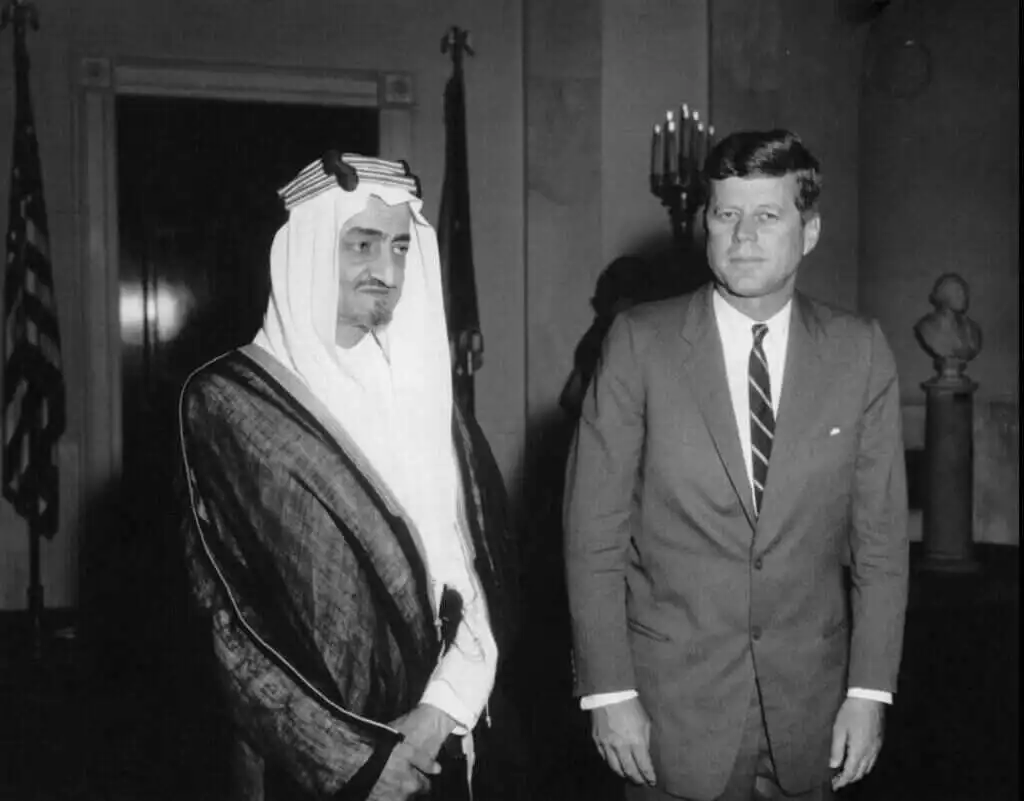
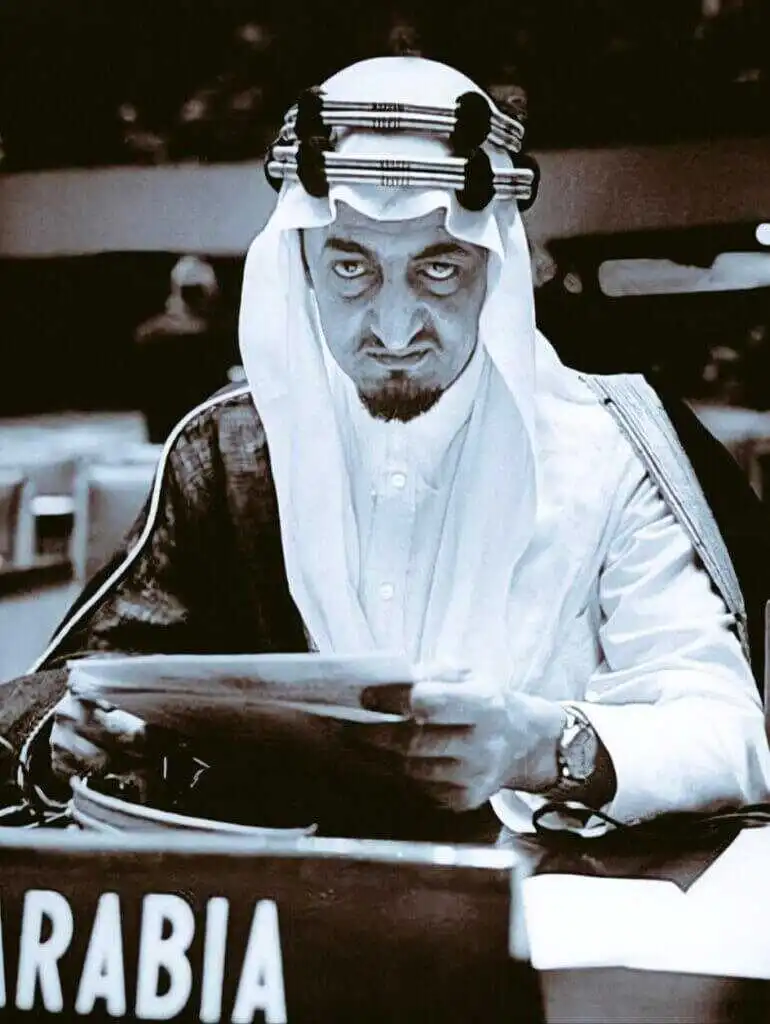
The Saudis take their kings pretty seriously. This dapper lad is King Faisal bin Abdulaziz.
I don’t pretend to understand the machinations of the Royal House of Saud. A true monarchy in the traditional sense, these potentates each have scads of kids with multiple women. The royal family tree is more like some kind of vast interdigitated creeping vine.
The Saudis are not the sort to throw convivial family picnics where cordial blood relationships are cemented. Deep-fried chicken and baked beans slathered in bacon grease are frowned upon thereabouts. Toss in a trillion or so petrodollars that literally sprang up out of the ground and you have the chemical formula for family friction.
The Assassination Mark
King Faisal was a proper player on the world stage.
King Faisal had a convoluted upbringing. Now stick with me here, this is complicated. I’m doing the best I can.
Faisal bin Abdulaziz al Saud was born in 1906 in Riyadh. His dad was Abdulaziz bin Abdulrahman, the Emir of Nejd. His mom was Tarfa bint Abdullah Al Sheikh. Tarfa descended from the religious leader Muhammad bin Abdul Wahhab. Faisal had an older sister who married a cousin. Faisal’s mom died when the boy was six months old, so he was raised by his maternal grandparents.
The Regent Comes of Age
Everyone knew that young Faisal was destined for great things.
Faisal engaged in an intensive study of Islamic Law and the Quran that culminated at age nine. Like any proper royal, he was well-versed in horsemanship, military affairs, and politics. It was clear that the boy was being groomed for something special.
Faisal was the first member of the Saudi royal family to see England. From there he tasted France as well, all in an official capacity. In 1926 at the age of twenty, Faisal was granted the title Viceroy of Hejaz, whatever that actually means. Going forward he served as a jet-setting diplomat, acting as the face of the government around both the region and the world.
Faisal started out as a statesman before eventually being crowned King of Saudi Arabia in 1964. He assumed the throne soon after slavery was abolished across the kingdom. The final tranche of 1,682 freedmen earned their owners a flat $2,000 apiece paid by the government in 1962. The Saudis were still holding slaves a mere four years before I was born. Wow.
Everything Changes
King Faisal helmed his kingdom through some fairly rocky times.
In the early part of the 20th century, Saudi royalty was a pretty big deal, but not many folks outside the region much cared. Then the entire planet went to war, and somebody thought to check the desert sands of the Middle East for oil. The first serious oil field, appropriately titled, “Prosperity Well,” was drilled in 1938. A bazillion dollars later, Saudi Arabia was on the map.
It’s tough to be the nouveaux rich. A redneck with a lot of money is still just a well-scrubbed redneck. While Faisal rose to the occasion and generally behaved himself, not everyone in his massive extended family felt constrained to do so.
The Origins of a Proper Villain
I think this is Musa’id bin Abdulaziz, father of the assassin Faisal. If it’s not, then please forgive me. They have really confusing names.
Faisal was a pretty popular name in Saudi Arabia. The younger Faisal bin Musa’id bin Abdulaziz (not to be confused with King Faisal we discussed previously) was born in 1944 to Prince Musa’id bin Abdulaziz. This particular Faisal’s dad was the son of the founder of Saudi Arabia and half-brother to fully half a dozen Saudi kings. However, Little Faisal’s old man did not wear his newfound wealth well.
Once Saudi Arabia discovered oil, the royal family became filthy rich overnight. Most of the male kids were sent off to the US and Europe to absorb a little culture. Prince Musa’id bin Abdulaziz spent time in both London and Paris.
Paris was a pretty harsh temptation for a guy raised amidst the puritanical mores of the desolate Saudi desert. Apparently, Musa’id got a bit carried away while there.
While in Paris, the young man was, “Caught in an inappropriate manner.” I can only imagine the details, but I’d bet they involved some hot French femmes. Musa’id soon found himself remanded back home to face Daddy’s wrath. King Abdulaziz subsequently confined the wayward youth to his room, or, in this case to the sprawling palace, until he seemed to have learned his lesson.
Musa’id eventually found time to court a fellow royal named Watfa. They produced a son named Faisal bin Musa’id born in Riyadh in 1940. Musa’id eventually grew weary of Watfa and divorced her, but not before fathering a bunch of kids in addition to Faisal.
Seeds of Discontent
Behold the face of the villain who, gasp, brought television to the Saudi kingdom.
In 1965, there was a sweeping violent demonstration in Riyadh protesting the introduction of television in the Saudi kingdom. That seems pretty silly in retrospect. The crux of the protestors’ grief was that depictions of the human form were offensive. Not meaning to seem flippant, but I’ve no idea how they ever managed the thorny problem of mirrors or reflections in still water. When the dust settled on the TV brouhaha, Faisal’s brother Khaled was dead.
King Faisal was behind the infamous television debacle along with a variety of other secular reforms. All of this was designed to drag Saudi Arabia out of the Iron Age and into the modern era. Along the way, however, the king made some determined enemies. His nephew, the one also named Faisal, was counted among them.
Nobody is sure what actually got the younger upstart Faisal energized. These are hot-blooded people. It often doesn’t take a whole lot to get killed over there.
Prince Faisal’s brother Khaled was purportedly killed resisting arrest at his home. The details were fuzzy, and there never was a proper investigation. Regardless, around that time, young Faisal hatched a plan.
The Assassination In Action
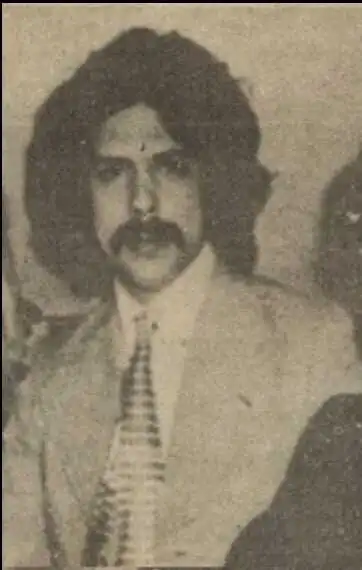
This is Prince Faisal at age 31 in all of his 1970s awesomeness. Nobody knows why he shot his uncle, the king of Saudi Arabia, in the head. Perhaps he needed money for a haircut.
On 25 March 1975, King Faisal was hosting a reception for visiting dignitaries, something called a majlis in that culture. Among the delegation was lurking the younger Prince Faisal. The king recognized his nephew in the crowd and called him forward. As the younger Faisal approached, the king lowered his head to allow him to kiss it, which was a thing they did. I’ve had uncles–that sounds pretty icky to me.
The younger Faisal suddenly produced a compact .38-caliber revolver from underneath his flowing Arabian robes. The first round struck his uncle in the chin. The second entered through his ear. A third went wide.
The assassin then tossed the gun away as the king slumped to the floor. A nearby bodyguard responded immediately, smacking the prince vigorously with a sheathed sword. The timely intervention by the Saudi oil minister, Ahmed Zaki Yamani, was the only thing that kept the security detail from beating the man to death.
The Aftermath Of The Assassination
he Saudis did not take kindly to Prince Faisal whacking their king.
The king was rushed to the nearby hospital where heroic measures were expended in an effort at saving his life. This included an open heart massage and extensive blood transfusions. However, the damage was done.
Throughout it all, Prince Faisal remained calm. As a result, the official narrative in the immediate aftermath was that he had lost his mind. “Deranged” was the term used in the press releases. However, a distinguished panel of Saudi physicians soon established that he appeared to have been in his right mind at the time of the assassination.
10,000 spectators watched Prince Faisal meet his maker here in Deere Square. The place is unofficially called Chop Chop Square for obvious reasons. They actually displayed the demised Prince’s head on a pole for a time.
The wheels of justice turn swiftly in the Kingdom of Saud. Less than three months after the assassination, a Sharia court found Faisal guilty of the king’s murder. Mere hours after the verdict was read, Saudi officials led Prince Faisal to the Deera Square in Riyadh. There they summarily chopped his head off with a single stroke from a gold-handled sword.
Whatever practical motivations Faisal had for shooting his uncle in the head the prince took with him to the grave. Some thought he was angry because his royal allowance was inadequate ($200k per annum in today’s money).
Another theory was that the king had unfairly restricted him to Saudi Arabia where he could not feed his drug and alcohol habit. Others held that this was somehow revenge for the death of his brother Khaled. Who knows? They lopped the guy’s head off before anybody got the details straight.
Ruminations
I blew this up myself. Donald Trump really could not have come much closer to getting his head blown off.
Trump survived his recent assassination attempt by a literal whisker. The iconography to spawn from the event—Trump shaking his bloody fist with the American flag in the background—was quite literally perfect. It was so perfect that it looked scripted. Naturally, before the dust settled Internet conspiracy theorists were suggesting exactly that.
Sixteen hours after being shot in the ear, Donald Trump purportedly played a round of golf. After draining a 20-foot putt he reportedly joked to his buddies, “Unlike the shooter, I don’t miss.” Stuff like that is red meat to guys like me.
The memes began flowing before the Secret Service got Trump down off the podium. They get better by the day.
You wouldn’t think that an overweight old guy with orange hair might ever successfully play the part of a brass-balled Chuck Norris-grade testosterone donor, yet here we are. Donald Trump has now been under fire for real, and on international TV no less. After his attempted assassination, he neither cowered nor ran. He spontaneously shook his fist and spit lightning out of his eyes, not knowing in the immediate aftermath how badly he was hurt or whether or not the threat had been neutralized. For all of his bombast and baggage, Trump’s performance in Pennsylvania was undeniably freaking awesome.
Epilogue
A final word on Corey Comperatore, the great American who was killed during the attempted assassination of President Trump. Corey threw himself across his family when the shooting started and subsequently traded his life to save theirs. We talk about heroes in this space most every week. There was a purity to Comperatore’s sacrifice that seems to eclipse them all. I will have myself had a successful life if I can be half the husband and father that man was.