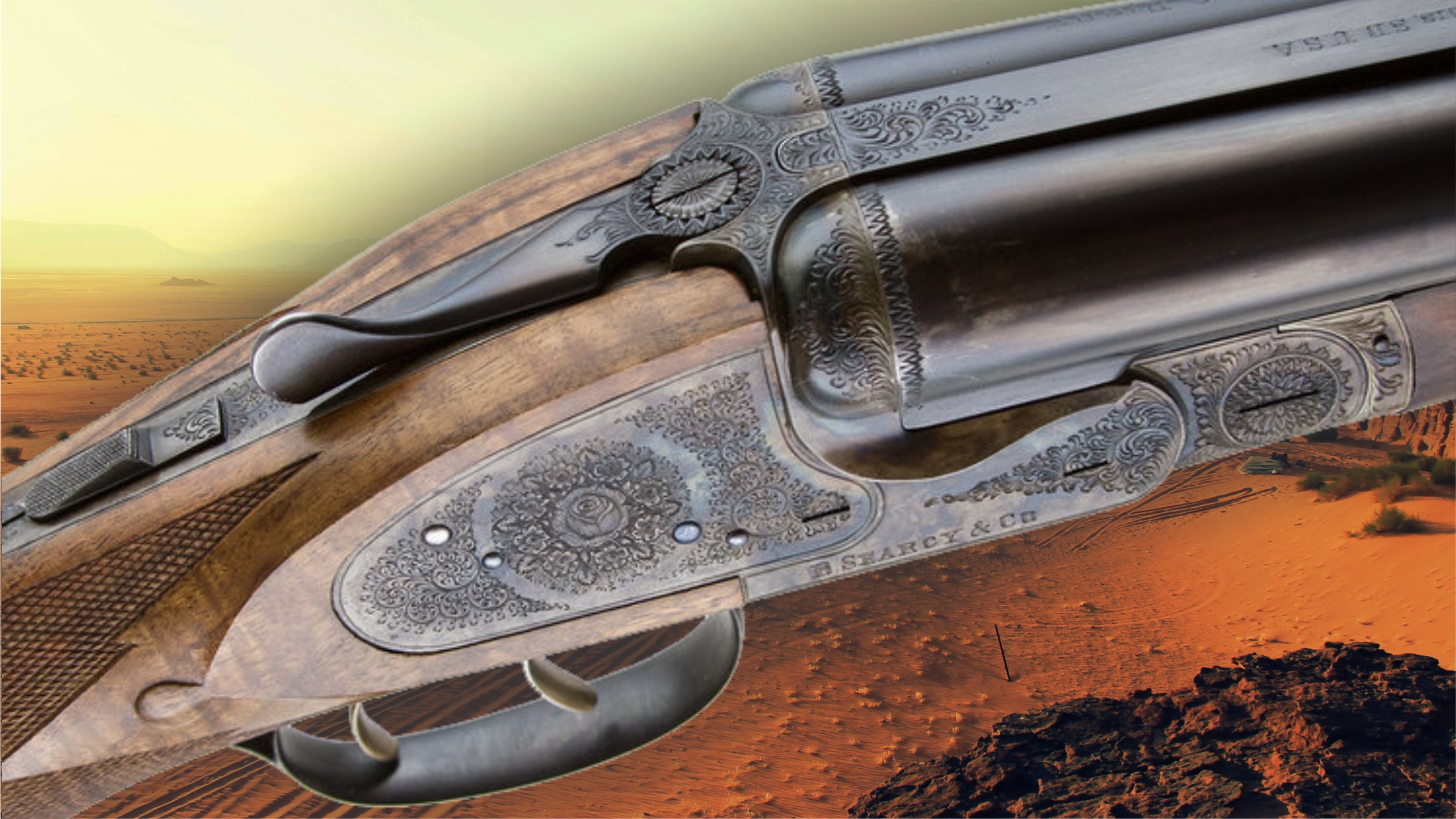
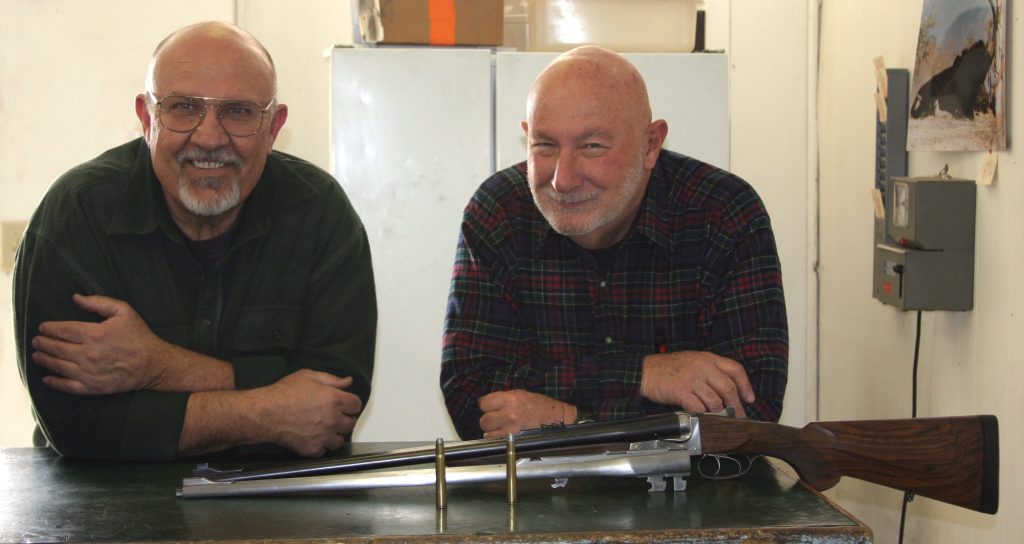
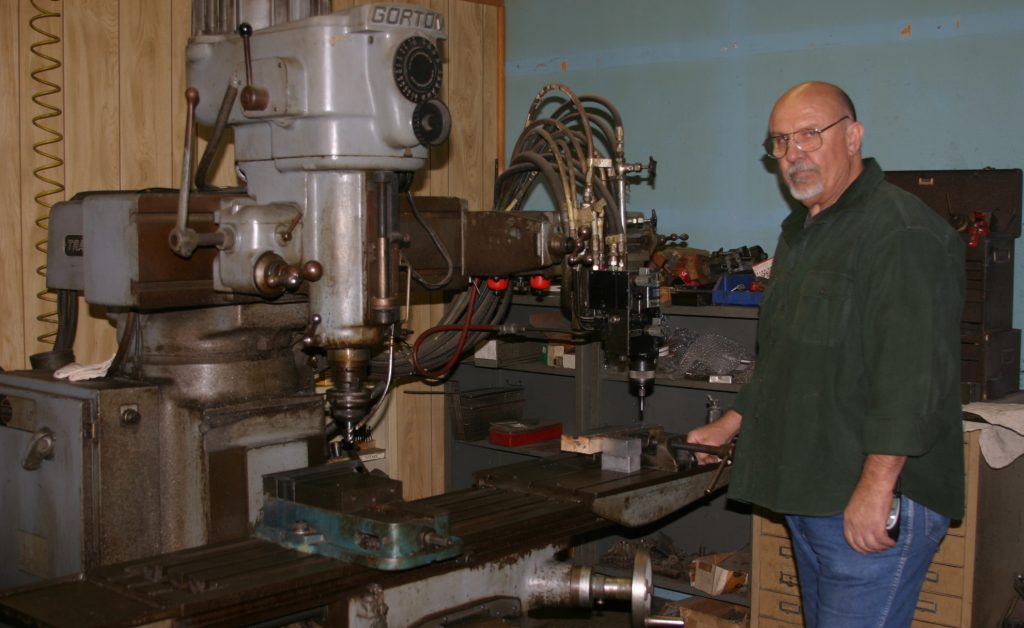
B. Searcy Company is headquartered in the small desert community of Boron, California, about 100 miles northeast of Los Angeles. Located in an old WWII Quonset building, just across the road from Edward’s Air Force Base, Searcy is ready to kit-up and custom fit a double enthusiast with a custom double barreled rifle in any caliber they are willing to pay for.
Butch offers six grades of double rifles: four boxlock designs and two sidelock designs. The Field Grade is the entry-level boxlock, which as of January 1, 2010, will have a base price of $11,500.
The next step up is the Classic boxlock at $18,000, then the Deluxe boxlock at $21,500, and the Sidelock at $22,000. Finally, there are the ultimate stoppers; a .577 Nitro Express double that you can have as a Boxlock or a Sidelock for $22,000 and $35,000 respectively (larger calibers available).
All these rifles have multiple options and feature choices, the details of which can be best viewed at Searcy’s website.
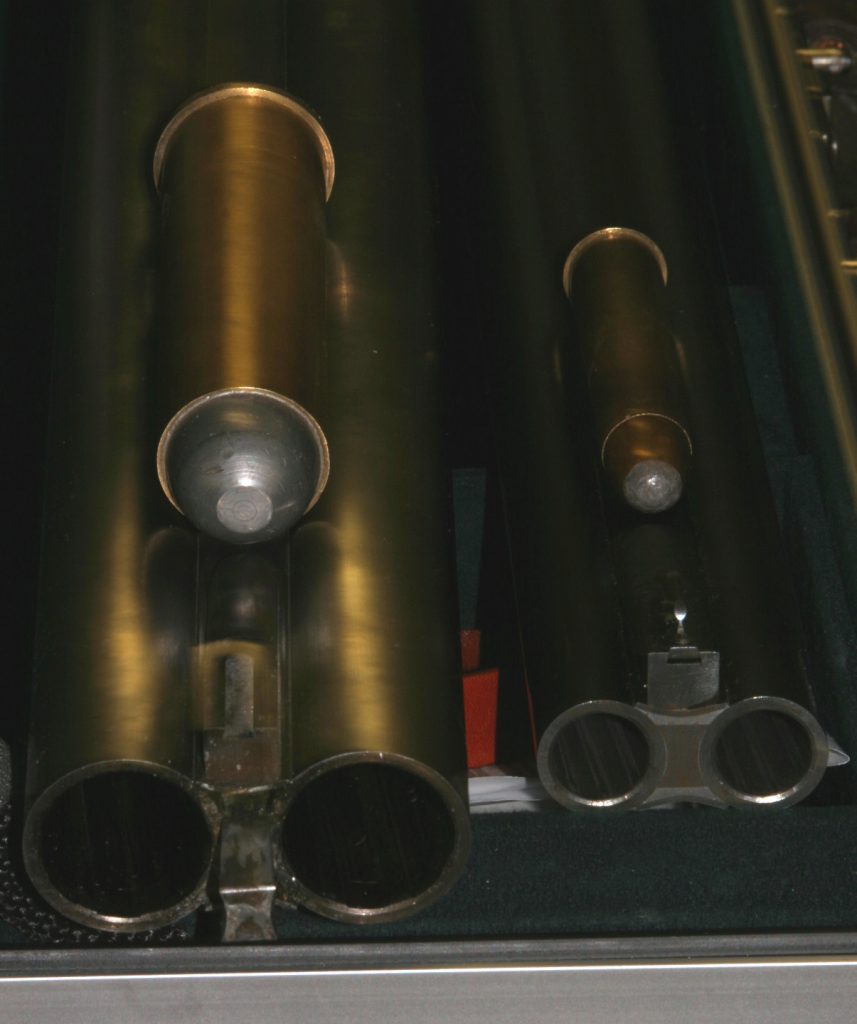
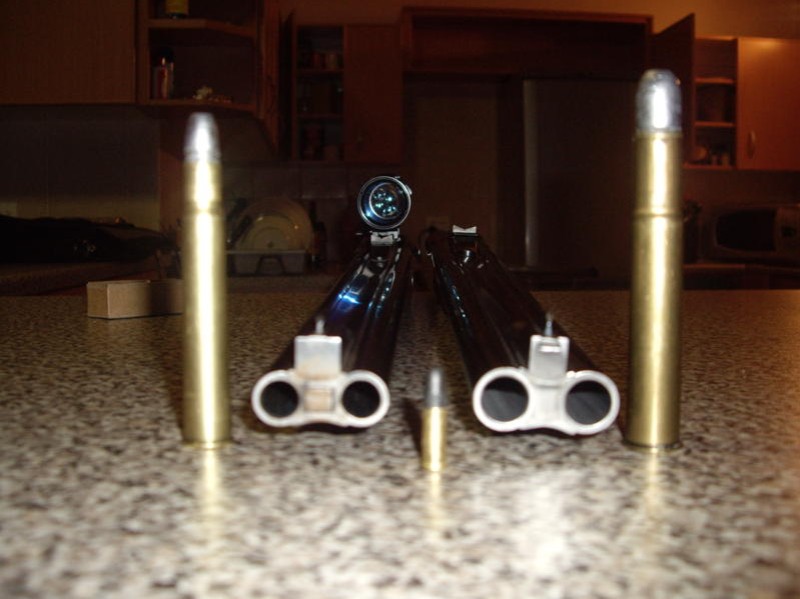
Standard calibers offered are the .375 H&H Flanged Magnum, the .450-400-3” (.411”), the .450 3¼” Nitro Express, the .450 Nitro Express, the .470 Nitro Express, the .500 Nitro Express (3” and 3 ¼”), the .577 Nitro Express, the .600 Nitro Express, the .700 Nitro Express, and the incredible 4-Bore. The 4-Bore double rifle starts at $85,000. Other calibers are available on request for an additional charge.
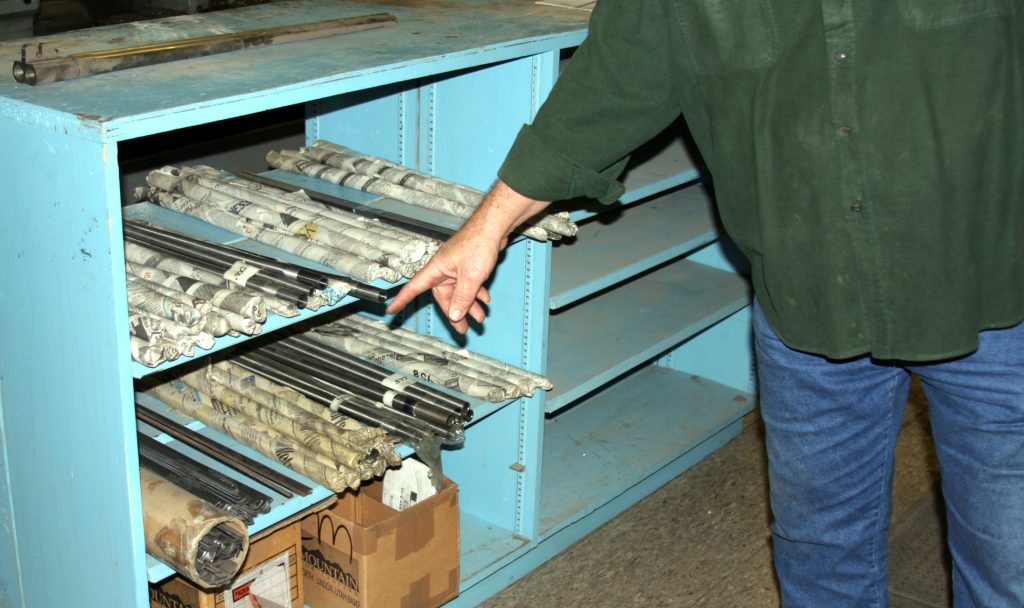
Only the Searcy double rifle can be described as an ‘All American’. Although other available doubles may be assembled in the United States, they are built on German or Italian actions. The Searcy rifles are machined right here in the States and have Anson and Deeley style receivers, with double Purdey bolting and top extension, and are CNC machined out of 4130 chromoly and 416 stainless steel bar stock into boxlock or sidelock configurations.
Searcy’s doubles come fitted with monobloc constructed PAC-NOR barrels, and are topped with iron sights from New England Custom Guns. A second set of double rifle barrels in a different caliber will set you back a cool $10,000, while a set of 12 gauge shotgun barrels can be fitted for a mere $4500.
Final barrel options include the choice of installing ejectors ($1000) or extractors (including rimless).
All Searcy rifles come standard with a quarter-rib, which includes one fixed rear sight and a caterpillar front sight. However, rear sights with folding leafs are available options at the rate of: one fixed + one folding leaf $400, one fixed sight + two folding leafs $500, and one fixed sight + three folding leafs $600. The final iron sight option is a front ‘night sight’ for $225.
Although not usually recommended for the larger ‘stopping’ caliber rifles, scope mounts are a popular option for the large medium bore caliber rifles, where a good quality riflescope can be very useful for long distance shots at plains game. Two styles of mounts are available; the renowned Talley rings and bases for $595 or the European style claw mounts for $2900.
To most traditionalists, red dot sights on double rifles are inconceivable. However, to a growing number of riflemen, they are a welcome addition to their sighting options. If you have vision issues that make the use of regular iron sights difficult, a lightweight red dot style sight is just the ticket for close shots where quick handling and accurate bullet placement is more important than traditional good looks.
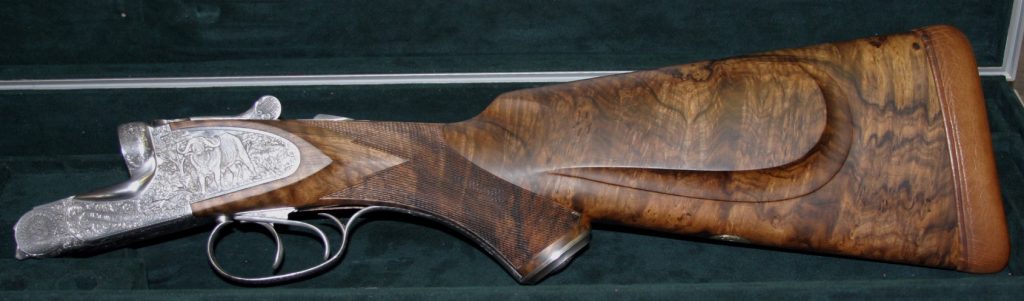
Any level of engraving and fancy metal work can be had on request. The depth of a shooter’s pocketbook is the only limit to the amount of decoration and embellishment available. To give the engravers additional working area, $1000 false side plates are offered for the boxlock rifles.
All of these doubles come with custom-fitted stocks in various grades of English walnut from Jim Preslick.
Besides fitting (length, bend or drop, and cast-on or cast-off), other options on stocks include; long tangs ($1500), long trigger guard ($800), trap grip cap ($550), stock medallion ($400), teardrop medallion ($500), and leather covered recoil pad ($400. And finally, for $1500, all rifles can be had in an oak & leather display case.
When you consider the entry-level Holland & Holland .470 double rifle at almost $80,000 and a Westley Richards sidelock at just over $96,000, a Searcy sidelock at $22,000 certainly does look like one of the best deals on this planet for a custom double.
However, there will soon be a new higher dollar rifle rolling out from Searcy’s shop. Built on the expensive to manufacture, but robust action that John Rigby and Thomas Bissell patented in 1879; the Sidelock Bissell Rising Third Bite action’s initial price will be $40,000.
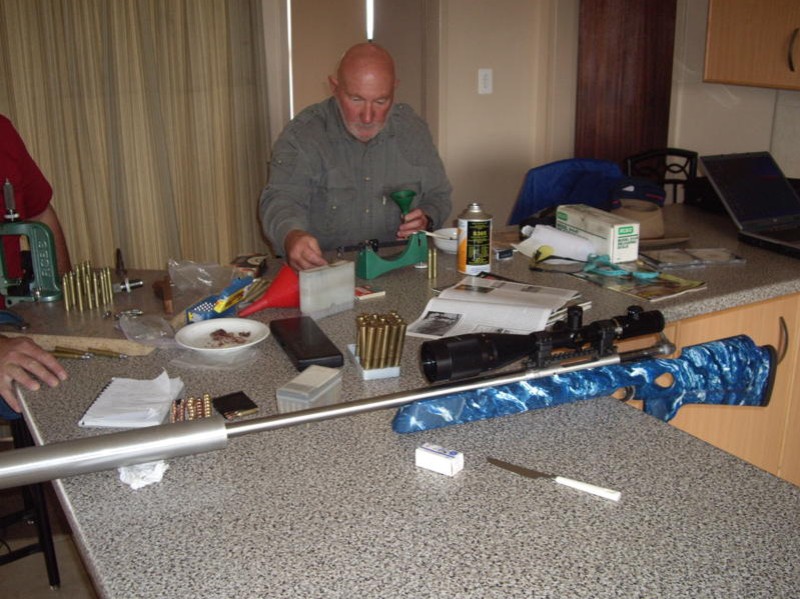
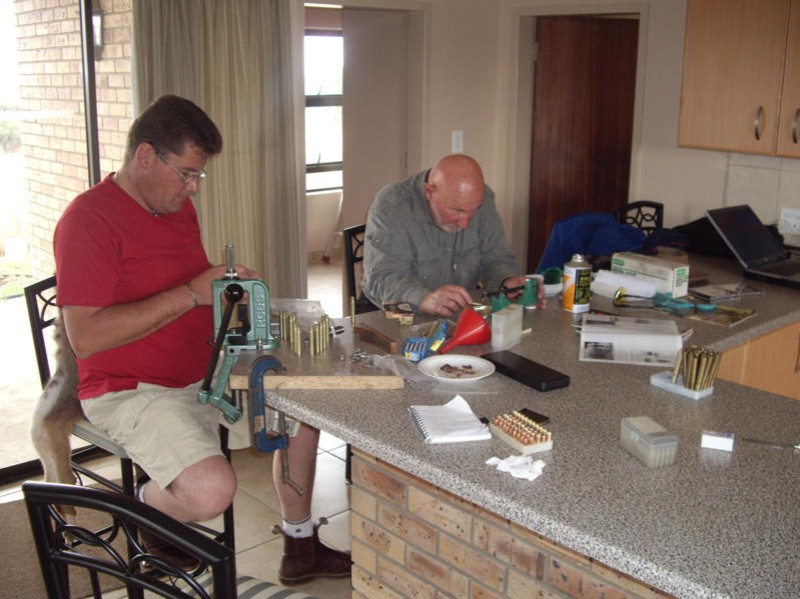
A couple of years ago, I had the good fortune to make my own pilgrimage to Butch’s legendary Quonset hut on 20 Mule Team Road in the company of .470 reloading guru, Leo Grizzaffi. As an old friend and customer of the B. Searcy Company, Leo had been asked by Butch to help him wring out a (then) new project, which consisted of fitting an extra set of 375 Flanged barrels to his well worn and well broken-in .470 Nitro Express.
This barrel combination has proven popular for many safari hunters who already own a double rifle in one of the heavy ‘stopping calibers’, i.e., a .45 caliber or larger. However, there are always other factors to consider when deciding on the caliber of your add-on barrel set. At that time, .375 Flanged brass was easier to find than .450/400 brass, but with Hornady’s recently introduced 3-inch and 3½-inch .450/400 brass now in production, getting .450/400 brass may no longer be a problem.
When I questioned Butch and Leo on the desirability of a .375 Flanged barrels vs. a set of barrels in .450/400, we got into the other issues which had led them into choosing the .375 Flanged. The deciding factors were; there is a large variety (and ample supply) of .375 caliber bullets available for handloading, and with its longer range and somewhat flatter trajectory, the .375 Flanged is more versatile in the field than the .450/400.
However, the final reason for going with the .375 Flanged was that the .450/400 simply was not a big enough step DOWN in power. With its significant reduction in recoil, the average person will find the .375 Flanged not only more pleasant to shoot, but more manageable than the .450/400. Even for someone like Leo, who has put over 5000 rounds through his .470, and over 2000 rounds through the .375 Flanged barrels, tailoring the amount of recoil down to more manageable levels was a major point. On a practical level, if the rifle is pleasant to shoot, more practice is done on a regular basis. That way, the shooter develops familiarity with the weapon, muscle memory is enhanced, and when it comes time for serious use, fear of recoil becomes a non-issue, with handling and reloading the rifle become second nature.
On the other end of the spectrum are the extreme big bore double rifles that Searcy makes, which start with the .577 Nitro Express and include the .600 Nitro Express, the .700 Nitro Express, and the massive 4-Bore. If you are not completely insensitive to recoil, the best thing you can do is stay on the porch, because recoil is where these big dogs run.
As a bonus for traditionalists, Butch also offers the dynamic duo of stopping calibers: the .450 Nitro Express and the .450 3¼” Nitro Express. These cartridges give the handloader the ability to use relatively cheap, and easily available .458 bullets to make premium ‘full-house’ hunting rounds, as well as use cast lead .458 bullets for ‘reduced load’ practice rounds.
It is not a problem if you own a modern rifle like a Searcy, but if you are going to handload full-house loads for any of the old original .450 Nitro Expresses, you should have a good gunsmith check the rifles out thoroughly, and remember to keep the pressures low. Inexpensive bullets and low recoil practice are an attractive combination of features in favor of choosing these calibers.
The 450 Nitro Express calibers were the first of their kind, and when it came out, it was viewed by many experts as the best in its class for hunting the most dangerous game. Guess what? It still is.
Having a custom double rifle maker like Searcy working right here in our back yard is a boon to the American customers who are in the market for a brand new double, and want something better than an ‘out of the box’ factory rifle.
Not only are his prices competitive with the factory doubles from Germany and France, but you are dealing with an honest US gun maker who is not only easily available, but willing to back up his product, and in most cases offer quicker delivery times.
If price is no option, and sending your rifle back to England for repairs is not inconvenient, then it is hard to argue with anyone who wants to buy a Holland and Holland or Westley Richard. However, in my opinion there is a lot of value for the first time double rifle owner to get into the game at roughly 25% of the big name English rifle makers entry level prices for doubles.
But at the end of the day, it is up to the individual buyer to weigh their own needs and opinions against what is available on the market today, and to decide for themselves what rifle brand best fits their budget, investment strategy, and expectations.
We are lucky to have the choice of a wide range of styles in double rifle design and cosmetics available in the in the 21st Century marketplace.
It wasn’t that long age when all the firearms pundits were convinced the double rifle had seen its last safari, but in a relatively short period of time, and despite the recent downturn in the US economy, double rifle sales have rebounded from their ‘death’ in the 1960’s, and looking at their sales in the long term, we are in the strongest market for double rifles since World War II.
Leo Grizzaffi is a lifelong hunter and veteran of many African safaris. Author and reloading expert, his specialty is the care and feeding of big bore double rifles, however he also dabbles with the little calibers. Leo resides in California, where being a lawyer and judge in the City of Los Angeles sometimes interferes with his busy hunting and reloading schedule.
A gun-rights coalition has reached a settlement resolving the remaining claims against the Los Angeles County Sheriff’s Department over its concealed carry permitting system. iStock-2196791813
The Second Amendment Foundation and its partners have reached a settlement resolving the remaining claims against the Los Angeles County Sheriff’s Department in a major lawsuit challenging California’s obstruction of the right to bear arms.
The settlement is not yet final. It remains subject to approval by the Los Angeles County Claims Board, according to the Second Amendment Foundation.
“This settlement marks meaningful progress, but our work to secure full recognition of the right to carry—including true interstate reciprocity—continues,” SAF Executive Director Adam Kraut said.
The separate lawsuit filed by the U.S. Department of Justice against LASD over its carry-permit delays is not resolved by this settlement and remains pending.
A Settlement Built on Real Concessions
SAF, the California Rifle and Pistol Association, Gun Owners of America, Gun Owners Foundation, Gun Owners of California, and several individual plaintiffs filed the lawsuit in December 2023.
The case challenged a collection of barriers California officials erected around the exercise of a fundamental constitutional right. Those included LASD’s extreme processing delays, California’s refusal to provide most nonresidents with a way to obtain a carry permit, high licensing costs, psychological examinations, and other subjective requirements.
The settlement resolves the remaining claims against LASD after the department represented that it had brought its processing times into compliance with the state’s 120-day deadline. That is a major change from the delays that helped trigger the litigation.
When the plaintiffs sought a preliminary injunction, some applicants had been waiting approximately 18 months for LASD to act. The federal court concluded that such delays went too far and granted relief to two individual plaintiffs.
The court also ordered California to allow qualified nonresidents who belonged to the plaintiff organizations to apply for California carry permits. California lawmakers later enacted AB 1078, creating a broader nonresident licensing process and largely codifying that part of the court’s injunction.
The case therefore ends with more than a negotiated dismissal. It produced changes that directly affect Californians and visitors seeking to lawfully carry a firearm for self-defense.
The Right Does Not Belong to the Bureaucracy
California officials have spent years treating the Second Amendment as though it were a privilege they may ration through delays, costs, and paperwork.
The Second Amendment protects the right of “the people” to keep and bear arms. It contains no California-residency exception and no bureaucratic-convenience exception. It does not permit a sheriff to suspend the right for a year or longer because the department is understaffed or has failed to build a functional application system.
A permit does not create the right. The right existed before the application was submitted, before the sheriff reviewed it, and before California wrote its licensing statutes.
Hostile jurisdictions learned an obvious lesson after the Supreme Court’s 2022 decision in New York State Rifle & Pistol Association v. Bruen. Once officials could no longer demand that applicants prove some special “good cause” to carry a handgun, they looked for other ways to slow the process.
A licensing system may say “shall issue” on paper while operating as “shall wait” in practice.
Years-long delays accomplish much the same thing as an outright denial. Citizens who need to defend themselves today receive no protection from a permit that might arrive two years from now.
The Supreme Court anticipated that problem in Bruen, warning that supposedly objective licensing systems could still face constitutional challenges when lengthy processing times or exorbitant fees prevent ordinary citizens from exercising the right to public carry.
That warning was not an invitation for California officials to test exactly how long they could make people wait.
More Than One Lawsuit Pressured LASD
The settlement also comes amid federal scrutiny of LASD’s carry-licensing operation.
The Justice Department sued the department in September 2025, accusing it of using administrative delay to deny citizens their Second Amendment rights. According to the federal complaint, LASD received 3,982 new carry applications between January 2024 and March 2025 but issued only two permits from that group during the period examined.
Applicants allegedly waited an average of 281 days merely for LASD to begin processing their applications. Some reportedly waited as long as 1,030 days—nearly three years.
LASD attributed its backlog to staffing shortages and its transition from a paper-based process to an online system. Those explanations may describe how the failure occurred, but they do not excuse it. The government cannot avoid its constitutional obligations by pointing to problems of its own making.
The DOJ case remains active despite SAF’s settlement, leaving additional pressure on the department to maintain its claimed compliance.
Progress, Not Full Reciprocity
The settlement should not be mistaken for California recognizing carry permits issued by other states.
Nonresidents now have a path to apply for a California permit, but they must still submit to California’s licensing process. That is a meaningful improvement over excluding nonresidents altogether, but it falls short of true interstate reciprocity.
Likewise, forcing LASD to act within 120 days is better than allowing applications to collect dust for 18 months or three years. Four months, however, should not be treated as the constitutional gold standard for exercising an enumerated right.
This settlement is nevertheless a significant conclusion to a lawsuit that forced one of the country’s most anti-gun jurisdictions to change its conduct. LASD says it is finally processing applications within the law. California now allows qualified nonresidents to apply. Other statutory barriers were changed while the case was pending.
Those results were not offered voluntarily. Gun owners had to sue for them.
SAF and its partners say they will continue monitoring the situation to ensure LASD does not return to its old practices. That vigilance is necessary because California’s respect for the Second Amendment has too often lasted only as long as an injunction, settlement, or federal lawsuit remained hanging over the state.
The Constitution says the right to keep and bear arms “shall not be infringed.” After years of delay and litigation, Los Angeles County is finally being made to act like those words mean something.
On a recent afternoon in Los Angeles, the veteran Hollywood agent Rob Kenneally was unwinding with his usual post-lunch ritual: firing a few rounds from his 9-millimeter pistol with a couple of friends.
“It’s a meditative thing for me,” said Kenneally, who at an earlier point in his movie industry career also worked part-time as a Los Angeles County reserve sheriff’s deputy. “It’s just always been a way to sort of blow the cobwebs out after a day of work.”
He was sitting in a dark leather armchair at the Range L.A., a members-only gun club on the border of the well-heeled Brentwood neighborhood that has become a gathering place for gun enthusiasts, industry professionals, actors and artists. Kenneally, 67, says he often runs into people he works with, and several of his clients take lessons from one of the club’s shooting instructors.
“It seems to attract, for some reason, people who are in the entertainment business,” he said.
That’s no doubt partly because of its location. Then there’s the atmosphere at the Range, whose interior resembles that of Equinox, the high-end gym chain that also happens to be its neighbor. Not far from where Kenneally sat were a touch-screen coffee machine, a Bevi flavored water dispenser, a shuffleboard table, vintage cowboy-themed posters and artwork mounted on exposed brick walls.
Image
A community space at the Range L.A. that is outfitted with leather seating and coffee-table books.
Image
Eric, left, and Peter Diamond, the brothers who opened the business a couple years ago with an eye toward an upscale clientele. “We cater to a specific demographic economically,” Eric Diamond said.
Similar high-end gun clubs (some of them members-only) have started popping up across the country, including Centennial Gun Club in the Denver metropolitan area, Frisco Gun Club outside Dallas, XCAL outside Washington, D.C., and the Blackwood Club, which is under construction in Bergen County, N.J. And the Range has two more locations in the works, in the South Bay and the San Fernando Valley.
The upscale grocery store Erewhon has catered events at the Range L.A.; Philip Goglia, the Kardashians’ celebrity nutritionist, is a member who drops by often; and it’s not uncommon to see a G-Wagon parked out front. Hollywood agents leave the firing line to take calls or business lunches in the club’s lounges.
“We have 20-something-year-olds, and we have 80-year-olds here; we have men and women,” said Peter Diamond, who opened the Range two years ago with Eric Diamond, his older brother. “We have people from all different political persuasions, and we have people from all different industries.”
He explained that they maintained a strict policy for the TVs in the facility: No news. No political shows.
Members of the Range — about 600, according to the owners — pay $3,700 to $5,400 annually. Guests have access to a pro shop of sorts, with an in-house armorer, private lessons and the use of some 40 firearms, many of which hang on the wall behind the check-in counter.
The brothers estimate that about 85 percent of their members are gun owners already, but the rentals allow them to try new firearms, come by with little notice or bring a guest. (California law prohibits open-carry in counties with at least 200,000 residents, but residents of less populated counties can apply for an open-carry license.)
On this afternoon, a young member and two friends were checking out rentals. They had guns at home, but had decided to swing by for a little range time.
Image
Michelle Blanchard, a former pro wrestler who is a member at the Range.
Image
Rob Kenneally, a veteran Hollywood agent, likes to stop by the Range on his downtime to blow off steam.
Image
Phoebe Solomon, another member of the Range.
The walls, filled with soundproofing and ballistic Kevlar, keep the noise to a minimum, but there’s still a steady drumbeat of gunshots heard in the lobby, which features lounge chairs, sofas and a low table scattered with coffee-table books like “Small Arms Visual Encyclopedia.”
The brothers had a particular vision in mind, hoping to distinguish their establishment from the handful of ranges in the Los Angeles area: “I tell people we’re a club that just happens to be a shooting range,” said Peter Diamond, an avuncular 60-year-old sitting behind a large wooden desk decorated with miniature black powder cannons.
As general manager, though, he’s not often found there: He prefers to walk the floor like a restaurant owner, checking in on guests and shaking hands with regulars. He usually carries a small Yugoslavian Zastava pistol from the 1970s in his pocket. (He has a concealed carry permit, as do many of his members. California allows residents to carry firearms with one of these permits.)
He and Eric Diamond, 65, who still maintains his day job as the chief operating officer of a business management firm, decided to open the Range after decades of shooting elsewhere around Los Angeles.
Both grew up shooting with their father and at rifle programs at summer camps in Pennsylvania and upstate New York, but the hobby was always a bit more of a passion for Peter, who also collected antique firearms. After a few career changes — including 15 years in the film industry as an assistant director and a production manager — Peter said he “finally grew up and figured out what I wanted to do with my life.”
There is some precedent for the upscale gun club, said David Yamane, the author of “Gun Curious: A Liberal Professor’s Surprising Journey Inside America’s Gun Culture,” drawing a comparison to exclusive 19th-century establishments like the Boone and Crockett Club, which Theodore Roosevelt helped found. Often centered around hunting, “it wasn’t just a matter of could you afford to join, but were you the right kind of person,” Yamane said.
The modern “guntry clubs,” as he calls them, are a sign that as American gun culture has evolved, it has become increasingly like other modern consumer cultures, said Yamane, who is a sociology professor at Wake Forest University. “I think a lot of these guntry clubs do remind me of what late-stage consumer capitalism looks like.”
“A $6,000 pistol is not necessarily 10 times better than a $600 pistol,” he added, “so you’re buying it for something other than just functionality.”
The Diamond brothers are conscious that the Range’s members often “belong to a dining club, a golf club, a tennis club, and maybe to a smoking club,” said Eric Diamond, citing Brentwood Country Club and Riviera Country Club nearby. “We cater to a specific demographic economically.”
The staff of eight covers desk check-in, basic weapons maintenance, training and range safety, but when hiring, Peter said he and his brother “didn’t want a bunch of gun guys.”
Image
Bob Wu, an instructor at the Range L.A., giving a lesson with a training firearm.
Image
The club’s interior feels not dissimilar to that of its neighbor, the high-end gym chain Equinox, with its touch-screen coffee machine and a Bevi flavored water dispenser.
“We’re a hospitality-based business,” he said. “I want hotel front desk staff. You can teach someone the mechanics of the gun industry. I can’t teach someone to be personable and nice and polite.”
At the Range, Jonathan Gomez, the in-house armorer, was in the middle of installing a member’s upgraded trigger kit for a Sig Sauer P365 handgun. At first, he said, he was surprised by the types of guns members were shooting. It’s “definitely a different type of gun owner,” said Gomez, 27, a bespectacled man with a handful of tattoos going down his left arm. By “different” he clarified that he meant the guns are more expensive here than at a typical range.
Many members shoot Staccato pistols, he said, which in California can cost up to $6,000 depending on the model. Another popular, more boutique firearm brand is the local Taran Tactical Innovations, which has grown in popularity since helping to provide John Wick’s arsenal. A Taran Tactical Innovations Pit Viper pistol can retail for nearly $9,000. The Range has a variety of Staccato and Taran Tactical guns for rent.
“It’s kind of like watches or shoes,” Gomez continued. “People have their collections. They have nicer stuff they can show off here.”
Some may relish their expensive weaponry, but the Range members are drawn there for a number of reasons.
Image
Wu displayed a firearm from the “John Wick” movie franchise.
Image
Leonard Konopelski, a retired professor, in a firing bay.
Jodi Ladge, a physician assistant in neurosurgery, said she had originally bought a gun for self-protection about two years ago, worrying about “the way things have been in L.A.,” but is now entering competitive shooting matches.
Ladge, wearing her gun belt, which carries her spare magazines, holster, shooting gloves and first-aid kit, has been a member of the Range for more than a year. She was with two friends she had made at the club, and they were discussing lunch plans.
“I never thought I would be doing this ever,” she said. But it is an ideal way for her to decompress, especially with the Range ambience. “All you can think of when you’re shooting is shooting,” she said.
Like Kenneally, the Hollywood agent, Leonard Konopelski, a graphic designer wearing arty royal-blue glasses, said he found shooting therapeutic. “I’m coming here to try to relax my body,” said Konopelski, 83.
He shoots at the Range about three days a week and views his pistol as a precise instrument, like a Leica camera. Mr. Konopelski, who first became interested in shooting as a boy in Poland and later during his mandatory military training, said he liked that the Range was somewhere he could easily drop into as a member.
By midafternoon, the concrete floor of the 16 shooting lanes was thick with spent shell casings. In a period of calm, the range was declared “cold,” and an employee picked up the brass with a small cylindrical cart reminiscent of those used on tennis courts. In the lounge, a member took a Zoom call, while another grabbed a snack. Soon, the brass was piling up again.
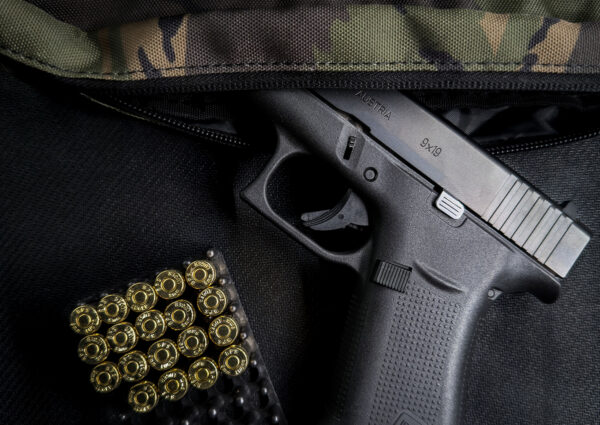
In a bold and unprecedented move, Harmeet Dhillon, Assistant Attorney General for the Civil Rights Division, sent Governor Gavin Newsom and Attorney General Rob Bonta a formal notice of suit to drop the Glock ban or get sued.
She gave the state until 5 p.m. EST on June 30 to say whether they will negotiate. If California does not respond, the United States may file its complaint without further notice. Excellent news.
The Second Amendment continues to rack up victories in the courts. From the Supreme Court’s landmark rulings in Hemani and Wolford to a federal judge blocking enforcement of Virginia’s unconstitutional “assault weapon” ban while the case proceeds, the momentum is clearly on the side of constitutional rights.
 B. Searcy Company is headquartered in the small desert community of Boron, California, about 100 miles northeast of Los Angeles. Located in an old WWII Quonset building, just across the road from Edward’s Air Force Base, Searcy is ready to kit-up and custom fit a double enthusiast with a custom double barreled rifle in any caliber they are willing to pay for.
 But at the end of the day, it is up to the individual buyer to weigh their own needs and opinions against what is available on the market today, and to decide for themselves what rifle brand best fits their budget, investment strategy, and expectations.