Trenton Democrats desperately want to pass something, anything. They just are not sure what. So far, their approach has been to throw everything at the wall and see what sticks. Make no mistake, Gov. Phil Murphy loaded them up with plenty of bad ideas, and now, they seem destined to intertwine their political fortunes (or misfortunes) with his.
As previously reported, your NRA testified against a package of gun bills on Wednesday in the Assembly Judiciary Committee. With less than 24-hours-notice, we were back to do the same in the Senate Law & Public Safety Committee on Thursday. The late schedule change was accompanied by late amendments and bill drafts, which in some cases, were being handed out as lawmakers were still shuffling into the room. In addition, two sitting members of the Senate Judiciary Committee were late scratches, with Sen. Joe Cryan and Senate President Nicholas Scutari sitting in to fill the vacancies. Perhaps all of their members do not want to be forced to vote for unworkable and unconstitutional gun control bills? We will never know what the motivation was for the swap-out. Regular committee members were not the only thing scratched for the day. Several bills did not make the cut in the Senate Committee either, including bills to require mandatory storage and a bill to raise the age for long gun purchases from 18 to 20. This does not mean they are dead; far from it. Ultimately, there is a lot to be sorted out. Some bills have passed one chamber but not the other. Some haven’t passed either chamber and yet others have been amended. Remember, for a bill to go to the Governor, it has to pass both chambers in identical form.
At the end of the week, every single Democrat on both panels voted in favor of the gun bills, moving them to the Appropriations Committee before sending them to the floor in both chambers. As Thursday’s hearing was happening, the Supreme Court released its Bruen decision which seemed to inject another layer of uncertainty into the plans of Trenton gun grabbers. New Jersey, of course, was one of six states specifically mentioned in that decision. The decision is going to force the state to make some changes with how it has been issuing (or not issuing) concealed carry permits.
There are Senate and Assembly sessions scheduled for next Thursday and Friday. They are trying to finish up the budget, and these are the days when this package of bills could potentially move before a brief summer recess.
They don’t know what they are doing in Trenton, but we do! We are opposing any and all gun control in the Garden State. New Jersey has some of the toughest gun laws in the country and enough is enough. Please continue your sustained pressure and contact your Assembly member and Senator today!
Last week the Los Angeles County Board of Supervisors voted to direct the county attorneys to determine if the county can legally pass additional infringements upon Second Amendment rights, including age discrimination, additional background checks, court orders to suspend Second Amendment rights without due process, and banning arbitrary categories of firearms. The Board approved a similar proposal in 2018, and decided to not take action at that time. The new measure calls for county attorneys to provide an updated legal review of the 2018 report and recommendations on “how to improve the efficacy of existing gun control and safety measures.”
————————————————————————————-Gee does the phrase CYA come to mind for anybody else out there? Grumpy
The Supreme Court’s decision in Bruen on Thursday didn’t simply shoot down New York’s onerous “good-cause requirement” in the gun permit application process. It set up similar laws in other states for likely revocation.
One of those states is California, where they have their own requirement that applicants must show a “good cause” or “special need” before a carry permit is issued. State Attorney General Rob Bonta sent out a letter on Friday to law enforcement and government attorneys noting the change and saying that the state’s current “may issue” regime should be able to be converted to a “shall issue” regime with few modifications. So that’s good news, right?
Not so fast. As Eugene Volokh points out at Reason, Bonta pivoted from signaling compliance with the new SCOTUS ruling to identifying another way to deny permits to people with no criminal record. He claims that the ruling will not impact the existing requirement for applicants to be able to demonstrate that they are “of good moral character.” On that basis, the state can start snooping around to see if you hold any unauthorized opinions or are prone to demonstrate “hatred and racism.” And how would they know that? Well, by going through your social media accounts, of course.
Other jurisdictions list the personal characteristics one reasonably expects of candidates for a public-carry license who do not pose a danger to themselves or others. The Riverside County Sheriff’s Department’s policy, for example, currently provides as follows: “Legal judgments of good moral character can include consideration of honesty, trustworthiness, diligence, reliability, respect for the law, integrity, candor, discretion, observance of fiduciary duty, respect for the rights of others, absence of hatred and racism, fiscal stability, profession-specific criteria such as pledging to honor the constitution and uphold the law, and the absence of criminal conviction.” [Emphasis added.]
As a starting point for purposes of investigating an applicant’s moral character, many issuing authorities require personal references and/or reference letters. Investigators may personally interview applicants and use the opportunity to gain further insight into the applicant’s character. And they may search publicly-available information, including social media accounts, in assessing the applicant’s character. [Emphasis added.]
As Volokh goes on to explain, this entire scheme appears to be completely unconstitutional. It’s a violation of the First Amendment before we even begin to examine how it would hold up under the Second Amendment. The government is not allowed to restrict your actions or suspend your Constitutional rights based on the viewpoints you express, even if they are unpopular with the current regime.
This is an even more critical distinction to make in an era where the government is busy redefining words and appointing people to decide what is or isn’t “misinformation.” If you spoke out against the violence on display during the BLM riots, you’ve already been defined as a “racist.” Based on that alone, the California AG could determine that you are of insufficiently good moral character to be approved for a permit. If you applauded the overturning of Roe v Wade you are no doubt already on a list of “haters” of some sort so you can be similarly denied.
Volokh correctly describes the words “hatred” and “racism” as being “potentially extraordinarily broad and vague terms.” Of course they are. And that’s more true than ever in the current climate as I described above.
The problem is that this clause has been on the books in California for years. Nobody really noticed it, however, because the state government was too busy denying carry permits to people because of their supposed lack of a “good cause.” They didn’t need to bother checking into your “good moral character” because most people never made it that far in the process. And the ruling in Bruen didn’t address this point.
What that means is that if California simply begins denying carry permit applications in massive numbers based on this clause, a challenge will have to be brought against them and the whole process will have to start all over again. The Bruen case had been grinding its way through the courts since 2018 before finally reaching a conclusion last week. If someone has to start over from scratch in California, the state will be able to continue flaunting the Constitutional rights of citizens for years to come.
Rep. Andy Biggs (R-AZ) spoke with Breitbart News about the current push for gun control in the House and warned us to be ready to see gun controllers “go after ammunition and ammunition manufacturers.”
Biggs noted a number of gun controls have been passed by the Democrat-controlled House, and even though those controls have not passed the Senate he believes the House will pass even more.
He explained, “I expect some additional gun control legislation to come out of the House. I expect there will be an attempt to do an ‘assault weapons’ ban, I think they’re going to continue to try to eliminate liability protections on gun manufacturers, and I think they’re also going to go after ammunition and ammunition manufacturers.”
Biggs then talked about gun control in the Senate, where he said, “When gun control reared its head again, after Uvalde, I expected 20 members of Senate Republicans to cave and give things like red flag laws and whatever else that the House pushing. But I’m sure what, if anything, is going to get out now, because it has taken so long and they have no language.”
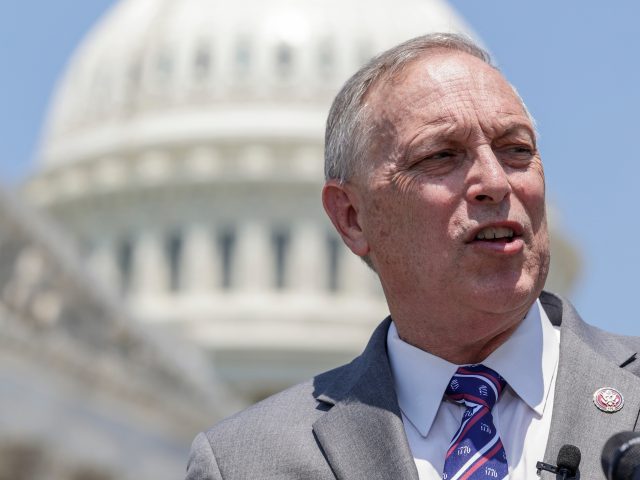
Rep. Andy Biggs, R-Ariz., speaks during the Due Process Denied news conference on the January 6 trials and DC jail treatment outside the Capitol on Wednesday, June 15, 2022. Rep. Louie Gohmert, R-Texas, is in the background. (Bill Clark/CQ-Roll Call, Inc via Getty Images)
He added, “When you have no language to look at, they start working off what is called a framework, and that leads to infighting where some Senators want certain things but not other things, and that indicates a lack a consensus.”
And Biggs stressed the more time passes the less chance there is consensus will occur.
He also noted the way Sen. John Cornyn (R-TX) was booed on Friday at the Texas GOP Convention, and said, “That response indicates that gun owners are not real pleased with the Republicans that are undermining the Second Amendment.”
Biggs emphasized the launch of a watchdog group, the Arizona Second Amendment Coalition, a coalition of people he has pulled together to stay on top of the fight for Second Amendment rights.
Members of the coalition include elected officials, student advocates, individuals who work in the firearm industry, and members of pro-2A groups like the DC Project, among others.
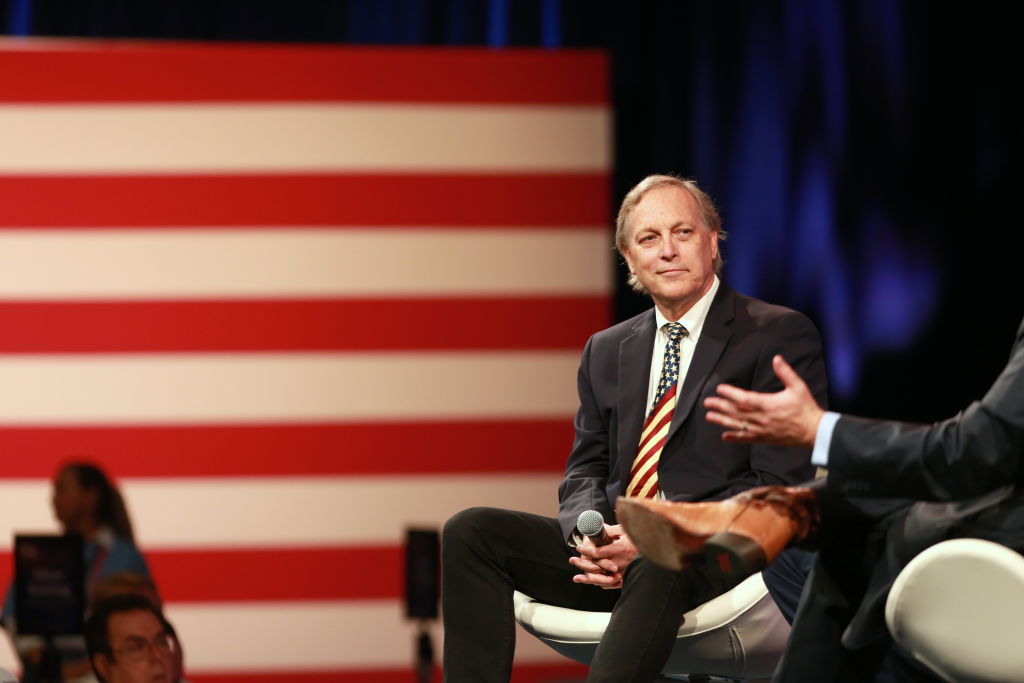
Rep. Andy Biggs, a Republican from Arizona, listens during the Conservative Political Action Conference (CPAC) in Dallas, Texas, U.S., on Friday, July 9, 2021. (Dylan Hollingsworth/Bloomberg via Getty)
Biggs said, “We’re trying to make it a broad-based coalition where we talk about challenges to the exercise of Second Amendment rights. Whether that is an ATF challenge, something the Biden administration is doing, or what policies–local, state, and federal–that may either positively or negatively impact the Second Amendment.”
On January 3, 2022, Breitbart News reported Biggs stressing that carrying a gun for self-defense is part of being a “free American.”
Biggs said, “When you start talking about my wife or me or someone else, we’re talking about self-defense, and the first liberty is the right to life. So, if you can’t defense yourself against the bad guys you start looking like the 12 cities in America that have the highest homicide rate in their history.”
He then added, “You don’t want to look like that. You don’t want to look like Venezuela. You want to be a free American and the way to be free and reduce crime is to allow people to carry guns.”
AWR Hawkins is an award-winning Second Amendment columnist for Breitbart News and the writer/curator of Down Range with AWR Hawkins, a weekly newsletter focused on all things Second Amendment, also for Breitbart News. He is the political analyst for Armed American Radio and a Turning Point USA Ambassador. Follow him on Instagram: @awr_hawkins. Reach him at awrhawkins@breitbart.com. You can sign up to get Down Range at breitbart.com/downrange.
“It is time for us to think outside the box and form two countries. Instead of civil war I propose civil separation. We are two countries, so ideologically opposed that each feels victimized and dominated by the other. Political leaders need to step up and brainstorm next steps. Clearly lay out the two ideologies and give each state a vote as to where they belong.” ~“Opinion Letter” from reader of The New York Times posted on June 5, 2022, responding to May 27, 2022 “America May Be Broken Beyond Repair,” by the Political Progressive Columnist for the Times, Michelle Goldberg. The letter writer, Dawn Menken, a Psychologist, from Portland, Oregon, is the author of “Facilitating a More Perfect Union: A Guide for Politicians and Leaders,” published in 2021*
If the American public didn’t know the truth before, it knows it now: the battle for the very Soul of the Country is on the line, and Ground Zero of that battle isn’t Uvalde, Texas. It’s New York City, New York, with the Bruen case shortly coming down the pike.
The Nation is indeed “two Countries,”—no less so now than at the time of the American Civil War: friend against friend, brother against brother, uncle against cousin, father against son. But what is different today is that ideologies cut across and into the very notion of what it means to be an American. There are those who hold to the meaning and purport of our Nation as set forth in our Constitution and especially in the Nation’s Bill of Rights. And there are those who wish to jettison all of it in the erroneous belief that our Nation is at its core, immoral, even evil. They wish to destroy the very fabric of a free Constitutional Republic.
But the salient difference between these two Countries rests on this:
Those Americans who embrace and cherish their fundamental right to keep and bear arms, and others who do not.
Those who embrace and cherish their fundamental right to keep and bear arms also recognize and embrace their sovereignty over Government. They understand that government exists to serve the interests of the people. They recognize that Government is the servant and the American people are the sole master.
Unfortunately, many Americans are of a different mindset. Such Americans have bought into the psychological conditioning programmed into them that guns are awful and gun owners are to be despised. Such Americans care not that Government is their servant, not their master. They recognize not and care not that by ceding their God-Given right to keep and bear arms, they have laid the foundation for their own demise: loss of Selfhood, loss of Dignity, loss of Self-Reliance, loss of mastery over their own destiny.
But what does the Government Tyrant do about the population of gun owners? That places the Tyrant in a quandary. The Tyrant cannot gain control over those who have the will and means to effectively resist the insinuation of tyranny over them. And, while two-thirds of the population has apparently capitulated, that still leaves a goodly third of Americans who have not and will not capitulate. One hundred million people is a lot of people by any reckoning.
What, then, does a Tyrannical Government do?
How does the Tyrant go about separating an estimated 400 million firearms (according to American Gun Facts) in the hands of roughly one-third of the population?
The American public is routinely bombarded with viral memes. Injected with and subjected to verbal and visual memes on a daily basis, many Americans develop a phobic reaction toward guns and toward those who possess them: word phrases such as “Gun Violence,” “Gun Culture,” “Mass Shootings,” “Assault Weapons,” “AR-15 Rifles,” “Weapons of War,” “Large Capacity Magazines,” and other such nomenclature, when coupled with images of violence, operate as visual and auditory cues, that induce a neurotic reaction in the target population. This is to be expected; in fact, this is intended. The goal is to create in the mind of the target audience a feeling of physical revulsion and repulsion toward guns.
But is it really a concern over the safety of innocent people that motivates a vigorous response against firearms and firearms ownership, misguided though that be, or is there something more sinister at play? If it were the former, one would expect a harsh response toward the massive wave of everyday criminal violence infecting and infesting our Country, especially in the major urban areas. But we see no such response.
Those State and municipal Government officials and legislators, who rabidly attack guns in the hands of average, rational, responsible, individuals, handle rampant violent and vicious crime infecting their locales with diffidence and an air of casual indifference.
So, it cannot be violent crime generally or violent gun crime committed by drug-crazed lunatics, psychopathic and psychotic gangbangers, and garden-variety criminals, particularly, that motivate these officials.
What might it be, then? Why would Globalist Government officials, along with their compatriots in the Press, go off half-cocked whenever a rare occurrence, invariably avoidable, of “mass violence” arises, occasioned by the actions of a solitary lunatic?
Why would Government officials and legislators shriek for more nonsensical gun laws, targeting tens of millions of average Americans, predicating the need for all of it on the lowest common denominator among us: the lone wolf psychotic.
The answer is plain. The actions of that lone wolf psychotic merely provide a convenient pretext. It isn’t the criminal actions of the lone wolf killer that Government is concerned about. For he doesn’t pose a viable threat to Government. Rather, it is the armed citizenry that poses a threat to a Tyrannical Government and poses a threat by virtue of the mere fact of being armed.
But why should Government fear its own armed citizenry? It shouldn’t and wouldn’t unless Government seeks to usurp the sovereignty of the citizenry, as it clearly aims to do here.
A perspicacious Tyrant would know it is a Tyrant. But this Federal Government doesn’t know it.
The Federal Government has amassed power and authority that doesn’t belong to it; power and authority that never did belong to it, believing, wrongly, that the power it has usurped from the people is rightfully its own. And the Government has become jealous in guarding this power, hoarding it.
The Federal Government has come to perceive the armed citizenry as a potential rival that must be crushed, and not as a master to whom it must serve. And we, gun owners, for our part, would do well to view this present Government as a rival to our rightful claim of sovereignty over the Federal Government.
Our claim of sole sovereignty over Government is grounded on the Constitution, and on fundamental, unalienable, immutable, eternal God-given natural law Rights. And, what, then, does the Federal Government presume to claim its sovereignty over us on? What can it presume to claim sovereignty over the American people on? Nothing but a set of limited, contingent, demarcated powers and authority handed through us to it, conditioned on the fact that Government exists to serve our interests, not its own.
Whose claim of sovereignty is superior? And, if one falls back on the aphorism, “might makes right,” well, then, the Government is not alone as the bearer of arms.
*Menken’s book purports to be a guide for political leaders on how to bring the Country together to resolve the Nation’s differences. Yet, one year after the publication of her book, it is clear from her NYTimes letter Times, that Menken has had a change of heart; surrendered to the truth that reconciliation is impossible. That should have been obvious to her all along. It wasn’t.
There are two antithetical ideologies at play. One ideology is grounded on the principles, precepts, and tenets laid down in our Nation’s sacred documents. The other intends to cast it out. One ideology was forged in the Nation’s struggle for independence from tyranny. The proponents of that ideology seek to preserve the Natural Law Rights and Liberties of the people. They intend to maintain and preserve the success of the American Revolution.
The other ideology, grounded on the principles, tenets, and precepts of Collectivism, much in evidence today, seeks to upend the hard-fought battle for Independence from tyranny. For Collectivism is predicated on Tyranny. It is inextricably tied to it. On our website, we discussed all of this in several articles some time ago. See, e.g., our article posted four years ago, in 2018, titled: “The Modern American Civil War: A Clash of Ideologies.”
About The Arbalest Quarrel:
Arbalest Group created `The Arbalest Quarrel’ website for a special purpose. That purpose is to educate the American public about recent Federal and State firearms control legislation. No other website, to our knowledge, provides as deep an analysis or as thorough an analysis. Arbalest Group offers this information free.
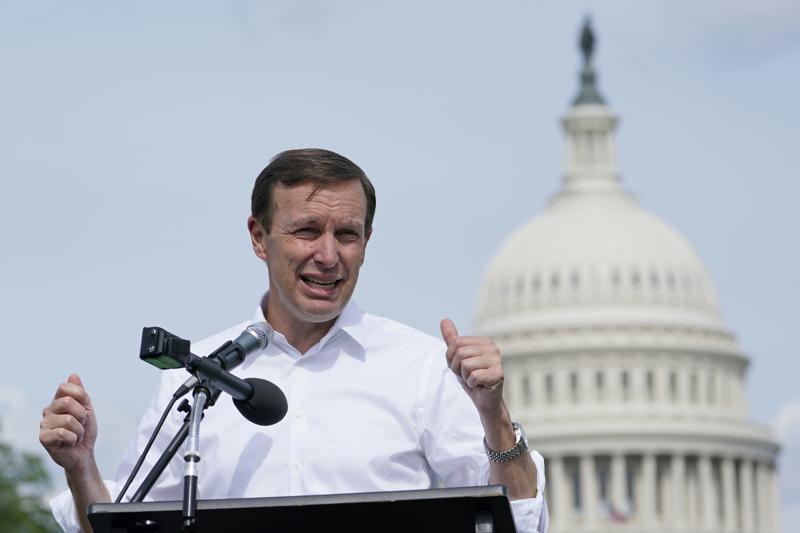
Sen. Chris Murphy, D-Conn., speaks during a rally near Capitol Hill in Washington, Friday, June 10, 2022, urging Congress to pass gun legislation. (AP Photo/Susan Walsh)
WASHINGTON (AP) — Senators have moved to the brink of an agreement on a bipartisan gun violence bill, Democrats’ lead negotiator said Tuesday, potentially teeing up votes this week on an incremental but notable package that would stand as Congress’s response to mass shootings in Texas and New York that shook the nation.
Nine days after Senate bargainers agreed to a framework proposal — and 29 years after Congress last enacted a major measure curbing firearms — Sen. Chris Murphy, D-Conn., told reporters that a final agreement on the proposal’s details was at hand.
The legislation lawmakers have been working toward would toughen background checks for the youngest firearms buyers, require more sellers to conduct background checks and beef up penalties on gun traffickers. It also would disburse money to states and communities aimed at improving school safety and mental health initiatives.
“I think we’ve reached agreement,” Murphy said. “And just we’re dotting the I’s and crossing the T’s right now. I think we’re in good shape.”
Sen. John Cornyn, R-Texas, the chief Republican bargainer, spoke on the Senate floor moments later and said he, Murphy and the other two top Senate bargainers had “reached agreement.”
The senators did not initially say how they’d resolved the two major stumbling blocks that had delayed agreement on the plan’s legislative language.
One was how to make abusive romantic partners subject to the existing ban that violent spouses face to obtaining guns. The other was providing federal aid to states that have “red flag” laws that make it easier to temporarily take firearms away from people deemed dangerous or to states that have violence intervention programs.
If enacted, the election-year measure would spotlight a modest but telling shift in the politics of an issue that has defied compromise since Bill Clinton was president.
After 10 Black shoppers were killed last month in Buffalo, New York, and 19 children and two teachers died days later in Uvalde, Texas, Democrats and some Republicans decided that this time, measured steps were preferable to Congress’ usual reaction to such horrors — gridlock.
What’s uncertain is whether the Senate agreement and its passage would mark the beginning of slow but gradual congressional action to curb gun violence, or the high water mark on the issue. Until Buffalo and Uvalde, a numbing parade of mass slayings — at sites including elementary and high schools, houses of worship, military facilities, bars and the Las Vegas Strip — have yielded only gridlock in Washington.
Republicans refused to include proposals in Tuesday’s compromise that were sought by President Joe Biden and Democrats to ban assault weapons or raise the minimum age for buying them, prohibit high-capacity magazines or require background checks for virtually all gun sales.
It seemed likely a majority of Republicans — especially in the House — would oppose the legislation. Underscoring the backlash GOP lawmakers supporting the pact would face from the most conservative voters, delegates booed Cornyn at his state’s Republican convention Saturday as he described the measure.
Senate Majority Leader Chuck Schumer, D-N.Y., has said his goal was for his chamber to debate and vote on the legislation this week. Momentum in Congress for gun legislation has a history of waning quickly after mass shootings. Lawmakers are scheduled to begin a two-week July 4th recess at the end of this week.
Senate Minority Leader Mitch McConnell, R-Ky., said he supported the outline bargainers announced last weekend. House Speaker Nancy Pelosi, D-Calif., also said she backed the effort and seems sure to set up votes on it as quickly as she can.
California would be the first state to require gun owners to buy liability insurance to cover the negligent or accidental use of their firearms, if lawmakers approve a measure announced Thursday.
“Guns kill more people than cars. Yet gun owners are not required to carry liability insurance like car owners must,” Democratic state Sen. Nancy Skinner said in a statement.
She said the costs of gun violence shouldn’t be borne by taxpayers, survivors, families, employers and communities: “It’s time for gun owners to shoulder their fair share.”
The state of New York is considering a similar requirement in the wake of numerous recent mass shootings and a rise in gun violence.
No insurance company will cover the misuse of a firearm, predicted Sam Paredes, executive director of Gun Owners of California.
He said such requirements are an illegal infringement on gun owners’ constitutional rights.
“We don’t believe you can put precursors on the exercising of a constitutional right,” Paredes said. “By requiring somebody to get insurance in order to exercise their right to keep and bear arms, that ceases to make it a right.”
Skinner is amending an existing bill on another topic to allow gun owners to be held civilly liable if their firearms are used to cause property damage, injury or death.
The bill would also require gun owners to have insurance that covers loses or damages from the negligent or accidental use of their firearm. And they would have to keep proof of insurance with their firearm and show it to police if they are stopped for some reason.
Paredes had similar objections to a second bill that also would affect gun owners’ costs, this one by imposing an excise tax on firearms and ammunition.
The bill would impose an excise tax equal to 10% of the sales price of a handgun and 11% of the sales price of a long gun, ammunition or parts to build firearms.
Democratic Assemblyman Marc Levine estimated his bill would bring in more than $118 million annually that would go toward gun violence prevention programs.
Because it would impose a tax, Levine’s bill would require approval by two-thirds majorities in the Legislature. His similar measure last year fell four votes short of the 54 it needed in the 80-member Assembly.
The bills are among numerous firearms measures being considered by California lawmakers this year, including one that would make it easier to sue gun-makers and another that would allow private citizens to sue those who traffic in illegal weapons.
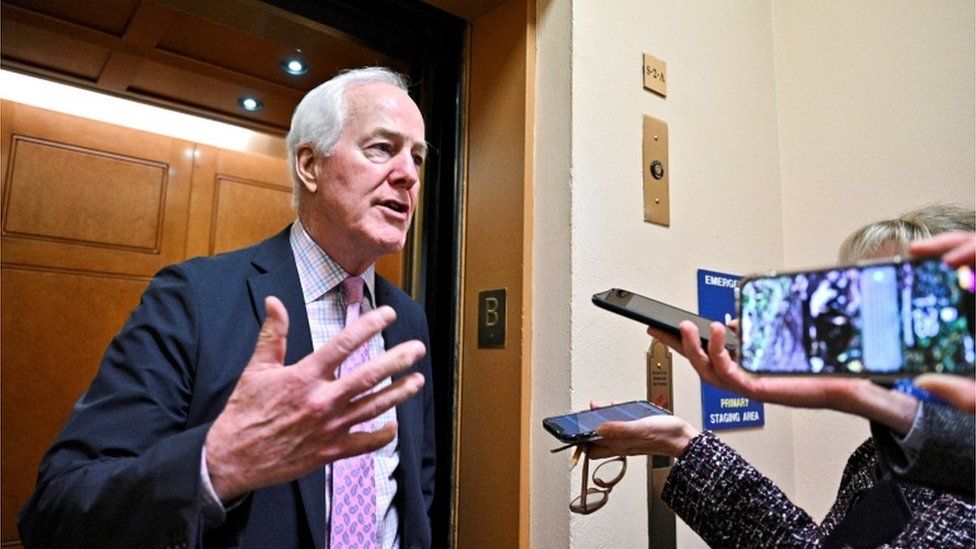
The lead Republican negotiator for what would be the US Senate’s first gun control bill in a generation has walked out of talks with Democrats.
Texas Senator John Cornyn has played a key role in drafting the framework of a proposed firearms bill following mass shootings in Texas and New York.
Leaving Washington, he said: “I’m through talking.”
The plans include tougher checks for buyers under the age of 21 and cracking down on illegal gun purchases.
The proposals have shown some rare cross-party cooperation on the issue of gun control, but still fall far short of what many Democrats and activists have been calling for.
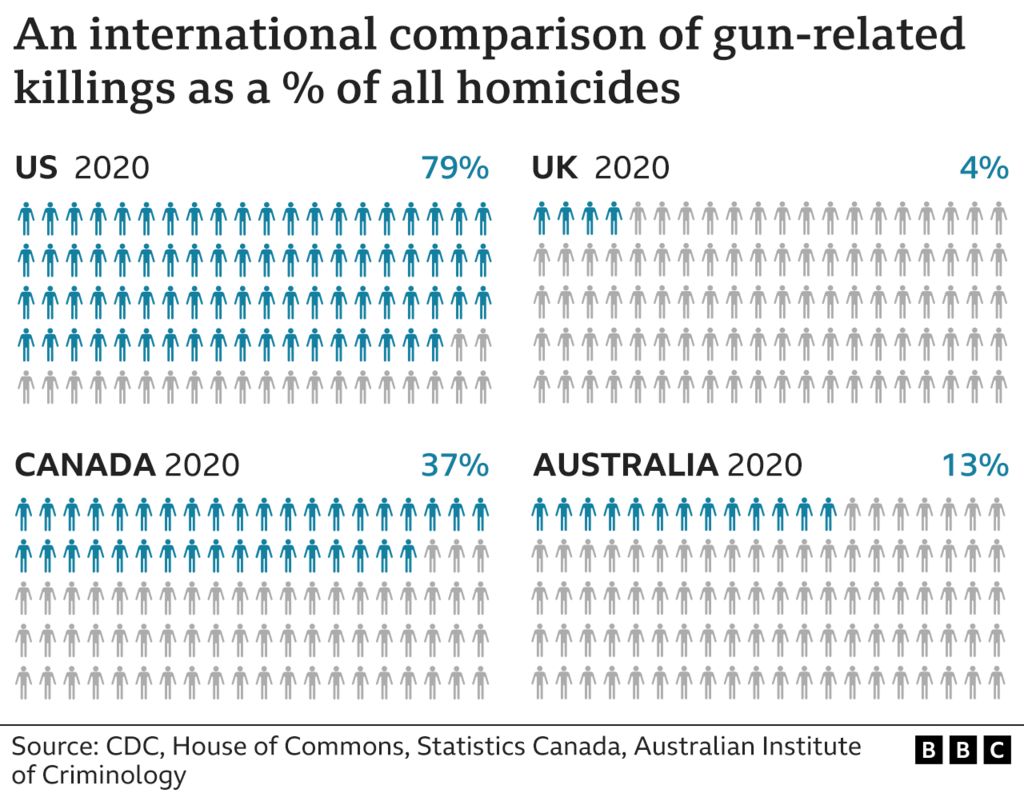
Recent attempts to tighten gun laws in the US – which has the highest rate of firearms deaths among the world’s wealthy nations – have failed to get the required support in Congress.
The flurry of action comes after 19 young children and two adults were killed at a school in Uvalde, Texas, less than two weeks after a racially motivated shooting at a grocery store in Buffalo, New York, left 10 dead.
But Mr Cornyn’s walk-out has placed a question mark over the legislation’s future. Axios, a political outlet, reported earlier on Thursday that conservative colleagues of the Texas senator are frustrated at his handling of the talks and want time to consider the text of any proposal before it is introduced to the chamber floor.
The legislative window to pass a new law is narrowing as November’s mid-term elections loom, but the lead Democratic negotiator said he was still hopeful the bill could go to a vote next week.
A bipartisan group of senators has been working to draft the text of a bill for lawmakers to vote on before they leave for a two-week 4 July recess.
But they have become bogged down in recent days, as Democrats and Republicans disagree on provisions that would strip certain Americans of their guns.
Mr Cornyn told reporters on Thursday that now is the time for action: “I don’t know what they have in mind, but I’m through talking.”
Earlier in the day, he warned that time was running out to reach an agreement.
“We’re about run out of our rope here, and we got to make some final decisions today if we’re going to be able to get this on the floor next week,” he told radio host Hugh Hewitt.
Connecticut Democrat Chris Murphy and North Carolina Republican Thom Tillis told reporters later on Thursday that the group was still inching towards an agreement.
“To land a deal like this is difficult. It comes with a lot of emotions,” said Mr Murphy, who is leading the Democratic negotiations.
“It comes with political risk to both sides. But we’re close enough that we should be able to get there.”
Senators say disagreements remain over incentives for states to enact so-called red flag laws, which allow police to seize guns from people deemed dangerous. Talks are also ongoing to close the “boyfriend loophole”, which permits abusive partners to buy guns.
If both the Senate and House of Representatives can agree on a bill, it would go to President Joe Biden’s desk to be signed into law.
President Biden has said the plans are a step in the right direction but fall far short of what he called for.
Despite the high rate of firearms deaths, many people in the US cherish their gun rights, which are protected by the Constitution’s Second Amendment to “keep and bear arms”.
These are the first gun safety laws in decades to receive this level of bipartisan support, with previous Democratic attempts at strengthening controls frustrated by Republicans.
Similar efforts in the wake of a previous school shooting at Sandy Hook in Connecticut nearly a decade ago – in which 20 children and six adults were killed – failed to get the required number of votes in Congress.
The Senate, or upper chamber of Congress, is currently split – with 50 Democrats and 50 Republicans – and legislation must have 60 votes to overcome a blocking manoeuvre known as the filibuster.
Ten of the 20 senators who proposed the measures are Republicans, meaning the new legislation could reach that threshold.


 AP Photo/Sue Ogrocki