Categories
Category: Ammo
Long-time hunter Craig Boddington takes an honest look at new cartridges that are essentially remakes of old cartridges. Are they worth it? Some are; some may not be.

Author Craig Boddington shot this buck with his Ruger No. One rebarreled to .280 Ross. His perspective on the resurgence of old cartridges in new packages will be familiar to many old-school hunters.
There is a lot of overlap, duplication and redundancy in rifle cartridge performance. As an aging curmudgeon, I constantly question the need for new cartridges. But I do it in good humor, because I’m not yet irascible enough to bite the hands that feed me, and it’s in my best interests to write about new numbers. The last few years, I’ve written about a bunch of them: ARCs, Buckhammers, Bushmasters, Creedmoors, Legends, Westerns, Noslers and PRCs.
They’re all good stuff, but actual performance in terms of velocity and energy can’t be new because these levels were established long ago by the expansion rate of nitrocellulose.
There are modern nuances like the ability to cram more performance into specific action types and lengths, or better downrange performance thanks to modern aerodynamic bullets and faster rifling twists. Or you can purposely step down in performance to meet straight-wall cartridge criteria required by some whitetail states—and thereby avoid having to use shotgun slugs.
All do what they’re supposed to do, but I also have a penchant for older cartridges. Dig deep into cartridge history, and you’ll find there isn’t much new under the sun. The 6.5 Creedmoor is today’s most popular 6.5mm, and it is ballistically identical to 1894’s 6.5×55 Swedish Mauser. The Creedmoor’s main advantage is that it fits into a short action, while the 6.5 Swede does not.
With greater case capacity, with careful handloading the 6.5×55 can be slightly faster, but they are duplicative in performance, and accuracy depends on barrel and ammo. These days, I’m almost certain to see Creedmoors in my Kansas deer camp, but we also see 6.5x55s. They bring a smile to my face.
I love the 1892 7×57 Mauser so much that I have three. The 7mm-08 Rem. introduced in 1980 is a ballistic twin, with much the same comparison as the Creedmoor and the Swede: 7mm-08 fits into a short action; the 7×57 does not. The 7×57 has greater case capacity, but 7mm-08 is loaded to higher pressure. So in factory loads, the 7mm-08 has a velocity edge, but no deer will know the difference.
For nostalgia and tradition—and perhaps just to be different—I stick with the 7×57. There’s nothing wrong with being contrarian, but you still must feed the rifle. Thankfully, 6.5×55 and 7×57 ammo aren’t rare, but they’re not nearly as available as Creedmoor and 7mm-08—which is why my wife and daughters shoot a 7mm-08 and not a 7×57.
Again, if you delve back into cartridge history, you’ll find there isn’t much that’s truly new. Charles Newton (1868-1932) was way ahead of his time. He designed the .22 Savage High Power and .250 Savage (.250-3000) for Arthur Savage. The latter was the first commercial cartridge to break 3,000 fps.
Newton’s own cartridges were even hotter. His .30 Newton, with .523-inch base diameter and 2.52-inch case, is surprisingly similar to the .300 PRC, but it’s a full century older.
Avid Ruger collector and friend Lee Newton has an original .30 Newton he wanted to bring to our Kansas deer season. Lee has original ammo, but it’s too old and collectible to shoot. He has dies, but he hasn’t been able to obtain brass.
Lee also has an original Canadian military straight-pull .280 Ross, also with old ammo and dies. The .280 Ross was the first 7mm “magnum.” Designed in 1906, the .280 Ross uses a 2.59-inch semi-rimmed case with .534-inch base and .556-inch rim.
Although not quite 3,000 fps as loaded with vintage propellent, it was the hottest pre-1910 cartridge, pushing a 140-grain bullet at 2,900 fps. The cartridge was loaded on both sides of the pond until 1935. Lee’s original Kynoch boxes are marked “.280 Rimless (Ross Pattern).”
In those days, hunters were enamored of newfound smokeless velocity, but they didn’t understand that expanding bullet technology hadn’t caught up. The .22 Savage High Power, .250-3000 (with 87-grain bullet) and the .280 Ross all struck like lightning when they worked, but performance was inconsistent.
In 1911, George Grey, brother of Great Britain’s foreign minister, Sir Edward Grey, was killed by a lion when he failed to stop it with 140-grain bullets from his .280 Ross. The incident was infamous enough that the .280 Ross never overcame the stigma. One wonders if the Ross’s 180-grain load could have changed history.
Frequent Kansas hunter Larry Tremaine has an original 1910 Ross sporter in .280 Ross he brought for our 2022 season. Lee Newton also has a gorgeous custom Ruger No. 1 barreled to .280 Ross, which he said I could use if I wanted.
The .280 Ross has a complication in that it calls for a .287-inch bullet, which is almost impossible to obtain. Larry came to Kansas rounds loaded with undersize .284-inch 140-grain Ballistic Tips. His old Ross seemed accurate enough for a close-range shot with original aperture sight, and he dropped a nice eight-pointer at 40 yards.
Larry offered to let us use his ammo in Lee’s custom No. 1. Accuracy wasn’t great with those undersize bullets, but it held “minute of vital zone” at 100 yards.
I couldn’t resist. I figured I’d never have another chance to hunt with a .280 Ross. I knew where I would sit, with a maximum 100-yard shot, and on the last morning one of my management bucks came out. The shot was about 80 yards, and the buck went down in his tracks.
Under the heading of “not much new,” Holland & Holland’s .275 Belted Rimless using a .284-inch bullet was introduced at the same time as the .375 H&H— same .532-inch rim and belt, case shortened to 2.5 inches. Sound familiar? It should; it was almost identical to the 7mm Rem. Mag. introduced 50 years later.
George Gibbs, Purdey, Lancaster, Rigby and Westley Richards all produced early smokeless cartridges with ballistics that hold up well to this day. Many are almost forgotten, and standardization wasn’t widespread, so case dimensions and bullet diameters are all over the map.
Some older cartridges are well worth resurrecting in new rifles, if only for fun. Others are much too difficult, at least for me. When I hear about a new cartridge, I go back to references and see if there was something similar way back when. It’s surprising how often there was.
Categories
Russian Winchester 1895
Categories
Ammunition production line
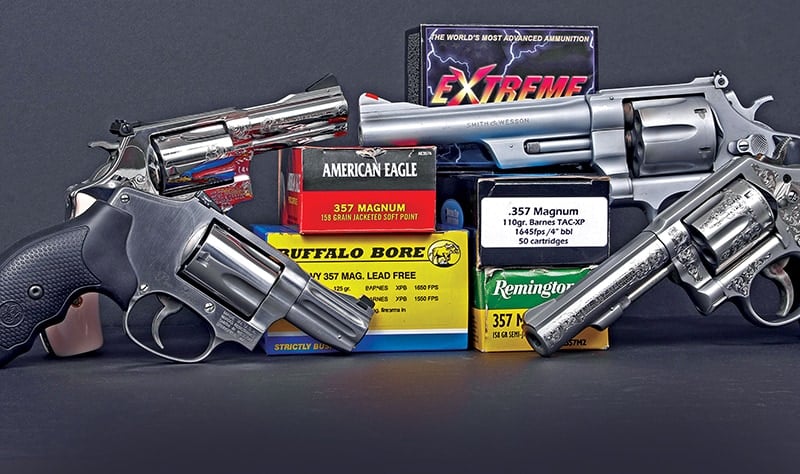
One of the more common letters I get here are readers worrying if their self-defense load is adequate. Regardless of the caliber, they still worry. They often say, “The forums are full of a mixed bag of opinions, but I hesitate to trust comments from anyone who is unwilling to even sign their name. I know who you guys are, know the articles are vetted, and trust you — can you help me out?” One thing they usually bring up first, is the velocity of their chosen load.
While forums and websites can offer solid info, you’re smart to balance it with other resources. Your personal experience, books, articles, a trusted friend’s opinions, etc. all serve to find a common denominator. Once the chaff floats away, what remains is probably pretty good to rely on. Right off the top — and we’ll prove this in a future issue with a new, groundbreaking stopping power article — any handgun caliber (from 9mm/.38 Special on up), loaded with reliable, modern defensive ammunition, will do the job to protect you. And amazingly enough, in our study we learned virtually any caliber, from 9mm to .44 Mag, takes from one to two shots to stop a bad guy. The final numbers showed around 55 percent are stopped within one to two shots — regardless of caliber! There truly are no magic bullets or calibers, and shot placement and penetration are paramount.
But still, many of you are caught up in the velocity issue. “Yeah, but isn’t 1,257 fps better than 1,245 fps? It is, isn’t it? Isn’t it?” And then you invest hard-earned dollars chasing that velocity nirvana, which is, I might add, mostly a complete waste of your time. Huh? Did he just say that?
I’ve been doing some work with Ruger’s new M77 .357 Magnum bolt action rifle. A very cool, short, light rifle, just made for kids and recoil-sensitive shooters. So, I had a fairly good selection of .357 Mag loads on-hand. I thought, hey, let’s shoot them in a wide range of barrel lengths and see just what velocity changes might occur. And then, let’s ask if any of it really matters in the real world? Check out the chart, and we’ll chat about it a bit.
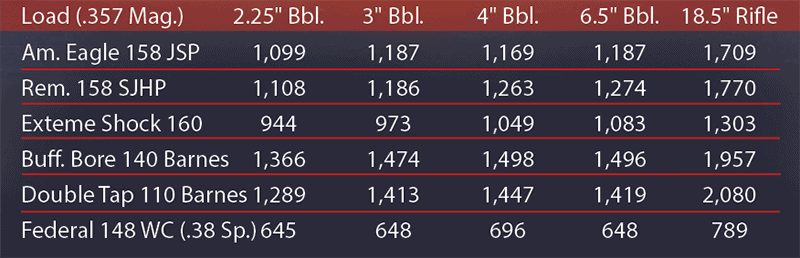
Let’s think about that stopping power/velocity question I hear so often. Our bullet weights ranged from 110 grains to 160 grains, and velocities of the .357s ranged from a low of 944 fps (Extreme Shock 160 gr.) in the 2.25″ Performance Center .357 J-frame, to a high of 1,496 fps (Buffalo Bore 140-gr. Barnes) in the 6.5″ Highway Patrolman. I tossed in the rifle velocities just for fun so you could see what happens when you bring a rifle to a handgun fight, even when using some pistol calibers. The Ruger gave 1,957 with that same Buffalo Bore load, and 2,080 with DoubleTap’s 110 Barnes. Once you reach near 2,000 fps, serious things begin to happen, and then velocity tends to work well — but not so much before then.
But what did we learn? As far as handgun loads go, I learned you don’t want to shoot heavy .357 loads in J-frame guns, especially in lightweight models. Muzzleblast is shocking (I can’t imagine firing one without hearing protection, like at night in your bedroom …) and the palm-slapping recoil borders on uncontrollable. Just don’t do it. But look at those velocities — any of the loads tested, from the low of 944 to the high of 1,496 would be very capable self-defense loads. And, if it were me, I’d lean toward the moderate ones, with heavier bullets, so they aren’t so much of a handful. Check out how the velocity of some loads increased with barrel length, and not so much for others. The more consistent loads often offer good performance in shorter barrels since the powders seem to burn well in shorter barrels. The penalty in recoil, muzzleblast, controllability and cost when you move from 950 fps to 1,450 fps is extreme, while the stopping power increase is hard to measure in the real world. Read that sentence again. Stopped is stopped, regardless of the velocity.
I threw in the 148-gr. .38 Special wadcutters just for fun. Note from 2.25″ to 6.5″ you don’t gain a thing. As a matter of fact, other than the slight increase in the 4″ gun (normal velocity variances) it was very consistent. That’s why that load if so accurate, and burns cleanly in short-barreled guns. Gel testing I’ve done shows 148-gr. lead wadcutters often penetrate 14″ or more, and offer mild recoil and no muzzle flash. Hmm … maybe velocity isn’t that important after all? Before you get hysterical, think this over some more and hang-loose until we run that stopping power article soon.
Unless you’re approaching rifle velocities, why beat yourself and your handguns up worrying about a gain of 100 or even 300 fps or so? A 950 fps bullet of adequate design will stop someone virtually as well as the same bullet at 1,250 fps, and sometimes better — so it’s time to stop worrying. If you’re hunting, velocity and bullet construction can be very important, but not as much as you might think. We’ll talk about that another time. A bunch of stuff to think about, I’d say?
Categories