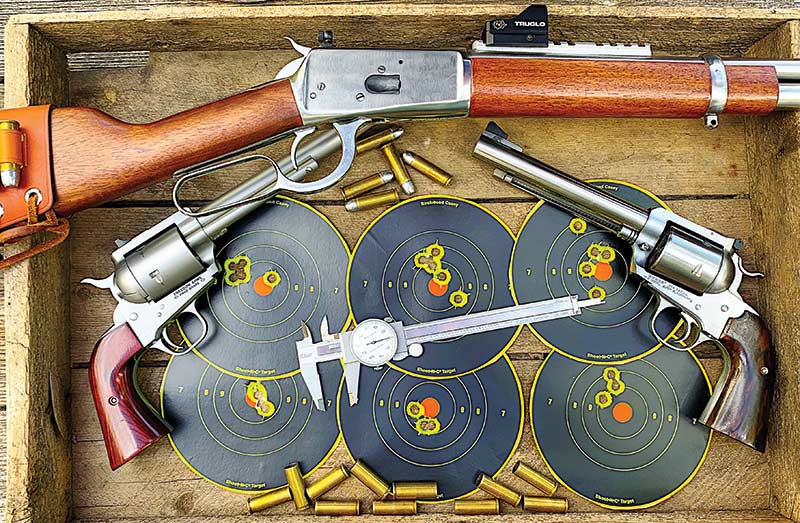
Typical 50-yard groups from the Rossi R92, bottom row targets,
and handgun targets, top row, shot at 25 yards.
Deep within the belly of social media, amongst tiered special-interest groups, you’ll find “bullet casters” at the bottom of the heap. A small lot, these lead-heads and worshippers of the silver stream manage to miraculously meet up.
Roaming the earth like dinosaurs before them, lead bullet casters are almost as rare. It’s also how jacketed bullet shooters think of them, snidely asking, “You’re still shooting lead?” But it’s more accusation than question. The dinosaurs grin, shrugging prehistoric shoulders, knowing the reasons why.
Perhaps this is the reason lead-heads seek their own, talking cast bullets/loads, fully aware of the fun the average shooter is missing? Dinosaurs are more than happy to share this information to those appreciating it.
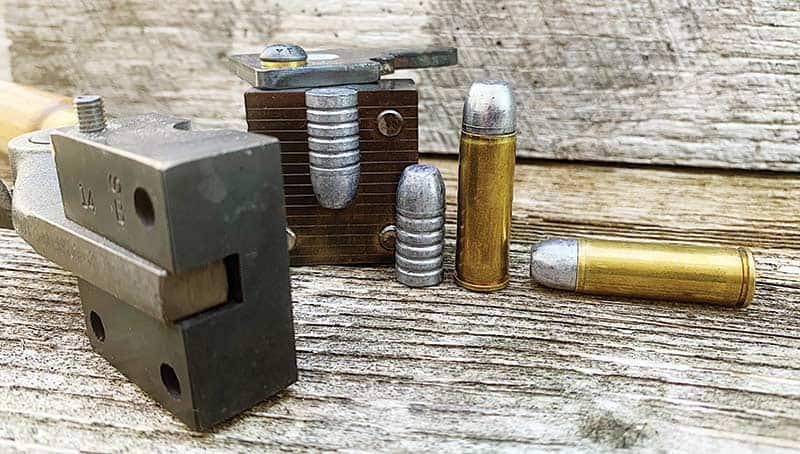
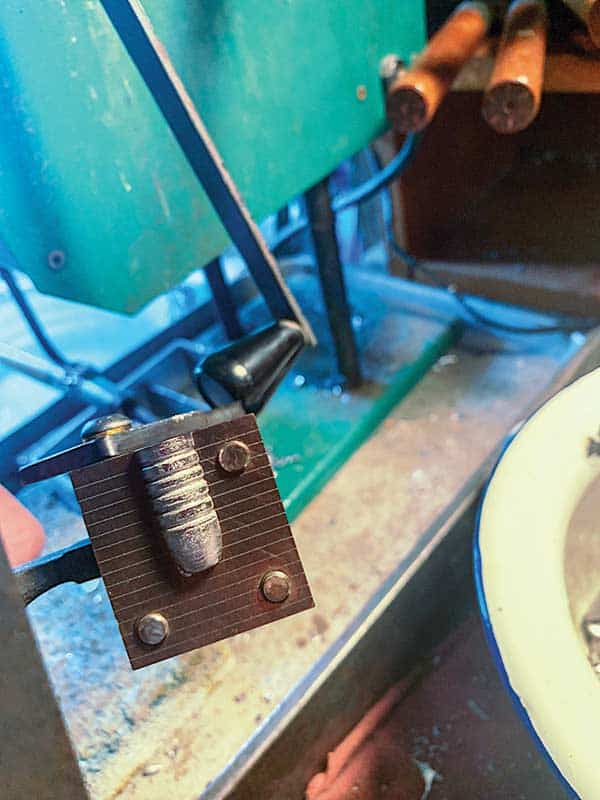
Steve Brooks made the quality single-cavity mold designed by Mic McPherson.
The mold makes it very easy to cast wonderful bullets.
A Friend Indeed
This was the case when friend Jim Williamson called. You remember Jim, he owns a very cool 71/84 11mm Mauser I wrote about here. Seeing my article on the Rossi .454 Casull R92, a lightbulb went off in his head. Seems he and Mick McPherson were experimenting with the Freedom Arms 454 Casull. Mick designed a special mold casting a heavyweight bullet for long-range shooting at easy cruising speeds. Jim offered some of the bullets for me to try. A few days later, over two hundred of the prettiest cast slugs arrived in the mail.
Weighing in at a hefty 420-grains, this long bullet is oozing with sectional density and bearing surface, making it fly true and penetrate deep at great distances. Jim told me they’ve discovered using 11.0 grains of Hodgdon Longshot generates 1,000 fps from Freedom Arms model 83s with wonderful accuracy.
Jim also stated they’ve shot it out to 600 yards, busting rocks, and it appears to be stable at this distance. This isn’t surprising, as Mic McPherson knows how to design a bullet. He’s a walking encyclopedia on handloading, gunsmithing and any other shooting-related information.
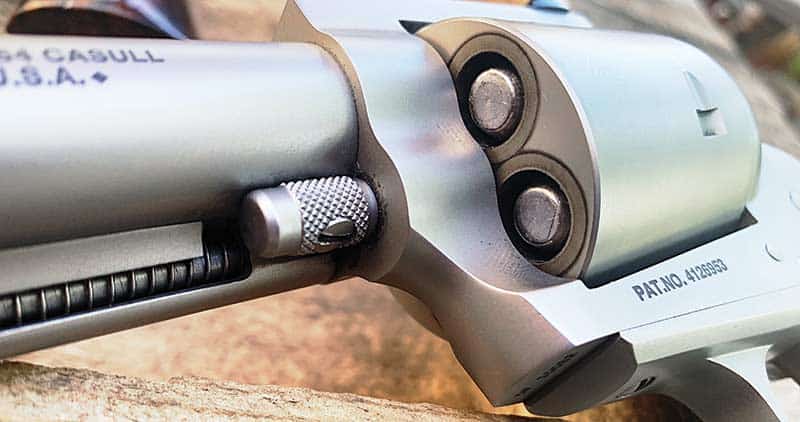
The bullet is designed to maximize powder capacity, so the crimp-groove
keeps the bullet seated as far out as possible on Freedom Arms model 83s.
Load & Shoot
Loading Jim’s slugs over the suggested 11.0 grains of Longshot, sparked by a CCI 400 small rifle primer in Starline brass and using my Dillon 550C progressive press, I’m ready for the range. I bring the Rossi R92 in .454 Casull, along with a Freedom Arms model 83 and Ruger Bisley 5-shot.
Touching off a typical 454 Casull load — a 300-grain bullet going in excess of 1,600 fps —is pretty violent, like holding onto a stick of dynamite. This load is much more manageable.
Shooting day was hot, 95º with 88% of T-shirt-wringing humidity. I had a TRUGLO Micro red dot sight mounted on the Rossi. At 50 yards, 3-shot groups cloverleafed into sub-inch groups. The Freedom Arms stayed true to its reputation with 1″ groups or better at 25 yards.
The Ruger 5-shot Bisley held its own with groups in the 1″ to 1.5″ range. The load, while stout, isn’t unpleasant at all to shoot. Without sweat stinging my eyes, I believe accuracy could have been a smidge better.
Jim’s right — velocity hovers around the 1,000 fps mark for the revolvers. The Rossi and its 20″ barrel increase velocity to 1,350 fps, which incidentally matches velocity of a Sharps rifle with black powder loads. A 420-grain slug, ambling along at 1,000 or 1,350 fps has a lot of momentum. Worshippers of the silver stream know this, as did the buffalo hunters so many years ago.
Nice Dinosaurs Rule!
Bullet Casters/Shooters are a complex breed, indeed. Far from being Luddites, they like doing things the old way while applying the newest techniques, designs, and thoughts to their shooting. One thing for certain — while some may call them dinosaurs, the Cast Bullet brotherhood is far from being extinct.
I have a feeling there’s going to be an avalanche of busted rocks next year at the Whittington Center from all the 420-grain bullets pulverizing boulders, one shot at a time. Jim let me borrow his mold, so I’ll cast plenty of bullets. Dinosaurs are known to do such things, just to have some good prehistoric fun.
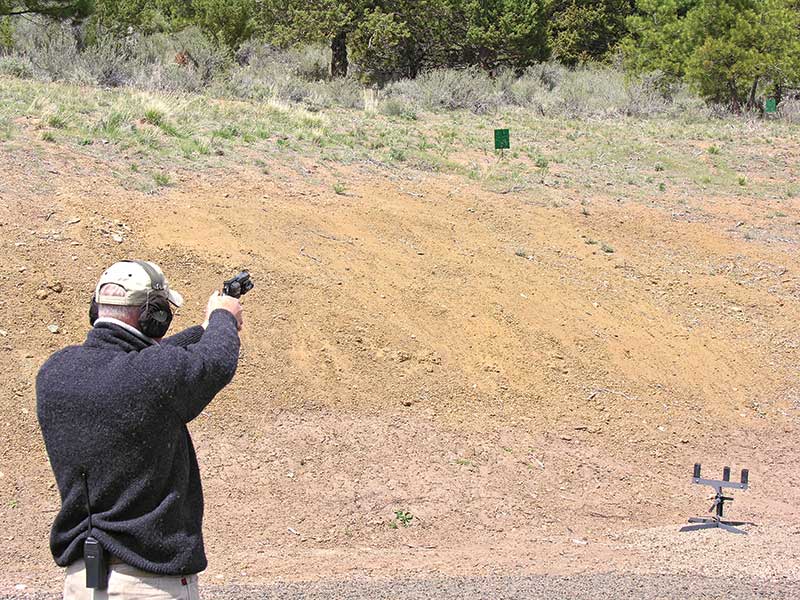
Duke shot the new S&W TRD .45 only in double action. He didn’t dare shoot it single action,
but such a method is possible. Just not when Clint Smith is around.
When Smith & Wesson’s Tony Miele and Thunder Ranch’s Director, Clint Smith, got together a few year’s ago, their fertile brains cooked up something special. It was the third revolver introduced in collaboration between Thunder Ranch and Smith & Wesson, but as you will see this one was a departure from those first two Thunder Ranch Revolvers. It is the Thunder Ranch Defense revolver or TRD.
Here’s some background. Back at SHOT Show 2004, Clint, Tony, Roy Huntington and myself had dinner together. It was the first time Clint and I had met Tony, who at that time was Smith & Wesson’s production manager. Naturally we all launched into our ideas about what revolvers Smith & Wesson should be making. Guess what it was? Right! We wanted all steel, fixed sight, wood gripped, big-bore sixguns. Such are traditional Smith & Wesson handguns to shooters of our age.
Thunder Ranch Revolver
We got them too. By April Tony, Clint, and I shot together at a Thunder Ranch Revolver class in Texas passing around the prototype first Thunder Ranch Revolver. It was a Model 21-4 .44 Special, with 4″ barrel. It went over so well Thunder Ranch and Smith & Wesson did another revolver together in late 2005. This time it was a Model 22-4, which externally was similar to the Model 21-4, but chambered for .45 ACP/.45 Auto-Rim. If anything, it was an even bigger success.
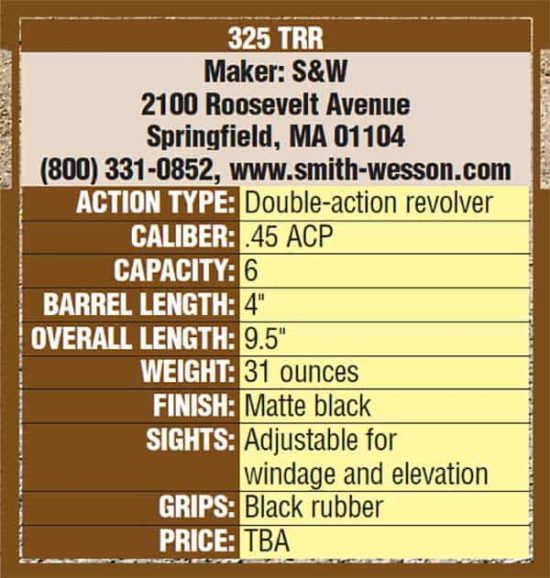
This set the stage for the TRD, which as I said is a departure from tradition. Clint referred to this new revolver as “new age.” Instead of steel, its N-frame is scandium, while its cylinder is blackened stainless steel. Instead of fixed sights, it has adjustable ones, and the grips are rubber. In fact about the only things “traditional” about it are the 4″ barrel and caliber.
Again, it is chambered for .45 ACP/.45 Auto-Rim. I asked Clint why did you pick the .45 ACP/.45 Auto-Rim again? He said, “Because the revolver is versatile ammo-wise and allows the 1911 people to also have a viable revolver in a matching caliber. Also, with .45 ACP/.45 Auto-Rim someone has the option of 1/2-moon clips or full-moon clips with .45 ACP or speed loaders with .45 Auto-Rim.” I’m also happy to note the .45 Auto-Rim isn’t just an option for hand-loaders. The South Dakota-based firm Black Hills Ammunition is again offering .45 Auto-Rim factory loads.
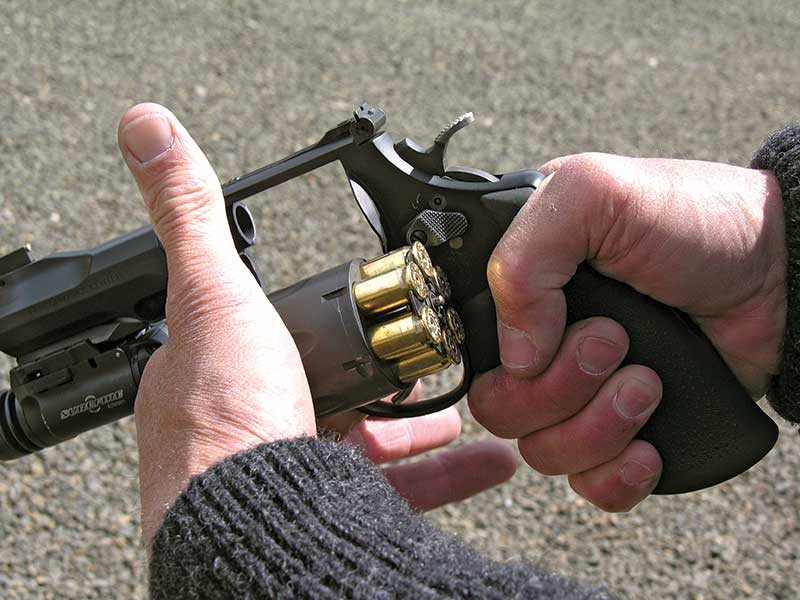
The new S&W TRD .45 can handle .45 ACP ammunition (above) in either full or 1/2-moon clips
and .45 Auto Rim in speed loaders. One benefit of a revolver chambered for .45 ACP (below)
is the car-tridges can be held in 1/2 or full-moon clips for a truly flexible reload.
Sight Thoughts
When I got to Oregon, the first thing Clint and Tony showed me was the sample TRD revolver. When I saw it carried adjustable sights, I had to ask why. After all Clint had wanted the earlier Model 21-4 and 22-4 precisely because they were fixed-sight revolvers, hence nearly impossible to knock askew once sighted in. And that’s a good thing for a defensive handgun. But, Clint said experience showed him adjustable sights were logical for a .45 ACP/.45 Auto-Rim revolver because of the wide range of bullet weights available.
For instance, .44 Special factory load bullet weights generally run from 200 to 250 grains. In comparison .45 ACP/.45 Auto-Rim now have factory load bullet weights from 155 grains to 255 grains. The lighter load is the TTI brand of “green” or lead-less factory ammo in .45 ACP. The heavier bullet is the lead 255-grain SWC carried in Black Hills new .45 Auto-Rim loading. Depending on exact barrel length, velocity, and/or range the points of impact between 155-and 255-grain bullets can be a foot or more. Hence adjustable sights are more practical.
The new TRD revolver’s rear sight was perfectly familiar to me, being the standard S&W micrometer style inlet into the topstrap and adjustable for both windage and elevation by means of a small screwdriver. I’ve used hundreds of S&W revolvers so equipped. However, the front sight got my attention. It had a gold bead, but the interesting thing is that its “quick detachable.” Pulling it back against spring pressure and then lifting it upwards brings it right out of its slot. As shipped from the factory these new TRD revolvers will have a gold bead with a sight height of .250″. However, the buyer can order other sight blades to suit his individual needs such as higher, shorter, or the Hi-Viz colored types S&W has been marketing for awhile. I thought it was a nifty option, all the while feeling perfectly happy with the original gold bead while shooting of several hundred rounds through the TRD during my visit.
A Little More Custom
In the above paragraph I mentioned “shipped from the factory.” Let’s be clear on one point — these Smith & Wesson TRD revolvers were actually coming from their Performance Center. Coming out of the PC, the revolver has a few options standard factory revolvers don’t have. One is the hammer and trigger are forged and machined parts and not the MIM (machine injected molding) parts as found on factory issue Smith & Wesson revolvers nowadays. They are color case hardened. Second, the hammer has a shape referred to as a “tear-drop” which is slightly different from the rectangular one on standard revolvers. Third, the trigger comes with an overtravel stop. And finally, the cylinder’s crane has an extra lock-up in the form of a ball detent, in addition to the standard lock-up of the ejector rod fore and aft. That third lock, while not exactly like those found on the old “Triplelocks” (Hand Ejector, 1st Model), serves the same purpose.
All us “old revolver guys” like wood grips on our handguns, or perhaps even grips made of some exotic material like ivory or bone. Therefore, I was a bit surprised the TRD has rubber, finger-groove grips. Again I asked Clint why. He said, “Many revolver people like custom grips of their choosing, so the rubber works well, yet is cost effective in case the owner wants to ditch them. In fairness, though, the rubber is also pretty tough stuff for everyday carry or field work.”
Personally speaking, I’ve had a deep aversion to rubber grips all my life. That is until encountering Smith & Wesson’s new breed of AirLite revolvers. These ultra light revolvers are great for carrying but firing them with wood stocks will tear up your hands in short order. Yet, the rubber grips make them perfectly usable. The TRD, with its scandium frame and shrouded barrel weighs a mere 31 ounces. We fired hundreds of rounds through it while I was at Thunder Ranch, and those grips made it perfectly pleasant to shoot. So once more, a departure from “tradition” was well thought out.
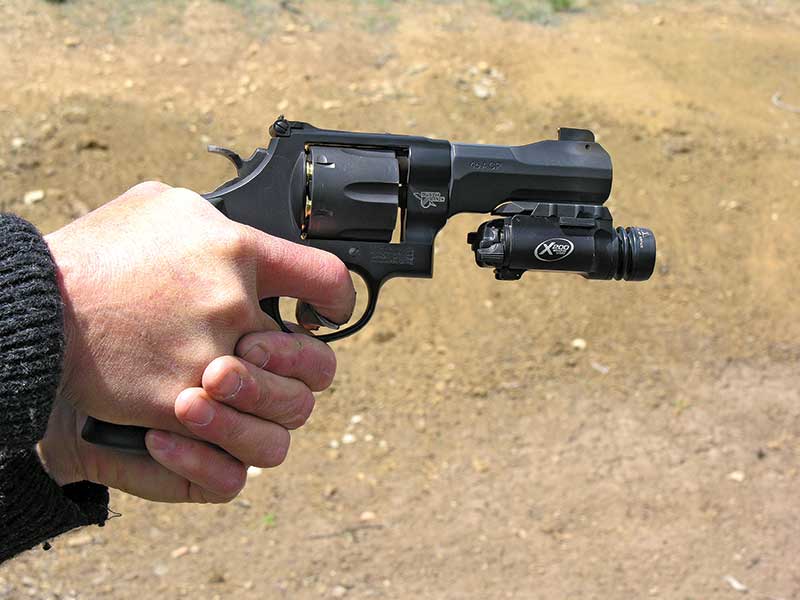
The new Smith & Wesson TRD .45 comes with a Picatinny rail beneath the
4″ barrel (above). It is removable if lights aren’t your thing.
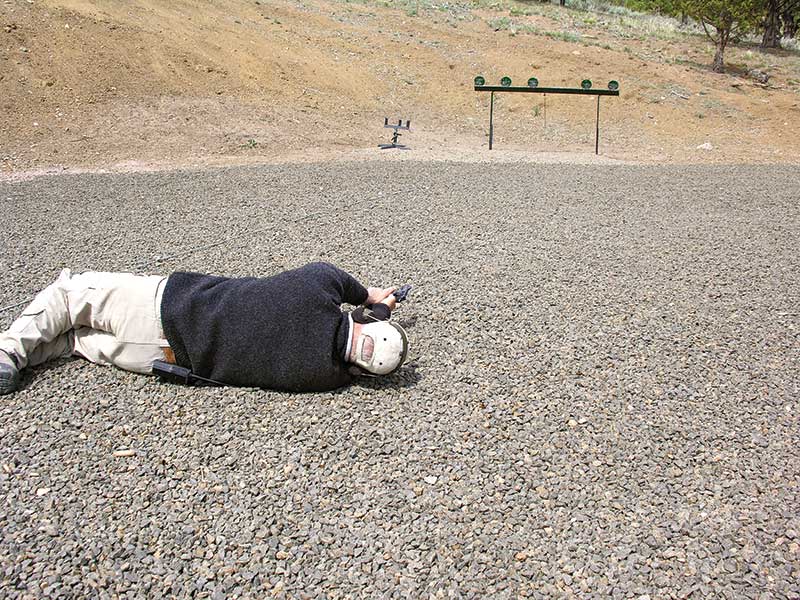
You never can predict how you might have to engage an enemy, so Clint practices being able
to shoot from many positions. Here, he puts the new TRD .45 through its paces from such
unorthodox positions as this. It functioned flawlessly for 2,000 rounds.
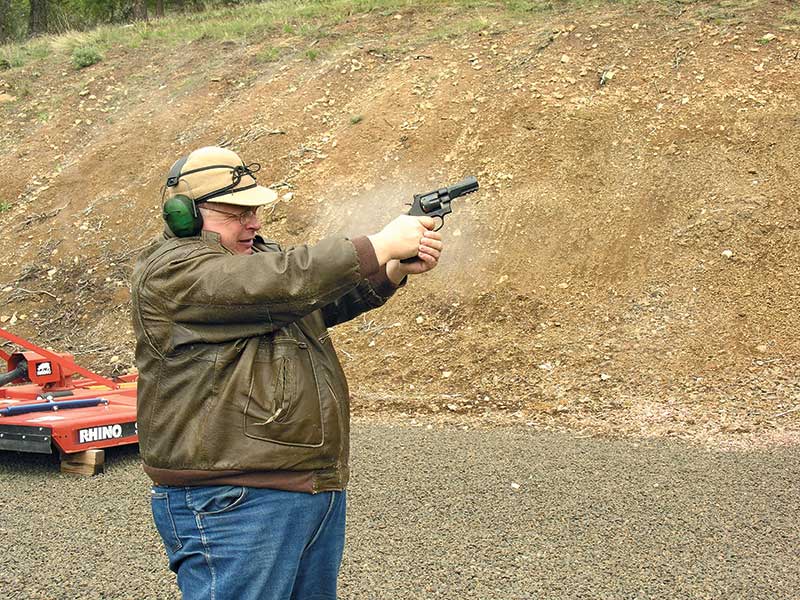
Clint shooting the new Smith & Wesson Thunder Ranch Defense (TRD) revolver .45 ACP
double-action at a steel plate 45-yards away. Hits were easy.
New Tradition
But this next item is perhaps the most non-traditional of all. It’s a Picatinny style light rail mounted beneath the barrel. I have no experience with handgun-mounted lights, so again Clint had to be referenced as to why he thought it a good idea. Here’s what he said, “The light rail is there because so much of what happens confrontation-wise is in an altered light environment. The idea is to carry the TRD for daily use without the light, and then when you get home mount the light. An option would be to have the light with you and then mount it when needed, such as a cop might have to do when entering a dark building.” Also, it should be mentioned the Picatinny-style light rail can be dismounted from the barrel, in case the owner feels no need for it at all.
Now at this point in the usual sort of gun test we would tell about the groups it fired on paper from sandbag or machine rest. That we didn’t do. What’s the point?
Every single one of these new S&W revolvers we have “test fired” the last few years have been extremely accurate. So instead we had a lot of fun shooting steel. In fact while I was there in Oregon the number of rounds put through that sample TRD passed 2,000 and none of them were fired at paper targets. Clint has a steel falling plate range set up for use at dis-tances from seven to 25 yards. Also on the hill above the plates are larger plates 12″ wide and 18″ tall set at 45 and 65 yards.
Right off the bat when it was my turn to shoot the TRD the first time, I reached up to cock the hammer and fire it single action. After all why did God give me thumbs if he didn’t want me to use them? A ton of bricks might as well have fallen on me. Clint said, “It’s a double-action revolver! Shoot it double action!” I know better than to argue with him, and besides he’s been trying to teach me proficiency in double action shooting for several years.
It didn’t surprise me I was able to hit those falling plates at ranges from seven to 10 yards. What did surprise me was we were all hitting them at 15 to 20 yards, and it astounded me that all three of us were regularly hitting those 45-and 65-yard distant plates shooting double action. The double-action trigger pull on the TRD revolver was just plain smooth, yet the hammer fall was strong enough it never failed to set off a primer.
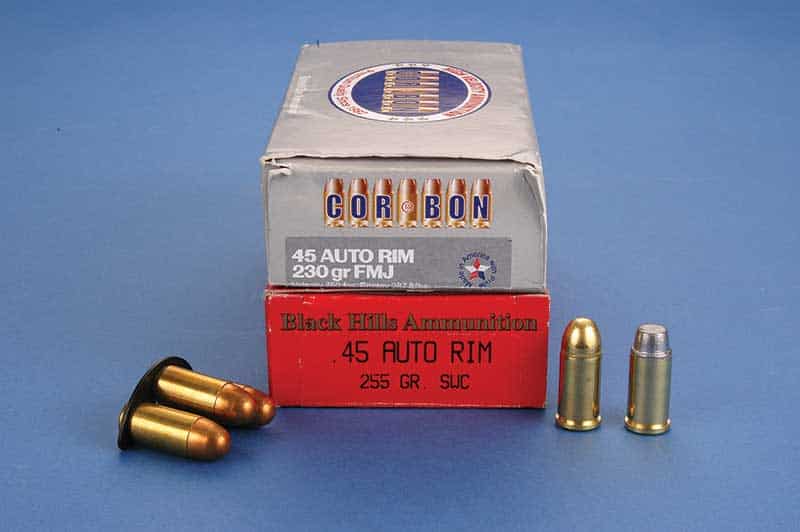
Besides the vast amount of .45 ACP loads available, both Cor-Bon and Black Hills
Ammunition are now making .45 Auto-Rim factory loads once more.
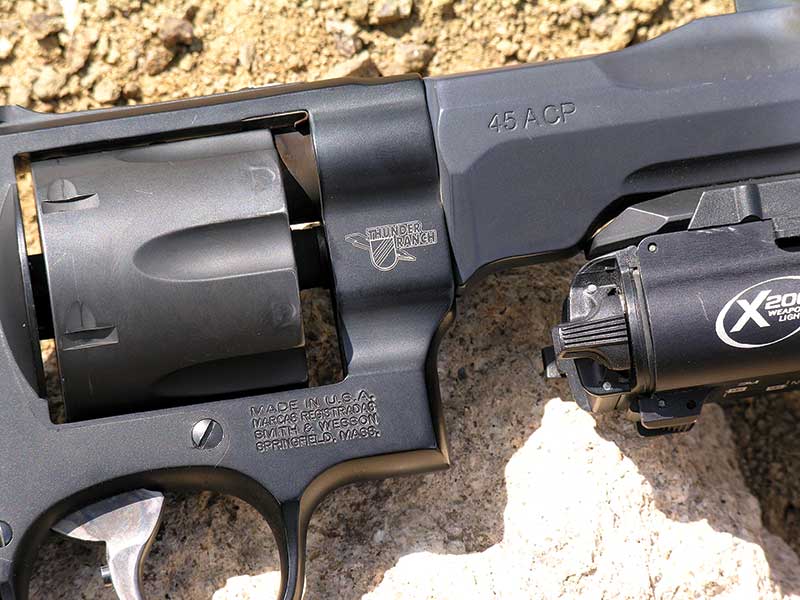
Each Thunder Ranch Defense revolver has the Thunder Ranch logo etched into its frame.
Ammo Choices
Not only did we fire .45 ACP Remington 230-grain FMJ factory loads and TTI 155-grain lead-less .45 ACP factory loads, but also tried Cor-Bon’s new 230-grain FMJ Auto Rim load and Black Hills new 255-grain SWC Auto Rim load. All shot just fine albeit with some sight changes to com-pensate for differing bullet weights. (I never did fire the thing single action, so I have no idea as to how its SA trigger felt. I wasn’t about to let Clint catch me thumb-cocking it again!)
At the end, I had to ask Clint again; “Why the great departure from the first two Smith & Wesson and Thunder Ranch collaborations?” He said, “This TRD is a sort of update or new age version of the defensive revolver. The Models 21/22 were an attempt on my part to bring back the old guns so they could be carried and shot, maybe by people who couldn’t find or afford original Model 21s and 22s.”
Milt Sparks, the famous Idaho holster maker, has both inside and out-side the pants holsters for the TRD and its light rail.
Superman is my personal favorite superhero. However, 11-year-old Alaskan Elliot Clark could beat down the Man of Steel without breaking a sweat.
In a world awash to its gunwales in make-believe spandex-clad superheroes, sometimes it is cool to hear about the real thing. Alaskan brown bears are some of the most formidable predators on the planet, the apex hunters in their natural world. When an Alaskan youth named Elliot Clark faced one of these enormous beasts intent on eating him and his family, this young stud stood his ground, lifted his Remington 870 20-gauge, and put the monster down.
How Scary are Bears Really?
Richard White met his end while trekking alone through bear country in Alaska.
In August of 2012 Richard White, a 49-year-old pharmacologist from San Diego, California, was hiking alone through the vast expanse of Denali National Park. Denali is one of the most pristine tracts of unspoiled wilderness on the planet. It is also home to some legendarily huge Alaskan brown bears.
Bear spray is a particularly intense version of pepper spray formulated to dissuade an angry bear. I’d personally sooner pack a decent gun.
Richard was an experienced hiker who had hiked Denali solo before. However, he carried neither firearm nor bear spray. On his application for a backcountry permit, he listed his primary bear deterrent as a whistle.
A mature grizzly bear in a foul mood is a sight to behold.
Fellow hikers happened upon a bloody backpack near the Toklat River and notified park rangers. The rangers found a large boar grizzly standing guard over White’s remains. The big bear had partially eaten and buried the man. As they lost the light the rangers fired on the bear twice but missed.
Alaskan brown bears get really big.
The following day rangers found the bear still guarding White’s body and dispatched the animal from a helicopter. A necropsy of the 600-pound mature male proved that they had gotten the right bear. They found White’s undamaged digital camera nearby.
A grizzly can hit 35 mph in a sprint. By contrast, Usain Bolt, the world’s fastest living human, can only make 27.
White had photographed the bear that killed him twenty-six times in less than eight minutes. He began shooting pictures at a range of approximately forty yards, but the bear was on him quickly. Richard White left behind a wife and young daughter. Brown bears are remarkably efficient killers.
A Most Extraordinary Young Man…
Rural Alaska is a place of spectacular beauty and wondrous natural grandeur. The fishing and hunting are unsurpassed.
Five years later, 11-year-old Elliot Clark was walking along a trail headed to a familiar fishing spot on Game Creek just south of Hoonah, Alaska, on Chichagof Island. Elliot’s uncle and grandfather were in the lead. His cousin pulled up the rear. Three family dogs screened the flanks.
Elliott kept his 20-gauge Remington 870 close at hand.
Young Elliot was already an experienced Alaskan and fully acclimated to firearms. His uncle slung a serious rifle on his back. Elliot carried his slide-action Remington 20-gauge at port arms. Elliot’s dad was away at the time but had planned on installing a sling on the shotgun when he returned. This becomes pertinent in a moment.
A 20-gauge shotgun has a bore diameter of .615 inches, substantially wider than the bullet in a 50BMG round. A typical 20-gauge slug throws a ¾-ounce lead projectile at a modest velocity.
Elliot carried his shotgun with a round of birdshot in the chamber followed by slugs. The young man had asked his dad the week before for permission to remove the plug from his gun that limited the weapon to two rounds in the magazine. Elliot’s father agreed that he was ready for the upgrade, so his gun packed a full four slug rounds in the tube.
A charging brown bear is a chemical formula for horrifying.
An enormous brown bear appeared without warning and charged the small party. The gigantic animal tossed the two adults clear with ease before focusing on Elliot and his young cousin. Any normal kid might have run or simply frozen in place. Elliot, by contrast, stood his ground between the charging grizzly and his unarmed relative, raised his shotgun, drew a bead, and fired.
Here we see Elliott with the bear he killed. Note the perfectly placed entrance wound on the animal’s snout.
That first charge of 20-gauge birdshot had no discernible effect on the enraged bruin, but young Elliot cycled the gun in an instant. His first slug struck the bear squarely in the nose and tracked down into its neck. Cycling the action again Elliot put his second slug into the animal’s shoulder at bad breath range. The muzzle blast from this third round was close enough to leave powder burns in the giant bear’s mouth. This third shot knocked the animal down, its momentum causing the creature to slide past the two kids. Elliot stepped over to the panting beast and killed it outright with a third slug delivered at contact range.
Elliott Clark, shown on the right, saved his family with a youth model Remington 20-gauge and an unnatural excess of manliness.
I lived for three years in the Alaskan interior. It is a beautiful though unforgiving place of frightening weather and simply breathtaking predators. Firearms are background clutter. Most everybody outside the immediate environs of Fairbanks was typically armed. At an age when most young men are trying to survive sixth-grade social studies, Elliot Clark used his pump-action 20-gauge to singlehandedly save his family from the jaws of Alaska’s apex predator. What a freaking stud.
The Assailant
Grizzlies vary widely in size based primarily upon their habitat and food sources.
The Alaskan brown bear (Ursus arctos horribilis) comes in a variety of flavors. The largest of the lot live in the coastal areas and can attain veritable prehistoric proportions. While I am sure to offend the purist, we shall heretofore refer to all brown bears as grizzlies. A fully-grown peninsular grizzly feeding on clams, salmon, and sedge grass can top out between 800 and 1,200 pounds. This makes the Alaskan brown bear one of the largest land predators on the planet.
It is tough to visualize just how big these animals can become. I have personally seen them in Alaska that taxidermied out to more than nine feet.
Coastal grizzlies can become truly epic specimens. The world record example was killed in 1948 near Cold Bay. This monster was freshly out of hibernation and was therefore devoid of any extraneous fat. It nonetheless weighed in excess of 1,700 pounds and stood nearly ten feet tall. Biologists estimated that this particular bruin would have weighed 1,850 pounds by the end of the following summer.
While grizzlies will eat almost anything they can catch, they are remarkably efficient against man-sized prey. As this unfortunate drunken soul found out the hard way, jumping into the bear paddock at the local zoo on a dare is reliably stupid.
Grizzlies are omnivores, meaning they will eat almost anything. These tremendous animals do actually consume a fair amount of grass. Additionally, it seems the entire state of Alaska is covered with a thin patina of berries. Bears devour these delectable morsels by the basketful. What really makes the animals enormous, however, is fish.
Grizzly bears really like fish. They are remarkably efficient at catching spawning salmon.
Fish-fed grizzlies have raised angling to an art form. They catch spawning salmon in mid-air or pin the slippery fish with their claws. When I worked and wandered deep in the Alaskan bush it was always unsettling to encounter the copious remains of bear-slaughtered salmon littering remote riverbanks.
The Gun
The Remington 870 is truly America’s shotgun. In service for nearly seventy years, there are millions in circulation.
The Remington 870 slide-action shotgun is the most popular shotgun ever made. Since its introduction in 1950 more than 11 million copies have been produced. Offered in 12, 16, 20, 28, and .410 gauges, the 870 has been sold around the world.
The 870’s simple and rugged design has ensured worldwide distribution. This classic slide-action Remington is a popular military and police weapon.
L. Ray Crittendon, Phillip Haskell, Ellis Hailston, and G.E. Pinckney designed the weapon. The gun features right-sided ejection, twin action bars, and a tubular magazine underneath the barrel. Depending upon the configuration this magazine can carry 4, 5, 6, or 7 rounds. Extended magazine tubes can make that number even larger.
The Remington 870 is readily accessorized to meet a variety of missions.
Given the 870’s widespread distribution it is no surprise that the gun has been extensively accessorized. Sundry barrels, stocks, forearms, sights, widgets, and ditzels litter the landscape. Most any version you might want is readily available right here on GunsAmerica.
12-gauge on the right, and 20 on the left. An inexpensive adaptor lets you mix and match stocks between the two platforms.
Early 20-gauge receivers accepted the same stocks as the larger 12-gauge versions. However, since the late 1970’s the 20-gauge guns have used a proprietary stock mounting architecture.
This 20-gauge stock adaptor runs about $30 online.
Adaptors that allow 12-gauge stocks to fit 20-gauge receivers are readily available and cheap.
The Norinco HP9 is a Chinese copy of the Remington 870 shotgun.
The basic 870 design has been widely copied. The Chinese Norinco Company produces an unlicensed version titled the HP9. These foreign knockoff guns are typically quite inexpensive.
Personal Connection
This modified short-barreled 870 12-gauge formed the basis of my first gun article some 25 years ago. I never shot a bear with it, but it has claimed more than its share of Mississippi water moccasins.
I packed a short-barreled 870 12-gauge for bear defense when I lived in Alaska. In fact, this gun formed the basis for my first gun magazine article back a quarter-century ago. This particular weapon began life as a standard 870 Express that was a birthday present from my precious wife.
A legal BATF Form 1 conversion on a Remington 870 makes for a fun and economical DIY gun project. I cut this barrel down with nothing more than a hacksaw and a Dremel tool.
I did a BATF Form 1 on the gun to legally shorten the barrel. Back then a Form 1 turned around in a couple of months as opposed to the better part of a year they require today. Once the paper came back approved I shortened the tube with a hacksaw and dressed the muzzle with a Dremel tool. Installing a new front sight bead was a simple chore with a drill press.
The top-folding Law Enforcement Only Remington stock is lyrically inefficient, but it looks just cool as heck.
I tracked down an original Law Enforcement Only top-folding stock and mounted up a sling. That original stock is insanely uncomfortable, but it looks undeniably cool. Thusly configured I packed the gun with sabot slugs and kept it handy when I fished, flew, and explored out where the Wild Things roamed.
Ruminations
These craptastic unwashed reprobates wouldn’t last a week with Elliot Clark in theater.
Elliot Clark is clearly one serious young American. One can only hope that he aspires to become a Navy SEAL or Army Ranger. Once he hits puberty we could just put him in a loincloth, give him a knife, and let him HALO into central Afghanistan. He would have the Taliban defeated within the week.
A long-time native Alaskan veteran of countless moose and bear hunts advised against the use of Dragon’s Breath 12-gauge rounds for bear defense.
I once asked a lifelong Alaskan buddy his opinion of those 12-gauge Dragon’s Breath flamethrower rounds that launch copious flaming magnesium as a possible bear deterrent. He pondered my question and said, “Nope, son, I wouldn’t do that,” stroking his ample whiskers before proceeding. “The only thing I can think of worse than being charged by an angry grizzly bear would have to be being charged by an angry grizzly bear on fire.”
That seemed like sage advice to me.
Here’s my son’s short-barreled Remington 870 20-gauge. We built it up legally together as a Form 1 project when he was about Elliot Clark’s age.A properly customized Remington 870 makes a splendid general-purpose survival arm.