Categories
Category: Ammo
Categories
.338 Win Mag is a BEAST

The sound of heavy machinery at the munitions factory in Washington, North East England, rumbles day and night for most of the week.
At the BAE Systems plant, workers are busy forging 155mm shell casings that will eventually be fired by Ukrainian soldiers battling Russia more than 1,400 miles away.
With Kyiv’s need for ammunition still enormous, all production lines are set to ramp up to a 24/7 operation by 2026 – boosting capacity eightfold.
Until recently, operations like these were largely neglected as governments cashed in the “peace dividend” following the fall of the Berlin Wall 34 years ago and the military-industrial economy in Europe was allowed to wither.
Now, governments around the world are scrambling to ramp up production as stockpiles run low and the outbreak of the Israel-Hamas war signals yet more demand for munitions.
The Washington factory is just one cog in a vast industrial complex that is slowly spinning up again throughout the Western world, as the need for weapons and munitions reaches levels not seen since the Cold War.
For more than 20 months, the UK and its Nato allies have been funnelling weapons to Ukraine from their own stockpiles.
But Admiral Rob Bauer, Nato’s most senior military official, warned delegates at the Warsaw Security Forum last month: “The bottom of the barrel is now visible.”
He was speaking just days before a fresh conflict broke out between Israel and Hamas terrorists in Gaza, piling yet more pressure on international ammunition supply chains.

Jerusalem warned the Pentagon it needed shell stockpiles for an invasion of the Gaza Strip CREDIT: AMIR COHEN/REUTERS
Since early 2023, the US has been sending 155mm artillery shells from its stockpiles in Israel to Ukraine.
Following the October 7 attacks, when Hamas massacred an estimated 1,200 Israeli civilians, Jerusalem told the Pentagon it needed the shells urgently for an impending invasion of the Gaza Strip.
The opening of a second war front comes as the US and Europe are already nervous about their own dwindling stocks and are also seeking to rearm, not least because they must be ready for any future conflicts that could break out.
Most wars fought by Western forces in the past 20 years or so – such as Afghanistan – have focused on counter-insurgency operations rather than the artillery-heavy, land-based fighting taking place in Ukraine.
This made it tempting for some governments to prune their stockpiles, rather than maintain large and expensive warehouses, says James Black, assistant director for defence and security research at RAND Europe.
Now, they need ammunition again but ramping up production is not the work of a moment.
“You can’t just flip a switch,” says Black.
Exactly how much ammo has been used, how big the stockpiles are and how much is needed is – unsurprisingly – classified information.
But Black says: “We’ve seen underinvestment and cutbacks to stockpiles, which have been viewed as inefficient uses of expenditure at a time of curtailed defence budgets.
“So today you have less ammunition stored in warehouses, ready to go, but also production lines have been reduced because there was not enough demand previously to justify investment.”

Ukraine is banking on a production increase to meet its artillery demands CREDIT: Anadolu Agency/Muhammed Enes Yildirim
That all changed following Russia’s invasion of Ukraine in February 2022.
At first, Ukraine needed anti-armour weapons like British, shoulder-fired NLAWS to stop Russian tanks. But the fighting has since turned to heavy artillery fire after both sides dug in last winter, with Ukraine using howitzers as well as US-supplied HIMARS rocket launchers.
Russia has been firing up to an estimated 60,000 shells a day, while this year Ukraine was reportedly firing 6,000 back at the height of its counter-offensive. The shells Kyiv is typically relying on are NATO-standard, Howitzer-fired 155mm rounds produced by the likes of BAE’s Washington factory.
The US has donated more than two million artillery rounds alone to Ukraine, while the UK has sent more than 300,000. Europe has promised one million, having delivered about one quarter of that so far.
Military stockpiles across Europe are now running too low to give more, meaning there must be a big production increase to meet Kyiv’s needs, which amount to about 1.5 million shells per year according to some estimates.
The entire output of 155mm shells across all of Europe was thought to be around 230,000 rounds per year before the war, according to the Warsaw-based Centre for Eastern Studies. It signifies there must be a rapid ramp up of production.
As a result, governments are spending heavily again and defence companies are ramping up activity. The UK Ministry of Defence has awarded contracts worth £410m in total to BAE to produce 155mm shells, 30mm medium caliber rounds and 5.56mm ammunition, aimed at restocking the Army’s arsenal.
The new UK contracts will require BAE to set up an additional production line in Tyne and Wear as well as a new explosive filling facility in Glascoed, South Wales.
Shares in BAE have leapt 36pc higher over the last year.
Similar contracts have been awarded by the European Defence Agency to contractors on the Continent.
In that respect, rearmament is proving a boon to defence contractors, including giants such as Lockheed Martin and General Dynamics, which also makes 155mm shells.

Lord Cameron promised to give President Zelensky ‘all the military support’ he needs CREDIT: HANDOUT/AFP
Others in Europe, such as sensor and radar maker Hensoldt, tanks manufacturer Rheinmetall and French fighter jet maker Dassault Aviation are also winning business.
But increasing production will take time, says RAND’s Black.
“These are skilled manufacturing jobs, handling explosive materials and sophisticated sensors and other equipment, so that takes a level of experience,” he explains.
It also requires consistency from policymakers.
Black says: “It is also a question of political will. How long will the war [and Western support for Ukraine] last?
“If you’re a manufacturer thinking about investing in production capacity, that will be contingent on what you think future demand looks like.”
On his first visit to Kyiv as Foreign Secretary last week, Lord David Cameron promised to give President Zelensky “all the military support that you need”. In Washington, activity is the highest it has been since the war in Afghanistan.
For now at least, there is plenty of work to go around.

An agreement between the Army and one of the nation’s largest ammunition manufacturers is receiving new scrutiny because of a little-known provision allowing a government facility to produce hundreds of millions of rounds for the retail market.
Over more than a decade, contracts between the Pentagon and a series of private companies have permitted an Army site, the Lake City Army Ammunition Plant, to become one of the world’s largest commercial suppliers of cartridges for AR-15-style guns.
Built during World War II near Kansas City, Mo., to supply the U.S. military, the plant has in recent years directed a majority of its production toward the commercial market, including sales to retailers, law enforcement agencies and foreign governments.
A New York Times investigation published this month traced rounds from Lake City to a dozen mass shootings and many other crimes across the country since 2012.
After the Times article, several members of Congress questioned the benefits of the Army’s arrangement with Olin Winchester, the current contractor, and demanded more information from the Army.
In a letter to the Army Secretary on Friday, Representative Robert Garcia, a Democrat from California, said that “federal subsidies may be artificially increasing the availability of ammunition in the civilian marketplace and contributing to serious violence by private citizens.”
The letter continued, “This raises serious questions about the role the Department of the Army has played in subsidizing the firearms industry and the level of oversight that the Department has exercised in supporting the plant’s operations.”
Mr. Garcia cited The Times’s reporting, as well as a subsequently published Bloomberg article about Lake City.
Another Democratic member of the House, Betty McCollum of Minnesota, also expressed concern about “the disturbing use” of Lake City ammunition in mass shootings.
“More questions need to be asked and answered about how this ammunition is being marketed to the American public,” she said in a statement. “I will be requesting a briefing from the Army on how the contracts are issued at this plant.”
While the Army has been public about the production of commercial ammunition at Lake City, it has obfuscated the scale, arguing that the information is confidential and can be released only by the contractor. That secrecy has prevented substantive public oversight of the contract.
The Army says that the arrangement, which requires contractors to maintain the ability to produce around 1.6 billion rounds of ammunition a year, is vital for national security and has saved taxpayers hundreds of millions of dollars. The Pentagon has invested more than $860 million in improving and maintaining the plant over the past two decades, The Times reported earlier.
The Times investigation found that Lake City rounds, which are typically stamped with the plant’s initials, “LC,” were used in massacres including at a movie theater in Aurora, Colo.; a church in Sutherland Springs, Texas; a high school in Parkland, Fla.; and an elementary school in Uvalde, Texas. They have also turned up in a variety of other criminal investigations, from robberies to the murder of police officers. Authorities have seized the rounds from drug dealers, biker gangs, violent felons and rioters at the U.S. Capitol.
Earlier this month Mr. Garcia, along with Senators Elizabeth Warren of Massachusetts and Richard Blumenthal of Connecticut and Representative Debbie Wasserman Schultz of Florida, introduced a bill aimed at putting more controls on ammunition sales — which are largely unregulated — by requiring sellers to obtain a federal license and to conduct background checks on buyers. It would also limit bulk sales of ammunition and prevent so-called straw purchases, in which a buyer with a clean record turns around and sells to someone else.
In a statement, Ms. Warren criticized the Lake City contract and called for “meaningful oversight” by Congress.
“It’s unconscionable for the U.S. government to be in the business of making military-grade ammunition to sell to civilians,” she said.
The revelations have also drawn outrage from gun control advocates and families of shooting victims.
Fred Guttenberg, the father of a high school student killed in Parkland, Fla., wrote on social media, “To learn Lake City Rounds like this were possibly used to kill my daughter & the sale may have been subsidized by the US Govt is hard to comprehend.”
The post Army Ammunition Factory Tied to Mass Shootings Faces New Scrutiny appeared first on New York Times.
Categories
Winchester Model 1886 in .33 WCF

Comments during Ammo Inc.’s Nov. 9 earnings conference call indicate enthusiasts can expect cartridge prices to increase for the rest of the year and continue to do so through 2024. Officials from the firm base that prediction on demand for its Streak Visual Ammunition, Jagemann Munition Components, /stelTH/ Subsonic Ammunition and Ammo Incorporated Signature lines. Sell through on Gunbroker, which it also owns, supports that conclusion.
One caller asked if the recent increase in ammunition sales reflected a seasonal trend, rather than an unexpected market shift. Ammo Inc. CEO Jared Smith answered, “So we would expect anywhere between a 5- to 6-percent increase and a gentle trend coming from September into October. This was a pretty sharp trend in that 14.7 percent. And that’s really because these events happened in the second half of October, it was really sharp incline after the events in Israel and Hamas that we saw the uptick.”
Retail prices haven’t—so far—reached Covid-19’s painful level, although “…we’re seeing wholesale pricing increase slightly,” Smith said. “And we continue to see opportunistic buys out there that says that price continues to escalate. So, do we think it will—that this is a long-term hold? We think there is a strategic repricing that’s happening going into the 2024 year.”
He said the increase in demand, according to results on Gunbroker, includes firearms as well. As for cartridges most in demand, Smith said, “…the stuff that everybody’s running for is 5.56 NATO and .223 Rem., 7.62×39 mm, all your larger rifle calibers, anything related to military calibers, because of the news between Israel and Hamas.”
The company reported a decline in total revenue for the quarter, however, attributed to a decline in its ammunition segment. That loss, according to officials, was largely due to a new, high-volume brass press that preforms cartridge casings. It was idled due to mechanical issues and—coupled with OEM-quality replacement parts still scarce after Covid-19—only recently repaired, tested and expected to go back online soon.
Categories
Bizarro Single-Action Calibers

Groups just over one inch at 50 yards were the norm with AA1680 powder.
Bill Noody of Northern Precision has been thinking big these days, caliber-wise. He’s had requests for 0.500″-sized bullets and Bill delivered. Using .50 BMG cases for the bullet jackets, he draws them out and works his magic, then adds a lead alloy. The large Ma Deuce cases work perfectly and with the skillful use of his series of Corbin dies, he completes the bullets. If bonded bullets are wanted, an extra step is added.
These bullets can be made to any weight from 350 to 600 grains with a large meplat nose profile. When loaded with bullets crimped in the cannelure, they cycle flawlessly through my Big Horn Armory Model 89.

Bill Noody is a one-man show and his work is flawless!
A Little History
The .500 S&W Magnum made its debut at the 2003 SHOT show. Cor-bon designed the cartridge in a partnership with S&W. The motive was twofold. First, the companies wanted a handgun and cartridge capable of taking the largest North American big-game species. The second? Simply having bragging rights for the most powerful production handgun and load produced.
If you’re gonna’ do it, do it big — and that’s what they did!

The fixin’s for some good handloads. Look at the Big Horn
Armory wood upgrade — worth every cent!
Big Horn Armory 89
About five years later, Big Horn Armory owner Greg Buchel had the desire to build a lever gun sturdy enough to shoot the powerful .500 S&W cartridge in a John Browning-style lever gun. Makes sense, right? He knew the sleek model 92 was too small and he didn’t welcome the bulkiness of the 1886 Winchester. So, he combined the attributes of both and came out with a lever gun halfway between the ’92 and ’86, which happens to be 89 — hence the Big Horn Armory Model 89 came to fruition.
Buchel uses 17-4PH stainless steel, a steel three times stronger than that originally used by Winchester. The mid-sized action allows adjusting pivot pins for the carrier, release points of cartridge guides and other critical internal parts to form the correct geometry to consistently cycle the 500 S&W cartridges. Two large locking lugs keep the bolt locked solidly in the high pressure round. For a few extra bucks, Buchel offers beautifully stocked rifles. It’s well worth the money!
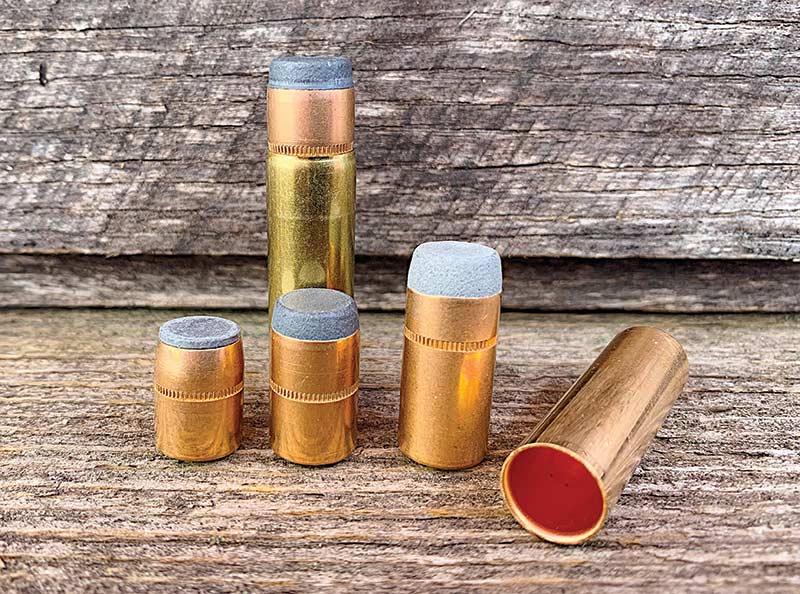
Northern Precision’s .500 bullets (left to right) — 350-grain, 450-grain and
600-grain bullets next to a drawn out .50 BMG case used for the bullet jacket.
The Load
Noody’s 500 bullets pack a punch from the large meplat he uses. Measured at 0.430″, this very blunt lead exposed nose transfers mega doses of energy. The tapered jacket allows perfect mushroom expansion without allowing the bullet to turn inside out. Tougher game like Cape Buffalo would benefit from Noody’s bonded bullets.
Looking at Big Horn Armory’s loading data, AA 1680 looked to be a good contender from what I had on hand. Using Hornady brass, Winchester Large Rifle primers and 42 grains of AA1680, I chronographed the 450-grain bullets right at 1,800 FPS. Accuracy at 50 yards using a Trijicon 6MOA red dot sight was just over an inch. With a 450-grain wide jacketed exposed nose bullet going 1,800 FPS, there’s not a lot of big game animals the bullet wouldn’t dispatch quickly.
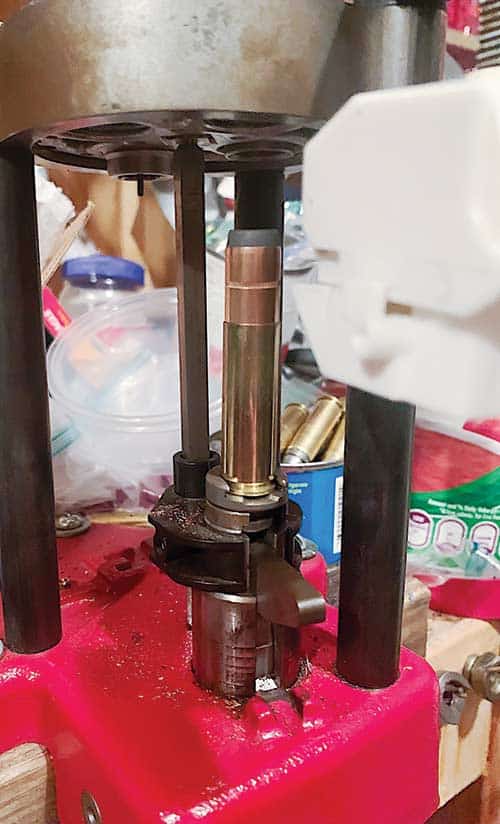
Loads were assembled using Hornady dies with Tank’s Lee Classic Turret press.
Final Word
Using custom-made bullets isn’t for everyone. But if you enjoy handloading and take pride in shooting your own ammunition, Northern Precision has the bullet for the job. The 500 S&W magnum will handle the world’s largest game. Using a traditional lever gun during your hunting endeavors is a traditionally fun way of doing so. You’ll take pride in carrying your Big Horn Armory lever gun and you’ll rejoice in taking game with it!
Teddy Roosevelt enjoyed hunting with lever guns and you will too! He called his Winchester 1895 chambered for the .405 Winchester “Big Medicine” while hunting lions and other beasts in Africa.
Bill Noody’s 0.500″ bullets will allow you to “speak quietly while carrying a big stick” when loaded with .500 S&W cartridges in a Big Horn Armory Model 89 lever gun. They are a match that complement each other rather nicely.
—————————————————————————————-Hey don’t blame me if your gun blows up by using any hand loading info on this site!!!!!!!!!!!!!!!!!!!!! Grumpy who is Lawyer proof i.e. I am broke and POOR!!!!!!!!!!!!!!!!!!!!