Category: Ammo
Categories
Teddy
Categories
What I call a pretty good start!

Categories
Caliber Basics

Oh, the 6.5 Creedmoor! Some people break out in hives at the mere mention of the cartridge, some people are head-over-heels in love with it and—somewhat surprisingly—it’s been around long enough that there are shooters who know only the Creedmoor; they’ve never tried anything else.

It’s only a cartridge, a vessel for holding primer, powder and bullet, but if you bring it up in conversation, you will find some people foaming at the mouth, with bloodshot eyes and a rising heart rate. Let’s look at four reasons to hate the 6.5 Creedmoor.
1. It’s certainly not the only target cartridge in existence. Long before anyone heard the word Creedmoor—it is actually the name of a farm on Long Island, NY where the NRA shooting matches were held—people were shooting 1,000-yard targets. Hell, before there was smokeless powder there were 1,000-yard international competitions held at the Creedmoor facility. The .30-06 Springfield was a favorite for 1,000-yard shooting, the .300 Holland & Holland won the Wimbledon Cup in 1935, the .308 Winchester was the darling of the target community, the .300 Winchester Magnum surely does the job and the .260 Remington and 6.5-284 Norma certainly represented the 6.5mm bore. There’s much more out there than just the Creedmoor.
2. It’s not old enough to be your grandfather’s cartridge. Anything the 6.5 Creedmoor can do, the 6.5×55 Swedish has been doing since the end of the 19th century. The .260 Remington is based on the .308 Winchester from 1952, and the .264 Winchester Magnum is based on the .375 Holland & Holland from 1912. The 6.5-284 Norma is based on the .284 Winchester, and at least that is over a half-century old. Based on the .30 T/C—a cartridge that nobody cared about in the first place—the 6.5 Creedmoor is way too young to be considered a viable cartridge for anything, let alone to be considered one of the best long-range cartridges ever.

3. It’s going to take over the hunting industry. The 6.5 Creedmoor is the new .30-06 Springfield. The Creedmoor is the one cartridge you should buy your kid. The Creedmoor is the new all-around North American cartridge. The Creedmoor is all any rifleman needs. Sell all your other rifles and buy a Creedmoor. No, that’s not the way it works folks. It doesn’t replace the .30-06 in the hunting fields and it never will. It’s a great choice for deer, antelope, and even coyotes and hogs. It’s most definitely on the light side for elk and moose, and while it works well on lighter African plains game, it does have its limits, especially on species like zebra, wildebeest and eland. A .30-06 will handle all of those species, with no qualms whatsoever. Is there room for the Creedmoor and other cartridges? There most certainly is; like any .25 or 6.5mm cartridge, it makes an excellent deer gun, and the 140-grain bullets can handle black bears, but there are better choices for larger game.
4. It works. There are those people who root against the Yankees, and revel in their losses, just as there are those people who find joy being mean to children and kittens. These same people love to hate the 6.5 Creedmoor. Look, the Creedmoor is an excellent target cartridge; it’s accurate, resists wind deflection, is easy on both shoulders and barrels, and is affordable. It has brought a huge number of new shooters to the range, and has been nothing but a boon for competition shooters. The Creedmoor makes hitting a 1,000-yard target much, much easier than using a .308 Winchester, and if nothing more, it’s been a wonderful shot-in-the-arm for the 6.5mm bore. Hornady, for all their excellent products over the years, have most certainly pushed the envelope of cartridge development, as well as the bullets needed to serve those cartridges. The new A-Tip, loaded in the Creedmoor, was a definite eye-opener at the Leupold Optics Academy, where the cartridge showed its virtues at 1,500 yards in terrible eastern Oregon winds. It’s also good for medium-sized game, no argument here. A well-built 140-grain bullet at 2750 fps, put in the vital organs of an animal, will always get the job done, providing it will reach those vitals. Common sense should prevail, as it always should, when choosing a cartridge to properly handle a particular game animal.

If you want to hate the 6.5 Creedmoor, so be it, but to deny the fact that it’s a good target and hunting cartridge (for its intended applications) is unfounded. It is the equal—yet not superior—of the .260 Remington as a hunting cartridge, as the target advantages of the Creedmoor won’t show up until out past 500 yards, and that’s probably too far to be shooting at unwounded game. The Creedmoor works better in the confines of a short-action magazine, as the case is short enough to handle the longer ogive bullets, where the .260 Remington has trouble with the seating depth.
Is the 6.5 Creedmoor the be-all-and-end-all cartridge? No, no it isn’t. Is it a good choice for the target shooter who wants long barrel life, superb accuracy and the ability to hit targets out to 1,500 yards and beyond? Absolutely, and it will continue be so for decades to come.

Georg Luger was an interesting man. Born into a rather privileged family on March 6, 1849, his father was a renowned surgeon, so Georg was schooled in Italy. He later studied business at studied at the Wiener Handelsakademie (Vienna Commercial Academy). In 1867 he enlisted into the Austria-Hungary 78th Infantry Regiment as a reserve officer cadet. It was here that he showed his superior marksmanship skills which garnered him an assignment to Austro-Hungarian Military Firearms School at Camp Bruckneudorf.
Soon he became an instructor there. Automatic firearms were in its infancy, but the idea fascinated Luger, and he took an active role in developing automatic loading firearms. After his military stint Luger floated around a bit surviving on jobs like an accountant at a jockey club. He met Austrian firearms engineer Ferdinand von Mannlicher during this time, and the two worked together on developing rifle magazines.
By 1891 Luger had found employment with Ludwig Loewe & Company, Berlin, Germany, eventually working his way into a design consultant. After Ludwig Loewe’s death, the company became Deutsche Waffen und Munitions Fabriken (DWM), and was the manufacturer of the Hugo Borchardt-designed C-93 pistol. Luger was tagged with demonstrating it to the U.S. Army.
Though rejected, Luger carefully recorded the criticisms the army had with the pistol and returned to DWM. Borchardt disallowed the criticisms, which included unwieldly overall handling because of its weight and nearly vertical grip, excessive recoil from the 7.65×25 mm Borchardt cartridge, as well as being too expensive to mass produce, and refused to make any design changes. The job was then given to Luger to integrate the improvements.
Luger shortened the cartridge to 21 mm, calling it the 7.65×21mm Parabellum—Parabellum meaning “prepare for war.” This allowed him to lighten and shrink the size of the toggle-link system of the C-93, shorten the stroke of the toggle, design a narrower angular grip that helped balance the pistol better in the hand and offer a more natural pointing of it. The result was the Luger Parabellum pistol of 1898.
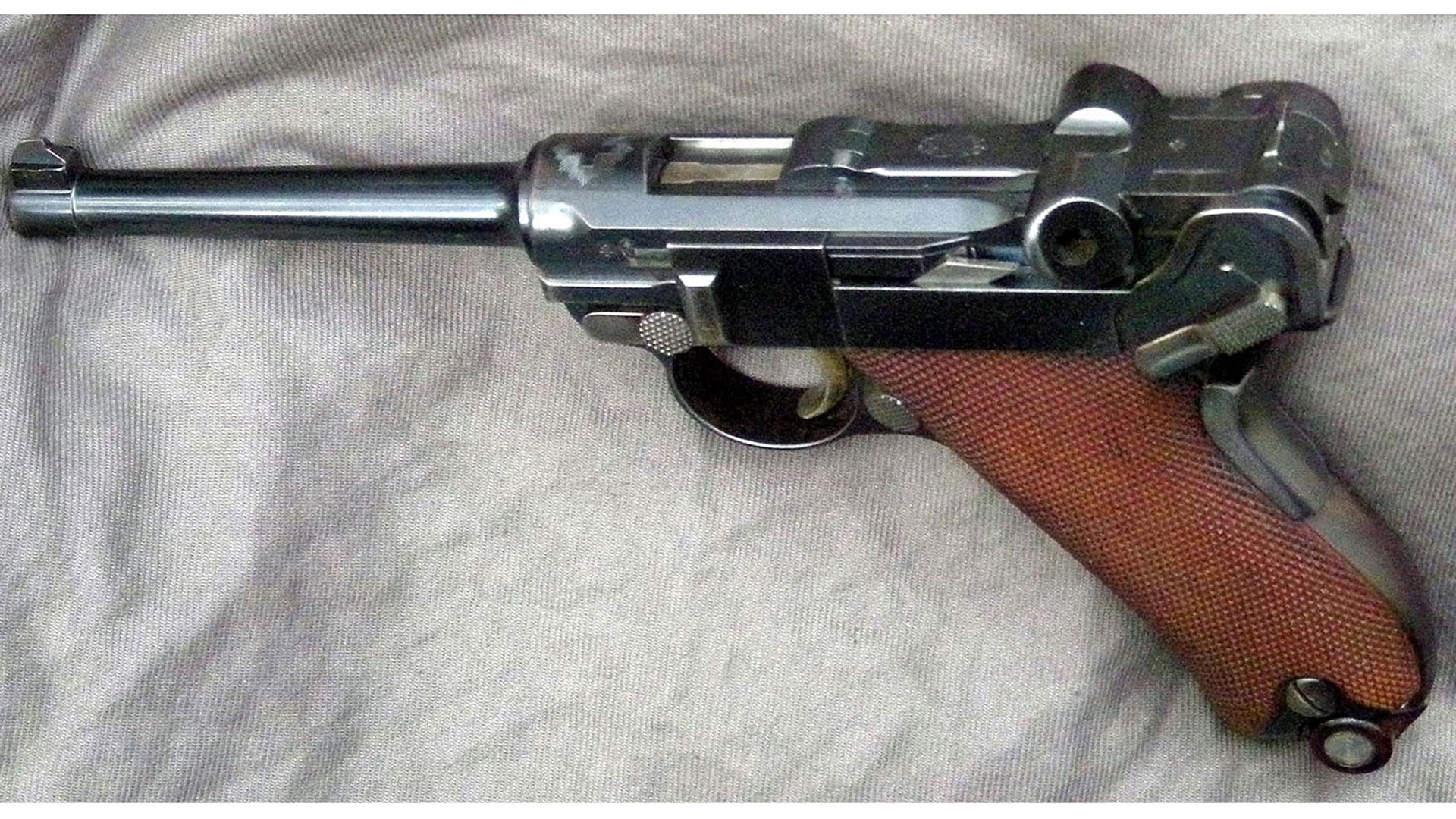 A Model 1900 Parabellum pistol. These Swiss military service pistols were introduced in 1900 and chambered in 7.65×21mm Parabellum. The engraving of the Swiss cross “in splendor” (rather than as a coat of arms) indicates that this pistol was built before 1909. Photo from Hmaag.
Production began in 1900, and Switzerland immediately adopted the Pistole Parabellum in 7.65×21mm, a.k.a. 7.65 Parabellum and .30 Luger. The cartridge has been popular in Europe and the U.S., as well as Brazil. European police agencies used this cartridge well into the 1960s, however Germany led the move to upsize the power by increasing the bullet diameter to 9 mm, the weight of the standard bullet from 93 to 116 grains while retaining a nominal muzzle velocity of 1,200 fps from a 4.25″ barrel.
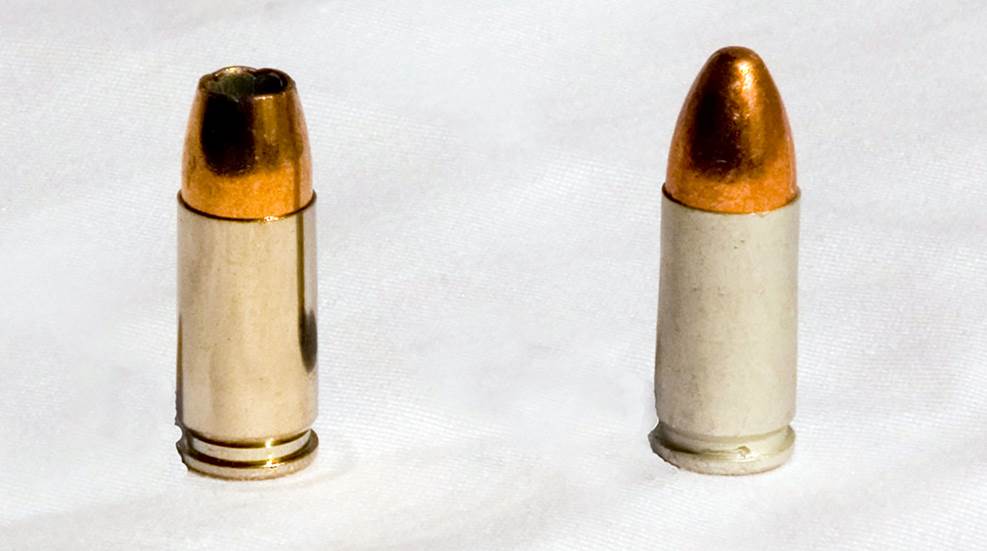
The case was shortened from a net 21.59mm to a net of 19.15mm by removing the bottleneck while retaining the taper of the parent case. The result was the 9x19mm Parabellum or 9mm Luger, developed in 1901. To say that the 9mm Luger has been a success would be a severe understatement. The cartridge is, without a doubt, the most popular pistol and submachine gun cartridge in the world since the end of World War I. It has a lot going for it. First, it is effective, especially in its military role.
Newer developments in propellant and bullet design have increased its effectiveness, greatly providing even more incentive to those needing a firearm for personal defense. Pistols made for the cartridge have not been overly burdensome, and more recent developments in sub-compact handgun design allow the full-size service pistol cartridge to be crammed into astonishingly micro-weight pistols that are easy to carry. The 9mm Luger is accurate enough for the target range and the roil is light enough to be controlled by most. The array of different firearms produced in this chambering is almost incomprehensible.
Not only has it been chambered into the beautifully engineered and produced Luger P-08 and Browning Hi-Power P35 pistols, it has been at the forefront of handgun design for more than a century. The first successful double-action, locked-breech, semi-automatic pistol, the Walther P-38, is chambered in 9mm Luger. Even revolvers, both double- and single-action, have been chambered or co-chambered in 9mm. In short, any gun enthusiast worth his or her salt that wants to shoot something prevalent and inexpensive should have something chambered in 9mm.
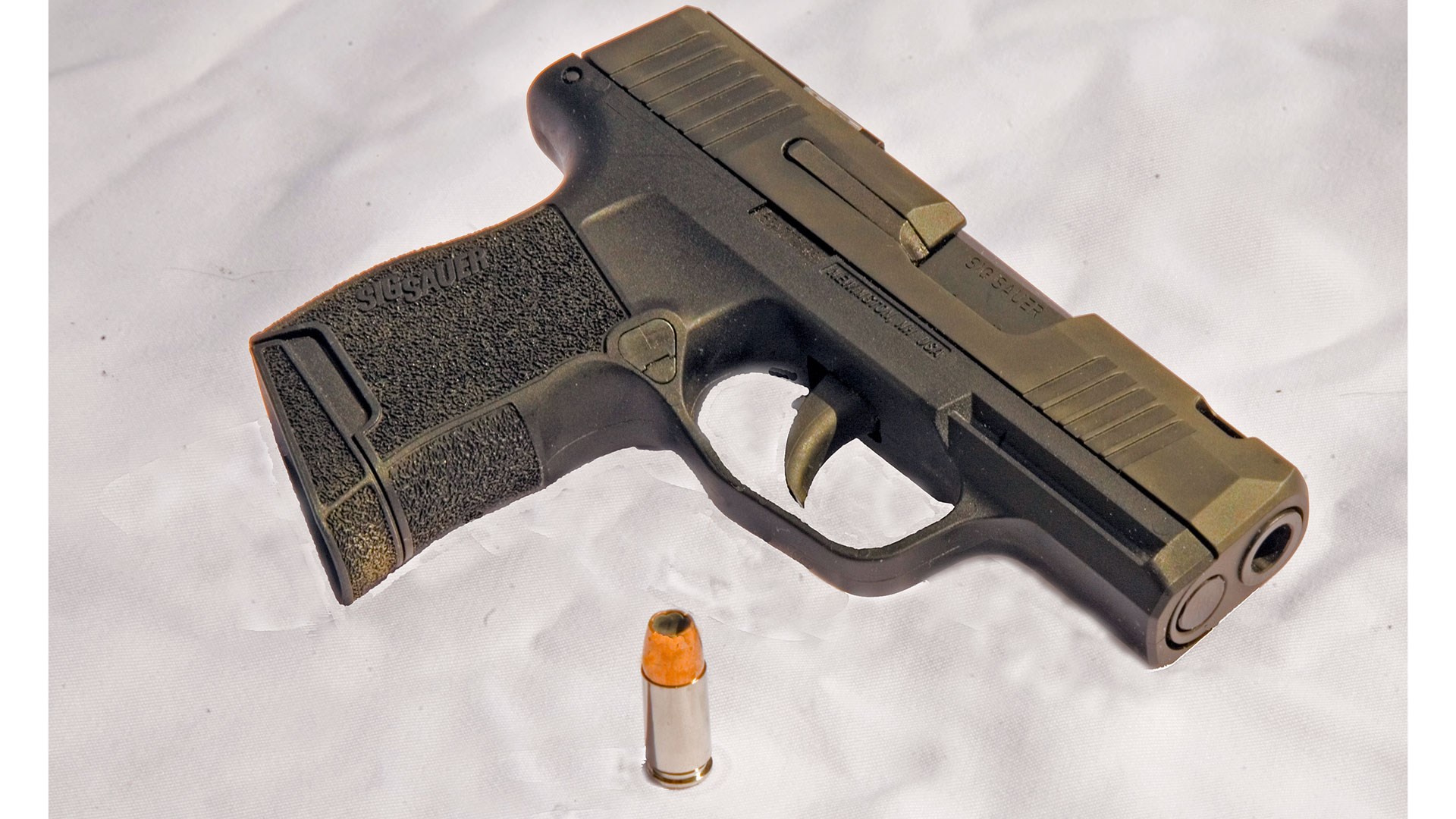 One of the many more recent sub-compact handguns to hit the market chambered for 9 mm, the SIG Sauer P365.
In the early days of World War II, Commonwealth countries developed and adopted a higher-pressure loading of the 9x19mm cartridge. Designated the 9 m/m ball MK 1z (Commonwealth nomenclature), it soon became the standard loading for modern firearms like the Browning Hi-Power and Sterling submachine guns. This load featured a 116-gr. bullet at a claimed 1,300 f.p.s. Canada put together a similar, but slightly softer load clocking in the mid-1,200s in 1955. It was adopted as the standard NATO load in 1962.
After the 1986 FBI Miami shootout between eight FBI agents and two murderous bank robbers, it was found that despite a 4-to-1 one advantage, the FBI lost two agents due in large part to the superior firepower of the criminals’ rifles versus the FBI’s .357 Mag. revolvers. A search began to find a better cartridge for revolvers as personal-defense weapons for agents and other law enforcement professionals.
Eleven years later, across the nation in North Hollywood, another pair of bank robbers stood off dozens of Los Angeles Police Department officers armed with 9mm pistols and .38 Spl. revolvers with a pair of Kalashnikovs. A dozen officers and members of the public were wounded during that 44-minute exchange. Along with other shootings, the incentive to build a firearm with a large magazine capacity and better stopping power led to the development of the so-called “Wonder-Nines.”
“Wonder Nine” is a term coined by writer Robert Shimek during this period. It referred to the “wonder” pistols of the day, chambered in 9mm Luger with double-column magazines holding at least 15 rounds. As much as anything, the popularity of the 9mm as a law-enforcement and personal-defense round in America is due to this evolution in firearms and cartridge design.
More recent bullet developments, along with some propellant improvements, have moved the 9mm ahead of such American stalwarts as the .45 ACP and .357 Mag. Mind you, the American cartridges are by no means obsolete, nor are they any less effective. In fact, some of these advances in bullet and propellant technology have rubbed off on those other cartridges. Regardless, the 102-year-old 9mm Luger is still on the throne as king of the pistol cartridges. I don’t see that changing in the near future.
Categories