Category: Ammo
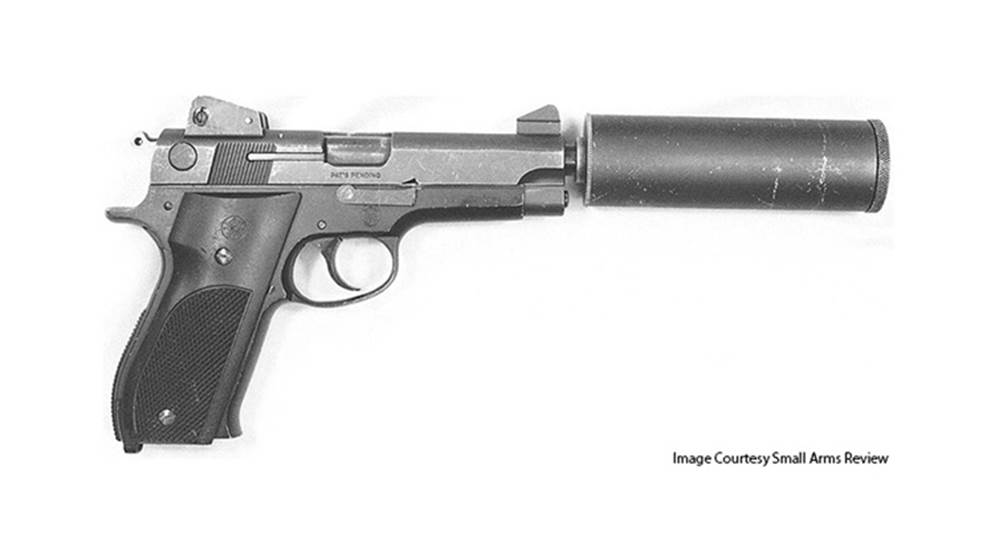
During the Vietnam war, the Sea, Air and Land special operators (SEALs) were just developing their covert techniques that would eventually make them into the finest fighting force in the world. Most of what these men did—the war stories and how they accomplished what they did—remains classified. Some facts eventually do leak out, and one of them was the existence of the “Hush Puppy” pistol, a modified Smith & Wesson Model 39 with a screw-on suppressor that was named the Mark 22 pistol by the U.S. Navy.
The SEALs were given the freedom to utilize non-standard military arms because of their special-operations status. At first, the Navy bought a handful of Model 39s for testing purposes. The fledgling SEALs got hold of them and found them useful. The Model 39 is a 28-oz. 9 mm double-/single-action semi-auto pistol with a 4” barrel and a single-column, 8-round magazine. At 11 ozs. less than the Model 1911A1, the compact 9 mm seemed to offer exactly what a covert operator needed in a sidearm. Its light weight and smaller profile were highly desired features by the early SEAL operators.
Then, as today, the guys in the field started pining for modifications to the standard Model 39. Relatively few were modified into Mark 22 status. Those modifications included a slightly longer barrel threaded at the muzzle to accept the suppressor, high-profile sights that could be seen and used with the suppressor, and a grip reconfigured to accept originally a Browning P35 double-column, 13-round magazine—later to accept a Smith & Wesson designed 14-rounder. A slide-lock switch was added to the frame to prevent the slide from operating, thus making the pistol a single shot. This was done to prevent the enemy from hearing the pistol operate. The suppressor was so effective with subsonic ammunition that the loudest part of the gun was the cycling of the slide. A detachable wire shoulder stock and holster were also part of the weapon package.
That suppressor, called the Mark 3, was 5” long and weighed 8 ozs. Because the frogmen often operated in a marine environment, a chamber plug and muzzle cap made from phenolic were included in the Mark 22 kit. Special ammunition, Mark 4, featured a 158-gr. FMJ bullet with a green tip and loaded to 900 fps. Also included as part of the kit was a spare suppressor insert tube with extra heavy rubber wipes. These wipes were reputed to be serviceable for a couple of dozen rounds or so before needing replacement.
If that seems rather fragile, remember this pistol was not intended as a quintessential self-defense weapon; rather it was designed around the need to take out sentries very quietly. SEALs were—and are—superb combat marksmen and were fully capable of neutralizing a target with a single round.
Altogether, the “Hush Puppy” Mark 22 package, including the pistol, can and a loaded 13-round magazine weighed in at 40 ounces, only an ounce heavier than a 1911A1 pistol. It was replaced in 1991 by the Mark 23 pistol, a 12-round-capacity .45 ACP made by Heckler & Koch. Though larger, heavier and more powerful than the first Mark 22 pistols, the concepts developed more than 50 years ago for a covert pistol for SEALs and other special operators still remain the foundation of such weaponry.
Very few—some say only two—original Mark 22 Hush Puppies have found their way into private collections. I was unable to find a “going rate” for such a collectable, but it would likely be astronomical.
The Model 39 Smith & Wesson remained cataloged for 27 years—1955 to 1982. Eventually Smith & Wesson made a commercial model of the Hush Puppy pistol, the 14-shot Model 59—sans the can, shoulder stock and extra-high sights. Later generations of these pistols were among the so-called “Wondernines” during the late 1980s and early ’90s.
Hush Puppy image courtesy Small Arms Review.
Is there anything more soothing than a campfire surrounded by a relaxing group of hunters vigorously discussing the pros and cons of one hunting cartridge over another? How many times have we entertained each other with heroic stories of hunts past, when “that old magnum” or something similar saved the day with an unbelievable takedown on a monster buck?
Well stoke up the fire folks and draw near. We’re about to analyze two of history’s greatest contenders.
The .300 Winchester Magnum has reigned supreme for nearly 60 years and is one of America’s most prolific cartridges. It is used by hunters, target shooters, law enforcement, and military snipers. The difference is significant between the .300 Win Mag and our other contender, the 7mm Remington Magnum. Many would be surprised to learn that even though both cartridges share ancestry from the Holland & Holland Magnum family, the 7mm Rem Mag is actually older than the .300 Win Mag. It was born from one of my favorite cartridges, the .264 Winchester Magnum, which was adapted to accept the .7mm bullet.
Colloquially known by many as the “seven em em,” it has a near-religious following among hunters. But it hasn’t enjoyed anywhere near the popularity of the .300 Win Mag. Perhaps the more common and seemingly more American .30 caliber gave the Win Mag a leg up.
RIFLE PLATFORMS

Both cartridges share a common ancestry and have identical case heads. They use the standard magnum bolt face (.532), which means that either of them can be chambered in magnum actions. The .300 Win Mag was released in the Winchester Model 70, while the 7mm Rem Mag was made for the Remington 700. These are two of the most common and widely used rifles in American. Almost every popular firearms manufacturer in the U.S. and some others offer rifles chambered in these two cartridges.
When selecting a rifle for either of these two cartridges, I would select one that has an aggressive twist rate. The way bullets are advancing technologically could bring additional heavy bullets to market, and you don’t want to be stuck with some 11- or 12-inch twist rate. For .300 magnums, I like a 9- or 10-inch twist. It’s fast enough for the heavier bullets I like to shoot. But it’s not so fast that I can’t run them hard. In the 7mm magnums, I like a twist of 7.5 to 8.5 inches for the same reasons.
AMMUNITION SELECTION

If you purchase ammunition, the popularity of the .300 Win Mag may be appealing. There are literally hundreds of different manufactures for this ammo. There are as many loads as you can think of, whether it is for hunting, match shooting, plinking, or anything else. Bullet weights range from very light 125-150 grains, all the way up to super heavy 220-240 grain. Since .30 caliber cartridges enjoy great popularity, there is a larger assortment of bullets to choose from as well.
The 7mm genre, while still quite popular, does not have quite as broad a selection. But there are more than adequate options comparable to the .300. Bullets range from 120 grains all the way up to around 197 grains. The lighter 7mm bullets are usually fired a little faster, so while the .300 Win Mag may shoot a 180-grain bullet at 2,900 fps, the 7mm Rem Mag might shoot a 160-grain bullet at 3,000 fps or more. So the energy delivered to the target is somewhat comparable.
If you twisted my arm, I’d say my first-choice factory ammunition for the .300 Win Mag would be the Hornady 195 ELD Match and HSM 180 Berger VLD ammunition for the 7mm.
BULLETS

There is something to be said about the near-mystical performance of the slenderer 7mm bullet. In weight for weight comparison, 7mm bullets have a slenderer profile than .30 caliber bullets, which typically gives them a superior ballistic performance. This may be the source of the devout following it enjoys with a near-magical ability to carry energy downrange bucking wind all along the way.
The shape and angles of a bullet, combined with its weight, are what give a bullet its ballistic characteristics. The guys in lab coats have come up with a numerical grading system and called it a ballistic coefficient. The higher the number, the better it performs against wind deflection, loss of speed, and drop.
The 7mm bullet has a higher BC compared to an equally weighted .30 caliber bullet. With the recent release of a hoard of incredibly efficient bullets, it’s not difficult to load a 7mm Rem Mag into a better than typical .300 Win Mag load. But to be fair, the .300 also has some wickedly efficient bullets that will certainly overtake the 7mm Rem Mag. This, of course, comes at a cost of higher recoil.
High BCs and magnum velocities are the spice of life. But for hunting big game like deer and elk, my preference would be the 7mm Rem Mag – less powder, less recoil, and a killer flat performance with comparable energy. Bullet weights for either .30 caliber or 7mm are well within the standard range for big game. My choice as far as bullets go would be Hornady 195 BTHP for .300 Win Mag and Sierra 183 Match King or Hornady 162 ELD for the 7mm Rem Mag.
TERMINAL PERFORMANCE

The same qualities that make these two cartridges excellent in shooting, also make them very good at killing game. Let’s look at two of my favorites: the 195 ELDM .300 Win Mag (2,930 fps) and 162 ELDM 7mm Rem Mag (3,050 fps). At 200 yards, the .300 Win Mag drops 3 inches and velocity slows down to 2,609 fps, but it still carries 2,947 pounds of energy. At the same distance, the 7mm Rem Mag drops 2.6 inches and velocity slows to 2,766 fps, and it still has 2,752 pounds of energy. Both of these sets of numbers will take down nearly any big game animal in North America.
At 500 yards, the .300 Win Mag drops 45.6 inches and the velocity is 2,165 fps, leaving 2,029 pounds of energy. The 7mm Rem Mag drops 39.8 inches with a velocity of 2,366, leaving 2,014 pounds of energy. Did you see what happened there? The 7mm Rem Mag drops almost six inches less and is 200 fps faster, with only 10 pounds less energy. If we go out a little further, it actually reverses, and the 7mm Rem Mag is ahead in drop, velocity, and energy.
You could switch things up and turn the tables another way. The reason I mentioned these numbers is that they are directly related to killing animals like elk and deer. While both of these cartridges will do the job, you can see why I might favor the 7mm. That’s not to say the .300 Win Mag won’t do the same things, just with higher recoil and more powder.
Categories
How Did 243 Win. Bury 6mm Rem?
 A .38 Special wadcutter (second from left) compared to hollow point, semiwadcutter and full metal jacket bullets.
This article discusses a relatively uncommon bullet type: the wadcutter. Though the wadcutter is not extremely rare, it is still a relatively specialized bullet type that is only utilized in a few different cartridges. Like most highly specialized bullets, the wadcutter is great at the job it was designed for: competitive shooting. However, it struggles in applications outside of its primary use.
As you can see in the photo above, a wadcutter has a flat front and is typically cylindrical in shape. Additionally, the bullet is usually all lead and has no jacket. Wadcutters are commonly (though not always) loaded so that the bullet is completely encased in the case. Some wadcutters have a flat base, but bullets with a hollow base are probably more common.
The flat shape of the nose is the primary feature of the wadcutter. Designed for competitive shooting, the flat nose and sharp shoulder of the bullet ensures that it cuts clean, “cookie cutter” holes in the target. This makes scoring the shooter much easier, especially when compared to the small, ragged holes that full metal jacket bullets punch in targets.
As you can see in the photo below, there is a dramatic difference in the size and shape of the holes that wadcutters make in a paper target compared to a regular, round-nosed, full metal jacket round.
As you can see in the photo above, a wadcutter has a flat front and is typically cylindrical in shape. Additionally, the bullet is usually all lead and has no jacket. Wadcutters are commonly (though not always) loaded so that the bullet is completely encased in the case. Some wadcutters have a flat base, but bullets with a hollow base are probably more common.
The flat shape of the nose is the primary feature of the wadcutter. Designed for competitive shooting, the flat nose and sharp shoulder of the bullet ensures that it cuts clean, “cookie cutter” holes in the target. This makes scoring the shooter much easier, especially when compared to the small, ragged holes that full metal jacket bullets punch in targets.
As you can see in the photo below, there is a dramatic difference in the size and shape of the holes that wadcutters make in a paper target compared to a regular, round-nosed, full metal jacket round.
Wadcutter bullets are almost always unjacketed and made of lead. Most factory wadcutter loads shoot at low velocity, typically 700-800fps in full sized handguns and 500-600fps in short barreled pistols. The low velocity of these rounds significantly reduces their recoil. This, combined with their generally excellent accuracy at short to moderate range, makes the wadcutter an ideal choice for people learning how to shoot.
Unfortunately, the shape of the bullet combined with the extreme low velocity of the round also decreases the effectiveness of wadcutters when used for self-defense. Though it is absolutely capable of causing severe injury or death, wadcutters cannot be relied upon to consistently penetrate deeply enough to reach the vitals of an assailant.
I’ve read about hand-loaders taking hollow-base wadcutter bullets and seating them upside down for use as self-defense ammunition, but results were often erratic. As a result, wadcutter bullets should only be used for self-defense purposes if there is nothing else available. The same shortcomings that make the wadcutter unsuitable for self-defense also make it a less-than-ideal choice for hunting big game.
Another disadvantage of the waductter bullet is the horrible aerodynamic shape of the bullet. This restricts the use of wadcutters to relatively close range (<50 yards). Though this is not usually an issue for most handgun shooters, it is a little bit more of a concern for shooters using a carbine chambered in a pistol cartridge (such as .357 or .44 Magnum).
Additionally, wadcutters are difficult to quickly load due to the blunt, un-tapered shape of the bullet. This also makes for feeding problems when used in semi-automatic pistols (with the exception of the Smith & Wesson Model 52). As a result, full wadcutter bullets are almost always used in revolvers, with .38 Special being the most common caliber.
Though full wadcutter bullets are often unreliable in semi-automatic pistols, semi-wadcutter bullets usually work much better. As you can see in the photo above, the .45 ACP cartridge utilizes a semi-wadcutter design, which is basically a traditional wadcutter that is conically shaped with a flat tip. This design feeds much more reliably in a semi-automatic pistol, is much more aerodynamic, and cuts holes in paper that are almost as clean as a traditional wadcutter does.
Semi-wadcutters generally have a shorter bearing surface than traditional wadcutters. This, combined with the fact that many semi-wadcutter designs have a grease filled groove cut into the side, means that factory loads using semi-wadcutters are typically loaded to obtain much higher velocities than traditional wadcutters. Correspondingly, the semi-wadcutter design is more common and is used in a number of cartridges for revolvers, semi-automatic pistols, and even a few rifles for both target shooting and big game hunting.
Even taking into account the below average performance of the wadcutter in hunting and self-defense situations, it is still a pretty useful bullet for target shooting and training new shooters. Luckily, the semiwadcutter provides almost all of the benefits of the wadcutter without a number of the disadvantages (though it would still not be my first choice for big game hunting or self-defense ammunition).
If you own a revolver, especially one chambered in .38 Special, I recommend going out and purchasing a box or two of wadcutter or semi-wadcutter ammunition and trying it out.
Categories
.50 BMG vs Baboon | PEST CONTROL
Categories
9mm: Underpowered and Overrated
Categories