Category: Ammo
Categories
375 Winchester Bullet Performance

Categories
WADCUTTERS WILL WORK By Kevin McPherson

Revolvers soldier on as defensive weapons because they perform certain tasks very well. As deep cover carry guns, small revolvers are arguably superior to semiautos. The revolver’s lack of sharp angles lends itself to concealment and minimizes printing.
Small revolvers tend to function more reliably than small autos when used within grappling distance—e specially when fired one handed with a less than perfect grip. It’s hard to beat a five-shot .38 like a J Frame Smith or Ruger LCR for this application. Selecting the right carry ammo to find the balance between effectiveness and user friendliness takes some thought.
Even with the advancements made with modern ammunition, it’s a challenge to make hollow points expand reliably in a short barreled .38 Special. There’s no JHP out there that will consistently perform “as advertised” from a two-inch barrel in the real world. Low velocities, intermediate barriers, and even some clothing fabrics can take the magic out of bullets designed to expand. Plus P offerings bring more pressure, blast and recoil, but cannot guarantee results.
The humble wadcutter is worth a look for this application. It won’t expand, but it will poke a clean .35 caliber hole and leave a large permanent wound channel. The sharp shoulder delivers deep penetration and is less likely to be deflected by bone than a round nose. The flat nose produces more shock and creates more trauma by crushing tissue.
Round nose or non-expanded hollow point bullets pass through tissue leaving permanent channels that are less than bullet diameter; tissue stretches to allow the bullet to pass but then shrinks back. Even at the modest velocities of factory loads (650-700 fps depending on manufacturer), wadcutters exit short barrels penetrate impressively in ballistic gel—around 16 inches. Wadcutters do this with low recoil and blast.
The fixed sights on most .38’s are regulated for standard velocity 158-grain bullets. Wadcutters thankfully hit to the same point of aim.
There are a few companies out there that recognize the value of this concept and load wadcutters for defensive purposes. Buffalo Bore offers a 150-grain hard cast wadcutter loaded to “heavy standard pressure”. They use powders with flash suppressants to minimize flash while firing.
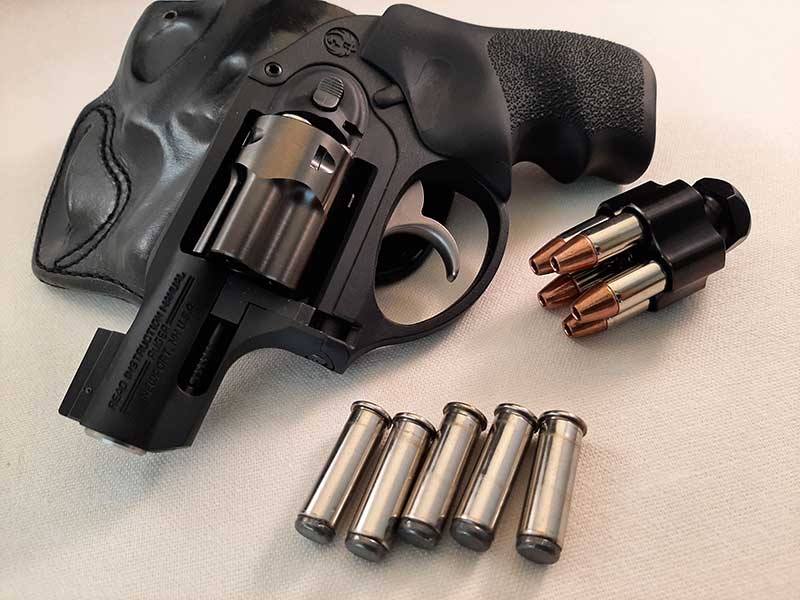
Small .38’s like this Ruger LCR make great deep cover guns. Wadcutters might be a better balance in this 13.5-ounce gun than +P JHP’s.
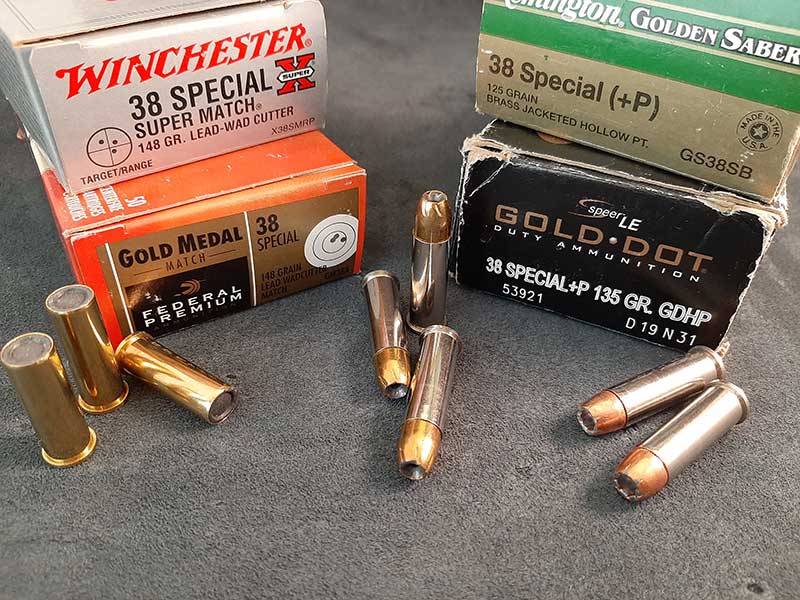
It’s hard to make even modern quality hollow points expand consistently from a two-inch barrel. Wadcutters penetrate well and produce more shock than round nose bullets with minimal blast and recoil.
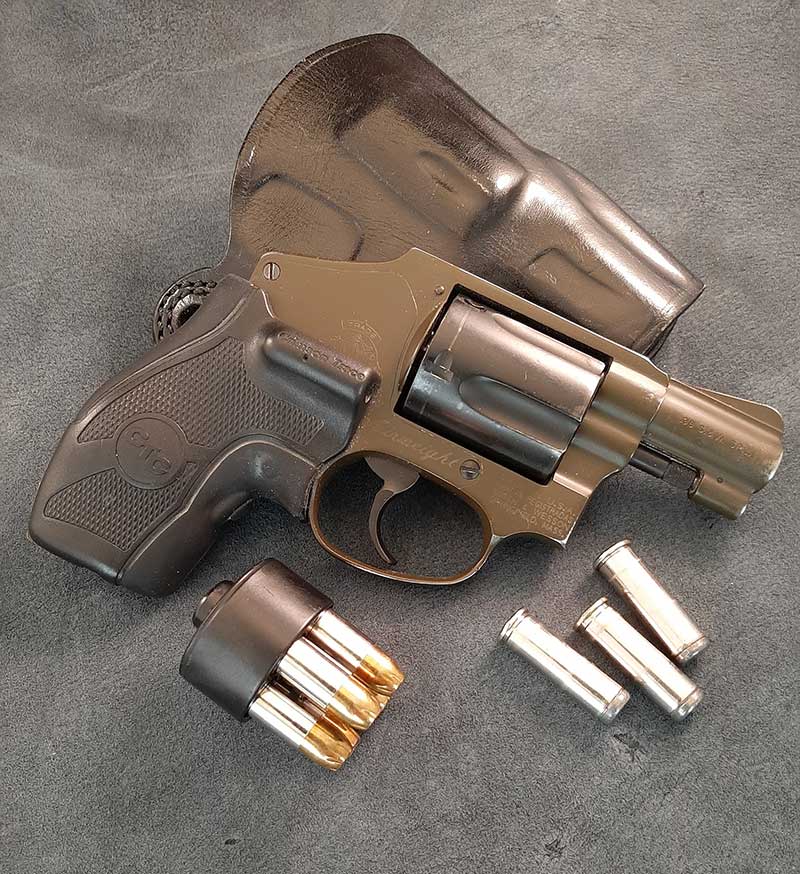
Wadcutters in the gun with round nosed projectiles in the speedloader for an emergency reload.
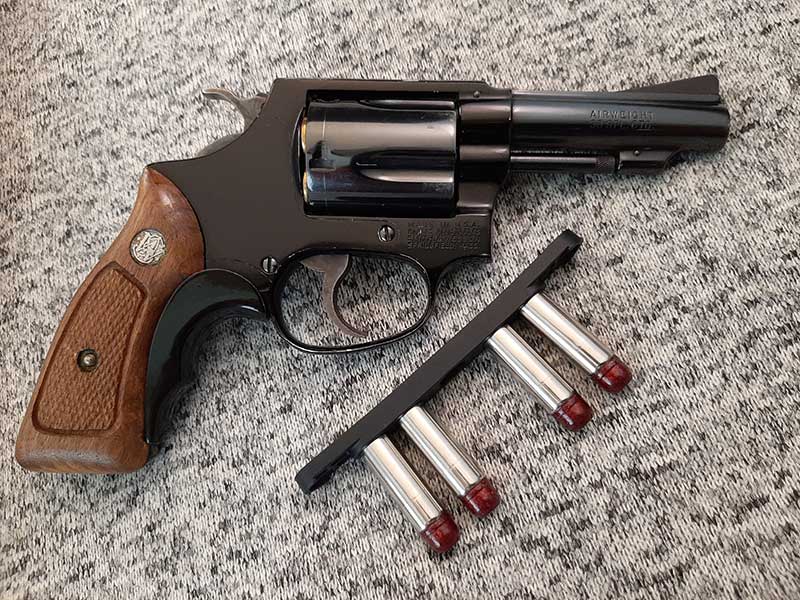
This old J frame Airweight Model 37 loaded with factory wadcutters would make a nice companion for an evening walk in most neighborhoods.
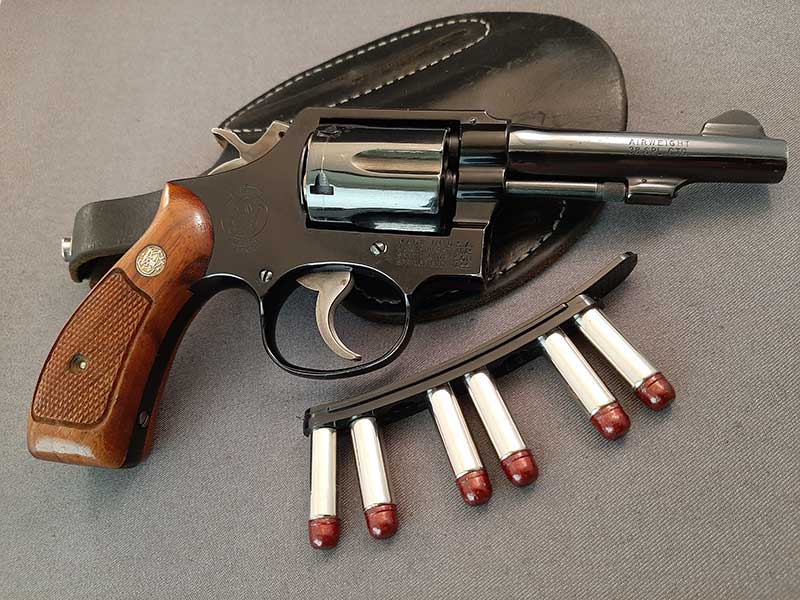
This Model 12 was never rated for +P ammo. Wadcutters hit to the sights and would be a good choice in this old light weight.
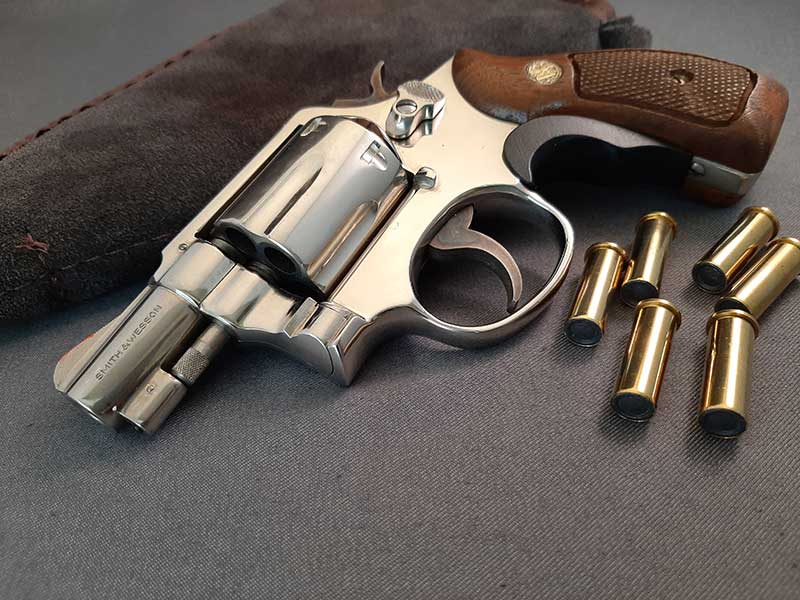
Wadcutters won’t beat up this classic two-inch Nickel Model 12—or the person shooting it.
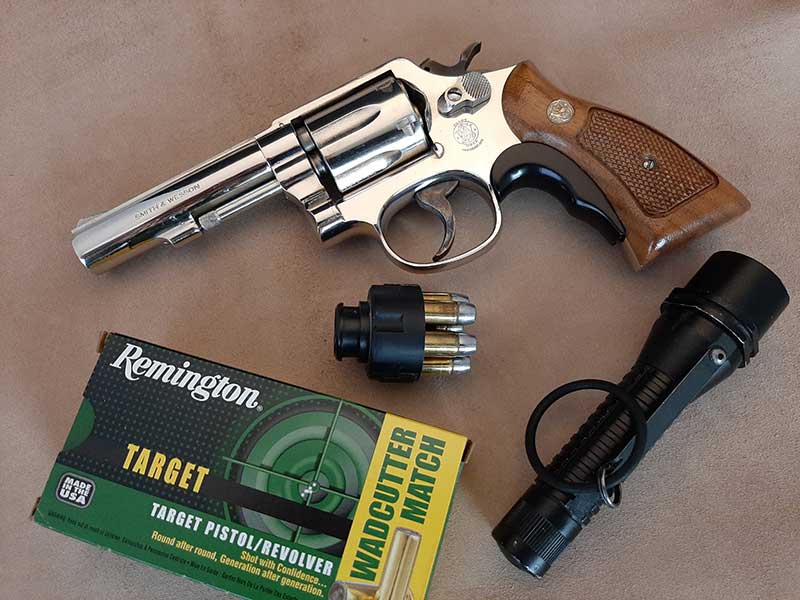
You can bet this old Model 10 will work after being stashed in a drawer for years. The wadcutters would make it easier to deliver good hits than +P JHP’s. Round nose cartridges in the speedloader if a reload is needed.
Buffalo Bore publishes velocities from actual firearms (not vented test barrels) that I have always found to be honest and accurate. BB’s wadcutter averages 868 fps from a two-inch Model 60, 961 fps from a three-inch Ruger SP101, and 1,005 fps from a four-inch S&W.
Underwood Ammunition sells a similar 150-grain hard cast wadcutter in a standard pressure loading. They use a bullet with “Hi-Tek” coating and nickel-plated cases. The polymer coating covers exposed lead with a slick finish, nickel cases stand up to corrosion better than plain brass. The velocity is listed at 1,000 fps. It’s safe to assume that speed will be close to Buffalo Bore’s from a two-inch barrel.
If you train with your five-shot lightweight .38, the benefit of standard pressure ammunition is hard to overstate. The guns may be +P rated, but shooting +P soon pegs your fun meter and moves into “this really sucks” territory for most people.
With wadcutters, you can practice with your carry ammo without getting beat up. This makes most of us much more likely to train with the little guns. Wadcutters are a great option for older guns that were never rated for +P ammo. They enhance the viability of carrying S&W Airweights like the K frame Model 12 and the J frame Model 37.
There are a few negatives with cast wadcutters, both of which can be mitigated. They will foul your gun faster than shooting a diet of solely jacketed bullets. A little more diligence is required during maintenance to keep the revolver functionally clean.
The shape of wadcutters don’t lend themselves to rapid reloads, especially while under stress. It’s a wise practice to carry rounds with a more forgiving profile in speedloaders and/or strips. If you must perform an emergency reload, a bullet with a rounded ogive makes this task much easier.
Another task revolvers perform well is as a home defense handgun that may be used by family members that are less familiar or skilled.
A four-inch Model 10 loaded with wadcutters is a gun that most people can learn to shoot well with minimal training. It can sit it a drawer fully loaded indefinitely with the expectation that it will function reliably if ever called upon.
It’s a good bet that wadcutters will work equally well if that day comes.
Categories
4 Deadly Varieties of Civil War Artillery!

It just is. My cartridge is so vastly superior to yours that I will preach its virtues at the top of my lungs in the gun shop. I will show you the photos of my latest buck, show you the targets that have tiny little groups, I will reiterate the stories of my hunting and shooting exploits for the umpteenth time—usually with the distances increasing with each telling—and will give my testimony whether you want it or not.
I will quickly and effectively prove to you why your cartridge is a waste of time (it was since its inception) and why mine makes so much more sense. Doesn’t matter to me whether or not you’ve taken your cartridge around the world—you’ve obviously been lucky this whole time, as everyone knows your cartridge shouldn’t work—my choice is simply superior.
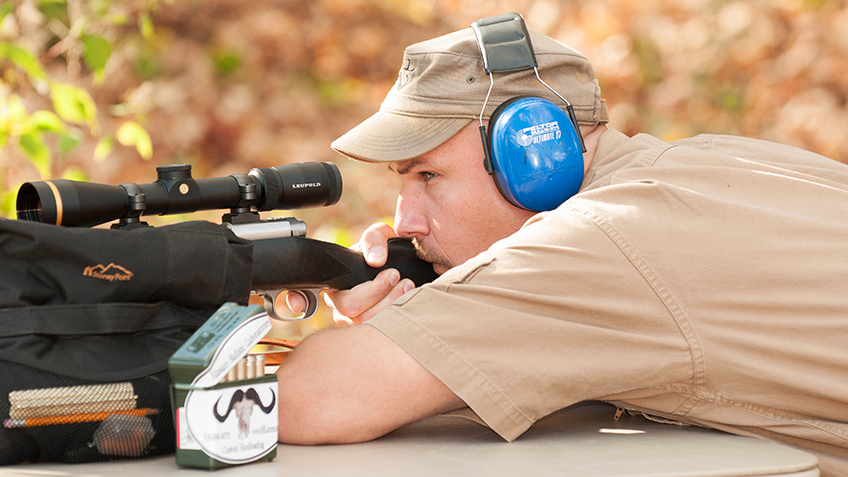
We’ve all heard this guy; whether the topic is varmint cartridges, target cartridges, deer cartridges or safari cartridges. He—or even she—can become wild-eyed, nearly rabid in the defense of their chosen miracle-writ-in-brass. Fact of the matter is, we have so many good cartridges available for any class of game animal that we’ve been splitting hairs for quite some time, quibbling over an extra 50 fps, or ½-inch of action length or whether or not the cartridge is short and fat or long and lean. I’ve had a guy argue, with bulging veins, over how his .300 Weatherby Magnum was vastly superior to my .300 Winchester Magnum; in the same argument, he admitted he’d never shot an animal over 150 yards away. Others have insisted that the .270 Winchester is, hands down, the absolute best choice for a whitetail deer, and to use any other cartridge is simply ridiculous.
Hunters have posted on social media that anyone hunting buffalo in Africa with anything less than a .500 Nitro Express is a fool who is asking for trouble and will eventually end up a pile of khaki jelly. In spite of the hundreds, if not thousands, of buffalo taken every year with what the gentleman considered to be a pop gun—the revered .375 H&H Magnum—he adamantly insisted that all those hunters using these ‘little cartridges’ were merely lucky they didn’t die.
And these aren’t rare instances; I’ve noticed that the arguing has become more prevalent lately. “The 6.5 Creedmoor is junk; my .260 Remington is such a better choice!” Mister, I highly doubt that any animal which can be taken cleanly with a 6.5mm would give a wet fart whether or not you shot it with a Creedmoor or a Remington; both are seriously accurate and are so similar in performance it just doesn’t matter. Deer don’t have a favorite cartridge; they hate them all equally.
While I do a considerable amount of writing on the subtle differences in cartridge performance, I want to stress this point: you can’t buy field performance. No matter whose name is on the headstamp, no matter how fast the cartridge may be, you must put the bullet in the right place in order for the cartridge to be effective. I’ve seen a .416 Remington in the wrong place have an animal run almost 500 yards before we could dispatch it, and I’ve seen a 6mm in the right place neatly take the same animal down. No matter what cartridge you have chosen—providing there is a sensible amount of bullet weight and velocity for the scenario—you simply must learn how to shoot it from field positions.
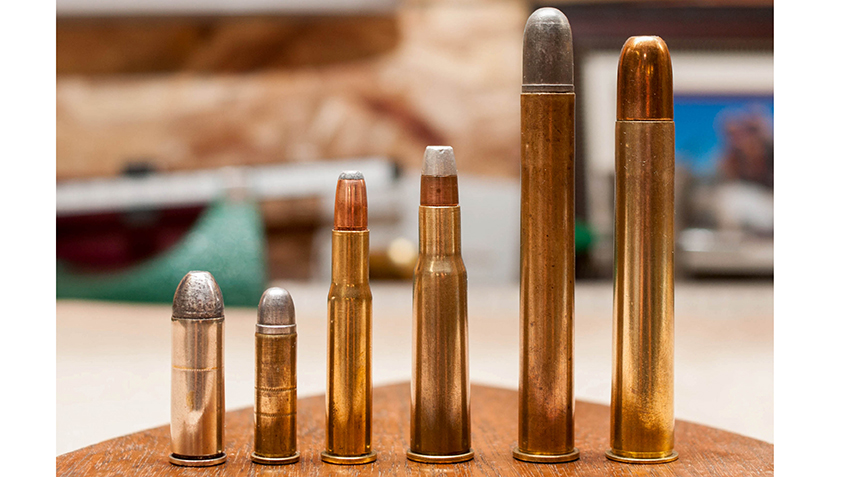
I don’t care if you like the good old .30-06 Springfield, believe in the .308 Winchester, carry a vintage .300 Savage, or prefer one of the numerous (and oft overlapping) .300 Magnums; if you can’t shoot it well, all of the energy figures and ballistic coefficient in the world won’t help you. Find a rifle/cartridge combination that is both suitable for the game animal you’re hunting and that fits you well, so you can shoot it accurately from field positions. Sight the rifle from the bench, and then abandon the bench altogether. It’s humbling, but it’s real, and will (hopefully) inspire you to become a better rifleman, through training and practice.
I’ve been fortunate enough to have made several safaris to Africa, and many of them for dangerous game. The professional hunters across southern and eastern Africa are often limited in their choice of rifles, cartridges and projectiles, and I’ve seen all sorts of stuff in the field. Their general consensus? If it’s a suitable cartridge, and (most importantly) the client can shoot it well, let’s stop talking numbers and go hunting. Those professional hunters, who you’d think would be the best source of information regarding those niggling energy figures and all the miniscule things we like to dwell upon, tend to use what’s available; however, they’re accomplished marksmen from field positions, and that makes all the difference.
Slight variations in cartridge performance are far less important than the ability to place your shot where it needs to be. My grandfather couldn’t tell you the muzzle velocity or energy figures of his only rifle, a Savage 99 in .308 Winchester, but he could put that bullet where it needed to be on a whitetail running across a corn field. Am I suggesting that the latest .300 Whizzbang Magnum is unnecessary? Not entirely, but it seems there’s a whole lot of overlap; there are only so many ways to launch a .30-caliber bullet, but if the cartridge of the month appeals to you, so be it, just so long as you understand that it’s your skills that matter most in the hunting fields. Love carrying that wildcat? Two thumbs up from me, as I love the diversity of the cartridge world, but just remember that elk don’t appreciate a wildcat cartridge any more or less than a standard cartridge.
Is my cartridge any better than yours? Probably not. Many of the best hunting cartridges have been with us for over a century, performing even better now with modern bullets than they ever have. Marketing is marketing, and will always be a factor, but I can effectively hunt the world with cartridges that were designed a hundred years ago. As the old phrase goes: “It’s the Indian, not the arrow.” Our arrows are better than ever, let’s become better Indians
.png)