Category: Allies
When the Confederates fired the opening rounds of the Civil War on Fort Sumter, South Carolina, in April 1861, the U.S. Marine Corps comprised 46 officers and 1,755 enlisted men; by 1916, the year before the United States declared war on Germany, those slim numbers had increased only to 348 and 10,253.
Such a small organization accommodated a variety of eccentrics, any number of whom provided grist for either the accolades or complaints of congressional watchdogs or members of the Fourth Estate in search of a newsworthy story. Scrutiny of personnel records and application of the rigid tenets of political correctness may provide cause to wonder just how such an obstreperous lot managed to play such a prominent role in the shaping of the American Empire.
War crimes, or violations of the normal laws of land warfare, rarely have been politically correct. Three such instances involved Old-Corps Marines. The celebrated case of Major Littleton Waller Tazwell Waller remains the best known. On 28 September 1901, a group of Filipinos on the island of Samar wiped out a company of the 9th Infantry at Balangiga. In response, the military governor of the Philippines ordered the formation of a suitable force under Army Brigadier General Jacob H. Smith to seek retribution. Caught in the spirit of the moment, the admiral commanding the Asiatic Fleet offered to provide a battalion of Marines.
The colonel commanding at Cavite selected Major Waller, one of the Corps’ most spirited and pugnacious officers, to lead the 15 officers and 300 enlisted men. Smith’s instructions to Waller left no doubt as to the severity expected during the punitive campaign: “The more you kill and burn, the more it will please me.” Stunned, Waller asked “Hell Roaring Jake” Smith just what constituted a Filipino insurgent targeted for elimination and received the grave reply that “any Filipino male over age ten” satisfied that criteria.
Waller and his Marines accomplished their mission, burning villages and shooting Filipinos. Then, Waller split his small force to map potential telegraph routes across the dense interior of southern Samar. Waller, 4 of his own officers, 50 enlisted Marines, a lieutenant and a handful of soldiers from the 7th Infantry, 2 native scouts, and 33 native bearers struck out across Samar. As conditions worsened, and the force dwindled—by then, 11 of the Americans had died along the jungle trail—Waller grew increasingly convinced that the Filipino bearers were bordering on mutiny. After one of them attempted to strike an officer with a bolo, Waller ordered 11 of the Filipinos executed.
Already under intense criticism for its harsh colonial policy in its newfound possession, the administration of President Theodore Roosevelt looked askance at the incident. Returning to Cavite, Waller found himself facing a court-martial, convened hastily to put the matter to rest. Fortunately for the combative campaigner, another Marine had witnessed Smith’s exhortation, and the court found Waller not guilty.1
Almost two decades later, the worst Leatherneck atrocity of the colonial infantry era failed to rise to public scrutiny outside the Department of the Navy. In early fall 1918, the brigade commander in Santo Domingo brought charges against Captain Charles F. Merkel. The German-born former enlisted Marine—known by the nom de guerre “Tiger of Seybo” for a predilection to burn down the homes of restless natives—was charged with cutting off a prisoner’s ear, then slicing his chest and pouring salt into the wound.
Worse, Merkel then ordered the luckless Dominican confined for three days without food, water, or medical attention. Had the matter gone to trial by court-martial, the alleged war crime might have tarnished further the performance of Leathernecks in their role as a colonial constabulary. But Merkel set the matter aside himself with the simple expedient of his own suicide, supposedly with a pistol containing a single bullet provided by some of his fellow officers in hopes of saving the Marine Corps from embarrassment.2
The specter of war crimes committed by the Marines of the Old Corps emerged again in the Caribbean barely a year later. In 1919, Major General Commandant George Barnett expressed shock after reading a defense counsel’s allegation that “indiscriminate killing of natives [in Haiti] by Marines” was commonplace. Barnett followed his review of the transcript of the court-martial by ordering an official investigation and then sending a “confidential and personal” letter to the commander of the brigade in Haiti, Colonel John H. Russell, expressing his consternation.
Within a year, however, criticism of Yankee military intervention in the western half of Hispaniola increased markedly. A journalist returned from Haiti to report that “1 have heard [U.S. Marines in Haiti] talk of ‘bumping off gooks’ as if it were a variety of sport like duck hunting.”
The reporter’s material inflamed the African American community and their liberal supporters, and his charge that many Marines in Haiti were “ignorant and brutal” gained currency. In the closing days of the administration of President Woodrow Wilson, the allegation became a cause célèbre during the presidential election of 1920.
As presidential hopeful Warren G. Harding continued to arouse crowds with the statement that “the Marines in Haiti, for the most part, are ignorant and brutal,” the Secretary of the Navy ordered Barnett to submit a written report. Tire canny former Commandant included a copy of his “letter of caution” to Russell in the report, but the usually introspective Josephus Daniels failed to note the inflammatory correspondence.
An intrepid journalist spotted Barnett’s letter, however. Republican rhetoric heated up quickly following publication of the new material, and Harding thundered moralistically that “thousands of Haitians have been killed by American Marines.”3
While charges of Marine misconduct slipped quietly into the dustbin of history, the allegations underscored the difficulties involved in the Corps’ new role as a naval constabulary for the American Century. Yankee altruism may have generated warm and fuzzy feelings for government 0 officials and at least a portion of the body politic, but the uniformed instruments of U.S. foreign policy often demonstrated a lack of enthusiasm.
Increasingly, Marines grew to loathe the tours overseas in harsh tropical climates—usually two to two-and-one-half years—and the frustrations of dealing with less-than-appreciative native populations.
Lieutenant Colonel Earl H. “Pete” Ellis sputtered that Waller “had only done what others had done—except that he failed to kill them all—if he had done the latter, who would have told the tale? Whatever you do; do thoroughly!” Racial and ethnic slurs appeared frequently in Ellis’s personal correspondence thereafter during his two tours in the Philippines and a later posting to the Dominican Republic.
An essay that Ellis penned offering his personal prescription for colonial infantry duties was considered so offensive, i.e., politically incorrect, that the Secretary of the Navy refused to approve its publication.
Another veteran tropical campaigner of the era, Frederick M. “Fritz” Wise, did manage to provide a cynical postscript in print: “There was no question that some rough stuff had been pulled in Haiti since the first American occupation. There was no question that some of it had been justified . . . Haiti had been brought to peace by men fighting and living amid conditions that people back home could never picture.”1
Although a variety of problems buffeted the Marine Corps in this era, nothing plagued the Commandant and his senior officers quite so much as their enlisted force. The Rudyard Kipling of the Old Corps, John Thomason, described the other ranks of the era in hagiographic if not politically incorrect prose.
He noted that most smoked or chewed rank cigars, drank most anything containing alcohol—even preferring hair tonic over post-exchange beer, which was described simply as “horse piss.” They swore with a studied and colored persistency, and acted as if no life existed outside their own.
But Thomason softened his characterization of these unhealthy lifestyles, possibly immoral traits, and anti-intellectual perspectives by noting that the Marines of the era understood their weapons and how best to employ them. If they did not know every Leatherneck by name, they at least knew every officer by name and reputation.
Scrutiny of records for that period suggests an enlisted force plagued with faults that would make today’s social engineers in the Pentagon wince with righteous indignation. The Old Corps recorded a scandalous desertion rate. Low pay, excessive hours of tedious guard duty, poor food, life in unsanitary barracks, and sleeping on straw-filled mattress ticks contributed to the problem.
It was a dismal existence. After a night of heavy drinking in a saloon or horizontal refreshment in a bordello near their barracks, many Marines found it easy to remain absent-without-leave (AWOL). Successive Commandants argued, mostly unsuccessfully, for increases in funds and manpower to alleviate the situation. Secretaries of the Navy, Presidents, and Congress usually turned a deaf ear to the entreaties.
A sample from the records of the era’s enlisted force suggests the difficult, almost Herculean, problems faced by senior Marine Corps officers:5
★ Christopher Nugent enlisted in 1858, sewed on his corporal’s stripes two years later, then deserted but was apprehended and reduced to private. He re-enlisted in 1862, was promoted to corporal the next day and sergeant the following month, but deserted again in 1865 and never returned to the Corps.
★ John Morris enlisted in 1880 and served in the USS Lancaster for less than two years before deserting.
★ Daniel Campbell enlisted in 1896. Before his discharge in 1901, he had amassed seven offenses for drunkenness, disorderly conduct, and absences without leave.
★ Oscar Field enlisted in 1896 and re-enlisted in 1901. During his checkered career, he went from private to corporal and back to private in 1902, and sergeant and orderly sergeant a year later. After seven instances of AWOL and drunkenness, the Marine Corps discharged him for “mania” and as “unfit for duty.”
★ Pomeroy Parker enlisted in 1892 and re-enlisted in 1897. His record of AWOLs and drunkenness resulted in 20 days’ confinement in double irons, but the punishment failed to dissuade his untoward attitude toward military discipline. As Pomeroy’s obstreperous behavior worsened, a court-martial awarded him a dishonorable discharge in 1899.
★ Joseph F. Scott enlisted in 1888, re-enlisting for what appeared as a full-service career. Between 1897 and 1900, his record of frequent AWOLs and drunkenness resulted in just as frequent reductions to private, but he always regained his lost stripes. Caught sleeping on post, probably intoxicated, Scott was ordered by court-martial reduced to private and confined for a year. Within a year of his release from the brig, he had sewn on his corporal’s stripes again; shortly thereafter, Scott left the Marine Corps with a mark of “excellent” for character.
★ Walter S. West enlisted in 1897, earned a stiff sentence from a summary court-martial a year later, and then a bad-conduct discharge in 1899.
★ John M. Adams, a Harvard drop-out from the Class of 1893, enlisted in 1893 and re-enlisted in 1897 and 1906. Adams received a medical discharge two years later. But in 1917, the Army commissioned him in the coastal artillery.
★ James Cooney enlisted in 1889 and re-enlisted successfully to serve until 1903. His record reveals 5 offenses of AWOL, and 15 for drunkenness.
★ Thomas W. Kates enlisted in 1899, deserted in 1903, and never returned to the Corps.
★ Harry C. Adriance enlisted in 1898 and re-enlisted in 1903. A year into his second enlistment, Adriance’s frequent offenses of AWOL and drunkenness resulted in a bad-conduct discharge.
While this litany of scandalous behavior appears not at all unique for a good portion of the Old Corps enlisted Marines, what marks the Leathernecks selected for this sample as unusual is that all of them earned the Medal of Honor.
Various Commandants sought initially to improve the quality of officers as a means to correct the performance and decorum of the Marine Corps. But a consistent and reliable source of new officers, second lieutenants that served satisfactorily and remained in uniform for a full-service career, never materialized despite the entreaties of every Commandant from Archibald Henderson to Charles G. McCawley.
Between 1798 and 1902, a total of 718 men earned commissions. Of that number, 418 failed to remain in uniform until retirement (151 died or were killed in duels, 47 were dismissed or cashiered for a variety of transgressions, and 220 simply resigned to return to whatever pursuit their affluent parents might suggest). The deplorable situation earned the ire of congressional critics and the barbs of journalists, some of whom suggested that “USMC” meant “useless-sons-made-comfortable.”6
Hope sprang anew, albeit briefly, during the dog days of summer 1882. As Congress wrestled with the problem of a burgeoning list of Navy officers with too few vacancies in a fleet diminishing in size, it opted to release most of the graduates of the U. S. Naval Academy from a postgraduation obligation of Navy service.
But a caveat to the unpopular legislation allowed the Marine Corps access to the midshipmen no longer needed in the Navy. Young men who had studied for four years in a military environment and then toiled at sea for an additional two years appeared as a suitable remedy for the ills plaguing the officer corps of the smaller of the naval services. But many of the graduates of that era commissioned in the Marine Corps, from 1883 until 1896 (when the Navy began to use every graduate to man a rapidly expanding fleet), adopted mannerisms and lifestyles differing little from the officers that came before them.
Of the 11 midshipmen from the Class of 1881 who entered the Marine Corps, one drowned and another resigned his commission. Of the remaining nine graduates who completed or attempted to complete full-service careers, i.e. serving until age 64, four demonstrated symptoms of alcohol abuse. Charles A. Doyen received a series of unsatisfactory fitness reports for binge-drinking and unauthorized absences from duty. In an incredible act of contrition and penitence, he sent a pledge of abstention for the remainder of his time in uniform to the Commandant of the Marine Corps as an explanation for his unsatisfactory fitness report. Within a few short years, both Doyen and his Naval Academy classmate, James E. Mahoney, earned courts-martial for drunkenness.
Constantine M. Perkins’s erratic behavior, attributed to alcohol abuse, prompted a medical board to declare him temporarily unfit for duty. Another medical board sent Henry C. Haines into premature retirement when his bouts of delirium tremens became so severe that he no longer could perform his duties adequately. While his fondness for distilled spirits never resulted in an unsatisfactory fitness report, Lincoln Karmany was wont to growl “there may be a few good men who don’t drink, but they’ve got to prove it.” The colorful and hard-drinking Karmany earned the ire of the wardroom in the USS Indiana by his constant references to the battleship’s captain, Robley D. “Fighting Bob” Evans, as “Frightened Bob.”7
Relations with the opposite sex rarely troubled civilian officials and senior officers within the Department of the Navy. A time-honored expression—“if the Marine Corps wanted you to have a wife, it would have issued you one”—rang true. Hardly any of the enlisted men were married, and if they were, their wives lived off-post and received no special allowances or remuneration based on their husbands’ occupations.
Because of the frequent postings to sea or overseas, most junior officers eschewed marriage until at least reaching field-grade ranks. The system fostered sexual promiscuity. Medical officers treated the results with professional aplomb and perhaps with a wink and a nod.
When Louie Cukela reported for his physical examination in anticipation of a battlefield commission following his heroism at Belleau Wood in 1918, Navy doctors found him infected with gonorrhea. Three years later, mustering for his physical examination for promotion to first lieutenant, doctors noted that the Marine had contracted syphilis.
The colorful Cukela retired as a major in 1940 after an illustrious career that included numerous awards: the Medal of Honor and the Silver Star; France’s Medaille Militaire, Legion d’Honneur (rank of Chevalier), and three Croix de Guerre; Italy’s Croce al Merito di Guerra; and Yugoslavia’s Commanders’ Cross of the Royal Order of the Crown.
He suffered two wounds, both at the hands of the enemy and not to be confused with injuries sustained in nocturnal trysts with les femmes fatale. But Cukela, like many of the occasionally flawed and politically incorrect Marines of the Old Corps, proved militarily correct when the klaxon of war sounded.8
In the Machiavellian scenario involving the selection of a new Commandant of the Marine Corps in late 1913-early 1914, presided over by the aforementioned indefatigable and boring moralist, Secretary of the Navy Josephus Daniels, the tenets of political correctness came into play fully to determine the selection of the winning candidate.
A veteran and colorful campaigner, the also aforementioned Littleton W. T. Waller, had the best hand to play with the endorsement of all 31 Democrats in the Senate. But his record of harsh treatment of the Filipino people conflicted sharply with the Wilson administration’s announced policy of a more forward policy toward its far-flung possession and made Waller’s appointment politically incorrect.
The incumbent’s hand-selected successor, Lincoln Kar- many, had turned his wife in for a younger model, a circumstance that enraged genteel naval circles of the era. Secretary Daniels’s pungent diary entry during the deliberations leaves no doubt as to why Karmany lost; “Karnody [Karmany]-divorced.”9
Thus, a variety of scenarios involving what a later generation would call political correctness impacted on the Marine Corps. The end of the era of the Old Corps was fraught with irony, as both the reminder of a decade-old incident of harsh colonial repression combined with a fundamentalist, North Carolinian’s concept of morality to deny the Corps’ highest post to two veteran campaigners.
And thus, the ultimate irony appears in Secretary Daniels’s selection of his third choice among the eight colonels of the line on his list. While claiming in his published memoirs to be reluctant to select George Barnett because of the absence of powder burns and tropical sweat stains on his uniforms, Daniels bowed to Republican pressures.
In his slightly more than six years in office, Barnett oversaw the largest increase in personnel numbers between the founding of the Marine Corps and its expansion just prior to World War I. And the Marines of that era, many of whom appeared as manifestations of the politically incorrect Old Corps, won fresh laurels that remained unsurpassed until the amphibious campaigns of World War II in the Pacific.
1. Vernon Williams, “The U. S. Navy in the Philippine Insurrection and Subsequent Native Unrest” (Ph.D. dissertation, Texas A & M University, 1985), pp. 217-25. The reports of the Commandant of the Marine Corps to the Secretary of the Navy, 13 February and 30 September 1899; Entry 6, Press Copies of Letters, Endorsements, and Annual Reports to the Secretary of the Navy, RG 127, Records of the U. S. Marine Corps, National Archives and Records Administration (hereafter NARA) contain Waller’s version and the Marine Corps’ endorsement of his actions.
2. Merkel file, Reference Section, Marine Corps Historical Center; General Correspondence, file 26283-4352-2, parts 1 & 2, Records of the Secretary of the Navy, RG 80, NARA; and Merkel file, Entry 62, Records of Marine Corps Boards of Examination, RG 125, Records of the Judge Advocate-General of the Navy, NARA.
3. Herbert J. Seligman, “The Conquest of Haiti,” The Nation, 10 July 1920, pp. 35-36; George Barnett to John H. Russell, 2 October 1919, container 2, Barnett MSS, Marine Corps Research Center, Quantico; Barnett’s notes, n.d., container 3, Denby MSS, Burton Collection, Detroit Public Library; Barnett’s statement, 17 October 1923, Barnett 1921 file, container 64, Josephus Daniels MSS, Manuscripts Division, Library of Congress; and E. David Cronin, ed., The Cabinet Diaries of Josephus Daniels, 1913-1921 (Lincoln: University of Nebraska Press, 1963), pp. 553-58.
4. Earl H. Ellis to his mother, 21 May and 29 June 1902, folder 6, container 1, Ellis MSS, Marine Corps Research Center; Secretary of the Navy to Ellis, 19 February 1920, General Correspondence, file 19685-2120, RG 80, Records of the Secretary of the Navy, NARA; and Frederic M. Wise and Meigs O. Frost, A Marine Tells It to You (New York: Sears, 1929), p. 334.
5. Service Records of Enlisted Men, 1798-1895, Entry 76, Records of the U. S. Marine Corps, RG 127, NARA.
6. Richard Strader Collum, History of the United States Marine Corps (Philadelphia: Hamersley, 1903), pp. 430-49; “Status of Marine Corps,” Army-Navy Journal, 24 (25 December 1886): 428; and Jack Shulimson, The Marine Corps’ Search for a Mission, 1880-1898 (Lawrence: University Press of Kansas, 1993).
7. On Karmany, see Robert D. Heinl, Jr., Soldiers of the Sea: The United States Marine Corps, 1775-1962 (Annapolis: Naval Institute Press, 1962; reprint ed., Baltimore: Nautical &. Aviation Publishing Company of America, 1991), pp. 104, 153; on the records of the Marines from the Class of the Class of 1881, Records of Examining Boards of Marine Corps Officers, Entry 62, Records of the Judge Advocate-General of the Navy, RG 125, NARA; for the courts-martial of Doyen and Mahoney, see Army-Navy Journal, 20 May 1905; for Perkins’s erratic behavior, see Littleton W. T. Waller to John A. Lejeune, 1 July 1916, reel 8, Lejeune MSS, Manuscripts Division, Library of Congress and John A. Hughes’ response to an unsatisfactory fitness report submitted on him by Perkins in Hughes’ file, Entry 62, RG 125, NARA.
8. Louis Cukela file, Entry 62, RG 125, NARA.
9. Cronin, ed., The Cabinet Diaries of Josephus Daniels, 1913-1921, p. 83. See also, Senator Claude A. Swanson to President Woodrow Wilson, 2 December 1913, Marine Corps Commandant Candidates file, Container 531, Daniels MSS, Manuscripts Division, Library of Congress; and Josephus Daniels, The Wilson Years: Years of Peace, 1910-1917 (Chapel Hill, NC: University of North Carolina Press, 1944), pp. 322-23.

When it comes to recognizing and responding to a bear attack, few people have as much experience as Alaska’s Steve Nelson, a former research geologist for the U.S. Geological Survey who’s spent the last 41 years teaching bear defense courses in the Last Frontier. As a geologist, Nelson has killed four bears in defense of life and property (DLP), including two black bears and two grizzlies. Nelson continues to teach a bear defense course in Alaska, instructing geologists and representatives from other government agencies how to operate a wide variety of firearms platforms in a bear defense situation.
In terms of firearm selection, Nelson said it’s really about delivering a few well-placed shots on target in a short timeframe. The more energy and penetration the better, provided you don’t select a firearm that’s too powerful for you to adequately manage. As the bear charge drill in his course demonstrates, the average bear attack will happen at 50 yards or less with an 800-pound animal moving at 30 mph. At that distance, a shooter has roughly four seconds to make a charge-stopping shot, which requires a steady hand under intense pressure.

Among firearms platforms, a rifle delivers more energy and is effective to greater distances, making it the first choice. A 12-gauge shotgun and slug will deliver impressive energy and is effective to moderate ranges. A handgun is worn on your person, however, and is invaluable because it stays with you, whether you’re answering nature’s call or stopping to field dress a game animal. Like the Spartan’s xiphos blade, the handgun is a much shorter secondary weapon intended for up-close-and-personal encounters.
Over the decades, several cartridges have proved themselves as worthy against the nastiest bears North America has to offer. Here’s a look at the eight best charge-stopping bear cartridges ever made.

1. .45-70 Government
First adopted by the U.S. military in 1873, the .45-70 Government has been one of the longest-standing big-game cartridges of all time. It’s also been incredibly popular among Alaskan hunters and guides, especially in lever-actions like Marlin’s 1895 Guide Gun, which is compact, fairly lightweight and highly maneuverable in close quarters. It’s also capable of sending a massive projectile, like Buffalo Bore’s 430-grain hard-cast bullet, at roughly 2000 fps and 3,600 ft.-lbs. from the muzzle. Talk about stopping power.
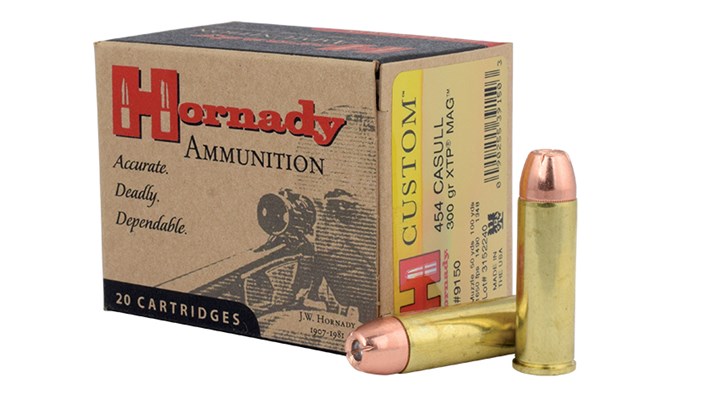
2. .454 Casull
Developed by Dick Casull and Jack Fulmer in 1957, the .454 Casull is a dangerous game hunter’s dream come true. One of the more powerful handguns available today, the .454 is capable of pushing a 300-grain Buffalo Bore bullet at 1650 fps with 1,813 ft.-lbs. of energy at the muzzle. Nelson killed one of his charging grizzlies with a .454 Casull, which he says is one of his favorite choices for bear defense. Ruger chambers the .454 Casull in both the Super Redhawk with a 4-inch barrel and the Alaskan in a 3-inch variant, both of which are compact and easy to draw when things get up close and personal. Is it fun to shoot? Not at all. Nelson says after about 20 shots, his wrist starts to swell and he can no longer shoot. The beauty of the .454, however, is that you can practice with .45 Colt rounds and save yourself a bit of recoil trauma.
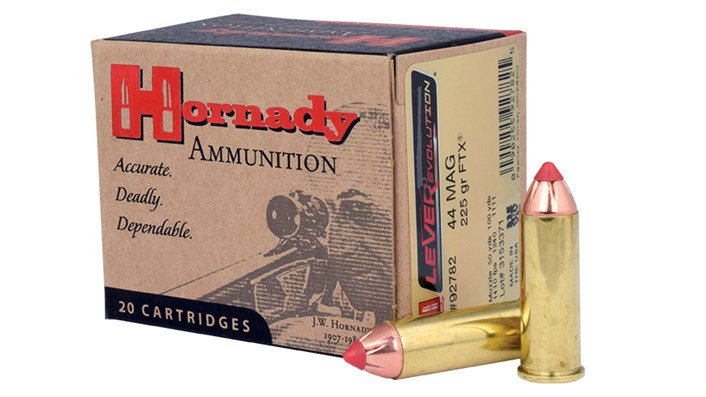
3. .44 Remington Magnum
Considered by many to be the minimum for big bear defense rounds, the .44 Remington Magnum was first introduced in 1955 for revolvers and gained widespread popularity in the 1970s thanks to Dirty Harry. While some may consider it the minimum, it’s plenty powerful enough to stop an onerous bear. A 240-grain +P Buffalo Bore projectile carries roughly 1,600 ft.-lbs. of energy at 1550 fps, which is more than double that of the 10mm and four times more energy than the 9mm. Available in shorter versions like the Smith & Wesson 629 with 4-inch barrel, the .44 Mag. has a well-deserved reputation as a charge-stopper.

4. .375 H&H Magnum
One of the original belted, rimless magnum rifle cartridges, Holland & Holland’s .375 is not only considered one of the best cartridges for hunting Africa, it also has a proven track record for lethality on large-bodied game in Canada and Alaska, including moose and bear. Popular among Alaskan guides and hunters, the .375 is capable of launching a 270-grain bullet at 4,300 ft.-lbs. and 2700 fps, thus delivering massive energy on target. As Nelson points out, the first shot may end the charge but doesn’t always kill the bear, which means it’s handy to have a rifle that can make the longer follow-up shot.
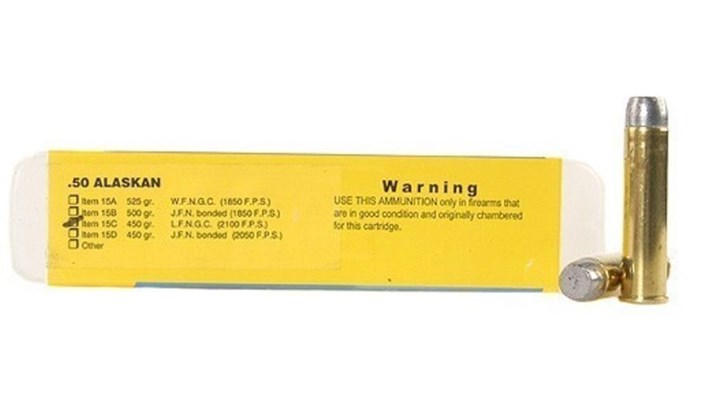
5. .50 Alaskan
Taking a .348 Winchester case and necking it out to accept a .510-inch, Alaskan Harold Johnson was able to successfully convert a Winchester Model 1886 rifle into a .50-caliber, bear-killing machine. The result, of course, was the .50 Alaskan. Buffalo Bore produces several loads for the .50 Alaskan, including a 450-grain bullet that delivers a whopping 4,400 ft.-lbs. of energy from the muzzle. As a wildcat cartridge, it hasn’t seen the widespread use of other rounds on this list, but that hasn’t stopped many guides and hunters, Nelson included, from converting Marlin lever guns for its very effective use.
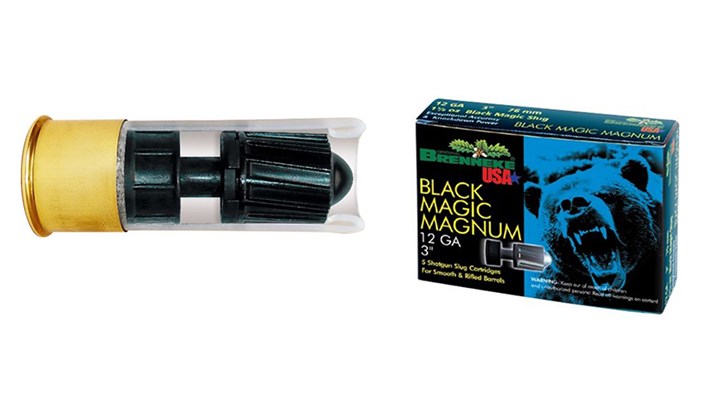
6. 12-Gauge Slug
According to Nelson, the 12-gauge slug gun is by far one of the most popular choices for bear protection in the Alaskan bush. While it is extremely effective, the main reason it’s been so widely-used is because shotguns like the Remington 870 and Mossberg 500 are a fraction of the price of bolt-guns and, in turn, that’s what the government has provided to its employees. Based on ballistic testing and field use, Nelson recommends Brenneke’s Black Magic Magnum or DDupleks’ Monolit 32 solid steel slug. The Black Magic Magnum is a 602-grain slug that carries 3,000 ft.-lbs. of energy at 1500 fps, while the 495-grain DDupleks leaves the muzzle at 1410 fps with 2,180 ft.-lbs. of energy.

7. .338 Winchester Magnum
The favorite among Alaskan guides as a backup gun, the .338 Winchester Magnum was released in 1958 as belted, rimless cartridge. Based on the .375 H&H, the .338 will send a 300-grain Barnes bullet out the barrel at 2500 fps with a devastating 4,100 ft.-lbs. of energy. Considered by many to be the most versatile North American big-game cartridge, the .338 Win. Mag. has killed its fair share of charging bears. It’s chambered in nearly every major manufacturer’s rifle and has a plethora of ammunition choices as well.
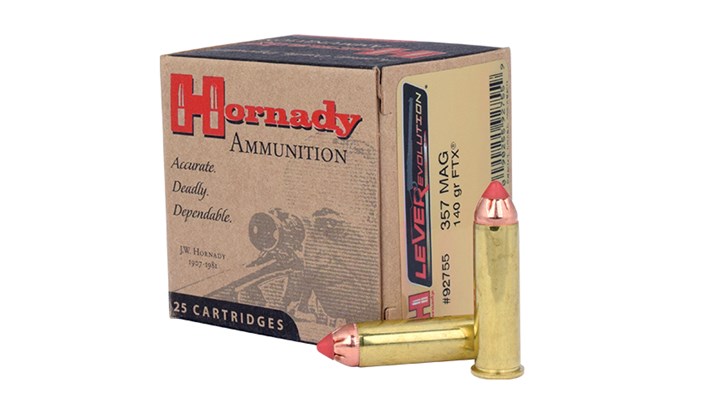
8. .357 S&W Magnum
While some folks claim the .44 Magnum is the minimum for charging bears, many others have opted for a Glock 20 in 10mm Auto and, interestingly enough, passed right by the .357 S&W Magnum. Several folks have even successfully killed bears with a 9mm. While a well-placed shot from a 10mm can no doubt do the trick, the .357 Mag. has 780 ft.-lbs. of energy, while the 10mm has about 728 ft.-lbs., both with a 180-grain Buffalo Bore bullet. As Nelson has seen in bear defense training, many shooters have cycling issues with the 10mm due to the “limp-wrist syndrome,” something that isn’t an issue with a revolver and is the last thing you want to happen during a bear charge. The .357 is also available in smaller-framed revolvers that fit smaller hands, making it ideal for women and less experienced shooters. Any way you slice it, the .357 has proven itself as a worthy close-range bear stopper.
Having a hand in the specification of a pair of deluxe side-by-sides makes the job of testing even more of a pleasure, and Michael Yardley is excited to see exactly what the guns can do
Having a pair of side-by-sides to test is a luxury and Michael Yardley, after having a hand in the specification of the guns, takes even more pleasure when he takes them out to put them through their paces.
AYA DE LUXE NO 2 SIDE-BY- SIDE

This month’s test concerns a new pair of AyA No 2 12-bore de Luxe sidelock side-by-sides specifically built for grouse shooting, proofed and choked for steel shot. Weighing in at just over 7lb, an ideal weight for a modern 30in game gun – or, indeed, a vintage one – they were ordered from AyA by ASI of Snape, the British importer that also brings in Rizzini from Italy. I must declare an interest before continuing: I helped specify these guns for a friend, but this afforded me the opportunity not only to consider them in much detail, but to handle and shoot them more than I normally would when testing.
First impressions are of an attractive, classically styled and well-stocked pair of guns. The scroll engraving (which is laser cut but hand finished) looks good. While you can tell the difference under scrutiny, I wouldn’t bother, however, paying more for handwork on guns intended for the field (although nothing beats hand-cut Holland or Purdey scroll). Laser engraving techniques have much advanced and suit medium scroll, as seen here, especially well. The stocks of the test guns are well proportioned, longer than the average at 15 3/4in and slightly deeper in the butt sole (at 5 3/8in) too as requested. They are nicely figured Turkish walnut and well finished in oil with hand-cut chequering. I liked the proportions of the grips and the combs. The grip is slim without being too slim. It was also specified that the combs be made a little fuller than the AyA norm.
The guns dry-mount well and feel secure at the shoulder and well anchored. They also have a bit more cast than is typical. This opens an interesting issue. The man for whom they were made – a right-hander shooting off the right shoulder – has a left eye that cuts in a bit more than it should sometimes (as many of us have). The remedy for this would normally be extra cast, but he also wanted guns that handled without feeling too odd or crooked on the moor. He had shot near-standard measurements for a long time.
So, after considerable thought and a little experiment, a compromise was reached. On clay birds, I had noted he didn’t seem too badly affected by eye dominance issues when he focused hard (indeed, he shot well). On the pattern plates, however, the potential problem became more evident. My final advice was to go with extra cast, but not as much as some old-school gunfitters (who loved specifying bent stocks) might have liked.
Breaking with our precedent to leave shooting impressions until the end, I will also note here en courant that it was really gratifying that when he did shoot with these guns for the first time, he was connecting with 90% or more of what was presented. I don’t think he would have done better with more cast – probably worse – and the guns were mounting beautifully. Generally, I always avoid extremes of cast in over-and-unders, but these guns have made me reconsider cast on side-by-sides too. Watching someone shoot should be the final arbiter, not just the pattern plate.

Back to the main plot. A feature of these guns, and another aspect of them where much thought went in, was the barrel specification. They are chopper lump and fleur-de-lys steel shot proofed at tight 1/4 (15 thou or 3/8) in both barrels for lead or steel. Steel shot does not suit tight constriction, but this choking is most efficient with lead too. Having the same choke also avoids the ‘ballistic thrombosis’ of worrying about constriction (in the old days, meantime, grouse guns were sometimes choked a little tighter in the right barrel preparing for what was expected to be a rangier first shot).
What else to say? Well, these are No 2 guns, albeit deluxe ones. AyA does still make its mechanically similar No 1, which is considerably more expensive, benefiting from better wood and engraving, and a finer finish. But, for me, the No 2 de Luxe meets a very acceptable standard for practical use.
TECHNICAL
AyA has long used the pattern of the Holland Royal as the inspiration for its sidelocks. Continental manufacturers making side-by-sides tend to copy the Holland rather than the Purdey design because it is more straightforward to make and, critically, simpler to regulate with its Southgate over-centre cam ejector work. AyA has had huge success with its sidelocks. With actions made from forgings, they have proven themselves extremely reliable. The test guns have the usual AyA features, including disc-set strikers, replaceable hinge pins and chopper-lump barrels – in this case proofed for steel shot and choked at 15 thou constriction right and left. Steel shot does not need any more constriction to pattern well. It is a mistake to over-choke it. I also tend to use a pellet one size bigger now rather than two. These guns have a longer forcing cone better suited to steel shot, but will happily digest conventional lead loads as well.
SHOOTING IMPRESSIONS
Being involved with the specification, I was excited to actually try the AyAs. Aesthetically, it would be hard to better them at the price. Dry handling was good. Balance was on the hinge pins even with the 30in barrels, and the weight was ideal. The first bird was centred, and, happily, so were the next half-dozen, swapping the guns every few shots. On tougher stuff, the AyAs continued to perform well. The 3/8 chokes in both barrels (near ideal for steel) produced good kills with lead too. Even on the 120ft tower, the guns continued to do the business. The combs, a little fuller than the AyA norm, were fine. The extra cast suited. Ejection was excellent. For the price – which is not insignificant – these offer a lot. They are a 10th of the cost of the English equivalent, but would still stand happily in more exalted company.

AYA DE LUXE NO 2 SIDE-BY- SIDE
♦ RRP: £12,900
♦ ASI Ltd, Alliance House, Snape, Saxmundham, Suffolk, IP17 1SW
♦ 01728 688555
Categories
India’s Fight Against China is a Nightmare