Categories
All About Guns Allies War

Albert Patterson, the British SAS, and Gun Control Gone Mad by WILL DABBS

Albert Patterson was a distinguished veteran of British Special Operations. He is shown here serving with the 22d SAS during the First Gulf War.

Gun control is in the news these days, because gun control is forever in the news. Elected officials who wouldn’t know a gas tube from a sling swivel weaponize the latest headlines and pontificate accordingly, the Constitution be damned. Whether it is Ruby Ridge, Waco, the Oklahoma City bombing, Operation Fast and Furious, or Albert Patterson, it is in the unintended consequences where the true preventable tragedy rests.

Patterson was removed from a Sea King helicopter during combat operations in the Falklands when it became overloaded. The aircraft crashed, and all aboard were subsequently lost.

Albert Patterson was the kind of warrior about whom books are written. A 22-year veteran of the British Paras and the 22d Special Air Service, Patterson was the very tip of the spear fighting for Queen and country in hotspots around the globe. While serving during the Falklands War, Albert Patterson lost 22 friends when a Sea King helicopter he was supposed to be on crashed into the sea. While in combat Patterson captured an Argentine officer and confiscated his pistol.

Albert Patterson spent his entire adult life fighting for his country.

Albert Patterson was a natural born warrior. Once his time with the British Army was complete he took private security jobs where he could put his unique skills to good use. He maintained a home both in Hereford in the UK as well as Thailand. Most of his time was spent overseas.

This is Albert Patterson’s daughter and ex-wife while they were lobbying for his freedom. An errant phone call to the British police precipitated a firestorm.

Military life is hard on a family, and the world of Special Operations all the more so. I resigned my commission once I realized I could either be a soldier or a Dad but couldn’t be both. By 2014 Patterson’s marriage had self-destructed. His ex-wife noticed Patterson’s brother poking around their old home and called the cops to report him as a burglar.

By American standards Patterson’s terrifying weapons stash was awfully tame.

Police searched the Patterson home and discovered the Browning Hi-Power pistol Patterson had taken from the Argentine officer, five rounds of hollowpoint ammunition, 177 rounds of 9mm ball, four Enfield revolvers, and some component parts from an L1A1 SLR rifle. The Hi-Power had sat unmolested in Patterson’s basement for 33 years. At that point Albert Patterson, now in his sixties, was well and truly screwed.

Gun Control in England

These cumbersome rascals were the subject of Britain’s first gun control initiative back in the 16th century.

In 1584 William of Orange was assassinated by an assailant with a wheellock pistol. This led Queen Elizabeth I to enact Britain’s first gun control law banning possession of wheellock pistols near the royal palace. The British Bill of Rights of 1688 states, “That the Subjects which are Protestants may have Arms for their Defence, suitable to their Condition, and as allowed by Law.” Suffice it to say that moldy old writ doesn’t carry much weight today.

Lots of guns like this C96 Mauser Broomhandle came back home from WW1 with English combat veterans. Concerned that the working class could not be trusted with such stuff unsupervised, the British government began to regulate gun ownership heavily in 1920.

The Pistols Act of 1903 strived and failed to regulate the possession of handguns in Britain. The Firearms Act of 1920 was crafted to restrict ownership of WW1-surplus firearms by the working class. This act first mandated that British citizens obtain a firearm certificate to own a gun. In 1937 the British Home Secretary ruled that, “Firearms cannot be regarded as a suitable means of protection and may be a source of danger.” Ironic that this edict was issued three years before the epic Battle of Britain. The Firearms Act of 1968 further consolidated British gun laws.

In the early 1980’s private ownership of firearms was a recognized thing in Britain. Guns like this AR180 were produced in England for use by private citizens.

Prior to 1988 there yet remained a thriving gun culture in the UK. I have an ArmaLite AR180 in my personal collection that was produced by Sterling Armaments in Dagenham in the early 1980’s. However, in August of 1987 an unhinged antiques dealer named Michael Robert Ryan went on an undeniably horrific rampage in Hungerford and killed sixteen people. He ultimately murdered both an unarmed police officer and his own mother before shooting himself. This sordid tragedy precipitated the Firearms Act of 1988. This law prohibited pump-action shotguns and self-loading rifles. Sterling Armaments went bankrupt that same year.

British gun laws are so draconian that English Olympic shooters can no longer train with their .22-caliber target pistols. Nowadays the Brits seem to be legitimately terrified of firearms.

An amendment to the Firearm Act in 1997 criminalized the possession of handguns without meaningful exception. It was so oppressive that Olympic athletes were no longer allowed to train with their target pistols. As a result 57,000 British subjects surrendered 162,000 handguns along with 700 tons of ammunition. During this time apparently Albert Patterson was serving overseas and unable to avail himself of the resulting firearms amnesty.

Airsoft guns are pretty harmless. If attacked by an assailant thusly armed hiding behind a proper cardboard box will render you immune. However, nowadays this is apparently a terrifying arsenal in the UK.

In 2006 the British government further restricted the commerce in primers, air rifles, paintball guns, airsoft weapons, and replica firearms. Today airsoft guns are restricted in the UK to use by members of an organized airsoft site conducting permitted activities and possessing third-party liability insurance. Wow.

I was tempted to engage with a forlorn British airgun shooter I saw in a pub but couldn’t bring myself to interrupt his reverie.

I was in the UK a couple years ago. One evening while having dinner with my wife in an English pub I saw an older gentleman sit down at the bar and produce a stack of paper targets he had clearly perforated with an air rifle. While nursing his pint of bitter the man carefully measured his groups and documented the results in a notebook. The whole episode simply reeked of oppressive melancholia.

Albert Patterson’s Gun

The Browning P35 was originally titled the “Grand Rendement” which translates literally to “High Yield.” We call it the Hi-Power.

The P35 Browning Hi-Power is one of the most popular military weapons in the world. John Moses Browning contrived the gun as a submission for some French military pistol trials. However, the great man died before the design could be perfected. Dieudonne Saive, the Belgian gun designer responsible for the FN FAL rifle, completed the work. The apparently-perfect linkless short recoil action of the Hi-Power went on to drive easily 90% of the world’s combat pistols. If you’re not familiar with the particulars just strip your favorite Glock, SIG, Springfield Armory, or HK handgun. That’s all unfiltered Hi-Power inside.

The Hi-Power has seen service around the globe. This ludicrously embellished version was Muammar Gaddafi’s personal pistol.

More than 1.5 million Hi-Power pistols have seen service with around ninety nations. In 1982 during the Falklands War both the Argentines and the British issued their own versions of the Hi-Power. The Hi-Power retains its rabid acolytes even today.

After David killed Goliath in the Valley of Elah the young man took the giant’s sword as a war trophy.

Accumulating battlefield trophies is as old as warfare. A teenaged David took the sword of Goliath after relieving him of his head as depicted in the Biblical book of Samuel. To expect young warriors to go off to faraway lands and risk their lives without bringing back mementos of their service is simply magical thinking.

A friend was forced to resign from the military when he was caught smuggling a Makarov pistol like this one back from Iraq.

The 1983 invasion of Grenada was the last conflict wherein American troops were legally allowed to retain captured firearms. An Army officer comrade of mine had his career ruined when his ex-wife reported the Makarov pistol he had smuggled back from the First Gulf War. That same gun could be had at the local pawn shop for less than $200 at the time. A cursory review of the trajectory of British gun control demonstrates that the United States is currently following a similar albeit somewhat delayed path.

The Rest of the Story

This is the guy the British put in prison for possessing a war trophy firearm.

In January of 2015 Albert Patterson was arrested and charged with possession of an autoloading handgun and associated ammunition. He pled guilty and explained that his infrequent times at home had never coincided with firearms amnesty periods. The sentencing judge Christopher Plunkett reviewed his exemplary record of military service and still remanded him to a custodial prison term of fifteen months. By way of explanation he said, “In the wrong hands these weapons could lead to the death of police officers or cause all sorts of mayhem. It is this risk Parliament is concerned about.”

It took a massive political effort to get Albert Patterson freed from prison.

There resulted a national outcry, much of it organized by The Sun newspaper. The petition for his release garnered some 160,000 signatures. Colonel Richard Kemp, former commander of British forces in Afghanistan, said, “This is another example of our troops being persecuted by a government and courts obsessed with political correctness. An SAS hero who risked his life to defend our country shouldn’t be treated like a South London drug dealer. He should be freed immediately. The country should be grateful for what he did.”

Here is a picture of Albert Patterson alongside Prince Charles. This guy is a stud hero of the highest order.

Albert Patterson spent fifteen years with the SAS. Prior to his sentence Patterson had actually been to prison once before. In 1987 he dove through the roof at Peterhead Prison as part of an SAS assault team to rescue 56-year-old Jackie Stuart, a kidnapped prison guard taken captive during a violent uprising. The appeals court explained that the mandatory sentence for possession of such a firearm was five years, implying that this war hero was getting off easy. Patterson’s ex-wife testified that he had never even fired the gun.

The British admittedly suffer a mere fraction of the gun violence that we endure over on our side of the pond. However, such chaos is a terribly unfortunate side effect of life in a society that is, for now at least, truly free.

The British people seem quite proud of their gun control laws. British police officers seldom carry firearms, and there were only three fatal shootings of British police officers in England and Wales during the eleven years following 2000. However, Britain is not America.

What the Left cannot seem to grasp is the simply breathtaking scale of firearms ownership in America. No amount of restrictive legislation will ever make a dent in gun possession by criminals here.

American gun owners currently possess more than 400 million firearms. You and I own twenty times as many guns as there are soldiers under arms in every military in the world combined. Gun control laws will simply never work here. That ship has sailed.

After a herculean effort to mobilize the British population Albert Patterson was eventually released from prison and reunited with his family.

If we outlawed all commerce in firearms tomorrow American criminals would remain well armed until the sun burns out. What future gun control legislation could very effectively do, however, is incarcerate military heroes for non-violent possession of war trophies or precipitate another unnecessary Waco-grade bloodbath. Our own great nation is following a similar track, albeit offset by a decade or two. We’ve got to vote like our freedom depends upon it.

This story has a happy ending I suppose. However, it seems a travesty that a purportedly free society could become so terrified of firearms that they incarcerate a military hero over possession of a war trophy he had never fired.

This institutional aversion to firearms now pervades the British populace. Lofty Wiseman, a respected former SAS operator, had this to say, “If you have a weapon in a house with ammunition, there’s always that temptation…you can never say you’re going to use it but different circumstances, state of mind, if it’s there, it can be used so that’s where you must have laws.” To have such castrated pablum spewed by a supposedly free nation’s warrior class is just sad.

The British people once set the world’s standard for resolve in the face of adversity. Winston Churchill was one of the manliest men who ever lived. He packed a full-sized Colt 1911 .45ACP pistol on his person whenever he was out in public.
Nowadays the British seem sadly to be made of somewhat softer stuff.
Categories
Allies Paint me surprised by this Some Red Hot Gospel there! This great Nation & Its People

Gordon Sinclair – The Americans (A Canadian’s Opinion)

Categories
Allies Soldiering

Brits on horseback

United Kingdom
As a courtesy to British visitors, these pages are written in -tentative- English

British Hussars

It would naturally take some time for the “Hussar craze” to contaminate the United Kingdom after sweeping over the Continent. The dash of attire and behaviour displayed on the Napoleonic battlefields in the service of France certainly made the best impression, and in due time the British Army started changing her Light Dragoon Regiments into Hussars, in dress and in title.

A proud tradition was established, and British Hussars displayed their elegant uniforms both in Society and over the Battlefields of the world. Some dramatic events made the stuff of legend. The Crimean War was a milestone, for the undying glory of the Light Brigade or the subsequent drastic changes in uniform.

Queen Victoria’s Army counted up to 13 Hussar Regiments. I may say that they sported some of the most splendid uniforms of the time. The trademark of the Victorian British Army, Regimental particularities, makes it a pleasure scrutinizing those images of the past, on the lookout for the telltale sign that will eventually give out the sitter’s regiment. Army lists and medal Rolls are the necessary companions of the researcher.

A bit more disturbing is the abundance of territorial Hussars in the Yeomanry Cavalry regiments. Uniformology resources are scarce, but a little thoroughness makes up for that.

“Chase me Ladies, I’m in the Cavalry !”
Portrait of the Young Man as a Hussar
The Regiments
(click on the postcard icons to access the various Regiment pages)
3rd (King’s Own) Hussars 4th (Queen’s Own) Hussars 7th (Queen’s Own) Hussars 8th (K.’s Royal Irish) Hussars
10th (P. of W.’s Own) Hussars 11th (P. Albert’s Own) Hussars 13th Hussars 14th (King’s) Hussars
15th (The King’s) Hussars 18th (Q. Mary’s Own) Hussars 19th (Q. Alex.’s Own) Hussars 20th Hussars
21st Hussars
The Cavalry Depôt
When a Regiment was sent to serve overseas, a Squadron would stay in England to do depôt service – training new recruits and horses, to be sent over as reinforcements when needed.
The Cavalry Depôt was reorganized in Canterbury in 1871, and would gather the depôt squadrons of all the Cavalry Regiments on foreign service.
The Cavalry Depôt also served as a Riding School, training the future Regimental Riding-Masters, thus ensuring a certain level of uniformity in the equestrian arts among the various Regiments.
Officers at Canterbury in 1878

Yeomanry Cavalry

Early Yeomanry (territorial volunteer cavalry) uniforms is not as well a covered field as the regular army – but the good news are that most uniforms are quite distinctive. Most Yeomanry uniforms display white / silver lace, as opposed to the yellow / gold of the regulars (though there were, of course, exceptions to a rule that could never be fully enforced).
When faced with a supected Yeoman, first thing is to localize the county where the photographer’s studio was located. That holds the key to most identifications.
The 1898 Army List lists 38 Yeomanry Regiments (not all Hussars, some styling and fitting themselves Lancers or Dragoons), plus two Irish Terrritorial Cavalry units and the London Mounted Brigade.
Here are a few of them, classified by the order of precedence authorised in 1884 by Queen Victoria (when appropriate) :

1. Royal Wiltshire Yeomanry 2. Warwickshire Yeomanry 3. Yorkshire Hussars 4. Sherwood Rangers 5. Staffordshire Yeomanry 8. Cheshire Yeomanry 9. Ayrshire Yeomanry
10. Leicestershire Yeomanry 11.North Somerset Yeomanry 14. Northumberland Hussars 15. South Notts Hussars 16. Denbighshire Hussars
17. Westmorland & Cumberland 18. Pembroke Yeomanry Cavalry
19.Royal East Kent Mounted Rifles 20. Hampshire Carabiniers 21. Royal Bucks Hussars 23. Dorset Yeomanry 24. Royal Gloucestershire Hrs 28. Royal 1st Devon Yeomanry 29. Loyal Suffolk Hussars 30. Royal North Devon Yeomanry
31. Queen’s Own Worcestershire Hussars 32. West Kent Yeomanry 33. West Somerset Yeomanry 36. 2nd West York Yeomanry Cavalry 39. Lancashire Hussars 3rd County of London (Sharpshooters)
The Lost Hussars
It is not always within my capacity to formally ascertain which regiment a subject belongs to ; your help is more than welcome, if you have any clue thanks for contacting me at djedj@hotmail.com
Sergeant in Hull North Somerset Yeomanry ? Cornet  Staff Sergeant Drill Instructor
 
This is knot a Hussar
Ceci n’est pas un Hussard

Many British units sported uniforms that incorporated  traditional elements of the Hussars’ outfit : Hungarian knots, fur busbies, braided jackets…
It is therefore quite natural to mistake them for Hussars.

Some of them are devoted pages on their own right :
– the Royal Horse Artillery
(click on the image to the left)
-the Indian Army
(click on the image to the right).

A few other ones are presented hereunder.

Royal Horse Artillery The Indian Army
Royal Artillery Royal Engineers Rifle Volunteers Lancers Staff Officer
Recommended Readings
British Hussar Regiments 1805-1914
(Almark)
by AH Bowling
The Mess Dress of the Yeomanry Cavalry 1880-1914
by David J. Knight and Robert J. Smith
The Uniforms of the Imperial Yeomanry, 1901-1908
(the Military Historical Society, 2009)
by David J. Knight and Robert J. Smith
Evolution of the uniform patterns ; this deceiptively small book is packed with information and illustrations ; excellent value. Packed with information and illustrations : photos, drawings and colour plates, including some  reference work on lace and braid patterns ; superb work ! To know how the uniforms of the Yeomanry evolved, between proud traditions and the modernity brought up by the Boer War. Another excellent read on a fast moving era.
Recommended Browsings
Soldiers of the Queen The British Empire
A Beautiful Collection of Period Photographs from “Soldiers of the Queen”.
A very inspirational website – the design of mine owes MUCH to SotQ. Great stuff !
Military history and uniformology ; great reference with lots of scholarly commented pictures. I bookmarked the “Armed Forces” pages but there’s more to the website.
Categories
All About Guns Allies

A Manor & Co 10-bore side-by-side by Michael Yardley

This month’s test gun is splendidly different – a Manor & Co 10-bore side-by- side weighing in at 9½lb even with its relatively short 26in barrels. I’ve used the word ‘beast’ to apply to some 12-bores in the past, and it certainly applies here.

When you bring the relatively compact, 31/2in-chambered and steel shot- proofed gun up to the shoulder, it requires surprising effort – more than its actual weight (no greater than some 32in 12-bore competition guns) might suggest. The shapes are excellent, though. The large Holland & Holland-style diamond grip is especially good. The balance is on the hinge pin, although this gun might well benefit from longer barrels with a more forward balance.

MANOR & CO 10-BORE SIDE-BY-SIDE

10-bore side-by-side

The Manor 10 has been built in Spain within the AyA factory to the specification of Gerald Coulter, the founder of Manor & Co, and using parts supplied by him from another now defunct Eibar maker. We have looked at other guns of his in these pages. Coulter, an aviation engineer by trade, has a passion for the eccentric. As well as this project, and another to manufacture ammunition for it (now difficult to obtain in Britain even in conventional lead loads), he is determined to repopularise the 16-bore and make improved steel loads available for that and smaller bores (which, save for the 20-bore, are poorly served at the moment).

You have to admire his pluck. I should also declare that I have recently accepted a commission from him to help with the load development. It’s good to see our trade still experimenting and taking risks. No one with too much of an eye to the bottom line would take this on; it is more for passion than profit in the current climate.

First impressions of the Manor & Co 10-bore side-by-side are positive. It appears to be finished to a high standard and is based on a large Anson & Deeley action. It is well scaled, so you would be hard-pressed to tell the bore of the gun from the photographs presented here. The fixed-choke barrels (1/4 and 1/2) are topped with a cross-hatched and tapered (11mm to 8mm) rib that is exceptionally well done. The action body, fore-end iron, top-lever and trigger-guard are hand engraved with Purdey-style rose and scroll. The action is traditionally bonemeal colour hardened. All good.

The gun is well stocked in a decent piece of Turkish walnut, with straight grain going through the large but elegant grip and a pleasantly figured butt. The dimensions of this demonstrator were 1½in and 2in for drop and 151/4in for length, including a short black ‘rubber’ pad. There was an extra ¼in at heel and ⅜in at toe – all very sensible. The classical stock shapes were excellent. The grip was particularly good for a large straighthand design (semi and full patterns are options), but it would have been hard to improve on the comb shapes too.

Coulter told me: “The gun is entirely bespoke – you can have whatever stock type and grip, barrel length and ribbing you want within reason. All the guns are future-proofed for steel. The 10- and 16-bores that I am having built at the moment – the latter as sidelock ejectors – will represent the end of an era. We are building a new 10 at the moment with ‘demasiado’ gold-inlay work on a black action. We had to bring a man out of retirement to do this.”

What of the 10-bore cartridge? It was once almost as popular as the 12-bore in the USA and had a strong following among wildfowlers here. The 10-bore side-by-side has been made with 25/8in, 2¾in, 27/8in, 3in, 3¼in and 3½in chambers. The 27/8in cartridges were the standard until 3½in (86mm and 89mm) became predominant (John Olin of Winchester was the father of the 3½in load, which dates, surprisingly, to 1932). The 31/2in lead loads may go up to 21/2oz.

10-bore side-by-side

TECHNICAL

The Anson & Deeley (A&D) was the first commercially successful hammerless design. It was called a boxlock because the hammers and mainsprings were contained within the action body (distinguishing it from sidelock and trigger-plate guns – the former carrying hammers and springs on its side-mounted locks, the latter on a plate screwed to the action).

Initially, the A&D boxlock was made with a single barrel lump, but this was soon changed to the now ubiquitous Purdey double lumps. The A&D design made the hammergun obsolete. It was patented by two Westley Richards employees in 1875 (five years before the equally famous sidelock designed by Frederick Beesley and licensed to his sometime employer James Purdey). Choke would be popularised in the same era, with ejectors perfected in the 1880s and 1890s as well. The modern shotgun was complete in concept.

SHOOTING IMPRESSIONS

Olly Searl had kindly offered the use of his excellent shooting ground at Fyfield, but the test was hindered by the fact that only 2oz payload cartridges could be sourced. Two targets were used: a going-away bird and a crosser. I missed the first but barely noticed because I found myself pushed almost out of the ‘cage’ on firing. This was a thumper – recoil is considerable.

I got the measure of it, leaned in and targets evaporated. It was an experience to remember. The gun has a quality feel, the shapes are excellent. It could be very different with better-tailored loads. As it is, you might put iron sights on the rib and use it with rifled slugs for boar or big game at close range. It wouldn’t be first choice for geese, but it’s still a wonderful project, and I take my hat off to Coulter for commissioning something so marvellously different.


MANOR & CO 10-BORE SIDE-BY-SIDE INFORMATION

♦ RRP: from £16,000

♦ Manor & Co, London

♦ 020 7993 2222

♦ manor.london

Categories
All About Guns Allies

Shooting Watermelons with @hickok45 – Season 2 Episode 97

Categories
All About Guns Allies

I Bought The Internet’s Cheapest Shotgun!

Categories
All About Guns Allies Gear & Stuff Soldiering

Can we say that Tommy Atkins was over loaded with gear?

And the Brass wonders why Tommy is always tired & has a bad attitude. By the way if he “lost” any of this junk, he had to pay for it out of his patheic WWII pay! Grumpy
Categories
Allies Soldiering War

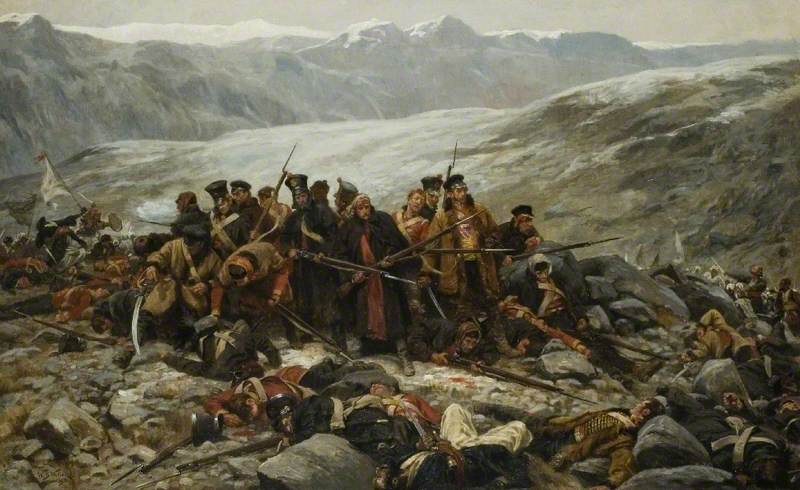
The Last Stand of the 44th Foot Regiment | Battle of Gandamak 1842

https://youtu.be/ROxOFhqBGjo

Categories
Allies Soldiering War

Battle of Alma – Crimean War 1854

Categories
All About Guns Allies

The 5-Barrel Nordenfelt Gun