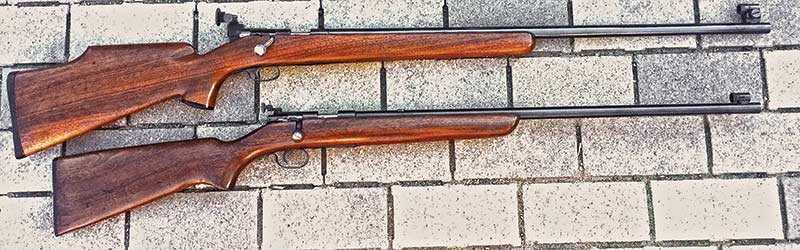
Winchester’s Model 75 Target (top) was similar in many respects to the company’s
Model 69A (bottom), which was introduced in 1937. Both delivered competition-class
accuracy for considerably less money than the flagship Model 52.
Few vintage .22s have the legendary reputation for tack-driving accuracy as Winchester’s Model 52. It was discontinued in 1979, but whether in Sporter or Target trim, it’s still a byword among connoisseurs of bolt-action rimfires. The only drawback, of course, has been its premium price.
The original 1919 sticker for the M52 Sporter was $88.50. That sounds like a whopping good deal until you stop to consider what it translates to in today’s dollars. (Hint: it’s a couple hundred bucks north of a grand).
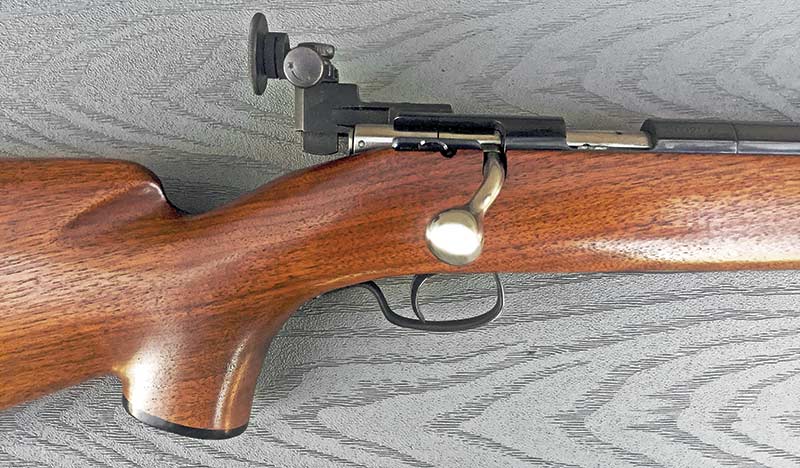
Vintage Redfield aperture sights — front and rear — establish
the Model 75’s paper-punching credibility.
A Better Mousetrap
What was needed, according to the Winchester brain trust, was a relatively low-cost alternative to the storied M52, one that was lighter, yet accurate enough to allow for competition. So they developed the Model 75, which enjoyed a 20-year production span from 1938 to 1958.
To be sure, Winchester also had another “price” alternative to the Model 52 — the Model 69/69A (1935–1963). The M75’s action was similar, yet the bolt was designed with tighter tolerances and the stock was configured for prone shooting. But these were most certainly not the only bolt-action offerings Winchester rolled out over the years preceding World War II. It isn’t surprising when you consider how popular competitive smallbore rifle shooting was “back in the day.”
R.L. Wilson, in his Winchester, An American Legend, put it this way:
“A flurry of activity in the bolt-action .22 market saw a number of new models brought out by Winchester in the late 1920s and early 1930s. The Models 56, 57, 58, 59, 60, 60A, 67, 68, 69, 677, 72 and 75 all preceded World War II … these rifles intended to claim their fair share of the increasingly competitive .22 bolt-action rimfire market.”
I’m old enough to remember when serious target “.22-ing” was every bit as popular as Cowboy Action or Metallic Silhouette in their respective heydays.
In those pre-Ruger 10/22 days — or make that Remington Nylon 66 days if you’re really old — I can recall shooting 50-foot smallbore targets from prone on a padded mat with some fairly hefty bolt actions when I was a kid. So I immediately had a twinge of nostalgia when hefting the 8.5-lb. Model 75 Target.
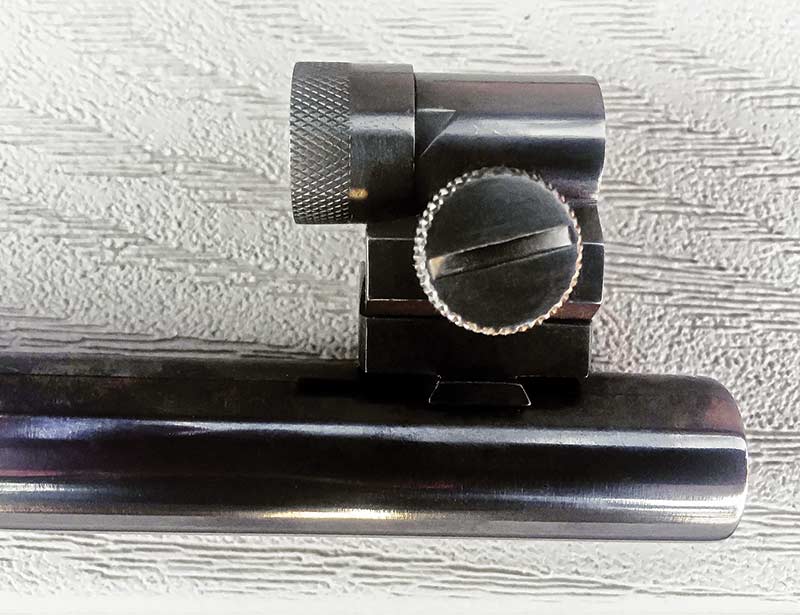
This particular specimen is owned by a shooting buddy, John Wightman. It features marvelous quarter-minute click-adjustable Redfield sights — specifically a Model 75 Micrometer rear and a M63 Globe front. These, I was to discover, required a bit of re-familiarization.
The Model 75 Target sports a 28″ barrel and an OAL of close to 45″. It was also offered at one time with the Lyman 77 front sight and 58E rear. Like its pricier stablemate, the Model 52, the Model 75 could also be had in a lighter, shorter barreled (24″) Sporter configuration.
John, like any sensible collector of vintage .22s, had scoured the market for spare magazines and had both the flush-fitting 5-shot and extended 10-shot models. These are expensive items, running around $70 per copy or more — although this isn’t out of line if you’re hunting spare magazines for classic Winchester rimfires.
And speaking of price, expect starting auction bids for replacement Lyman or Redfield vintage target sights be semi-stratospheric.
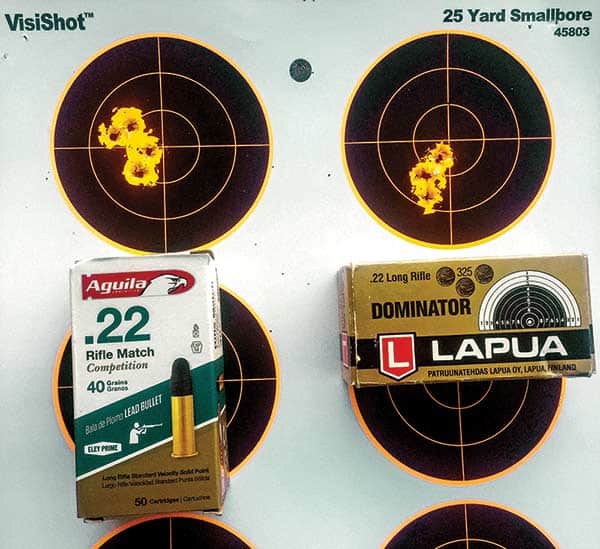
Lapua’s Dominator ammo (right) delivered the tightest groups at both 25 and 50 yards.
The Model 75 — long, hefty and “man-sized” — balances well for offhand shooting.
Range Time
We tried to mix up our test ammo menu between bulk pack bargain stuff, high-velocity 36-grain HPs, and standard velocity 40-grain match brands. The list included Aguila Rifle Match Competition and Super Extra HP, Lapua Dominator, Winchester Super-X Power Point, Sellier and Bellot Club and CCI Mini Mag HP.
At 25 yards virtually everything stayed under an inch for 5 shots, with the Lapua Dominator consistently clustering under a half-inch. We then subjected our aging eyes to the aperture sights at an optimistic (for us) full 50 yards with the Lapua and still beat the 1″ mark.
One thing should be mentioned in passing — the trigger was a fabulously crisp 2 lbs. It’s adjustable, but what we were working with was far removed from what were later referred to as “lawyer triggers.”
We were pretty satisfied with the results, seeing as how we’ve been spoiled with scope reticles for most of our adult lives. And those of us who’ve stuck with iron have generally used ghost-ring setups with far more generous apertures than the pinprick-sized hole on a serious target .22.
There’s a definite learning curve to shooting well by centering a 3″ bullseye in a circular aperture (front and rear) and “keeping the edges even” while breaking the shot.
One trick we did learn in coping with the micrometer sights: If your eyes are “well-aged,” a magnifying glass is a godsend in making adjustments and keeping track of those hashmarks. Once you’re locked down, those old sights are pretty much bombproof.
One other caveat — during extended shooting sessions, the occasional scrub with a brush is sometimes needed to prevent sticky chambering from waxy bullet lube buildup.
Winchester’s Model 75 is a wonderfully crafted walnut and blued-steel artifact from what could be described as an era of “full-size, target grade, receiver-sighted bolt-action .22s.”
Harvey Milk (left) and George Moscone were both gunned down in the San Francisco City Hall on November 27, 1978.
Dan White was a baby boomer born in 1946 in Long Beach, California, the second of nine children. Though he was expelled in his junior year of High School for violence, he later transferred to another school and graduated as valedictorian. In 1965, White enlisted in the Army.
Dan White gravitated toward action jobs.
White was assigned to the 101st Airborne Division as an NCO and served a year in Vietnam. He left the military in 1971 and became a police officer in San Francisco. He purportedly quit the force after reporting a fellow officer for beating a handcuffed suspect. White then joined the San Francisco Fire Department. His rescue of a woman and her baby from a seventh-floor apartment during a fire was the sort of stuff of which heroes are made.
Dan White sought city office as a Democrat.
White parlayed his experience as both a cop and a fireman into a budding political career. In 1977 he was elected to the San Francisco Board of Supervisors. During his tenure, he served alongside a youthful Dianne Feinstein and Harvey Milk.
The Saga of Harvey Milk
Harvey Milk, shown here as a child alongside his older brother, grew up in Woodmere, a suburb of New York City.
Harvey Bernard Milk was born in New York City in 1930, the son of Lithuanian parents. Milk was known as an outgoing extrovert in school—the class clown. He played football and was an opera enthusiast. He studied mathematics in college and subsequently entered the US Navy.
Homosexual activity was grounds for court-martial in Milk’s day.
Milk served as a diving officer assigned to the submarine rescue ship USS Kittiwake. After a stint portside as a diving instructor Milk was removed from the military via an “Other Than Honorable” discharge for homosexuality. Milk then hopped through several jobs and multiple gay relationships in various cities across the country.
San Francisco’s thriving gay community drew Harvey Milk in the 1970s.
Milk eventually settled in San Francisco. He worked for a time for an investment firm before being fired for growing his hair long in protest of US combat operations in Cambodia. After several failed local election attempts Milk was appointed to the city Board of Permit Appeals in 1976 by San Francisco Mayor George Moscone. This appointment made Harvey Milk the first openly gay city commissioner in the United States.
Mayor George Moscone
George Moscone was a career politician.
George Moscone was a San Francisco native of Italian heritage. His dad had been a prison guard at San Quentin. Moscone attended law school, got married, and also served a stint in the Navy. After a term on the San Francisco Board of Supervisors, Moscone was elected to the California State Senate.
During his time in the State Senate, George Moscone helped drive the Democratic agenda.
Moscone’s time in the State Senate saw him sponsor a statewide school lunch program as well as the law that legalized abortion in California. Throughout it all, he developed a reputation for championing gay rights. In 1975 he was elected Mayor of San Francisco, beating out conservative John Barbagelata as well as Dianne Feinstein.
Behold the face of evil.Jim Jones, shown here on the left along with George Moscone, was ultimately responsible for one of modern history’s truly epic mass murders.
The success of Moscone’s campaign turned on a grassroots effort funneled through a variety of local churches. Among them was the People’s Temple, the suicide cult run by charismatic charlatan Jim Jones. You can read more about Jim Jones and the Guyana Massacre here. In recognition of his support, Moscone later appointed Jones as Chairman of the San Francisco Housing Commission.
The Conflict
Harvey Milk (left) and Dan White apparently got along fairly well at the beginning.
Dan White and Harvey Milk were initially political allies. Despite their wildly disparate backgrounds, they were both ardent Democrats and enjoyed a compatible ideology. Disagreements over business development issues and ultimately Milk’s placement of a controversial group home in White’s district eventually drove a wedge between them. Their conflict was eventually seen as a bitter proxy fight between traditional family values and gay rights.
The stresses of family life and San Francisco politics ultimately took a heavy toll on Dan White.
White’s supervisor job paid $9,600 per year ($40,200 today). A local ordnance prohibited any one individual from holding two city jobs simultaneously. As a result, White was forced to resign as a firefighter. He tried to start a business selling baked potatoes from a cart, but this endeavor failed. With a wife and three children to support this created a financial burden. Frustrated with his lack of money as well as the labyrinthine machinations of San Francisco politics, Dan White submitted his resignation as Supervisor to Mayor Moscone on November 10, 1978.
Dan White (right) now had to beg the Mayor to try to get his old job back.
The rules were such that the Mayor appointed a temporary successor after a Supervisor resigned. White’s vacancy insured that the Mayor could stack the board with a majority that was warm to his agenda and potentially hostile to local business. Under pressure from his constituents, White approached Moscone and attempted to rescind his resignation.
Milk and Moscone sensed advantage in Dan White’s departure.
Mayor Moscone and Harvey Milk saw White’s departure as an opportunity. Milk pressured Moscone not to re-seat White. Moscone subsequently announced that he was appointing Don Horanzy to the position, a farther-Left local politician.
The Killings
The Smith and Wesson Model 36 was designed to be concealable.
A bit more than two weeks after his resignation White had an unsuspecting friend drive him to City Hall. In his pocket, he carried the loaded Smith and Wesson Model 36 .38 Special revolver he had used as a police officer along with ten loose rounds of hollowpoint ammunition. Given the fulminant nature of San Francisco politics, metal detectors had recently been installed at the entrances to the building.
The San Francisco City Hall is a fairly palatial edifice. This made it difficult to secure.
White entered the structure through an unlocked first-story window. Apparently, city officials frequently came to work by this means so as to avoid the waits at the detectors. There’s a message there, but we lack the space to explore it today.
Willie Brown (far left) went on to a successful career in San Francisco politics.
Mayor Moscone was in a meeting with Willie Brown who would himself eventually go on to become Mayor of San Francisco. After Brown departed, White confronted Moscone, again demanding he be given his old job back. Not wishing to make a scene, Moscone invited White into a private lounge attached to the Mayor’s office. Once behind closed doors Moscone lit a cigarette and poured drinks.
Dan White learned how to shoot in this place.
Dan White was a trained soldier, a combat veteran, and an experienced police officer. He knew how to run a gun. White drew his revolver and shot Moscone twice, once in the shoulder and again in the chest, perforating the man’s lung. White then shot Moscone twice at close range through the ear, killing him. Bystanders later reported that they took the sound for a car backfiring.
Dianne Feinstein has been a US Senator since 1992. Once entrenched those guys don’t see a great deal of turnover.
As White left the office Dianne Feinstein recognized him and called his name. White responded with, “I have to do something first.” He then sought out Harvey Milk and caught him in a hallway before inviting him into a private office.
Harvey Milk died at the scene.
White closed the door, produced his pistol, and opened fire. His first round passed through Milk’s wrist, while the next two struck him in the chest. The fourth hit Milk in the head. As before, White then fired his final shot into Milk’s skull at close range. Feinstein entered the office as White left and discovered Milk’s body.
The Gun
The Smith and Wesson Chief’s Special was the archetypal concealed carry/backup gun.
The Smith and Wesson Model 36 is likely the most popular snub-nosed revolver ever produced. The name Chief’s Special spawned from a popular vote conducted at the International Association of Chiefs of Police Convention held in 1950. Barrels could be had in either two or three-inch versions, and the gun carried five rounds onboard.
The LadySmith reflected a successful effort at marketing a handgun especially for women.
Serial number 337 was engraved with J. Edgar Hoover’s name and given to him as a gift. An aluminum-framed version was called the Airweight. A variant specifically marketed for female shooters was titled the LadySmith. The gun remains in production today.
The Rest of the Story
Dan White’s case drew a surprising lot of sympathy among Law Enforcement and aligned citizens. “Free Dan White” t-shirts were popular in the day.
Dan White walked out of City Hall unmolested and eventually surrendered to Frank Falzon, a fellow detective from his days with the SFPD. He acknowledged shooting Milk and Moscone but denied having planned the attack. White was charged with murder in the first degree with special circumstances, making him eligible for the death penalty.
It was rumored that White’s legal team used Twinkies as part of his defense. The details were blown out of proportion in the media.
White’s legal team claimed that he was caught in the throes of depression and therefore not responsible for his actions. They explained that White, previously a bit of a fitness fanatic, had given himself over to junk food. Subsequent myths perpetuated in the media asserted that his lawyers were alleging that the junk food caused a mental break. This led to the popular term “Twinkie Defense” in the newspapers of the day.
In reality, they were just claiming that the junk food addiction was evidence of his altered mental state, not its cause. Regardless, the jury inexplicably bought this bizarre story. If ever you should choose to assassinate your political rivals in cold blood in a public place, apparently you might want to do it in California.
Dan White’s relatively light sentence precipitated a round of violent riots in the city. This evening of chaos came to be called “White Night.”
Jurors purportedly wept when his confession was played in the courtroom. White was subsequently convicted of voluntary manslaughter and sentenced to seven years in prison. He was paroled after five, lost his family, and killed himself via carbon monoxide poisoning in his garage two years later.
A Point of Personal Privilege
Harvey Milk’s legacy has been cemented with the naming of a new ship in his honor.
Harvey Milk endured discrimination, served in politics, and was gunned down in cold blood by an unhinged lunatic. In 2009 President Obama awarded Milk a posthumous Presidential Medal of Freedom. On November 6, 2021, the US Navy launched the USNS Harvey Milk, the second of the John Lewis class of underway replenishment oilers. As martyrs go, I’d say he’s earned his accolades.
Social justice warriors act like they are transforming the modern American slave state into some kind of idealized European utopia. Reality is that today’s American culture is more tolerant and inviting than that found most anywhere in the world at any point in history. Those who gripe the loudest about America have typically never lived anywhere else.
Most thinking folks agree that no one should undergo discrimination. However, ours is a cruel, violent species. There has never since the dawn of time been fairness or equality in a human culture to compare with what we enjoy today. The pursuit is a noble goal to be sure. However, it seems to me we should spend more time being thankful for what we’ve accomplished and less screaming at each other about how horrible things are.
I couldn’t care less who this guy slept with. I just admire that he was really, really smart.
I grow weary of our current unhealthy fixation with sexual practices. In my perfect world, people would be judged based upon what they accomplished or how they’ve made the world better, not with whom they slept or what kind of clothes they wore. That’s a pretty shallow way to define one’s self. Sex is a fairly straightforward primal thing, and most people can do it. The details do not reflect any extraordinary accomplishment. Would it be too much to ask if we just treat everybody nicely and focus on something more substantive for a change?
Dan White ultimately took his own life some seven years after he killed George Moscone and Harvey Milk.

.jpg)