Category: You have to be kidding, right!?!
Categories
Cute


The M-41 pulse rifle is the all-purpose workhorse for U.S. Army as well as Colonial Marine Expeditionary Forces deployed across the entire spectrum of battlespace.
From classic low-intensity conflicts and peacekeeping deployments to military operations on a planetary scale, the M-41 does yeomen’s duty as a general-issue small arms platform.
The original M-41 was developed nearly twenty years ago by Alliant Techsystems in response to a joint services request to replace the venerable M-28 flechette gun. The M-28 had soldiered on reliably in one form or another for more than forty years but its relatively bulky tactical footprint and near-notorious lack of one shot stopping power demanded a new small arms solution for the modern light infantry soldier.
The M-41 represented the right melding of technology and practical ergonomics, bringing today’s soldier or marine a lightweight, versatile, and imminently lethal weapon that was equally effective in environments ranging from steaming jungles to the vacuum of space. The key to the success of this revolutionary weapon was the perfection of its caseless ammunition technology.
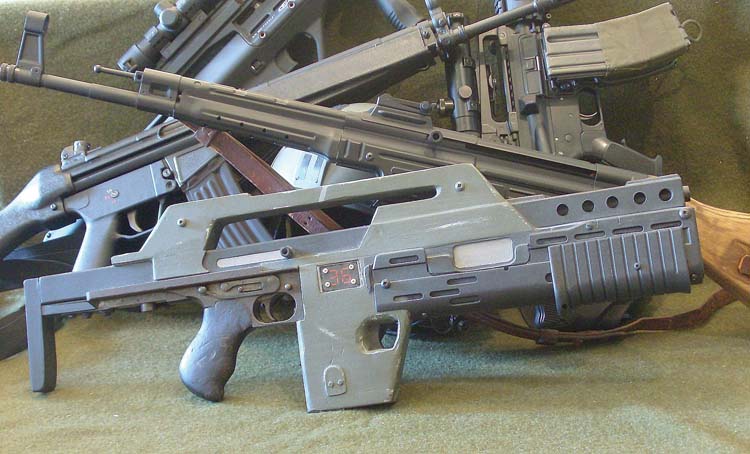
Caseless ammunition had been a pipe dream for more than two centuries. The Victor-Heddon caseless rifle marketed commercially in the United States in the 1960s represented a marginally-successful rudimentary effort.
This weapon was a single shot .22 caliber plinking rifle that employed then-revolutionary caseless rounds incorporating an unjacketed .22 caliber projectile attached to a pellet of carbide-based propellant. The weapon itself was little more than a heavily-modified air rifle.
The gun’s air piston was charged via a long lever underneath the forearm. When the trigger was actuated the piston released a jet of high-pressure air that generated sufficient friction to ignite the propellant charge.
The weapon produced ballistics comparable to a conventional .22 long cartridge and, obviously, ejected no spent cartridge cases. While technically successful, the ammunition was fragile and sensitive to moisture and rough handling. After a brief commercial run the weapon was discontinued and relegated to the status of collector’s item.

Prior to the collapse of communism in the late 1980s the then West German government embarked on an aggressive program to produce a viable caseless military arm.
The resulting Heckler and Koch G-11 was a recoil-operated weapon that fired a 4.7mm bullet mounted atop a pressure-formed propellant grain of square cross section. This cartridge was treated to make it moisture resistant and incorporated a proprietary consumable primer. The G-11 fed from a top-mounted fifty-round disposable box magazine and incorporated a novel rotary operating system.
The bolt on the G-11 was a fairly large rotating cylinder that incorporated an integrated chamber design that turned through a full ninety degrees to chamber a round and align it with the barrel for firing.
This mechanism, while complex, was sealed from the elements and facilitated some fairly unique performance specifications. The G-11 had a four-position selector that allowed a full-auto cyclic rate of 600 rounds per minute and a rate in three-round burst mode of 2,000 rpm. In burst mode the intent was to have all three rounds launched prior to the recoil impulse being transmitted to the firer. In this regard the design was both unique and successful.
The G-11 had great promise. The ammunition was indeed fairly robust. One of the designers for Dynamit Nobel was said to have carried a round in his pocket with his keys for more than a year and then successfully fired it with no ill effects. However, the peaceful collapse of communism and the reunification of Germany negated the mission for the G-11 and the program was cancelled.
The early part of the 21st century saw the acceptance of polymer-cased military ammunition as well as the perfection of telescoped-case technology. These technological milestones served as stepping stones to the 10mm caseless ammunition employed so successfully on the M-41.
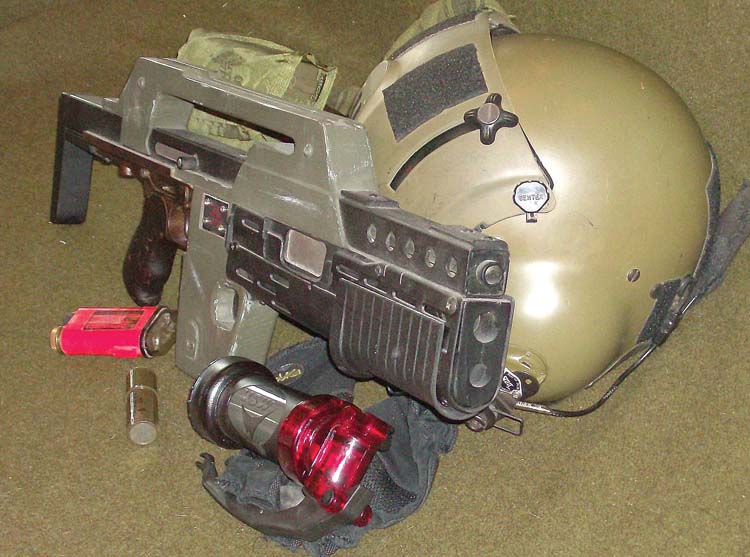
The M-41 Pulse Rifle is so designated based upon its ingenious cartridge ignition system. Caseless rounds are fed into the chamber by the piston-driven, gas-operated recoil mechanism and then detonated via electrical pulse from a cold-load lithium ion battery.
This power cell is installed at the factory and is rated for fifteen years of continuous operation. The system is effectively environmentally-sealed to allow operation in any conceivable tactical environment. The electronic circuitry on board the weapon is also hardened against the electromagnetic pulse from a nuclear detonation.
The M-41 will actually function and fire reliably both underwater and in the vacuum of space. In must be noted, however, that accuracy is spotty at all but point blank range when fired underwater. Additionally, I am told by some operators who have tried it that managing recoil in a weightless vacuum can make for some exciting zero-G gyrations.
Ammunition for the M-41 comes in a variety of flavors. Standard general issue combat rounds incorporate a small point-detonating high explosive charge along with a tungsten light armor penetrator.
This general-purpose combat round is effective against most man-portable body armor out to its accepted maximum effective range of five hundred fifty meters. Combat experience has shown this round to retain its lethality out much farther than that, however. There has been at least one confirmed one-shot kill at more than 1,200 meters undertaken by a Marine Designated Marksman equipped with a stock M-41 outfitted with gyrostabilized optics.
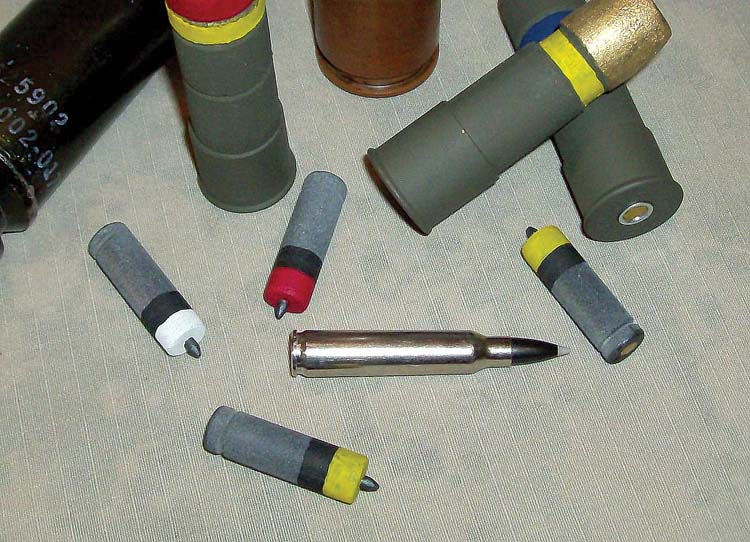
Tracer rounds and inert training variants that mimic the trajectory of the standard explosive-tipped caseless light armor-piercing rounds but lack their H.E. payload are available as well.
Obviously, civilian owners of sporterized M-41 variants only have access to the training rounds. Live firing of combat ammunition requires specialized range facilities to accommodate the possibility of UXO or unexploded ordnance.
Though detonation rates in excess of 99.99% have been documented against backstops ranging from earth to snow to water, the risk of dud rounds still mandates that most training be conducted with solid tipped training ammunition.
The M-41 is clearly a weapon designed with operator’s input from the very outset. The controls are intuitive and the center of balance is perfect. The integrated carrying handle and sighting rail provides a handy carrying point for long ruck marches while the sling attachment points are fully ambidextrous.
The shoulder stock adjusts to accommodate various physiques as well as body armor. Fire controls and magazine releases are mirrored on both sides of the weapon and the caseless nature of the design makes it equally comfortable for both right and left handed shooters.
The cyclic rate of fire in fully automatic mode is 700 rounds per minute. The nature of the caseless ammunition combined with the weapon’s novel hydro-pneumatic buffer system keeps recoil mild and burst firing controllable.
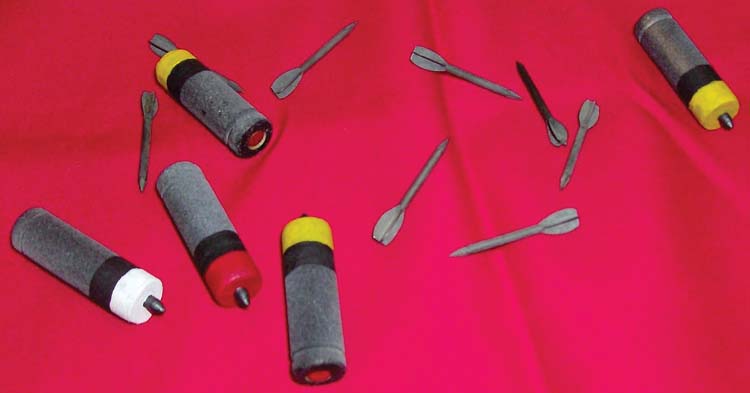
The M-41 feeds from an ingenious quad-stack disposable magazine available in both fifty and hundred round versions. Ammunition is issued pre-loaded in these robust polymer magazines and the spent mags are subsequently discarded.
The use of disposable polymer magazines negates the potential for weapons malfunction due to magazine wear, a common failure point for weapons employed under hard use conditions.
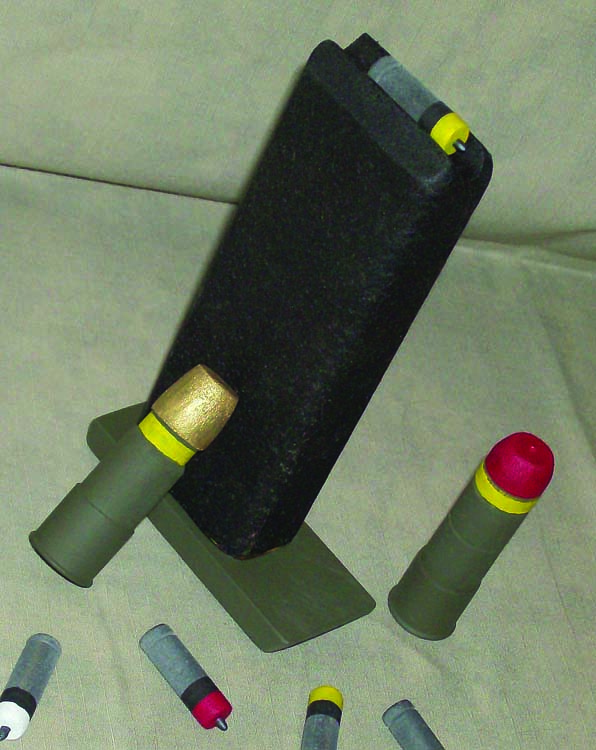
The one addition to the M-41 platform that makes it most popular with troops in the field when compared to the older M-28 family of weapons is the integrated 30mm over-and-under pump-action grenade launcher. This weapon is lightweight, easy to operate tactically, and profoundly effective.
The integrated grenade launcher brings each individual soldier or marine the capability to defeat light armored vehicles as well as targets behind mild cover. Additionally, the operator equipped with the M-41 also possesses the capability of engaging targets behind heavy cover via indirect fire. This weapon carries five rounds in its ready configuration and the high-low pressure system incorporated into the ammunition keeps recoil manageable.
There is a wide selection of tactical loadings available for the grenade launcher component of the M-41. Standard Mk-118 general-purpose grenades are of the High-Explosive Dual-Purpose (HEDP) variety.
These rounds provide a five meter bursting radius against unprotected targets as well as the capability to defeat up to three inches of rolled homogenous steel armor. In addition, the operator may remove the gold cap from these rounds and actuate the fusing mechanism manually.
In this configuration the Mk-118 incorporates an electromechanical four-second time delay and serves as the standard issue hand-thrown antipersonnel grenade.
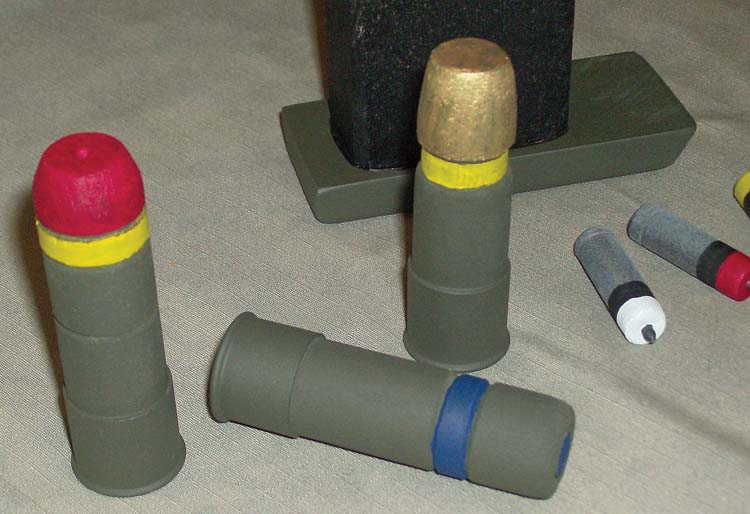
The Mk-192 thermobaric grenade incorporates a friable explosive thermobaric warhead designed for use against buildings and similar enclosed targets. The Mk-192 is designed to punch a hole through a structure’s outer skin and then destroy it from within via overpressure from the friable explosive warhead.
Many troops in combat will actually load their grenade launchers alternating Mk-118 and Mk-192 rounds and then engage each target twice as a matter of protocol. As the Marines are wont to say, in combat there really is no such thing as overkill.
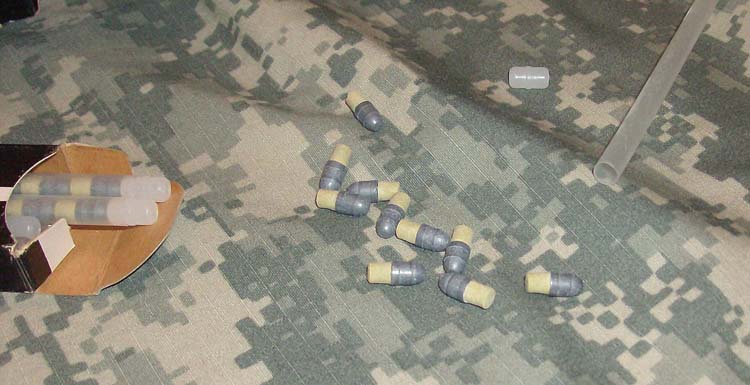
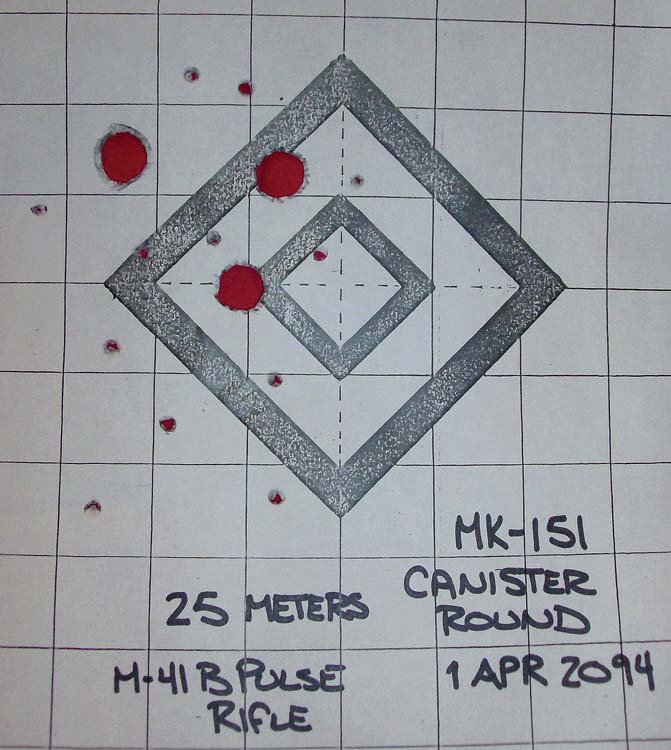
Another popular loading is the Mk-151 antipersonnel canister round for Military Operations in Urban Terrain (MOUT) use as well as Close Quarters Battle (CQB). The canister loading incorporates three tungsten disks nested within a matrix of a dozen plated lead pellets. At close ranges these canister loadings turn the M-41 into the equivalent of a large-bore pump action shotgun and are absolutely devastating against lightly armored targets.
Other specialized rounds include incendiary loadings, star clusters for signal purposes, and bounding rounds that rebound off of a target surface to detonate at a fixed distance above the ground though these specific rounds are used more for specialized operations and are not commonly issued.
On the range the M-41 is clearly a rifleman’s weapon. The total weight of the system fully loaded is just shy of three kilos and the composite housing on the weapon is devoid of sharp corners that might otherwise gouge one’s anatomy on a long forced march. The top rail provides a handy interface for gyrostabilized optical sights and there are mounting points alongside both sides of the barrel shroud for white lights, laser designators, or infrared illuminators.
Though only ten inches long, each carbon fiber composite barrel is rated for more than 30,000 rounds before required gauging or replacement and is capable of excellent combat accuracy. Groups at 100 meters were consistently two inches or less from a rest. The composite material used in the barrels does a great job of dissipating heat from extended firing sessions and the combustible insulative polymer coating applied to the ammunition during manufacture makes the rounds more resistant to cookoffs than more conventional brass, steel, or polymer-cased ammo.
The issue trigger is sharp with no discernible creep and very little take-up, an intended consequence of the pulse rifle’s electronic ignition system. Head shots at 300 meters on the range were easy with the M-41 even for my old eyes. Burst firing is manageable so long as even rudimentary tactical technique is employed with all rounds from a 3-5 round burst consistently remaining on a standard tactical silhouette out to fifty meters or so. Even neophyte shooters who fired the M-41 for the first time found that they could consistently hit targets out to at least two hundred meters with minimal instruction. Small-framed female shooters also performed well with the weapon, clearly an intentional component of the design given the large percentage of female soldiers and marines serving in the combat arms these days.
The grenade launcher was both effective and fun to shoot. Recoil is more of a push than a jolt and all five rounds could be fired and cycled in less time than it takes to describe. Firing the 30mm grenade launcher really does give the shooter a feeling of near-invincibility on the range. Minimum arming distance for all explosive rounds is twenty-five meters while the effective bursting radius of Mk-118 standard HEDP combat rounds was found in practice to be in excess of the publicized five meters.
The original M-41 has gone through two major upgrades during the course of its service life. The M-41A was four ounces lighter than the original M-41 and incorporated a new electronic round counter on the right side of the magazine well that allows the operator to keep an exact tally of his or her ammunition remaining on board the weapon in any lighting conditions. The electronic round counter is powered by the same lithium ion battery that powers the weapon’s ignition system.
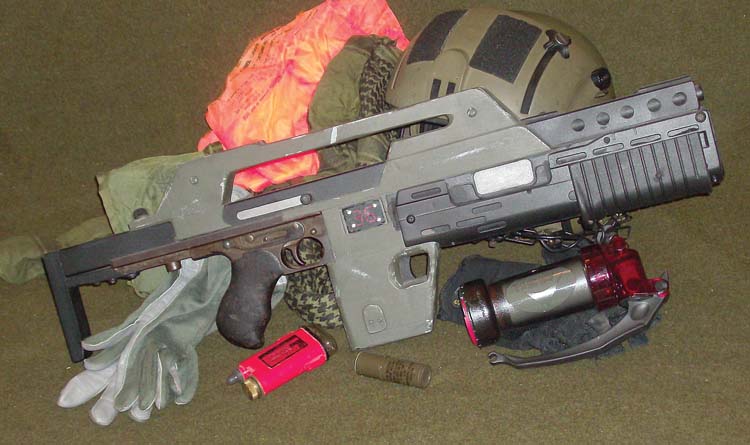
The M-41B is essentially the same weapon as the M-41A with a few engineering changes aimed at speeding production. The composite stock system on the weapon can be had in black, white, olive drab, coyote tan, or any one of a variety of camouflage patterns. The bolt of the grenade launcher is now hard chromed for durability and corrosion resistance.
It has been more than one hundred years since the machine gun ban of 1986 so factory fully automatic versions of the M-41 series of weapons are not available to the civilian shooting public. While there are a few post-sample conversions floating around that are available only to licensed NFA dealers and law enforcement, original factory fully automatic and burst firing variants of the M-41 are only available to the military and certified law enforcement organizations. All is not lost, however, for the civilian shooter who wants to own what is essentially the same weapon carried into battle by our Colonial Marines.
Several enterprising manufacturers have constructed their own aftermarket stock sets and conversion systems to transform the Alliant Techsystems M-41S Sporter into something more akin to the Mil-Spec variant. Advanced collectors with deep pockets can even land an operational grenade launcher though the resulting composite weapon requires two tax stamps for transfer, one as a short-barreled rifle for the host weapon and another a destructive device stamp for the grenade launcher. Sadly, civilian owners will likely never even see live high explosive rounds. As previously discussed, stringent range requirements would preclude safe firing even if the rounds were available legally.
The M-41B pulse rifle represents the state of the art in contemporary small arms technology. The result of literally countless hours and millions of dollars of research combined with operator input and a steady and focused product improvement program, the M-41 series of weapons stands poised to satisfy the small arms requirements for all five U.S. armed services for many years to come.
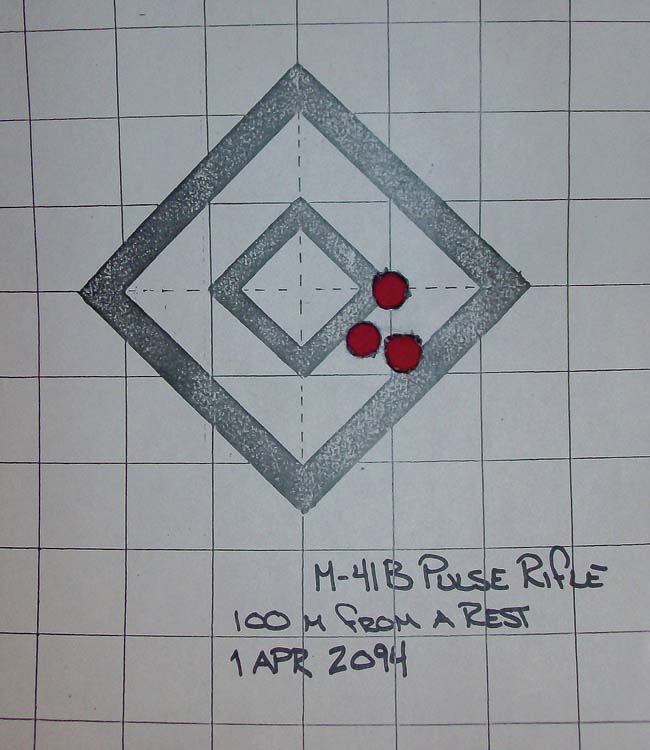
Many thanks to Captain Cynthia Becker, Public Affairs Officer for the 1st Marine Expeditionary Force, United States Colonial Marines, for her invaluable assistance in the preparation of this article. Without the generous assistance of the Corps and subsequent access to M-41 variants and high-explosive ammunition operated solely by the military services this article would not have been possible. Semper Fi.
(Editor’s note: APRIL FOOLS!)

Attilio Gatti
|
Attilio Gatti
|
|
|---|---|
.jpg)
A c. 1939 illustration of Gatti
|
|
| Born | 10 July 1896 |
| Died | 1 July 1969 (aged 72)
Derby Line, Vermont, United States
|
| Occupations |
|
| Spouse |
Ellen Gatti
(died 1962) |
Attilio Gatti (10 July 1896 – 1 July 1969)[1] was an Italian-born explorer, author, and documentary filmmaker who travelled extensively in Africa in the first half of the 20th century.[2]
Expeditions

Gatti, a member of the Società Reale Italiana di Geografia ed Antropologia, was among the last great safari expedition men. He led thirteen expeditions to Africa starting in 1922.[3] Broke after the financial disaster of his 7th African expedition, Gatti settled in the US in 1930.
His second spouse, Ellen[4], accompanied him on his 8th expedition. They did the 10th (in Belgian Congo, 1938–1940) and 11th expeditions (“To the Mountains of the Moon” i.e. the Rwenzori Mountains at the border of Uganda, 1947–1948) with a caravan of motor vehicles including a 9-ton “Jungle Yacht”, custom-built by International Harvester in Chicago.[5]
Gatti became one of the first Europeans to see and capture the fabled okapi and bongo, a brown lyre-horned antelope with white stripes.
He was an enthusiastic amateur radio operator using callsign OQ5ZZ. Known as “Bwana Makubwa”, he was very familiar to the Pygmy tribe. He photographed them as well as the Watussi and Masai.[citation needed]
His books, articles, and some 53,000 photos have become invaluable scientific and anthropological resources.[citation needed]
Books
- Gatti, Attilio. Tom-toms in the Night. London : Hutchinson & Co, 1932, 285 p., fig. (includes: The King of the Gorillas. 1932)
- Black Mist. 1933
- Gatti, Ellen; Gatti, Attilio. Hidden Africa. London : Hutchinson & Co. Ltd, 1933. 286 p., ill.
- Gatti, Attilio. Musungu : romanzo. Milano : Editrice Genio, 1933, 247 p., ill.
- Gatti, Attilio. Great Mother Forest. London : Hodder & Stoughton, 1936. 344 p.
- Gatti, Attilio. Saranga the Pigmy. Ill. by Kurt Wiese. New York : Charles Scribner’s Sons, 1939, 226 p. (trad. in Italian: Saranga il cacciatore. 1941)
- Kamanda: An African Boy. 1941 (with ill. by Ellen Gatti)
- The Wrath of Moto. 1941
- Gatti, Attilio. Adventure in black and white. Ill. by Kurt Wiese. New York, C. Scribner’s Sons, 1943. 172 p., ill.
- Gatti, Ellen; Gatti, Attilio. Here is Africa. Ill. with photographs by Attilio Gatti and others; maps by Raymond Lufkin. New York : Scribner’s Sons, 1943, 166 p., carte, fig.
- Gatti, Attilio. Killers all !. New York : R.M. McBride & c°, 1943, 245 p., ill.
- Mediterranean Spotlights. 1944
- South of the Sahara: Perilous Encounters with Big Game and Strange Peoples in the African Wilds. 1945
- Here Is the Veld. 1948
- Kamanda on Safari. (1953?)
- Jungle Killers. 1958
- Gatti, Attilio. Africa is adventure. New York : Messner, 1959, 249 p.
- Gatti, Ellen; Gatti, Attilio.The New Africa. Ill. with phot. by the authors and others; maps by Rafael Palacios. New York : Charles Scribner’s Sons, World background books, 1960, X, 213 p., ill.
- Sangoma. 1962
- Bapuka. 1963
Ellen Gatti: Exploring We Would Go. 1944 (autobiography)
Films
- Siliva Zulu: Storia Negra in 5 Parti (Italy 1927/1928; silent film; with anthropologist professor Lidio Cipriani)[6]
- Tramonto dei blasoni (Italy 1928; silent film)
- Perils of the Jungle (USA 1941)
- Bitter Spears (USA 1956; remake of “Siliva the Zulu”) [7]
References
- Library of Congress entry for Gatti, Attilio, 1896-1969
- “Attilio Gatti Books”. Shakari Connection. Retrieved 7 October 2019.
- “Fig. 2. Raymond Dart with the gorilla shot by Attilio Gatti (Congo, 1930)”. ResearchGate. Retrieved 7 October 2019.
- Ellen Morgan Waddill Gatti (b. 1893 (or 1894) in Missouri, USA – d. 24.09.1962 in Ticino, Switzerland, 69 years old)
- “International Trucks Chosen For Commander Gatti’s “Jungle Yachts” | Print Ads”. hobbyDB. 17 June 2015. Retrieved 31 August 2021.
- “Attilio Gatti”. IFFR. 4 September 2015. Retrieved 7 October 2019.
- “Africa Was Never Like This”. The New York Times. 10 November 1956.


|
































Or it could be Trump’s new Limo for all that I know! Grumpy
