Categories

|
Joe Ronnie Hooper
|
|
|---|---|
| Born | August 8, 1938 Piedmont, South Carolina, U.S. |
| Died | May 6, 1979 (aged 40) Louisville, Kentucky, U.S. |
| Buried | |
| Allegiance | United States of America |
| Service/ |
 United States Navy United States Navy United States Army United States Army |
| Years of service | 1956–1959 (USN) 1960–1978 (USA) |
| Rank |  Petty officer third class (USN) Petty officer third class (USN) Captain (USAR) Captain (USAR) |
| Unit |  2nd Battalion, 501st Airborne Infantry, 101st Airborne Division 2nd Battalion, 501st Airborne Infantry, 101st Airborne Division |
| Battles/wars | Vietnam War (WIA) |
| Awards |  Medal of Honor Medal of Honor Silver Star (2) Silver Star (2) Bronze Star (6) w/ “V” Device Bronze Star (6) w/ “V” Device Purple Heart (8) Purple Heart (8) Air Medal (5) Air Medal (5) Army Commendation Medal (2) w/ “V” Device Army Commendation Medal (2) w/ “V” Device |
Joe Ronnie Hooper (August 8, 1938 – May 6, 1979) was an American who served in both the United States Navy and United States Army where he finished his career there as a captain. He earned the Medal of Honor while serving as an army staff sergeant on February 21, 1968, during the Vietnam War. He was one of the most decorated U.S. soldiers of the war and was wounded in action eight times.
Hooper was born on August 8, 1938, in Piedmont, South Carolina. His family moved when he was a child to Moses Lake, Washington where he attended Moses Lake High School.
Hooper enlisted in the United States Navy in December 1956. After graduation from boot camp at San Diego, California he served as an Airman aboard USS Wasp and USS Hancock. He was honorably discharged in July 1959, shortly after being advanced to petty officer third class.
Hooper enlisted in the United States Army in May 1960 as a private first class, and attended Basic Training at Fort Ord, California. After graduation, he volunteered for Airborne School at Fort Benning, Georgia, then was assigned to Company C, 1st Airborne Battle Group, 325th Infantry,[1] 82nd Airborne Division at Fort Bragg, North Carolina, and was promoted to corporal during this assignment.
He served a tour of duty in South Korea with the 20th Infantry in October 1961, and shortly after arriving, he was promoted to sergeant and was made a squad leader. He left Korea in November 1963, and was assigned to the 2nd Armored Division at Fort Hood, Texas for a year as a squad leader, then became a squad leader with Company D, 2nd Battalion (Airborne), 502nd Infantry, 101st Airborne Division at Fort Campbell, Kentucky.
He was promoted to staff sergeant in September 1966, and volunteered for service in South Vietnam. Instead, he was assigned as a platoon sergeant in Panama with the 3rd Battalion (Airborne), 508th Infantry, first with HQ Company and later with Company B.
Hooper could not stay out of trouble, and suffered several Article 15 hearings, then was reduced to the rank of corporal in July 1967. He was promoted once again to sergeant in October 1967, and was assigned to Company D, 2nd Battalion (Airborne), 501st Airborne Infantry, 101st Airborne Division at Fort Campbell, and deployed with the division to South Vietnam in December as a squad leader.
During his tour of duty with Delta Company (Delta Raiders), 2nd Battalion (Airborne), 501st Airborne Infantry, he was recommended for the Medal of Honor for his heroic actions on February 21, 1968, during the Battle of Huế.[2]
He returned from South Vietnam, and was discharged in June 1968. He re-enlisted in the Army the following September, and served as a public relations specialist. On March 7, 1969, he was presented the Medal of Honor by President Richard Nixon during a ceremony in the White House. From July 1969 to August 1970, he served as a platoon sergeant with the 3rd Battalion, 5th Infantry in Panama.
He managed to finagle a second tour in South Vietnam; from April to June 1970, he served as a pathfinder with the 101st Aviation Group, 101st Airborne Division (Airmobile), and from June to December 1970, he served as a platoon sergeant with Company A, 2nd Battalion, 327th Infantry, 101st Airborne Division (Airmobile).
In December 1970, he received a direct commission to second lieutenant and served as a platoon leader with Company A, 2nd Battalion, 501st Infantry, 101st Airborne Division (Airmobile) until April 1971.
Upon his return to the United States, he attended the Infantry Officer Basic Course at Fort Benning, and was assigned as an instructor at Fort Polk, Louisiana. Despite wanting to serve twenty years in the Army, Hooper was made to retire in February 1974 as a first lieutenant, mainly because he only completed a handful of college courses beyond his GED.
As soon as he was released from active duty, he joined a unit of the Army Reserve’s 12th Special Forces Group (Airborne) in Washington as a Company Executive Officer. In February 1976, he transferred to the 104th Division (Training), also based in Washington. He was promoted to captain in March 1977. He attended drills intermittently, and was separated from the service in September 1978.
For his service in Vietnam, the U.S. Army also awarded Hooper two Silver Stars, six Bronze Stars, eight Purple Hearts, the Presidential Unit Citation, the Vietnam Service Medal with six campaign stars, and the Combat Infantryman Badge.
He is credited with 115 enemy killed in ground combat, 22 of which occurred on February 21, 1968. He became one of the most-decorated soldiers in the Vietnam War,[2] and was one of three soldiers wounded in action eight times in the war.
According to rumors, he was distressed by the anti-war politics of the time, and compensated with excessive drinking which contributed to his death.[3] He died of a cerebral hemorrhage in Louisville, Kentucky on May 6, 1979, at the age of 40.
Hooper is buried at Arlington National Cemetery in Section 46, adjacent to the Memorial Amphitheater.
Hooper’s military decorations and awards include:
 |
|||

|
|||
   |
|
|
|
|
  |
 |
|
 |
 |
   |
|
 |
 |
 |
|
| Combat Infantryman Badge | |||||||||||
| Medal of Honor | Silver Star w/ 1 bronze oak leaf cluster |
||||||||||
| Bronze Star w/ Valor device and 1 silver oak leaf cluster |
Purple Heart w/ 1 silver and 2 bronze oak leaf clusters |
Air Medal w/ 4 bronze oak leaf clusters |
|||||||||
| Army Commendation Medal w/ Valor device and 1 bronze oak leaf cluster |
Army Good Conduct Medal w/ 3 bronze Good conduct loops |
Navy Good Conduct Medal | |||||||||
| National Defense Service Medal | Armed Forces Expeditionary Medal | Vietnam Service Medal w/ 1 silver and 1 bronze campaign stars |
|||||||||
| Vietnam Cross of Gallantry w/ Palm |
Republic of Vietnam Campaign Medal | Navy Pistol Marksmanship Ribbon w/ “E” Device |
|||||||||
 |
||
.png)   |
||
| Army Presidential Unit Citation | ||
| Vietnam Presidential Unit Citation | Republic of Vietnam Gallantry Cross Unit Citation | Republic of Vietnam Civil Actions Unit Citation |
.svg) |
 |
 |
| Master Parachutist Badge | Expert Marksmanship Badge w/ 1 weapon bar |
Vietnam Parachutist Badge |

Medal of Honor
{{quote|Rank and organization: Staff Sergeant, U.S. Army, Company D, 2d Battalion (Airborne), 501st Infantry, 101st Airborne Division. Place and date: Near Huế, Republic of Vietnam, February 21, 1968. Entered service at: Los Angeles, Calif. Born: August 8, 1938, Piedmont, S.C.
For conspicuous gallantry and intrepidity in action at the risk of his life above and beyond the call of duty. Staff Sergeant (then Sgt.) Hooper, U.S. Army, distinguished himself while serving as squad leader with Company D. Company D was assaulting a heavily defended enemy position along a river bank when it encountered a withering hail of fire from rockets, machine guns and automatic weapons. S/Sgt. Hooper rallied several men and stormed across the river, overrunning several bunkers on the opposite shore.
Thus inspired, the rest of the company moved to the attack. With utter disregard for his own safety, he moved out under the intense fire again and pulled back the wounded, moving them to safety. During this act S/Sgt. Hooper was seriously wounded, but he refused medical aid and returned to his men. With the relentless enemy fire disrupting the attack, he single-handedly stormed 3 enemy bunkers, destroying them with hand grenade and rifle fire, and shot 2 enemy soldiers who had attacked and wounded the Chaplain. Leading his men forward in a sweep of the area, S/Sgt. Hooper destroyed 3 buildings housing enemy riflemen.
At this point he was attacked by a North Vietnamese officer whom he fatally wounded with his bayonet. Finding his men under heavy fire from a house to the front, he proceeded alone to the building, killing its occupants with rifle fire and grenades.
By now his initial body wound had been compounded by grenade fragments, yet despite the multiple wounds and loss of blood, he continued to lead his men against the intense enemy fire. As his squad reached the final line of enemy resistance, it received devastating fire from 4 bunkers in line on its left flank. S/Sgt. Hooper gathered several hand grenades and raced down a small trench which ran the length of the bunker line, tossing grenades into each bunker as he passed by, killing all but 2 of the occupants.
With these positions destroyed, he concentrated on the last bunkers facing his men, destroying the first with an incendiary grenade and neutralizing 2 more by rifle fire. He then raced across an open field, still under enemy fire, to rescue a wounded man who was trapped in a trench.
Upon reaching the man, he was faced by an armed enemy soldier whom he killed with a pistol. Moving his comrade to safety and returning to his men, he neutralized the final pocket of enemy resistance by fatally wounding 3 North Vietnamese officers with rifle fire. S/Sgt. Hooper then established a final line and reorganized his men, not accepting treatment until this was accomplished and not consenting to evacuation until the following morning.
His supreme valor, inspiring leadership and heroic self-sacrifice were directly responsible for the company’s success and provided a lasting example in personal courage for every man on the field. S/Sgt. Hooper’s actions were in keeping with the highest traditions of the military service and reflect great credit upon himself and the U.S. Army.
———————————————————————————— What a Stud!!! Grumpy




Last week the Supreme Court dealt what seems to be a massive blow to the bureaucracy of the modern Administrative State — wherein an agency can become a de facto mini-state by creating and interpreting its own regulations, and then enforcing them without much in the way of legal oversight and defense.
The beacon in this ruling is SEC v. Jarkesy, which noted “…the Securities Exchange Commission’s power to serve as enforcer, prosecutor, judge, jury, and executioner in administrative proceedings for violating the securities laws. The Court found that the defendants are entitled to a jury trial before an Article III judge.”
Needless to say, the gun guys — especially these folks, from whom I excerpted and modified the previous paragraph — who have long suffered such iniquity at the hands of the loathsome Alcohol, Tobacco & Firearms (ATF) agency, are all over this.
However, lost in all this excitement is the agency which I think has the most to lose from Jarkesy (and the earlier Loper Bright v. Raimondo decision).
I refer here to the still-more loathsome Internal Revenue Service (IRS), who have always been able to bludgeon taxpayers in this manner. They have their own regulations, their own courts and, lest we forget, a veritable army of well-armed minions who are only too willing to enforce their agency’s regulatory diktat. I remember seeing on TV an excellent summary of the power of the IRS when a judge said, “So basically, in order to win your case against this man, all the IRS has to do is prove that they followed their own internal procedures properly?” to which the IRS lawyer said, “Yes, your Honor.”
Massive rafts of tax law have given birth to an entire world of tax lawyers and -accountants (both in private practice and in the IRS itself), which is in itself excessive and burdensome. (I am reminded of the way colonial Hong Kong collected income tax: once a year the taxpayer took to the tax office his employer’s statement of his gross salary paid, and he would write out a cheque for 5% of that total to the government. That’s it. Imagine the impact of that scenario in the United States today.)
Anyway, I’m not only not a lawyer, but I also don’t play one on TV and I sure as hell don’t play one on this blog. But I am generally cognizant of the bigger picture, and I’m just wondering if the greatest losers of the Lopez Bright and Jarkesy decisions will not be the horrible SEC, EPA and ATF, but the fouler-still IRS.
I am sure t
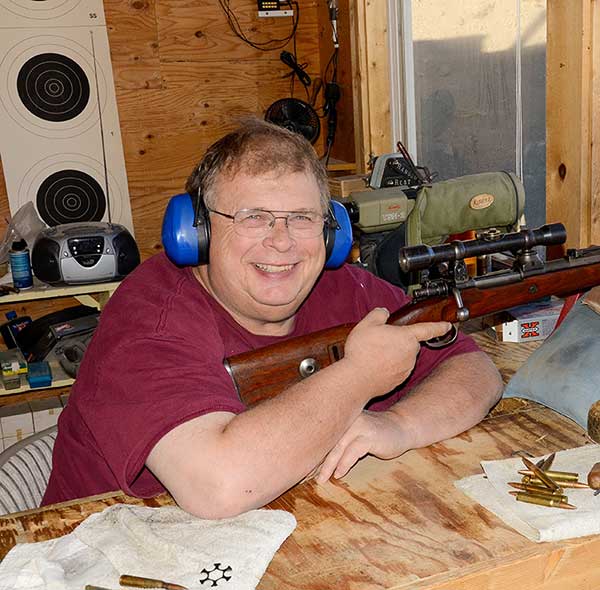
This image of a smiling Mike Venturino has gotten lots of
attention in the wake of his passing. It’s how I hope we
all remember him.
The passing of American Handgunner and GUNS Magazine’s Mike “Duke” Venturino hit us, his colleagues and admirers, hard.
I cannot claim to have known him as well as I would have liked, but I knew him well enough to recognize a genuinely nice guy. We first met face-to-face on an airplane heading to a SHOT Show many years ago.
My flight stopped somewhere, and he came aboard, taking the seat next to me. There were the usual introductions, and for the next couple of hours, we talked about guns, gear and some of the folks we mutually knew.
There were plenty of chuckles a few shakes of heads, and maybe even an eye roll. It is surprising how fast about three hours can pass when the conversation is fun, and you’re talking to a new friend.
Duke was a writer’s writer; a fellow dedicated to detail and entertaining his readers as well as educating them. He attended Marshall University, where he studied journalism, which one could tell in an instant by the way he wrote, especially if you also studied journalism (University of Washington) some decades back in the 20th Century.
I learned of his passing at about 3 a.m. on a Monday morning and spent the next several hours finding out all I could before writing about it at TheGunMag.com, where being editor-in-chief sometimes includes the unpleasant job of writing about someone who has, as they say, “left the range.”
In all the years I’ve been writing about firearms and reading what others wrote — and the reactions from readers — I cannot recall a single person ever disparaging Mike Venturino.
More than 35 years ago, one of my long-gone shooting/hunting buddies remarked about having read something he wrote with a connection to the gun-related thing we were discussing. “Well, Venturino said …” This seems to have been stated over the years by more people than I can count. Translation: Mike’s observations were the gold standard.
Safe in Seattle?
Back in 2020, I was working on a column about the events of the Old West in 1876, which included a mention of the Custer debacle at Little Bighorn. I was interested in the ammunition 7th Cavalry troopers used in their Colt SAA revolvers, so I reached out to Venturino, who was the only guy on the planet I figured would have the information. We were Facebook “friends” by then, so I fired off a message.
Two hours later, I got a reply. Duke was matter-of-fact, explaining they used “standard .45 Colt rounds. They were loaded with 30 grains (of) black powder and 250-grain bullets,” to which he added, “I have a photo of an original box that belongs to a friend. It is dated January 1874 and has those specs on the label.” Why didn’t that surprise me? He was a living encyclopedia of gun stuff.
And then he added a comment, mindful of the insanity of the protests going on at the time in Seattle where what the ex-mayor flippantly — and ignorantly — described as the “summer of love” was unfolding in broken glass, vandalized police vehicles, some looting, property damage and a couple of murders following the death of George Floyd at the hands of Minneapolis police.
“I hope you are surviving all the crap over your way,” he wrote, and I knew he meant it. I still consider it a very thoughtful thing to say.
A couple of years later, I was researching another piece, doing some background, when something triggered my recollection of a teacher in junior high school telling me about how he and some buddies had allegedly once drilled out a .44-caliber bullet and inserted an inverted .22 Short case, presumably with the powder intact, to make an “exploding” projectile. I have no idea whether he was telling a tale, but I remembered it more than 50 years later. It was and remains one of the all-time stupidest things I’ve ever heard of. Ultimately, this moronic stunt had nothing to do with the story I was working on, but I sent Duke a note anyway, asking if he’d ever heard of such a harebrained stunt.
Kids … and adults … do NOT try this at home or anywhere else. Run, don’t walk, away from anybody who suggests giving this a try.
“I have heard of that,” Mike replied about four hours later, “but I’m like you. It’s harebrained!”
About 18 months ago, I inquired about what kind of computer he used, as I was prepping to replace my aging desktop. I still get a chuckle from his reply: “I have no idea what it actually is except it uses Apple stuff. I just told a local guy that I needed a new computer, and he came and set it up.”
Mike and I obviously had more in common than just guns!
Still, our exchanges stuck mainly to guns. Last July, I sent a message to tell him how much I enjoyed a story he did on snake loads. At the time, I had a 25-pound bag of tiny lead shot I planned to bring over last summer if I had a chance to get to Montana. I never got to make that trip, and now it is too late. The moral: If you want to do something for a pal, do it. Next year may be too late.
‘They Don’t Make ‘Em…’
People like Mike Venturino happen once in a great while, possibly once in anyone’s lifetime — if even that frequently. Guys like him are very rare indeed and the best thing one journalist can say about another is this: “I shall miss his byline.”
He authored books and a few thousand stories during his career of about 50 years. That was one heck of a lifetime. I will think good thoughts about Duke at the campfire.