
Categories
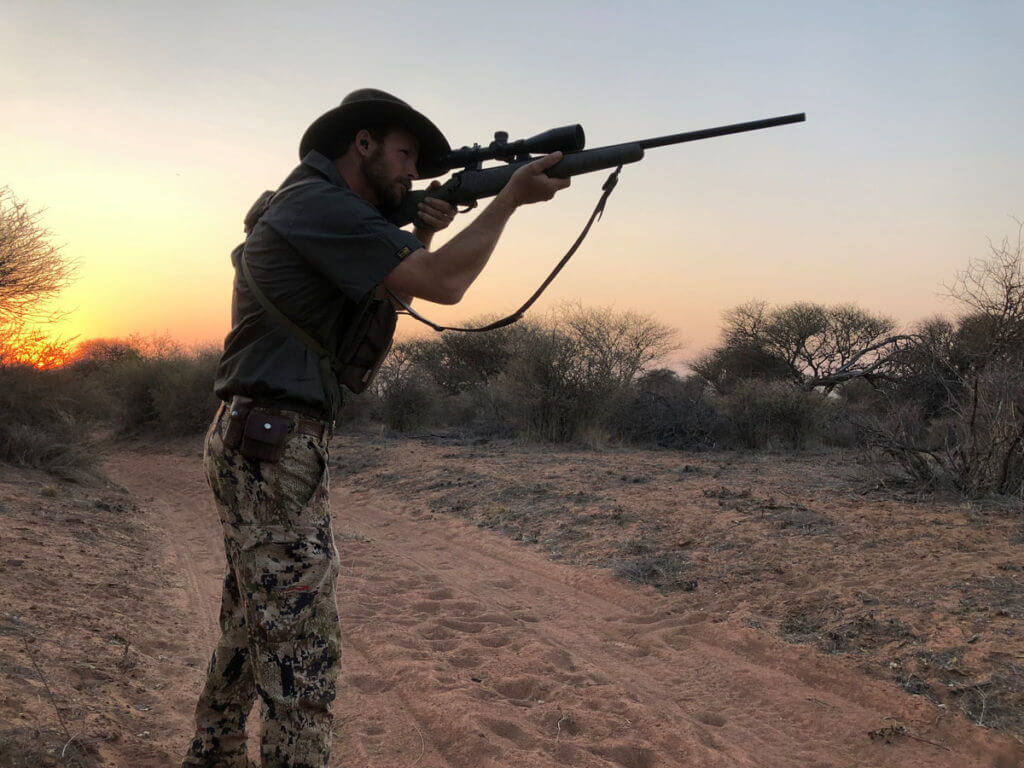
Dawn broke cold over the high country, with a threat of snow hanging in the air. Twelve cow elk grazed in a meadow at 11,500 feet, one small five-by-six bull still sleeping off his night of debauchery. I crept into place, rested my .300 Winchester Magnum atop a lightweight tripod, and squeezed the trigger. The bull never regained his feet.
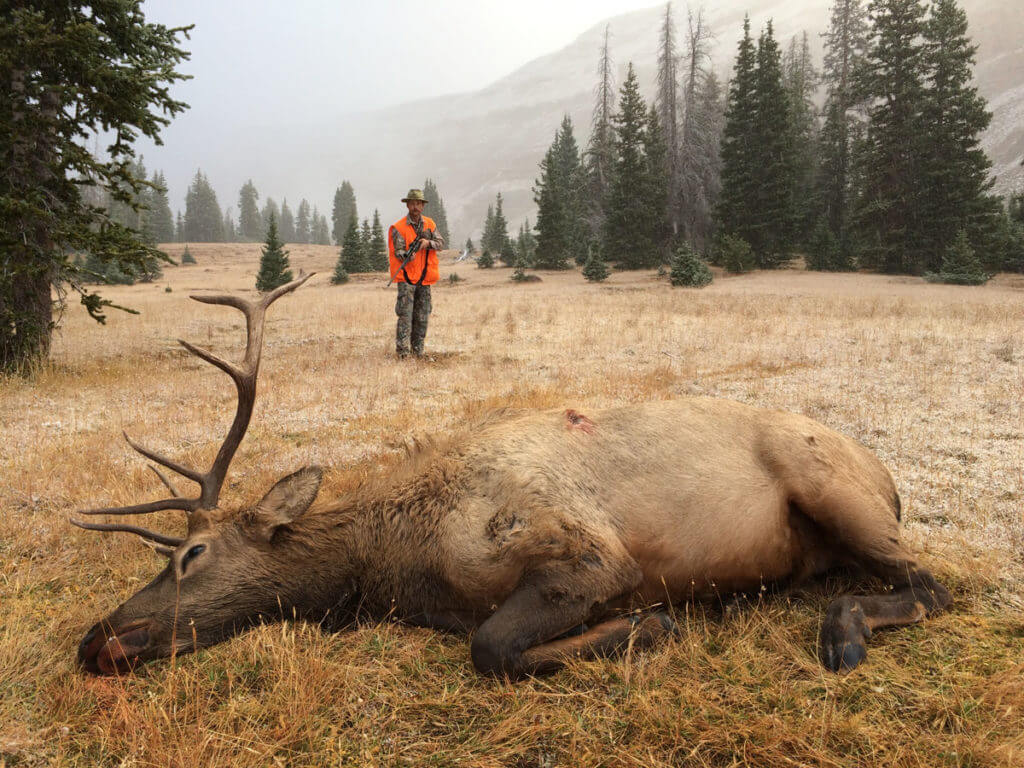
Two years later I approached the same meadow, this time with a friend who carried a 6.5 Creedmoor on her shoulder and an elk tag in her pocket. Fresh elk tracks showed the way and we flushed another, bigger 5X6 bull. I cow called, my friend pressed the trigger, and another bull lay still in the snow. Both elk succumbed to a single shot. Only the duration of the kill was different. Mine died almost instantly; the other bull stayed on his feet for almost a minute, even though he was hit perfectly.
For decades big, hard-hitting calibers held court across America’s hunting grounds. Recoil wasn’t considered the detriment it is today, indeed some shooters and hunters acclaimed hard-kicking rifles as superior, and accused those chambered in more mannerly cartridges as being sissified. This opinion was created by the projectile performance of the day. Simply put, the then-new high-velocity cartridges of the 20th century generated so much speed that traditional bullets struggled to maintain their composure when impacting heavy hide and bone. Bigger, heavier bullets had a better chance of holding together and penetrating deeply.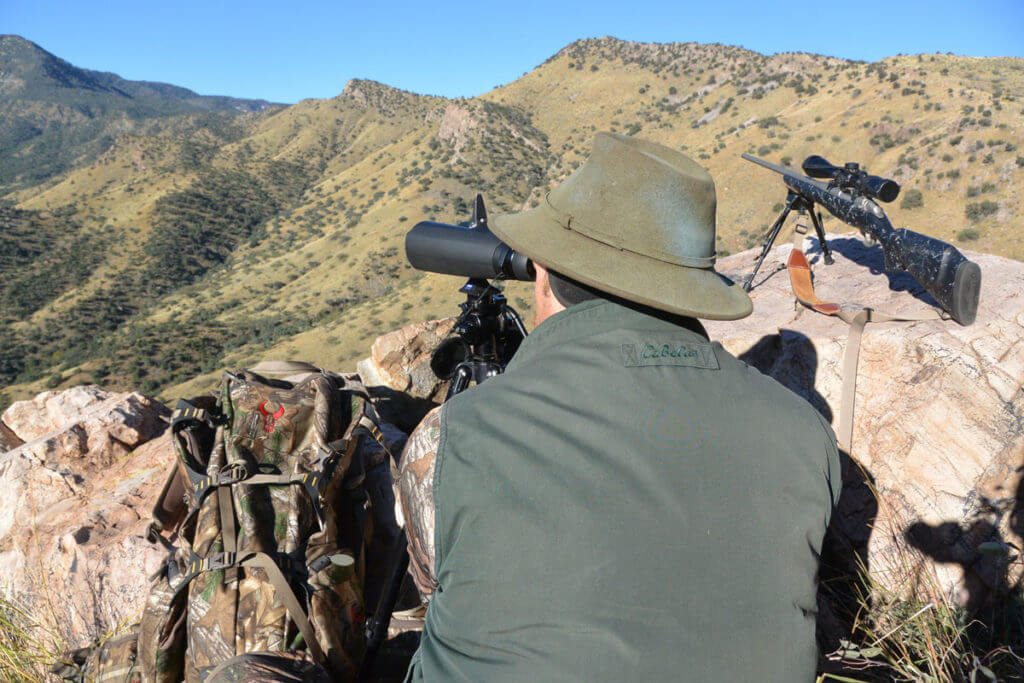
Today the pendulum has swung, and many hunters and shooters opine that bigger, harder-hitting calibers belong with folks of limited intelligence. According to these same hunters and shooters, anyone with enough electronic devices and high enough projectile BC (ballistic coefficient) can kill a mastodon at 1,000 yards with a 6mm Creedmoor. The one thing they do have right is that things have changed. Coming full circle, it’s all about bullet performance. Today’s premium projectiles are incredibly accurate and consistent. More to the point, they penetrate deeply and perform reliably at a wide variety of impact velocities. What this means is that today’s small, recoil-friendly calibers can kill as cleanly as yesterday’s bigger, harder-hitting calibers.

Smaller calibers and cartridges kick less. They tend to be accurate and are certainly easier to shoot well. Loaded with a premium bullet they penetrate deeply and create a devastating wound channel. They do everything a big, hard-kicking caliber can do, right?
Wrong. There are two things they can never do as well:
Hit Hard: Two elements affect how hard a bullet impacts. The first is frontal diameter. The greater the frontal diameter, the more surface area and tissue the bullet impacts directly. Remember; surface area in a circle increases exponentially as diameter increases. The second element is weight. The heavier a projectile is the harder it hits. Consider the difference between getting hit by a pencil eraser traveling at 100 feet per second (fps), and a softball traveling the same speed. Neither will penetrate your skin, but the softball will hit much harder due to greater weight and diameter.
Penetrate Deep: In a nutshell, bigger, heavier bullets penetrate deeper than smaller, lighter projectiles of the same design. That said, modern-day bullet design has leveled the scale, to a degree. Projectiles such as Barnes’ TTSX, (a monolithic, solid copper/alloy bullet), and Federal Premium’s Terminal Ascent (built with a rapid-expanding jacketed lead front and a solid copper rear portion) maintain weight and drive deep, even in lighter, more friendly calibers.
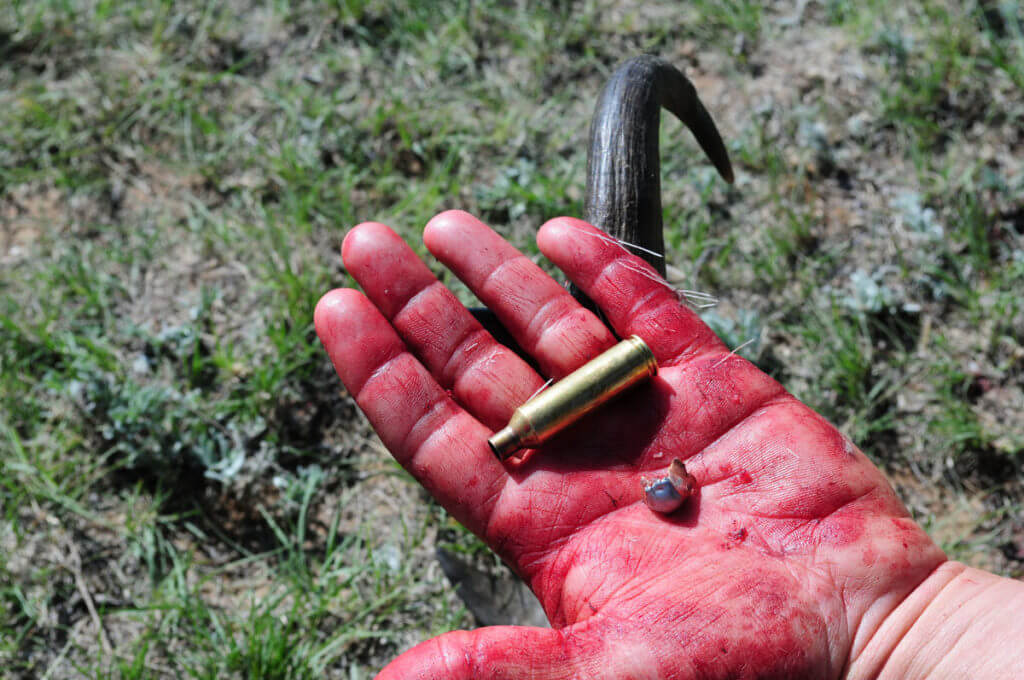
The final word, though, is that a 200-grain bullet from a .300 Win Mag will out-penetrate a same-design 130-grain bullet sent from a 6.5 PRC.
Light/sweet-shooting calibers are easier and friendlier to shoot, and now (with premium bullets) perform and penetrate admirably. Bigger calibers kick harder, but also hit harder and penetrate better. So what is best? The answer is, of course, situation and species specific. The light/sweet crowd will say, “It’s all about shot placement. Just wait for a good broadside shot and place your bullet right in the boiler room”.
To an extent that’s true. But what if your quarry never offers you a broadside shot? Let’s consider a common elk-woods scenario: You’re on a dream hunt in the Rocky Mountains. You’ve hunted hard, and you want to kill an elk in the worst way. On the last day of your hunt, you finally find a bull, a good one with heavy six-point antlers. You’re set up on a little rocky outcropping, using your pack as a dead rest. The bull is going over a thick timbered ridge and isn’t giving you a shot at all.
You keep your crosshairs on him, hoping against hope that he steps into a clearing and gives you a shot. Finally, it happens; 350 yards away he stops, turns, and bugles back down the canyon. You can see his shoulder clearly between tree trunks, but he’s steeply quartered toward you. Your crosshairs are steady, your finger on the trigger. But you subscribe to the “wait till they’re broadside” strategy, and inside your rifle’s 6.5 PRC chamber rests a rapid-expansion 140-grain bullet. What do you do?
If you’re honest and ethical, you let the bull walk.

The chance that your soft, rapid-expansion bullet will make it through the many inches of hide, flesh, bone, and sinew protecting the vitals at this angle is remote. You pull that trigger, and you’re likely in for a long, heart-wrenching recovery effort. But if you continue to wait for that broadside shot the bull will likely walk over that ridge and out of your life forever.
Now, hit rewind and change your chosen bullet to a 130-grain Federal Premium Terminal Ascent. Suddenly, you’ve completely altered this scenario. You’re not going to hit a massive old bull elk very hard with a 130-grain bullet at 350 yards, but an accurate shot with this deep-penetrating bullet will kill him, even through the point of the shoulder. And that’s what has changed. That’s the new difference.
Rewind the scenario again, and change your rifle to a .300 Win Mag. Shooting a 200-grain Federal Premium Terminal Ascent bullet, you will hit that bull very hard and kill him very quickly. No doubt about it, this is the better elk round. If you can handle the kick and shoot it well, by all means use it. But if the recoil loosens your fillings and crosses your eyes every time you squeeze the trigger, you better lighten up.

This scenario changes dramatically, of course, if the primary species you hunt is deer, pronghorn, or sheep. For smaller, lighter boned members of the big game family the 6.5 PRC and similar cartridges are optimal. Loaded with one of the premium bullets mentioned above they will penetrate into a deer’s vitals from any angle. Recoil is civilized, and terminal performance all you will ever need. But what if you use one rifle to hunt a broad spectrum of big game – elk one week, deer the next, and moose the third?
 The author with a big mule deer harvested with a rifle chambered in .280 Ackley Improved; one of his favorite all-around big game hunting calibers.
In my opinion, the ideal solution for an all-around rifle is a mid-level cartridge like the .280 Ackley Improved, .30-06 Springfield, or 7mm Remington Magnum. Recoil generated by these cartridges will not rattle your teeth or cross your eyes, yet they hit hard enough and penetrate admirably. Loaded with premium bullets, they’re cheerfully adequate for everything from coyotes to Alaskan moose.
It is hard to believe Skeeter Skelton has been gone from us for a quarter of a century. There have been many excellent gunwriters over the past 100 years or so, and I have looked up articles by them written before WWI. Beginning in the late 1920s, Elmer Keith caught the attention of shooters and held it for over 50 years; I believe I’ve read everything he ever wrote, especially pertaining to sixguns. Keith wrote about sixguns, shotguns, rifles and hunting with nearly a dozen books to his credit.
Skeeter on the other hand, wrote mostly, almost exclusively, about handguns. His writing career lasted less than 30 years and he never wrote a book, however many of his articles were compiled into a pair of books after his passing and his influence and appeal are everlasting. Those two books which demand high dollar prices these days are Hipshots, Hoglegs, and Jalapenos and Good Friends, Good Guns, Good Whiskey. Just as with Elmer Keith, today Skeeter’s articles seem somewhat dated, nevertheless, just as with Keith, they are also highly relevant in many ways to shooters today.
Skeeter joined the Border Patrol in the early 1950s at a time when it was still a horseback outfit, and also was actually allowed to enforce federal law concerning illegals. He went on to become sheriff of Deaf Smith County, Texas, and while serving as sheriff wrote many of his early articles. His first freelance efforts appeared in this very magazine under his given name of Charles A. Skelton.
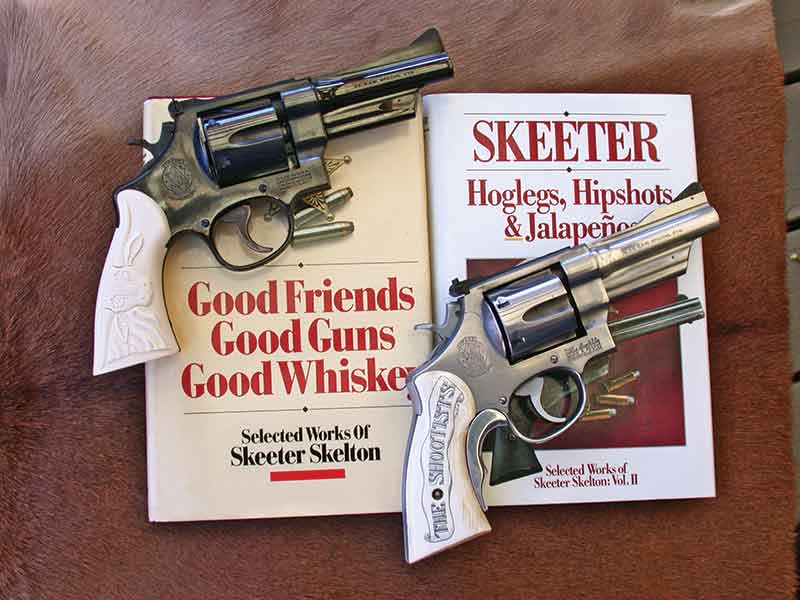
Skeeter Skelton was directly responsible for the resurrection of the S&W .44 Specials in the early 1980s.
Some articles I recall (in fact saved in my file) are “Pistols For Plainclothesmen,” “The New Varminters,” “Rigging Up For Sixgunning” and “Belt Guns Along Rio Grande.” I’m not a betting man, but if I was, I would be willing to wager many of those reading this have done the same thing. Skeeter also freelanced for Gun World and GunSport, then became handgun editor for Shooting Times in the mid-1960s. For more than 20 years in that position, Skeeter caught the imagination and attention of sixgunners everywhere.
Skeeter was more than just a gunwriter as he had a natural talent for entertaining stories, whether they were about his childhood days with his friend in the “Me And Joe” tales or his fictional accounts of the adventures of Dobe Grant. The imaginary Dobe was made up using a compilation of the attributes of several real characters in Skeeter’s life such as Bill Jordan and Evan Quiros. With “Me And Joe,” many of us were able to relive parts of our childhood and dream of years gone by that we shall never see again; with Dobe Grant there was always an adventure and a good definition of what real friendship is.
I first met Skeeter in 1978. The NRA Show was held in Salt Lake City that year, so Diamond Dot and I drove down to attend it as well as The Outstanding American Handgunner Awards Foundation Banquet. I had high hopes Skeeter would win that year, which he did, and I still have the banquet program he autographed for me. I caught his attention on the show floor by walking up to him and handing him a picture. It was a picture of a 1st Generation Colt Single Action I owned and the close-up of the barrel revealed an inscription: “Russian and S&W Special 44.” Skeeter grabbed me by the arm and said, “Let’s go find a place to talk.” He loved Colt Single Actions, especially the .44 Special.
Over the years, Skeeter’s physical condition suffered greatly because of several fights he experienced as a law officer, car accidents and especially a botched operation. He was 60 years old when everything finally caught up with him. While Skeeter was in the hospital I sent him many of my manuscripts, hoping with them he would experience just a small part of the enjoyment I had received from his.
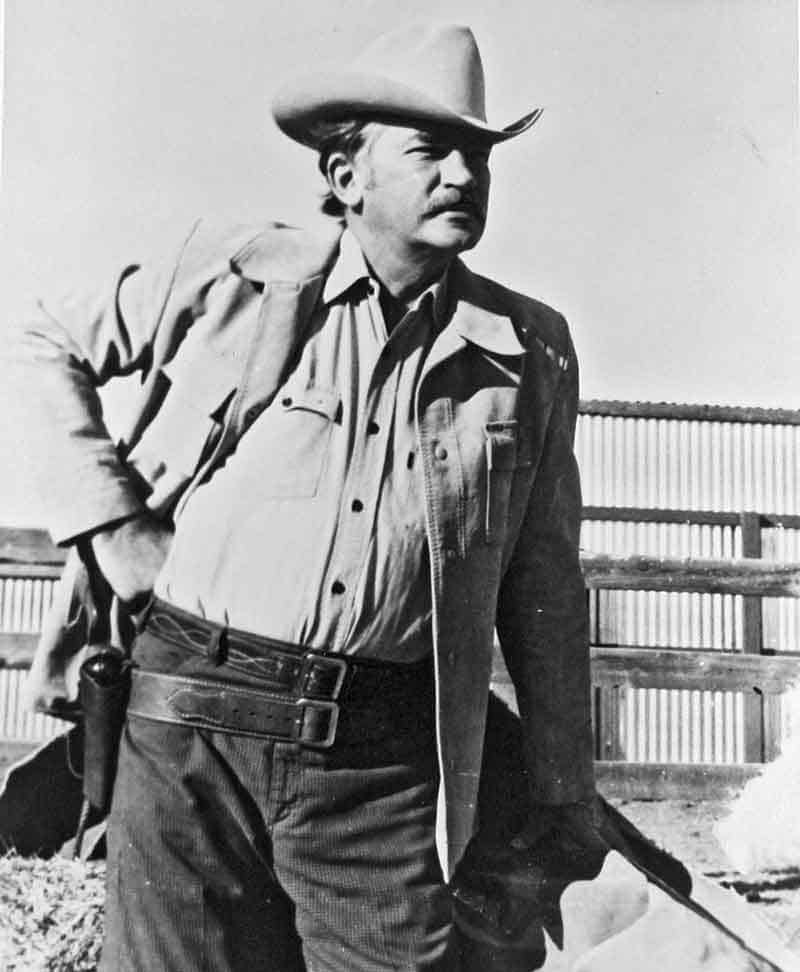
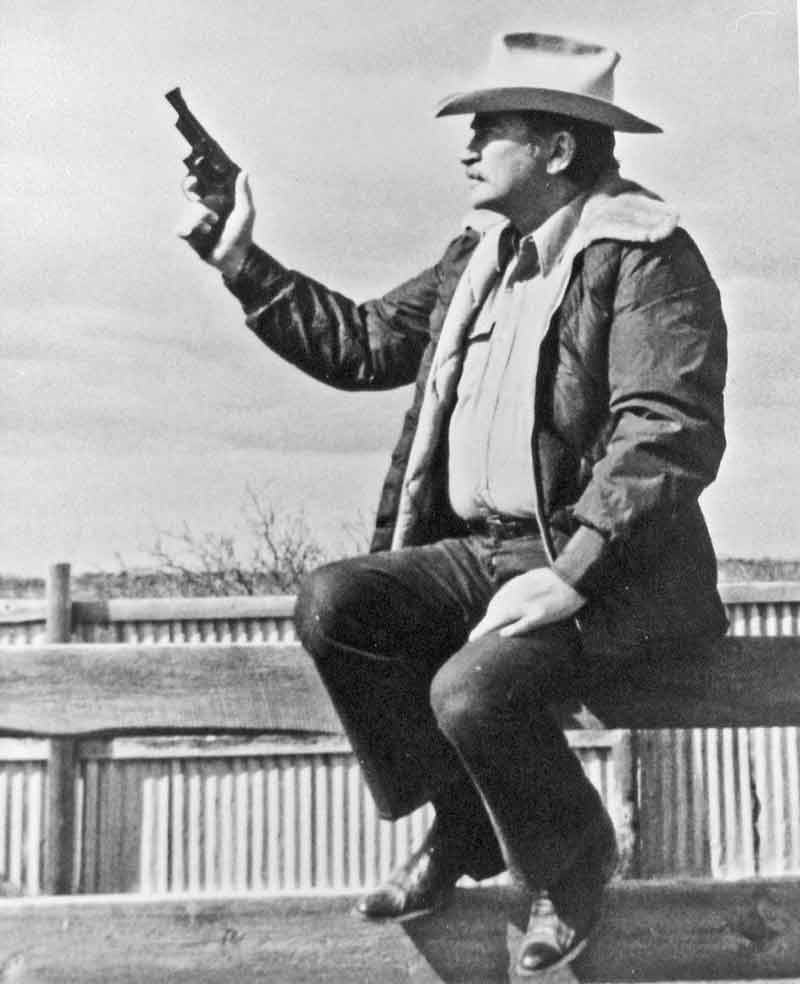
Skeeter often carried a Colt Single Action (above). Skeeter with
his favorite 5″ Smith & Wesson .357 Magnum (below).
Two of my friends, John Wootters and Bob Baer, spent a lot of time visiting with Skeeter in the hospital, and the three of them, along with the help of Bill Grover, built what turned out to be Skeeter’s last sixgun. It is a Ruger 3-Screw .357 Blackhawk converted to .44 Special, fitted with stocks made from the horns of a bighorn sheep picked up by Wootters and Skeeter while in British Columbia. This sixgun now belongs to John Wootters and is pictured in my Book of the .44, which is now out of print. I also dedicated a chapter in that book to Skeeter and the resurrection of the .44 Special. Since his passing in 1988, I have tried to pick up the torch and carry it for sixguns in general… the .44 Special in particular.
Skeeter’s articles were mostly written at the time of the Classic Sixguns, in the middle of the 20th century. I was in college when he wrote about the arrival of the Colt New Frontier. His 5-1/2″ .44 Special was about the most beautiful single-action sixgun I had ever seen and I dreamed of the day I could possibly have one of my own. He not only liked the New Frontier but he had a special fondness for 4-3/4″ Colt Single Actions in both .45 Colt and .44 Special. He made all of us dream of what could be with his articles on custom single actions.
By the late 1970s, it was pretty impossible to find a Colt or Smith & Wesson .44 Special as they had both been removed from production. Skeeter showed us how to make our own in one of his articles. His piece on converting .357 Magnums to .44 Specials has had a tremendous affect over the past 30 years, with the result several top-drawer gunsmiths have converted hundreds of .357 Magnums to .44 Specials.
Skeeter showed us how to do it with both a Ruger 3-Screw Blackhawk and a S&W Highway Patrolman. Because of his writings, Colt returned the .44 Special Single Action into production and S&W produced both blued and stainless steel N-Frame .44 Specials in the early 1980s. Today both companies again offer .44 Specials; Ruger produces the .44 Special Flat-Top New Model while Lipsey’s offers special runs of Ruger .44 Specials, including the Bisley Model and the stainless steel Flat-Top Blackhawk. The .44 Special is indeed alive and well and are a lasting testimony to Skeeter’s inspirational articles.
Skeeter was also a great fan of the S&W double-action sixgun. We could all sympathize with him as he wrote how difficult it was to find a .357 Magnum S&W in the late 1950s. He finally came up with a 5″ Smith and, from his writings, I conclude it was one of his all-time favorite sixguns. Not only were .357 Magnum revolvers hard to find at that time, it was also very difficult to come up with .357 Magnum brass.
The load he developed will probably be forever known as the “Skeeter Load” and consisted of .38 Special brass, 13.5 grains of 2400 powder, and the Lyman Ray Thompson designed 358156 gas-checked bullet. This bullet has two crimping grooves and Skeeter used the bottom groove to allow more case capacity; muzzle velocity is right at 1,300 fps. With the arrival of the K-framed Smith & Wesson .357 Combat Magnum, Skeeter found he had a smaller and lighter Magnum which was much easier to pack all day; however, he still used his same load for this S&W sixgun.
Skeeter acquired one of the first 4″ 1950 Target .44 Special S&Ws, although when the .44 Magnum arrived he replaced it with a 4″ version of the latter. He soon found the Magnum was too heavy and too powerful for police work and went back to a 4″ 1950 Target Model .44 Special. (Just about every .44 Special sixgunner knows of and uses Skeeter’s .44 Special Load, the 250-grain Keith bullet over 7.5 grains of Unique.)
He opined at the time the .44 Magnum was strictly for hunting and he found a slightly used 7-1/2″ .44 Blackhawk, the original Flat-Top version and this became his favorite hunting handgun carried in a George Lawrence No. 120 Keith holster. He was carrying that sixgun and his brush clothes when he was called to take part in a drug raid and also when he pulled down on a drug smuggler, who was armed and ready to fight.
With that big .44, all the fight disappeared from the contrabandista; the man later said: “That cowboy had the biggest gun I ever saw!”
What are probably the most popular double-action revolver stocks ever designed are now known as Skeeter Skelton Stocks. Skeeter took the stocks Walter Roper designed for the S&W in the 1930s but modified them to better fit his hand. My friend, the late Deacon Deason of BearHug, acquired permission from Skeeter to reproduce this grip. With the passing of Deacon, friend Tedd Adamovich of BluMagnum now offers the same excellent grip for S&W double-action sixguns.
When it comes to sixguns and sixgunning, Elmer Keith and Skeeter Skelton influenced just about everything. Their writings caught the imagination, heart and soul of every true sixgunner. I hope in some small way, I have carried on their tradition.
