Author: Grumpy

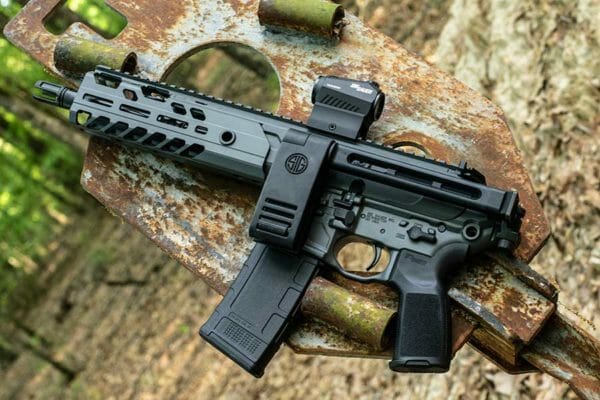
Released in 2022, POF’s Phoenix is a ruggedly-built pistol chambered in 9mm. Named for the town it’s manufactured in, the Pheonix is feature rich and has 35 reasons you should own it.


All the controls for the Phoenix Pistol are ambidextrous and AR-compatible out of the box. The fire selector and grip can be swapped with ARs, and it comes with a Mil-spec trigger that is drop-in compatible.
The Phoenix’s direct blowback action is housed in a monolithic aluminum upper receiver. The receiver has M-Lok slots and a full-length Picatinny rail over the 8″ barrel.
Its overall length is just 17.5″ and it weighs in at 4.6 lbs.

Topping off the ambidextrousness, the non-reciprocating charging handle can be fixed to either side of the upper.
The upper is finished with a hand stop, and the barrel is tipped with a dual-port muzzle brake. The barrel’s 1/2″-28 thread is suppressor-ready.
At the other end, the butt plate has a Picatinny rail and an integrated QD sling point. Get this soon and get a free stamp for the ATF to make it an SBR with a stock.

The big thing, though, is that the Phoenix comes with a 35-round injection molded double-stack magazine. The magazine curves for natural stacking and reliable feeding, and it includes a polymer mag loader. 20- and 10-round mags are also available for a slimmer fit or compliance.
POF’s Phoenix pistol is available now in black or FDE. MSRP starts at $1,801.
Specs
- Caliber: 9X19mm
- Action: Blowback
- Weight: 4.6 lbs
- Barrel: 8.5”
- Rifling: 1:10, 1/2×28 muzzle threads
- Overall Length: 17.5”
- Receiver Finish: Black anodized
- Handguard: Monolithic upper receiver with M-Lok
- Muzzle Device: Dual Chamber Muzzle Brake
- Trigger: Mil-Spec AR-style
- Grip: Mission First Tactical
- Fire Control: Ambidextrous
Categories
Desert Tech FAT MAG
Gun Owners of America’s (GOA) preliminary injunction against the Bureau of Alcohol, Tobacco, Firearms and Explosives (ATF) rule on pistol stabilizing devices (Final Rule 2021R-08F) has been extended until the conclusion of the case.
The case, State of Texas v. ATF, was bought by GOA, Gun Owners Foundation (GOF), and the state of Texas to challenge the ATF rule that reversed years of determinations surrounding pistols equipped with stabilizing devices. The ATF’s new rule reclassified most pistols with stabilizing braces to short-barreled rifles (SBRs), meaning the firearms would be regulated under the National Firearms Act of 1934 (NFA). It required owners of these guns to register the firearms with the ATF, submit to additional background checks, hand over passport pictures, and provide fingerprints.
If the gun owners don’t want to register the pistol, the ATF gives them four choices. The first choice is to turn over the pistol to law enforcement. The second is to install a barrel greater than 16 inches. The third is to remove the brace and make it so it can never be installed again. The final choice is to destroy the firearm.
The rule set off a flurry of lawsuits asking for a nationwide injunction before the June 1, 2023, effective date. Second Amendment Foundation (SAF) would get an injunction in a Texas District Court. Firearms Policy Coalition (FPC) would get their injunction from the Fifth Circuit Court of Appeals. GOA’s injunction would also come from a Texas District Court—none of the injunctions applied to all gun owners. Only the members of the organizations were covered. The injunctions were issued before the cut-off date.
The injunctions would be used as stop gaps until later to give the courts time to rule on the cases. Judge Drew B. Tipton has now decided to extend the preliminary injunction until the case is settled.
A preliminary injunction is an “extraordinary remedy” to maintain the status quo. Several factors have to be considered for an injunction to be issued.
The first and most important factor is the likelihood of the plaintiffs to succeed on the merits of the case. Judge Tipton cited the ruling in Mock v. Garland, where the Fifth Circuit Court of Appeals found that the ATF violated the Administrative Procedures Act (APA) by pulling a bait and switch with the Proposed Rule and the Final Rule.
The ATF presented a rule with a form (ATF Form 4999) with a point system to determine if a brace would turn a pistol into an SBR. When the Final Rule was unveiled, the point system was gone. All braces currently on the market would turn any pistol into an SBR if equipped. The rule bore no resemblance to the Proposed Rule.
“The first inquiry is whether a Plaintiff that has standing has established a substantial likelihood of prevailing on the merits. Id. The Fifth Circuit has already decided “that the Final Rule fails the logical-outgrowth test and violates the APA.” Mock, 75 F.4th at 578. Because that holding pertained to the ATF’s rulemaking process, any plaintiff challenging the Final Rule on APA grounds in the Fifth Circuit has the same likelihood of success. Therefore, Plaintiffs have a substantial likelihood to succeed on the merits of their logical-outgrowth claim,” Judge Tipton wrote in his 29-page decision.
The judge also believes the plaintiffs will suffer irreparable harm if the Court doesn’t issue an injunction. Judge Tipton pointed out that the plaintiffs would be forced to comply with ATF’s rule if no injunction is issued, meaning they would have to get rid of or modify their firearms.
“The ATF gave affected gun owners until May 31, 2023, to register their stabilizing braces. 88 Fed. Reg. at 6570. Because that deadline has now passed, complying with the Final Rule would require the private Plaintiffs to do one of four things: (1) permanently modify their weapon to remove it from the scope of the NFA, (2) dispose of or ‘alter’ their stabilizing brace so that it can never be reattached, (3) turn over their weapon to the ATF, or (4) destroy their weapon completely,” the order reads.
The final factor in a preliminary injunction is the balance of equities and public interest. In this stage, the judge explores the harm to the plaintiff if an injunction is not issued. The judge also looks to the harm caused to the defendant if an injunction is issued. The judge will then look at the public interest.
The judge ruled that the plaintiff would experience harm immediately without an injunction. He said the ATF’s harm is more administrative and speculative. Judge Tipton also ruled that “there is no public interest in the perpetuation of unlawful agency action.”
“The Court finds that the balance of equities tips in Plaintiffs favor because the Final Rule’s effect on Plaintiffs is immediate and imminent while the effect on Defendants, especially the ATF, is more administrative and speculative. Defendants’ arguments of harm to the public are unavailing,” the judge wrote.
The judge kept the scope of the ruling just to GOA members. This decision means that all GOA members will be protected from ATF enforcement actions over braced pistols for the foreseeable future. Even though there is no all-encompassing order enjoining the ATF from taking enforcement action against anyone who owns a pistol equipped with a stabilizing brace, the scale of the current injunctions means millions of Americans are protected from ATF action. Since none of the groups are required to share their membership rolls with the ATF, many believe the rule is currently unenforceable.
The ATF Final Rule on the classification of pistols equipped with stabilizing braces is not dead yet, but it is on life support.
GOA’s Injunction Against The ATF’s Pistol Brace Rule Extended Until The Case Is Settled by AmmoLand Shooting Sports News on Scribd
Categories
My Teachers Pension check has cleared!


Above: The Air Force National Trophy winning team at Camp Perry, 1966. Author Arnie Vitarbo is second from the left in the back row.
The beginning
The beginning
In early 1951 a plan was put into motion whereby the Air Force might qualify for the 1952 Olympic Games held in Finland. In addition to the smallbore rifle team, the fiercest Air Force pistol competitors were Alan Luke, John Kelly, LTC Charles Densford and Col. Thomas Kelly. At the time, Col. Kelly was not aware of the place in Air Force history that awaited him.The tipping point
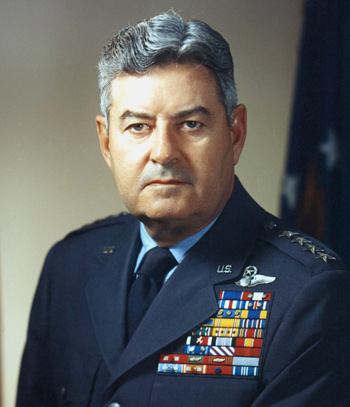
General Curtis LeMay.
Following an attack during the Korean War, General Curtis LeMay went to Kimpo Air Base to take stock of the situation. Learning that fallen U.S. Airmen had perished with M2 Carbines in their hands after their apparent futile attempts to load them with .45 cal. service pistol magazines, the general vowed “never again.” After becoming Chief of Staff of the Air Force, he was able to make good on that promise. The general reached out to Col. Kelly to organize the first Air Force Marksmanship School at Lackland Air Force Base, San Antonio, TX. Col. Kelly’s assignment was to 1) Train and organize competent gunsmiths; 2) Establish a marksmanship school; and 3) Organize and field the best competitive shooters in the world. In typical military fashion, the colonel complied.
Many of the early gunsmithing “recruits” were aircraft engine mechanics, fighter pilots or other maintenance personnel who just liked to target shoot or hunt. From that early nucleus came the Air Force’s Gunsmithing “Shop” with pistol, smallbore and high power rifle, shotgun and subsequently running boar (now moving target) sections. An ammunition section was also formed to find the best loads, using their own 100-yard test tunnel. The shop would test a few rounds of ammunition from every manufacturer and, once they found the best, they would buy the entire lot. We knew when we were issued ammunition that we were getting the best available.
With the gunsmithing program underway, efforts turned to establishing a marksmanship school. The first contingent of Air Force shooters arrived at Ft. Benning, GA, to attend the U.S. Army’s advanced coach class in 1958. [Editor’s note: For reference, the Army formed its marksmanship unit in 1956, the Navy in 1957.] The Air Force marksmanship school “went live” later that year and present-day Air Force “Red Hat” rifle range instructors are the direct result of that original program.
With gunsmiths and a marksmanship school in place, Col. Kelly turned his attention to his final set of orders—making the best shooters in the world. Air Force shooters from 1959 until the program was discontinued in 1969 performed extremely well. I will only cover the accomplishments of the pistol team of which I was a part of and knew from firsthand experience.
Team composition
The majority of the early team members came from within the Air Force but there were some who came from the other Services. The first was Bill Mellon who came over from the Navy, then me, Arnold Vitarbo, from the U.S. Marine Corps. I was a member of the Marine Corps Pistol Team from 1961 through most of 1963, and was an established “2650 Bullseye” shooter for the Corps. In those days, whenever we encountered the Air Force Team at matches we were very impressed by their skill and professionalism, so much so that I wanted to become a part of it. During November of 1963, I completed my 10th year in the Marine Corps and decided to join the Air Force. After my discharge from the Marine Corps, I was turned down by an Air Force recruiter on a normal enlistment and actually was headed to Hawaii where we planned to live.
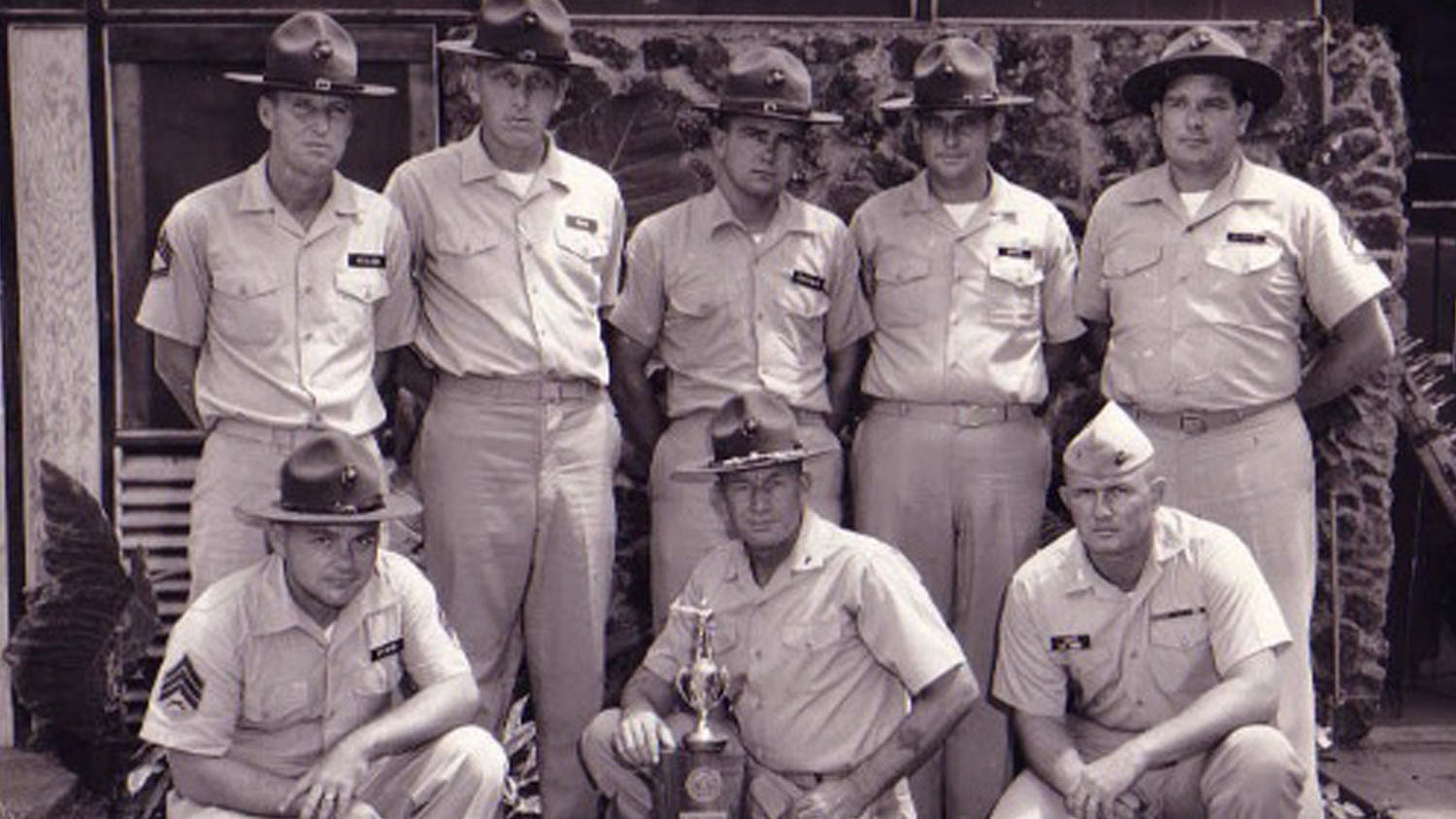
Not related to the Air Force team, this picture instead shows the author with the Hawaii Marine Pistol Team in 1961. Readers may recognize the young Officer kneeling on the right of the photograph. Jim Land (former NRA Secretary) and Vitarbo shot on the Hawaii Marine Pistol Team for a while together.
Col. George Van Deusen, Commander of the Air Force Marksmanship School, helped get me assigned directly to the team at Lackland AFB. It should be noted that Col. Van Deusen, a former fighter pilot with the “Flying Tigers,” often traveled with us and usually shot well over 2600 himself. When I arrived at Lackland I found that of the 15 shooters assigned to the Pistol Team, seven of them were current 2650 shooters, including the team captain and coach. (Note that all of these scores were fired with open sights, no scopes.) During my first half-year on the Air Force team in 1964, I fired in over 20 matches and had a 2646 match average, but was not able to make the Blue Team until later that year. My first match as a firing member of the Blue Team made me realize just how tough these guys were. From here on, I would like to list some of the highlights of our team’s accomplishments and put them in perspective.
-SSGT John Mahan broke 2650 12 times and never won a match with it. He was the only shooter I ever met who actually had his sights adjusted for a controlled “jerk.” Anyone else who shot his guns always shot high and to the right.
-In 1966, Capt. T.D. Smith III shot his .45 cal. wad cutter in centerfire matches and his “hardball” gun in the .45 stages for the entire year, with the goal of winning the National Trophy at Camp Perry. After 20 matches and an average close to 2650, he was, instead, sent to Vietnam.
-Capt. Franklin C. Green held the bullseye record for a while with a score of 2665. He injured his left hand so he switched and broke 2660 with his right hand. He became National Champion in 1968.
-TSGT Alvin R. Merx was the first man to shoot 300 over the .22 National Match course. (He subsequently equaled that score several more times.) Merx complained all the time because he hated shooting and said it was boring. He used to assemble distributor caps at a Ford Motor plant in Detroit and said that is what he enjoyed doing.
-Myself, Capt. T.D. Smith III, Capt. Frank Green, SSGT John Mahan and a few others also shot 300 in competition in the National Match course on different occasions. The first time I shot over 2660 (2664) I walked off the line thinking I had the match won, but soon found out that I came in second to T.D., who shot a 2666. In 1968 at Camp Perry, the Air Force made a clean sweep of the Nationals. We won the warm up match, all three guns and Frank Green won the Grand Aggregate. SSGT Edwin L. Teague won the National Trophy Individual Match and we also won all three Team Matches. In the American Rifleman magazine, the reporter said that the Air Force won everything except Lake Erie.
One team only
In those days, there were no separate Conventional and International teams. Those of us who could do both, shot in all of the major matches of each. Our Blue Team in Conventional was usually made up of the International shooters that included:
- Capt. Franklin C. Green, 1964 Olympic Silver Medalist in Free Pistol, 1968 National Pistol Champion, 2650 Club and President’s 100.
- Capt. Thomas D. Smith III, 1964 Olympic Team for Free Pistol, World Champion Center Fire and the retired record holder with a score of 599, 1963-64 Interservice Pistol Champion with a score of 2658-140X, (T. D. shot over 890 with the .22 so many times that it became common place for him), 2650 Club, President’s 100.
- SSGT Arnold Vitarbo (author), 1968 Olympic Team in Free Pistol, 1966 World Championships Free Pistol fourth place finish, 1967 Pan American Games Free Pistol fifth place finish, Team Gold Medal and Individual Gold, 1985 and 1968-1970 World Championship Team Member with a 568-match average in Free Pistol, 1969-1985 Free Pistol Record holder with a 571, 1969-1981 Standard Pistol Record of 586, 1985 Air Pistol Record of 584, 1973 National Free Pistol Champion, 1966 National Center Fire Championship, Distinguished in Rifle, Pistol and International, averaged 288 in individual and Team Matches with the Service Pistol for six seasons, 2650 Club, and President’s 100 seven times.
- SSGT Edwin L. Teague, 1964 Olympic Team in Rapid Fire and 1968 National Trophy Pistol Champion. Ed was a tremendous Police Combat Action shooter and had unbelievably quick reflexes. He later became the head of the SWAT program for the Arizona State Police. He was also part of the 2650 Club and President’s 100.
- LT. Gail Liberty shot as high as 2625 in the Conventional Pistol matches and was a member of the 1966 World Championship Team. After she retired from the Air Force, she made the National Team in Women’s Sport Pistol and Women’s Air Pistol.
Something to pass along
We had a large team score board set up at each match and were required to post our scores. The team would always gather around the score board after the match for open discussion. Although there was much camaraderie among the team members, when the match began, it was “dog-eat-dog.” I feel this attitude was very healthy and that it contributed to our overall success. If you were “thin skinned” you would not have lasted very long on the team.
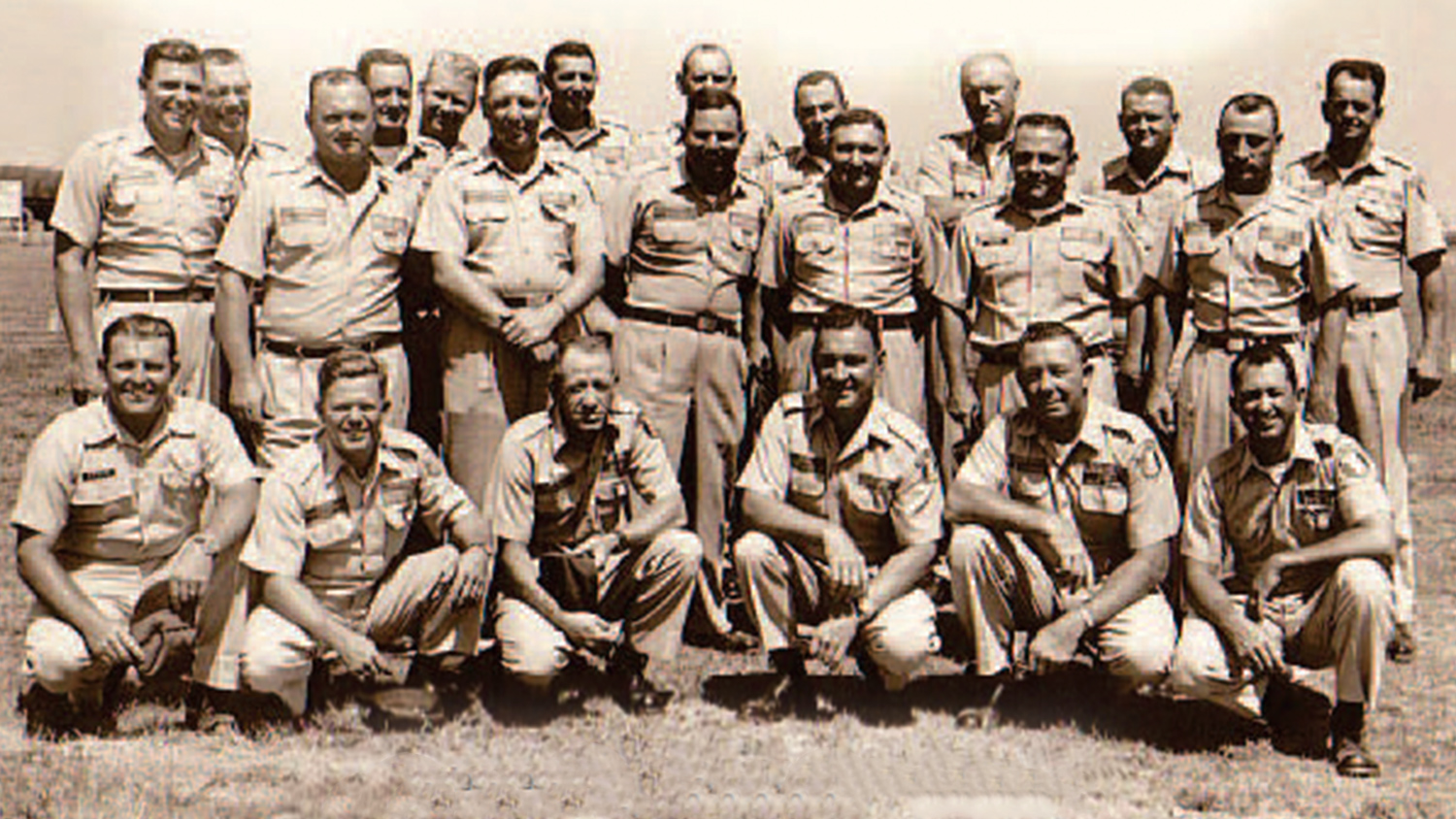
The United States Air Force Pistol Team at Camp Perry in 1964: Front Row (l. to r.) Capt. Green, Bob Day (Gunsmith), MSGT Byers (NCOIC), Col. George Van Duesen, MSGT Dave Miller (Coach), SSGT Scott Wroten. Second Row: MSGT Carter, SSGT Graf, SSGT Mahan, TSGT Crump, TSGT Merx, SSGT Vitarbo, SSGT Teague. Back Row: SSGT Stoltman, SSGT Duett, SSGT Breeding (Gunsmith), SSGT Thyarks, SSGT Kwas, SSGT Legg, Capt. Smith, SSGT Yeager, TSGT Mellon. Photo courtesy USAF Archives.
During team discussions, the subject of how to handle match pressure would always come up. In their own way, each shooter would finally admit they used some form of mental training, including imagery. The mental preparation normally began weeks before a major competition. The closer the “big” match came, the more we would get into our “shell.” These thoughts would include hearing ourselves being called to the firing line, getting our guns ready, etc. The night before a big match, we would try to imagine in more detail actually firing the match, hearing the range commands, the noise and also preparing for any problems that might arise like weather, target breakdowns, etc. When the command was finally given to commence firing, before each shot or string of shots was fired, we would rehearse the entire shot or string in our mind. This mental imagery included breathing, rise of the gun, watching the sights, feeling the trigger pressure and follow through. Immediately after this exercise, we would raise the gun and fire a well-planned shot or be ready for the commands for the sustained fire stages.
I still teach the following techniques to my students in my Coaching and Advanced Marksmanship Clinics. We would try to imagine seeing our sights clearly with our eyes closed. This is normally an acquired skill and takes time to master. It also helps to dry fire in a dark room or closet to get the feel of the trigger and how a smooth break should feel.
Closing remarks
It is my opinion that the reason for the overall skill level that was present during the 1960s was in large part due to the Air Force and its program. We were expected to act like professionals and were treated as such. The performances of the Air Force Team had a snowball effect: As the Air Force improved, the U.S. Army Marksmanship Unit at Ft. Benning improved along with the Navy shooters who, in turn, began to be a force to be reckoned with. The Air Force had to improve to beat the Army and Navy, and they in turn did likewise. The overall result was extremely high scores with a very high expectation level. There are record scores that were fired in the 1960s and early 1970s that are still standing.
There are other members too numerous to include in this article and I apologize for not mentioning anyone before 1962, but I was not on the team at that time.