Categories
All About Guns

Lost Treasure: Magic, Mystery and a Colt 1911 by JUSTIN DYAL

nm-1911-with-magtech-ammo.jpg

This is not just a 1911 story. It is a treasure story, just as much a mystery, and there is definitely magic involved. The story involves a multi-generational saga, so it defies normal categorization. But that is what makes it worth telling.

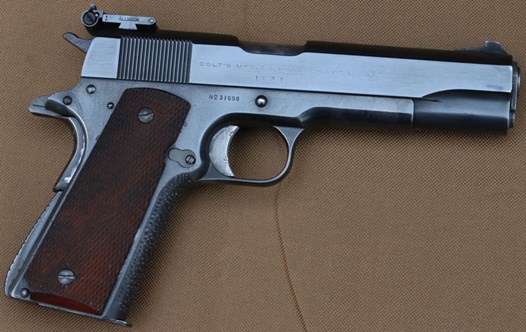
Like every good tale, this one begins with a “So there I was” … surfing Gunbroker looking at a few reliable sellers who have great stuff. I needed nothing and was simply enjoying some browsing. And then, there it was. The title said “Colt 1911… Arsenal rebuilt, 1913 US Property frame.” The images showed a well-used 1911 set up as a National Match or bullseye “hardball” gun.

The slide and frame were made by Colt, but the slide had later commercial roll marks, while the frame was an original 1911-style without the trigger scallops. The “UNITED STATES PROPERTY” stamp and the inspector’s cartouche proved its G.I. heritage, while the 31,000’s serial number put it at 1913, a little more than a year from Colt’s initial deliveries of the pistol.
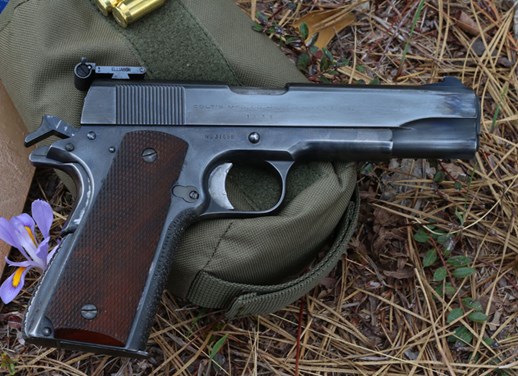
The frame was stippled with a punch rather haphazardly, and the arched mainspring housing had been worked over diagonally and deeply with some sort of file for a coarse, “checkered” effect. The slide wore a National Match front sight matched up to an old-style Colt Eliason adjustable rear.

The long aluminum trigger had unsightly divots where there was once a trigger shoe installed, and someone had scrawled “BAB” in electro-pencil on the inboard side. The slide had “1332” marked under the ejection port, worn faint from some polishing that had occurred before the mismatched upper and lower had been re-blued together.
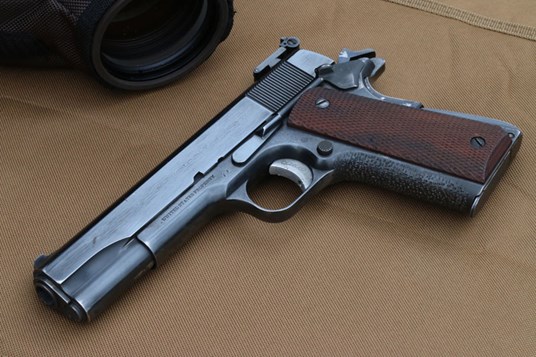
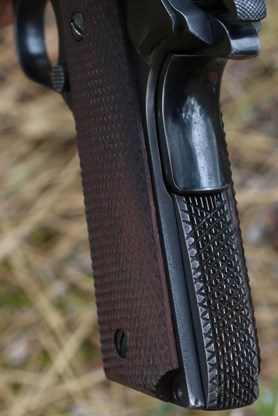
Everything about this pistol was slightly off. You wouldn’t expect to find such an early frame mated to what appeared to be a National Match slide. However, something about this pistol absolutely shouted “military armorer build” to me.

When I shot for one of the Marine Corps’ station pistol teams we had been issued old Quantico-built National Match-style .45s, and this had that look—a number of small tells that appeared emblematic of a military build. Military armorers tend to be oblivious to cosmetic touches, for example, and tend to stipple in a way that no commercial pistol-smith would—functional; effective; ugly.

Bidding on a mixmaster match gun is high risk; the lockwork is almost certainly messed with—perhaps poorly—the two halves may not function reliably as a whole, etc. I barely stopped to consider these or other pitfalls, though I’ve been burned on auction sites before. Something about the photos of this Colt spoke to me in a way that no other pistol ever has. It was as if this .45 was reaching out to me through the internet.

Not in a puppy at the pound, please take me home way. More like excalibur in the stone beckoning Arthur to come release it. I named my price. Apparently the rest of the internet simply saw a mixmaster, beater 1911. A complete 1913 manufacture Army Colt would be a hefty sum. Likewise would be a complete postwar National Match. My winning bid was a couple hundred dollars less than the rack-grade price of current CMP mixed-part 1911A1s.
When the Colt arrived it took only one cycling of the action to confirm my hopes. The pistol cycled like the very best custom 1911s from an earlier era. It was tightly fitted in a way that in the days of pre-CNC machined and custom-mated parts meant hours of careful work. The pistol was almost perfectly tight, but cycled with an oily smoothness that inspired admiration and confidence. I had every suspicion this was going to be a shooter.

The custom Colt felt really good in the hand, the ugly-duckling stippling and checkering almost perfectly coarse for my taste, and the aged figured walnut stocks with plenty of bite left on the checkered points. I verified empty and tested the trigger pull. I’ve had the great fortune to handle a large number of custom, semi-custom and just plain nice pistols, and the first press on a great trigger never gets old. This one brought a deep smile to my face. If I said it was like perfection dipped in warm chocolate, it is probably a better description than the usual 1911 cliches. I was wiling to bet money the trigger was breaking a feather above 4 lbs. (the rulebook minimum for a service pistol). Upon measurement … 4.09 lbs. This with old school parts—the early long trigger, a G.I. hammer that had been milled down to reduce hammer bite and weight and likely a G.I. sear and spring.
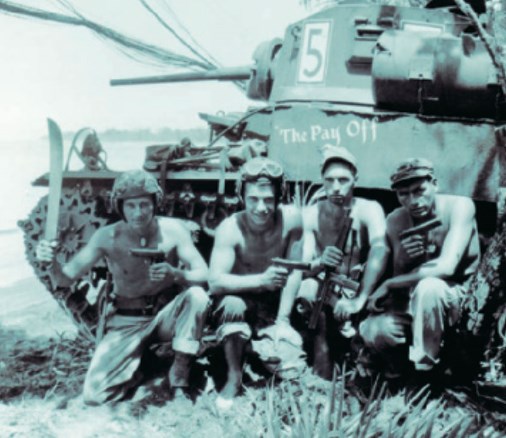
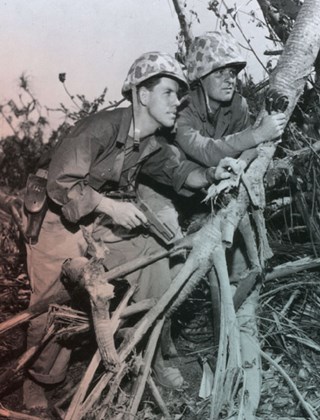
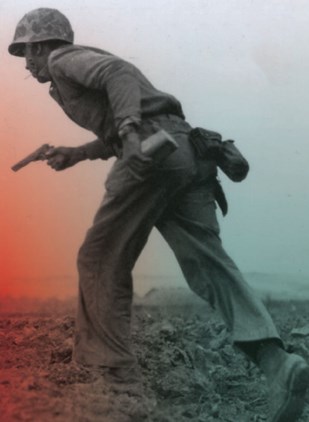
I thought about the old 1913 frame on the gun. This thing was made just as Theodore Roosevelt had lost his Bull Moose party run for the presidency and Woodrow Wilson took office. The Colt had probably gone to the border in a cavalry flap holster, either on horseback or in one of the “new” motor cars to chase Pancho Villa. You can almost imagine the wonderment of the trooper as he handled the cutting edge, “self-loading” .45. The Colt almost certainly went “Over There” with the same soldier, or perhaps another doughboy to fight through the trenches in World War I. The “AA” marking on the dust cover showed the pistol was overhauled at the Augusta Arsenal for further service, and very likely served through the Second World War with another generation. I could picture this same pistol comforting some G.I. through long nights on some steamy Pacific island, ready to repel a banzai charge or clenched in hand to clear caves and tunnels.
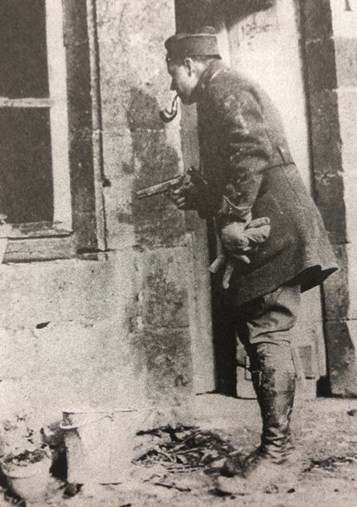
How did this thing end up with a National Match slide? I had a couple of working theories. In one, a talented armorer chose the 1913 frame because of its fit on the slide, and as it was older, it wouldn’t be a loss to dedicate it as a match gun. In another—less charitable—an armorer brought home some parts, including the NM serialized slide, and built them up on a cheap, recently DCM (precursor to CMP) surplus, arsenal-rebuilt, 1911 frame. Whoever the smith and whatever the path that brought these two Colt halves together, it is a happy ending.
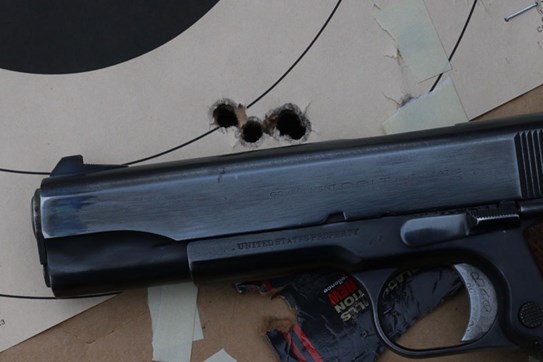
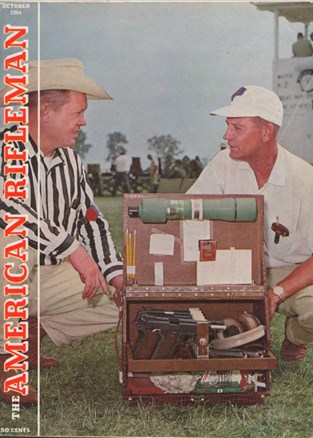
And who was the “BAB” represented by the letters on the trigger? The ‘smith, or perhaps the shooter? The parts and build of this pistol suggest a late 1950s or early 1960s timeframe, smack dab in the golden age of bullseye shooting as the predominant pistol sport. Did the original owner proudly heft this Colt and stack enough “X”s to win a shelf of trophies? I tend to believe so, though with no way of substantiating it.

I took the old Colt to the range and starting shooting. It cycled smoothly and reliably, with the oily grace only a full custom build produces. When shooting an old loose 1911, the parts are rattling together into a locked position, then every motion in the firing cycle imparts a subtle jolt as the parts jostle back and forth. When the design is fitted tight and right there is a smoothness that is a wholly different experience (most current-production 1911s are thankfully past the midpoint on this spectrum). One might compare it to the difference between cutting a fine steak with a coarse serrated knife and a razor-sharp steak knife. Both produce the same function with a similar motion, but the feel is entirely dissimilar.
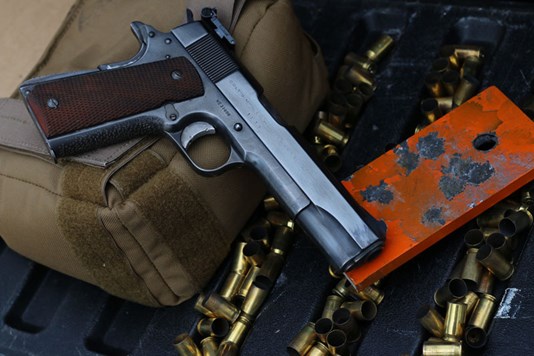
I fired a few representative groups with different loads. Some Black Hills hollow points punched into less than an inch, some MagTech semi-wadcutters just barely over. A couple of handloads piled three or four into a single hole with a fifth close by. I was as excited as a kid catching his first fish. This kicked off the quest.

For months I would bring the National Match out on each range trip and log a few more loads. I would mostly fire one representative group, maybe a second or third group if there was real potential, or if I felt there were some fliers. After the first six or so, the average was about an inch and a quarter—a group that would neatly nearly fit under the inch and a half cap to the typical gallon jug of milk. At 10 groups the average hadn’t budged, nor at 15. By 20, the average had started to creep closer to an inch. I found loads with multiple bullet styles and weights, and several powders that would cut ragged holes. The Colt was indifferent to whether the loads were hardball, modern defensive hollow points or match loads- every shot seemed to pull the next one close.
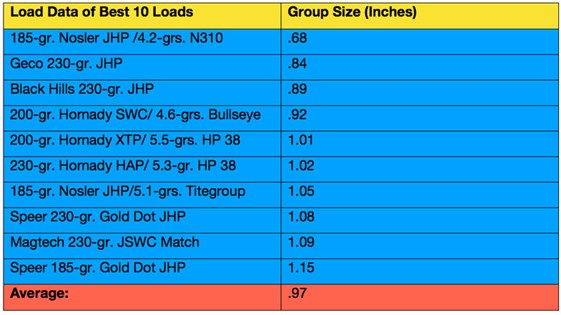
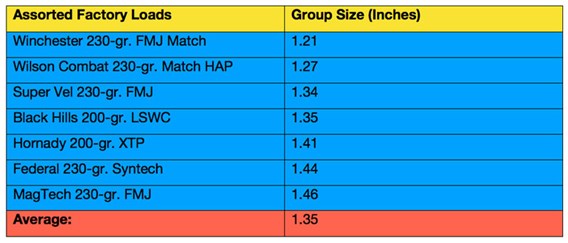
As of this writing, the best 10 loads average under an inch at .97”. The average of over 25 different loads is 1.18”. Some highlights are in the table, but this is perhaps the most consistently accurate 1911 I’ve fired. Keep in mind, these groups are all fired over a standing rest—my preferred method—but also one that makes groups much under an inch and a quarter a real challenge.

Outside of the 25-yd. groups I have pushed the old Colt on some challenging drills with results beyond what I can guarantee with even current custom pistols. In a nutshell, this 107-year-old Colt has 40 ozs. of magic forged into its Hartford steel.
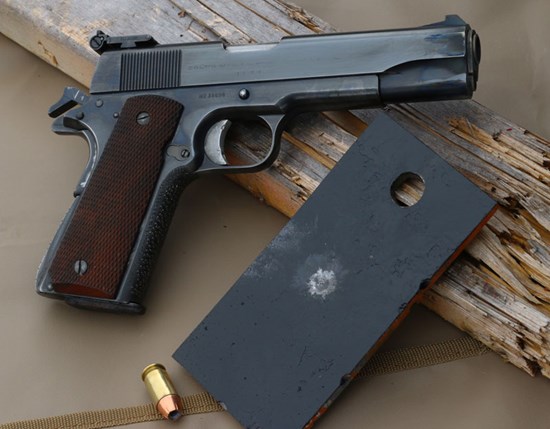
I often shoot the plate rack at 50 yards for a challenge. With some pistols, that is better described as “I hit some plates at 50 yards,” and with others, it is “I hit most plates at 50 yards.” The mixed Colt shrugged off the plates like they were a gimme, so I began actually running the rack of six for time. My current best center-fire semi-automatic time belongs to the Colt, with a time so short it challenges belief.

Here is a fun fact: Most .45 ACP loads when sighted for a 6 o’clock hold at 25 yards will strike close to dead on at 70. With the old Colt, I started lobbing rounds at the 8” plates from 70 yards on most trips. I was able to record eight or nine hits out of 10 with numerous loads. On several days where the light was ideal and I was shooting strongly, most of those impacts formed nearly overlapping spatter marks into a fist-sized group. At present, my best is 10 out of 11, and hopefully by the time this is printed, I’ll have a perfect run.

Shooting this National Match is a unique and distinctly rewarding experience. Every time I marvel at how well it shoots from a purely practical point of view. This invariably leads to a deep appreciation for the pistolsmith who fitted it up and tuned it so expertly some 60 or more years ago. That leads as often as not to wondering about the past lives that have intertwined with a common bond in this old Colt over the last century-plus in service, combat and competition. It is no surprise that wrapping a hand around that frame is akin to shaking hands with something special. I’m just glad that the old Colt found me.
Categories
All About Guns

HERTER’S BIG BORE SIXGUNS THE “OTHER” MAGNUM REVOLVERS WRITTEN BY MIKE HOLMES

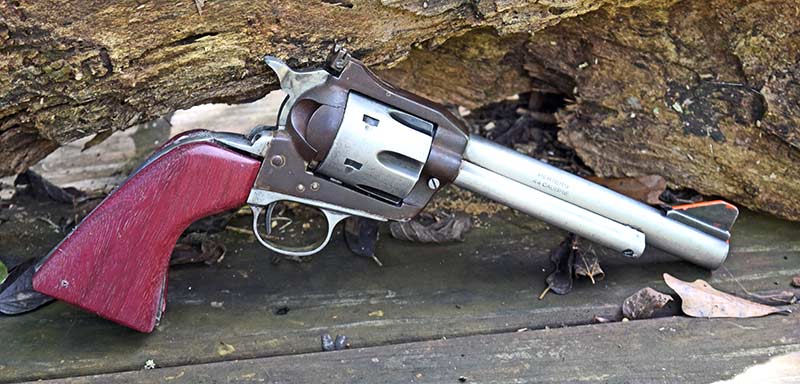
Herter’s revolver with 6″ barrel and Mike’s “custom” purple heart grips. He found it to be a fun shooter, but confesses he’s no gripmaker!

As Mike says, if you squint a bit it doesn’t look too bad in spite of the “original” grips on it when he bought it.

Readers in my age group likely remember when the Herter’s Company had a thriving mail order sporting goods business, selling everything from firearms and ammunition, reloading equipment and fishing tackle to camping supplies. This was in a different America, one that must still give Hillary Clinton and her ilk nightmares. In “those days” customers could order a firearm — even a handgun — through the mail and have it delivered to their doorstep, and with no paperwork or permits involved.

Herter’s revolvers were based on the Colt single action — as were most other SA revolvers of the time — and priced lower than a Ruger or Colt. Lest we assume they were strictly a “cheap” gun, they were imported by Herter’s, but produced in Western Germany by J.P. Sauer & Sohn. These revolvers were solidly constructed, with good sights, had case head recesses in the cylinders and were produced in .357 Magnum, .44 Magnum and a cartridge exclusive to Herter’s, the .401 Herter’s Powermag.

Way back in the early 1970’s, I swapped for a .44 Magnum Herter’s, the first .44 Mag. I ever owned, or shot. Mine had a 4″ barrel, which I now understand was a rare edition, and the recoil was stout, to put it mildly. After every cylinder of ammo fired I had to tighten all the action screws. And the cylinder base pin was prone to jump out fairly often. Still, I got a real kick out of sliding those big .44 cartridges into the chambers and holding on tight when it fired!

I finally sold it after losing the base pin in the woods, but had fond enough memories of it to make a swap recently for another .44 Mag. Herter’s. My “new” Herter’s revolver is in slightly better shape than the first one, although it needed a very thorough cleaning to be smoothly operational. This one has a 6″ barrel, and I have had enough experience with big bore revolvers by now that recoil is not as intimidating as on that first .44 Magnum.

The appearance of this gun was a bit sad, however, even for a handgun made in 1966. The grips appeared to have been carved from pine plywood with a dull pocketknife and the finish was a bit worn. I first made a set of grips from a piece of white oak once part of the engine bed in a friend’s old wooden 39-foot Post sportfishing boat.

Then I stripped the worn bluing off. The grip frame, cylinder, barrel and ejector rod housing have been so far left as polished steel, but the cylinder frame was “rust browned,” mostly because I wanted to see what it would look like. Finding the resulting finish was to my liking, and was also sometimes referred to as “plum brown,” I fashioned a set of grips from purple heart wood. This resulted in the revolver being given the nickname “Deep Purple.” I am by no means a competent grip-maker, but I like the way these turned out, especially after I decided to use magnets to hold them to the heavy steel grip frame. There’s no screw heads or nuts showing.

A criticism of the Herter’s guns was they were not attractive. But — in all modesty — I think my .44 is!

The .44 Magnum (top) and .401 below. Mike found them both to
be fun, shootable and rugged for the money. They were made in
Germany by J.P. Sauer & Sohn. Thanks to Mr. & Mrs. Leroy Anderle
(Mike’s in-laws) for the use of their garden rock for the photo.

Very Affordable

The Herter’s revolvers are actually beginning to have some collector interest, but prices are still very low compared to a Ruger or Colt. The main value of these guns, though, is probably as shooters. I would expect mine to withstand “heavy” .44 Mag. loads easily, but I have settled on handloads using .44 Mag. brass and .44 Special power levels pushing 290-grain cast bullets of which I have a large supply. With a modest charge of Titegroup I get a bit over 800 fps, which will allow the old gun to complete its long life cycle as a “woods walking” gun for me to use on feral hogs.

The reason for the longer .44 Mag. brass is because I spent some time with a wire brush on a drill “polishing” out the carbon rings in the cylinders left by a previous owner shooting a bunch of the shorter .44 Special ammo. I actually load all my .44 Mag. ammo for my Rugers and Contenders to 1,000 fps or less with heavy-for-caliber, hard-cast bullets. These get the job done even on large hogs and are much more pleasant to shoot.

I found myself enjoying the refurbishing of this revolver so much I began a search for another Herter’s to work on, since I will not be doing a lot of things to my Rugers. After one obvious approach by a scammer, my WTB ad produced a contact from a gentleman in Sante Fe, Texas, about 30 miles down the road from my home. Turns out he collects Herter’s guns. He told me he had a .357 Mag., a .44 Mag. and four of the much harder to find .401 Powermag revolvers.

He now only has three .401’s! The .401 has an actual bore of usually around 0.403″ and is often surmised to have been the inspiration for the .41 Remington Magnum, which came later in handgun history. Early .401’s were stamped as “Single Six” on the barrel, but Ruger objected to this, since they had a prior claim to the name, so most still in the factory had those letters stamped through with “X’s.” My new friend has one of those with the Single Six lettering not stamped out.

Original Herter’s .401 Powermag ammo is scarce
as hen’s teeth. Here’s an original box.

Factory .41 Magnum brass can be formed into .401 Powermag brass.On the right are some cases marked “Herter’s.” The Powermag canpush loads to the 1,500 fps level if you’re game, but why beat up a classic?

.401 Ammo

The original ammo sold by Herter’s used cases made by Norma, and has not been offered for many years. Boxes of the original ammo can be found on gun auction sites, or eBay, for very premium prices. New loading dies for .401 Powermag are available from Buffalo Arms, but 10mm dies can be used for most of the process. I soon found GAD Custom Cartridge, of Medford, Wis., offers .401 ammo loaded in used original cases as well as in “formed” cases made from .41 Mag brass. I also found out .30-30 brass can also be used to make .401 brass.

Missouri Bullet Company made up a “sample pack” for me of their “Hi-Tek” coated hard cast 180-grain TCFP bullets with a Brinell Hardness Number of 18. The bullet has an un-sized diameter of 0.402″, which measures 0.403″ with the coating. These are working very well in my revolver.

Although built on the same frame, there are some differences between the .44 Mag. and the .401, other than cylinder size. The most obvious is the trigger pull. My .44 Mag. version shows 4 lbs. of pull to break on my gauge, but the .401 is almost scary, breaking at less than 2 lbs.! David Reis, from whom I obtained my .401, says all of his had a similar trigger, so it apparently left the factory that way. This will take some getting used to for me, as I am not normally a light trigger advocate (but I’m thinking I may end up liking it!).

The sights on both Herter’s versions are good, with a tall ramp front Elmer Keith would have loved, and an adjustable rear. While the rear sight on the .401 is of a “normal” notch variety, my .44 Mag. has a gold rear leaf of the semi-buckhorn style probably added at some point in its history.

Herter’s grip frames are much larger than those of a Ruger Super Blackhawk — the reason I had to make new grips — and have a Bisley-like shape. The action shows the familiar 3 screws of an Old Model Ruger, and the guns have the half-cock loading position of older Rugers and Colts. Since I’ve been looking for an Old Model Ruger at a decent price, I was happy to find this action on the Herter’s.

The .44 Mag. proved to have decent accuracy at 25 yards, and seemed to do better with the hotter loads I tried.

The original .401 models had “Single Six” on the barrels but were
stamped out at the factory due to a conflict with Ruger’s
Single Six model name.

Challenges

The drawback to a .401 as a shooter of course, would be the lack of ammunition. David Reis has a good accumulation of both brass and loaded ammo, but is saving them for his grandchildren to enjoy.

In correspondence with Lee Martin of Singleactions.com, who has several Herter’s revolvers in his collection — including .401’s — I was made aware it’s possible to rechamber a Herter’s .357 Mag cylinder to 10mm, making a .401 into a convertible! The cost of such a procedure will be much less than a Ruger “Buckeye Special” with .38-40 and 10mm cylinders, and even those are getting hard to find!

I have a .357 cylinder I got from Numrich I will be taking to Allan Harton soon for this surgery. David Reis is an officer in the Cast Bullet Association and reminded me 10mm bullets will be a bit small for the 0.403″ bore in the Herter’s. However, since he has every mold produced for the .401, we are confident we can get cast bullets to perform well in this application.

Lee also told me a .401 cylinder can be rechambered to .38-40, adding a third chambering to the switch-cylinder capability, and Numrich also lists these as being in stock. Since the .38-40 can be loaded to some impressive velocities with modern powders, this might be an attractive option as well.

So, the old Herter’s revolvers are getting harder to find. But, they are still available at reasonable prices, very shootable in most cases and offer both a glimpse back into handgunning history and one of the few chances to own a 10mm revolver. They are heavy, well-built firearms, and with a little “re-modeling” work — and if you squint your eyes just right — they aren’t half-bad looking!


Categories
COOL!!!!!!!!!!!!!!!!!

That design may be humanity’s top achievement in flying machine artistry. It will look just as good a thousand years from today.

Categories
All About Guns

Vintage side-by-side shotguns (Part 1) Aya model 116 aka AyA Jaguar Special

Categories
Real men Soldiering War

How Turkey Won the Korean War | Cold War Files

Categories
All About Guns Well I thought it was funny!

Ten Examples of the Internet’s Worst Gun Advice

Apparently I’ve taken on a task that it simply not possible without violating several laws of our physical universe – picking only 10 of the worst pieces of shooting advice from across the vast and vacuous expanse known as the internet.
P.S. I stopped counting at 32,987,412,318. But no worries, I’ll persevere.
Here we go, drum roll please…

1. A firearm light or laser will just give away your position!

If the self-defense scenarios swirling around your brain involve moving ninja fights in the dark that emulate Crouching Tiger, Hidden Dragon moves, you’re absolutely right! A weapon light will give away your position, and your tactical pose hanging from the chandelier will be compromised. In real life, the benefits of seeing where and/or what you’re shooting at far outweigh any realistic disadvantages of “giving away your position.” One more thing, make it a point to tell the hundreds of thousands of military and law enforcement personnel who mount lights and lasers on their guns specifically for the purpose of fighting in the dark that this is a tactical blunder. What do they know anyway?

2. To defend your home, blast your shotgun through the front door!

We all know that politicians are (self-defined) experts in all things. Some of the best (worst!) gun advice in recent history comes from our very own vice president: “[if] you want to keep someone away from your house, just fire the shotgun through the door.” While blasting your shotgun through the door may help you drill a hole for one of those handy peep holes, it won’t help your legal cause in any way, shape, or form. Most likely, this strategy will send you straight to jail. Just ask the Virginia Beach man who actually did this when confronted with two armed and masked home invaders. The bad guys escaped, but the Biden disciple was charged with a crime. The “Biden Defense” is just not likely to yield a positive outcome. Come on, we all know politicians are immune to repercussions from bad behavior. It’s an expected part of the job.

3. Don’t use an AR-15 for home defense!

You might have heard from internet commandos that a “high-powered” .223 round will go clear through your interior and exterior walls, Margaritaville machine, and most of Montana—or maybe that if you torch off a .223 round indoors, the building will explode. Actually, most standard AR-15 ammunition will only go through a few pieces of interior drywall with any significant energy. The projectiles are light and traveling extremely fast. This combination results in rapid tumbling and fragmentation when barriers are hit. While there may be other factors in the debate on using AR-15s for home defense, over-penetration is not one of them—especially when compared to pistolammunition and buckshot. Of course, exceptions apply if you choose to use ammunitiondesigned to penetrate.

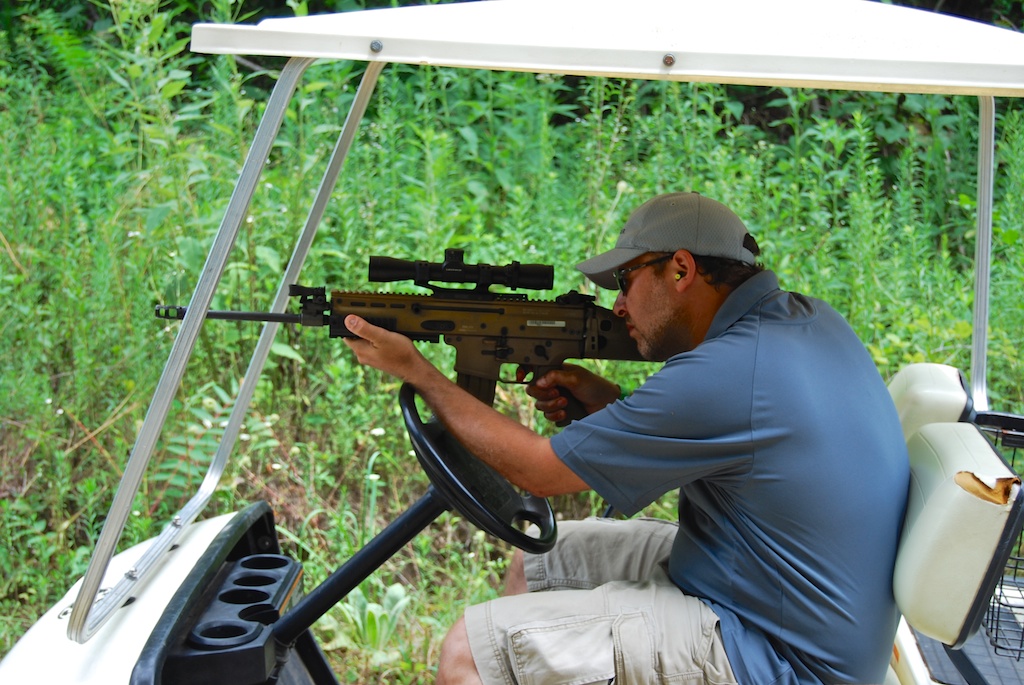
Here's some practical advice: Always keep one hand on the wheel while shooting a tactical rifle from a golf cart.
Here’s some practical advice: always keep one hand on the wheel while shooting a tactical rifle from a golf cart.

4. You should carry your self-defense gun with the chamber empty.

Unless your self-defense gun is a single-action revolver with a hammer-mounted firing pin, that’s almost always bad advice. If you think you can simply keep an eye on things around you so you have plenty of time to draw your gun, and rack the slide, in the event of an attack, try a Tueller drill sometime. It’s enlightening and will quickly relieve you of any security gained by carrying with an empty chamber. Also, please write Hollywood and tell them to stop racking the slide every time someone is about to fire a gun. It’s a waste of perfectly good pretend ammunition.

5. I only train for head shots.

Some of the couch commandos elite-speak of training for head shots to defeat body armor and perhaps save ammunition during these tough economic times. On the range, a cardboard target is pretty darn easy to hit anywhere you like. Now try that while running full speed. Then try that while you and the target are running full speed. Then try it when everyone is running full speed, shouting, and the target is trying to kill you. Enough said.

6. You don’t have to aim a shotgun!

The tireless persistence of this one is incredible. At any reasonable self-defense distance, a shotgun pattern is measured in inches, and when indoors, usually less. Compared to firing a shotgun, you need to aim it less if you were to swing it like a club.

7. Any advice that includes the words “knockdown power.”

Remember Wayne’s brother Isaac? As in Newton? According to him, and word is that he was really, really good at science, if your gun could knock someone down, you would also be knocked down in the process of firing it. In fairness, some people who use this term really mean “stopping power.” Even still, guns, and especially pistols, just make little holes. Rifles make bigger holes, and therefore are more likely to have “stopping power” as big holes in our bodies tend to make us stop and evaluate things. I’m thinking that cannons and howitzers do have “knockdown power,” as the last time I held one and fired it, I was, in fact, knocked down.

8. Standing downrange during training is the best to prepare for a real gunfight!

Unless you’re a special forces operator and need to train with a half-dozen of your buddies who will all be shooting in the same room, you don’t need to be downrange during training. Some schools insist on posting videos of “operators” being as “operate-y” as they possibly can by sending students and instructors downrange so they can hear they bulletsfly by. If you want to learn self- and home-defense skills, avoid these schools like you would avoid Justin Bieber’s Tupperware Party.

9. You don’t need an AR-15!

If you’re ever the victim of a home invasion, you “need” about 14 miniguns, a howitzer or two, and a MK-19 Automatic Grenade launcher. Those tools are just not very practical, so you get by with what you have. Allowing people to define “need” is a slippery downhill slope that never ends well. Next time someone tells you that you don’t “need” an AR-15, ask them if they “need” a car that goes faster than 60 miles per hour, bacon or periodic bathing. We don’t “need” anything beyond air, water, shelter and calories.

10. It’s OK, you can ________, because this gun is unloaded!

There’s no scenario where playing with, or pointing, guns is “OK” because a gun is unloaded. Rule one: a gun is always loaded.
These are some of my pet peeves. What say you?
Editor’s note added March 18: This topic sure has generated a lot of discussion! Check out Tom’s follow-up article regarding “knockdown power” and continue the discussion here.

Categories
Uncategorized

Have a great week Folks !!! Thanks Grumpy NSFW

Categories
Dear Grumpy Advice on Teaching in Today's Classroom Well I thought it was neat!

A neat map program

https://satellitemap.space/

Categories
All About Guns Allies

LEVER GUN ’LOPE

GOOD FRIENDS, GOOD GUN, GOOD GOATS!

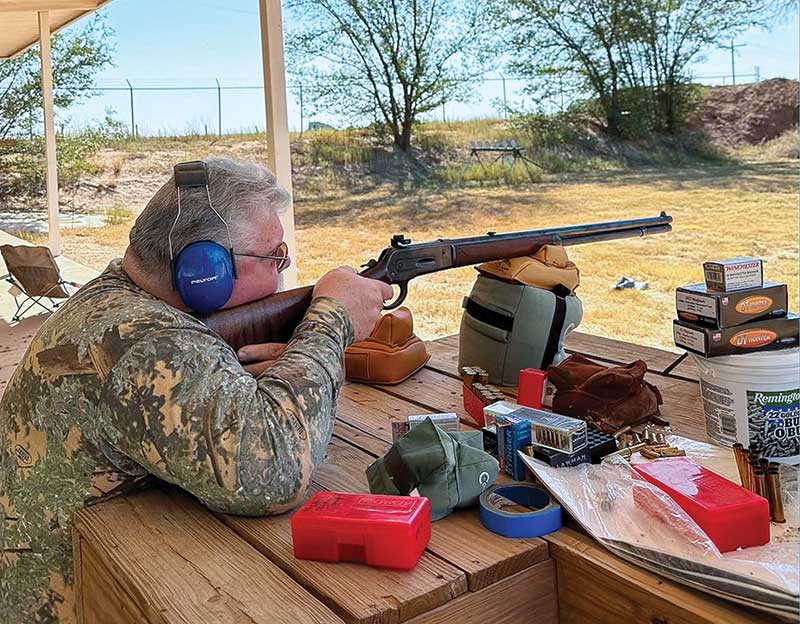
Tank sighting-in the vintage 1886 at Bobby Tyler’s backyard range.

Watching the wide, heavy antlered buck antelope was amusing as he was keeping his harem of roughly a dozen in a tight pack. If one ventured too far, he’d make a wide circle, much like a border collie and herd her back within the group. He liked them packed tight and under his watchful eye. He wasn’t about to share them with anyone.

Bobby and I had spotted him two evenings ago while scouting. His cartoonish, abnormally wide heavy horns were a dead giveaway, making him easy to recognize. He was a perfect buck for me, as I relish nature’s freakish critters. They were roughly 600 yards away.

After studying them for 15 minutes, Bobby Tyler, head honcho of Tyler Gun Works said, “Well, we got about a 50/50 chance of getting him — if we try.” We were here to hunt, so that’s what we did. A plan was hatched and the stalk began. Bobby was driving his Polaris Ranger and I was riding shotgun. Jason Cloessner of Lipsey’s Inc., was in the backseat with son Evan, who scored a dandy buck a few hours earlier. It’s always nice having witnesses when things go right …

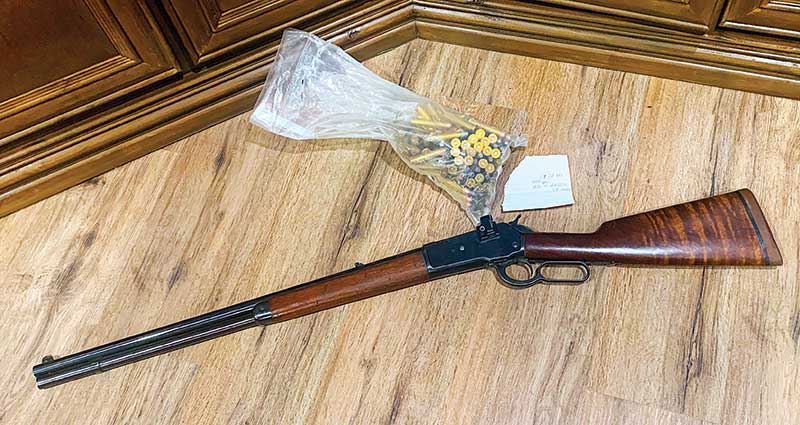
John Purcell’s Winchester Model 1886 next to a sack of ammo belonging
to Jeff Quinn. Tank felt their spirits were smiling as he used their gear!

The Gun

The rifle I was using was not your typical antelope gun by any means. It was a vintage 1905 Winchester 1886 .45-70 from the estate of John Purcell. John was a fellow member of The Shootists, as are Bobby and Jason. When John died last year, Bobby handled the gun end of his estate and planned on keeping the old rifle to honor him.

For some reason, Bobby wanted me to hunt the first day using John’s rifle. We sighted it in the day before using a sack full of commercially loaded ammunition Bobby obtained when handling Jeff Quinn’s estate. Jeff was also a fellow Shootist.

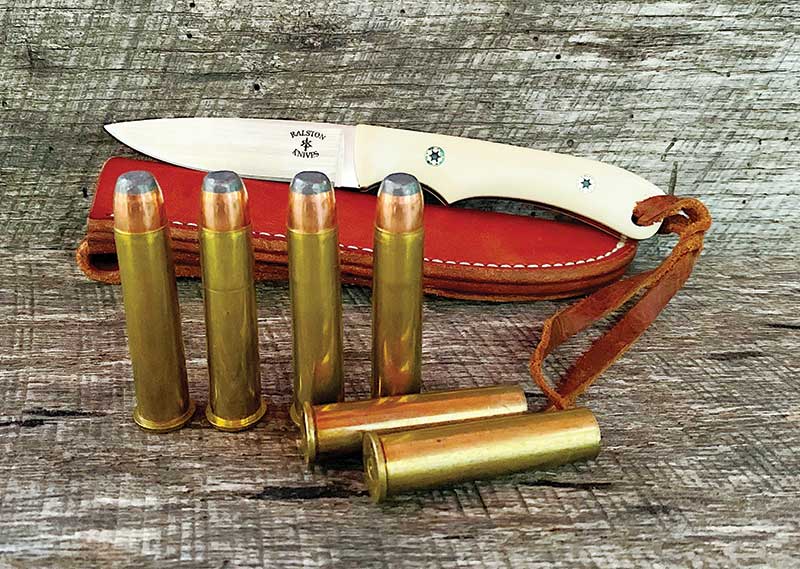
Jeff Quinn’s .45-70 ammo and Tank’s empties from the hunt, with a Kim Ralston knife in the background.

The Load

A card in the large ammo sack stated the load was a 405-grain soft point slug loaded over 55.5 grains of AA2320, sparked with a Winchester large rifle primer. Velocity was 1,978 FPS. Purcell had mounted a Williams peep sight on the rifle. Using his setting, the ammo was dead-on when testing it on Bobby’s 150-yard range. To say I felt confident with the load/rifle combination would be correct. Now if we could only get close enough on a nice ’lope.

From left to right, Jason, Tank and Bobby holding the .45-70 Model 1886 Winchester formerly owned by John Purcell. Who hunts speed goats with a buffalo gun? Tank, that’s who!

The Chase!

After studying the herd, Bobby decided to swing wide to get downwind for the final stalk. The wary prairie goats knew something was up and bolted! Bobby hit the gas as we streaked across the open prairie. Hanging on for dear life, I thought I was going to be ejected fighting the forces of the bucking UTV. I wasn’t worried so much about my welfare, but I was for the classic 1886 I was holding onto.

After a game of cat and mouse, the herd finally settled, thinking they have given us the slip. We were out of their sight, thanks to a series of large dirt mounds pushed up to prevent flooding from road runoff during heavy rainstorms. As we carefully crested the hill in a crawl, the sharp-eyed speed-goats spotted us again. We were only 65 yards away from them. The wide horned buck was in the lead and angling away on the run.

While thumbing the hammer back, I brought the rifle to my shoulder, finding the buck in the peep sight. I swung the front sight slightly ahead of him and pressed the trigger. After a few steps he stopped. The shot was farther back than I wanted, but as Elmer Keith would say, it “sickened him enough to not want to run.” A second shot exited his off-shoulder, dumping him instantly. I had my lever gun ’lope!

It was especially nice sharing the hunt, stalk and shots with Bobby, Jason and Evan. It was also nice to have used a rifle and ammo belonging to fellow Shootists. It keeps the spirit of the hunt and memories of those who’ve moved on, alive, making it special indeed. If this kind of hunt doesn’t stir the soul, nothing will.

The Deal

After the hunt, I knew I wanted the rifle, but I didn’t want to offend Bobby or put him in an awkward position. After mulling it over for a few days, we talked about it. “Bobby, would you ever consider selling John’s rifle?” “Only to you, Tank. The way I see it, I’ll be getting it back in 20–30 years and it will mean more to me then, knowing you used it during that time.”

We both laughed at the awkward, harsh, but honest statement. Yup, that’s about right and how the cycle of life — and guns — goes. I’ve got one story to tell about the old Winchester and hopefully some more will follow. The gun reminds me of ol’ John Purcell and a crazy antelope hunt with friends.

Who in their right mind hunts antelope with a 117-year-old iron-sighted Winchester .45-70? Not many, but it’s all part of the story …

Categories
This looks like a lot of fun to me! Well I thought it was funny!

Has to be Europe!