Categories
Author: Grumpy

Police in New York want the legal ability to seize firearms during a domestic violence call – even if no arrests were made. However, instead of going through normal legal channels and obtaining a search warrant or court order, police just want the legal ability to take the guns on their own.
New York State lawmakers plan to reintroduce a bill during the next legislative session that will go farther than the state’s Safe Homes Act of 2020, which allows officers to seize firearms found during a consensual search when police respond to a domestic dispute.
New York State Senator Peter Harckham, a Democrat from Westchester County, has sponsored a bill that would
“mandate” officers to confiscate all firearms left out in the open during a domestic call.
“This is not gun control, this is gun safety; and this is domestic safety,” the senator told Spectrum News. “This is keeping the victims of domestic violence alive. We had two fatalities through domestic violence and firearms in my district in the last month. This is very real. This is very deadly and this is not a permanent seizure.”
Senator Harckham’s bill would allow police to keep the seized weapons for five days – most likely to seek restraining orders or other legal options – before returning them to their rightful owners. Also, police would likely extend this five-day time limit as needed.
Tom King, president of New York State’s Rifle & Pistol Association, balked loudly about the new bill.
“No person shall be deprived of life, liberty or property without due process of law,” King told the reporters. “That means a search warrant or an order from a judge to confiscate the firearms, and they’re doing this without that.”
King pointed out the more than 100 New Yorkers who had firearms seized under the state’s newly expanded red-flag law. This group contacted King’s nonprofit seeking help getting their guns back. Some have already paid more than $10,000 in legal expenses, King said.
Takeaways
The main problem with the new bill is that it offers police yet another illegal mechanism to seize someone’s guns.
Our federal law does not allow law enforcement to go traipsing through someone’s home looking for firearms that were never used in a crime, which they will then seize for no evidentiary value.
These types of laws are passed solely for one reason – harassment. They want to harass gun owners. They want gun owners temporarily disarmed and then forced to make several trips to the police station to get their property returned, at great cost, too. Don’t forget that.
Today, gun owners have fewer rights in places like New York than they do in free states. This new bill will only make it worse.
Article courtesy of the Second Amendment Foundation’s Investigative Journalism Project. Click here to support the project.
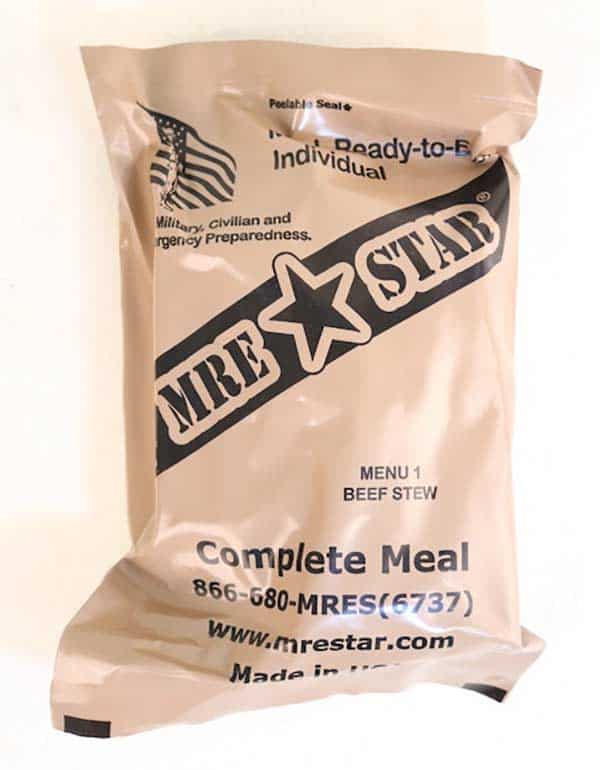
MREs (Meals, Ready-to-Eat) have come a long way since their formal introduction in 1986.
I came on active duty right at the end of the C-ration era. For those of you who might not have had the pleasure, C-rations, or “C-Rats” for short, were self-contained military meals that came in tin cans. We opened the cans with our nifty little P38 can openers.
You could heat your food right in the can over a cup of sand soaked in jet fuel, hexamine fuel tablets, or a dab of burning C4 plastic explosive. You could also use the empty cans to enhance the feed on your M60 machinegun. The downside was that C-Rats were both heavy and bulky.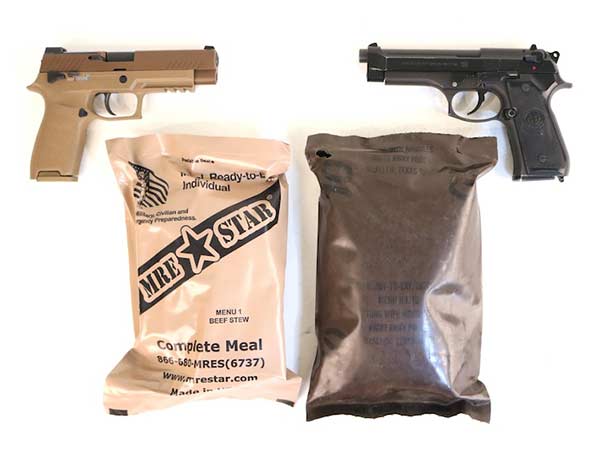
Old MREs came in a brown pouch. The newer versions are tan.
A Brave New World
MREs were exotic when they first arrived. They were an evolutionary development of the Vietnam-era Long Range Patrol or LRP ration. They looked like astronaut food. In fact, much of the technology that went into MREs had its origins in the space program.
The first MREs were pretty basic. There were 12 meal options, one of which was legit inedible. They were Ham and Chicken Loaf, Beef Slices in BBQ Sauce, Diced Turkey with Gravy, Diced Beef with Gravy, Frankfurters, Beef Stew, Ground Beef with Spiced Sauce, Ham Slices, Meatballs in BBQ Sauce, Chicken Ala King, and dehydrated Beef and Pork Patties. The wet entrees came sealed in foil pouches.
Each meal included some bizarre crackers. They looked like normal crackers but tasted like building materials. There was typically either peanut butter or some kind of processed synthetic pseudo-cheese as well. Sundry nut cakes and brownies added a little sweet variety.
The accessory pack contained stuff like salt, pepper, freeze-dried coffee, matches and a pair of Chiclets. There was also some toilet paper that was inexplicably cut into tiny little individual squares. Trust me, in an austere environment, a modest roll would have been better.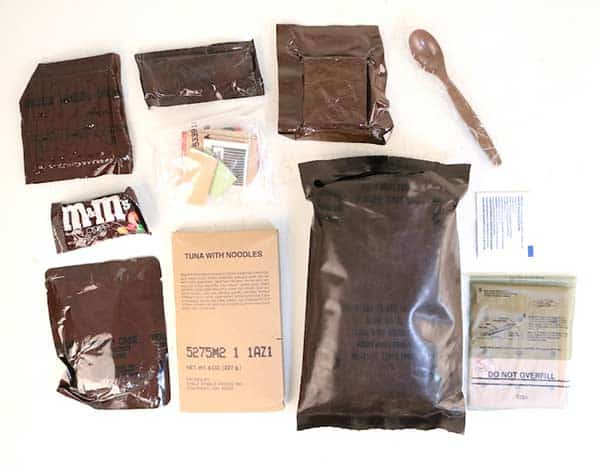
MREs include everything a busy lad needs to keep spunky in an austere environment.
Freeze Dried Freedom
Those pioneering MREs also included a lot of freeze-dried stuff. Freeze-dried fruit was ambrosia— the food of the gods. In fact, I broke out a vintage example and photographed it for this project. Despite its being older than many serving college professors, I gobbled it right up. You can relax, it had aged well. Dehydrated beef and pork patties, however, were another thing entirely.
The beef patties were okay. You could soak them in water and then warm them up, and they would make a passable hamburger. Sprinkle that into your beans or pin it between those horrible crackers, and it rated a solid decent. The pork patties, however, were simply awful.
Nothing could eat pork patties. I used to have a St. Bernard dog named Beauregard who would eat anything. He once ate an entire box of Ding Dongs that was still in the foil wrappers. The foil showed up right on cue a few days later. He wouldn’t get close to the pork patties.
While I liked the dehydrated stuff myself, it would indeed desiccate you if you didn’t have enough water. As a result, the MRE people eventually phased all that out. I do mourn the passing of dehydrated strawberries. I’ll never forget munching on that stuff at the midpoint of a 15-mile road march. That represented a bright spot in an otherwise fairly bleak day.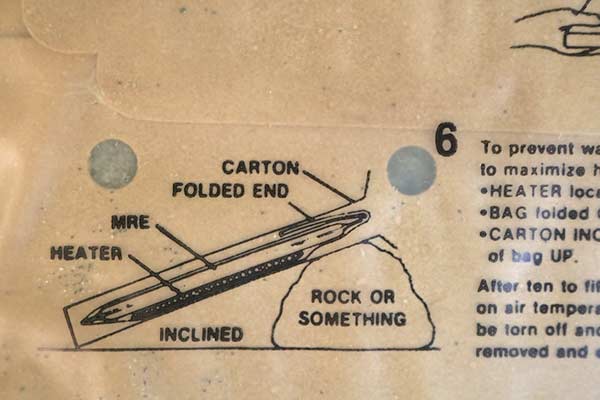
We were directed to lean our MRE heaters against a “rock or something.” That became an inside joke throughout the military.
Evolution in Action
The world has changed a great deal since 1986, and MREs changed right along with it. There are now 18 different varieties. Modern iterations are varied, tasty and culturally sensitive. There are vegetarian versions as well as the kosher and halal sort. Additionally, each and every meal comes with a neat Flameless Ration Heater (FRH).
This may seem a small thing. It’s not. For the first time in human history, the U.S. military can avail its soldiers of three hot meals a day, anywhere in the world. To use these heaters, you slide the entrée into a plastic pouch and pour in a little water. Fold the top of the pouch over and slip it back into the cardboard container that originally held your entrée. Then, according to the pictograph directions, you lean the whole shebang against a “Rock or Something.” I actually saw one vet who had that diagram tattooed onto his leg. I’m not big on tattoos myself, but that one was undeniably epic.
These flameless heaters also gave off some kind of gas. You could crunch one up, mash it into a water bottle, pour in a little water, and then replace the cap to create a fairly decent DIY bomb. Toss that bad boy underneath a buddy while he’s sleeping or into a porta-john during his quality time and be ready for some top-flight comedy. You can take the boys out of second grade, but you’ll never take the second grade out of the boys.
Modern MREs also include an adorable little bottle of Tabasco sauce. This stuff adds a little flavor to an otherwise bland dining experience. You can also dribble that stuff onto the Yukon stove in your buddy’s tent in the arctic and create poor man’s tear gas. See previous comment about the sophomoric nature of the human male.
I once popped open a fresh case of MREs in the desert only to find one of them swollen up like a big brown toad. With great trepidation, I gently carried it outside the company area and buried it. One of my grunt buddies suggested using it as a pillow. Had it burst, however, the resulting fumes most likely would have killed me outright.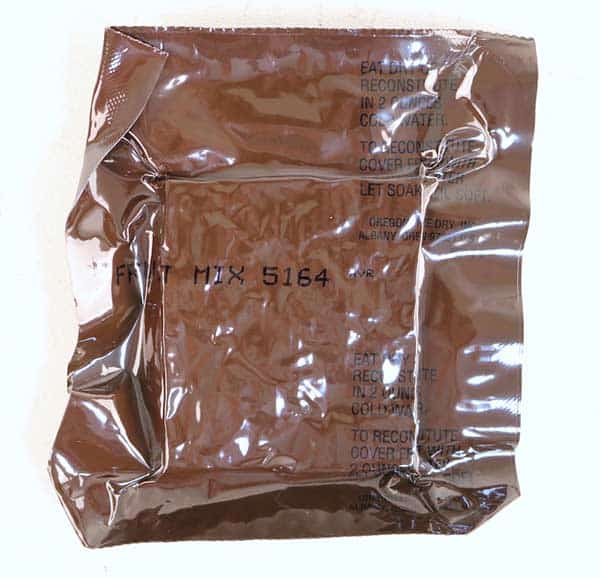
I mourn the passing of freeze dried fruit. That stuff was legendary.
I enjoyed this example as soon as my pictures were done despite
its being about 30 years old.
Ruminations
Lamentably, MREs don’t last very long. Mountain House freeze dried food is good for a quarter century if stored in a cool dry place. That makes a much better choice for long-term survival use. However, little is better than fresh MREs for hiking or camping.
It is a soldier’s prerogative to gripe about his food. However, Uncle Sam invested some breathtaking treasure figuring out the best way to feed his troops in the field. In the case of MREs, they actually got input from some respected chefs. The end result, nowadays at least, is quite good. Contract overruns are available on Amazon at about 10 bucks a pop.
Categories
Marlon’s HK416 Pattern Carbine
Obituary: Brigadier Michael Calvert by M. R. D. Foot
MICHAEL CALVERT, who survived both the Chindit expeditions into Burma, was one of the outstanding leaders of irregular troops during the Second World War, though born into the old officer class and himself a regular army officer.
He was the youngest son of a senior member of the Indian Civil Service, who rose to be acting governor of the Punjab; his mother was Irish. He was himself born in the Raj, near Delhi; went to school at Bradfield; and followed his brothers to “The Shop”, the Royal Military Academy at Woolwich. Though he cared little for smartness he passed out seventh and was commissioned a second lieutenant Royal Engineers in 1933. He then spent a year at Cambridge reading Mechanical Sciences at St John’s and securing a swimming Blue. He was also a boxer, later the Army’s middleweight champion.
His first Army posting was to Hong Kong where he raised a force of coolies. He was then moved on to Shanghai in time to witness its conquest by the Japanese in 1937: an early lesson in the horrors of war. He reported in detail on the infantry landing craft, with hinged front panels, which he saw the Japanese using; his report lay forgotten in a pigeon-hole in the War Office.
The outbreak of war saw him adjutant of a London RE battalion, work so dull that he volunteered for the Fifth Battalion, the Scots Guards (though well under the proper height for a guardsman). This battalion consisted of men preparing to fight beside the Finns against the Soviet Union during the winter war of 1939 to 1940. They spent weeks at Chamonix learning to ski, and were then disbanded as the Finns had given in.
Calvert missed the fighting in France next summer but was an early member of the Commando training school at Lochailort in the Highlands, which he left to assist Peter Fleming in preparing the stay-behind parties in Kent who were to try to upset the communications and petrol supplies of the German army that, thank goodness, never invaded.
He was then sent out to Australia to help set up a school similar to Lochailort there. From one of his fellow instructors, Freddie Spencer- Chapman (later author of that marvellous book, The Jungle is Neutral, 1949), he learned a lot about jungle warfare; and he helped to train Australian special forces. He was moved on to set up a bush warfare school at Maymyo in Burma, east of Mandalay – in fact a school to train guerrillas to fight in China.
There he was surprised by the Japanese invasion in the winter of 1941/42. Off his own bat he dressed his staff and pupils in Australian bush hats and mounted a raid by river craft behind the Japanese lines, intended to lead them to think that the Australian army was already present in Burma in force. He got no thanks in the short run – indeed he was reprimanded for damaging the property of the Burmah Oil Company without permission. He discovered in the long run that he had indeed done a little to hold up the Japanese advance. His casualties were light and he had managed some important demolitions.
Moreover he next met Orde Wingate, that formidable pillar of unconventionality; who had read a paper Calvert had scribbled in 1940, about the way raiding parties could be kept supplied by air, far behind any existing fighting line, and was looking forward to implementing that then quite novel idea in the field. Calvert was one of the few regular officers whom Wingate was prepared to treat as an equal. That their ranks at the time were major and brigadier made no difference at all; the two of them got on splendidly.
Before he could rejoin Wingate, Calvert had a couple of months hard fighting in the rearguard of the army retreating from Burma, with such wild men as he could find to undertake tasks that were at first glance hopeless. In his autobiography, Fighting Mad (1964), this is the point at which he lays down a principle. “I have always maintained that the men in a fighting unit must be led from in front by a commander they know is willing and able to do everything he asks them to do and probably more.”
Nelson would have approved; this is the way real leaders lead. Once Calvert paused to bathe in a river, and met a Japanese officer who was doing exactly the same. He won a quarter of an hour’s wrestling match, drowned his opponent, and had his patrol kill the whole Japanese patrol whom they surprised in the next bend of the river.
He then got back to India, with infinite difficulty through the monsoon, and was at once summoned by Wingate to help train his first Chindit expedition. “God often gives men peculiar instruments with which to pursue His will,” Wingate remarked; “David was armed only with a sling.”
In August 1942 Calvert joined 77th Brigade which Wingate commanded; in it Calvert commanded a column of some 400 men when it went into Burma six months later. This first attempt at Long Range Penetration – its official name – had little strategic impact but was a colossal propaganda success: home morale in Great Britain was much boosted by the idea that our men were attacking the Japanese in the jungle and the name of Chindit became famous. Casualties were heavy, at about 30 per cent of the force; Calvert, though emaciated after a march of over a thousand miles through jungle, survived.
He was indeed promoted brigadier – thus winning a bet he had made with a schoolfriend when he was 12 – and took 77th Brigade into Burma again by air on 5 March 1944. He established a stronghold and landing ground codenamed Broadway well behind the Japanese lines, and another called White City a little farther south; and held both of them against sustained Japanese attacks. This operation was of far more use than the previous one – it dislocated the Japanese assault on Imphal, that threatened India; but the fire went out of it when Wingate was killed in an air crash, and Calvert found himself under the orders of the American General Stilwell – passionately anti-British – and forced to fight a conventional war for which his men were neither equipped nor trained.
This time Calvert lost over nine-tenths of his Brigade, but his leadership kept the survivors together as a formidable fighting force however weakened, and he pulled through himself. For each of these Chindit sorties he was appointed to the DSO. Absurdly enough he then injured his Achilles tendon in a football match. He returned to the United Kingdom and in March 1945, was picked to succeed Brigadier R.W. McLeod in command of the Special Air Service brigade. Leading again from in front he took two French parachute units of that brigade into eastern Holland and north-west Germany in the closing stages of the war. For those actions he was awarded a French and a Belgian Croix de Guerre.
Thereafter his career went downhill. He had a spell helping to administer Trieste while its ownership was in dispute between Italy and Yugoslavia. In 1950 he was posted to command a new SAS unit called the Malayan Scouts in a colony already troubled by Communist subversion. Many men posted to him from elsewhere in the Army were discards from their former units and with this material even he could do nothing useful. He fell ill; returned to England; and was posted – in his substantive rank, still major – to a corner of the control commission in Germany.
He did not get on with his fellow officers and took to drinking by himself in a bar in Soltau (though he spoke no German). Some young men called on him and accused him of trying to seduce them. He was court-martialled for conduct unbecoming to an officer and a gentleman – his biographer David Rooney strongly suspects that he was framed – and dismissed from the service.
He tried business in Australia; it did not succeed. He then took to drink in so big a way that he was reduced to methylated spirits in the slums of Glasgow. His fellow drinkers abused him – what was an educated man like him doing among such down-and- outs as themselves? This shocked him back on to the water wagon; and for a few years he worked as a temporary lecturer in Military Studies at Manchester University. A book he then projected on the theory of guerrilla warfare was never finished; and he retired to the Charterhouse. Alas what the temperance movement used to call the “Demon Drink” reasserted its hold.
Though he never rose above brigadier anyone who served under him knew that Michael Calvert was a tremendous leader of men; quite careless of his own danger and taking care not to put his troops into worse trouble than he could help.
James Michael Calvert, soldier: born Rohtak, India 6 March 1913; DSO 1943, and Bar 1944; died London 26 November 1998.