Categories
Author: Grumpy

AKA Pontius Pilate’s Bodyguard
 |
|||||||||
|
Command can be fun but that is times that are few and very far apart.
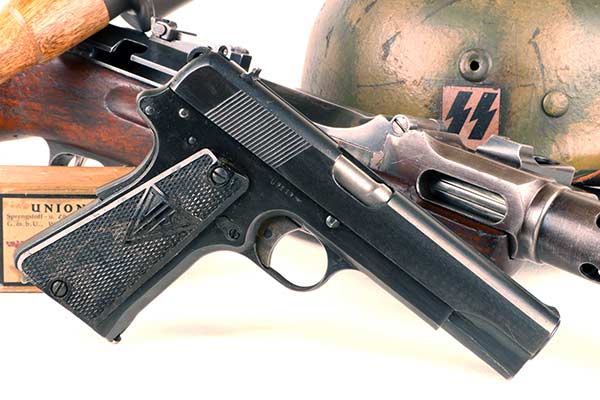
The Polish 9mm Pistole 35(p) Vis is a relatively little known but
superb example of World War II-era handgun technology. Similar
to Browning’s Hi-Power, the Vis was widely used by German
Fallschirmjagers and Waffen SS troops.
Poland has a storied and well-earned reputation for arms making. Their pistolet wz. 35 Vis was one of the most refined and effective combat handguns of World War II. Wz is the Polish abbreviation for wzor (model). Vis is Latin for “force” or “power.” The gun’s salient attributes were so laudable the Nazis maintained production for their elite troops throughout their occupation of the country.
The Vis is typically erroneously referred to as the Radom. Radom is actually the city where the gun was produced, but the Poles disavow the term for the gun. The beating heart of the wz. 35 Vis spawned from the wellspring of firearms brilliance that was John Moses Browning. The short-recoil locked breech action is functionally identical to the P35 Browning Hi-Power. Unlike the P35, the Vis feeds from an 8-round box magazine.
More than 360,000 of these guns were built. Introduced in 1935, the Vis went through several design evolutions during the course of its service life. The Nazis took over production in 1939 and renamed the gun the Pistole 645(p). For reasons lost to history they subsequently shortened the name to P35(p).
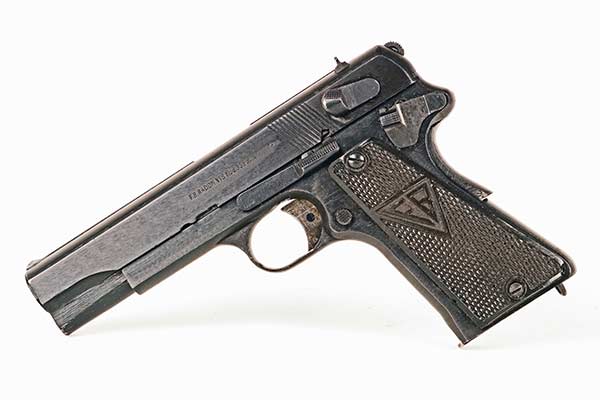
The Vis is an excellent pistol with terrific handling
characteristics and reliable performance.

No wonder it was so popular during World War II. The Germans
were so impressed by the pistol they kept it in production under
occupation and armed their troops with it.
Morphology
Some of the Polish Vis is familiar, while some is not. The action is classic Browning, and the grip safety looks as though it was lifted bodily from the 1911. The magazine release is in the same spot as the 1911 and the Hi-Power, though the magazine on my copy does not drop cleanly free. Wartime grips were of brown plastic. The left grip was imprinted with FB for Fabryka Broni or “Arms Factory.” The right grip sports VIS in a triangle.
The hammer is partially shrouded by the slide, and the butt includes a lanyard ring. The sights are small, as was typical of the day, and the rear sight is drift adjustable for windage. The top of the slide sports a roughened crosshatched strip to minimize glare. The single-action trigger is equal to the GI 1911’s of the day.
The first thing one notices when initially hefting the Vis is the left side is simply festooned with switches. The slide release operates the same as the 1911, while the slide-mounted lever is a hammer drop safety. Depressing this switch secures the firing pin and drops the hammer safety on a loaded chamber. The gun was designed to be carried in this manner and the hammer would be manually cocked prior to firing.
The switch at the left rear of the frame looking like a 1911 safety is nothing more than a takedown aid. To strip the gun, retract the slide and raise this catch to secure the slide to the rear. The slide release may then be pressed out from the right to the left and the gun stripped in the manner of the Hi-Power. Not unlike the Tokarev TT33, the Vis actually has no manual safety. As the war dragged on and partisan activity made production more challenging, the quality of both fit and finish declined. Ultimately the disassembly catch was dropped. There were a few versions slotted for a shoulder stock, but these stocks are rarer than unicorn horns today.
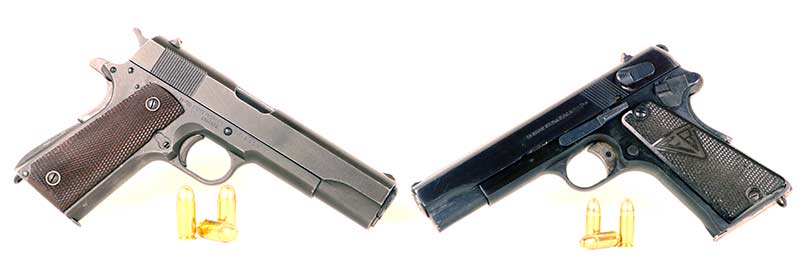
The morphological similarities between the Polish 9mm Pistole
35(p) Vis and the standard 1911A1 .45 ACP service pistol are obvious.
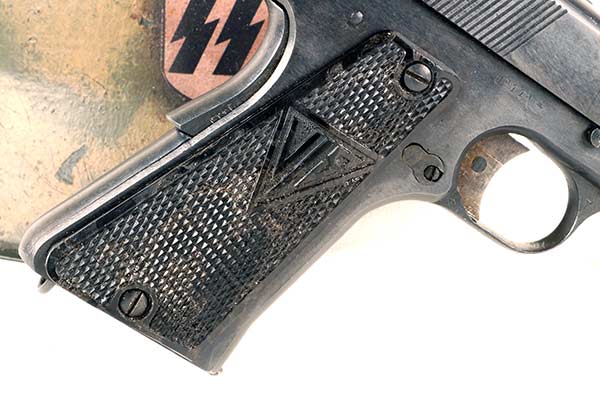
Vis is Latin for “force” or “power,” and it’s molded into the right grip of the Polish 9mm Pistole 35(p).

The single stack 8-round magazine of the Pistole 35(p) Vis sports index holes but does not drop free.
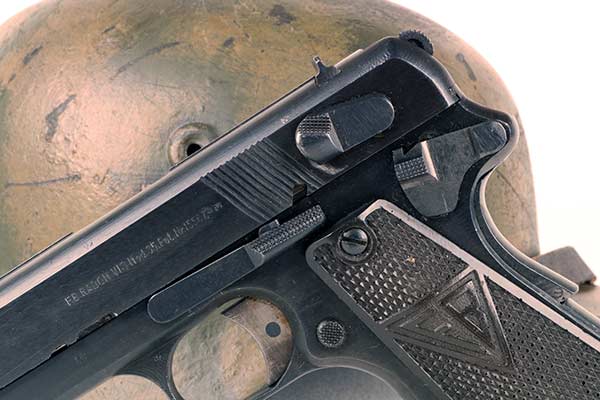
The slide-mounted lever is a hammer-drop safety. The rear lever restrains the slide for disassembly.
Practical Impressions
The 1911-style, grip-to-frame angle makes the gun feel comfortable and familiar to corn-fed Americans with plenty of 1911 trigger time. Index holes indicate rounds remaining in the magazine, though this component must obviously be ejected to facilitate a count. The thin nature of the pistol’s design would facilitate concealed carry were you unfortunate enough to be facing down battalions of soulless Nazis on the wartime streets of Warsaw.
The gun runs great on the range when compared alongside competing designs of the day. The trigger is nicer than that of the P08 and P38, while recoil is more palatable than that of the 1911. I can see why German Fallschirmjagers and SS troopers coveted the gun.