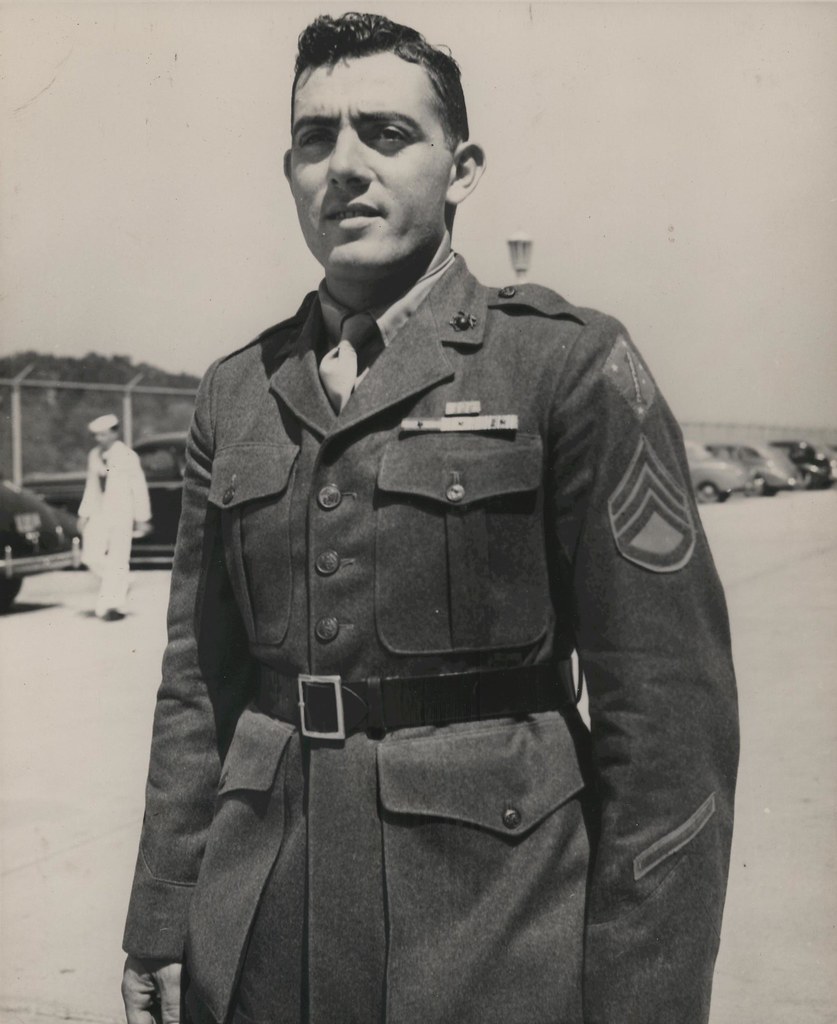
John Basilone (November 4, 1916 – February 19, 1945) was a United States Marine Corps Gunnery Sergeant who was killed in action during World War II.
He received the Medal of Honor for heroism above and beyond the call of duty during the Battle for Henderson Field in the Guadalcanal Campaign, and the Navy Crossposthumously for extraordinary heroism during the Battle of Iwo Jima.
He was the only enlisted Marine to receive both of these decorations in World War II.
He enlisted in the Marine Corps on June 3, 1940, after serving three years in the United States Army with duty in the Philippines.
He was deployed to Guantánamo Bay, Cuba, and in August 1942, he took part in the invasion of Guadalcanal.
In October, he and two other Marines used machine guns to hold off an attack by a far numerically superior Japanese force. In February 1945, he was killed in action on the first day of the invasion of Iwo Jima, after he single-handedly destroyed an enemy blockhouse and led a Marine tank under fire safely through a minefield.
He has received many honors including being the namesake for streets, military locations, and two United States Navy destroyers.
Contents
Early life and education
Basilone was born in his parents’ home on November 4, 1916, in Buffalo, New York.[2] He was the sixth of ten children. His five older siblings were born in Raritan, New Jersey, before the family moved to Buffalo when John was born; they returned to Raritan in 1918.[1]
His father, Salvatore Basilone, emigrated from Colle Sannita, in the region of Benevento, Italy in 1903 and settled in Raritan. Basilone’s mother, Dora Bencivenga, was born in 1889 and grew up in Manville, New Jersey, but her parents, Carlo and Catrina, also came from Benevento. Basilone’s parents met at a church gathering and married three years later.
Basilone grew up in the nearby Raritan Town (now Borough of Raritan) where he attended St. Bernard Parochial School. After completing middle school at the age of 15, he dropped out prior to attending high school.[3] Basilone worked as a golf caddy for the local country club before joining the military.[4]
Military service
Basilone enlisted in the United States Army in July 1934[4] and completed his three-year enlistment with service in the Philippines, where he was a champion boxer.[5]
In the Army, Basilone was initially assigned to the 16th Infantry at Fort Jay, before being discharged for a day, reenlisting, and being assigned to the 31st Infantry.[6][7]
After he was released from active duty, Basilone returned home and worked as a truck driver in Reisterstown, Maryland.[8]
After driving trucks for a few years, he wanted to go back to Manila and believed he could get there faster by serving in the Marines than in the Army.
U.S. Marine Corps[edit]
He enlisted in the Marine Corps in 1940, from Baltimore, Maryland. He went to recruit training at Marine Corps Recruit Depot Parris Island, followed by training at Marine Corps Base Quantico and New River.
The Marines sent him to Guantánamo Bay, Cuba for his next assignment, and then to Guadalcanal in the Solomon Islands as a member of “D” Company, 1st Battalion, 7th Marines, 1st Marine Division.[8]
Guadalcanal
In October 1942, during the Battle for Henderson Field, his unit came under attack by a regiment of about 3,000 soldiers from the Japanese Sendai Division. On October 24, Japanese forces began a frontal attack using machine guns, grenades, and mortars against the American heavy machine guns.
Basilone commanded two sections of machine guns which fought for the next two days until only Basilone and two other Marines were left standing.[9][10]
Basilone moved an extra gun into position and maintained continual fire against the incoming Japanese forces. He then repaired and manned another machine gun, holding the defensive line until replacements arrived.
As the battle went on, ammunition became critically low. Despite their supply lines’ having been cut off by enemies in the rear, Basilone fought through hostile ground to resupply his heavy machine gunners with urgently needed ammunition.
When the last of it ran out shortly before dawn on the second day, Basilone, using his pistol and a machete, held off the Japanese soldiers attacking his position.
By the end of the engagement, Japanese forces opposite their section of the line had been virtually annihilated. For his actions during the battle, Basilone received the United States military’s highest award for valor, the Medal of Honor.[11]
Afterwards, Private First Class Nash W. Phillips, of Fayetteville, North Carolina, recalled from the battle for Guadalcanal:
Basilone had a machine gun on the go for three days and nights without sleep, rest, or food. He was in a good emplacement, and causing the Japanese lots of trouble, not only firing his machine gun, but also using his pistol.[8]
War bond tours[edit]
In 1943, Basilone returned to the United States and participated in war bond tours. His arrival was highly publicized, and his hometown held a parade in his honor when he returned.
The homecoming parade occurred on Sunday, September 19 and drew a huge crowd with thousands of people, including politicians, celebrities, and the national press. The parade made national news in LIFE magazine and Fox Movietone News.[12]
After the parade, Basilone toured the country raising money for the war effort and achieved celebrity status. Although he appreciated the admiration, he felt out of place and requested to return to the operating forces fighting the war.
The Marine Corps denied his request and told him he was needed more on the home front. He was offered a commission, which he turned down, and was later offered an assignment as an instructor, but refused this as well.
When he requested again to return to the war, the request was approved. He left for Camp Pendleton, California, for training on December 27. On July 3, 1944, he reenlisted in the Marine Corps.[13]
Marriage
While stationed at Camp Pendleton, Basilone met his future wife, Lena Mae Riggi, who was a Sergeant in the Marine Corps Women’s Reserve.[14]
They were married at St. Mary’s Star of the Sea Church in Oceanside, California, on July 10, with a reception at the Carlsbad Hotel.[15] They honeymooned at an onion farm near Portland, Oregon.[16]
Iwo Jima and death

John Basilone’s headstone in Arlington National Cemetery
After his request to return to the fleet was approved, Basilone was assigned to “C” Company, 1st Battalion, 27th Marine Regiment, 5th Marine Division.
On February 19, 1945, the first day of invasion of Iwo Jima, he was serving as a machine gun section leader on Red Beach II.
While the Marines landed, the Japanese concentrated their fire at the incoming Marines from heavily fortified blockhouses staged throughout the island. With his unit pinned down, Basilone made his way around the side of the Japanese positions until he was directly on top of the blockhouse.
He then attacked with grenades and demolitions, single-handedly destroying the entire strong point and its defending garrison.
He then fought his way toward Airfield Number 1 and aided a Marine tank that was trapped in an enemy mine field under intense mortar and artillery barrages.
He guided the heavy vehicle over the hazardous terrain to safety, despite heavy weapons fire from the Japanese. As he moved along the edge of the airfield, he was killed by Japanese mortar shrapnel.[17][18]
His actions helped Marines penetrate the Japanese defense and get off the landing beach during the critical early stages of the invasion.
Basilone was posthumously awarded the Marine Corps’ second-highest decoration for valor, the Navy Cross, for extraordinary heroism during the battle of Iwo Jima.[19]
Based on his research for the book and mini-series The Pacific, author Hugh Ambrose suggested that Basilone was not killed by a mortar, but by small arms fire which hit him in the right groin and neck, and nearly took off his left arm.[20]
Burial
Basilone is interred in Arlington National Cemetery, in Section 12, Grave 384, grid Y/Z 23.5.[21]
His widow, Lena M. Basilone, died June 11, 1999, aged 86, and is buried at Riverside National Cemetery in Riverside, California.[22] Lena’s obituary notes that she never remarried and was buried still wearing her wedding ring.[23]
Awards and decorations
GySgt. Basilone’s military awards include: [24]
 |
 |
 |

|
 |
|
 |
|
 |
 |
||


| Medal of Honor | Navy Cross | Purple Heart Medal | |||
| Navy Presidential Unit Citation with one star | Marine Corps Good Conduct Medal | American Defense Service Medal with one star | |||
| American Campaign Medal | Asiatic–Pacific Campaign Medal with two stars | World War II Victory Medal | |||
| United States Marine Corps Rifle Sharpshooter badge | |||||
Medal of Honor citation
Basilone’s Medal of Honor citation reads as follows:
The President of the United States in the name of The Congress takes pride in presenting the MEDAL OF HONOR to
JOHN BASILONE
UNITED STATES MARINE CORPS

For extraordinary heroism and conspicuous gallantry in action against enemy Japanese forces, above and beyond the call of duty, while serving with the 1st Battalion, 7th Marines, 1st Marine Division in the Lunga Area, Guadalcanal, Solomon Islands, on 24 and 25 October 1942. While the enemy was hammering at the Marines’ defensive positions, Sgt. BASILONE, in charge of 2 sections of heavy machine guns, fought valiantly to check the savage and determined assault. In a fierce frontal attack with the Japanese blasting his guns with grenades and mortar fire, one of Sgt. BASILONE’S sections, with its gun crews, was put out of action, leaving only 2 men able to carry on. Moving an extra gun into position, he placed it in action, then, under continual fire, repaired another and personally manned it, gallantly holding his line until replacements arrived. A little later, with ammunition critically low and the supply lines cut off, Sgt. BASILONE, at great risk of his life and in the face of continued enemy attack, battled his way through hostile lines with urgently needed shells for his gunners, thereby contributing in large measure to the virtual annihilation of a Japanese regiment. His great personal valor and courageous initiative were in keeping with the highest traditions of the U.S. Naval Service.[11]
FRANKLIN D. ROOSEVELT
Basilone’s Navy Cross citation reads as follows:
The President of the United States takes pride in presenting the NAVY CROSS posthumously to
JOHN BASILONE
UNITED STATES MARINE CORPS

For extraordinary heroism while serving as a Leader of a Machine-Gun Section, Company C, 1st Battalion, 27th Marines, 5th Marine Division, in action against enemy Japanese forces on Iwo Jima in the Volcano Islands, 19 February 1945. Shrewdly gauging the tactical situation shortly after landing when his company’s advance was held up by the concentrated fire of a heavily fortified Japanese blockhouse, Gunnery Sergeant BASILONE boldly defied the smashing bombardment of heavy caliber fire to work his way around the flank and up to a position directly on top of the blockhouse and then, attacking with grenades and demolitions, single handedly destroyed the entire hostile strong point and its defending garrison. Consistently daring and aggressive as he fought his way over the battle-torn beach and up the sloping, gun-studded terraces toward Airfield Number 1, he repeatedly exposed himself to the blasting fury of exploding shells and later in the day coolly proceeded to the aid of a friendly tank which had been trapped in an enemy mine field under intense mortar and artillery barrages, skillfully guiding the heavy vehicle over the hazardous terrain to safety, despite the overwhelming volume of hostile fire. In the forefront of the assault at all times, he pushed forward with dauntless courage and iron determination until, moving upon the edge of the airfield, he fell, instantly killed by a bursting mortar shell. Stouthearted and indomitable, Gunnery Sergeant BASILONE, by his intrepid initiative, outstanding skill, and valiant spirit of self-sacrifice in the face of the fanatic opposition, contributed materially to the advance of his company during the early critical period of the assault, and his unwavering devotion to duty throughout the bitter conflict was an inspiration to his comrades and reflects the highest credit upon Gunnery Sergeant BASILONE and the United States Naval Service. He gallantly gave his life in the service of his country.
JAMES FORRESTAL
Secretary of the Navy
Other honors
Basilone has received numerous honors, including the following:
_at_the_Consolidated_Steel_Corporation_Orange,_Texas_(USA),_on_21_December_1945_(NH_103377).jpg)
Sgt. Lena Mae Basilone, USMC(WR), widow of John Basilone, prepares to christen the destroyer USS Basilone (December 21, 1945)
Marine Corps
Marine Corps Base Camp Pendleton:
- An entry point onto the base from U.S. Interstate 5 called “Basilone Road”;[25]
- A section of U.S. Interstate 5 running through the base called “Gunnery Sergeant John Basilone Memorial Highway”;[26]
- A parachute landing zone called “Basilone Drop Zone”.[27]
- During the Crucible portion of Marine Corps Recruit Training on the West Coast, there is an obstacle named “Basilone’s Challenge” that consists of carrying ammunition cans filled with concrete up a steep, wooded hill.[28]
- USS Basilone (DD-824): The United States Navy commissioned USS Basilone, a Gearing-class destroyer, in 1949. The ship’s keel was laid down on July 7, 1945, in Orange, Texas, and launched on December 21, 1945. His widow, Sergeant Lena Mae Basilone, sponsored the ship.[29]
- A plaque at the United States Navy Memorial in Washington, D.C.;[30]
- USS John Basilone (DDG-122): The future John Basilone (DDG-122) will be commissioned in 2019.
Public
Public honorable recognitions include:
- In 1944, Army Barracks from Washington State were moved to a site in front of Hansen Dam in Pacoima, California and rebuilt as 1,500 apartments for returning GIs. This development was named the “Basilone Homes” and was used until about 1955. The site is now a golf course.

Dedication sign for the Basilone Memorial Bridge
- The memorial parade for Basilone along Somerset Street in his hometown, Raritan, New Jersey, has been held since 1981,[2][31]
- A residential building at Montclair State University,[which?]
- At Bridgewater-Raritan High School:
- The football field is called “Basilone Field”. On the wall of the fieldhouse next to the field is a mural honoring Basilone.
- The Knights of Columbus Council #13264 in his hometown is named in his honor;[32]
- An overpass at the Somerville Circle in Somerville, New Jersey, on U.S. Highway 202 and 206 that goes under it, is named for Basilone[citation needed]
- The New Jersey Turnpike bridge across the Raritan River is named the “Basilone Bridge“,[33]
- A connector road at the southwest of Newark Liberty International Airport, that connects to Earheart Road, is named after Basilone[34]
- The new John Basilone Veterans Memorial Bridge crosses the Raritan River, in Raritan, NJ, at First Avenue and Canal Street
- A memorial statue featuring him holding a water-cooled Browning machine gun is located at the intersections of Old York Road and Canal Street in Raritan (Basilone’s childhood friend Phillip Orlando sculpted the statue),[citation needed]
- A bust of Basilone is sited at Piazza Basilone, in Little Italy San Diego, at Fir and India Streets. The war memorial there is dedicated to residents of Little Italy who served in World War II and Korea.[35]
- The Order of the Sons of Italy In America Lodge #2442 in Bohemia, New York is named in his honor,[36], and
- The Basilone Room in Raritan Public Library is where memorabilia about him is kept.[37]
- On November 10, 2005, the U.S. Postal Service issued the “Distinguished Marines” stamps honoring four Marine Corps heroes, including Basilone.[38][39]
- In 2011, Basilone was inducted into the New Jersey Hall of Fame.[40][41]
In media
- The film First to Fight (1967) features Chad Everett as “Shanghai Jack” Connell, a character based on “Manila John” Basilone.
- The 10-part HBO miniseries The Pacific (2010) is based on the intertwined stories of Basilone and two other Marines (Robert “Lucky” Leckie and Eugene “Sledgehammer” Sledge).[42] Actor Jon Seda stars as Basilone. In the film, he was killed by Japanese machine gun instead of mortar.