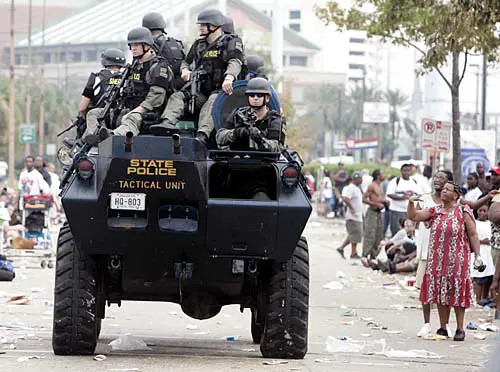
TxDPS, Texas Ranger Division
Texas |
Patch of the TxDPS, Texas Ranger Division
|

Logo of the TxDPS, Texas Ranger Division
|
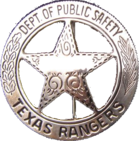
Official 1962 design of Texas Ranger badge
|

Flag of the State of Texas
|
| Agency overview |
| Formed |
October 17, 1835; 182 years agomodeled after Stephen F. Austin‘s 1823 ranger companies |
| Preceding agency |
Texas State Police |
| Legal personality |
Governmental: Government agency |
| Jurisdictional structure |
| Operations jurisdiction* |
State of Texas, U.S. |
 |
| Map of TxDPS, Texas Ranger Division’s jurisdiction. |
| Size |
268,820 square miles (696,240 km2) |
| Population |
27,469,114 (2015 est.)[1] |
| General nature |
|
| Operational structure |
| Headquarters |
Austin, Texas |
| Texas Rangers |
162[2] |
| Support Employees |
60[2] |
| Agency executive |
Randall Prince, Chief |
| Parent agency |
Texas Department of Public Safety |
| Companies |
6 |
| Website |
| Official Texas Rangers website |
| Footnotes |
| * Divisional agency: Division of the country, over which the agency has usual operational jurisdiction. |
The Texas Ranger Division, commonly called the Texas Rangers, is a law enforcement agency with statewide jurisdiction in Texas, based in the capital city of Austin. Over the years, the Texas Rangers have investigated crimes ranging from murder to political corruption, acted in riot control and as detectives, protected the Governor of Texas, tracked down fugitives, and functioned as a paramilitary force at the service of both the Republic (1836–45) and the state of Texas.
The Texas Rangers were unofficially created by Stephen F. Austin in a call-to-arms written in 1823 and were first headed by Captain Morris. After a decade, on August 10, 1835, Daniel Parker introduced a resolution to the Permanent Council creating a body of rangers to protect the border.[3] The unit was dissolved by the federal authorities during the post–Civil WarReconstruction Era, but was quickly reformed upon the reinstitution of home government. Since 1935, the organization has been a division of the Texas Department of Public Safety; it fulfills the role of Texas’ state bureau of investigation. As of 2015, there are 162 commissioned members of the Ranger force.[4]
The Rangers have taken part in many of the most important events of Texas history, such as stopping the assassination of Presidents William Howard Taft and Porfirio Díaz in El Paso, Texas, and in some of the best-known criminal cases in the history of the Old West, such as those of gunfighter John Wesley Hardin, bank robber Sam Bass, and outlaws Bonnie and Clyde. Scores of books have been written about the Rangers, from well-researched works of nonfiction to pulp novels and other such fiction, making the Rangers significant participants in the mythology of the Wild West. The Lone Ranger, perhaps the best-known example of a Texas Ranger-derived fictional character, draws his primary alias both from having once been a Texas Ranger himself and from being the only surviving member of a posse of six Texas Rangers whose other five members (including his own older brother, a Texas Rangers captain) were killed in a massacre at Bryant’s Gap.
During their history, a distinct Ranger tradition has evolved; their cultural significance to Texians and later Texansis such that they are legally protected against disbandment.[5] There is a museum dedicated to the Texas Rangers in Waco, Texas.
History
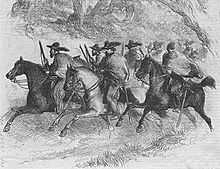
An early depiction of a group of Texas Rangers, c. 1845
The rangers were founded in 1823 when Stephen F. Austin, known as the Father of Texas, employed ten men to act as rangers to protect 600 to 700 newly settled families who arrived in Texas following the Mexican War of Independence. While there is some discussion as to when Austin actually employed men as “rangers”, Texas Ranger lore dates the year of their organization to this event.[6] The Texas Rangers were formally constituted in 1835 and, in November, Robert McAlpin Williamson was chosen to be the first Major of the Texas Rangers. Within two years the Rangers comprised more than 300 men.
Following the Texas Revolution and the creation of the Republic of Texas, newly elected president Mirabeau B. Lamar, (the second elected president of the Republic of Texas), raised a force of 56 Rangers to fight the Cherokee and the Comanche, partly in retaliation for the support they had given the Mexicans at the Cordova Rebellion against the Republic.[7] Ten rangers were killed in the Battle of Stone Houses in 1837.[8] The size of the Ranger force was increased from 56 to 150 men by Sam Houston, as President of the Republic, in 1841, (the 2nd time he was elected president of the Republic.)
The Rangers continued to participate in skirmishes with Native Americans through 1846, when the annexation of Texas to the United States and the Mexican–American War saw several companies of Rangers mustered into federal service. They played important roles at various battles, acting as guides and participating in Counter-guerrilla warfare, soon establishing a fearsome reputation among both Mexicans and Americans. At the Battle of Monterrey in September 1846, famous Texas Rangers such as John Coffee “Jack” Hays, Ben McCulloch, Bigfoot Wallace, and Samuel Hamilton Walker played important roles in the battle, to include advising General William Jenkins Worth on the tactics required to fight inside a Mexican city. Richard Addison Gillespie, a famed Texas Ranger, died at Monterrey, and General Worth renamed a hill “Mount Gillespie” after him.[9] Colonel Hays organized a second regiment of Texas Rangers, including Rip Ford, who fought with General Winfield Scott in his Mexico City Campaign and the Anti guerrilla campaign along his line of communications to Vera Cruz.[10]:60
John Jackson Tumlinson Sr., the first alcalde of the Colorado district, is considered by many Texas Ranger historians to be the first Texas Ranger killed in the line of duty.[11] One of his most urgent issues was protection of settlers from theft and murder by marauders. On his way to San Antonio, in 1823, to discuss the issue with the governor, Tumlinson was killed by Native Americans. His traveling companion, a Mr. Newman, escaped. Tumlinson’s body was never found.[12]
Following the end of the war in 1848, the Rangers were largely disbanded, but the election of Hardin Richard Runnels as governor in 1857 meant $70,000 was allocated to fund the Rangers under John Salmon “Rip” Ford,[10]:223 a veteran of the Mexican war. The now 100-strong Rangers participated in campaigns against the Comanche and other tribes, whose raids against the settlers and their properties had become common. Ford and his Rangers fought the Comanche in the Battle of Little Robe Creek in 1858 and then Juan Cortinain the Battle of Rio Grande City the following year.[10]:236,275
The success of a series of campaigns in the 1860s marked a turning point in Rangers’ history. The U.S. Army could provide only limited and thinly-stretched protection in the enormous territory of Texas. By contrast, the Rangers’ effectiveness when dealing with these threats convinced both the people of the state and the political leaders that a well-funded and organized state Ranger force was essential. Such a force could use the deep familiarity with the territory and the proximity with the theater of operations as major advantages in its favor. This option was not pursued, in view of the emerging national political problems (prelude to the American Civil War), and the Rangers were again dissolved.[13]

Texas Historical Marker for Texas Ranger Camp Roberts in Blanco Canyon
Many Rangers enlisted to fight for the Confederacyfollowing the secession of Texas from the United States in 1861 during the Civil War. In 1870, during Reconstruction, the Rangers were briefly replaced by a Union-controlled version called the Texas State Police, disbanded only three years later.[14]The state election of 1873 saw newly elected Governor Richard Coke and the state legislaturerecommission the Rangers.[15][16] During these times, many of the Rangers’ myths were born, such as their success in capturing or killing notorious criminals and desperados (including bank robber Sam Bass and gunfighter John Wesley Hardin), their involvement in the Mason County War, the Horrell–Higgins Feud, and their decisive role in the defeat of the Comanche, Kiowa and Apachepeoples. The Apache “dreaded the Texas Rangers…whose guns were always loaded and whose aim was unerring; they slept in the saddle and ate while they rode, or done without…when they took up our trail they followed it determinedly and doggedly day and night.”[17] Also during these years, the Rangers suffered the only defeat in their history when they surrendered at the Salinero Revolt in 1877. Despite the fame of their deeds, the conduct of the Rangers during this period was questionable. In particular, Leander H. McNelly and his men used ruthless methods that often rivaled the brutality of their opponents, such as taking part in summary executions and confessions induced by tortureand intimidation.[18]

Capt. Monroe Fox and two other Rangers on horseback with their lariats around the bodies of dead Mexican bandits, after the Norias Ranch Raid August 8, 1915
The Rangers next saw serious action at the summit of William Howard Taft and President Porfirio Díazin 1909, preventing an assassination of both presidents, and during the subsequent Mexican Revolution. The breakdown of law and order on the Mexican side of the border, coupled with the lack of federal military forces, meant the Rangers were once again called upon to restore and maintain law and order, by any necessary means. However, the situation necessitated the appointment of hundreds of new special Rangers by the state, which neglected to carefully screen aspiring members. The Rangers were responsible for several incidents, ending in the January 28, 1918, massacre of the male population[21](15 Mexican men and boys ranging in age from 16 to 72 years) of the tiny community of Porvenir, Texas, on the Mexican border in western Presidio County. Before the decade was over, thousands of lives were lost, Texans and Mexicans alike. In January 1919, an investigation launched by Texas lawmaker JT Canales found that from 300 to 5,000 people, mostly of Hispanic descent, had been killed by Rangers from 1910 to 1919, and that members of the Rangers had been involved in many acts of brutality and injustice.[22] The Rangers were reformed by a resolution of the Legislature in 1919, which saw the special Ranger groups disbanded and a complaints system instituted.
The Great Depression forced both the federal and state governments to cut down on personnel and funding of their organizations, and the number of commissioned officers was reduced to 45, with the only means of transportation afforded to Rangers being free railroad passes or using their personal horses. The agency was again damaged after supporting Governor Ross Sterling in his re-election campaign — but after his opponent Miriam Amanda “Ma” Ferguson won, she proceeded to discharge all serving Rangers in 1933.
The ensuing disorganization of law enforcement in the state caused the Legislature to engage a firm of consultants to reorganize the state security agencies. The consultants recommended merging the Rangers with the Texas Highway Patrol under a new agency called the Texas Department of Public Safety (DPS). This change took place in 1935, with an initial budget of $450,000. With minor rearrangements over the years, the 1935 reforms have ruled the Texas Rangers’ organization until present day. Hiring new members, which had been largely a political decision, was achieved through a series of examinations and merit evaluations. Promotion relied on seniority and performance in the line of duty. Today, the historical importance and symbolism of the Texas Rangers is such that they are protected by statute from being disbanded.[23]
Old West image
From its earliest days, the Rangers were surrounded with the mystique of the Old West. Although popular culture’s image of the Rangers is typically one of rough living, tough talk and a quick draw, Ranger Captain John “Rip” Ford described the men who served him as thus:
A large proportion … were unmarried. A few of them drank intoxicating liquors. Still, it was a company of sober and brave men. They knew their duty and they did it. While in a town they made no braggadocio demonstration. They did not gallop through the streets, shoot, and yell. They had a specie of moral discipline which developed moral courage. They did right because it was right.[24]
As it happened with many Old West myths like Billy the Kid or Wyatt Earp, the Rangers’ legendary aura was in part a result of the work of sensationalistic writers and the contemporary press, who glorified and embellished their deeds in an idealized manner. While some Rangers could be considered criminals wearing badges by a modern observer, many documented tales of bravery and selflessness are also intertwined in the group’s history.[25]
Despite the age of the agency, and the many contributions they have made to law enforcement over their entire history, Texas Rangers developed most of their reputation during the days of the Old West. Of the 79 Rangers killed in the line of duty, 30 were killed during the Old West period of 1858 through 1901. Also during this period, two of their three most high-profile captures or killings took place, the capture of John Wesley Hardin and the killing of Sam Bass, in addition to the capture of Texas gunman Billy Thompson and others.[26]
American historian Andrew Graybill has argued that the Texas Rangers resemble the Royal Canadian Mounted Police in many ways. He argues that each organization protected the established order by confining and removing Native Americans, by tightly controlling the mixed blood peoples (the African Americans in Texas, and the Métis in Canada), assisted the large-scale ranchers against the small-scale ranchers and farmers who fenced the land, and broke the power of labor unions that tried to organize the workers of industrial corporations.[27]
“One Riot, One Ranger”

Texas Rangers gathered at El Paso to stop the illegal Maher–Fitzsimmons fight, 1896. At the front row from the left are Adj. General W Mabry, and Capts. J Hughes, J Brooks, Bill McDonald (coiner of the phrase) and J Rogers.
A famous phrase associated with the Rangers is One Riot, One Ranger. It is somewhat apocryphal in that there was never actually a riot; rather, the phrase was coined by Ranger Captain William “Bill” McDonald, who was sent to Dallas in 1896 to prevent the illegal heavyweight prize fight between Pete Maher and Bob Fitzsimmons that had been organized by Dan Stuart and patronized by the eccentric “Hanging Judge” Roy Bean of Langtry, Texas.[28] According to the story, McDonald’s train was met by the mayor, who asked the single Ranger where the other lawmen were. McDonald is said to have replied: “Hell! Ain’t I enough? There’s only one prize-fight!”[29]
Although some measure of truth lies within the tale, it is largely an idealized account written by author Bigelow Paine and loosely based on McDonald’s statements, published in Paine’s 1909 book Captain Bill McDonald: Texas Ranger. In truth, the fight had been so heavily publicized that nearly every Ranger was on hand, including all captains and their superior, Adjutant General Woodford H Mabry. Many of them were undecided on stopping the fight or attending it; and other famous lawmen, such as Bat Masterson, were also present. The orders of the governor were clear, however, and the bout was stopped. Stuart then tried to reorganize it in El Paso and later in Langtry, but the Rangers thwarted his attempts. Finally, the fight took place on the Mexican side of the Rio Grande near Langtry.[30]
The motto appears on the pedestal of the bronze Texas Ranger statue at the Dallas Love Field airport, contributed in 1961 by Earle Wyatt and his wife.[31]
High-profile cases
The Texas Rangers have assisted in many high-profile cases throughout the years. Most of them had a short-lived repercussion, while others have received wide coverage by the press and writers alike. However, there are some cases that are deeply entrenched in the Rangers’ lore, such as those of outlaw John Wesley Hardin, bank robber Sam Bass, and Bonnie and Clyde.
Sam Bass[edit]
In 1878, Sam Bass and his gang, who had perpetrated a series of bank and stagecoach robberies beginning in 1877, held up two stagecoaches and four trains within 25 miles (40 km) of Dallas. The gang quickly found themselves the object of pursuit across North Texas by a special company of Texas Rangers headed by Captain Junius “June” Peak. Bass was able to elude the Rangers until a member of his party, Jim Murphy, turned informer, cut a deal to save himself, and led the law to the gang. As Bass’ band rode south, Murphy wrote to Major John B. Jones, commander of the Frontier Battalion of Texas Rangers.
Jones set up an ambush at Round Rock, where the Bass gang had planned to rob the Williamson County Bank. On July 19, 1878, Bass and his gang scouted the area before the actual robbery. They bought some tobacco at a store, and were noticed by Williamson County Sheriff Caige Grimes, who approached the group and was shot and killed. A heavy gunfight ensued between the outlaws and the Rangers and local lawmen. A deputy named Moore was mortally wounded, as was Bass. The gang quickly mounted their horses and tried to escape while continuing to fire, and as they galloped away, Bass was shot again in the back by Ranger George Herold. Bass was later found lying helpless in a pasture north of town by the authorities. They took him into custody; he died from his wounds the next day.
John Wesley Hardin
One of Texas’ deadliest outlaws, John Wesley Hardin, was reputed to be the meanest man alive, an accolade he supposedly earned by killing a man for snoring. He committed his first murder at age 15, and admitted to killing more than 40 men over 27 years. In May 1874, Hardin killed Charles Webb, the deputy sheriff of Brown Countyand a former Texas Ranger. John Barclay Armstrong, a Texas Ranger known as “McNelly’s Bulldog” since he served with the Special Force as a sergeant and Captain Leander McNelly’s right hand, received permission to arrest the outlaw. He pursued Hardin across Alabama and into Florida, and caught up with him in Pensacola.
After Armstrong, Colt pistol in hand, boarded a train that Hardin and four companions were on, the outlaw shouted, “Texas, by God!” and drew his own pistol. When it was over, one of his gang members was killed, and his three surviving friends were staring at Armstrong’s pistol. Hardin had been knocked unconscious. Armstrong’s hat had been pierced by a bullet, but he was uninjured. Hardin was charged for murder, convicted, and sentenced to 25 years in prison. Seventeen years later, Hardin was pardoned by Governor Jim Hogg and released from prison on March 16, 1894. He moved to El Paso, where he began practicing law. On August 19, 1895, he was murdered during a poker game at the Acme Saloon over a personal disagreement.[32]
Taft-Díaz Assassination Attempt[edit]
In 1909, Private C.R. Moore of Company A, “performed one of the most important feats in the history of the Texas Rangers”. William Howard Taft and Porfirio Díaz planned a summit in El Paso, Texas, and Ciudad Juárez, Mexico, a historic first meeting between a U.S. president and a Mexican president and the first time an American president would cross the border into Mexico. But tensions rose on both sides of the border, including threats of assassination, so the Texas Rangers, 4,000 U.S. and Mexican troops, U.S. Secret Service agents and U.S. marshals were all called in to provide security. Frederick Russell Burnham, the celebrated scout, was put in charge of a 250-person private security detail hired by John Hays Hammond, a nephew of Texas Ranger John Coffee Hays, who in addition to owning large investments in Mexico was a close friend of Taft from Yale and a U.S. Vice-Presidential candidate in 1908. On October 16, the day of the summit, Burnham and Private C.R. Moore discovered a man holding a concealed palm pistolstanding at the El Paso Chamber of Commerce building along the procession route.Burnham and Moore captured, disarmed, and arrested the would-be assassin within only a few feet of Taft and Díaz.
Bandit War
The Bandit War, a small but major campaign during the Border War, was fought in 1910-1915 in Texas.[40] The conflict was a series of violent raids conducted by Mexican revolutionaries in the American settlements of Tamaulipas, Coahuila and Chihuahua. The Texas Rangers became the primary fighting force and protection of the Texans during the operations against the rebels. The Mexican faction’s incursion in the territory were carried out by the Seditionistas and Carrancistas, led by major political leaders such as Basilio Ramos and Luis de la Rosca. However, the Seditionistas were never able to launch a full-scale invasion of the United States so they resorted to conducting small raids into Texas. Much of the fighting involved the Texas Ranger Division though the United States Army also engaged in operations against the rebels. The Texas Rangers were led by Captain Harry Ransom on the orders of the Governor of Texas, James E. Ferguson.[41][42]
Bonnie and Clyde
Frank Hamer, the longtime Ranger captain, left the Rangers in 1932. In 1934, at the request of Col. Lee Simmons, head of the Texas prison system, Hamer was asked to use his skills to track down Bonnie Parker and Clyde Barrow, whose Barrow gang had engineered a successful breakout of associates imprisoned at the Eastham Prison Farm in Houston County. Prisoner and Barrow friend Joe Palmer had killed a guard while escaping, and the Barrow gang was responsible for many murders, robberies, and car thefts in Texas alone. Nine law enforcement officers had already died in confrontations with the gang.
After tracking the Barrow gang across nine states, Hamer, in conjunction with officials in Louisiana, learned Bonnie and Clyde had visited a home in Bienville Parish on May 21, 1934, and that Clyde had designated a rendezvous point in the vicinity with gang member Henry Methvin, in case they were later separated. Methvin, allegedly cooperating with law enforcement, made sure he was separated from them that evening in Shreveport, and the posse set up an ambush along the route to the rendezvous at Highway 154, between Gibsland and Sailes. Led by former Rangers Hamer and B. M. “Manny” Gault, the posse included Sheriff Henderson Jordan and Deputy Prentiss Oakley of Bienville Parish, Louisiana, and Dallas County Deputies Bob Alcorn and Ted Hinton. They were in place by 9:00 that night, waiting all through the next day, but with no sign of Bonnie and Clyde.
Around 9:00 a.m. on May 23, the posse, concealed in the bushes and almost ready to concede defeat, heard Clyde’s stolen Ford V-8 approaching. When he stopped to speak with Henry Methvin’s father (planted there with his truck that morning to distract Clyde and force him into the lane closest to the posse), the lawmen opened fire, killing Bonnie and Clyde while shooting a combined total of approximately 130 rounds.
Irene Garza Murder
The Texas Rangers have received widespread coverage for their role in the investigation of the death of Irene Garza, a Texas beauty queen. In this murder from 1960, there has been one primary suspect, Father John Feit, but the case stalled for many years as the Hidalgo County district attorney did not feel that the evidence was sufficient to secure a conviction. Texas Ranger Rudy Jaramillo has been working on the case since 2002.[43] In 2015, under a new district attorney, Feit was indicted for murder. As of 2016, he awaits trial.[44]
Duties
The duties of the Texas Ranger Division consist of conducting criminal and special investigations; apprehending wanted felons; suppressing major disturbances; the protection of life and property; and rendering assistance to local law enforcement in suppressing crime and violence. The Texas Ranger Division is also responsible for the gathering and dissemination of criminal intelligence pertaining to all facets of organized crime. The Texas Ranger Division joins with all other enforcement agencies in the suppression of the same; under orders of the Director, suppress all criminal activity in any given area, when it is apparent that the local officials are unwilling or unable to maintain law and order; also upon the request or order of a judge of a court of record, Texas Rangers may serve as officers of the court and assist in the maintenance of decorum, the protection of life, and the preservation of property during any judicial proceeding; and provide protection for elected officials at public functions and at any other time or place when directed. The Texas Rangers, with the approval of the Director, may conduct investigations of any alleged misconduct on the part of other Department of Public Safety personnel.[45]
Organization
The Texas Rangers’ internal organization still maintains the basic outlines that were set in 1935. The agency is divided into seven companies: six District Companies lettered from “A” to “F”, and Headquarters Company “H”. The number of personnel is set by the Texas Legislature; as of 2014, the Texas Rangers number 150 commissioned officers, one forensic artist, one fiscal analyst and 24 civilian support personnel.[46] The Legislature has also made a provision for the temporary commissioned appointment of up to 300 Special Rangers for use in investigative or emergency situations. The statewide headquarters of the Texas Rangers is located in Austin at the Texas DPS headquarters. As of 1 October 2014, the Chief of the Texas Rangers is Assistant Director of DPS Randall Prince.
The District Companies’ headquarters are distributed in six geographical locations:[47]
- Houston is the headquarters for Company A, commanded by Major Jason Taylor.
- Garland is the headquarters for Company B, commanded by Major Grover Huff.
- Lubbock is the headquarters for Company C, commanded by Major Todd Snyder.
- Weslaco is the headquarters for Company D, commanded by Major Brian Burzynski.
- El Paso is the headquarters for Company E, commanded by Major Crayton McGee.
- Waco is the headquarters for Company F, commanded by Major Chance Collins.
Division Headquarters:
- Austin is the home of Division Headquarters, commanded by Chief Randall Prince. The Special Operations Group commanded by Major J.D. Robertson include Special Weapons and Tactics Team (SWAT), Bomb Squad, Ranger Reconnaissance Team, Special Response Teams (SRT), Crisis Negotiation Teams (CNT), and Border Security Operations Center (BSOC) – Joint Operations and Intelligence Centers (JOIC). Specialized Programs include the Unsolved Crimes Investigation Program and Public Corruption Unit.
Uniforms
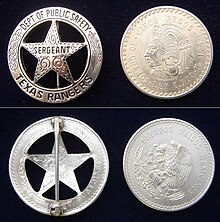
The modern-day badge of a Texas Ranger is compared to the obverse and reverse of a 1948 cinco pesos coin from which it is made.
Modern-day Rangers (as well as their predecessors) do not have a prescribed uniform, per se, although the State of Texas does provide guidelines as to appropriate Ranger attire, including a requirement that Rangers wear clothing that is western in nature. Currently, the favored attire includes white shirt and tie, khaki/tan or gray trousers, light-colored western hat, “ranger” belt, and cowboy boots. Historically, according to pictorial evidence, Rangers wore whatever clothes they could afford or muster, which were usually worn out from heavy use. While Rangers still pay for their clothing today, they receive an initial stipend to offset some of the costs of boots, gunbelts and hats.
To carry out their horseback missions, Rangers adapted tack and personal gear to fit their needs. Until the beginning of the 20th century, the greatest influence was from the vaqueros(Mexican cowboys). Saddles, spurs, ropes and vests used by the Rangers were all fashioned after those of the vaqueros. Most Rangers also preferred to wear broader-brimmed sombreros as opposed to cowboy hats, and they favored square-cut, knee-high boots with a high heel and pointed toes, in a more Spanish style. Both groups carried their guns the same way, with the holsters positioned high around their hips instead of low on the thigh. This placement made it easier to draw and shoot while riding a horse.[48]
Badges
The wearing of badges became more common in the late 1800s. Historians have put forth several reasons for the lack of the regular use of a badge; among them, some Rangers felt a shiny badge was a tempting target. Other historians have speculated there was no real need to show a badge to a hostile Native American or outlaw. Additionally, from a historical viewpoint, a Ranger’s pay was so scanty that the money required for such fancy accoutrements was rarely available. Nevertheless, some Rangers did wear badges, and the first of these appeared around 1875. They were locally made and varied considerably from one to another, but they invariably represented a star cut from a Mexican silver coin (usually a five-pesos coin). The design is reminiscent of Texas’s Lone Star flag.
Although present-day Rangers wear the familiar “star in a wheel” badge, it was adopted officially only recently. The current design of the Rangers’ badge was incorporated in 1962, when Ranger Hardy L. Purvis and his mother donated enough Mexican five-pesos coins to the DPS to provide badges for all 62 Rangers who were working at that time as commissioned officers.[49]
Officers killed
Since the establishment of the Texas Department of Public Safety Texas Rangers Division, 108 Rangers have died in the line of duty. The following list also contains officers from the Texas Rangers, which was merged into the Texas Department of Public Safety.[50][51]
The causes of death are as follows:
| Causes of death |
Number of deaths |
| Assault |
24 |
| Automobile accident |
2 |
| Duty related illness |
7 |
| Drowned |
2 |
| Gunfire |
66 |
| Gunfire (accidental) |
3 |
| Stabbed |
1 |
| Struck by train |
2 |
| Struck by vehicle |
1 |
In popular culture
Numerous films and television series focus closely or loosely on the Texas Rangers. In addition, the Texas Rangers baseball team, when it relocated to the Dallas-Fort Worth Metroplex in 1972, took its name from the legendary force.
Tales of the Texas Rangers a Western procedural radio program that ran on NBC from 1950 to 1951, starring Joel McCrea, which was described as Dragnet with a Western flavor, and dealt with Ranger investigations in the 1930s and 1940s. The program was adapted to television in the mid-50s as a Saturday morning juvenile Western, again on NBC, including contemporary stories as well as stories from the old West.
The 1957-1959 CBS western series, Trackdown, starring Robert Culp as the fictional Ranger Hoby Gilman, even carried the official endorsement of the Rangers and the State of Texas. Trackdown episodes were set in both fictional and real locations in Texas though the series itself was filmed at the former Iverson Movie Ranch in Chatsworth, California. Episodes focus on Gilman tracking down bank robbers, horse thieves, swindlers, and murderers.[52]
John Horton Slaughter, a former Texas Ranger who later became a rancher in and the sheriff of Cochise County in southeastern Arizona, was the focus of the 1958-1961 Walt Disney miniseries Texas John Slaughter.
The Lone Ranger, which aired from 1949 to 1957 on ABC and was that network’s first hit series, is a tale of the Rangers too, starring Clayton Moore and for two seasons John Hart.
CBS had a children’s program from 1955 to 1959, Tales of the Texas Rangers, with Willard Parker and Harry Lauter as fictional rangers, which ran on the Saturday morning scheduleand later in rebroadcasts on ABC.[53]
From 1965 to 1967, NBC aired Laredo, a light-hearted look at a company of Rangers in the border city of Laredo. A spin-off of The Virginian, Laredo starred Philip Carey, Peter Brown, William Smith, and Neville Brand.
Rango (1967). Short-lived comedy series starring Tim Conway as the eponymous Rango, a bumbling Texas Ranger in the 19th century. Rango got the job only because his uncle is a high-ranking officer in the organization.
The syndicated western series Judge Roy Bean, with Edgar Buchanan in the starring role of Justice of the Peace Roy Bean, had a Texas Ranger character, Steve, played by Russell Hayden.
Both the novel series Lonesome Dove and its television adaptation focus on the Texas Rangers, among them Woodrow F. Call and Augustus McCrae.
The film Lone Wolf McQuade (1983) starring Chuck Norris, David Carradine, Barbara Carrera and Robert Beltran follows Texas Ranger J.J. McQuade (Norris) as he investigates a ring of arms dealers.
Walter Hill‘s movie Extreme Prejudice (1987), starring Nick Nolte, Powers Boothe, Michael Ironside and María Conchita Alonso, focuses on the fight between a ranger and his former childhood friend, turned drug lord.
The television series Walker, Texas Ranger (1993-2001) followed the fictional Rangers Cordell Walker and James Trivette, played by Chuck Norris and Clarence Gilyard, Jr.. In the series, Walker and Trivette are assigned to B Company, stationed first in Fort Worth, and later in Dallas.
The animated television series King of the Hill (1997-2010) featured Jeff Boomhauer, whose profession was a long running secret (much like the state that houses Springfield, of the Simpsons’ residence in The Simpsons). In the final episode of King of the Hill that aired September 13, 2009, it was revealed that Jeff Boomhauer was indeed a Texas Ranger when his wallet revealed his badge and information.
The film Man of the House (2005), starring Tommy Lee Jones as a Texas Ranger.
In Harry Turtledove‘s alternative history novel, Settling Accounts: In at the Death (2007), Texas Rangers from the newly recreated Republic of Texas, detain and arrest Jefferson Pinkard, commander of Camp Determination.
The novel True Grit and the 1969 and 2010 films based on the novel include a Texas Ranger as a prominent member of the story.
In the television series From Dusk ’til Dawn (2014) includes Texas Rangers as the primary antagonists hunting the main characters and also discusses some of the history of racial tension along the Texas-Mexico Border and the suffering of the Mexican and Mexican American peoples of that area at the hands of “Los Rinches” or the Texas Rangers.
In the post-apocalypse television series Revolution (2012-2014), when Texas is once again an independent nation, the Texas Rangers appear in the second season and serve as the main military of Texas.
Ranger Molly Parker was portrayed in the eight-episode television drama (2014) Killer Women, created by Hannah Shakespeare and starring Tricia Helfer as Molly Parker. All of the criminals portrayed in the series were women, and the show highlighted how only a very few Rangers were women.
The film Hell or High Water (2016), an American neo-Western crime thriller film directed by David Mackenzie and written by Taylor Sheridan, features prominently the roles of two Texas Rangers (portrayed by Jeff Bridges and Gil Birmingham), who pursue two brothers (portrayed by Chris Pine and Ben Foster) engaged in a series of bank robberies throughout the small towns of the region known as West Texas (part of the greater Comancheria) in order to save their family ranch from foreclosure and repossession.
In 2016 Faber & Faber published the first in a series of novels featuring 1960’s Texas Ranger John Q, by JM Gulvin.
Hall of Fame and Museum
The Texas Ranger Hall of Fame and Museum opened in Waco in 1968.
Notable Texas Rangers
-
-
-
-
-
-
-
-
-
-
-
-
-
-
“Every Texas Ranger has Mexican blood”—and then they would pause and add—“on the tips of his boots.”








 Vietnam War Casualties
 V’nam Casualties by Race, Ethnicity and Natl Origin


.jpg)