 The first British troops landed at Mondego Bay on 1 August 1808 and 4 days later Sir Arthur Wellesley had 13,000 troops ashore. On the 17 August, Wellesley beat a French force under General Delaborde at Roliça.
(see my article on the Battle of Roliça and Wellington’s first victory in the Peninsular) www.dukeofwellington.org/post/the-battle-of-roli%C3%A7a-17th-august-1808-wellington-s-first-peninsular-attack-and-victory
The French commander, General Delaborde retreated back towards Lisbon and linked up with General Junot, who took command of their combined forces.
Over the 19th & 20th August two fleets brought around 3,000 British reinforcements ashore, using small boats at Porto Novo. It wasn’t without causalities, as the current and surf swept away some boats and capsized others, causing some fatalities. Wellesley’s army was camped on the cliff tops nearby and waited for these much needed troops, which would tip the balance of numbers in their favour.
The fleet however also brought Sir Harry Burrard, who was to replace Wellesley (he in turn was replaced on the 22nd August, following Vimerio by Sir Hew Dalrymple). The replacement of British commander was not made until the evening of the 21st due both to the approaching French Army, and the fact Sir Harry Burrard stayed aboard his ship, HMS Brazen, for comfort, meaning Arthur Wellesley, the future Duke of Wellington, commanded the British force until the closing stages of the battle.

The opposing forces on the 21st August 1808:
The British Forces of around 15,000 men:
Commander: Sir Arthur Wellesley
1st Brigade: General Rowland Hill
5th Foot
9th Foot
38th Foot
2nd Brigade: General Ronald Ferguson
36th Foot, 40th Foot, 71st Foot
3rd Brigade: General Miles Nightingall
29th Foot, 82nd Foot
4th Brigade: General Barnard Bowes
6th Foot, 32nd Foot
5th Brigade: General James Caitland Craufurd
50th Foot, 91st Foot
6th Brigade: General Henry Fane
45th Foot, 5th Battalion 60th Foot, 2nd Battalion 95th Rifles
7th Brigade: General Robert Anstruther
2nd Battalion 9th Foot, 2nd Battalion 43rd Light
,2nd Battalion 52nd Light, 2nd Battalion 97th Highlanders
8th Brigade: General Wroth Palmer Acland
2nd Foot, 20th Foot (7 and 1/2 Companies), 1st Battalion 95th Rifles (2 Companies), 20th Light Dragoons (Half Regiment)
3 Batteries of Royal Artillery (16 Guns)
Portuguese Troops: Colonel Nicolas Trant
6th, 11th, & 12th Cavalry Regiments (And Lisbon Police Cavalry), 12th, 21st, and 24th line Battalions, 6th Caçadores, 4th Artillery Regiment
French Forces13,000 men and 23 guns:
Commander: General Jean-Androche Junot
1st Division: General Henri-François Delaborde
Brigade: General Antoine-François Brenier de Montmorand
3rd Battalion 2nd Légère
3rd Battalion 4th Légère
70th Ligne Regiment (1st and 2nd Battalions)
Brigade: General Jean-Guillaume-Barthélemy Thomières
86th Ligne Regiment (1st and 2nd Battalions minus two companies left at Elvas)
4th Swiss Regiment (2 Companies)
2nd Division: General Louis-Henri Loison
Brigade: General Jean-Baptiste Solignac
3rd Battalion 12th Légère
3rd Battalion 15th Légère
3rd Battalion 58th Ligne
Brigade; General Hugues Charlot
3rd Battalion 32nd Ligne
3rd Battalion 82nd Ligne
Reserve of Grenadiers: François-Etienne Kellerman
1st Regiment (1st and 2nd Battalions)
2nd Regiment (1st and 2nd Battalions)
Cavalry Division: General Pierre Maragon
1st Provisional Chasseurs
3rd Provisional Dragoons
4th Provisional Dragoons
5th Provisional Dragoons
Squadron of Volunteer Cavalry
Wellesley decided to face the French in the vicinity of the coastal region near Vimeiro. There he would defend two strategic ridgelines. The ridgelines were littered with stone walls and vineyards, making them a good defensive position.
Wellesley thought the French would attack the western ridge and decided the Vimeiro Hill was the key to his position. He placed General Hill’s Brigade on his right flank, with Anstruther’s just to their left. Fane’s Brigade would defend the town of Vimeiro itself, while Acland’s, Bowe’s, Crawfurd’s, Ferguson’s and Nightingall’s, Brigades would be in reserve.
Trant’s Portuguese were held further back, except for the cavalry who were to support the small force of the 20th Light Dragoons (which consisted of just 240 mounted men).
General Junot has pushed his men on through the night of the 20th/21st in order to reach Vimerio before Sir John Moore’s army of an additional 12,000 men could link up with Wellesley’s at the coast.
British cavalry patrols has spotted the marching French troops about 5 kilometres south of Vimerio and reported this intelligence back to Wellesley who, expecting to be replaced as commander soon, ordered the British troops to be stood to, and “under arms by three o’clock in the morning” (Chartrand p.64).
[20th Light Dragoons on patrol to gather intelligence, spotting the enemy. By W.B. Wollen]
For the opening stage of the battle, Junot directed Brenier’s Brigade, comprising the 4 battalions that had fought under Delaborde at Roliça earlier that week, with a regiment of dragoons, to advance onto the eastern Ridge. Brenier was to continue north and, turn west, to march onto the East Ridge at its furthest point. Junot’s intention was, as soon as Brenier’s attack was well under way, to launch an assault on Vimeiro Hill in Wellesley’s centre.
Seeing the dust arising from Brenier’s trooping marching to the north, Wellesley ordered the four Brigades of, Acland, Bowes’ Ferguson and Nightingall to move to the East Ridge, to repulse the attacking French. As they approached, the two forces moving to the ridge were roughly marching in parallel to one another. Within minutes of reaching the ridge’s top, the British regiments deployed, in a smooth and efficient manner, a way in which the French had not encountered in Spain or Portugal yet.
Seeing British deploying onto the eastern ridge, Junot ordered the three battalion’s from Solignac’s Brigade to support Brennier’s men.
Junot now felt that the best course of success now lay with a frontal attack on the Vimeiro Hill. This was made by Thomière’s Brigade and Charlot’s Brigade, comprising 4 ½ battalions. Confidence was high and the men advance in their famous columns. General Delaborde led Thomière’s Brigade on the right and Loison led Charlot’s Brigade on the left, with 7 Guns.
The French attack on Vimeiro Hill fell on Fane’s Brigade on the British left, which largely consisted of riflemen of the 5/60th and 95th Regiments. These skirmishers would fire and fall back as the French approached. Also in good cover was Anstruther’s Brigade on the British right. The British infantry were supported by 12 guns. When the French columns got close enough, the red coated infantry poured volley fire of steady muskets into them, with the artillery in close support.
As the French took heavy casualties, the 97th (Queen’s Germans) moved out of their covered position and attacked the front of the columns, which the 52nd (Light Infantry) fell onto its flank.
This was too much for the French, even in column and they broke, running back down the slope of the ridge. Seeing this, the 50th (West Kent) supported by Riflemen did the same to Thomière’s column. Among the heavy casualties, general Delaborde and Charlot were wounded.

[The British advance on the French columns, as Riflemen of the 5/60th fall back. Source Devon Wargaming blog]
Though the failure to capture the ridge caused heavy casualties and must have been frustrating to Junot, it was not his main attack and he still had reserves. Calling up the two battalion of the 2nd Grenadier Reserve Regiment and rallying the fleeing survivors of the first attack, they made their way back up the eastern ridge again.
The British on the ridge were ready to meet the second attack. The Riflemen and skirmishers had been recalled, so the Artillery had a clear field of fire down the slope. For the first time in a battle, a new type of weapon was about to be used, Shrapnel shells. Devised by their namesake, Sir Henry Shrapnel of the Royal Artillery.
These shells (officially designated “spherical case”) could be fired by cannon to rain their deadly payload of musket balls at increased range and lethality. These shells found a perfect target on the densely packed French columns, though they were twice as wide as they were deep for each battalion, they were closely supported by a following battalion, giving them a ‘snaking’ effect from the British viewpoint.
The French Grenadiers did not make it halfway up the ridge, before the jubilant 52nd, 97th and Rifle battalions added their weight of fire to the gunners. Unable to advance against the intense volleys and with men falling on the slope, they broke back down the slope, leaving many dead and dying alongside those of the earlier attack.
Junot knew this position must be taken, so he called up both battalions the 1st Grenadier Reserve Regiment to “Pour en finir – put an end to it” (Chartrand p. 73) and capture the ridge.
This time General Kellerman led the attack, instead of coming straight up the slope and hoping for success where failure was met twice before, he attempted to outflank the British by moving along a lower ridge, if they succeeded they would open up the road to the town of Vimerio.
Though a bold and clever plan, they had been spotted by Brigadier-General Anstruther who moved the 43rd (Monmouthshire) Light Infantry, who had not yet been engaged in the fighting on the ridge. They took up position in a high-walled churchyard by the road.
Using this elevated and protected position the 43rd Light Infantry were able to fire into the advancing French Grenadiers, who were not able to scale the wall or have a clear view of their enemy. On the Grenadier’s other flank, two companies of 95th Rifles, joined by the Light Companies of the 2nd (The Queen’s Royal) and 20th (East Devonshire), supported by Fane’s Brigade guns opened fire.
Shrapnel exploded overhead, whilst musket volleys cut down large numbers, with rifle shots picking out individuals, yet still the Grenadiers came on, hoping to push their way up the road and into the town, they might have succeeded, despite the casualties if the 50th and 43rd regiments had not been added to the fray, charging into their flank, the fighting was desperate, with reports that at this stage most muskets were fired within 5 foot of the enemy along with bayonet attacks.
This fierce fighting pushed the balance, forcing the French to flee, but not before inflicting casualties on their attackers also.
[The 43rd use the Churchyard wall to attack the 1st Grenadier Reserve Regiment from multiple sides. Note the Belgic Shakos were introduced in 1812 onward in the British Army but are common in artistic impressions]
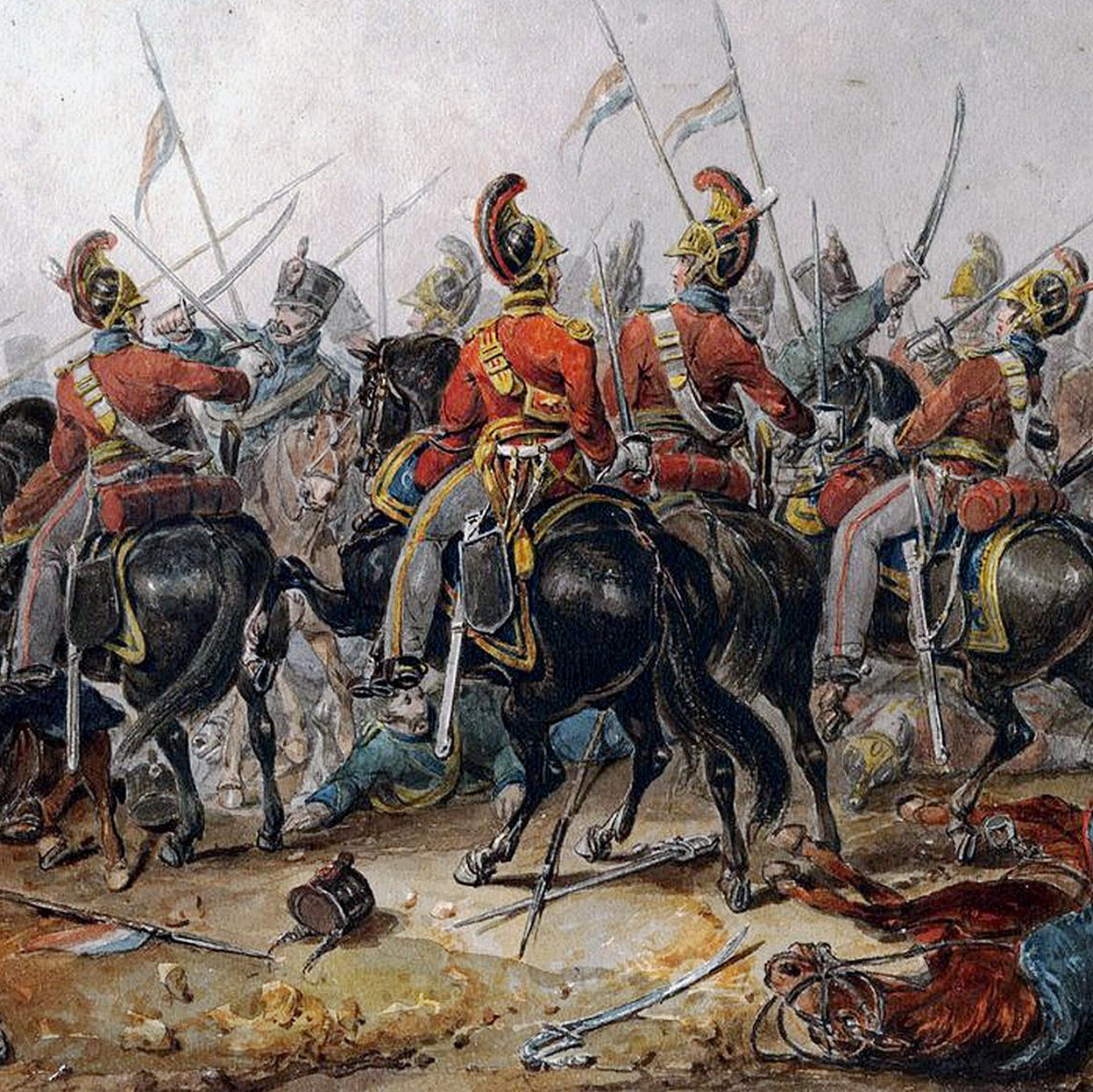
Observing this third attack fail, Wellesley now decided it was the perfect time to commit his cavalry. Reportedly turning to Lieutenant Colonel Taylor of the 20th Light Dragoons, raising his hat and rather mirroring his order to the Guards at Waterloo “Now 20th, now is the time!” (Chartrand P.76).
The 240 British Troopers advanced from their position in the rear with 260 Portuguese cavalry on their flanks, some of whom were the Lisbon Police detachment, who had been hastily added to the cavalry’s ranks.
The cavalry formed line and went after the retreating French, some of whom saw that their best chance was to turn and fight. The muskets must have caused some casualties in the Portuguese ranks, who were very inexperienced, many panicked and galloped away to take shelter back behind British lines.
But not all as it was noted that a Commandant of the Lisbon Police was killed much further on. Now largely unsupported, the two squadrons of the 20th Light Dragoons pushed on, through the fleeing French infantry, into a unit of enemy Dragoons, who they manage to surprise and overpower.
They were still able to push on and on further up the far hill, until checked by a stone wall, it was here that the two regiments of French Dragoons who had been held in reserve fell upon them.
Outnumbered and spent from their charge, the Light Dragoons should have been massacred, but in a great act of daring, most of the troopers managed to escape, with just the loss of 21 killed, 24 wounded and 11 captured. Even General Junot praised the bravery of these men to one of the captured officers. However the charge had mostly failed from the moment the Portuguese left.
[The charge of the 20th Light Dragoons and counter charge. WikiGallery]
By this point in the battle, Junot had committed nearly all of his troops into the attacks on Vimeiro. By comparison, Wellesley still had fresh reserves and not all the troops on the ridge had actually been fully engaged, so had full ranks and plenty of ammunition but were now spurred on with the successes of the day so far.
With repeated frontal attacks failing, Junot’s hope lay in outflanking the British position. For this wide move he chose Brenier’s Brigade again, who had led the opening attack in the morning. The plan was to sweep round the north-east, towards a farm at Ventosa.
Thinking that his supporting artillery could not use the roads due to hills and ravines, he decided to make a wide detour, going far round the position and adding time onto the march. Junot supported Brenier with a brigade under Solignac.
As Solignac was trying to catch Brenier up, he went on the more direct road through the ravines and pressed up. Much to Solignac’s surprise he reached the farm of Ventosa first as Brenier had yet to reach it.
Spotting a thin line of British Infantry in the distance, in their recognisable red coat, Solignac deployed the three battalions under his command at the foot of a hill, what he did not know was what, if anything lay over the hill.
Obscured by the rise and shielded by the skirmishers were three Brigades of British infantry under Bowes, Ferguson and Nightingall, consisting of seven battalions on infantry in two lines. Furthermore Acland’s and Crauford’s Brigades were only a little less than 2 kilometres away.
The three French Battalions went up the hill, their voltigeurs deployed out to the front, in order to engage the British light troops. Expecting to fight a deadly duel that light infantry fought, but with close support from their approaching line infantry the voltiguers pushed on and the Light Companies withdrew, for they knew what lay beyond the hill.
As the French reached the crest they saw over double their number of British Infantry marching towards them, the red coated infantry were so numerous, that even in a double line of battalions they overlapped the French. Solignac had little choice but to stand and fight.
At less than 100 meters, the British presented their muskets and delivered a devastating volley, effectively wiping out the voltiguers to their front and wounding General Jean-Baptiste Solignac.
The whole British line reloaded and stepped forward, ready to engage the main French force. The French returned ineffective fire, there was already mass confusion after the surprise of the three advancing brigades, they were outnumbered, suffering casualties and their commander was wounded.
With a road to their rear, Solignac’s men broke and ran, some British regiments, namely the 36th (Herefordshire) and 40th (2nd Somersetshire) gave pursuit, firing at their backs and catching up with men as they went, taking many prisoner and capturing three guns.
[Reenactors at Vimerio march to new positions]
At the captured guns the 71st (Glasgow Highland) Light Infantry and 82nd (Prince of Wales’s Volunteers) Regiments stopped and paused, observing them was General Brenier who had just arrived on the scene.
Brenier immediately ordered his two squadrons of Dragoons to charge down the slope and catch the men of the 71st and 82nd by surprise and maybe recapture the guns. The British troops were caught unawares by the charging Dragoons, but they fell back, rallied and formed a defensive line.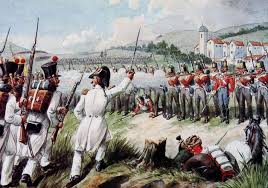 The 29th (Worcestershire) Regiment standing firm against a French attack at Vimiera – by R. Simkin
Unfortunately for the attacking French Dragoons the 29th (Worcestershire) Regiment who had recently lost their commander, Colonel Lake at Roliça just 4 days earlier, came to their aid.
The three British Regiments formed a formidable line and advanced against the French cavalry, firing volleys into them. They carried on up the hill and continued their volleys against the infantry, in a repeat of the earlier attacks Brenier was wounded and the French broke and ran this time leaving their commander behind, so General Antoine-François Brenier de Montmorand was captured on the final attack of the day, after having led the first one of the battle.
[The 71st capture General Brenier]
There were still unengaged troops from these three British Brigades and Crauford’s Brigade was nearing the position as well as Colonel Vane’s Portuguese troops who were marching hard to join the fighting.
The flanking movement had utterly failed, attacking without supporting each other and being surprised in turn, much of the French army was it full retreat and being taken prisoner, Junot had led a disastrous series of attacks and could expect to lose thousands more into captivity, after less than three hours fighting.
At this time a shocking new order came to the British officers. They were to stop their pursuit and halt. A new British Commander had arrived, Sir Harry Burrard.
Waiting, wisely for Wellesley to command the troops through the battle, Burrard assumed the chief command after victory seemed assured, and, believing the French had a reserve as yet untouched, forbade Ferguson to advance.
The very next day Sir Hew Dalrymple assumed the chief command. Sir Harry Burrard and Sir Hew Dalrymple agreed and signed the controversial Convention of Cintra, while Arthur Wellesley was ordered to do so despite his opposition to the convention. All three generals were recalled, back to England. I feel that the Convention of Cintra is worthy of its own investigation and perhaps the topic of a future article.
The Battle of Vimerio should have been a total strategic success for the British, but they were muzzled at their moment of success by Sir Harry Burrard.
It was a desperately fought engagement, the French reported 1,500 officers and men killed or wounded with 300 to 400 taken prisoner, including General Brenier and the loss of three guns.
The British suffered their own losses, but were less than half that of their foe at, 720 in total killed or wounded, which broke down as, 4 officers and 131 men killed, 37 officers and 497 men wounded, 2 officers and 49 missing (likely captured), the Portuguese suffered at least 1 fatality from the Lisbon Police along a cadet and others wounded from their cavalry charge.
Burrard only held onto the command for one day, but all three generals would return to England, eventually leaving the command to Sir John Moore.
By the time he was admonished for his part in the Convention of Cintra and return to Portugal, Sir Arthur Wellesley would be too late to save his army from the events leading to Corunna which would cost Sir John Moore and thousands of men and horses their lives.
Categories
He sure looks a lot like me!


We reported recently how Sig Sauer’s popular P320 pistol has come under fire by some law enforcement agencies, military branches and even Gunsite Academy because of alleged safety problems. One such law enforcement group, the Washington State Criminal Justice Training Commission (WSCJTC), which operates Washington’s police training academy, banned the P320 for trainee use.
“My position has to be safety because we know so much now that if I make a different decision, I don’t feel like I’m being responsible,” Monica Alexander, WSCJTC executive director, said upon announcing the ban.
Now, SIG has filed a lawsuit, Sig Sauer Inc. v. WSCJTC, seeking to have the ban reversed and claiming that the ban is unnecessary and not well grounded in fact or law.
“Law enforcement departments throughout Washington State trust, rely on, and prefer the P320 as their service pistol of choice,” the lawsuit states. “By banning the P320 for new law enforcement recruits, the WSCJTC is putting these men and women at a disadvantage when they enter the field and will be assigned the P320.
The action also imposes negative financial impacts on all those law enforcement agencies that utilize the P320 and Sig Sauer. It further inappropriately and unjustifiably inflicts reputational and economic harms on Sig Sauer.”
The plaintiff further argues the lawsuit that the organization’s P320 ban runs afoul of state law and the state’s statute outlining the right to keep and bear arms.
“The executive director’s unilateral decision is inconsistent with the state’s preemption in the field of firearms regulations under Chapter 9.41 RCW and does not fall withing any statutory exception,” the complaint argues. “Chapter 9.41 RCW fully occupies and preempts the entire field of firearms regulation within the boundaries of the state, including the registration, licensing, possession, purchase, sale, acquisition, transfer, discharge and transportation of firearms, or any other elements relating to firearms parts thereof.
“Moreover, the action implicates constitutional rights, and at a minimum should be subject of formal rulemaking. The Action has the effect of regulating a field contained in Article 1, Section 24 (Right to Bear Arms)of the Washington Constitution.”
Of course, Sig Sauer is facing a number of lawsuits of its own. One was filed by Houston police officer Rick Fernandez, who claims he was shot in the leg by his holstered P320.
“The bullet from the subject handgun shot through Officer Fernandez’s right calf and lodged into his ankle,” the lawsuit stated. “But the subject handgun, at all times, remained holstered. He never pulled the trigger or otherwise handled the gun.”
Another ongoing lawsuit by a Kentucky man, who claims his holstered P320 fired on its own, is pending before the 6th Circuit Court of Appeals. In January, that court ruled that a lower court erred in dismissing Timothy Davis’s product liability claims against Sig Sauer. The court found that the district court wrongly barred Davis from using expert witnesses to support his claim that the P320 handgun was defectively designed due to its lack of external safety mechanisms.

by Lee Williams
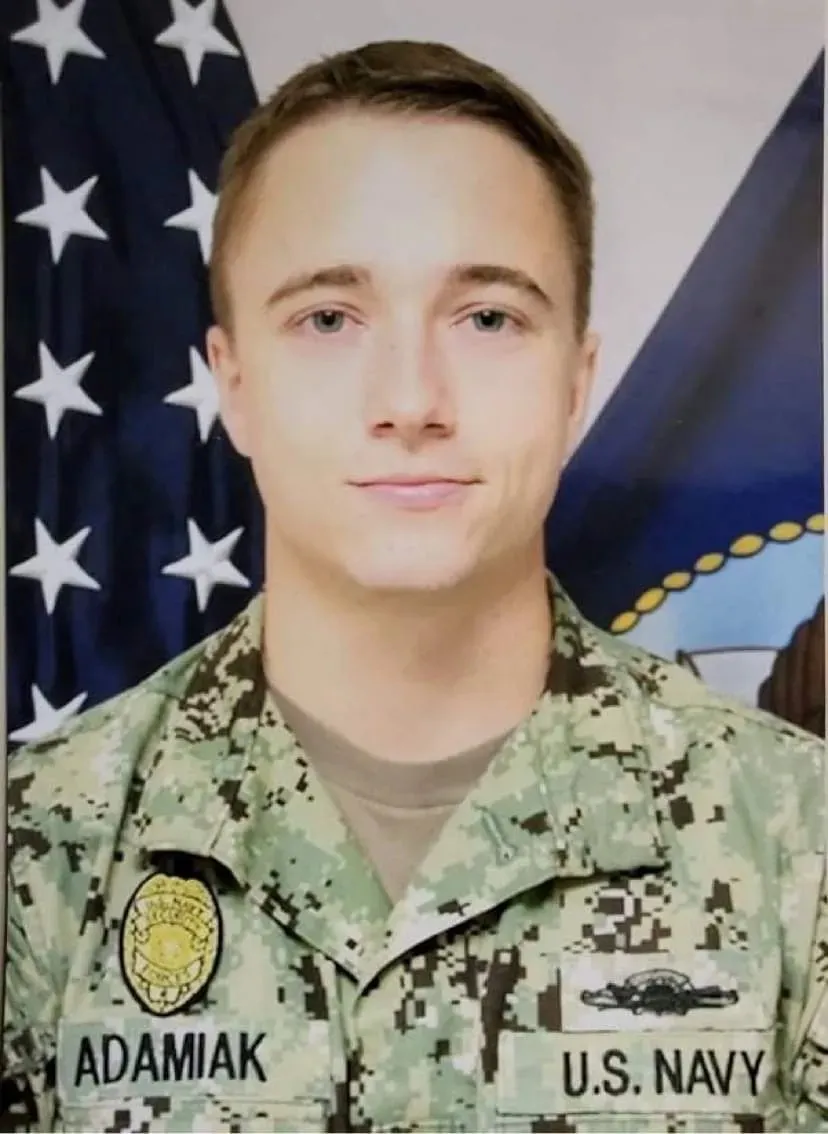
Patrick “Tate” Adamiak has been behind bars in a New Jersey federal prison for almost three years, but he still has 17 years left of his 20-year sentence even though he says he did absolutely nothing illegal or even wrong.
Adamiak recently sent a personal letter to President Donald J. Trump seeking a presidential pardon, which is one of the very few ways he has left to obtain his freedom. He has written letters to other politicians, but his letter to President Trump is special. It is far more private than anything he’s written before. The former sailor got very personal, especially about his mother’s death.
If he receives a pardon, Adamiak was very clear about what he will do next.
“I will go to the recruiter’s office and get back into the military,” he said Tuesday morning from his federal prison in New Jersey. “I still want to serve.”
He’s adamant he did nothing wrong. Prosecutors and the ATF misused the evidence during his trial, he said.
“Not one of the items meets the definition of a firearm under the statutes,” he said.
He was very clear about why he sent the letter to President Trump.
“I sent it because if he was made aware of what actually happened, he would do the right thing,” Adamiak said. “This would never have happened under his leadership. I hope he’s willing to fix another Biden-era disaster.”
A Presidential pardon may be the only route left to obtain his freedom.
“We’re still on appeal, but that’s been getting kicked down the road for three years now,” he said. “There’s been no decision on it. We’ll still continue to appeal. We can appeal to the U.S. Supreme Court, but there’s only a .02-percent chance they’ll take the case.”
Here is Adamiak’s letter to the President:
June 1st, 2025
To: President Donald J. Trump
From: Patrick Tate Adamiak
President Trump,
I hope this letter finds you well. My name is Patrick “Tate” Adamiak. I am a 31 year old young man—a Patriot that has devoted my entire life to serving this great country. In my decade of honorable service in the United States Navy, under three separate Commanders in Chief, I can say with absolute personal conviction that I was most proud while serving under your strong unparalleled leadership. Having a President with courage means something.
I achieved many great things during my tenure in the military, operating in the Middle East, Africa, Europe, and the Panama Canal in Central America. While on active duty, I was simultaneously and diligently working toward my bachelor’s degree, which I completed with a 4.0 GPA, earning a spot on the President’s list. This degree was required to attend Officer Candidate School, as I was on track to achieving a life goal of mine, becoming a Commissioned Naval Officer.
Aside from my Naval career, I was also a very small-scale entrepreneur, owning some rental properties, and building a successful retail store online. I actually attribute much of my business “drive” to you, as I remember watching you on “The Apprentice” as a little boy, always appreciating the “Art of the Deal.”
In fact, you might be surprised to learn that my mother actually worked for you in the early 80s. She was a renowned ballet dancer in New York City, and you hired her to teach a football team you owned, The New Jersey Generals, coordination and balance techniques. My morn always used to tell me a funny story about the day she met you met. Her name was “Senga” Adamiak, and she told me that you asked her where a name like that came from. She then told you the story about how her name was supposed to be “Agnes,” but it was mistakenly spelled backwards on her birth certificate by her dyslexic Uncle, who was at the hospital filling out the paperwork because her father was deployed. Apparently, you got quite the kick out of that, and every time you came up, she’d remind me of this story.
Today, I am writing you because I am in desperate need of your helps as you are the only person that can save me. While it may seem that I had the perfect life trajectory. it was ALL taken from me due to the incompetency of the Biden era administration. Just like you, I fell victim to politically motivated Lawfare. I was targeted by overzealous prosecutors, and a then a corrupt DOJ. I did absolutely nothing wrong, yet had to lose my Naval career, cease pursuing my Master’s degree, deplete my life’s savings to go to federal trial, be pulled from my loved ones, and now have been held hostage in a Jersey federal prison for almost three years. the worst part is, the amount of turmoil and chaos this situation created pushed my frail mother, Senga, to her death, just weeks after my arrest, She couldn’t handle the stress and died of a broken heart.
Biden put pressure on the ATF in early 2022, to “do something” about firearms in the United States. The objective was to target so called “ghost guns,” however certain rogue ATF agents went even further than that, completely violating the rights of law abiding gun owners and Americans.
As a passionate military history enthusiast, I was a collector of inert and non-functional weaponry and memorabilia. Props and replicas. Absolutely none of the items at issue in my case could even shoot a single round, nor were they for sale, yet I was smeared and made out to be some dangerous weapons trafficker and treated like a domestic terrorist. Everything I owned is still legally available in the open market to this day.
A deranged ATF employee literally took toy replica weapons and “classified” them as machine guns. He testified at trial to his findings before a liberal anti-gun judge who accepted his testimony and proceeded to give me a TWENTY year prison sentence. Two decades for inert dummy guns that were not used in any crimes. I was even attacked for being a conservative in this court room, the prosecution making sure the jury knew I was team MAGA.
This was nothing short of a weaponized agency overreach. It was a political stunt to make it look like Biden’s administration was accomplishing “something,” and to help the ATF justify their existence and wasteful budgets. I was used as an example.
None of this would have happened if you were President. I would have never even been arrested. My case may seem bizarre and unbelievable, but nobody knows better than you what it feels like to be unfairly targeted. I was de-banked ripped from my career, my family—my whole life destroyed over nothing. There were no victims, nothing was stolen, no evil intent or nefarious agendas, no crime whatsoever, yet here I sit. perishing in prison.
My case has gained significant media attention since you came back into office. There are tens of thousands of Americans rallying behind me—many of whom likely voted for you all THREE times you won the election, that are urging you to consider a Pardon for me. Even Senator Rick Scott of Florida has publicly commented that 1 should never have served a single day in jail. Additionally, Daniel C. O’Kelly, a senior ATF official has come forward as a whistle blower, publicly exposing the fact that nothing I possessed qualifies as a firearm under federal law, further supporting my claim that no crime has been committed. Mr. O’Kelly believes I felt victim to the pressure on the ATF from the Biden administration, poorly trained ATF agents that misclassified the items in my case, and ignorant prosecutors that know nothing about firearms and just took the ATF at their word.
Mr. President, I need you. 1 need you to intervene and help resolve this miscarriage of justice and help me get my life back. I want nothing more than to return to service, pursue my goals in becoming a Naval Officer and to serve under the greatest President that this country has ever seen.
I am more than willing to provide your staff and legal team any evidence, documentation, or expert testimony that will help you understand the full scope of my case. I can easily prove that virtually every claim against me is FAKE NEWS and completely not in line with federal laws. I also invite you to visit my website, www.FreedomForTate.org, to see the ongoing advocacy effort and coverage on my case.
Mr. President, please give me a second chance at life. Let me get back to being the functional member of society I was, instead of being in the draconian and broken Federal Bureau of Prisons system, where I am losing the best years of my life. You are the only person on earth that can save me from this unjust 20 year sentence I am serving, and also hold accountable the lunatics within the ATF and DOJ that maliciously put me here. I hope that you will consider intervening. I will not make you regret your decision.
Thank you for your time, consideration, and service in keeping the United States the best country in the world.
Very respectfully,
Patrick Tate Adamiak
95252-509
FCI Fort Dix
P0 Box 2000
Joint Base MDL, NJ 08640