Categories
The Green Machine War

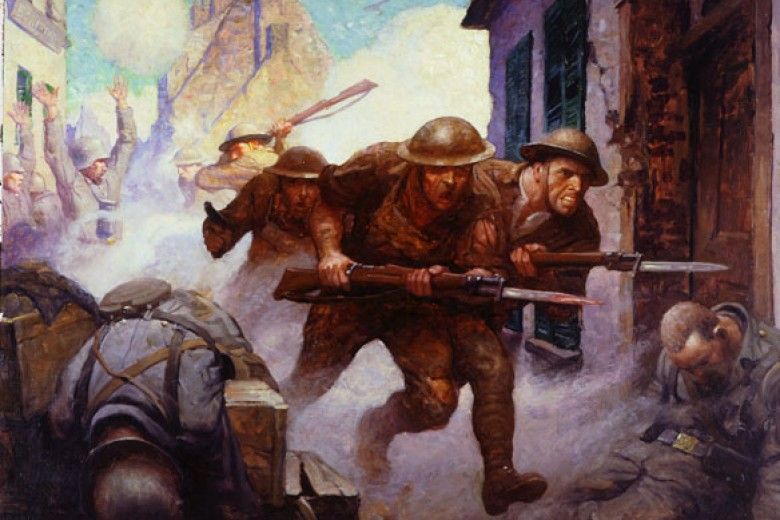
THE BATTLE FOR BELLEAU WOOD (1918) One Hundred Years ago today!

Image result for battle of chateau thierry
The Battle of Château-Thierry was fought on July 18, 1918 and was one of the first actions of the American Expeditionary Forces (AEF) under General John J. “Black Jack” Pershing.
Scott Belleau Wood.jpg
It was a battle in World War I as part of the Second Battle of the Marne, initially prompted by a German offensive launched on 15 July against the AEF, an expeditionary force consisting of troops from both the Army and Marine Corps, and the newest troops on the front.Related image
On the morning of 18 July 1918, the French (some of them colonial)   and American forces between Fontenoy and Château-Thierry launched a counter-assault under the overall direction of Allied généralissime Ferdinand Foch against the German positions.
This assault on a 40 km (25 mi) wide front was the first in over a year. The American army played a role fighting for the regions around Soissons and Château-Thierry, in collaboration with predominantly French forces.
The allied forces had managed to keep their plans a secret, and their attack at 04:45 took the Germans by surprise when the troops went “Over the Top” without a preparatory artillery bombardment, but instead followed closely behind a rolling barrage which began with great synchronized precision.
Eventually, the two opposing assaults (lines) inter-penetrated and individual American units exercised initiative and continued fighting despite being nominally behind enemy lines.[2]

Background

Despite the revolution in Russia, fortune seemed to favor the Allies with the arrival of the Americans to France. However, these troops needed time to train before they could be combat effective.
Recognizing the window of opportunity, Ludendorff consolidated the manpower freed up from the Eastern Front to conduct Operation Michael in order to split the Allies’ lines. The successes of the German Stormtroopers infiltration tactics earned Germany approximately 40 miles of territory. But the offensive lost momentum when it surpassed its supply lines.
Up to this point, American General Pershing refused to hand over American divisions to either the British or French armies, insisting on keeping them together as one army. But in the face of the German onslaught, Pershing relented and sent a portion of his army to assist the French in blocking the German advance.[3]:7–10

Prelude[edit]

Looking to defeat the British occupied in Flanders, Ludendorff sought to divert the Allies’ French reserves away from the region. In his Operation Blucher, Ludendorff aimed some of his forces at the Chemin des Dames and took the French Sixth Army by surprise.
Driving on, the Germans were soon at the Marne River, situated under 50 miles from Paris. With Marshal Ferdinand Foch unable to acquire British assistance, General Pershing’s chief of operation, Colonel Fox Conner, recognized the gravity of the situation and ordered the 3rd Division to block them.[3]:39–41[4]

Battle

The 3rd Division occupied the main bridge on the south bank of the Marne that led in Chateau Thierry on May 31 as the French 10th Colonial Division rendezvoused with them from the north bank. The Americans positioned their machine guns to cover the French retreat, and had a unit led by Lt John Bissell situated north of the second bridge. The French spent the night adding explosives to the bridges to destroy them. Early the following morning, on June 1, the Germans advanced into Chateau Thierry from the north, forcing the French to the main bridge, which they defended with the support of American machine-gun fire. The French succeeded in destroying the bridge as the Americans kept up their fire on the Germans. Lt. Bissell’s group was still on the north side of the Marne. They worked their way back to the secondary bridge in-between American machine-gun fire and made it across, along with a group of Germans that were captured shortly afterwards. From the north of the Marne on June 2, the Germans engaged in heavy artillery and sniper fire against the Allies. They made an attempt to take the remaining bridge but were forced to end the assault as the casualties rose.[3]:41–42

Memorials[edit]

After World War I, a memorial was built on Hill 204, 2 miles (3 km.) west of the town for which it is named. The Château-Thierry Monument, designed by Paul P. Cret of Philadelphia, was constructed by the American Battle Monuments Commission “to commemorate the sacrifices and achievements of American and French fighting men in the region, and the friendship and cooperation of French and American forces during World War I.”[5]
There is also a monument in front of the Bronx County Courthouse in New York City that was presented by the American Legion on November 11, 1940. The monument consists of the “Keystone from an arch of the old bridge at Chateau Thierry,” which the monument notes was “Gloriously and successfully defended by American troops.”[6]
The first Filipino to die in World War I was Private Tomas Mateo Claudio who served with the U.S. Army as part of the American Expeditionary Forces to Europe. He died in the Battle of Chateau Thierry in France on June 29, 1918.[7][8] The Tomas Claudio Memorial College in Morong Rizal, Philippines, which was founded in 1950, was named in his honor.[9]

References[edit]

  1. Jump up^ http://www.kumc.edu/wwi/index-of-essays/american-military-operations-and-casualties.html
  2. Jump up^ Edwin L. James (1918). “A Description of the Battle of Chateau-Thierry”New York Times Current History. New York Times. Archived from the original on 6 June 2009. Retrieved 2009-06-22.
  3. Jump up to:a b c David Bonk (2007). Chateau Thierry and Belleau Wood 1918: America’s baptism of fire on the Marne. Great Britain: Osprey Publishing. ISBN 978-1-84603-034-5. Retrieved 31 October 2016.
  4. Jump up^ Eisenhower, John S.D. (2001). Yanks: The Epic Story of the American Army in World War I. New York: The Free Press. pp. 136–137. ISBN 0-684-86304-9.
  5. Jump up^ “Aisne-Marne American Cemetery and Memorial” (PDF). American Battle Monuments Commission, U.S. Government. Archived from the original (PDF) on 2009-07-04. Retrieved 2009-06-22.
  6. Jump up^ “An overlooked memorial”. Matt at I’m Just Walkin’. Retrieved 2014-11-15.
  7. Jump up^ Zena Sultana-Babao, America’s Thanksgiving and the Philippines’ National Heroes Day: Two Holidays Rooted in History and Tradition, Asian Journal, retrieved 2008-01-12
  8. Jump up^ Source: Philippine Military Academy
  9. Jump up^ “Schools, colleges and Universities: Tomas Claudio Memorial College”. Manila Bulletin Online. Archived from the original on 2007-07-07. Retrieved 2007-07-04.
    – “Tomas Claudio Memorial College”. www.tcmc.edu.ph. Retrieved 2007-07-04.

The Story of the American Expeditionary Forces


CHATEAU – THIERRY

U.S. Marine Corps

THE    BATTLE

FOR
BELLEAU  WOOD


At Belleau Wood


Quick Facts | Background  | Chronology |
A First Hand Account |

Quick Facts

Where:    The Aisne-Marne Sector, 5 miles immediately northwest of the town of Chateau-Thierry on the River Marne.
Check the Location on a Map of the Western Front
When:    June 1 – 26, 1918
AEF Units Participating:   Under command of the XXI Corps of the Sixth French Army – Second Division: 4th [Marine] Brigade, 2nd Engineers; Third Division: Elements of 7th Infantry Regiment
Click Here To See the disposition of 2nd Forces around Belleau Wood.
Opposing Forces:    From German Army Group Crown Prince – In Belleau Wood – the 461st Regiment of the German 237th Division; At Bouresches – elements of the 10th Division; Later reinforcements included elements of the 197th, 87th and 28th German Divisions.
Memorable As:      The first battle where the AEF experienced the heavy casualties associated with the Great War; the embodiment of U.S. Marine Corps determination and dedication; and a signal to both allies and adversaries that America was on the Western Front to fight.

Background

The Hunting Lodge within Belleau Wood
Note the Temporary US Graves

Explaining the Battle for Belleau Wood is a doubly difficult challenge. The three-week long action was simply a confused mess tactically. None of the participants ever quite knew where they, the front line or the enemy were inside that mile-square dark forest. This has made it almost impossible to create an hour-by-hour account of what transpired during the action.
Also, for eighty years, Belleau Wood has been the source of a number of disputes and controversies. Some writers, like Historian/Novelist Thomas Fleming, feel the battle should have never been fought, that American commanders should have seen the predictable outcome given the bloody results of similar assaults against other densely wooded patches on the Somme and in the Ypres Salient. Thus, the American generals should have resisted French orders to mount the attack. When the fight was still being waged, Army regulars began resenting the way the Marine Corps circumvented AEF news management to get their story told while the contributions of army units at Chateau-Thierry were unreported. Thus, military historians have put the tactics and methods applied at Belleau Wood under a very strong microscope. But also, there is considerable criticism laid at the feet of 4th Brigade Commander James Harbord, a Pershing favorite from the Army, for his lack of appreciation for the need to apply concentrated artillery fire to the task of clearing the wood and his piecemeal tactics.
The Editors of the Doughboy Center cannot resolve any of these issues. But, we want to give the readers an appreciation of what transpired at Belleau Wood during those grim days and we also want to make sure the contributions of all the participants are respected. We will try to do this by giving a day-by-day chronology of the major events of the battle and also share excerpts from the first hand account of one of its best known participants. Also, in our standard Sources and Thanks sections, we will list some of the best resources on Belleau Wood including some internet links.

Chronology: Belleau Wood, Day-by-Day

1 June 1918
2nd Division troops dig in along a defensive line just north of the village of Lucy-le-Bocage. Marine Captain Lloyd Williams when advised to withdraw, replies, “Retreat, Hell! We just got here!” Capt. Williams would not survive the ensuing battle.
The line was centered on Lucy-le-Bocage. Although the initial disposition of troops was haphazard at first due the emergency, the front settled eventually with the 5th Marines to the west and the 6th Marines to the east. Most of the units deployed without machineguns in support. At Les Mares Farm, members of 2nd Bn, 5th Marines began to show the Germans the effects of long distance marksmanship.
2 June 1918
Vanguard of the German advance reaches Belleau Wood.
3 June 1918
Units of German 237th Division occupy Belleau Wood.
4 June 1918
Determined German assault against American line turned back. .There as significant failure in coordination between 2dn Bn, 5th Marines around Les Mares Farm and 1st Bn, 5th Marine, on the right of 2/5’s position near Champillon. The German attack failed to take advantage of this gap between the units and attacked directly against the farm. By this time, the divisional artillery brigade and machinegun battalions had arrived. Many Marines, however, were feeling hungry because their kitchens were still stuck on the road trying to catchup. The failure of the attack on 4 June at the farm is generally acknowledged a the high water mark of the German offensive. It is the closest the Germans got to Paris, about 50 miles away. Future Commandant, Lt. Lemuel Shepard distinguished himself as the 55th Company defended the farm itself.
5 June 1918
French XXI Corps commander orders the 2nd Division to recapture of Belleau Wood indicating the enemy only holds a corner of the Wood. The main assault falls to the unit in that sector, the 4th [Marine] Brigade of the 2nd Division. Actually, the German Army had taken the entire wood and turned it into a bastion. No reconnaissance is made to confirm the position of the opposition.
6 June 1918
Arguably, this was the most catastrophic day in Marine Corps history to this date. Two assaults take place. At 0500, the 1st Battalion, 5th Marine Regiment attacks west of Belleau Wood straightening the front and capturing strategic Hill 142 to support an assault on the wooded area. The attack was successful despite the lack of preparation and poor timing. It went off with only 2 companies and timely arrival of the other two avoided a defeat. Gunnery Sgt E. A. Janson’s was awarded a Medal of Honor for his service in this assault. A member of Capt. Hamilton’s 49th Co., he was responsible for effectively stopping a German counterattack.
Twelve hours later battalions of the 5th and 6th Marine Regiments frontally assault the woods from the south and west and attempt to capture Bouresches on the east edge of the woods. This afternoon attack was to be coordinated between the 3rd Batt, 5th Marines [3/5] and 3rd Batt, 6th Marines [3/6] with the latter eventually taking the village of Bouresches.
The attack against the woods proper goes grimly. Crossing a wheat field where they are exposed to machine gun fire. Gunnery Sgt Dan Daly asks his men, “Come on ya sons-of-bitches, ya want to live forever?’ The attack is only able to seize a small corner of the wood. The army 2nd Engineer Regiment is called on to provide reinforcements.
The poorly coordinated attack on the woods left the 3/5 decimated and the 3/6 struggling to get into the southern edge of the woods. The Brigade order was amended and the 2/6 (in reserve around Triangle Farm) was directed to take Bouresches. Capt Duncan’s 96th Company led the way with future Corps Commandant Lt. Clifton Cates. Lead elements of the company got into the village and were then reinforced by Capt Zane’s 79th Company. The retention of the village was a real struggle due to the fact that the Marine flanks were wide-open fields and any attempt to reinforce received heavy German fire. Personal bravery kept the Marines supplied with needed supplies. US Navy Dental Service Officer Lt. JG. Weedon Osborne’s received the Medal of Honor after being killed trying to save Capt Duncan. Today there is street in Bouresches named for him.
In addition to the village, the Brigade was directed to take the railroad station just outside. However, it was heavily manned and protected by a railroad embankment providing the Germans excellent fields of fire and the attack failed. On this day, the Marine Brigade suffered the worst single day’s casualties in USMC history with 1087 men killed or wounded.
7 June 1918
Mostly a quiet day as US forces prepare to renew the offensive and the German units bring in relief.
8 June 1918
A renewed American assault fails to gain ground.
9 June 1918
Orders are issued for an attack the next morning. Late in the evening the assault units move into position.
10 June 1918
New attacks at 4:30 am with first use of heavy artillery. Units deep in the woods are ordered to withdraw to the south edge of the trees to avoid the shelling.
11 June 1918
The assault following the bombardment succeeds in capturing two-thirds of Belleau Wood, but again with heavy casualties. A battalion commander, Lt. Col. Frederick Wise erroneously reports his men were in control of the woods, but has misread his maps and position. Brigade Commander James Harbord requests relief for his men reporting their near physical exhaustion. Another Navy medical officer Lt Orlando Petty received the Medal of Honor for his service this day.
12 June 1918
Brigade command holds a council of war and conclude the German hold on the northern third of the wood is tenuous. An attack at 6 pm achieves a breakthrough, but they are now exposed.
13 June 1918
Marines plug the line in their exposed area. German counterattack begins supported by the artillery from three divisions and almost recaptures Bouresches. Heavy gas casualties. A planned relief of 2/5 goes for naught as 2/6 is caught in the open by a artillery barrage with gas. Gunnery Sgt F. Stockham is nominated for the Medal of Honor for putting his gas mask on a wounded Marine while continuing to assist others. Stockham died a few days later from the effects of the gas, but his medal was not awarded until 1939 following a unit reunion at which it was discovered that the recommendation from the then Lt. Clifton Cates was never acted on.
14 June 1918
Continued German counterattack fails. The 23rd Infantry extends its line to the edge of Bouresches freeing up Marines for the woods.
15 June 1918
Heavy bombardment from Germans.

Marines from Belleau Being Relieved June 16th

16 June 1918
Relief of Marine Units by 3rd Division’s 7th Infantry.
17 June 1918
Three battalions of the 7th Infantry deploy in the woods under 5th Marines commander Colonel Wendell Neville.
18 June 1918
Series attacks and maneuvers by 7th Infantry begin, All fail with Army officers complaining about tactics ordered of them.
19 June 1918
Continuous operations by 7th Infantry.
20 June 1918
French III Corps assumes direction of the sector.
21 June 1918
The last battalion-scale attack by Army units fail leaving the woods open. 7th Infantry deployments hit with heavy bombardment and machine gun fire.
22 June 1918
Marine units back in line replacing 7th Infantry relief forces. French commanders reiterate demands that the woods be seized.
23 June 1918
3rd Battalion of 5th Regiment begins final assault with minimal gains and terrible losses. Two hundred ambulances are needed to evacuate the wounded.
24 June 1918
French command commits sufficient artillery to reduce the woods. The guns are brought in to prepare for a renewed assault.
25 June 1918
Major 14-hour bombardment starting at 0300 makes clearance of the remaining woods possible. The following attack swamps the remaining machine gun outposts of the enemy. Marines and Army machine-gunners participate in the assault.
26 June 1918
After beating off some early morning counterattacks, Major Maurice Shearer sends signal, “Woods now entirely — US Marine Corps.”

The Battle for Belleau Wood –
A First Hand Account

From Colonel Frederick May Wise’s description of Bois de Belleau. Newly promoted Lt. Col. Wise was the commander of the 2nd Battalion of the 5th Marines at Belleau Wood. His incorrect report that the woods were occupied on June 11th was a serious error. He was, however, a fine combat reporter. Excerpts from his account of the battle are included here to give the reader a sense of the experience of the Battle for Belleau Wood. Wise’s remarks have been considerably abridged and the action line is somewhat disjointed in what follows.

Fifth Marine Mascot Jimmy the Anteater
with a Leatherneck Pal in Calmer Times

Just past noon, a runner came up the road with orders from Colonel Neville. We were to proceed to the northeast edge of the woods, which were northwest of Lucy-le-Bocage, and await orders.
By two o’clock that afternoon we were under way, going across open fields. High in the air I saw several German sausages (observation balloons). I knew those woods were going to catch hell shortly. In about an hour we were newly established on their edge. This time I had the men scatter well among the trees. I warned them especially against bunching up. We settled down again to wait for orders.
Along toward ten o’clock that night the German shelling started. They gave those woods hell. The Germans were pouring everything they had into that ridge. It didn’t take any urging for the Marines to get into fox holes the minute they knew we were going to hold it. But though the Germans didn’t launch any infantry attack, they kept up a continuous shelling with all the artillery in range, and poured an unceasing stream of machine-gun and rifle fire against that ridge. Everywhere up and down the line, masses of earth, chunks of rock, splinters of trees, leaped into the air as the shells exploded. Machine-gun and rifle bullets thudded into the earth unendingly. That place was getting warm.
Clinging to the crest of that ridge, we found the German shells bad enough. But there was worse to come. They had trench mortars in the Bois de Belleau, and presently they began to cut loose on us with them. Those aerial torpedoes, nearly four feet long, packed with T.N.T., would come sailing through the air and land on the ridge. That whole ridge literally shook every time one of them exploded.
All that day the bombardment kept up. It was the most terrific fire I had ever experienced. At night it slackened somewhat, only to resume next morning. It kept up all next day. Some gas shells fell, too, but the gas wasn’t bad enough to make us put on our masks. Why the Germans didn’t attack and break through that line of ours I never will be able to understand. All that second day we took the shelling in our faces and held the line. That night, thank God, it slackened again.
From where we sat we could see the ground where the attack was to be formed, and they’d have plenty of time to explain to the junior officers and men exactly what was to be done. The whole thing depended on getting across the Lucy-Torcy road before daybreak and making a rapid advance to the northern edge of the woods. The First Battalion was to relieve us at midnight. I had seen Major Turrill about it personally, so that the relief would be made rapidly and without noise.
Late that afternoon . . . I also went over and saw Major John A. Hughes, commanding the First Battalion of the Sixth Marines, who had made the last attack on the southern edge of Bois de Belleau and was still holding it. Major Hughes confirmed my idea that it was almost an impossible task to take that position by frontal attack. He told me a lot, too, about what the German defenses were. In that clump of woods covering a knoll a mile long and a half mile wide, rising sharply from the fields that surrounded it, was an outcrop of huge boulders cut with gullies and ravines, and with underbrush so thick in it that men could pass a few feet from each other, unseen. In that tangle were machine-guns camouflaged behind brush heaps and woodpiles, back of boulders and in shell proof pits under boulders. Snipers on the ground and in the tree tops. Picked German veterans who were fighting desperately.
I went back to the ridge after my talk with him, thankful that I had a free hand and could hit them from the rear instead of having to make a frontal attack.” “Night came on. I sat there under the trees, going over all the details in my mind, waiting for four A.M. to come.
Through the dark a runner showed up, asking for me. “A message, sir,” he said, when I called to him. I looked at my wrist watch. Midnight. Four hours more to wait. I unfolded the message he handed me, crouched down, and turned the light of my electric torch on the paper. I read those typewritten lines. I couldn’t believe my eyes. It was an attack order.
My battalion was ordered to attack the Bois de Belleau FROM THE SOUTHERN EDGE at four o’clock that morning, behind a rolling barrage. It was signed “Harbord.” I was dumfounded. All my plans were up in the air. I knew that piece of paper I held in my hand meant the needless death of most of my battalion. “The plans have been changed,” I [had to tell my subordinates].
[Later] I stood there under some trees by a ditch on the southern edge of the Bois de Belleau, and in the growing light watched my battalion march into position. It was getting lighter every minute. Suddenly the barrage dropped, several hundred yards in front of our lines. . . Amid the explosions of the bursting shells we could hear the German machine guns in the woods come to life. They couldn’t see us yet, but they knew from the barrage that the attack was coming.”
“The barrage lifted and crawled ahead. The whistles of our platoon leaders sounded up and down the line. The battalion rose to its feet. Bayonets fixed, rifles at the ready, the men started their slow advance.
I stood there watching them go forward. The Germans could see us now. They had the range. Here and there men were dropping. But the line went steadily on. The Germans couldn’t have had better targets if they had ordered the attack themselves. The barrage kept crawling on. About two hundred and fifty yards behind it the battalion went on, men dropping, men dropping, men dropping. Yard by yard they advanced. Minutes after, I saw them disappear into the woods. Those woods seemed to have swallowed up the barrage without an effort. Now they swallowed up the battalion.
As the Marines vanished into the undergrowth beneath the trees, the German machine-gun fire slackened. The detonations of the barrage had ceased. Across those fields from the woods I could distinguish machine-gun fire, rifle fire. A sudden ripping burst of machine-gun fire would break out. That meant the Marines were advancing on a nest. It would die down. That meant the nest was taken. Back across that open field wounded men began crawling to the rear. There was a dressing station at Lucy, about a mile away.
Marine Memorial at Belleau Wood Glade – Detail
Company runners began to come back out of the woods with reports. Messages hastily scrawled in pencil. This objective attained. That objective attained. Heavy casualties. Prisoners commenced to come back. Convoys of twenty, thirty, fifty Germans, herded along by some single Marine – generally a wounded one at that.
From time to time company runners kept coming out of the woods with reports of objectives gained and held, about mid-afternoon I figured it was time for me to go and take a look-see. I left Legendre at the P.C., took Coutra with me, and went over to the edge of the woods. There were paths I could follow through the undergrowth.
Just inside the edge of the woods I came upon one of those German machine-guns camouflaged behind a brush pile. Dead Marines lay in front of it. Dead Germans lay about it. A strange silence held in the woods. The youngster in command told me of the terrific fighting they’d had. Foot by foot they had pushed their way through the underbrush in the face of a continuous machine-gun and rifle fire. Snipers had shot them from brush piles on the ground; from perches high in the trees. Germans they had left sprawled on the ground for dead as they went on, had risen and shot them in the back.
I went on down the line. Lieutenant Cook was unwounded, but he had lost several of his juniors and a lot of his men. . . “Whenever we took a machine-gun nest,” he said, “another one opened up on their flank. That happened many times. The second one would never fire a shot until we had taken the first. Then they opened up on us.” His outfit, too, were in fox holes and waiting for the expected German counterattack. . .Captain Dunbeck told me how Lieutenant Heiser had died. Leading an attack on a German machine-gun nest, Heiser had been literally decapitated. His head had been cut clean from his body by a stream of machine-gun bullets that caught him in the throat.
Capt. Wass told me of. . . the difficulties they had in orienting themselves in that heavy underbrush. There were no landmarks, once you got into those woods. If you turned around twice you lost all sense of direction and only your compass could straighten you out. “The German machine-gunners are braver than the infantry,” Wass said. “But when you once get within bayonet reach of any of them, they’re eager enough to surrender.”
Nothing in all our training had foreseen fighting like this. If there was any strategy in it, it was the strategy of the Red Indian. The only thing that drove those Marines through those woods in the face of such resistance as they met was their individual, elemental guts, plus the hardening of the training through which they had gone. I passed nest after nest of German machine-guns. Out in front of every gun lay Marines where they had fallen. Around the guns themselves there weren’t so very many dead Germans. They had worked their guns up to the moment the Marines got among them with the bayonet — and then they had surrendered. Most of my wounded had been worked out. Here and there through the woods stretcher bearers were searching for more. There was some little evidence of that rolling barrage under which we had advanced, in a few shell holes and splintered trees. But not much. It hadn’t hurt the Germans enough to mention. But it had given them plenty of notice that we were coming.
Though everywhere I could see Marines who had been killed by machine guns and snipers, though there were plenty of dead Germans, killed by rifle fire, nowhere was there any sign that the Germans had stood face to face with Marines at close quarters and fought it out. Always when it got hot and hand to hand, they had surrendered. But now the German artillery stepped in. They had a pretty thorough idea of our position in those woods. About ten o’clock that night they sounded off. They gave us an awful pounding. It lasted for about two hours.
. . . The Bois de Belleau was an unforgettable sight that night. I had dozed off in the dark during a lull. The explosions of renewed shelling woke me to see the blackness rent and torn everywhere with those terrific flashes of bluish flame from the bursting shells. Silhouetted in that ghastly light I could see splintered tree trunks and twisted limbs and the black mass of the forest stretching off on both sides. Then for minutes those flashes would come so fast that it looked as if a great ragged searchlight was playing up and down in the dark, so continuous would be the illumination. And all the time the shattering impact of the bursts would hammer on your ears.
By daybreak next morning I was out on inspection again. The woods were strangely silent. I found to my amazement that the terrific barrage of the night before had done comparatively little damage to our front line. It had torn the woods just behind the line to pieces. If we’d had supports in those woods, they would have been annihilated.
At the battle’s end. . .I lined the men up and looked them over. It was enough to break your heart. I had left Courcelles May 31st with nine hundred and sixty-five men and twenty six officers — the best battalion I ever saw anywhere. I had taken them, raw recruits for the most. Ten months I had trained them. I had seen them grow into Marines. Now before me stood three hundred and fifty men and six officers. Six hundred and fifteen men and nineteen officers were gone.
Click here to visit Part III of Chateau-Thierry:
The Capture of Vaux

Sources and thanks: A half dozen works were consulted for this page including E.M. Coffman’s War to End All Wars, Stalling’s The Doughboys, Friedel’s Over There, SLA Marshall text in the American Heritage History of World War I and American Armies and Battlefields in Europe. The most valuable resource for the chronology was the Official 2nd Division History which is now available on CD from our friends at the Digital Bookshelf. A forgotten Marine contributor sent the Frederick Wise comments which are from the memoir, A MARINE TELLS IT TO YOU. The top illustration is a detail from a Leatherneck Magazine cover. Regular contributors Herb Stickel and Ray Mentzer helped with the other photos.All of the above are recommended for deeper study of the battle as well as two interesting websites:
Bradley Omanson’s Scuttlebutt & Small Chow: A Salty Old Harbor of Marine Corps History 
Great War Society Member Edward Swaim’s Belleau Wood Today Photo Essay
Last, a special thanks for Col. Bill Anderson, USMC, a Great War Society Member and student of the battle who caught some serious errors of omission in my original draft.
MH
To find other Doughboy Features visit ourDirectory Page For Great War Society
Membership InformationClick on Icon
For further information on the events of 1914-1918 visit the homepage of
The Great War Society

Additions and comments on these pages may be directed to:
Michael E. Hanlon (medwardh@hotmail.com)

Categories
Allies

Memorial Day

Categories
All About Guns

American Western Arms PeaceKeeper .45 Colt caliber revolver. 7 ½”

Categories
All About Guns

Cimarron 1876 Centennial “Tom Horn” Signature Rifle – Review by WAYNE LINCOURT

We all grew up watching cowboys played by the likes of John Wayne, Clint Eastwood, Matt Damon, and Emilio Estevez carrying 1873 lever actions. Its big brother, the Winchester Model 1876, however, despite being the first large caliber repeating rifle, never quite got the same acclaim.
When the 1873 came out it was a paradigm shift. A repeating rifle that was as reliable and capable as it was practical. However, it was still a pistol caliber carbine. For real rifle work, you had to go to something like an 1869 Sharps, a Ballard Perfection rifle, or a Remington Rolling Block. That’s what buffalo hunters used. What these long range, big game guns had in common was that they were all single shot firearms. The Winchester Model 1876 changed that forever.

Photo courtesy of Cimarron Firearms.

Whether shooting grizzlies, buffalo, or marauding Indians, having the ability to fire multiple shots in quick succession often meant the difference between life and death for the western frontiersman. It was embraced by those who needed the power and range the bigger cartridges provided including settlers, professional hunters, and soldiers. Probably also why it became a favorite of Teddy Roosevelt in his treks out west (and even Africa).

Roosevelt with his Winchester 1876 rifle. Phot courtesy Library of Congress.

Cimarron contracted with Uberti to produce the replica Winchester Model 1876 and they couldn’t have picked a better company. Uberti makes beautiful and detailed replica guns. Their Model 1876 is a gorgeous rifle. The wood, bluing, fit of the wood to steel, and the action are all excellent. And it shoots as good as it looks.
 

Tom Horn Signature

It also wears the Tom Thorn Aperture Sight from the Steve McQueen Movie.

In order to handle more powerful cartridges, Winchester took their successful Model 1873 and made it bigger. In fact, the 1876 utilizes the same toggle action as the 1873. However, in the Cimarron/Uberti guns, it’s much stronger than the original. Modern metallurgy definitely makes a difference.

A Brass elevator positions the round for chambering

The gun pictured and evaluated is Cimarron’s special Tom Thorn edition. So who was Tom Thorn, you might ask? Horn was a legend in his own time. At 6’ 2” and 200 lbs. he was an imposing figure. A cowboy, US Army scout in on the capture of Geronimo, a Pinkerton agent in the time of Butch Cassidy and the Hole-in-the-Wall gang, and a range detective (some might say hired gun) working for cattleman’s associations.  In other words, he was a bigger than life, fiercely independent, and rugged individual fighting for what he thought was right.

Storage in the stock for emergency supplies, extra ammo, or Slim Jims. Horn carried a cleaning rod in his.

Although there have been at least ten movies and TV programs over the years featuring the legendary Thomas Thorn, Jr., the best known is probably the 1980 movie starring Steve McQueen. In this movie, Horn’s near constant companion is a Winchester Model 1876 in 45-60. (Back in the black powder days, cartridges were typically denoted by the caliber followed by the number of grains of black powder they contained. So 45-60 was a 45 caliber bullet, generally cast lead, over a charge of 60 grains of powder.)

Photo downloaded from http://www.imfdb.org/wiki/Tom_Horn shows how big the 1876 is.

The gun McQueen carried in the movie was an original Winchester Model 1876. It was, in reality, a 45-75 but was depicted in the movie as a 45-60 since that’s the caliber Horn used. In fact when Horn was arrested for the murder of Willie Nickell, a murder which he probably didn’t commit, he had 45-60 cartridges in his pocket. Unfortunately, Horn still swung from a rope for it in Cheyenne, Wyoming.

The gun was modified for the movie with a rear aperture sight as is the Cimarron version. Photo downloaded from http://www.imfdb.org/wiki/Tom_Horn

The Winchester Model 1876 was introduced at the Philadelphia Centennial Exposition celebrating the founding of the USA and was well received. It achieved a unique position in the market until being dethroned by the Winchester Model 1886. Still, it was produced until 1897 with a total production of 64,000 guns. The Cimarron Model 1876 is the very first version to be produced since then.

A dustcover protects the elevator area from dirt and debris and retracts when the action is opened.

 
1876 Centennial “Tom Horn” Signature Rifle Specs

Price $1,818.70
Caliber 45-60
Style Centennial Rifle
Trigger 7 lb. 8 oz.
Frame Standard Blue
Finish Standard Blue
Stock/Forearm Walnut
Barrel 28 in.
Weight 10.05 Lbs.

Shooting the 1876

My first outing with the 1876 was a little disappointing. The action was stiff, the sight was off quite a bit to the left, and I got some light primer strikes. Keep in mind that the test and evaluation (T&E) guns we writers get to review make the rounds. I didn’t clean or lubricate it when I got it. I just went straight to the range. When I got home I cleaned it, sprayed some Rem Oil down the firing pin hole, and properly lubricated the other moving parts. Should’a done that to begin with.

Fired Ventura Heritage 305 grain RNFP ammo. It was a joy to shoot.

My next trip to the range the action was slick as warm butter, the front sight was easily adjusted, and no more light primer strikes. It functioned flawlessly. Lesson learned. Clean it before you shoot.

Front sight adjustment is as easy as loosening a screw and moving the blade in the dovetail.

I have to say that this is a fun gun to shoot. The weight of the gun mitigates the recoil from the 45-60 round firing a 305 grain lead round nose flat point (RNFP) bullet. With a muzzle velocity of 1137 fps you get muzzle energy of 876 foot pounds. That’s more than enough for deer, hogs, or black bear.

The only safety is a lever safety button that must be depressed.

Firing offhand at 50 yards, like you would if you were hunting, my best group was 2.238”. Four of the five shots were at just over an inch and a half. You should know that I’m not the best with iron sights. The targets I brought with me that day were also black and it was even more difficult to see the blued, almost black sights on a black target. So you might say this was a worst case test. I truly believe that the gun is more accurate than this for someone with younger eyes. Still, that accuracy is good enough for shots out to 100 yards, even for me. You could likely use it successfully to 200. That’s probably the limit of its accuracy for humane kills due to the trajectory of the most un-aerodynamic blunt 305 grain bullet.

Four rounds into 1 ½” at 50 yards plus a flier.

The trigger was a little heavier than what I prefer in a rifle, but I can’t blame the trigger for my shooting. Even though it broke at 7 pounds 8 ounces on my Lyman trigger gauge, there was no takeup, it broke crisply, and with almost no over travel. It is one sweet trigger.

Ammo

Ammo is an issue since you’re not likely to find it at your local gun shop. The only ammo I was able to get for the evaluation was from Ventura Munitions. From what I’ve read in the forums, ammo is a little scarce although Cimarron is investigating ways to make it more available. If you roll your own, you shouldn’t have any problems. Otherwise, check with these three sources:
Buffalo Arms
Goex Black Dawge – Midway
Ventura Munitions

Wrap up

 The Cimarron Centennial Tom Thorn Signature Edition rifle doesn’t have a cross block safety or half cock safety, just like the original. The only compromise made for our litigious society is a lever safety. The lever has to be held against the stock to depress a button. Easy enough to do, especially once you’ve familiarized yourself with the gun.
Although not the best-known rifle from our frontier days, the 1876 is still a storied gun. Get into the history of the era and the rifle and you’ll learn a lot about the old west and some legendary characters who carried it. If you like to hunt with a firearm that was used extensively in the wild west, you owe it to yourself to consider the beautiful guns from Cimarron like the Tom Horn Signature Edition Model 1876.

Categories
Grumpy's hall of Shame

An Enemy of the People (I actually feel sorry for the Little Toad in a way)

Shoppers Step Over Bodies at Hogg-Led Publix Protests


  After having begun the week receiving national attention for being run by people too stupid to know the difference between academic achievement and pornography, Publix Supermarkets Inc. finished it letting everyone know that the company’s corporate stupidity is here to stay:

The Newly Press has more:

 Liberal Democrats who believe in  bullying people and/or corporations into submission ought to feel proud today, ladies and gentlemen, because thanks to the bullying of David Hogg and his peers, one major Florida company has just abdicated its free speech rights. 

  The bullying started this week after Hogg, a survivor of the Marjory Stoneman Douglas High School mass shooting in Florida three months earlier, began targeting a popular employee-owned supermarket chain that employees over 190,000 Americans.

Publix supermarket chain attracted the 18-year-old gun control zealot’s ire after he learned that it had contributed over half a million dollars to the Florida gubernatorial campaign of Adam Putnam, a Second Amendment advocate and proud NRA member.

  For those who have been busy enjoying life and not reading news about David Hogg, the kid’s modus operandi (not dirty, Publix, I swear!) is to use his Prized Progressive Puppet status to bully anyone who disagrees with him into silence.

As the progs and Democrats really have nothing else going for them at the moment, he’s getting an extension on his fifteen minutes of fame.

While Hogg’s spiteful focus is currently on NRA supporters, the odds are probably pretty good that the kid will be branching out to a variety of other leftist issues before long.

  These thoughts and actions aren’t his own, remember. His handlers are grooming him for bigger things. Look for him to be targeting anyone who opposes taxpayer funding of Planned Parenthood any day now.

  There is also a fairly decent chance Hogg will eventually be a violent alcoholic because, instead of getting the trauma counseling he so desperately needed, heartless progressive activists kept shoving him in front of television cameras while he was still in shock.

The real laugher in all of this is that every time Hogg gets a victory with public threats and bullying, he starts blathering about “love”:

“Yay! I just threatened to destroy people and it worked again! Also: love or something.”

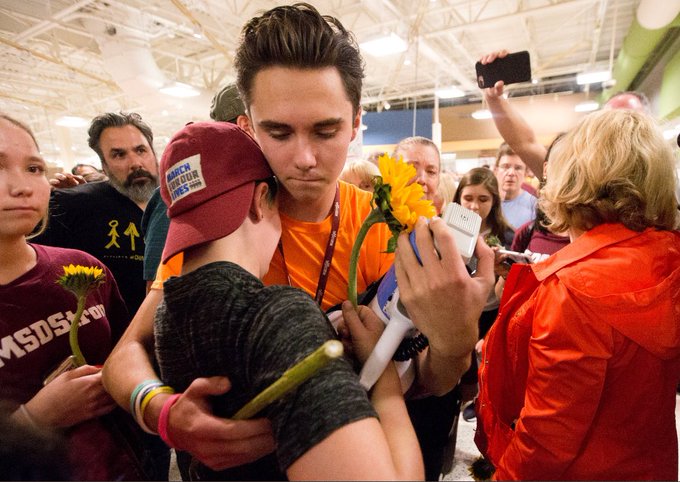
You know what I love? This picture from Hogg’s “die-in”:

“Oh, you’re having a die-in? Well, I’m having a walk-over. It’s a holiday weekend and I’m making fruit salad for the barbecue.”

Not every hero wears a cape.

Publix managed a couple of perverse publicity bookends for the week. They dishonored a kid who quietly achieved highest academic honors, then honored a kid who publicly complained about not being accepted at any of the universities he wanted to go to.

“Florida Man” has now become “Florida Company.”

Categories
All About Guns

A Winchester 1907 Self Loader .351 Win Self Loading caliber rifle

Categories
All About Guns

Colt 1878 Double Action .45 LC caliber revolver in Caliber .45 Long Colt. Barrel length is 7 ½

Categories
Allies War

While you are enjoying the day off!

Categories
All About Guns Related Topics

Faulty, Fabulous, or Fad? An M.D. Argues the 40 S&W by WILL DABBS

From left to right is a Gorilla Ammo .45ACP, a Browning .40S&W, and a Winchester 9mm Parabellum round.

Our patient was a heavily muscled young gladiator of the sort who frequents an urban emergency department. Stabbings and gunshot wounds are lamentable side effects of his day job. When he hobbled into the ER he had a bandana pressed against the lower right side of his abdomen yet seemed pleasant enough.
I forget the sordid details. Turf, drugs, or women accounted for the lion’s share of the chaos, so the impetus this evening was likely some toxic combination. Once we got him into the CT scanner we could see the 9mm round flattened against the back of his pelvis. The bullet had undoubtedly played holy havoc with the intervening entrails so the surgical residents got a laparotomy out of it, but I will never forget how calm he seemed. The round could have ricocheted or passed through some intervening barrier material to bleed a little horsepower, but its terminal effectiveness in this particular instance was decidedly underwhelming.
I have seen men killed with the 9mm round, but that experience with that thug in the ER made an impression. I like to shoot the 9mm because it is lightweight and fun. The round is cheap, produces modest recoil, and remains easy to carry. None of these attributes speaks to the crux of the issue, however, which is speedy incapacitation and expedient behavior modification.

Background

The 9mm Parabellum is the most popular centerfire pistol cartridge in the world. Parabellum means, “If you seek peace, prepare for war.” Georg Luger contrived the round in 1902 to feed his eponymous toggle-locked handgun. 60% of the cops in America carry 9mm handguns, and the FBI relatively recently retired their .40-caliber weapons in favor of guns firing the smaller round. The 9mm is credited with the demise of the combat revolver in America in favor of high-capacity autoloading handguns.
In its military guise, the 9mm cartridge pushes a 124-grain metal-jacketed lead-cored projectile to about 1,150 feet per second. I have an acquaintance who shot a man in Iraq three times in the chest with his M9 Beretta handgun after an unfortunate surprise encounter in an alleyway. He then went on to develop a friendship with the hapless Iraqi after he recovered. When shooting ball ammo the 9mm never seemed to command respect in the ER.

The .45 ACP—Practical Tactical

This poor guy caught a .45ACP round to the head and was rapidly approaching room temperature when we met. The bullet separated from the jacket and went its own way, while the jacket lodged outbound between his skull and his scalp. The jagged scrap of copper measured 11mm on a piece of EKG paper. The job that thing did on that guy’s melon was the stuff of nightmares.
Special Forces Operational Detachment-Delta employs some of the finest shooters on the planet. They called it the Combat Applications Group for a time. I think the Army’s pet name is Army Compartmented Element these days. JSOC calls it Task Force Green. The guys who actually serve there just call it “The Unit.” Delta is the best we can produce, and they are some rarefied warriors indeed. Their very existence is supposed to be a secret, but they have a Wikipedia page.
The Delta guys I bumped into back when I wore the uniform typically carried high-capacity 1911 handguns. Their pistols were built around Para-Ordnance frames and had all the bells and whistles. With 14+1 of .45ACP chaos onboard these were some of the most effective combat handguns in the world. They also must have been boat anchors to hump. I’m told there are more Glocks in those holsters nowadays, but these guys know guns and the .45ACP was their round.
The .45ACP was a John Moses Browning creation in 1905, and it pushed a bullet roughly twice as big as that of the original 9mm Parabellum. However, all that horsepower comes at a cost. The .45ACP is big and chunky to tote and a handful to run for those with modest mitts.

The .40S&W—The Grand Compromise

If there is a message to be found in the ignoble tale that follows it is that the sensible citizen should never try to run over a police officer with an automobile. The cop sidestepped the speeding car and fired a single .40-caliber round through the driver’s side window. The bullet struck the hapless felon in the chest and peeled open the left ventricle of his heart like a can opener. Had it happened in the operating room the guy still wouldn’t have survived. That high-performance police-issue expanding bullet performed exactly as it was intended. It passed through the glass, the dude’s shirt, his skin, and the intervening muscle without checking up before deploying like a miniature buzzsaw to thoroughly rearrange the guy’s chest cavity. It didn’t hurt long.
The .40S&W arose as the indirect result of the FBI’s 1986 Miami shootout. If you aren’t familiar with the details surf on over when you’re done here. Any student of small arms is well served to read up on it. Google is your buddy.
During the Miami shootout, two FBI special agents were killed and five wounded by a pair of bank robbers wielding a variety of weapons. One of the Bad Guys, in particular, took a 9mm round to the chest and went on to foment a great deal of mischief before he succumbed. With this as an impetus, S&W partnered with Winchester to produce the ideal Law Enforcement pistol round.
The resulting .40S&W was, in essence, a shortened 10mm auto cartridge. This rimless straight-walled round was short enough to fit into existing 9mm pistol frames yet pushed a 165-grain bullet to more than 1,100 feet per second. In many cases converting between 9mm and .40S&W was as simple as exchanging the barrel and magazine. The resulting magazine capacity was typically reduced from 2 to 4 rounds, but this interchangeability meant easier maintenance and a convenient transition for officers already familiar with the platform.
.40S&W does inevitably offer greater recoil than the 9mm but remains more pleasant than the .45ACP. There were some teething problems but in general, the .40S&W has lived up to its press releases. Why then might the FBI and 60% of American Law Enforcement agencies be switching back to the 116-year-old 9mm Parabellum when the .40S&W was specifically designed to replace it?

Despite its blocky utilitarian appearance, the Glock 22 is an exceptionally efficient combat implement.

Technology Marches On

The three anecdotes related above represent a comically small sample size. I have seen a guy survive being shot with a .45ACP to the torso and another paralyzed for life with a .25ACP to the neck. Shot placement is everything, and bullet design is indeed a combat multiplier. However, there’s way more to it than that. No handgun round will reliably guarantee one-shot stops.
Most of the thugs I have encountered feed their cheap crappy guns the cheapest ball ammo they can steal. As a result, the downrange effects can indeed be underwhelming. By contrast, trained Law Enforcement Officers running the finest antipersonnel rounds money can buy generally find their tools to be markedly more effective.
In 2014 the FBI produced a report that detailed how improvements in powder efficiency and bullet design had generated 9mm performance that was in some cases superior to comparable .40S&W and .45ACP Law Enforcement loads. Given that 9mm ammo is cheaper and produces less recoil, this equates out to less expensive training and better accuracy, particularly with small-statured officers. As a direct result, Law Enforcement agencies across our great republic seem to be tripping over themselves to trade out their .40S&W handguns for the 9mm sort.
Statistically, trained Law Enforcement Officers shooting under the stress of a life or death situation connect with their targets with one round in five. As a result, a softer-shooting handgun that yields better follow up accuracy can itself render a combat advantage so long as penetration is adequate. However, that takes us full circle to Miami, wherein a determined assailant hit in the chest with a bullet that rendered adequate penetration went on to kill two federal agents before he expired. What conclusions should we mere civilians draw from all this?

The Real Skinny

Whenever I am not asleep or in the shower I am invariably armed, but I’m not a cop. I carry my handguns concealed or in a vehicle and don’t expect to engage an armed assailant as part of my day job. However, I have a difficult time getting past the image of that guy standing in the exam room with the bandana on his groin.
The 2014 FBI report is itself fascinating reading, and it makes some great points. However, I’m personally not quite ready to cash in my .40’s for something smaller. I have carried most everything at one point or another, and I do prefer toting a compact 9mm as I wander through my daily sojourn. However, when I travel or am someplace static the game changes. If I have two otherwise identical handguns sitting on the table, one in 9mm and the other in .40S&W, it’s most typically the .40 that ends up in the center console of the truck.

A Few Options

Most popular modern combat handguns sport polymer frames and striker-fired triggers. The Glock 22 is the industry standard. The Glock 22 packs 15 rounds in its magazine and sports the raked grip-to-frame angle and low bore axis for which Glock has become justifiably famous. The sole external safety is a blade in the trigger, and the gun is arguably the most reliable autoloading handgun ever made.

The Glock 22 is the most popular .40-caliber pistol in Law Enforcement. Sporting legendary reliability and simple operation, the Glock and its Safe Action trigger precipitated the polymer pistol revolution.

 
The Smith and Wesson M&P offers an oblique grip-to-frame angle more akin to that of the 1911 and a pivoting safety as part of the trigger body. The M&P has interchangeable palm swells and a 15-round magazine. The M&P comes standard with steel sights and is a dream on the range.

The Smith and Wesson M&P .40 is a rugged and effective design. Sporting interchangeable palm swells and a bilateral slide release, the M&P .40 is an Amer-ican-made warhorse.

The Steyr L40A1 is the “Other Austrian Combat Pistol.” Featuring the same raked grip-to-frame angle and low bore axis as the Glock, the L40A1 has an extended slide and barrel for enhanced accuracy. Magazine capacity is limited to 12 rounds, but the gun looks like it fell off the set of a science fiction movie.

The Steyr L40A1 is the longest of their three .40-caliber combat handguns. The rakish design offers an exceptionally low bore axis and a fresh slick geometry.

The HK VP40 offers the most customizable grip of any combat pistol in the world with three interchangeable backstraps and six side panels of various thicknesses. The slide also includes polymer ears the company calls “charging supports” to enhance your grip when sweaty or rushed. There is the obligatory trigger safety, and the gun is available in black or FDE. The VP40 carries 13 rounds in its magazine. The VP40 is the most expensive gun of the four profiled, but it also sports a legendarily smooth crisp trigger.

The HK VP40 features the most customizable grip in the industry. Grip panels are interchangeable between 9mm and .40-caliber versions, so I just mixed and matched.

Ruminations

All things being equal I shoot a bit better with a .40S&W than I do a .45ACP. I also shoot a little bit better with a 9mm than a .40S&W. However, taken to an illogical extreme, I shoot even better than that with a decent .22LR. Life is all about compromises, and the .40S&W was designed from the outset to balance power and portability. As a result, I think until I can lay my hands on a phased plasma rifle in the 40-watt range I’ll hang onto my full-sized .40-caliber handguns. They all punch deep, but the .40 seems intuitively destined to make bigger holes.

The polymer-framed .40-caliber pistol still offers more power than the 9mm and less recoil than a .45ACP all in an envelope comparable to the weaker gun.

Technical Specifications

                             Glock 22     S&W M&P          Steyr L40A1         HK VP40
Caliber                  .40S&W     .40S&W               .40S&W               .40S&W
Barrel Length        4.49in       4.25in                   4.5in                     4.09in
Overall Length      8.03in       7.6in                     7.4in                     7.34in
Weight                  25.59oz       27.9oz                  28.8oz                 28.93oz
Mag Capacity        15               15                         12                         13
MSRP                  NP              $569                     $575                     $719

All of these guns are fast. Magazines drop away freely, and these tapered magazines find the magwell easily.

 
About the Author – Will was born and raised in the Mississippi Delta, having been immersed in hunting and the outdoors since his earliest recollections. He holds a degree in Mechanical Engineering from the University of Mississippi and is the product of a traditional American nuclear family. Where most normal American kids get drunk to celebrate their 21st birthday, Will bought his first two machineguns.
Will served eight years as an Army Aviator and accumulated more than 1,100 flight hours piloting CH47D, UH1H, OH58A/C, and AH1S helicopters. He is scuba qualified, has parachuted out of perfectly good airplanes at 3 o’clock in the morning, and has summited Mt. McKinley, Alaska–the highest point in North America–six times (at the controls of a helicopter, which is the only way sensible folk climb mountains). For reasons that seemed sagacious at the time he ultimately left the Army as a Major to pursue medical school.
Dr. Dabbs has for the last dozen years owned the Urgent Care Clinic of Ox-ford, Mississippi. He also serves as the plant physician for the sprawling Winchester ammunition plant in that same delightful little Southern town. Will is a founding partner of Advanced Tactical Ordnance LLC, a licensed 07/02 firearms manufacturer and has written for the gun press for a quarter century. He writes solely to support a shooting habit that is as insensate as it is insatiable. Will has been married to his high school sweetheart for more than thirty years. He and his wife currently have three adult children and a most thoroughly worthless farm dog named Dog.

Categories
Well I thought it was funny!

I am sure that this will cause trouble for me