

“We are fast approaching the stage of the ultimate inversion: the stage where the government is free to do anything it pleases, while the citizens may act only by permission; which is the stage of the darkest periods of human history, the stage of rule by brute force.” — Ayn Rand
Rule by brute force.
That’s about as good a description as you’ll find for the sorry state of our nation.
SWAT teams crashing through doors. Militarized police shooting unarmed citizens. Traffic cops tasering old men and pregnant women for not complying fast enough with an order. Resource officers shackling children for acting like children. Homeowners finding their homes under siege by police out to confiscate lawfully-owned guns. Drivers having their cash seized under the pretext that they might have done something wrong.
The list of abuses being perpetrated against the American people by their government is growing rapidly.
We are approaching critical mass.
The groundwork has been laid for a new kind of government where it won’t matter if you’re innocent or guilty, whether you’re a threat to the nation, or even if you’re a citizen. What will matter is what the government—or whoever happens to be calling the shots at the time—thinks. And if the powers-that-be think you’re a threat to the nation and should be locked up, then you’ll be locked up with no access to the protections our Constitution provides.
In effect, you will disappear.
Our freedoms are already being made to disappear.
We have seen this come to pass under past presidents with their use of executive orders, decrees, memorandums, proclamations, national security directives and legislative signing statements.
President Biden’s long list of executive orders, executive actions, proclamations and directives is just more of the same: rule by fiat.
Now the Biden Administration is setting its sights on gun control.
Mark my words: gun control legislation, especially in the form of red flag gun laws, which allow the police to remove guns from people “suspected” of being threats, will become yet another means by which to subvert the Constitution and sabotage the rights of the people.
These laws, growing in popularity as a legislative means by which to seize guns from individuals viewed as a danger to themselves or others, are yet another Trojan Horse, a stealth maneuver by the police state to gain greater power over an unsuspecting and largely gullible populace.
Nineteen states and Washington DC have red flag laws on their books.
That number is growing.
As The Washington Post reports, these laws “allow a family member, roommate, beau, law enforcement officer or any type of medical professional to file a petition [with a court] asking that a person’s home be temporarily cleared of firearms. It doesn’t require a mental-health diagnosis or an arrest.”
In the midst of what feels like an epidemic of mass shootings (the statistics suggest otherwise), these gun confiscation laws—extreme risk protection order (ERPO) laws—may appease the fears of those who believe that fewer guns in the hands of the general populace will make our society safer.
Of course, it doesn’t always work that way.
Anything—knives, vehicles, planes, pressure cookers—can become a weapon when wielded with deadly intentions.
With these red flag gun laws, the stated intention is to disarm individuals who are potential threats… to “stop dangerous people before they act.”
While in theory it appears perfectly reasonable to want to disarm individuals who are clearly suicidal and/or pose an “immediate danger” to themselves or others, where the problem arises is when you put the power to determine who is a potential danger in the hands of government agencies, the courts and the police.
We’ve been down this road before.
Remember, this is the same government that uses the words “anti-government,” “extremist” and “terrorist” interchangeably.
This is the same government whose agents are spinning a sticky spider-web of threat assessments, behavioral sensing warnings, flagged “words,” and “suspicious” activity reports using automated eyes and ears, social media, behavior sensing software, and citizen spies to identify potential threats.
This is the same government that keeps re-upping the National Defense Authorization Act (NDAA), which allows the military to detain American citizens with no access to friends, family or the courts if the government believes them to be a threat.
This is the same government that has a growing list—shared with fusion centers and law enforcement agencies—of ideologies, behaviors, affiliations and other characteristics that could flag someone as suspicious and result in their being labeled potential enemies of the state.
For instance, if you believe in and exercise your rights under the Constitution (namely, your right to speak freely, worship freely, associate with like-minded individuals who share your political views, criticize the government, own a weapon, demand a warrant before being questioned or searched, or any other activity viewed as potentially anti-government, racist, bigoted, anarchic or sovereign), you could be at the top of the government’s terrorism watch list.
Moreover, as a New York Times editorial warns, you may be an anti-government extremist (a.k.a. domestic terrorist) in the eyes of the police if you are afraid that the government is plotting to confiscate your firearms, if you believe the economy is about to collapse and the government will soon declare martial law, or if you display an unusual number of political and/or ideological bumper stickers on your car.
Let that sink in a moment.
Now consider the ramifications of giving police that kind of authority: to preemptively raid homes in order to neutralize a potential threat.
It’s a powder keg waiting for a lit match.
Under these red flag laws, what happened to Duncan Lemp—who was gunned down in his bedroom during an early morning, no-knock SWAT team raid on his family’s home—could very well happen to more people.
At 4:30 a.m. on March 12, 2020, in the midst of a COVID-19 pandemic that had most of the country under a partial lockdown and sheltering at home, a masked SWAT team—deployed to execute a “high risk” search warrant for unauthorized firearms—stormed the suburban house where 21-year-old Duncan, a software engineer and Second Amendment advocate, lived with his parents and 19-year-old brother.
The entire household, including Lemp and his girlfriend, was reportedly asleep when the SWAT team directed flash bang grenades and gunfire through Lemp’s bedroom window.
Lemp was killed and his girlfriend injured.
No one in the house that morning, including Lemp, had a criminal record.
No one in the house that morning, including Lemp, was considered an “imminent threat” to law enforcement or the public, at least not according to the search warrant.
So what was so urgent that militarized police felt compelled to employ battlefield tactics in the pre-dawn hours of a day when most people are asleep in bed, not to mention stuck at home as part of a nationwide lockdown?
According to police, they were tipped off that Lemp was in possession of “firearms.”
Thus, rather than approaching the house by the front door at a reasonable hour in order to investigate this complaint—which is what the Fourth Amendment requires—police instead strapped on their guns, loaded up their flash bang grenades and acted like battle-crazed warriors.
This is the blowback from all that military weaponry flowing to domestic police departments.
This is what happens when you use SWAT teams to carry out routine search warrants.
This is what happens when you adopt red flag gun laws, which Maryland did in 2018, painting anyone who might be in possession of a gun—legal or otherwise—as a threat that must be neutralized.
Therein lies the danger of these red flag laws, specifically, and pre-crime laws such as these generally where the burden of proof is reversed and you are guilty before you are given any chance to prove you are innocent.
Red flag gun laws merely push us that much closer towards a suspect society where everyone is potentially guilty of some crime or another and must be preemptively rendered harmless.
Where many Americans go wrong is in naively assuming that you have to be doing something illegal or harmful in order to be flagged and targeted for some form of intervention or detention.
In fact, U.S. police agencies have been working to identify and manage potential extremist “threats,” violent or otherwise, before they can become actual threats for some time now.
All you need to do these days to end up on a government watch list or be subjected to heightened scrutiny is use certain trigger words (like cloud, pork and pirates), surf the internet, communicate using a cell phone, limp or stutter, drive a car, stay at a hotel, attend a political rally, express yourself on social media, appear mentally ill, serve in the military, disagree with a law enforcement official, call in sick to work, purchase materials at a hardware store, take flying or boating lessons, appear suspicious, appear confused or nervous, fidget or whistle or smell bad, be seen in public waving a toy gun or anything remotely resembling a gun (such as a water nozzle or a remote control or a walking cane), stare at a police officer, question government authority, appear to be pro-gun or pro-freedom, or generally live in the United States.
Be warned: once you get on such a government watch list—whether it’s a terrorist watch list, a mental health watch list, a dissident watch list, or a red flag gun watch list—there’s no clear-cut way to get off, whether or not you should actually be on there.
You will be tracked wherever you go.
You will be flagged as a potential threat and dealt with accordingly.
This is pre-crime on an ideological scale and it’s been a long time coming.
The government has been building its pre-crime, surveillance network in concert with fusion centers (of which there are 78 nationwide, with partners in the private sector and globally), data collection agencies, behavioral scientists, corporations, social media, and community organizers and by relying on cutting-edge technology for surveillance, facial recognition, predictive policing, biometrics, and behavioral epigenetics (in which life experiences alter one’s genetic makeup).
To that noxious mix, add in a proposal introduced under the Trump Administration and being considered by Biden for a new government agency HARPA (a healthcare counterpart to the Pentagon’s research and development arm DARPA) that will take the lead in identifying and targeting “signs” of mental illness or violent inclinations among the populace by using artificial intelligence to collect data from Apple Watches, Fitbits, Amazon Echo and Google Home.
It’s the American police state’s take on the dystopian terrors foreshadowed by George Orwell, Aldous Huxley and Phillip K. Dick all rolled up into one oppressive pre-crime and pre-thought crime package.
If you’re not scared yet, you should be.
Connect the dots.
Start with the powers amassed by the government under the USA Patriot Act, note the government’s ever-broadening definition of what it considers to be an “extremist,” then add in the government’s detention powers under NDAA, the National Security Agency’s far-reaching surveillance networks, and fusion centers that collect and share surveillance data between local, state and federal police agencies.
To that, add tens of thousands of armed, surveillance drones that will soon blanket American skies, facial recognition technology that will identify and track you wherever you go and whatever you do. And then to complete the picture, toss in the real-time crime centers being deployed in cities across the country, which will be attempting to “predict” crimes and identify criminals before they happen based on widespread surveillance, complex mathematical algorithms and prognostication programs.
Hopefully you’re starting to understand how easy we’ve made it for the government to identify, label, target, defuse and detain anyone it views as a potential threat for a variety of reasons that run the gamut from mental illness to having a military background to challenging its authority to just being on the government’s list of persona non grata. Finally, add in the local police agencies and SWAT teams that are being “gifted” military-grade weaponry and equipment designed for the battlefield and trained in the tactics of war.
It all adds up to a terrifying package of brute force coupled with invasive technology and totalitarian tactics.
This brings me back to those red flag gun laws.
In the short term, these gun confiscation laws may serve to temporarily delay or discourage those wishing to inflict violence on others, but it will not resolve whatever madness or hate or instability therein that causes someone to pull a trigger or launch a bomb or unleash violence on another.
Indeed, those same individuals sick enough to walk into an elementary school or a movie theater and open fire using a gun can and do wreak just as much havoc with homemade bombs made out of pressure cookers and a handful of knives.
Nor will these laws save us from government-instigated and directed violence at the hands of the militarized police state or the blowback from the war-drenched, violence-imbued, profit-driven military industrial complex, both of which remain largely overlooked and underestimated pieces of the discussion on gun violence in America.
As I make clear in my book Battlefield America: The War on the American People, in the long term, all these gun confiscation laws will do is ensure that when the police state finally cracks down, “we the people” are defenseless in the face of the government’s arsenal of weapons.
No matter how well-meaning the politicians make these encroachments on our rights appear, in the right (or wrong) hands, benevolent plans can easily be put to malevolent purposes. In this way, even the most well-intentioned government law or program can be—and has been—perverted, corrupted and used to advance illegitimate purposes once profit and power are added to the equation.
The war on terror, the war on drugs, the war on illegal immigration, asset forfeiture schemes, road safety schemes, school safety schemes, eminent domain: all of these programs started out as legitimate responses to pressing concerns and have since become weapons of compliance and control in the police state’s hands.
Red flag laws and gun control legislation are no less a threat to our freedoms.
WC: 2365
Constitutional attorney and author John W. Whitehead is founder and president The Rutherford Institute. His books Battlefield America: The War on the American People and A Government of Wolves: The Emerging American Police State are available at www.amazon.com. He can be contacted at johnw@rutherford.org. Nisha Whitehead is the Executive Director of The Rutherford Institute. Information about The Rutherford Institute is available at www.rutherford.org.

Citing recent mass shootings in Orange, Boulder, Colo., and the Atlanta area, state lawmakers on Tuesday advanced a proposal for a new tax on the sale of guns and ammunition in California to boost funding for violence prevention programs.
The legislation by Assemblyman Marc Levine (D-San Rafael) would place a $25 excise tax on retailers for the sale of each new gun and an as-yet-undetermined levy on ammo sales to raise millions of dollars to fund the efforts.
“Gun violence will not end on its own,” Levine told the Assembly Public Safety Committee during a hearing Tuesday. “We must take responsible action to end the public health crisis that is gun violence in our state, in our nation.”
The panel voted 5 to 2 along party lines to approve the legislation, which still needs approval from the full Assembly.

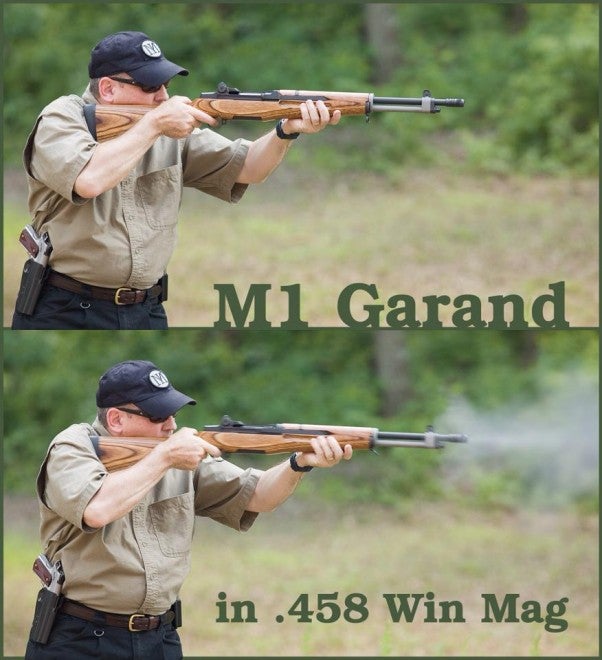
Well I thought this was really cool. Seeing that you get to see and hear stuff on this film that the “Professionals” so often leave out. So I hope that you enjoy this! Grumpy


One of TFB’s resident Jarheads, Nathan now works within the firearms industry. A consecutive Marine rifle and pistol expert, he enjoys local 3-gun, NFA, gunsmithing, MSR’s, & high-speed gear. Nathan has traveled to over 30 countries working with US DoD & foreign MoDs.
The above post is my opinion and does not reflect the views of any company or organization.

I bet that this puppy really snaps and lights up the area when you fire off some heavy handloads with it. But I sure would not try it! Grumpy