In the beginning, man had a rock, and man was hungry. Then a club came along, and that helped. And then spears, atlatls, bows and arrows, and, finally, gunpowder. For the most part, man is no longer hungry.
For millennia hunters have been striving to increase their reach, to find a better tool for bringing home the bacon. I grew up hunting the Rockies with a handmade flintlock muzzleloader and traditional archery gear, and believe me, I understand the necessity of getting close.
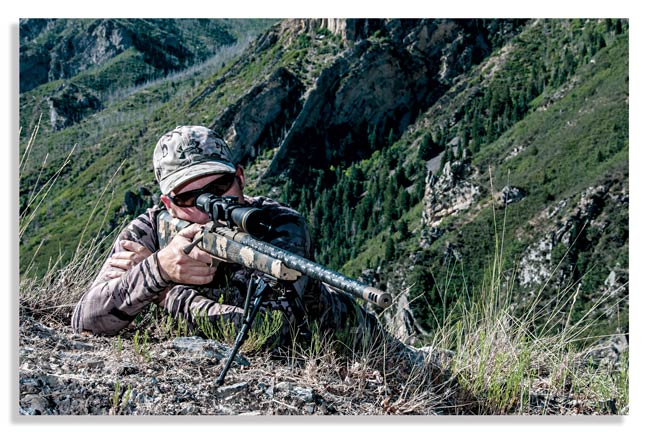
But when it comes time to find winter meat to feed the family, I reach for a powerful and accurate rifle that gives me as much reach as possible because in the West you often get only one opportunity. And if driven to choose between the ethics of letting my kids go without elk meat for a winter or taking a long shot, I’ll take the long shot.
The Hunting Bullet Challenge
Killing humanely at long range (I’ll leave “ethically” out of this) requires specialized rifles, optics, and, especially, bullets.
Early jacketed bullets had soft lead cores and thin jackets, and when big cartridges began hammering them into heavy-boned elk and moose at magnum velocities, they often failed spectacularly.
Most commonly, they would fragment into nothing and neglect to inform the big critter’s vital organs that it was quitting time. Along came John Nosler and a very big, very alive Alaskan moose that wanted to stay that way. After an unsatisfying encounter, Mr. Nosler came away thoroughly disenchanted with conventional bullets.
This happened in 1946, and shortly thereafter John became a bulletmaker and introduced the Partition, a now-legendary controlled-expansion bullet that created the benchmark by which game bullets are measured and which inspired bullet development among competitors. Hunters benefitted greatly. Deer, elk, and moose not so much.
With the advent of laser rangefinders that reliably read past 400 yards, a new world opened up to hunters—along with a whole slew of complex bullet performance issues. While a good rifleman with an accurate rifle could laser the distance, dial the scope, and hit the target with admirable consistency, the bullets he had at his disposal were fickle on impact.
As it turned out, few hunting bullets were very streamlined. Courtesy of air friction, they ran out of steam quickly, a very bad thing when maintaining velocity in order to buck the wind effectively and hitting big game hard is desirable. Worse yet, at long range conventional hunting bullets often had lost so much velocity that they didn’t expand on impact.
Even when put squarely through the lungs, it takes a big bull elk a while to notice a bullet hole the size of a knitting needle.
Match projectiles designed for long-range competition were much more aerodynamic, bucking the wind admirably and maintaining velocity, so they hit authoritatively way out there. On small-bodied game such as Coues deer and on bigger stuff at quite-far distances, match bullets performed well for far-sighted hunters. But the gods of hunting rained hell, misery, and body parts on hapless hunters that shot nearby game with such projectiles.
At up-close velocities, those thin-jacketed match bullets tended to grenade like a varmint bullet and often failed to penetrate through shoulder muscle and bone. And so the search for the ultimate long-range hunting bullet was on.
Desirable characteristics were:
- �Superb aerodynamics, which in bullet form are measured in ballistic coefficient (BC).
- Match bullet-like accuracy: to hit deer-size vitals at extreme ranges, extreme precision is imperative.
- Reliable expansion at low impact velocities.
- �Adequate weight retention/bullet integrity during close, high-velocity impact to ensure penetration to the vitals.
Combining all four of these desirable elements is beyond difficult, specifically because easy expansion (No. 3) and toughness (No. 4) are opposites. “Soft” bullets that expand easily at low velocity require thin jackets that don’t inhibit mushrooming.
Tough bullets need thick jackets to prevent core annihilation during close, fast impacts. Bonding helps bullets hold together, but is very difficult to do consistently enough to maintain precise accuracy. Accurate bullets almost demand thin jackets that can be built with extreme consistency and that take rifling easily.
It’s a daunting set of demands to place on one bullet.
Before moving on, let’s take a more in-depth look at each of these four desirable characteristics.
Ballistic Coefficient
In simple terms, BC is the measure of a bullet’s aerodynamics and predicts how well it overcomes the air friction it encounters during flight. Commonly displayed in terms of a decimal number, BC predicts how a given projectile will perform compared to a theoretical “standard” projectile.
“With the advent of laser rangefinders that reliably read past 400 yards, a new world opened up to hunters—along with a whole slew of complex bullet performance issues. While a good rifleman with an accurate rifle could laser the distance, dial the scope, and hit the target with admirable consistency, the bullets he had at his disposal were fickle on impact.”
What you really need to know is that most common hunting bullets have a BC of between .320 and .450. Good long-range bullets have much higher BCs, ranging from .550 up to .700 (which is obscenely good).
This is for the most common “G1” model. There’s another standard—the “G7” model—that is gaining in popularity, but that’s another topic.
Why is a high BC so important? The answer is threefold. A bullet that slips through the air easily will maintain velocity better and higher downrange velocity means more energy on impact. Less flight time to the target means the wind has less time to push the bullet off course. And of critical importance: Less lost velocity typically means better bullet performance on impact.
Match-Bullet Accuracy
If you’re going to poke at big game out past 400 yards, you need a bullet that will shoot sub-MOA (basically an inch or less at 100 yards) and preferably ½ MOA. When adrenaline, field positions, wind, and limited time elements are thrown in, you need forgiveness, and there’s no better way to get it than to shoot a superbly accurate bullet in your precision rifle.
Unfortunately, hunting bullet jackets must have thick bases, or they fragment violently and rapidly. The thicker the jacket, the harder it is to produce consistently. Accuracy suffers. Modern manufacturing techniques are slowly refining thick-jacket methods that provide sufficient accuracy, but it’s a time-consuming, attention-demanding process.
Reliable Low-Velocity Expansion/Adequate Weight Retention
Hunting bullets are designed to expand on impact yet hold at least partially together within an engineered velocity window. The expansion is critical for tissue damage, the weight retention for penetration.
If a bullet impacts going faster than designed, complete fragmentation usually results. If slower, little or no expansion occurs at all. Both results are unacceptable.
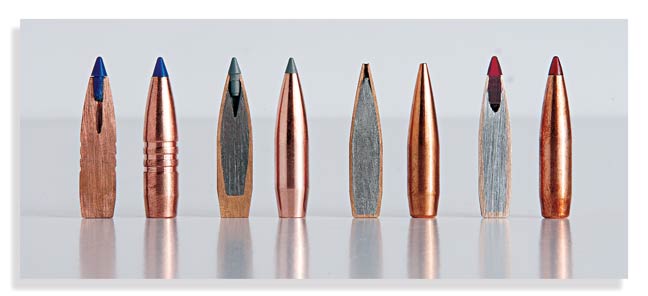
Purpose-built long-range bullets, from left: Barnes LRX, Nosler AccuBond Long Range, Berger VLD Hunting, Hornady ELD-X.
Maximizing that velocity window—for instance, from a performance parameter of 2,000 fps to 2,800 fps to a parameter of 1,600 fps to 3,000 fps—is extremely difficult, yet of critical importance. It’s the Golden Fleece of long-range hunting bullet engineers.
Various bullet manufacturers have attempted to solve this dilemma in several ways, almost all of which are compromises. Barnes’s LRX, Nosler’s AccuBond Long Range, Berger’s VLD Hunting, and Hornady’s new ELD-X are all worth careful study, but again, that’s a topic for another time.
400 Yards: The Inside/Outside Equation
Now, it’s important to note that inside 400 yards, most conventional, standard-construction, medium-BC hunting bullets work fine. Past that, do your time studying and choose the right bullet for the game you plan to hunt and, most importantly, practice in field conditions until you know without a doubt just how far you can reliably put that bullet into the vitals.