Categories


| January 11, 2016
“It is hard to over-value the powers of the clever tracker. To him the trail of each animal is not a mere series of similar footprints; it is an accurate account of the creature’s life, habit, changing whims, and emotions during the portion of life whose record is in view.” –Ernest Thompson Seton, Boy Scout Handbook, 1911
The other day while hiking some muddy trails with my family, my son pointed to a set of tracks and asked me what animal had made them. “That’s easy,” I said, “those are the tracks of a whitetail deer.” “What about those?” he asked, pointing to another set of footprints. “Those are, um, hmmm, well, I’m not sure what they are,” I confessed. I realized I needed to brush up on my knowledge of animal tracks.
Learning how to track and identify the footprints of animals is an ancient and largely forgotten art — one that’s not only important for hunters, but also enhances any outdoorsman’s experience in the wild. It’s fascinating to know what creatures are sharing the woods with you, and trying to track them down by following their trail is a lot of fun. Learning how to read tracks allows you to pick up on the little dramas enacted by wildlife that usually go unnoticed by the human eye. It’s thus a skill that both deepens your understanding of nature and heightens your all-important powers of observation.
Becoming an expert tracker takes years of practice. To get you started, today we offer a primer on the basics of identifying the footprints of common animals. We’ve taken as our guides two master woodsmen of yore — Ernest Thompson Seton, one of the founders of the Boy Scouts, and Charles “Ohiyesa” Eastman, who was raised as a Sioux tribesman — as well as drawn on tips from Tom Brown Jr., one of the foremost modern trackers.
Let’s head into the woods and see what we can discover!
“Never lose the chance of the first snow if you wish to become a trailer.” –Ernest Thompson Seton
Winter is primetime for animal tracking, as the prints are easy to find in the snow and can be followed for a long distance. However, as Seton explains:
“the first morning after a night’s snow fall is not so good as the second. Most creatures ‘lie up’ during the storm; the snow hides the tracks of those that do go forth; and some actually go into a ‘cold sleep’ for a day or two after a heavy downfall. But a calm, mild night following a storm is sure to offer abundant and ideal opportunity for beginning the study of the trail.”
The drawback of snow tracking is that in deep, soft snow you may find only the holes made by the animal’s feet and legs. Further accumulation and melting can also easily obscure the trail. And of course, some animals don’t come out at all during the winter because they are hibernating.
For these reasons, mud and fine, wet sand can be an even better medium, as they hold the shape of the footprint well. A mudbank stream is one of the best places to look for tracks, as it’s frequented by shore birds and waterfowl as well as animals like the raccoon and muskrat looking for food. After a rain, sand bars, ditches, and muddy gullies are also fruitful places to find the tracks of deer, possums, and other creatures. Looking over a dewy, open field in the morning can reveal the tracks creatures made in the night as well.
Whether in snow or dirt, a track is best and easiest to follow when it is freshest — before wind, rain, melting (in the case of snow), and debris have obscured the prints.
While it’s surely fun to track animals through the wilderness, it’s also enjoyable to try to find their footprints in your very own backyard (and around the trashcan!). So always be aware of your surroundings wherever you go, and you never know what you’ll see.
In learning which tracks belong to which animals, it can help to know the basic classifications of common animal families. Simply by counting the number of toes in a footprint, you can figure out which family the creature belongs to, and from there work on narrowing down which species you’re looking at.
In this narrowing down process, it’s useful to know which animals are common to your area. As Seton explains, “In studying trails one must always keep probabilities in mind”:
“Sometimes one kind of track looks much like another; then the question is, ‘Which is the likeliest in this place.’
If I saw a jaguar track in India, I should know it was made by a leopard. If I found a leopard in Colorado, I should be sure I had found the mark of a cougar or mountain lion. A wolf track on Broadway would doubtless be the doing of a very large dog, and a St. Bernard’s footmark in the Rockies, twenty miles from anywhere, would most likely turn out to be the happen-so imprint of a gray wolf’s foot. To be sure of the marks, then, one should know all the animals that belong to the neighborhood.”
Below you’ll find illustrations of the footprints of the track classifications for the most common families of animals; they break down not only what the tracks look like when the animal is walking (which is its typical gait), but also hopping/running (which it may do when chased by a predator, or doing some chasing of its own).
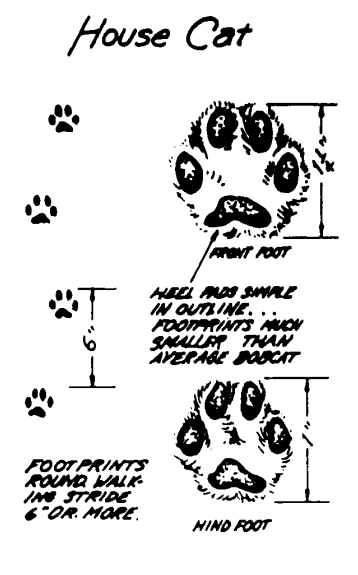
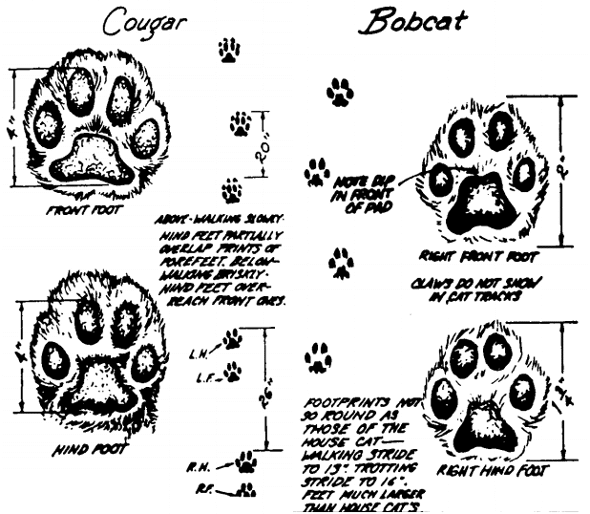
Cats leave rounded prints that show four soft, pliable, spread toes. The prints lack claws, since they’re retractable. A cat also walks in what’s called a “single register” — its hind legs exactly track its front legs, so that it appears to only be walking with two legs, rather than four. This aids in quiet, stealthy stalking.
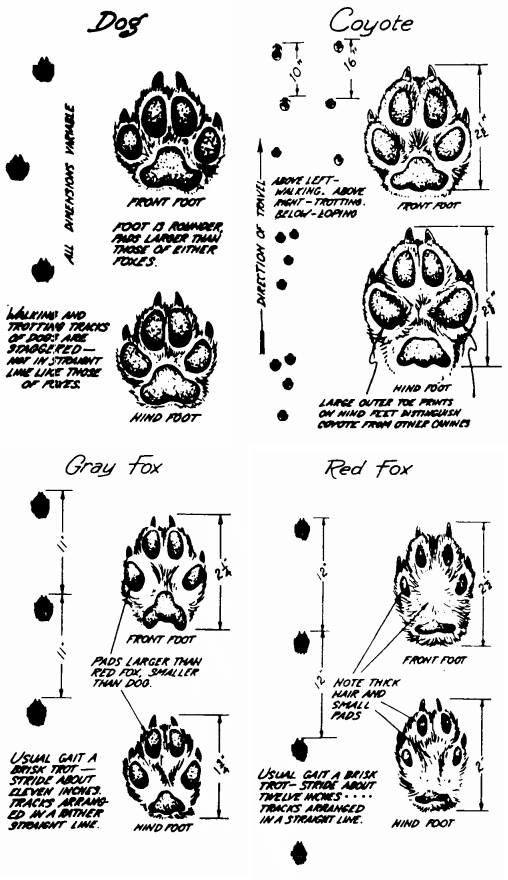
Canines have four toes like cats, but their feet are harder and their claws can be seen as they don’t retract. While the fox walks in a single register, dogs and coyotes walk in an indirect register — their hind legs land a little behind and to the side of the front print, leaving a messier track than that of a cat.
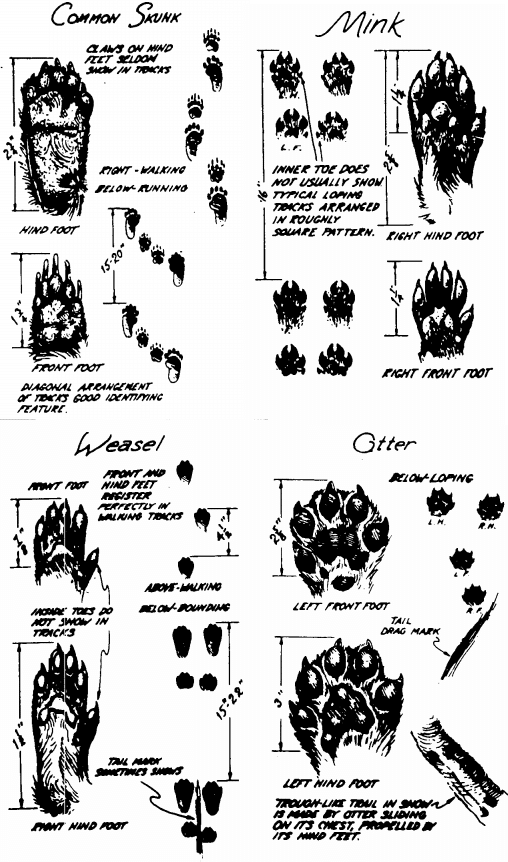
Members of the weasel family have five toes on both their front and hind feet, though all five don’t always show in the track.
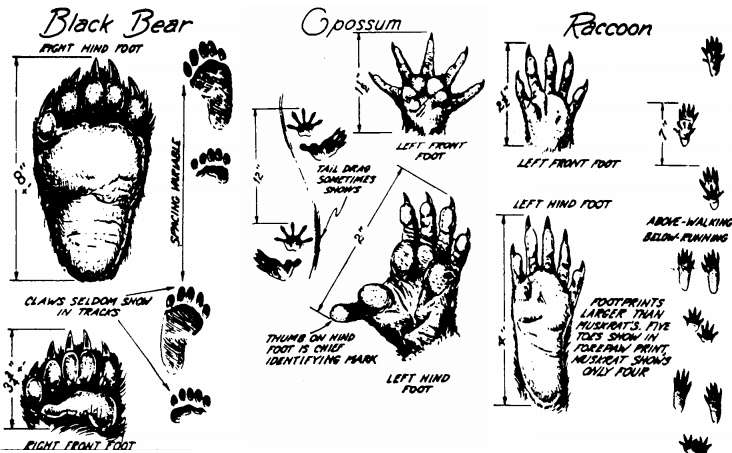
While bears, possums, and beavers don’t belong to the weasel family, their tracks are similar in that they also have five toes in both back and front. However, they differ in the flat, human-like nature of their feet.
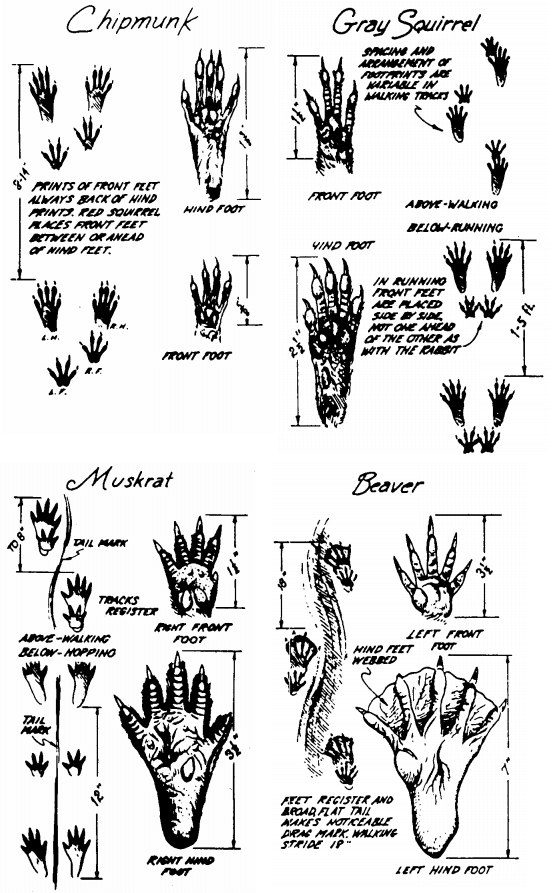
Rodents have four toes on their front feet, and five toes on their hind feet.
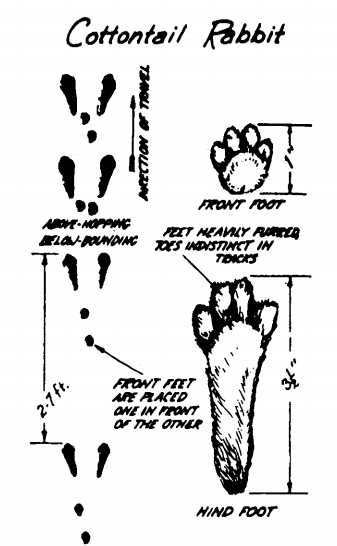
Rabbits have four toes on both their front and rear feet, and in almost all species the back feet leave tracks that are at least twice the size of the front.
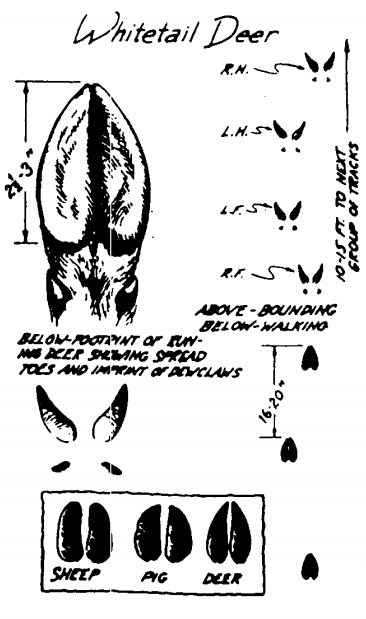
The tracks of hoofed animals are easy to recognize, and deer tracks are some of the most common to find in the woods. You can distinguish a doe from a buck, in that the female has sharper hoofs and a narrower foot than the male.
“I will now ask you to enter the forest with me. First, scan the horizon and look deep into the blue vault above you, to adjust your nerves and the muscles of your eye, just as you do other muscles by stretching them. There is still another point. You have spread a blank upon the retina, and you have cleared the decks of your mind, your soul, for action.
It is a crisp winter morning, and upon the glistening fresh snow we see everywhere the story of the early hours — now clear and plain, now tangled and illegible — where every traveler has left his mark upon the clean, white surface for you to decipher.
The first question is: Who is he? The second: Where is he now? Around these two points you must proceed to construct your story.” –Charles Eastman (Ohiyesa), Indian Scout Talks, 1915
Now that you know what the tracks look like, how do you follow the trail once you’ve identified it?
When following an animal’s footprints, try to track towards the sun if possible, as the shadows will make the impressions stand out more. The sun’s position in the sky during the early morning and late afternoon will particularly enhance the tracks.
As you follow an animal’s tracks, don’t just focus on the discrete sets of prints themselves, but continually take in the trail as a whole — which may in fact be easier than finding individual footprints. For example, by looking ahead, instead of having your nose to the ground, you may see a trail of bent grass through a field. Also look for other disturbances like cracked twigs, or pebbles and leaves that have been overturned to reveal their darker, wetter undersides. If you lose the trail, place a stick by the last set of prints you discovered and then walk around it in an ever widening spiral until you pick up the trail again.
Eastman lays out other considerations for your hunt:
“It is essential to estimate as closely as you can how much of a journey you will undertake if you determine to follow a particular trail. Many factors enter into this. When you come upon the trail, you must if possible ascertain when it was made. Examine the outline; if that is undisturbed, and the loose snow left on the surface has not yet settled, the track is very fresh, as even an inexperienced eye can tell…It will also be necessary to consider the time of year. It is of no use to follow a buck when he starts out on his travels in the autumn, and with the moose or elk it is the same.”
Animal tracks are the alphabet of the wild — an education in their language can help you read more of the nature all around you. As Seton concludes, knowing this language opens books of the woods and its inhabitants that would otherwise be closed to you:
“There is yet another feature of trail study that gives it exceptional value — it is an account of the creature pursuing its ordinary life. If you succeeded in getting a glimpse of a fox or a hare in the woods, the chances are a hundred to one that it was aware of your presence first. They are much cleverer than we are at this sort of thing, and if they do not actually sight or sense us, they observe, and are warned by the action of some other creature that did sense us, and so cease their occupations to steal away or hide. But the snow story will tell of the life that the animal ordinarily leads — its method of searching for food, its kind of food, the help it gets from its friends, or sometimes from its rivals — and thus offers an insight into its home ways that is scarcely to be attained in any other way.
The trailer has the key to a new storehouse of nature’s secrets, another of the Sybilline books is opened to his view; his fairy godmother has indeed conferred on him a wonderful gift in opening his eyes to the foot-writing of the trail. It is like giving sight to the blind man, like the rolling away of fogs from a mountain view, and the trailer comes closer than others to the heart of the woods.
Dowered with a precious power is he,
He drinks where others sipped,
And wild things write their lives for him
In endless manuscript.”


|
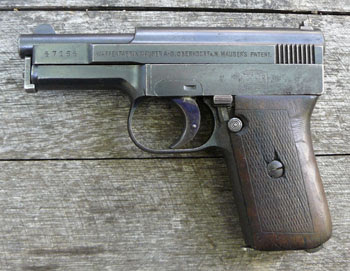
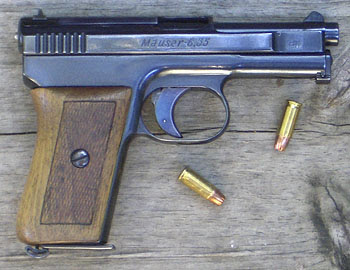
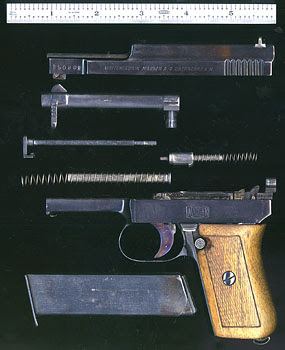
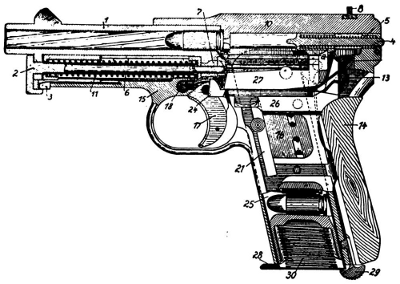
Mauser Pocket Pistols – an Introduction (Revised 14 Feb 2005) |
|
|
|||||||||||||||||||||||||||||||||||||||||||||||||||||||||||||||||||||||||
 |
|
|
||||||||||||||
|
MAUSER POCKET PISTOL TECHNICAL SPECIFICATIONS
MAUSER INFORMATION\REFERENCE MATERIALS AND PARTS BULLETIN BOARDS – INFORMATION EXCHANGE:
MAUSER BOOKS:
|
I could not imagine staying on a horse during a charge.

Bavarian military Pickelhaube

Prussian police leather Pickelhaube
The Pickelhaube (plural Pickelhauben; from the German Pickel, “point” or “pickaxe”, and Haube, “bonnet”, a general word for “headgear”), also Pickelhelm, was a spiked helmet worn in the nineteenth and twentieth centuries by German military, firefighters, and police.
Although typically associated with the Prussian army who adopted it in 1842-43,[1] the helmet was widely imitated by other armies during this period.[2]

Otto von Bismarck wearing a cuirassier officer’s metal Pickelhaube
The Pickelhaube was originally designed in 1842 by King Frederick William IV of Prussia,[3] perhaps as a copy of similar helmets that were adopted at the same time by the Russian military.[4]
It is not clear whether this was a case of imitation, parallel invention, or if both were based on the earlier Napoleonic cuirassier. The early Russian type (known as “The Helmet of Yaroslav Mudry“) was also used by cavalry, which had used the spike as a holder for a horsehair plume in full dress, a practice also followed with some Prussian models (see below).

Prussian infantry Pickelhaube in 1845 (at right)
Frederick William IV introduced the Pickelhaube for use by the majority of Prussian infantry on October 23, 1842 by a royal cabinet order.[5]
The use of the Pickelhaube spread rapidly to other German principalities. Oldenburg adopted it by 1849, Baden by 1870, and in 1887, the Kingdom of Bavaria was the last German state to adopt the Pickelhaube (since the Napoleonic Wars, they had had their own design of helmet, called the Raupenhelm, a Tarleton helmet).
Amongst other European armies, that of Sweden adopted the Prussian version of the spiked helmet in 1845[6] and the Russian Army in 1846[7] (although see above for Russian/Prussian controversy).
From the second half of the 19th century onwards, the armies of a number of nations besides Russia (including Bolivia, Colombia, Chile, Ecuador, Mexico, Portugal, Norway, Sweden, and Venezuela) adopted the Pickelhaube or something very similar.[8]
The popularity of this headdress in Latin America arose from a period during the early 20th century when military missions from Imperial Germany were widely employed to train and organize national armies.
Peru was the first to use the helmet for the Peruvian Army when some helmets were shipped to the country in the 1870s, but during the War of the Pacific the 6th Infantry Regiment “Chacabuco” of the Chilean Army became the first Chilean military unit to use them when its personnel used the helmets—which were seized from the Peruvians—in their red French-inspired uniforms.[9]
These sported the Imperial German eagles but in the 1900s the eagles were replaced by the national emblems of the countries that used them.
.jpg)
Tsarist Russian Pickelhauben, with detachable plumes, mid 19th century
The Russian version initially had a horsehair plume fitted to the end of the spike, but this was later discarded in some units. The Russian spike was topped with a grenade motif. At the beginning of the Crimean War, such helmets were common among infantry and grenadiers, but soon fell out of place in favour of the fatiguecap.
After 1862 the spiked helmet ceased to be generally worn by the Russian Army, although it was retained until 1914 by the Cuirassier regiments of the Imperial Guard and the Gendarmerie.
The Russians prolonged the history of the pointed military headgear with their own cloth Budenovka in the early 20th century.
The Pickelhaube also influenced the design of the British army Home Service helmet, as well as the custodian helmet still worn by police in England and Wales.
The linkage between Pickelhaube and Home Service helmet was however not a direct one, since the British headdress was higher, had only a small spike and was made of stiffened cloth over a cork framework, instead of leather.
Both the United States Army and Marine Corps wore helmets of the British pattern for full dress between 1881 and 1902.
The basic Pickelhaube was made of hardened (boiled) leather, given a glossy-black finish, and reinforced with metal trim (usually plated with gold or silver for officers) that included a metal spike at the crown.
Early versions had a high crown, but the height gradually was reduced and the helmet became more fitted in form, in a continuing process of weight-reduction and cost-saving.
In 1867 a further attempt at weight reduction by removing the metal binding of the front peak, and the metal reinforcing band on the rear of the crown (which also concealed the stitched rear seam of the leather crown), did not prove successful.
Some versions of the Pickelhaube worn by German artillery units employed a ball-shaped finial rather than the pointed spike. Prior to the outbreak of World War I in 1914 detachable black or white plumes were worn with the Pickelhaube in full dress by German generals, staff officers, dragoon regiments, infantry of the Prussian Guard and a number of line infantry regiments as a special distinction.
This was achieved by unscrewing the spike (a feature of all Pickelhauben regardless of whether they bore a plume) and replacing it with a tall metal plume-holder known as a trichter.
For musicians of these units, and also for Bavarian Artillery and an entire cavalry regiment of the Saxon Guard, this plume was red.
Aside from the spike finial, perhaps the most recognizable feature of the Pickelhaube was the ornamental front plate, which denoted the regiment’s province or state.
The most common plate design consisted of a large, spread-winged eagle, the emblem used by Prussia. Different plate designs were used by Bavaria, Württemberg, Baden, and the other German states. The Russians used the traditional double-headed eagle.
German military Pickelhauben also mounted two round, colored cockades behind the chinstraps attached to the sides of the helmet.
The right cockade, the national cockade, was red, black and white. The left cockade was used to denote the state of the soldier (Prussia-black and white; Bavaria-white and blue; etc.).
All-metal versions of the Pickelhaube were worn mainly by cuirassiers, and often appear in portraits of high-ranking military and political figures (such as Otto von Bismarck, pictured above).
These helmets were sometimes referred to as lobster-tail helmets, due to their distinctive articulated neck guard.
The design of these is based on cavalry helmets in common use since the 16th century, but with some features taken from the leather helmets.
The version worn by the Prussian Gardes du Corps was of tombac (copper and zinc alloy) with silver mountings. That worn by the cuirassiers of the line since 1842 was of polished steel with brass mountings,

1892 Überzug on 1895 Pickelhauben

U.S. Marine Corps helmet of similar form, 1881–1902
In 1892, a light brown cloth helmet cover, the M1892 Überzug, became standard issue for all Pickelhauben for manoeuvres and active service.
The Überzug was intended to protect the helmet from dirt and reduce its combat visibility, as the brass and silver fittings on the Pickelhaube proved to be highly reflective.[11] Regimental numbers were sewn or stenciled in red (green from August 1914) onto the front of the cover, other than in units of the Prussian Guards, which never carried regimental numbers or other adornments on the Überzug.
With exposure to the sun, the Überzug faded into a tan shade. In October 1916 the colour was changed to be feldgrau (field grey), although by that date the plain metal Stahlhelm was standard issue for most troops.
All helmets produced for the infantry before and during 1914 were made of leather. As the war progressed, Germany’s leather stockpiles dwindled. After extensive imports from South America, particularly Argentina, the German government began producing ersatz Pickelhauben made of other materials.
In 1915, some Pickelhauben began to be made from thin sheet steel. However, the German high command needed to produce an even greater number of helmets, leading to the usage of pressurized felt and even paper to construct Pickelhauben.
During the early months of World War I, it was soon discovered that the Pickelhaube did not measure up to the demanding conditions of trench warfare.
The leather helmets offered virtually no protection against shell fragments and shrapnel and the conspicuous spike made its wearer a target.
These shortcomings, combined with material shortages, led to the introduction of the simplified model 1915 helmet described above, with a detachable spike.
In September 1915 it was ordered that the new helmets were to be worn without spikes, when in the front line.[12]
Beginning in 1916, the Pickelhaube was slowly replaced by a new German steel helmet (the Stahlhelm) intended to offer greater head protection from shell fragments.
The German steel helmet decreased German head wound fatalities by 70%.
After the adoption of the Stahlhelm the Pickelhaube was reduced to limited ceremonial wear by senior officers away from the war zones; plus the Leibgendarmerie S.M. des Kaisers whose role as an Imperial/Royal escort led them to retain peacetime full dress throughout the war.
With the collapse of the German Empire in 1918, the Pickelhaube ceased to be part of the military uniform, and even the police adopted shakos of a Jäger style.
In modified forms the new Stahlhelm helmet would continue to be worn by German troops into World War II.


The Pickelhaube is still part of the parade/ceremonial uniform of the Life Guards of Sweden, the National Republican Guard (GNR) of Portugal, the military academies of Chile, Colombia, Venezuela and
Ecuador. the Military College of Bolivia, the Army Central Band and Army School Bands of Chile, the Chilean Army‘s 1st Cavalry and 1st Artillery Regiments, and the Presidential Guard Battalion and National Police of Colombia.
Traffic police in the Hashemite Kingdom of Jordan also use a form of the Pickelhaube. The modern Romanian Gendarmerie (Jandarmeria Româna) maintain a mounted detachment who wear a white plumed Pickelhaube of a model dating from the late 19th century, as part of their ceremonial uniform.
As early as in 1844, the poet Heinrich Heine mocked the Pickelhaube as a symbol of reaction and an unsuitable head-dress. He cautioned that the spike could easily “draw modern lightnings down on your romantic head”.[15]
The poem was part of his political satire on the contemporary monarchy, national chauvinism, and militarism entitled Germany. A Winter’s Tale.
In the lead-up to the 2006 FIFA World Cup in Germany, a moulded plastic version of the Pickelhaube was available as a fanware article.
The common model was colored in the black-red-gold of the current German flag, with a variety of other colours also available.
The spiked helmet remained part of a clichéd mental picture of Imperial Germany as late as the inter-war period even after the actual headdress had ceased to be worn.
This was possibly because of the extensive use of the pickelhaube in Allied propaganda during World War I, although the helmet had been a well known icon of Imperial Germany even prior to 1914. Pickelhauben were popular targets for Allied souvenir hunters during the early months of the war.
A World War I German Pickelhaube was used as a prop in the television series Hogan’s Heroes set during the second world war; it was supposedly issued to the prison camp commander during the first war and he kept it atop his desk.
It appeared as one element of the show’s “logo”, shown (with a U.S. Army officer’s service cap hanging from its spike) as background for the show’s end credits.



Here is their address for folks in the neighborhood!
The Crossroads Pawn and Audio in Little River, S.C