Categories
Gun Info for Rookies

No, I did not get paid for this one! Why Gun Owners Need Special Coverage From Collectibles Insurance Services by John Crump

Opinion : John explains why he prefers Collectibles Insurance Services’ gun insurance policy over his regular homeowners insurance.
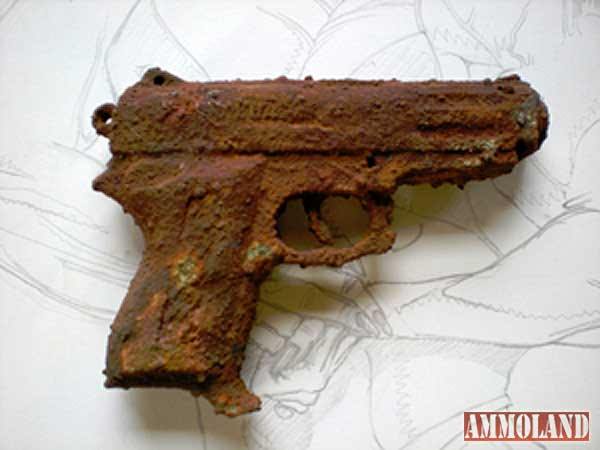
Rusty Gun
About a year ago I started looking into how to protect myself not only for theft but also from other events like fire or flooding.

U.S.A. –-(Ammoland.com)- Imagine if you come home to find your treasured collection of firearms gone. Years of collecting and thousands of dollars down the drain. If only there were a way to protect your investment!

This scenario has been one of my greatest fears. About a year ago I started looking into how to protect myself not only for theft but also from other events like fire or flooding.

There is always homeowner’s insurance, but that can be very risky. Depending on your policy, homeowner’s insurance might not cover your firearms. If your policy does include your guns, the policy will most likely base the value of your collection on the sale price of your guns minus depreciation and your deductible. This formula means that it considers your Colt Python at most is worth $125 since that was the original sale price.
The policy also usually has a limit of the amount that the insurance company will cover for the items in your house. For example, my homeowner’s policy will only cover up to $2500 for my gun collection. I found out that some policies have an even lower cap.
Most insurance companies also want a list of the firearms you have including serial numbers. Giving this information over to an insurance company makes me nervous. Maybe it is just paranoia, but I don’t want information on my collection being turned over to Big Brother.
Most homeowner’s insurance companies do not cover acts of God such as floods and earthquakes unless the homeowner has additional insurance. I found this out the hard way when there was damage to my house after an extremely rare Virginia earthquake.
There is a way to keep your investment your gun collection safe. Collector’s insurance is something every gun owner with more than one or two guns should consider buying. It gives me a little more peace of mind when I compare it to just relying on my homeowner’s policy.

Collectibles Insurance Services

Collectibles Insurance Services

One of the best companies that offer collector’s insurance is Collectibles Insurance Services. Their rates were even cheaper than it was to schedule my firearms onto my homeowner’s policy.
The product that they sell is far superior to my homeowner’s policy. One of the most significant advantages it has over traditional policies and what drew me to it is the fact that the policy covers more than just my firearms.
Optics and other firearms accessories are not cheap. I am into long range shooting. Some of my scopes cost more than my rifles. Collectibles Insurance Services covers all my optics even when I do not have them mounted on my guns.
I also buy ammunition in bulk. It is cheaper in the long run, but the upfront cost is a lot higher. Losing all my ammo means losing a lot of money. Luckily for me, Collectibles Insurance Services (CIS) even covers the cost of ammunition! Not only that, but they also include coverage for the price my gun safes.
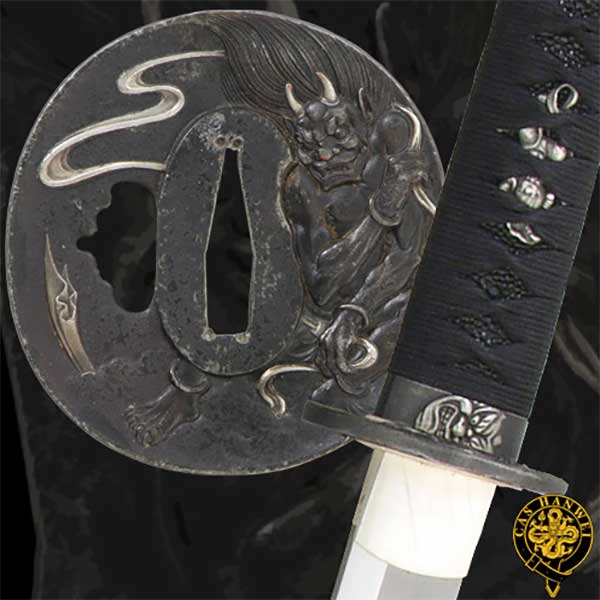
CAS Hanwei Oni Katana

I also prefer how Collectibles Insurance Services calculate the value of my guns. Different from the homeowner’s policy that I have, CIS uses the actual market value of the firearms with no deductible. That means that I would get paid out the current price of the Mosin Nagant I paid $75 for at a gun show back in the day. With my homeowner’s insurance policy, it wouldn’t be worth putting in a claim if something happened to my Mosin.
CIS ties their policies to the firearms and not the home. If your gun gets stolen from your car, then you are covered. I also travel with a firearm when I fly. If my gun gets taken from my checked bag when traveling, I know they still have my back. Collectibles Insurance Services even covers your guns if the postal services lose it when mailing my gun out to say a gunsmith.
Another cool thing about the collector’s policy offered by CIS is that it covers bladed weapons. I have a CAS Hanwei Oni Katana. It’s a real cutting sword. Its quality is impeccable, but that quality comes with a steep price. If anything ever happened to it, I would be able to put in a claim for its value.

No Firearms Serial Numbers Required, Your Guns Remain Private

This ‘like’ is a big deal. I like that Collectibles Insurance Services doesn’t ask for the serial numbers of your guns. Call me paranoid, but I don’t like sharing those with anyone. You only need to list firearms valued over $25,000 on the policy individualy. Even then, they only ask for make, model, and an estimated value of the gun.

CIS also covers my antique firearms along with my modern guns. This wide range of coverage saves me the pain of getting multiple policies.

CIS makes the process of getting a quote straightforward. All the collector have to do is answer a few easy questions on their website. They also have a toll free number ( 888-837-9537 ) where one of their team members can answer any question about their products.
From the collector to the dealer (yes they cover FFL dealer’s too!) everyone needs to protect his or her investment, and that is what Collectibles Insurance Services does best. Their service is something I hope I never have to use, but if I do, then I will be glad I have it.
You can get a free quote from Collectibles Insurance Services at https://collectinsure.com/guns
A CIS team member can answer any questions you have for them. They are available Monday to Friday from 8:30 AM to 5 PM ET at 888-837-9537.


About John CrumpJohn Crump
John is an NRA instructor and a constitutional activist. He is the former CEO of Veritas Firearms, LLC and is the co-host of The Patriot-News Podcast which can be found at www.blogtalkradio.com/patriotnews. John has written extensively on the patriot movement including 3%’ers, Oath Keepers, and Militias. In addition to the Patriot movement, John has written about firearms, interviewed people of all walks of life, and on the Constitution. John lives in Northern Virginia with his wife and sons and is currently working on a book on leftist deplatforming methods and can be followed on Twitter at @crumpyss, on Facebook at realjohncrump, or at www.crumpy.com.

Categories
All About Guns

W.T.F. is it?

Categories
All About Guns Gun Info for Rookies

A Pretty Good Outline about the Mosin Nagant Rifle Exploded Views and Disassembly

Home.jpg (2678 bytes) Mosin Nagant Rifle Exploded Views and Disassembly
All content copyright © 7.62x54r.net


The Mosin Nagant is a simple design that is easy to repair and maintain, but proper technique and an understanding of the design is important.
This page will attempt to guide Mosin owners through partial and complete disassembly and provide a pictorial reference of the various parts. For information on which parts will interchange between various models, see the Mosin Nagant Parts Compatibility page.
Tools Quality gunsmithing tools are imperative to prevent damage during firearm disassembly. Anyone who’s handled surplus firearms has seen the stripped screw heads, scratched metal and scarred wood.
While damage in battle is part of the history of a firearm, damage from poor maintenance techniques is a destruction of that history. Past damage can’t be undone, but future damage can be prevented.
A good set of hollow ground screwdrivers in various sizes is the most useful tool on the firearm bench. Following that, brass and steel punches and a light hammer are very handy. Forceps for handling small parts and a magnetic bowl for keeping track of them are useful.
A well lit, clean work area also helps prevent the loss of small parts. A protective mat on the bench will protect the finish of the firearm and a gun vise can make the job much easier when “three hands” are required. Plastic picks, nylon brushes, paper or cloth towels, swabs and pipe cleaners make detail cleaning easier.
A quality cleaning rod and patches will soon be appreciated over the discount variety for periodic maintenance.
Types of solvent and opinions on their use are almost as numerous as gun owners and is beyond the scope of this page. Dummy cartridges for checking function, a firing pin protrusion gauge, and a set of headspace gauges round out the well equipped bench.
Exploded Views Below are exploded views of a Soviet M91/30. Other models have variations in the parts which will be covered later. The primary differences are in the stock hardware and sights, especially among the later Finnish models. For larger views, click on the pictures.

4332.jpg (203327 bytes)

1. receiver and barrel
2. stock
3. handguard
4. magazine body/triggerguard
5. nosecap
6. nosecap screw
7. front barrel band spring
8. rear barrel band spring
9. front barrel band
10. rear barrel band
11. cleaning rod
12. cleaning rod retaining nut
13. stock recoil bolt
14. stock recoil bolt nut
15. butt plate
16. butt plate screw (2)
17. magazine tang screw
18. receiver tang screw
19. front sight
20. rear sight assembly
21. interrupter/ejector assembly
22. follower assembly
23. floorplate latch and screw
24. trigger/sear assembly
25. bolt assembly
26. sling and dog collars

4333.jpg (221536 bytes)

1. sear/trigger spring
2. sear screw
3. trigger/bolt stop
4. trigger pin
5. floorplate latch
6. floorplate latch screw
7. floorplate
8. follower carrier spring
9. follower carrier spring screw
10. follower carrier pin
11. follower carrier
12. follower spring
13. follower pin
14. follower

4334.jpg (119685 bytes)

1. ejector
2. interrupter/ejector spring
3. interrupter/ejector spring screw
4. rear sight base
5. rear sight base pin (2)
6. rear sight leaf spring
7. rear sight leaf
8. rear sight leaf pin
9. rear sight slide body
10. rear sight slide buttons (2)
11. rear sight slide button springs (2)

4335.jpg (178645 bytes)

1. bolt body
2. cocking knob/safety
3. guide rod/connector
4. firing pin
5. firing pin spring
6. bolt head
7. extractor


Disassembly The following pictures and comments will illustrate the disassembly procedure for the Soviet M91/30.

Before beginning disassembly, maintenance, or cleaning on any firearm visually inspect the chamber and magazine to be sure that it is unloaded.

td01.JPG (30326 bytes)

Remove the sling by unbuckling the dog collars and removing them from the sling slots.Unscrew the cleaning rod counterclockwise

td02.JPG (43973 bytes)

Depress the barrel band retaining springs and slide the barrel bands forward. td03.JPG (27621 bytes) td04.JPG (21724 bytes)
Slide both barrel bands forward past the end of the stock and remove the handguard. The barrel bands will not come off the barrel at this time due to the front sight. Other models may differ in this. td05.JPG (32482 bytes)
Hold the trigger back and pull the bolt straight to the rear. td06.JPG (62003 bytes)
Decock the bolt by turning the cocking knob 90 degrees counterclockwise and pull the bolt head and connector bar forward. td44.JPG (32392 bytes) td45.JPG (26571 bytes) td46.JPG (43124 bytes)
Rotate the bolt head 90 degrees clockwise and pull it off the connector bar. Using the large notch on the bolt tool or the connector bar as a wrench, grasp the firing pin between the fingers and unscrew it counterclockwise. Be careful to grasp it firmly as the spring is under pressure. td47.JPG (43649 bytes) td70.JPG (123219 bytes)
td48.JPG (68841 bytes) td49.JPG (66916 bytes)
Remove the magazine tang screw. td07.JPG (56517 bytes) td08.JPG (31825 bytes)
Remove the receiver tang screw. td09.JPG (35790 bytes) td10.JPG (24697 bytes)
Remove the magazine assembly and receiver assembly from the stock. Some Mosins, especially Finnish, but Russian and Soviet also, have shims at the tang and recoil lug. When removing the action from the stock be careful not to lose the shims and note their location. The trigger pin is held in place only by the stock and if it is loose can fall out upon removal of the action. td11.JPG (85912 bytes)
Depress the floorplate latch and pull the floorplate away from the magazine body. Compress the follower assembly and pull it straight down from the magazine body. td23.JPG (25351 bytes) td24.JPG (28667 bytes) td25.JPG (54189 bytes)

This completes partial disassembly for routine cleaning and maintenance.
For detailed disassembly, including the magazine and bolt assemblies, continue below.

Unscrew the butt plate. td12.JPG (23766 bytes) td13.JPG (20988 bytes)
Drift out the front and rear barrel band springs from the opposite side of the stock with a small blunt nail or punch. A hole for this purpose should be visible. These springs are delicate and can be easily broken if pulled out by the leaf. td14.JPG (31273 bytes) td15.JPG (43122 bytes) td16.JPG (29780 bytes)
Remove the nose cap screw and slide the nose cap forward off the end of the stock. The nose cap screw will thread into the top of the cleaning rod retaining nut and can aid in pulling it out of the stock.Note: Removal of the retaining nut is seldom necessary or worth risking damage to the nose cap screw. td17.JPG (24813 bytes) td18.JPG (31971 bytes) td19.JPG (31377 bytes)
Turn the stock recoil bolt nut counterclockwise with retaining ring pliers or another suitable tool. Carefully drive the recoil bolt out of the stock with a punch.Note: Removal of the recoil bolt is seldom necessary and there is a risk of damaging it. td20.JPG (28465 bytes) td21.JPG (24660 bytes) td22.JPG (31901 bytes)
Remove the floorplate latch screw and pull the floorplate latch straight down out of the magazine body/trigger guard. td26.JPG (19377 bytes) td27.JPG (38668 bytes)
Drift out the follower pin and follower carrier pin. The follower carrier spring is screwed to the floorplate. The follower spring can be removed from the follower carrier by lifting up and back. td28.JPG (47185 bytes) td29.JPG (15988 bytes) td30.JPG (53987 bytes)
Drift out the trigger pin and remove the sear/trigger spring screw. td31.JPG (14295 bytes) td32.JPG (35683 bytes)
Lift the ejector/interrupter spring and remove the ejector/interrupter from it’s slot. Remove the ejector/interrupter spring screw and slide the ejector/interrupter spring forward from the dovetail slot.Note: Early Russian ejector/interrupter were integral with the spring and are removed in one piece just as the spring is removed above. td33.JPG (47105 bytes) td34.JPG (33061 bytes) td35.JPG (53209 bytes)
Drift out the rear sight leaf pin and lift the rear sight leaf spring out of the rear sight base. Remove the rear sight slide from the leaf and pull the buttons and their springs out each side. td36.JPG (11776 bytes) td37.JPG (23661 bytes) td38.JPG (20430 bytes)
Drift out the rear sight base pins and drift the rear sight base forward off of the dovetail. td39.JPG (9531 bytes) td40.JPG (20981 bytes) td41.JPG (23567 bytes)
Drift the front sight off of it’s base. The barrel band can now be removed from the barrel.Note: The front sight base is staked to hold the sight in place. It should only be removed if necessary. td42.JPG (8776 bytes) td43.JPG (26169 bytes)
Drift the extractor out the back of the bolt head.Note: Removal of the extractor is seldom necessary and there is a risk of damaging it. If it is necessary, a drop of penetrating oil beforehand is recommended. td50.JPG (8028 bytes) td51.JPG (11860 bytes)

4331.jpg (189806 bytes)

Reassembly Reassemble the rifle in the reverse order of disassembly taking note of the following:

Screw the firing pin into the cocking knob until the back end is flush with the rear of the cocking knob and the slot lines up with the index mark. After fully assembling the bolt, decock it, make sure the bolt head is tight against the connector bar and check the firing pin protrusion with a gauge. The firing pin should touch the shallower (75) of the two center notches in the gauge and not touch the deeper (95) of the two center notches. If necessary, adjust by screwing the firing pin in or out of the cocking knob, always stopping with the index mark aligned. td57.JPG (7905 bytes) td58.JPG (78859 bytes) td59.JPG (78148 bytes)
A small C-clamp is useful for compressing the rear sight leaf spring.When replacing the front sight be sure to realign the index marks.
When replacing the action in the stock tighten the magazine tang screw and receiver tang screw evenly and securely. Loose action screws are a common cause of inaccuracy.
td60.JPG (80834 bytes) td61.JPG (15410 bytes)

Model Specifics The M91/30 was chosen because it is one of the most common models of the Mosin design and is more similar to all other models than any other model. Below are the exceptions to the above instructions for all other commonly encountered models of Mosins.

Russian M91 The M91 barrel bands are not retained by springs, but are held on by tension. The bands are loosened by turning the screw clockwise as if it were being tightened. The screw is captive to the band and if it is turned too far the wrong way it will break. The front band is removed first, the rear one is loosened to remove the handgaurd and then the rear band is removed. The bands will fit over the front sight to remove them from the barrel. M91earlyband.JPG (8691 bytes)
The rear sight leaf spring is retained by a screw. The sight base is soldered to the barrel. The rear sight slide is removed from the rear of the slide and can be done with the slide on or off of the rear sight base. Line up the notches on the bottom of the slide with the notches on the bottom of the leaf near the rear. M91rearsightside.JPG (2272 bytes) td65.JPG (23249 bytes)
Depress the spring cap on one side through the notches with a small punch while depressing the corresponding button. Pull that side of the slide slightly toward the rear of the leaf to prevent the spring cap from reseating. Repeat on the other side and remove the slide. td66.JPG (15599 bytes) td67.JPG (26120 bytes)
The buttons, springs, and spring caps can now be removed from the slide. td68.JPG (19996 bytes)
Soviet M38 The M38 barrel bands will come off over the front sight globe because it is closer to the end of the barrel. The front sight base is a sleeve held on with a pin. Removal is not recommended. M38frontsightside.JPG (2831 bytes)
The M38 rear sight base is a sleeve held in place by a pin. M38laterearsightside.JPG (3538 bytes)
Soviet M44
Eastern European M44
Chinese T53
Rear sight same as M38.
The M44/T53 has an attached bayonet that can be removed by taking out the screw. The screw is staked on the opposite end and can be difficult to loosen. The bayonet lug and front sight base are integral and held on by two pins. Removal is not recommended. The barrel bands cannot be removed without removing the bayonet/sight base. M44bayearlytop.JPG (4732 bytes)
Soviet M91/59Same as M38.
Soviet M91/38Rear sight same as M38. The M91/38 barrel bands will come off just as the M38 bands. The front sight base is often made from a turned down M44 bayonet/sight base and cannot be removed without damage because the rear pin is partially removed in the turning process. M9138frontsightside.JPG (2252 bytes)
Finnish M91
M24
P-series
Same as Russian M91.
Some Finnish long rifle barrel bands are retained by a pin which goes completely through the band and stock. It must be drifted out before removing the band in the same way as the Russian M91.Note: The pin can be delicate and should be removed with care only when necessary. td62.JPG (26222 bytes)
Some Finnish long rifle barrel bands are retained by a small wood screw into the stock just forward of the band. It must be removed before removing the band in the same way as the Russian M91. td63.JPG (33249 bytes)
Some Finnish long rifles use metal sling hangers in place of the dog collars and they must be removed before removing the rear barrel band. The screw passes through the stock and threads into the opposite side of the hanger. The rear hanger is attached in the same way but is larger. FinF.jpg (6794 bytes)
Finnish M27Rear sight same as Russian M91. Some M27s have a sling swivel through the front slot. It must be removed before removing the rear barrel band. FinM27SkiF.JPG (5371 bytes)
Some M27s have a rear sling swivel that is held in place by two wood screws. FinM27SkiR.JPG (3578 bytes)
The M27 nosecap has a transverse and longitudinal bolt. Remove these to hinge the top of the cap open and slide it forward off the stock. Some nosecaps have extensions to the rear that contain the transverse bolt.The rear barrel band is retained by a transverse bolt. M27nosecapearly.JPG (4575 bytes)
The front sight is soldered in place and cannot be removed without heating it. M27frontsightside.JPG (3205 bytes)
Finnish M28Rear sight same as Russian M91.
Rear barrel band same as M27.
Front sight similar to M27.
The M28 nosecap has a transverse bolt that is removed to slide the nose cap forward off the stock. Some nose caps have a seperate front plate that is attached to the stock by two wood screws. The nosecap will not come off over the front sight. M28nosecap.jpg (27735 bytes)
Finnish M28/30Rear barrel band same as M27.
Nose cap similar to M28.
The M28/30 rear sight base is a sleeve held in place by a retaining screw under the sight leaf and solder. M2830rearsightside.JPG (2559 bytes)
The slide is removable from the leaf by removing the leaf from the base. The slide buttons are retained by pins. (M39 sight pictured) td71.JPG (38383 bytes)
The M28/30 front sight has a blade that is adjusted with two screws, one on each side. The screws are removed counterclockwise and the blade is lifted from the base. (M39 sight pictured) td69.JPG (25942 bytes)
Finnish M39Rear sight similar to M28/30.
Front sight similar to M28/30.
The M39 has two set of sling attachment points. The lower rear sling swivel is similar to the the M27. The side rear sling attachement is held in place by two wood screws. FinM39R.JPG (5119 bytes)
The M39 barrel band is held in place by a spring similar to the M91/30. It also has a captive vertical bolt on the opposite side to provide tension. FinM39F.JPG (6413 bytes)
The M39 nose cap is held in place by a captive vertical bolt and transverse bolt. The top hinges to the left to allow the nosecap to be removed to the bottom of the stock. td64.JPG (31229 bytes)
Finnish M91/30Sling hangers same as Finnish M91. Some Finnish M91/30s have a blade front sight that allows the barrel bands to be removed over it. It also has “stacked” base. FinM9130frontsightside.JPG (2617 bytes)


Home.jpg (2678 bytes) All content copyright © 7.62x54r.net
Categories
Cops This great Nation & Its People Well I thought it was funny!

Somebody has a good sense of Humor!

Categories
Born again Cynic!

How I feel about most things at times

Categories
Cops Grumpy's hall of Shame

The Pussification of The American Male Continues

https://youtu.be/49pQf3E_yqE
Just a few years ago, she would of been disarmed and then been awaiting her trip to the local loony Bin! Grumpy

Categories
All About Guns

The almost perfect Pump Shotgun! From "The Counter Jockey Chronicles"

Winchester’s Perfect RepeaterImage result for winchester model 12 review

 The sound of someone racking a 12 gauge pump gun is enough to end a fight before it starts. And if it isn’t, your first round in the tube should be birdshot. That way you only wound the bad guy.
Oh, you shouldn’t have any concerns about short stroking a pump gun under stress. They are 100% reliable. And it doesn’t matter, as long as you touch off that one first round. Because you don’t have to aim a shotgun.
Did I miss anything? Any other pearls of gun counter wisdom concerning the pump gun?
Yeah, a lot of bullshit gets thrown around about the pump action shotgun. There is quite a debate about whether or not the shotgun is dead for CQB. I will say that even if the shotgun is being eclipsed by the 11.5 inch Mk18 style carbine for CQB, it’s still most handy for breaching.
And also, it is most handy when JAG/ROE mandates a number of less lethal options. But that is all about the tactical application of the venerable pump action 12 gauge shotgun. I want to talk about the shotgun,as imagine by John Browning and T.C. Johnson.
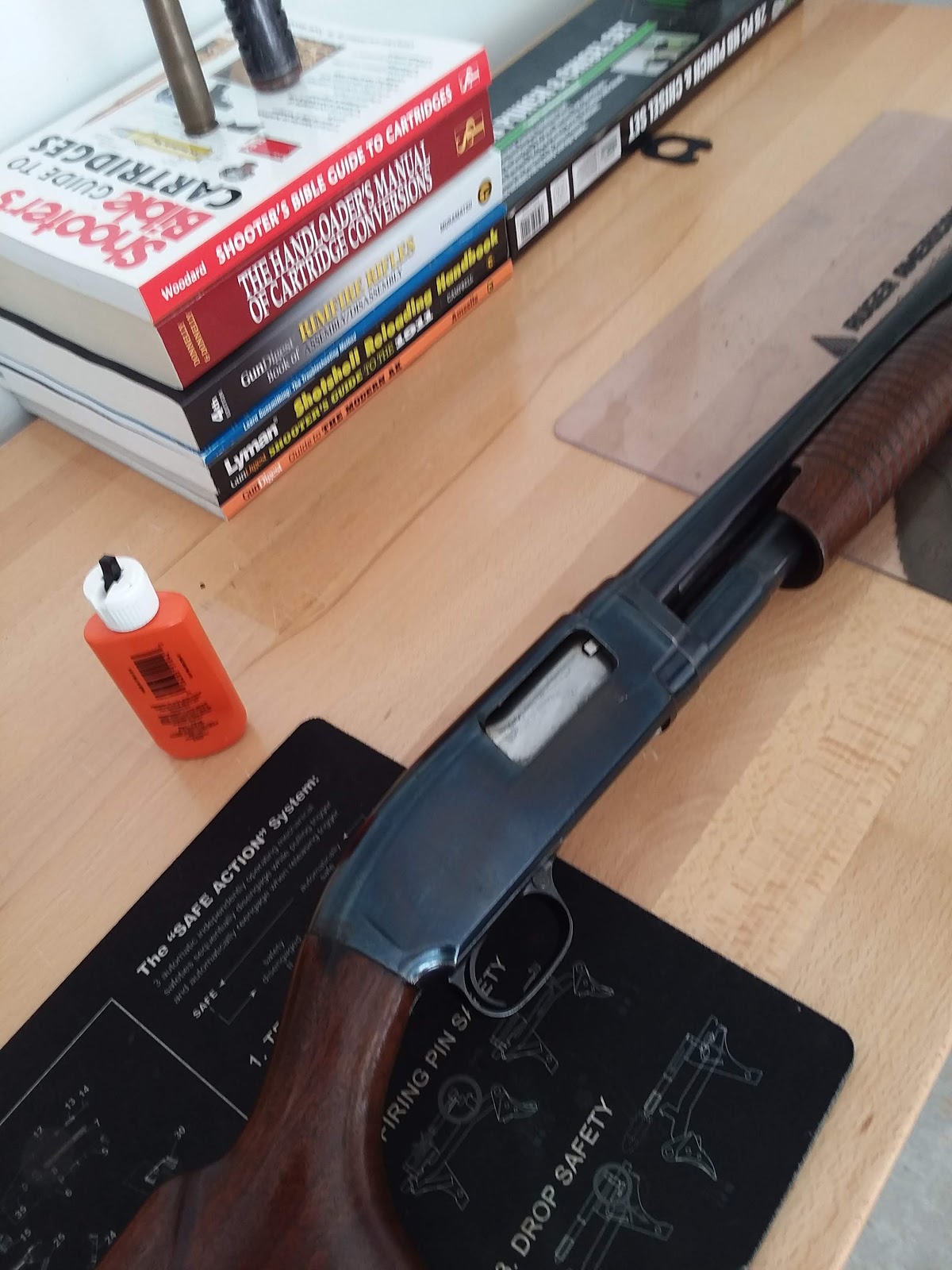
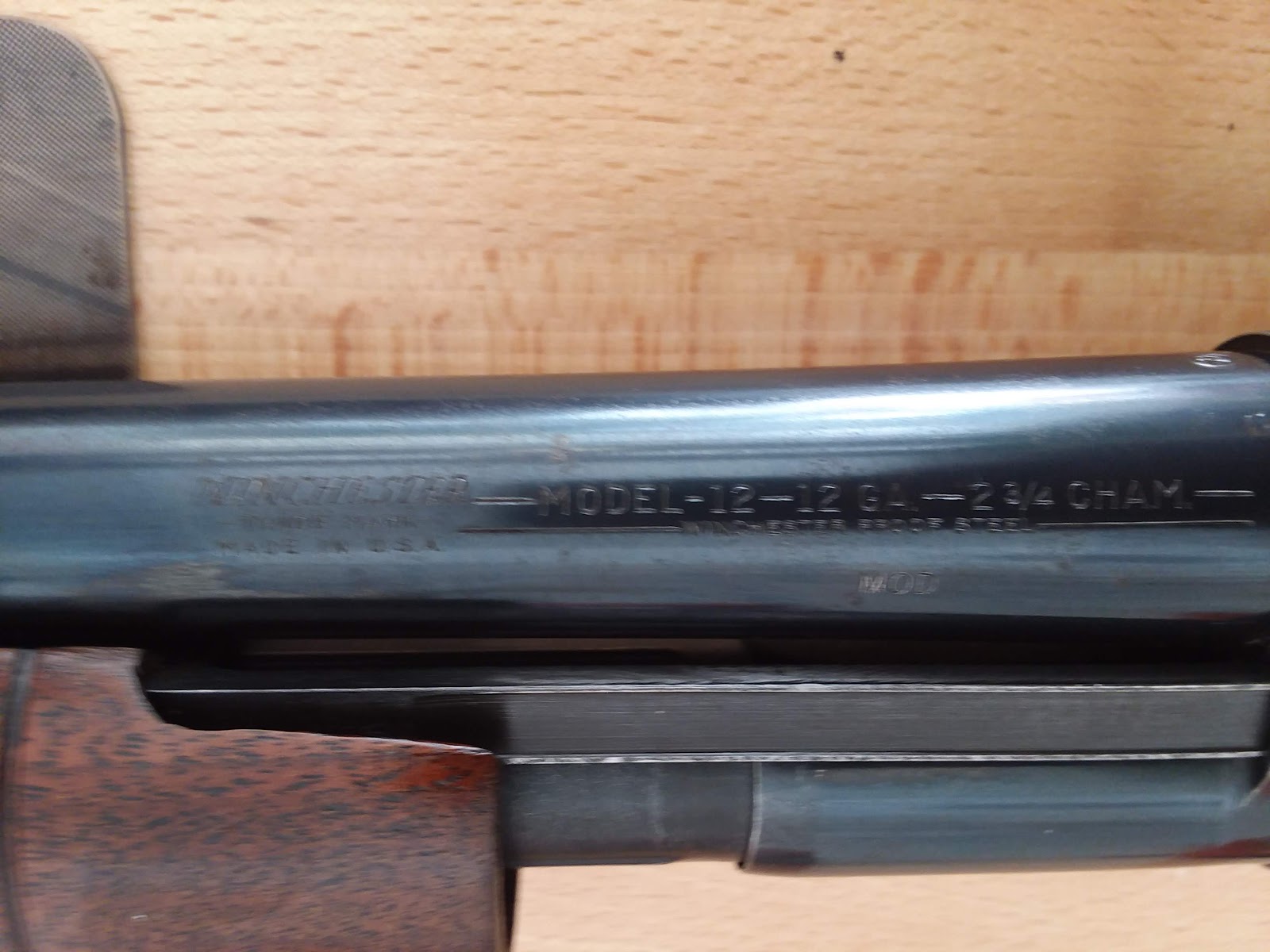
So, after Uncle Gaylon’s funeral, I stopped by the hometown pawn and gun. And there on the rack was a nearly mint condition Model 12, 1963 production. 12 gauge, modified choke. The bluing was good. The wood was good. I had to have it.
I’ve always wanted a Model 12. I’ve never been able to find one that wasn’t bastardized by some shade tree gunsmith or wasn’t either a Skeet or Heavy Duck in tip top shape with corresponding price tag. I nearly bought a beat to hell Model 25 before my Old Man talked me out of it.
The Model 12 was billed as the world’s perfect repeater. And man, they weren’t lying. You can throw that slide pretty damn quick.
As a kid, I read all the WEB Griffin books I could get my hands on. In “The Corps” series, an old Marine general mentions that he’s always squared when he goes trap shooting. Because he shoots his Model 12 far better than the Fox A Grade his wife bought him.
After my intial try at five stand with said gun, I can see why. When my good friend Pudge gets back from the Sandbox, I can’t wait to take it wing shooting in Kansas.

Blue steel and Walnut. Doesn’t get any better.

I just can’t get over how good the gun looks for being 55 years old. It looks really good haning on the wall, too.

Bluing is real good.

It’s in a running with my old Ithaca 37 for favorite pump gun.

Don’t see that roll mark anymore

Cost was a major factor in the discontinuation of the gun in 1964. As an aside, 1964 ranks right up there with 1934 and 1986 as like the worst year for the American gun owner.

A slew of poor imitations followed from New Haven. The 120 and the 1200. The 120 was utter garbage. The 1200 wasn’t terrible; but, nowhere near as good. At all.winchester model 12 shotgun
https://youtu.be/6bsJZO4zti0
Categories
All About Guns

Hickok 45 on the Winchester Model 92 44 40 Chapter 2

Categories
Dear Grumpy Advice on Teaching in Today's Classroom

For the History Teachers out there. A Really neat map of what Germany up to quite recently looked like!

 What a mess huh?

Categories
Dear Grumpy Advice on Teaching in Today's Classroom Fieldcraft

How to Build a Quinzee Snow Shelter [Illustrated Guide]

Brett & Kate McKay | December 4, 2015

Manly SkillsOutdoorsSurvivalVisual Guides
build a quinzee snow shelter illustration instructions

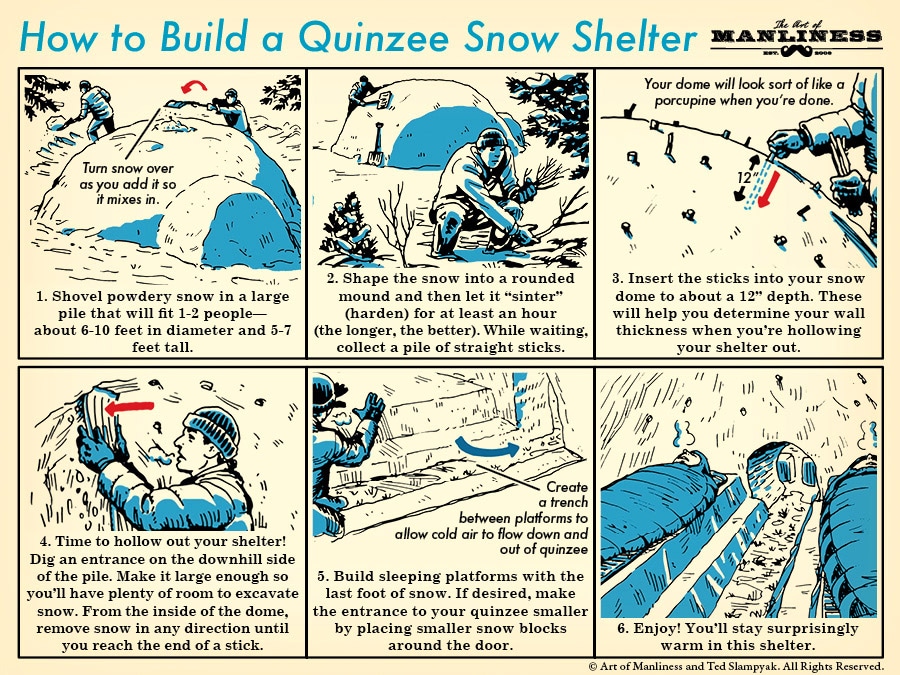
Whether you’re trying to survive in the frigid wilderness or you’re camping out in the winter for fun, building a quinzee is a great option for creating a shelter from the elements. All you need for its construction is a big pile of snow, which you then hollow out. Because it lacks a skeletal support structure, you’ll want to keep your quinzee relatively small — ideally building it for 3 people at the most. Shoveling all that snow works up a sweat, and snow will fall on you as you hollow out the inside, so be sure to change into dry clothes when you’re done to prevent hypothermia.
In today’s illustrated guide, we show you how to build your own quinzee with tips from Winter in the Wilderness by Dave Hall.
Like this illustrated guide? Then you’re going to love our book The Illustrated Art of Manliness! Pick up a copy on Amazon.
Illustration by Ted Slampyak