As World War II was winding down, armorers and inventors took a look at what was being used by U.S. servicemen and how to improve those tools. The M1 Garand was a resounding success, but even its inventor, John C. Garand, could see room for improvement. On the plus side was the legendary reliability of the first semi-automatic battle rifle, along with its phenomenal accuracy out to 500 yards and beyond. Its eight-round capacity easily outclassed the five-round capacity of most bolt-action rifles.
But, alas, there were a few flies in the pudding. First was the eight-round, en bloc clip. While eight rounds were good, it was apparent that future battles would call for even more firepower. Too, when the last round was fired, that damnable clip flew out of the rifle with a telltale “clink” that notified the enemy where the empty rifle was located. Another issue was the hand dance a rifleman had to do to load another clip without getting his thumb scrunched—the M1 thumb, as it was known. Military tacticians dreamed of one rifle that would cover the gamut of battle rifle, submachine gun and squad automatic weapon, thus the new rifle would need to be selective fire.
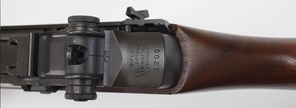
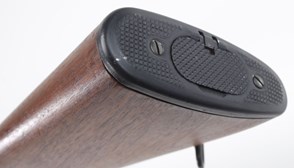
Work on modifications started even a little before the end of hostilities. Remington, Winchester and Springfield Armory (John Garand) began to float new prototypes. The T20 with modifications headed by Garand seemed to generate the most interest. It featured a slightly longer receiver to accommodate Browning Automatic Rifle 20-round magazines and had a switch to allow fully automatic capability at a rate of 700 r.p.m. The receiver was drilled and tapped on the side for a scope mount. Interestingly, the T20, despite the longer receiver, weighed in at just a hair more than 9 1/2 lbs. Dressed for battle with a bipod and an empty 20-round magazine, the T20 swelled to 12 1/2 lbs. Only 100 copies of the T20 were produced.
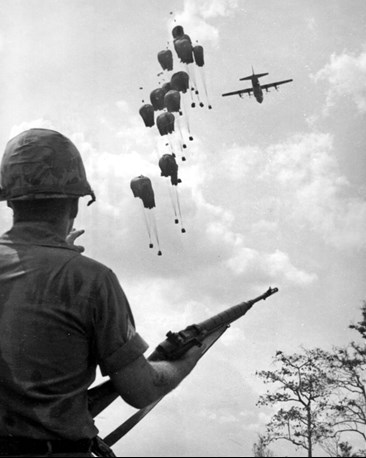
A U.S. soldier with an M14 in 1967 during the Vietnam War; Dept. of Defense image
Another prototype from Springfield Armory was the T25, a completely new rifle designed by Earle Harvey in 1945. The T25 was made around a new, light .30-cal. round, the T65 (7.62×49), that was a modified .300 Savage cartridge and designed by Frankfurt Arsenal. It featured a pistol grip and a buttstock reminiscent of the German MG 42 in an attempt to better control it in fully automatic. Trials at Fort Benning in 1950 revealed a few hiccups that were addressed by Harvey and a team of engineers at Springfield Armory. The newly modified T25 became the T47.
Concurrent with the rifle development, the T65 cartridge underwent some revisions as well. Lengthened a couple of millimeters and fueled by a new ball powder manufactured by Olin Industries, the new cartridge was coined the 7.62×51 NATO round, and because of the ball powder, it was very close to .30-’06 Sprg. in performance.
Still another concoction from Springfield Armory, the T44, was offered up for consideration. The T44 was cobbled from a T20E2 (the E2 designation was for a newer magazine to replace the large BAR mags) receiver and utilized a long operating rod and a piston instead of the T47’s gas cutoff system, which was prone to fouling. A straight operating rod and a bolt roller added reliability to the T44 rifle.
A series of trials conducted by the Infantry Board at Fort Benning in 1953 and ’54 pitted the T44, T47 and T48 (a modified FN FAL). When all was said and done, the T44 came out on top. The T47 experienced some reliability issues during cold weather tests, and while the T44 and T48 were about equal in performance, the T44 was about a pound lighter than the European; ergo it got the nod after everybody talked about it in 1957 under the designation U.S. Rifle, 7.62 mm M14.
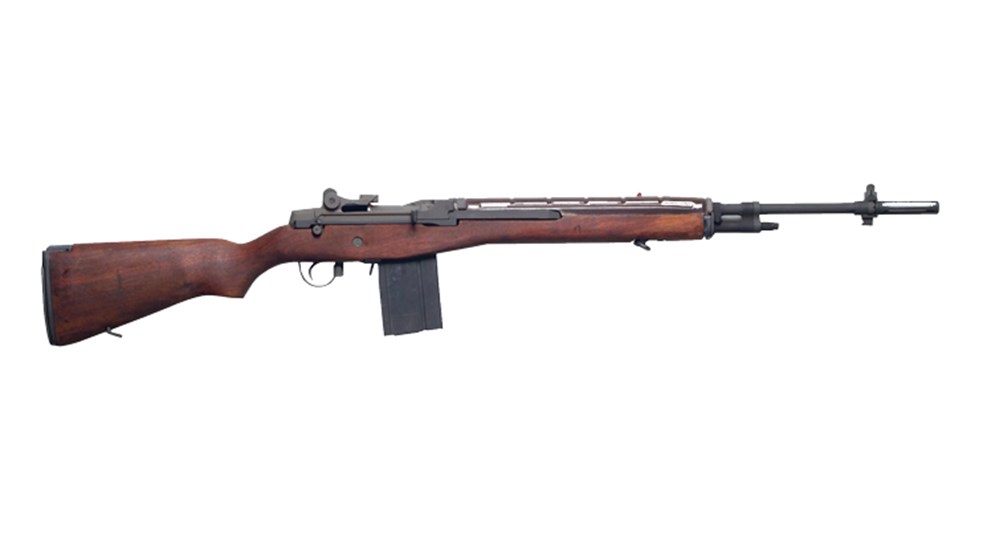
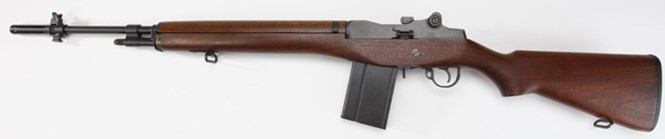
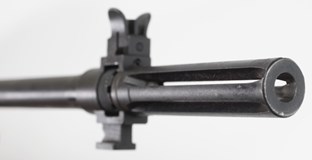
The M14 featured a 22″ barrel—2″ shorter than the M1 Garand—and originally the stock was made of walnut. Later stocks were made from birch, and still later, fiberglass. Until 1960, the handguard was made of walnut, but it would char during fully automatic fire, so it was changed to a ventilated fiberglass. That was changed to solid fiberglass when it was discovered that the ventilated guards were too fragile. A rather long flash suppressor is threaded to the muzzle, though it can be replaced with a grenade launcher or sound suppressor. Bare weight without a magazine was 8.33 lbs., about a pound and a quarter less than an M1. A full 20-round magazine adds just a smidgen more than a pound to the weight of it, making it still lighter than a Garand.
Production began in 1959, and Springfield Armory, Winchester, Harrington & Richardson and Thompson-Ramo-Wooldridge Inc. (TRW) produced 1,376,031 M14 service rifles until 1964. Initially, the unit cost of an M14 rifle was $68.75, about 70 percent of the cost of an M1 Garand. Production problems plagued Springfield Armory early on because of the mistaken notion that the M14 could be built on existing Garand tooling. The M14 saw service in the early years of the Vietnam War. It enjoyed a reputation of effectiveness and reliability but was also saddled with the omnipresent infantry complaint of being too heavy and unwieldy in the heavily forested jungles of Southeast Asia.
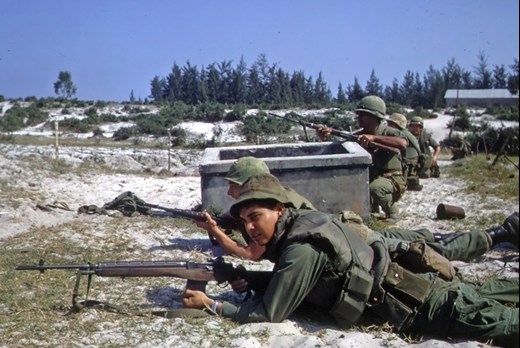
U.S. Marines and ARVN troops defend a position against enemy attack during the Tet Offensive. Photo circa January 1968. Dept. of Defense image
The overwhelming tide toward a lighter rifle with lighter ammunition capable of handling shorter-range (up to 300 meters) engagements, along with the political meddling of then-Secretary of Defense Robert McNamara, were the death knell of M14 production. Despite the complaints of officers on the battlefield, the M14 was replaced by the M16 rifle. McNamara ordered existing M14s to be destroyed. Most were de-milled—cut in two by a torch or shear—and many were brand new and unfired. Savvy officers did not send all of their M14 rifles to the scrap yard, though. Many were retained for sniper work as the M21 sniper rifle and served well in that role until replaced by the M24 SWS in 1988. 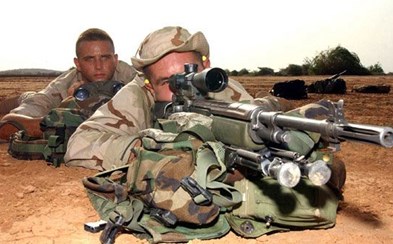
During the ensuing years, the M14 has been selectively deployed in a variety of roles, including Designated Marksman in the Marine Corps (right, Dept. of Defense photo), as well as SEAL teams and Spec Ops details. These rifles are tuned for their purpose of neutralizing multiple targets at extended range. The M14 has been dolled up and chromed for its role in parades and ceremonies. Most are now semi-automatic.
Springfield Armory produces a semi-automatic M1A rifle of superb quality and Fulton Armory does likewise with its M14 series for civilians. These rifles do not come cheap. An entry level M1A starts at $1,704, and dolled up versions can exceed three grand. Secondary (used) M1As or M14s won’t save you much. They are that popular.
Additional Reading:
The M14: Uncle Sam’s New Automatic Rifle (Archives)
M1A: The M14’s Successful Sibling