One of LA’s most important benefactors also spent time in San Quentin
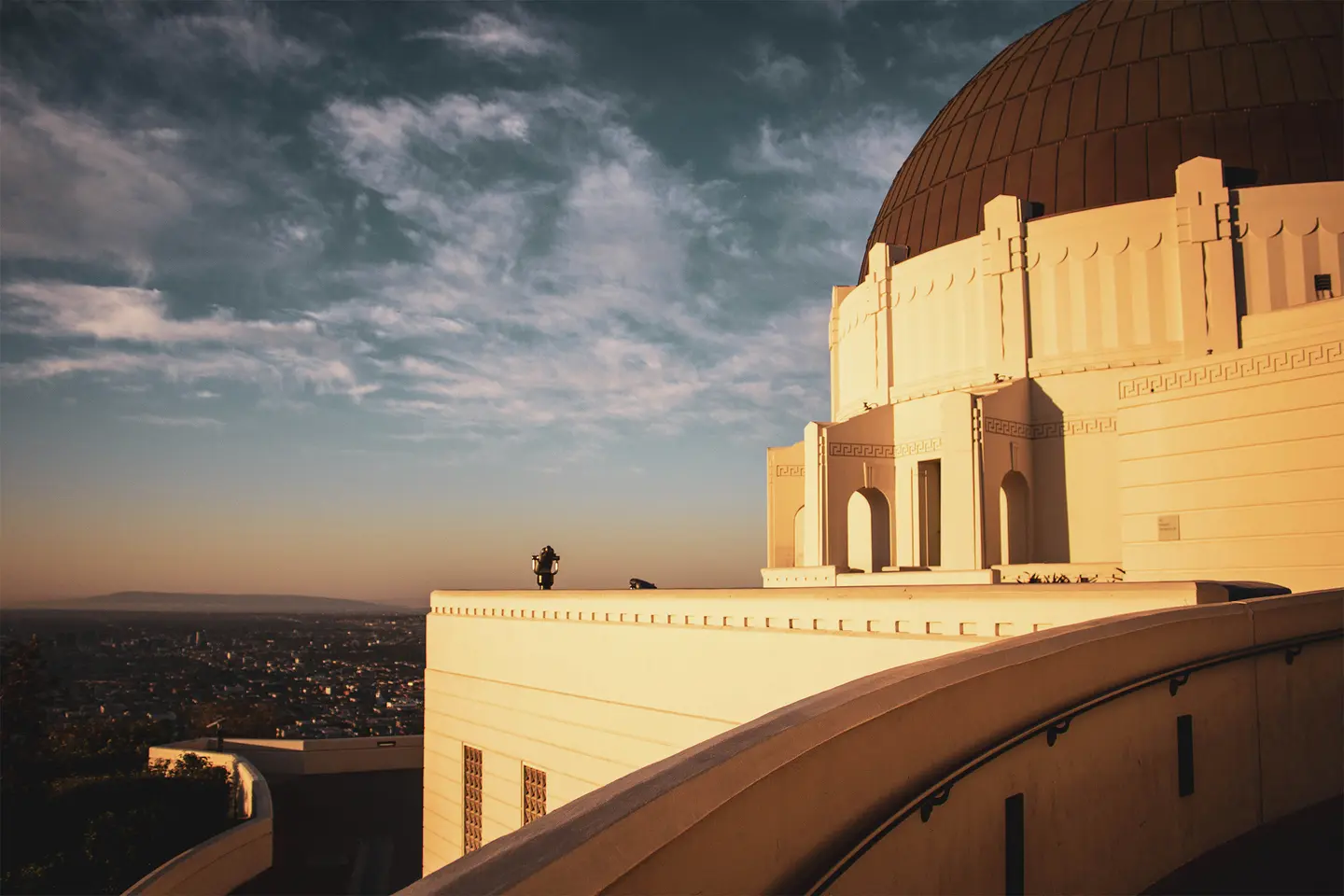
East side of Griffith Observatory in the city of Los Angeles.
Lena Wagner/Getty Images
By ,
To get a sense of what Griffith J. Griffith achieved for Los Angeles, all you have to do is hike up to the summit of Mount Hollywood, the second-highest point in the 4,210-acre urban wilderness park that bears his name.
“I find it a miracle that you look out over the basin and then you turn around and you look over the San Fernando Valley, and there is all of this urban and suburban sprawl, and some way, somehow, in the middle of it, there is this 4,000 acres for all of us,” said Mike Eberts, a professor of mass communications at Glendale Community College and author of a 1996 history book on Griffith Park published for the park’s centennial. “And Col. Griffith made that happen.”
“If there’s a list of people who’ve really made Los Angeles a great place to live, Griffith would be very high on that list,” Eberts, a board member of the Griffith Charitable Trust, continued.
In 1896, Griffith donated a massive piece of land to the city to be used as a public park, which today remains both a key city landmark and one of the largest municipal parks with urban wilderness in the United States. (For context, it is more than four times the size of San Francisco’s Golden Gate Park.)
The park likely wouldn’t exist today if it weren’t for Griffith’s foresight to set aside the land as green space in the city’s booming early days; he declared it “a place of recreation and rest for the plain people.” But while Griffith’s name is now emblazoned on the park, an observatory and a major boulevard, his legacy is complicated.

Construction of Griffith Observatory in Los Angeles, 1934.
Corbis/Getty Images

General view of the Hollywood Sign above Lake Hollywood on April 4, 2025, in Hollywood, Calif.
AaronP/Bauer-Griffin/Getty Images
In 1903, Griffith shot his wife in the face in a jealous rage and spent two years at San Quentin.
“He was a flawed man,” Eberts said, adding, “I like to think of him as someone who rose above his flaws.”
Col. Griffith J. Griffith was born in Wales in 1850 and moved to the United States as a teenager, later starting a career as a journalist covering mining in California.
He started working for mining companies as a side gig while still reporting on them (if you’re unfamiliar with journalism, that’s what’s called a conflict of interest) and eventually dropped the writing gig to manage mines full time.
In 1882, he moved to Los Angeles and purchased Rancho Los Feliz, 4,071 acres of a former land grant, all while dabbling in real estate and ranching and generally moving up into the city’s more elite circles.
Col. Griffith J. Griffith was also, notably, not a colonel. While he’d served as a major of riflery practice in the California National Guard, the colonel title was “apparently self-bestowed,” according to Eberts.

Portrait of Griffith J. Griffith circa 1910.
Calisphere/Los Angeles Public Library
In 1887, then-36-year-old Griffith married 23-year-old Mary Agnes Christina (“Tina”) Mesmer, daughter of an elite and wealthy Los Angeles family; “Union of Two Very Wealthy Los Angeles Families,” a headline proclaimed at the time.
Their relationship had developed while Tina was set to receive a large inheritance, something Griffith would have been aware of when the two first met, according to “Enlightened Egomaniac: The Life, Times & Crime of Griffith Jenkins Griffith,” a book by Miguel Llanos.
Griffith donated most of his rancho to the city in December 1896 (the press dubbed it a Christmas gift to Los Angeles) with much pomp and circumstance.
“Recognizing the duty which one who has acquired some little wealth owes to the community in which he has prospered … I am impelled to make an offer, the acceptance of which by yourselves, acting for the people, I believe will be a source of enjoyment and pride to my fellows and add a charm to our beloved city,” Griffith wrote in a letter to the mayor and city council.
At the time, the land “wasn’t really recognized as anything significant,” because it was so far away from downtown Los Angeles, according to Marian Dodge, board member at Friends of Griffith Park. To sweeten the deal, Griffith threw in land along the Los Angeles River, including the water rights.
Back then and in the years since, allegations and rumors have swirled that Griffith had other motives when making his generous donation — perhaps because previous business ventures at the rancho hadn’t panned out as planned, or to stop paying taxes on a huge piece of undevelopable property.
But regardless of motives, the giant parkland was set aside for generations of Angelenos, a slice of wilderness that dwarfs New York City’s Central Park several times over, set right in the middle of what became the nation’s second-largest city.
That massive swath of protected land means a chunk of the Santa Monica Mountains has been left undeveloped for over a century, while in other parts of the mountain range, conservation groups have had to fight to protect small pieces of habitat bit by bit, Dodge said.
“Griffith spoke of ‘taking time by the forelock, err it be too late,’ and so he really did see that this kind of frontier town, which we were when he donated the land in 1896, he envisioned it growing into a great city all around this park,” Eberts said.

Hotel Arcadia in Santa Monica, Calif., 1891.
Calisphere/Huntington Library
Then, amid his peak of local celebrity and reverie, Griffith committed a violent crime. Griffith and Tina were staying at a hotel in Santa Monica with their teenage son when an inebriated Griffith became paranoid and suspicious of Tina, accusing her of infidelity and asking if she was poisoning him (accusations she denied).
As the fight escalated, Griffith asked Tina to kneel, place a hand on a prayer book and answer his questions.
“His (last) question was: ‘Have you always been faithful to your marriage vows?’ I said: ‘As God is my judge, I have.’ As I answered the last question, he shot me,” according to a 1903 statement from Tina.
Tina survived but lost an eye and was disfigured by her injuries. She swiftly moved to divorce Griffith, and the judge granted the divorce in less than five minutes.
The day after the shooting, Griffith went right back to business around Los Angeles, including stops at his downtown office and a luncheon at the Jonathan Club.
When confronted by reporters about his wife’s injuries less than 24 hours prior, Griffith said that “the whole thing was purely accidental” and that Tina’s injuries were more from a fall out of the window than from the shot (Tina had jumped out of the hotel window to escape Griffith after he shot her).

Mug shots of Griffith J. Griffith, April 5, 1905.
California Department of Corrections and Rehabilitation
Griffith was ultimately found guilty of assault with a deadly weapon and sentenced to two years in San Quentin. When he emerged, he became an outspoken advocate for prison reform. Griffith J. Griffith “tells horrors of prison life” and “wages humanitarian crusade throughout country,” proclaimed one Los Angeles Herald headline in 1908 after Griffith’s release.
He also doubled down on securing his legacy as a wealthy yet generous member of the Los Angeles elite by offering $100,000 to the city to build a new observatory in Griffith Park.
Some city officials balked at taking more money from a man convicted of such a crime, and the efforts were slowed by litigation and debate for years. “The city still wanted his land, they still wanted his money, but they’re keeping him a little at arm’s length,” Eberts said.
Ultimately, Griffith left money to the city in his will for the construction of what became the Griffith Observatory and the nearby Greek Theatre, both of which opened in the 1930s, over a decade after Griffith’s death.

Helicopter point of view of Griffith Park Observatory in Los Angeles.
Getty Images/iStockphoto

Hiking path leading up to Griffith Observatory, with several hikers in the distance and trees on the edge of the path.
Lena Wagner/Getty Images
Griffith’s large donations appear to have memorialized him as a generous benefactor for the city, mostly overshadowing his violent crime.
In 1996, as part of Griffith Park’s centennial anniversary celebrations, a 14-foot bronze statue of Griffith was erected near the park entrance at the corner of Los Feliz Boulevard and Crystal Springs Drive.
The statue came after members of the Griffith Charitable Trust realized that “there was no dedication to the man who’d given the city this extraordinary gift,” according to nonprofit Friends of Griffith Park.
So the controversial figure now looms large over a busy intersection just outside the park, with a quote from Griffith that reads, “Public parks are a safety valve of great cities and should be made accessible and attractive where neither race, creed nor color could be excluded.”

The quote is attributed to Colonel Griffith, permanently cementing Griffith’s long con in stone.
———————————————————
As you see from this California & especially LA has always been a weird, violent and fun place to live.
A trio of New York City gun owners say the city’s gun registration requirements and waiting period require
them to traverse additional administrative hurdles to acquire guns legally.
MANHATTAN (CN) — A group of New York City gun buyers asked a federal appeals court on Tuesday to reinstate their Second Amendment challenge against the state’s administrative gun licensing requirements, which they claim infringe on their constitutional right to keep and bear arms.
Charles Mills, Craig Sotomayor, and Braden Holliday sued New York City in 2023, claiming regulations like the city’s 90-day waiting period to purchase firearms, background checks and the ban on possessing a backup concealed handgun limit are “absolute bar — even if temporarily — to their right to have and bear arms.”
Holliday, a Bronx resident, separately challenged the city’s imposition of purportedly exorbitant application and renewal fees as a restriction on his ability to possess arms.
He says New York City’s licensing and renewal fees, at $428.50, “grossly exceed” the $10 statutory cap imposed on every other jurisdiction in state, with the exception of Nassau County on Long Island.
Their case was thrown out at the motion to dismiss stage in December 2024 by U.S. District Judge Jed Rakoff, who concluded that “none of the predominantly administrative regulations here operates to permanently deprive applicants of their right to own and carry firearms.”
Appealing to the Second Circuit, the gun owners claim Rakoff misapplied and misunderstood the text, history and tradition analysis under Bruen to be applied in Second Amendment challenges, and the viability of constitutional challenges to “exorbitant licensing fees.”
“Reversal of the district court decision is required here, because at the 12(b)(6) [motion to dismiss] stage Second Amendment challenges, the issue is only whether the law is being challenged affect the plaintiff’s right to acquire, possess and or carry arms,” attorney Amy Bellantoni told the three-judge Second Circuit panel during oral arguments on Tuesday morning.
Bellantoni told the panel New York City’s administrative constraints on gun purchasing “go right to the very heart of the plain text of the Second Amendment, which is the right to keep and bear, to have and possess, and right to acquire is necessarily wrapped up within the right to possess, because without the ability to acquire, then you have no possession and no carriage, you have no defense.”
U.S. Circuit Michael Park, a Donald Trump appointee, queried what the injury from the licensing fee and registration fees entails for gun buyers.
“We’re not at the stage right now yet where the city needs to justify requiring a permission slip, but I will say that the harm there is that without the ability to acquire at the point of purchase, my client has been harmed,” Bellantoni said. “He’s not been able to acquire the handgun and carry it and possess it for self-defense at that moment.”
Park also asked how mandatory waiting period was different from a presumptively permissible administrative delay for a background check.
Bellantoni said a waiting period of five to fifteen minutes to run the buyers’ background check would be sufficient.
“Now, 30 days, it’s not reasonable,” she said. “What are we waiting for? They’re already eligible law-abiding people, and now they have to be like children. You know, wait until they get permission to take their property out of the store. It makes it’s it makes no sense.”
Jeremy W. Shweder for the New York City Law Department meanwhile urged the panel to affirm the lower court’s dismissal, arguing the gun owners lack standing or their claims are moot.
“Plaintiffs have not adequately alleged that there are no set of circumstances under which the challenge regulations would be valid,” he told the Second Circuit on Tuesday. “Plaintiffs essentially argue that they satisfy their burden at step one merely by saying that there exists a firearm regulation and then pointing to the Second Amendment.”
Shweder said the buyers had not plausibly argued that the 90-day waiting period, an anti-trafficking measure, infringes their acquisition to the point of infringing the keeping or bearing of arms for self-defense.
“Stepping back, the anti-trafficking law is not a bar on the acquisition of firearms,” the city wrote in its appellate brief. “It is not a bar on keeping or bearing firearms; and it is not a bar on where firearms can be carried. It simply regulates the pace of additional firearm acquisitions by requiring someone who has just acquired a handgun — and may already have many more — to wait 90 days before purchasing an additional one.”
The city noted the Second Circuit has already upheld the constitutionality of the $340 licensing fees in Kwong v. Bloomberg, and that Bruen specifically contemplates licensing fees as long as they are not so exorbitant as to deny the right to keep and bear arms.
U.S. Circuit Judges Debra Ann Livingston and Reena Raggi, both appointed by George W. Bush, rounded out the panel, which did not indicate how or when it would rule.