Categories
All About Guns Anti Civil Rights ideas & "Friends"

Biden Administration Urges Supreme Court To Let Cops Enter Homes And Seize Guns Without A Warrant

Nick Sibilla


The U.S. Supreme Court on Wednesday will hear oral argument in Caniglia v. Strom, a case that could have sweeping consequences for policing, due process, and mental health, with the Biden Administration and attorneys general from nine states urging the High Court to uphold warrantless gun confiscation. But what would ultimately become a major Fourth Amendment case began with an elderly couple’s spat over a coffee mug.

In August 2015, 68-year-old Edward Caniglia joked to Kim, his wife of 22 years, that he didn’t use a certain coffee mug after his brother-in-law had used it because he “might catch a case of dishonesty.” That quip quickly spiraled into an hour-long argument. Growing exhausted from the bickering, Edward stormed into his bedroom, grabbed an unloaded handgun, and put it on the kitchen table in front of his wife. With a flair for the dramatic, he then asked: “Why don’t you just shoot me and get me out of my misery?”

Perhaps unsurprisingly, the tactic backfired and the two continued to argue. Eventually, Edward took a drive to cool off. But when he returned, their argument flared up once again. This time, Kim decided to leave the house and spend the night at a motel. The next day, Kim phoned home. No answer.

Worried, she called the police in Cranston, Rhode Island and asked them to perform a “well check” on her husband and to escort her home. When they arrived, officers spoke with Edward on the back deck. According to an incident report, he “seemed normal,” “was calm for the most part,” and even said “he would never commit suicide.”

However, none of the officers had asked Edward any questions about the factors relating to his risk of suicide, risk of violence, or prior misuse of firearms. (Edward had no criminal record and no history of violence or self-harm.) In fact, one of the officers later admitted he “did not consult any specific psychological or psychiatric criteria” or medical professionals for his decisions that day.

MORE FOR YOU

Did You Get A Second Stimulus Check Today? Here’s Why

Trump Signs Executive Orders To Extend COVID-19 Economic Relief, Includes Unemployment Benefits, Eviction Moratorium

Biden: Stimulus Bill Passed During Lame Duck Session Is ‘At Best Just A Start’

Still, police were convinced that Edward could hurt himself and insisted he head to a local hospital for a psychiatric evaluation. After refusing and insisting that his mental health wasn’t their business, Edward agreed only after police (falsely) promised they wouldn’t seize his guns while he was gone.

Compounding the dishonesty, police then told Kim that Edward had consented to the confiscation. Believing the seizures were approved by her husband, Kim led the officers to the two handguns the couple owned, which were promptly seized. Even though Edward was immediately discharged from the hospital, police only returned the firearms after he filed a civil rights lawsuit against them.

Critically, when police seized the guns, they didn’t claim it was an emergency or to prevent imminent danger. Instead, the officers argued their actions were a form of “community caretaking,” a narrow exception to the Fourth Amendment’s warrant requirement.

First created by the Supreme Court nearly 50 years ago, the community caretaking exception was designed for cases involving impounded cars and highway safety, on the grounds that police are often called to car accidents to remove nuisances like inoperable vehicles on public roads.

Both a district and appellate court upheld the seizures as “reasonable” under the community caretaking exception. In deciding Caniglia’s case, the First Circuit U.S. Court of Appeals acknowledged that “the doctrine’s reach outside the motor vehicle context is ill-defined.” Nevertheless, the court decided to extend that doctrine to cover private homes, ruling that the officers “did not exceed the proper province of their community caretaking responsibilities.”

Siding with law enforcement, the First Circuit noted that a police officer “must act as a master of all emergencies, who is ‘expected to…provide an infinite variety of services to preserve and protect community safety.’” By letting police operate without a warrant, the community caretaking exception is “designed to give police elbow room to take appropriate action,” the court added.

In their opening brief for the Supreme Court, attorneys for Caniglia warned that “extending the community caretaking exception to homes would be anathema to the Fourth Amendment” because it “would grant police a blank check to intrude upon the home.”

That fear is not unwarranted. In jurisdictions that have extended the community caretaking exception to homes, “everything from loud music to leaky pipes have been used to justify warrantless invasion of the home,” a joint amicus brief by the ACLU, the Cato Institute, and the American Conservative Union revealed.

This expansion could also have perverse effects and disincentivize people from calling for help. As that brief noted, “When every interaction with police or request for help can become an invitation for police to invade the home, the willingness of individuals to seek assistance when it is most needed will suffer.”

But in its first amicus brief before the High Court, the Biden Administration glossed over these concerns and called on the justices to uphold the First Circuit’s ruling. Noting that “the ultimate touchstone of the Fourth Amendment is ‘reasonableness,’” the Justice Department argued that warrants should not be “presumptively required when a government official’s action is objectively grounded in a non-investigatory public interest, such as health or safety.”

“The ultimate question in this case is therefore not whether the respondent officers’ actions fit within some narrow warrant exception,” their brief stated, “but instead whether those actions were reasonable,” actions the Justice Department felt were “justified” in Caniglia’s case.

As a fail-safe, the Justice Department also urged the Supreme Court to uphold the lower court ruling on qualified immunity grounds, arguing that the officers’ “actions did not violate any clearly established law so as to render the officers individually liable in a damages action.”

But the Biden Administration, along with the courts that have extended the community caretaking exception, overlook a key component of the Fourth Amendment: the Security Clause. After all, the Fourth Amendment opens with the phrase, “the right of the people to be secure.”

In an amicus brief, the Institute for Justice noted that “to the Founding generation, ‘secure’ did not simply mean the right to be ‘spared’ an unreasonable search or seizure” but also involved “harms attributable to the potential for unreasonable searches and seizures.” Expanding the community caretaking exception to “allow warrantless entries into peoples’ homes on a whim,” argued the IJ brief, “invokes the arbitrary, looming threat of general writs that so incited the Framers” and would undermine “the right of the people to be secure” in their homes.

The IJ brief further argued that extending the “community caretaking” exception to the home would “flatly contradict” the Supreme Court’s prior rulings, which “has only discussed community caretaking in the context of vehicle searches and seizures.” In those cases, “the animating purpose for the exception [was] to allow officers to remove damaged or abandoned vehicles that pose a risk to public safety.” By contrast, the IJ amicus asserted,  “that justification is entirely absent” when it comes to homes.

“The Fourth Amendment protects our right to be secure in our property, which means the right to be free from fear that the police will enter your house without warning or authorization,” said Institute for Justice Attorney Joshua Windham. “A rule that allows police to burst into your home without a warrant whenever they feel they are acting as ‘community caretakers’ is a threat to everyone’s security.”
Categories
All About Guns

Colt Frontier Scout

Categories
All About Guns Anti Civil Rights ideas & "Friends" Cops Fieldcraft

Boulder Colorado. Threats and Solutions.

Categories
All About Guns

Beretta Model 76 22 Target Pistol Review

Categories
All About Guns Gun Info for Rookies Hard Nosed Folks Both Good & Bad

The .35 Whelen Story by Layne Simpson

The .35 Whelen Story

The origin of the .35 Whelen has long been debated despite the fact that in two of his books, Colonel Whelen named James V. Howe as its developer.

Remington forever legitimized the .35 Whelen when it began loading it in 1988. Eventually, Big Green would offer it in the Model 700 as well as its slide-action and semiautomatic rifles.
Prior to that, however, the .35 was one of our most popular wildcats. For about as long as it has been around, its origin has been debated. Some are convinced it was James V. Howe who created it, and others argue with equal fervor that it was Col. Townsend Whelen.
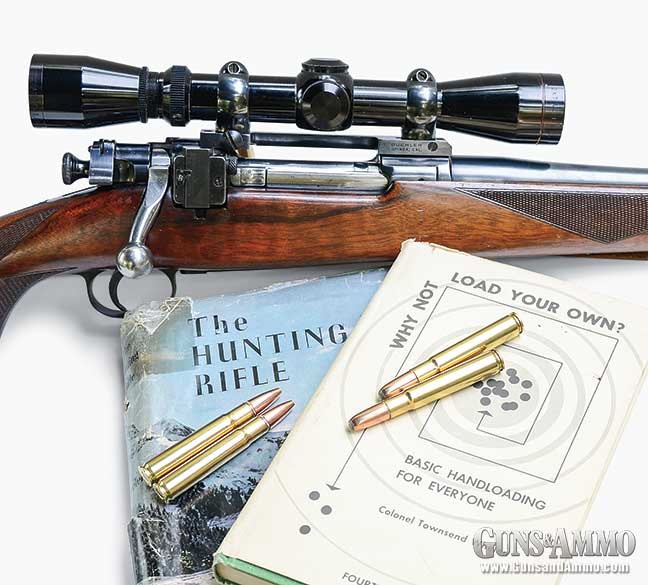
The argument rages on despite the fact that Whelen long ago settled it in two of his books. In the .35 Whelen section of “Why Not Load Your Own?” (1957), he writes, “This cartridge was developed by James V. Howe in 1922 and named for the writer.”
Page 271 of “The Hunting Rifle,” which was published during the early 1940s, reads in part, “In 1922, Mr. James V. Howe and the writer developed the .400 Whelen cartridge. This cartridge was constructed by taking the .30-’06 case before it had been necked at all and necking it down to .40 caliber.
About the time we completed development of this cartridge, I went on a long hunting trip in the Northwest, and when I returned, Mr. Howe showed me another cartridge that he had developed. The .30-’06 case was necked to .35 caliber to use existing .35-caliber bullets. Mr. Howe asked my permission to call this cartridge the .35 Whelen, but he alone deserves credit for its development
The .35 Whelen Story
After leaving Frankford in 1923, he got together with Seymour Griffin and formed Griffin & Howe, a shop that became widely known for building fine custom rifles. The partnership did not work out, and after about six months, Howe moved on to Hoffman Arms Company in Cleveland, Ohio, where he stayed for a long time.
Even though Col. Whelen staked no claim to the .35 Whelen, we still owe him partial credit for its existence. During the 1920s, American Leslie Simpson was considered to be an authority on hunting the African continent. Among other things, he, along with novelist Steward Edward White and a couple of others, was said to have taken more than 50 lions during a control shoot lasting three weeks.

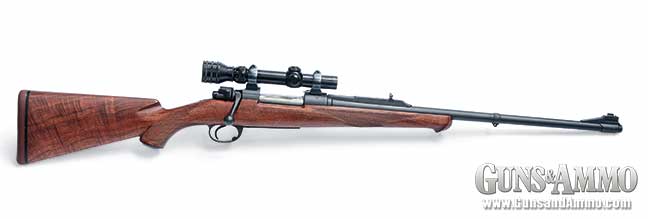
For the past 25 years, this custom rifle on a Whitworth Model 98 Mauser square-bridge action has been the author’s favorite in .35 Whelen. Its 22-inch Apex barrel was made by the late Sam May, and its 1:12-inch twist handles bullets as long as the 310-grain Woodleigh. Butch Searcy did the barreled action, and it was stocked by E.C. Bishop & Son of Warsaw, Missouri.

Simpson and Whelen became friends, and during one of their conversations, Simpson mentioned using the .35 Winchester and finding it lacking. What was needed for taking thin-skinned African game, including lions, was a cartridge of the same caliber but capable of pushing along a 250-grain bullet at 2,500 to 2,600 feet-per-second. Whelen passed the idea on to James Howe, who came up with two cartridges, one of which was the .35 Whelen while he was at Frankford Arsenal.
After moving on to Griffin & Howe, Howe followed up with the .350 G&H Magnum, and it was loaded by Western Cartridge Company.
Whelen had several favorites, but reading his books, I find very little evidence of the .35-caliber cartridge bearing his name being one of them. In fact, I’m not sure he ever actually hunted with it.
The book “Mister Rifleman,” published by Petersen Publishing Company after Whelen’s death in 1961, has a chapter titled “A Rifleman’s Battery.” It’s filled with two-page-spread photos of about 30 rifles owned by Whelen along with comments on each written by him. The only rifle in the group in .35 Whelen was built on a 1903 Springfield action by James Howe in 1922 and originally had a Niedner barrel in .400 Whelen.

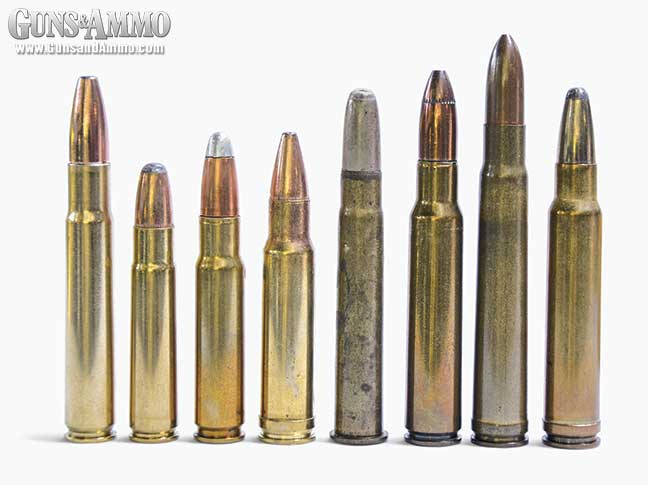
Of the various factory- loaded cartridges of .35 caliber introduced through the years, the .35 Whelen and .35 Remington went on to become the most popular. Left to right: .35 Whelen, .35 Remington, .358 Winchester, .350 Rem. Mag., .35 Winchester, .35 Newton, .350 G&H Mag., .358 Norma Mag.

Due to very little shoulder on its case for headspacing, the .400 was a troublesome cartridge to reload and shoot, yet Whelen did not get around to having the rifle rebarreled to .35 Whelen until around 1950, long after he did most of his hunting. His reloading manual came out seven years later, and he may have needed a rifle in .35 Whelen for developing the loads published in it.
Col. Whelen was a practical man, and my guess is that he had very little use for the .35 simply because the game he successfully hunted was easily taken with cartridges of smaller calibers and less recoil. His 40-year Army career began not long after the .30-40 Krag was adopted, and both became favorites in the hunting fields.
He later became equally fond of the .30-’06, 7x57mm Mauser and .257 Roberts, but the .270 Winchester that accounted for his best moose seemed to be his favorite. There were others in his life, both factory and wildcats, with the .243 Winchester and .308 Winchester among the last he wrote up while on the technical staff of Guns & Ammo.
Someone who did hunt a great deal with the .35 Whelen was Elmer Keith. Before using it, he used a custom Springfield in .400 Whelen given to him by James Howe in 1925. Like Whelen, he eventually had his rifle rebarreled to .35 Whelen and used it to take what he described as a record-book brown bear during his first hunt in Alaska in 1937.

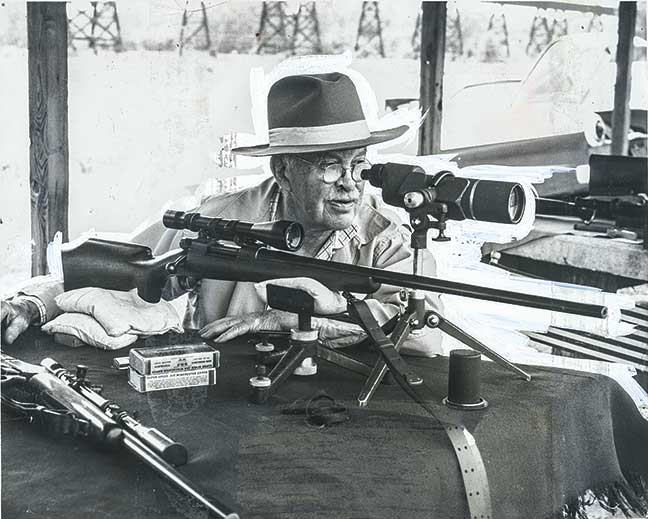
Col. Whelen, dean of American riflemen, shooting his 7mm rifle on assignment for accuracy and trajectory.

Keith took the bruin with a 275-grain bullet made by Western Tool & Copper Co., his favorite for all-around use. He loaded 57 grains of IMR 4064, but that powder in his day was a bit slower in burn rate than today’s version, since 52 grains is now considered maximum with a bullet of that weight. Elmer speculated that the 300-grain roundnose made by Fred Barnes might be a better choice when hunting elk in heavy timber, but I don’t believe he actually got around to trying it.
In notes written about his .35-caliber Griffin & Howe Springfield, Whelen recommended two loads for it with IMR 4350. One was 61 grains behind a 275-grain roundnose bullet made at the time by Joyce Hornady. Velocity was 2,375 fps. The other was 60 grains with the Barnes 300-grain bullet for 2,350 fps.
He must have been using special brass because I am unable to get that much IMR 4350 into factory .35 Whelen cases or those formed from various brands of .30-’06 brass and still have enough space left to seat bullets at the overall cartridge lengths required by the magazines of various bolt-action rifles. The heaviest charges I can squeeze behind 275- and 300-grain bullets are 59 and 53 grains, respectively, for velocities of 2,219 and 2,059 fps.
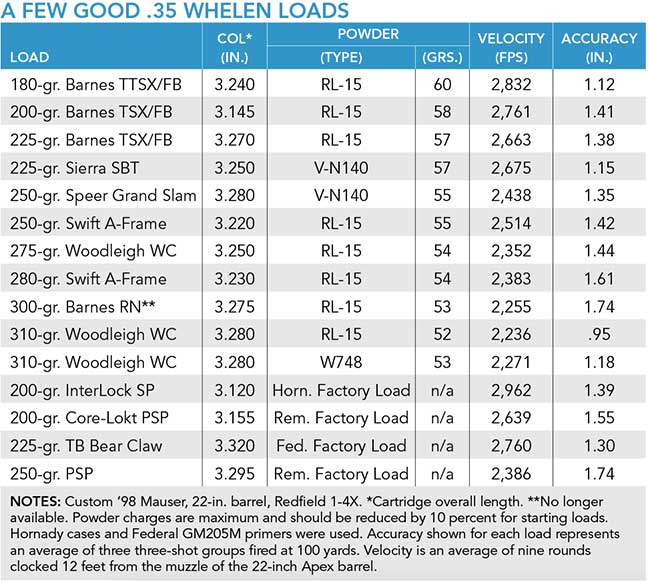
Reloder 15 has become the powder for .35 Whelen handloads, not only for me but for several other hunters I know who use the cartridge. Clean-burning, it delivers top velocities with all bullet weights, accuracy is usually very good, and it meters through powder measures with minimum charge-to-charge variation.

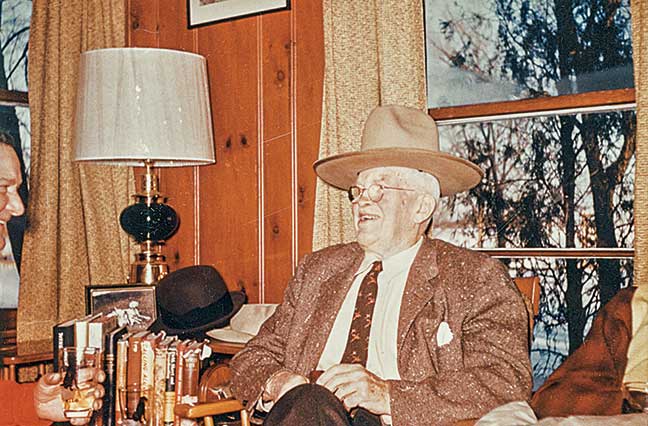
Col. Whelen at Winchester’s Nilo Farms. This photo, taken February 1961, is thought to be his last. He passed away 10 months later, on December 23, 1961, at age 84.

Maximum charges with all bullets weighing from 180 to 210 grains are either 100 percent density or close enough to it. If I were to pick a second favorite, it would be Vihtavuori N-140. Others with similar burn rates include Accurate 2520, Varget, W748 and IMR 4064. Various reloading manuals have data for all of them.
Today’s bullets are much better than in Elmer Keith’s time, and lighter weights than those used by him are capable of taking any game most would want to hunt with the .35 Whelen.
For those who wish to turn back the calendar to the good old days, a few heavyweights are available. Loading the heavier bullets also puts the .35 Whelen on a more equal footing with the 9.3x62mm Mauser. Woodleigh offers a 275-grain Weldcore, and from Swift we have a 280-grain A-Frame. Both are a bit long for the 1:16-inch twist of Remington rifles and usually require 1:14 or quicker.
The Woodleigh 310-grain roundnose is available in both expanding and solid styles; both require a 1:12 twist. I have not tried the 275-grain Lion Load bullet from A-Square, but since it is of roundnose form, it should work in a 1:16 twist. I believe Savage rifles have a 1:12 twist, but I’m not sure about Brownings, Rugers, Winchesters and others.
Unprimed cases are available from Nosler, Hornady, Remington and Norma USA, but necking up .30-’06 cases as in the old days remains an option. A tapered expander button in most .35 Whelen full-length resizing dies makes doing so easy. Applying a light coat of wax-type resizing lube (available from Hornady and Redding) to the mouth of each case makes the job go smoothly. Case loss should be zero if new brass is used.

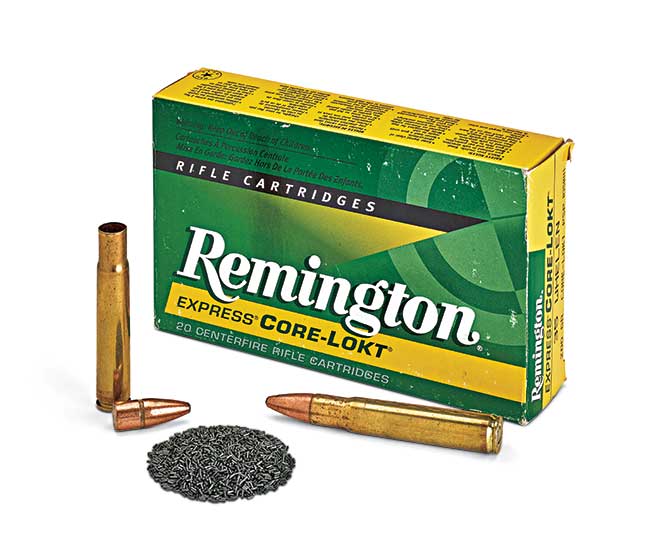
Remington Express Core-Lokt .35 Whelen, 200 gr.

Remington continues to offer two .35 Whelen loads: 200-grain Core-Lokt and 250-grain softnose, the latter a Hornady bullet. Federal Premium loaded with the 225-grain Trophy Bonded Bear Claw is a good choice when sticking with one load for everything from mice to moose. Nosler ammunition loaded with 225- and 250-grain Partition bullets has a following, and Winchester loads the cartridge as well.
Hornady Superformance with a 200-grain softpoint is the fastest factory load available. I wondered whether the 2,920-fps velocity printed on its box was a misprint, but skepticism turned to amazement when my Oehler Model 33 indicated an average of 2,962 fps from the 22-inch barrel of my Mauser. That’s more than 100 fps faster than maximum handloads with 180-grain bullets in that rifle. It should be devastating on deer. A second load with the 225-grain GMX at 2,800 fps or so would be equally effective on elk and other large game.
I have also owned a couple of Model 700s in this caliber, but my favorite is a custom rifle built about 25 years ago by Butch Searcy, who is now better known for building fine double rifles. He began the project by installing one of Sam May’s Apex barrels on a Whitworth ’98 Mauser square-bridge action.
The barrel is 22 inches long, and since the Barnes 275- and 300-grain bullets were available back then, I specified a rifling twist rate of 1:12 inches. Butch also machined a quarter rib for the barrel, installed a banded ramp sight up front and modified the bolt shroud for a Model 70-style safety.
loads-whelen-35-story-9

The barreled action was stocked by E.C. Bishop & Son custom shop in Warsaw, Missouri. The only scope it has ever worn is a Redfield 1-4X variable from the 1960s. It is held in place by quick-detach rings available at the time from Kimber of Oregon. Weight with scope is 8½ pounds. It is the most consistently accurate rifle in .35 Whelen I have ever owned and quite comfortable to shoot.
Down through the decades, a number of .35-caliber cartridges have been introduced, but not a single one has managed to win the hearts of America’s hunters. They range from oldies such as the .35 Remington, .35 Winchester, .35 Whelen, .35 Newton and .350 Griffin & Howe Magnum to newer numbers such as the .358 Winchester, .356 Winchester, .350 Remington Magnum and .358 Norma Magnum.
The .35 Remington was once quite popular among hunters in the east. It is the chambering I chose for my very first store-bought deer rifle and was used to take my first black bear. Sad to say, very few Marlin 336s in that caliber are sold these days.
The .35 Whelen has yet to win a popularity contest among hunters and probably never will, but the fact that it has been in use for more than 90 years is proof of its ability to shrug off the challenges of more modern cartridges. It may eventually be the only cartridge of its caliber we have left.

Categories
All About Guns

30 M1 Carbine: An Awesome Gun

https://youtu.be/9NpSenuVZnA

Categories
All About Guns

A Colt Model Trooper MK III Mark 3 .357 Magnum 6″ DA/SA Revolver, MFD 1979


Categories
All About Guns Anti Civil Rights ideas & "Friends"

Nevada Lawmakers Disagree On Gun Bill

State Lawmakers Disagree On Gun Bill

AB286 would increase penalties for some violations and ban the manufacturing and possession of kit guns.
Wednesday, March 17th 2021, 6:24 PM PDT
Updated: 


Legislators are discussing a bill that would increase restrictions on some gun laws. Existing law gives businesses the right to prohibit people from carrying firearms on their property. Assembly Bill 286 would take that one step further, increasing the penalties.

“This is actually giving teeth to that provision, allowing private business owners who have implemented or restricted people from visiting their premise with firearms to lean on law enforcement,” Assem. Sandra Jauregui, D-Las Vegas said.

Jauregui is the bill’s primary sponsor. She says the bill would only apply to businesses who opt in. People who violate the restriction would face a misdemeanor for the first offense, a gross misdemeanor for the second offense and a Category E felony for the third.

A big focus is on the Las Vegas Strip, where they have seen a spike in gun crimes.

“We need to make sure that Las Vegas continues to be an inviting place for the 40 million tourists who visit every single year,” Jauregui said.

Many of the resorts on the Strip already prohibit firearms in their properties. Currently, the violation is a trespassing charge.

“It is essential that we signal to our customers all over the world that Las Vegas is the safest place to be,” John McManus, Executive Vice President of MGM Resorts said.

Supporters say increasing safety on the Strip would result in more visitors and an improved economy. Some lawmakers say it could do the opposite because of some of the gun conventions at the Las Vegas resorts.

“We had one of our biggest shows, today, tell us that they would probably leave if this bill went through and that’s $100 million by itself,” Assem. Jim Wheeler, R-Minden said “Probably another $100 million in other gun shows throughout the state.”

The restriction would include hotel parking lots. Opponents say that would affect hunters. If they travel, they would not be able to have the weapon in the hotel or in their car unless it was off-property.

“I leave that in my truck and I go to that hotel, if that hotel has chosen to be a gun free zone, what am I going to do? I can’t bring my firearm,” Assem. Robin Titus, R-Smith Valley said.

Some say leaving a gun in a car, on a street leaves it vulnerable for theft. Others say it affects 143,000 Nevadans that have a permit to carry a concealed weapon.

“These are people that have been licensed, trained, gone through background checks and are authorized by their county sheriff, not to mention the 27 other states that we do recognize their permits,” Dan Reid, Western Regional Director of the National Rifle Association said. “CCW holders are amongst the most law-abiding people in this country.”

The second part of the bill would ban people from owning or manufacturing kit guns in Nevada. Many refer to them as ghost guns because they do not have serial numbers. People can order the parts online and assemble them at home.

“This means that ghost gun building blocks can be delivered right to the front door of a convicted domestic abuser, a gun trafficker, a child or a white supremacist,” Emily Walton, Member of Everytown for Gun Safety and Moms Demand Action said.

“These guns are untraceable,” Jauregui said. “They don’t have serial numbers so if they are used in a crime, it makes it difficult for law enforcement to be able to identify them.”

The bill would also have an affect on people who build guns as a hobby. Antique firearms and replicas would be exempt. Kit gun owners would have a grace period before they would have to sell their homemade guns out-of-state or surrender them.

“We make guns and having that as a private business and private ownership, to be outlawed is wrong,” Titus said.

“This is a long-standing American tradition,” Reid said. “People have been making their own firearms for personal use since before the American Revolutionary War. This is completely legal for personal use.”

Jauregui says she is willing to work with lawmakers to improve the bill. Her goal is to make Nevada a safer state for residents and visitors.

“We know we’re not going to prevent every single crime or every single act of gun violence,” Jauregui said. “We know that. We’re trying to prevent some of them.”

“Like all gun laws, they restrict the law abiding citizen and they do not restrict the criminal because the criminal doesn’t follow the gun laws,” Wheeler said.

Wednesday’s Assembly Committee on the Judiciary meeting was the first step in the process. The bill could still change before a vote.

Categories
All About Guns

UVF Gewehr 88: Gun Running Into Ireland in 1914

Categories
All About Guns Ammo

The most influential big bore hunting cartridges by John McAdams

The most influential big bore hunting cartridges Image: Big Game Hunting Adventures
Few hunters will ever truly need a big bore cartridge, but when you need one, you reallyneed one in the worst way possible. After all, sometimes bigger really is better.
However, since most of the biggest rifle cartridges were primarily used in the specialized role of stopping a charging buffalo or elephant at short range, relatively few hunters have ever shot, much less owned a big bore rifle.
Even so, there is a certain mystique about them. Perhaps that stems from a fascination many have with hunting Africa around the turn of the century. It may also just have something to do with the allure of owning or shooting the biggest possible rifle.
Regardless of exactly why some people love them so much, certain big bore rifle cartridges have really made a significant impact on the hunting world.
Before we get started, keep in mind that this is not meant to be an exhaustive list of really big rifle calibers. Instead, this article is primarily focused on the big bore hunting cartridges with outsized roles in hunting lore or cartridge development. For that reason, it does not include some more modern cartridges like the .577 Tyrannosaur and .600 Overkill or one-off novelty cartridges like the .950 JDJ.

.577 Nitro Express

.577 Nitro Compared to .22 CB. (Image: Wikimedia)

With the development of smokeless propellants in the late 1800s, British manufacturers wasted little time in developing what became known as the “Nitro Express” line of cartridges.
Born by adapting the old .577 Black Powder Express cartridge to use cordite, the new .577 Nitro Express 3″ cartridge was a dramatic improvement in performance over the old black powder load. It fired a 750-grain bullet at 2,050 feet per second for an astounding 7,000 foot pounds of energy.
This huge cartridge quickly developed a reputation for incredible stopping power and was extremely popular among elephant hunters around the turn of the century.

.600 Nitro Express

.505 Gibbs, .600 Nitro Express, 9.3x62mm Mauser, .308 Winchester. (Image: Big Game Hunting Adventures)

Not content with the performance of the .577 Nitro Express, W.J. Jeffery & Company developed the .600 Nitro Express cartridge a few years later. Firing a 900-grain bullet at a velocity of 1,950 feet per second with an incredible 7,600 foot pounds of energy, the .600 Nitro Express was the most powerful hunting cartridge in the world for the better part of a century.
Like the .577 Nitro, the .600 Nitro Express excelled in its primary role of stopping elephant and buffalo charges at close range.

.700 Nitro Express

.700 Nitro Express. (Image: Pinterest)

The .700 Nitro Express is the oddball cartridge on this list. It was not part of the original Nitro Express line and was instead designed by American shooters Jim Bell and William Feldstein.
As the story goes, Holland & Holland had completed production of their .600 Nitro Express series of rifles and refused to build Feldstein a new rifle in .600 Nitro. So, Feldstein and Bell designed what would become the .700 Nitro and asked Holland & Holland to build him a rifle chambered in that cartridge instead.
Holland & Holland agreed, and the new cartridge ended up sparking enough interest that the company started producing rifles chambered in .700 Nitro and even restarted production of rifles chambered in the .600 Nitro cartridge as well.
Firing a 1,000-grain bullet at 2,000 feet per second, the .700 Nitro Express packs a wallop with 8,900 foot pounds of energy. After it came on stage, the .700 Nitro took the title of the most powerful hunting cartridge sold commercially from the .600 Nitro.

4 Bore and 8 Bore

.600 Nitro, .577 Nitro, .30-06 Springfield, 8 Bore, 4 Bore. (Image: Rifle Magazine)

Now we need to go way back in time to the early days of European settlement in Africa to discuss the next entries on the list. Before the advent of smokeless powder and good quality jacketed bullets, hunters had to resort to shooting massive lead projectiles to have any hope of taking down the enormous game they encountered in Africa.
These massive firearms were the first elephant guns, and their size was denoted in the old English manner of bore or gauge (like a shotgun) instead of caliber. While hunters also used 2, 6 and 10 bore guns on occasion, the 4 bore was probably the most popular for hunting elephant, and the 8 bore was most popular for animals like buffalo and hippo.
Though there was some variation in the exact projectile sizes, an 8 bore rifle normally fired a humongous .835″ projectile, and a 4-bore fired a projectile around 1″ in diameter. These guns originally began as muzzleloaders and eventually were developed into breechloaders that used fixed cartridges.
For that reason, there was quite a bit of variation in loads for the 4 and 8 bore. A common 8 bore load was a 2 ounce (875 grains) round ball fired at muzzle velocity of about 1,600 feet per second. One popular 4 bore fired a 4 ounce (1,750 grains) projectile at around 1,500 feet per second.

For many years, these guns were the most effective means of taking down big animals like elephants. However, they had tremendous recoil and were incredibly heavy, and those gigantic lead projectiles did not penetrate well. Not surprisingly, the 4 and 8 Bore were quickly eclipsed by the Nitro Express cartridges that came along in the late 1800s.