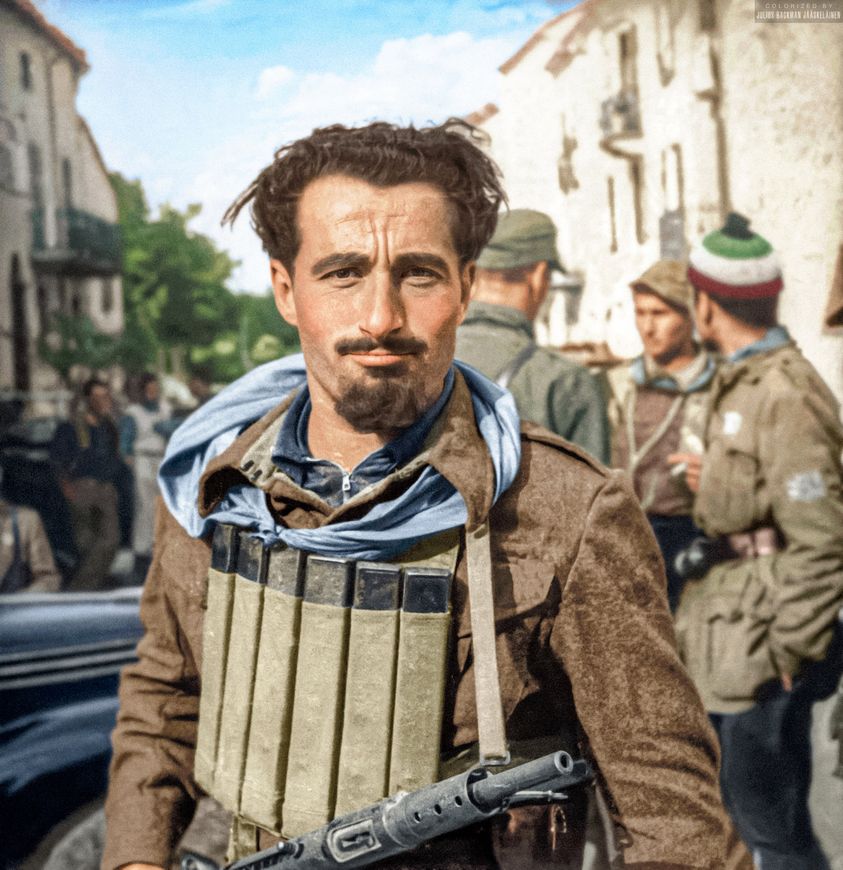
‘Partisan’ Stefano Candela known by his nickname ‘Eolo’, in his village of Piemonte, a region of Italy bordering France and Switzerland.
The region sits at the foot of the Alps in northernmost Italy. Photo was taken in October, 1944.
‘Partisan’ Stefano Candela known by his nickname ‘Eolo’, in his village of Piemonte, a region of Italy bordering France and Switzerland.

One does not see wood of this high a quality very often in these days of ugly plastic and the almighty profit line of todays so called firearms makers. That is why I try and buy such wonders to add to the collection. That is if and when my humble Gun Allowance & opportunity allows this Old Fart to pick one up.
| October 13, 2015
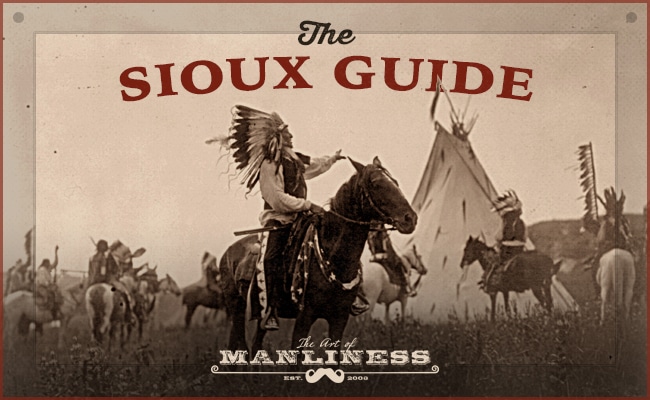
Charles Alexander Eastman was born in 1858 and raised as “Ohiyesa” to be a hunter and warrior in the traditional ways of the Santee Sioux. When he was almost 16 years old, he left tribal life to learn the culture of European-American civilization and earn his undergraduate and medical degrees. Eastman became a doctor, a tireless advocate for the rights of his people, and a writer of many works in which he sought to share the true ways of the American Indian. We previously shared Eastman’s insights on the Sioux ideal of manhood. Having laid that foundational overview, we will now offer a series of edited collections of Eastman’s writing on 3 specific subjects: situational awareness, physical and mental discipline, and spirituality.
First up: situational awareness. The life of the American Indian was a satisfying but precarious one. Natural and human dangers abounded. To watch for these threats, the Sioux selected certain men to serve as two types of scouts — one for hunting and one for war. Part of the job of the latter was to secrete themselves just outside the tribe’s village at night and listen and watch for potential enemies in the darkness; Eastman describes these nocturnal scouts as having “been so trained as to rival an owl or a cat in their ability to see in the dark.”
Yet beyond these appointed lookouts, “every Indian was a scout” and acted as “the immediate and unofficial guardians of our safety.” Every tribesman had to be extremely attuned to his environment in order to be an effective hunter and to guard against attacks from predators. As such, all young men were taught to be highly observant and to watch for the smallest changes in the environment. If they caught sight of a bear or a suspicious stranger while wandering in the woods, they knew how to “quickly pass the unspoken signal from boy to boy” and back to the village. The Sioux also cultivated an intuitive sense of how to navigate the wild, and the courage to traverse terrain in the dark of night.
Eastman dismissed the idea that the skills and kind of “sixth sense” possessed by his people were “instinctive and hereditary,” arguing that “all the stoicism and patience of the Indian are acquired traits, and continual practice alone makes him master of the art of woodcraft.” What kinds of training enabled the Sioux to become “alert and alive to everything” and to develop a heightened state of situational awareness? We now turn to Eastman’s words to offer his insights:
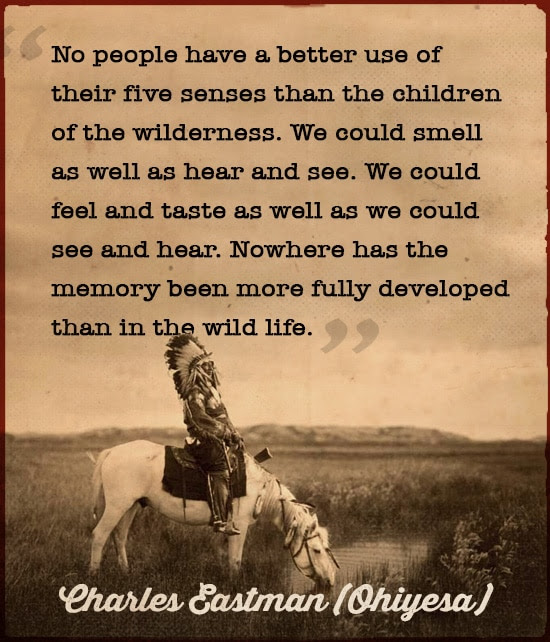
I will now ask you to enter the forest with me. First, scan the horizon and look deep into the blue vault above you, to adjust your nerves and the muscles of your eye, just as you do other muscles by stretching them. There is still another point. You have spread a blank upon the retina, and you have cleared the decks of your mind, your soul, for action.
We were close students of nature. We studied the habits of animals just as you study your books.

My uncle, who educated me up to the age of fifteen years, was a strict disciplinarian and a good teacher. When I left the teepee in the morning, he would say: “Hakadah, look closely to everything you see”; and at evening, on my return, he used often to catechize me for an hour or so.
“On which side of the trees is the lighter-colored bark? On which side do they have most regular branches?”
It was his custom to let me name all the new birds that I had seen during the day. I would name them according to the color or the shape of the bill or their song or the appearance and locality of the nest — in fact, anything about the bird that impressed me as a characteristic. I made many ridiculous errors, I must admit. He then usually informed me of the correct name. Occasionally I made a hit and this he would warmly commend.
He went much deeper into this science when I was a little older, that is, about the age of eight or nine years. He would say, for instance:
“How do you know that there are fish in yonder lake?”
“Because they jump out of the water for flies at mid-day.”
He would smile at my prompt but superficial reply.
“What do you think of the little pebbles grouped together under the shallow water? And what made the pretty curved marks in the sandy bottom and the little sand-banks? Where do you find the fish-eating birds? Have the inlet and the outlet of a lake anything to do with the question?”
He did not expect a correct reply at once to all the voluminous questions that he put to me on these occasions, but he meant to make me observant and a good student of nature.
“Hakadah,” he would say to me, “you ought to follow the example of the shunktokecha (wolf). Even when he is surprised and runs for his life, he will pause to take one more look at you before he enters his final retreat. So you must take a second look at everything you see.”
It was part of our hunting to find new and strange things in the woods. We examined the slightest sign of life; and if a bird had scratched the leaves off the ground, or a bear dragged up a root for his morning meal, we stopped to speculate on the time it was done. If we saw a large old tree with some scratches on its bark, we concluded that a bear or some raccoons must be living there. In that case we did not go any nearer than was necessary, but later reported the incident at home. An old deer-track would at once bring on a warm discussion as to whether it was the track of a buck or a doe. Generally, at noon, we met and compared our game, noting at the same time the peculiar characteristics of everything we had killed. It was not merely a hunt, for we combined with it the study of animal life.
Among the Indians, the study of human footprints was carried to a fine point. Many of us would be able to say at a glance, “Here goes So-and-So,” with perfect accuracy. Even the children would recognize instantly the footprint of a stranger from another tribe. I do not hesitate to say that faithful study of the language of footprints in all its details will be certain to develop your insight as well as your powers of observation.
The Indian youth was a born hunter. Every motion, every step expressed an inborn dignity and, at the same time, a depth of native caution. His moccasined foot fell like the velvet paw of a cat — noiselessly; his glittering black eyes scanned every object that appeared within their view. Not a bird, not even a chipmunk, escaped their piercing glance.
When in the evening the whippoorwill started his song with vim, no further than a stone’s throw from our tent in the woods, [my grandmother] would say to me:
“Hush! It may be an Ojibway scout!”
Again, when I waked at midnight, she would say:
“Do not cry! Hinakaga (the owl) is watching you from the tree-top.”
I usually covered up my head, for I had perfect faith in my grandmother’s admonitions, and she had given me a dreadful idea of this bird. It was one of her legends that a little boy was once standing just outside of the teepee (tent), crying vigorously for his mother, when Hinakaga swooped down in the darkness and carried the poor little fellow up into the trees. It was well known that the hoot of the owl was commonly imitated by Indian scouts when on the war-path. There had been dreadful massacres immediately following this call. Therefore it was deemed wise to impress the sound early upon the mind of the child.
I can scarcely recall the time when my stern teacher [Eastman’s uncle] began to give sudden war-whoops over my head in the morning while I was sound asleep. He expected me to leap up with perfect presence of mind, always ready to grasp a weapon of some sort and to give a shrill whoop in reply. If I was sleepy or startled and hardly knew what I was about, he would ridicule me and say that I need never expect to sell my scalp dear. Often he would vary these tactics by shooting off his gun just outside of the lodge while I was yet asleep, at the same time giving blood-curdling yells. After a time I became used to this.
It will be no exaggeration to say that the life of the Indian hunter was a life of fascination. From the moment that he lost sight of his rude home in the midst of the forest, his untutored mind lost itself in the myriad beauties and forces of nature. Yet he never forgot his personal danger from some lurking foe or savage beast, however absorbing was his passion for the chase.
It is true that our savage life was a precarious one, and full of dreadful catastrophes; however, this never prevented us from enjoying our sports to the fullest extent. As we left our teepees in the morning, we were never sure that our scalps would not dangle from a pole in the afternoon! It was an uncertain life, to be sure. Yet we observed that the fawns skipped and played happily while the gray wolves might be peeping forth from behind the hills, ready to tear them limb from limb.
Clear your mind of all dread and suspicion; this is the first step in the wilderness life. Think not the water will drown you, or that anything in the water or on land will bite or poison you. Have confidence in nature and yourself.
I will tell you how I was trained, as a boy, to overcome the terror of darkness and loneliness. My uncle, who was my first teacher, was accustomed to send me out from our night camp in search of water. As we lived a roving life in pursuit of game, my errand led me often into pathless and unfamiliar woods. While yet very young, all the manhood and self-reliance in me was called forth by this test.
You can imagine how I felt as I pushed forward alone into the blackness, conscious of real danger from possible wild beasts and lurking foes. How thrilling, how tantalizing the cry of the screech-owl! Even the rustling of a leaf or the snapping of a dry twig under foot sent a chill through my body. Novice that I was, I did not at once realize that it is as easy as swimming; all I needed was confidence in myself and in the elements.
As I hurried through the forest in the direction my uncle had indicated, there seemed gradually to develop sufficient light for me to distinguish the trees along my way. The return trip was easier. When, as often happened, he sent me for a second pailful, no protest or appeal escaped my lips. Instinct helped me, as he had foreseen, to follow the trail I had made, and the trees were already old acquaintances. I could hear my own breathing in the silence; my footfall and heartbeat sounded as though they were those of another person coming behind me, and while this disturbed me at first, I quickly became accustomed to it. Very soon I learned to distinguish different kinds of trees by the rustling of their leaves in the breeze which is caused by the stir of man or animal.
If you can accustom yourself to travel at night, how much more you will be able to see and appreciate in the daytime! You will become more sensible of the unseen presences all about you and understand better the communications of the wild creatures. Once you have thrown off the handicap of physical fear, there will develop a feeling of sympathetic warmth, unknown before.
How does he find his way so successfully in the pathless jungle without the aid of a compass? you ask. Well, it is no secret. In the first place, his vision is correct; and he is not merely conscious of what he sees, but also sub-consciously he observes the presence of any and all things within the range of his senses.
If you would learn his system, you must note the relative position of all objects, and especially the location of your camp in relation to river, lake, or mountain. The Indian is a close student of the topography of the country, and every landmark — hill, grove, or unusual tree — is noted and remembered. It is customary with the hunters and warriors to tell their stories of adventure most minutely, omitting no geographical and topographical details, so that the boy who has listened to such stories from babyhood can readily identify places he has never before seen.
This kind of knowledge is simple, and, like the everyday meal, it is properly digested and assimilated, and becomes a part of one’s self. It is this instant, intelligent recognition of every object within his vision in his daily roving, which fixes the primitive woodsman’s reckoning of time, distance, and direction.
Time is measured simply by the height of the sun. Shadow is the wild man’s dial; his own shadow is best. Hunger is a good guide when the sun is behind the clouds. Again, the distance traveled is an indicator, when one travels over known distances. In other words, he keeps his soul at one with the world about him, while the over-civilized man is trained to depend upon artificial means. He winds his watch, pins his thought to a chronometer, and disconnects himself from the world-current; then starts off on the well-beaten road. If he is compelled to cut across, he calls for a guide; in other words, he borrows or buys the mind of another.
The wild man has no chronometer, no yardstick, no unit of weight, no field-glass. He is himself a natural being in touch with nature. Some things he does, he scarcely knows why; certainly he could not explain them. His calculations are swift as a flash of lightning; best of all, they come out right!
Somebody who really knew what they were doing, did some mighty fancy checkering here! Grumpy
Plus somebody also put on a mighty nice looking skull cracker here!


Ensign Chekov of the StarShip Enterprise boldly proclaimed; every exciting technology encountered was Russian! We can say the same with Fedor Tokarev. This Comrade blended innovations from other autoloaders and triumphantly declared it was Russian.
The Tokarev 7.62x25mm Semi-automatic pistol was a prolific design, built by nearly every Warsaw Pact country. Some firearm enthusiasts, assume the Tokarev was crude and under-performing. This is a false assumption.
Russia does not mass-produce a firearm of any type, with polished slides or barrels, unless it is absolutely necessary. Russian firearms are mostly stamped steel frames and parts, and the firearms operate precisely as intended and last forever.
Tokarev designed his pistol in the early 1930s as a replacement for the 1895 Nagant revolver. The Tokarev beat out many lofty competitors, including Walther and Luger. Through the decades, they have manufactured the Tokarev in multiple countries, and each country has given the pistol its own special treatment.
Kirk and the crew would have been Proud!
Browning’s locked-breech was a significant influence, keeping the swinging link system of the Colt 1911. Production simplicity also influenced Tokarev’s design. Magazine production was simplified by eliminating the feed lips and machining them into the frame. Safeties were also done away with. Chekov would have been proud!
Russian firearm design principles revolved around production efficiency and easy maintenance on the battlefield. One feature many shooters like is that Tokarev built the hammer assembly for easy removal and cleaning. Given the harsh conditions in Russia, this was a necessity.
The Black Star or Model 54 Tokarev is an interesting variant of the Soviet version TT-33. This pistol got its unique name by its large embossed star on the black wooden grips.
We have an outstanding lot of “Black Star” pistols. These Chinese Type 54 Tokarev semi-auto pistols are chambered in the original 7.62x25mm caliber. Built by Norinco (North China Industries), they are in Very Good to Excellent condition. The Tokarev’s are C&R Eligible, and come with an 8 round magazine.

Chinese Type 54 Tokarev Pistol – C&R Eligible
Russia developed the 7.62x25mm Tokarev cartridge as a replacement for its long-standing C96 Mauser. The 7.62 is a powerful round with different muzzle velocities ranging from 1300 to 1800 fps. Experts consider the 7.62 an “over-penetrating” round for most home defense applications, which means the round may remain lethal even after penetrating its intended target
AllOutdoor gives this review of the 7.62x25mm, “The plus side of the load is its high penetration, sufficient to defeat car body panels and lower-level body armor. The downside is its high penetration, almost guaranteeing that the bullet will exit an unarmored opponent and keep going. That’s a liability.
Despite this potential problem, quite a few people carry pistols in 7.62×25. They are relatively inexpensive, robust, and have a dieselpunk style to them. The two most popular models are CZ vz.52, a roller-lock delayed blowback Czech pistol, and a TT33, a Soviet locked-breech design with very simple lockwork.”

Romanian TTC Tokarev – C&R Eligible
After World War II, the Soviets began their search for a compact pistol to replace the Tokarev. In 1951, they adopted the Makarov. Warsaw Pact countries used the Tokarev for several years, which led to production outside the Soviet Union.
Classic Firearms offers several fine examples of Tokarev pistol chambered in 7.62x25mm cartridges and produced outside of Russia, including:
Type 51 Tokarevs were built with a combination of Russia and Chinese parts in China. It is likely the Soviets supplied much of the production machinery to China. Any type 51 pistols are those that were likely brought home by GIs during the Korean War.
Type 54 pistols were built entirely in China. Production of the type 54 appears to have started around 1955 and continued until 1985. It is logical to assume (Spock raises his pointed ears at this assumption), single acquisition, Type 54 pistols found in the United States were manufactured between 1966 and 1967. Most of these Tokarevs were VietNam War Trophies.
China and North Korea’s relationship extended to the manufacture of Tokarevs. These pistols have designations of either Type 66 or 68, and closely resemble the TT-33. However, slides are shorter with a beavertail extension at the rear. North Korean Tokarevs incorporate linkless systems, similar to the Browning High-Power.
We rarely see North Korean Tokarevs in America; if one does show up, collectors snap them up in a time-warp.
Another Tokarev for collectors to look at, the Tokagypt. (I am not making that name up) Tokagypts were manufactured in Egypt, and by all accounts were well-made and very reliable pistols. The original contract called for 30,000 pistols; however, only half were delivered. Significant differences from the TT-33 model; Tokagypts were chambered in only 9x19mm, and featured a thumb safety and a wrap-around grip.

The Yugoslavian M57 TT Tokarev Pistol
The Tokarev is an impressive handgun, given the fact it is almost 100 years old. The pistol is an excellent value for the money; with good build quality and excellent durability. This economical pistol is designed for hard military use, and is perfectly capable of being used for recreational shooting.
Externally, the Tokarev looks very similar to the Colt 1911, with many shooters thinking it is just a modified version. There are a few significant differences. Hammer and sear is simpler than the 1911, with the hammer being external. The feed ramp is machined into the receiver, rather than part of the barrel, among other differences.
Tokarev’s 7.62x25mm round usually performs best with light loads, the 85 to 90 grain work best. The cartridge is fast and has a lot of energy. The 7.62 is a level 2 armor piercing round, but like I said earlier, it can over-penetrate with higher loads. The 7.62 is hard to compare with other ammunition, but overall it is a very good round.
Tokarev’s design, like many others of the day, has lasted decades and is quickly moving into its second century as a firearm that is still effective and viable. Firearm inventors of the day felt function over form was the key to a great firearm and history has proven them right. A great design never goes out of style.


