Categories
Categories
Belgian Browning Hi Power: YES!
Categories
What Happened To The 308 Winchester?

WASHINGTON (AP) — The Supreme Court ruling expanding gun rights threatens to upend firearms restrictions across the country as activists wage court battles over everything from bans on AR-15-style guns to age limits.
The decision handed down in June already has led one judge to temporarily block a Colorado town from enforcing a ban on the sale and possession of certain semi-automatic weapons.
The first major gun decision in more than a decade, the ruling could dramatically reshape gun laws in the U.S. even as a series of horrific mass shootings pushes the issue back into the headlines.
“The gun rights movement has been given a weapon of mass destruction, and it will annihilate approximately 75% of the gun laws eventually,” said Evan Nappen, a New Jersey gun rights attorney.
The court battles come as the Biden administration and police departments across the U.S. struggle to combat a surge in violent crime and mass shootings, including several high-profile killings carried out by suspects who purchased their guns legally.
And given the sheer number of cases now working through the courts, a lot more time will be spent in courtrooms no matter who wins.
“We will see a lot of tax dollars and government resources that should be used to stop gun crime being used to defend gun laws that are lifesaving and wildly popular,” said Jonathan Lowry, chief counsel and vice president at Brady, the gun control group.
Congress broke through years of deadlock to pass a modest gun violence prevention package weeks ago, and the House voted to renew a ban on high-powered semi-automatic weapons, though that effort is likely doomed in the Senate as Republicans push back on firearms restrictions and say recent spikes in gun violence should be met with a stepped-up police response.
The Supreme Court decision struck down a New York law requiring people to demonstrate a particular need to get a license to carry a concealed gun in public, saying it violates Second Amendment rights. Several other states including California, Hawaii, Maryland, Massachusetts, New Jersey and Rhode Island have similar laws expected to be directly impacted by the ruling.
In Massachusetts, for example, police chiefs can no longer deny or impose restrictions on licenses just because the applicant doesn’t have a “good reason” to carry a gun. New York quickly passed a new concealed-weapon law, but Republicans there predict it will also end up being overturned.
In its New York ruling, the high court’s conservative majority also changed a test lower courts had used for evaluating challenges to gun laws.
Judges should no longer consider whether the law serves public interests like enhancing public safety, the opinion authored by Justice Clarence Thomas said. Instead, they should only weigh whether the law is “consistent with the Second Amendment’s text and historical understanding.”
“Basically, the Supreme Court has given an invitation for the gun lobby to file lawsuits against virtually every gun law in America,” Lowry said.
The Supreme Court has ordered lower courts to take another look at several other cases under the court’s new test. Among them: laws in California and New Jersey that limit the amount of ammunition a gun magazine can hold and a 2013 ban on “assault weapons” in Maryland.
Gun rights groups are also challenging similar bans in California, New York, New Jersey and Delaware.
“The rifles at issue in this case are the sorts of bearable arms in common use for lawful purposes that responsible and peaceable people across the United States possess by the millions. And they are, moreover, exactly what they would bring to service in militia duty, should such be necessary,” a New Jersey lawsuit brought in June by the Firearms Policy Coalition says, referencing the language of the Second Amendment.
The ruling also has come up in challenges to restrictions on gun possession for 18- to 20-year-olds in Texas and Pennsylvania. And it has been cited in a case challenging a federal ban on gun possession for people convicted of nonviolent crimes punishable by more than a year behind bars, as well as a prohibition on concealed guns on the subway in Washington, D.C.
In addition, a gun rights group is suing Colorado over the state’s 2013 ban on magazines that hold more than 15 rounds, saying the high court ruling reinforces the group’s argument that it infringes on Second Amendment rights. And the ruling has public defenders in New York City asking judges to drop gun possession cases.
Not all those lawsuits will necessarily be successful. The Texas attorney general, for example, argues the Supreme Court ruling doesn’t affect the state’s age limit law, and more state and local governments can certainly defend their gun laws as being in line with U.S. history.
Adam Skaggs, chief counsel and policy director at the Giffords Law Center to Prevent Gun Violence, predicted that when the dust settles, only laws “along the margins” will eventually be struck down.
“Most judges are going to see these for what they are, which is overreaching and lacking in any merit,” he said.
Backers of gun restrictions can also look to a concurring opinion from Justice Brett Kavanaugh.
Joined by Chief Justice John Roberts, Kavanaugh stressed that the Second Amendment does allow for a “variety” of gun regulations. He cited the use of background checks and mental health records as part of a licensing process to carry a gun and noted that states can forbid the carrying of firearms in “sensitive places” such as schools and government buildings.
But the Colorado decision handed down last month, while still early in the process, was a rosy sign for gun rights groups.
U.S. District Court Judge Raymond Moore, who was nominated by President Barack Obama, said he was sympathetic to the town’s goal of preventing mass shootings like the one that killed 10 people at a grocery store in nearby Boulder last year. But Moore said he didn’t know of “historical precedent” for a law banning “a type of weapon that is commonly used by law-abiding citizens for lawful purposes,” so the gun rights groups have a strong case against the ordinance.
Encouraged by that decision, Taylor D. Rhodes, the executive director of the Rocky Mountain Gun Owners, told The Associated Press that his group was considering going after other gun measures in Colorado, where Democrats hold the majority in the state legislature and the governor’s office.
Referring to the Supreme Court’s ruling, Rhodes said: “The Bruen decision gave us a 4-ton wrecking ball.”
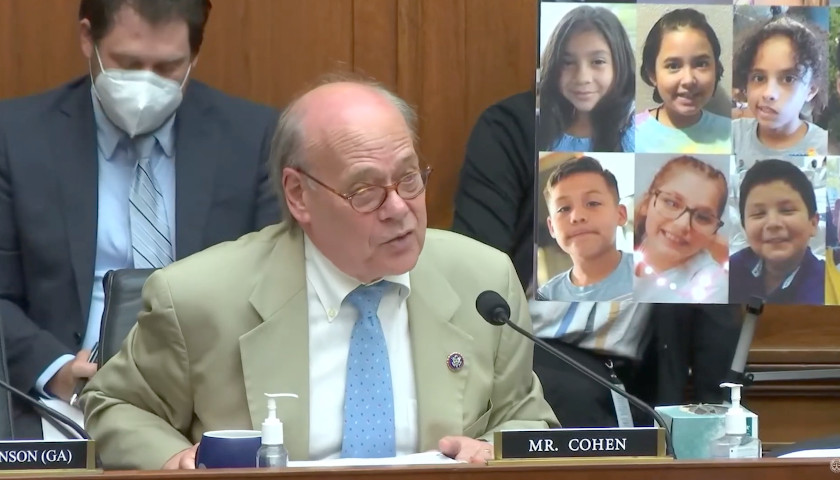
U.S. Representative Steve Cohen (D-TN-09) voted to advance legislation banning “assault weapons.” He touted his vote during House Judiciary Committee debate last week.
Cohen, a senior member of the Judiciary Committee, voted on July 20 to advance an “assault weapons ban” to the full House of Representatives.
During debate on the legislation, Cohen castigated Republican colleagues for opposing the ban, “arguing their defense of such weapons involves the anticipation of a civil war.”
In his remarks, he referred to House Judiciary Committee members Greg Steube (R-FL-17) and Chip Roy (R-TX-21).
“It was quite interesting what we heard from Mr. Steube about first accusing Democrats, wrongly, about being for de-funding the police, then they give all of the reasons why we don’t need the police because everybody in their districts has a gun and is saving somebody every other day. Who needs police when you’ve got Steube’s constituents?” he said.
“Mr. Chip Roy really put out what this is about: Many people on that side, and their constituents, sincerely think they need a gun to protect themselves against the government. They are ready for civil war … and when it almost came, they were on the wrong side,” Cohen later added.
The Tennessee Star previously reported that Cohen had been pushing for an “assault weapons ban” since June and promoted the idea that he is working with fellow Democrats to pass one.
Cohen’s office issued a press statement in June, discussing how he urged his colleagues to advance the Protect Our Kids Act and advocated a ban on “assault weapons.”
“Assault weapons were banned from 1994 to 2004. It was constitutionally permissible. It wasn’t until 2008 in the Heller decision when Justice Scalia said people have the right, based on the Second Amendment, to protect their homes with reasonable weapons. … The Second Amendment, like the First, is not absolute. … There are limits to the Second Amendment and assault weapons are one of those limits that we had for 10 years and during that time we had less mass killings in this country, and we should have it again,” he said during a meeting of the House Judiciary Committee.
He also tweeted about the issue, saying, “We need to ban assault weapons and I look forward to working with @RepCicilline to pass it.”
“There is something gun-crazed about our country that we need to deal with,” he additionally said in another tweet.
– – –
Aaron Gulbransen is a reporter at The Tennessee Star and The Star News Network. Email tips to agulbransen@gmail.com. Follow Aaron on GETTR, Twitter, Truth Social, and Parler.