
Categories
Russian Rifles of World War 1

As the wind swirled on the plateau I caught the smell of death. With the smell’s strength wavering between faint and nauseating, I kept working into the wind in the thick timber to locate its source. My eye caught movement directly in front of me about 20 yards into the brush and my hand dropped to the grip of my pistol as my brain registered what my eyes were seeing. A chocolate color phased black bear, gaining speed straight towards me.

Let me start from the beginning. The date is August 31, 2021. My client has been with me since the opening day of archery season and has hunted with a bow a long time. He was born in 1947 and has never killed a big bull elk— we are working on making that happen. Over the past couple of days, he has had some good opportunities but hasn’t let an arrow off its leash— waiting for the perfect shot.
On this morning, he is sitting a stand over a wallow by himself. The wind stays steady and elk come through the wallow in small groups until a mature six-point hits the water alone. The bow is drawn and the arrow released. My client texts me on his Garmin InReach and tells me he’s shot and it was a good hit. As soon as I get the message I start gearing up.
My tracking kit includes two GPS’s, a radio, flagging, binoculars, some hydrogen peroxide in a spray bottle, and a gun. Back in 2017 in this same part of the woods, an elderly client was following his guide who was blood trailing an elk when the hunter felt something was behind him. He turned to see a bear also following the blood trail and was able to get an arrow knocked, drawn, and fired into the bear. While mountain lions, bears, and wayward humans are not a common threat, I still consider it a responsibility to carry a gun while in the woods. I might need to shoot something.
Typically I bring a Marlin 45-70 with 400-grain hard cast gas checks. The rifle has a ghost ring peep sight and a section of rail attached to the side of the barrel near the end of the magazine tube where I have a 400-lumen Streamlight attached. The light is positioned in a way that it illuminates my front sight post in its halo, so if I have to shoot in the dark I at least know which way the gun is pointing.
But, I am not immune to making comfort-based decisions. Guiding early-season includes brutal hours. I am up by 0330 to prep gear, make coffee, wake up clients and get into the field well before shooting light. Evening hunts are followed by dinner and clean-up, and I’m not done until 2300 at night, even later if we kill an elk in the evening and need to get him packed out and hanging. As it happened, we had killed a big 6 point bull the night before and I was running on little sleep.
As I’m lacing up my boots I look at the gun options on the bench near the door of the lodge. I refer to them as casual, business, and emergency. Casual is my Sig P365 9mm. It is the standard P365 slide on the XL frame with a 12 round magazine. Emergency is the 45-70. Business is a P220 hunter in 10mm. Mine is a bit of a frankengun. The frame is finished in Kryptek while the slide is finished in First Lite. I wanted a slide that was cut for the new Romeo 2 red dot and this was the only one available. The Romeo2 is the only reflex sight from Sig that is enclosed and can survive the beating issued from the recoil of the 10mm. The enclosure makes it possible for outdoorsmen to actually use this sight, otherwise, a single drop of rain or a pine needle can block the red dot, making it useless.
Based on the information I have at the moment, a good shot has been made by an experienced hunter and I should just be going to recover an elk that didn’t go very far. So I choose my 10mm and head out the door.
Twenty yards from the wallow I find a single drop of blood mixed with the tracks of 100 head of elk. No arrow. No more blood. My apprentice guide, Aaron, the hunter, and I begin gridding. We find lung blood 200 yards later and start working hard on hands and knees, picking up a drop or two of blood every fifty yards or so. Mostly we track the bull by the extra weight he puts on his front right hoof.

Three hours into the trail I hear a raven and leave Aaron to work the trail while I go to investigate, hoping to get lucky. As I get closer I hear more ravens calling and start to pick up the sound of their wing beats and then smell the unmistakable odor of death.
I know this isn’t the bull I’ve been after, this is old stinky death. I still want to know what it was, and as I work my way into the wind I see the bear.
It’s hard to describe how it was moving. To begin with, it was popping up and down in a gallop and as it did so it appeared to be making up its mind to charge flat out. I drew my pistol and as soon as I saw the red dot with brown hair behind it I pulled the trigger. The bear stopped, roared, and spun as I fired again. At the impact of the second shot, it fell flat dead. The 180 grain V Crown had punched a hole through its heart.

I immediately started looking around for cubs or other threats as the adrenaline flooded. My breathing got heavy and my hands shook. I dead-checked the bear then went into the brush where it had come from and discovered a dead mature 5×6 bull elk with some of his velvet still on. My guess is he had died about 10 days earlier.
I had a fall bear tag in my pocket so I punched it. I called Aaron on the radio to let him know what was going on and we backed off the bull we had been tracking to give him more time. A few hours later we came back and found the elk who had been hit in one lung and died roughly 1/4 mile from where he had been shot. A beautiful 6×6 that was as full of character as the hunter who had killed him.

My thoughts on carrying a gun while bow hunting or guiding haven’t changed much since this bear charge, but rather have reinforced them.
First, carry a damn gun.
Secondly, there is a phrase in motorcycle riding regarding gear— “dress for the wreck.” This applies to backcountry carry as well. The gun you pick has to be convenient enough that you will bring it with you, but it also has to be capable of doing the job. The P365 has unmatched convenience, but once you are in a gunfight with a bear, do you want to have that or the heavier full-framed 10mm? I’m team 10mil on that one. Hindsight being what it is, I would still choose the 10mil over my 45-70 carbine for speed, and in this case, speed mattered. This bear died 8 yards away from me. They cover that distance in less than a second.
Third, get trained and keep training. I draw my pistol a lot. I have the same ammo struggles as everyone else so I can’t stand on the range and bang steel all day. The standard I train to is to be able to see a target, draw and have a good grip on the gun with the dot on the target in about 1 second. I practice that a couple of times every time I put the gun on. I owe a lot to Daniel Horner, who taught me grip and stance in a way that kept that bear from getting any closer.
Lastly, in selecting your carry pistol for hunting I suggest some additional criteria. Get a gun with a grip angle that matches your body. Carry it in a way you can access it quickly. Chest holsters are a great option when you are carrying a pack. If it’s inside your pack it might as well be a rock. Don’t stress about magazine capacity, it’s going to be over with before you get to the bottom of a single stack, one way or another. Carry the gun with a round in the chamber. I didn’t have time to rack the slide.
Stay vigilant out there folks. These animals aren’t civilized.



Hello and Welcome from an old campaigner …..
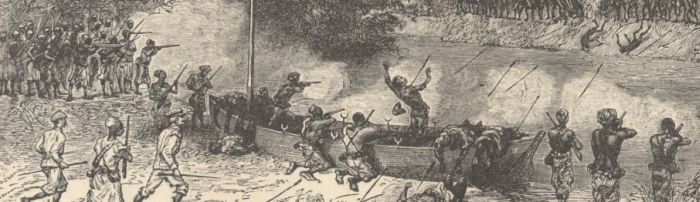 |
Here is a collection of military tales mostly based upon the activities of officers and men from the British County Regiments who came to Africa to do their duty as they understood it had to be done.
There is also some description of events during the Great War in Africa, and details of war-time units raised within the continent. Most of these accounts have been published in regimental and museum newsletters and journals.
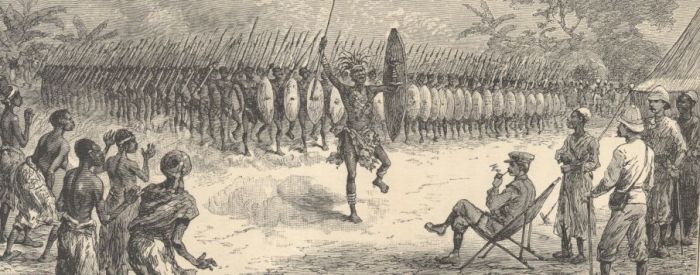
Some constant themes run through accounts of fighting in Africa:
–The ferocity of the fight – killing is the only thing that counts.
–Administrative problems, particularly the provision of water and the vulnerability of lines of communication, often determine tactics.
–Much of the terrain dictates that infantrymen do the fighting – armour, field artillery and aircraft may be useful but their presence involves costly technical support.
–Tribal custom and belief can win or lose the day.
–The local enemy leader does not burden his mind with complications such as taking prisoners or evacuating casualties.
–Africa always wins – the invaders or colonizers in the end acquiesce.
 |
During 50 years of observing campaigns in Africa – mercenary insertions, tribal conflicts, colonial actions, and liberation struggles – it is noticeable that nothing much changes.
As you read these words some army somewhere in Africa, probably equipped with very basic weapons, will be fighting and killing.
That is how it is.
So sit back and savour some military moments from the past.
After a particularly rough battle in Africa Sir Henry Newboldt wrote in his poem “Vitai Lampada”:
“The sand of the desert is sodden red,
Red with the wreck of a square that broke;
The Gatling’s jammed and the colonel dead,
And the regiment blind with dust and smoke.
The river of death has brimmed his banks,
And England’s far, and Honor a name,
But the voice of a schoolboy rallies the ranks,
“Play up! play up! and play the game!””
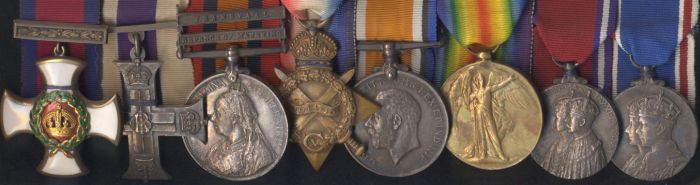 |
| Above: The Medals of Major E.W. Hunt DSO, MC. Major Hunt was an old Africa campaigner, besieged with Baden Powell at Mafeking he later fought in German South West Africa then German East Africa. |
Harry’s Wars in Africa
–Egypt 1882: Wolseley leads his men from Alexandria to Tel-El-Kebir
–Angoniland Rebellion: Nyasaland 1898-99
–Gambia 1866: A Victoria Cross for Samuel Hodge, serving with the 4th West India regiment
— The Yoni Campaign: Sierra Leone 1887-88
–Witu 1890: A punitive expedition in East Africa
–The Jebu War: Nigeria 1892
–Bronkhorst Spruit: The first shots of the 1880-1881 Transvaal war are fired.
–Rejaf 1897: A battle in the Congo Free State
–Taita Hills: A punitive expedition in 1898
–Bechuanaland: Fighting an epidemic, then fighting a battle
—Mafia Island: A Battle in an exotic location off the coast of GEA
–The Lake Chad area: The men of the Nigeria Regiment take WW1 up onto Mora Mountain
–The fight for Zuganatto bridge: Baron Eric von Otter of the 3rd King’s African Rifles wins the Military Cross
–A Final Volley! : Major Harold Walter Gooch Meyer Griffith, The Loyal North Lancashire Regiment was killed in Action in Kamerun in 1915, at the same time winning the French Croix de guerre
— Bweho-Chini: Bayonets in the bush then medals all around in a gallant action in German East Africa in 1917
— The East Africa Police Service Battalion: Policemen mobilised against the Schutztruppe.
— The Baganda Rifles: Ugandan hunters fighting in German East Africa
— Ross’s Scouts: Major Charles Ross DSO, leads a scouting commando in German East Africa.
–We have got the Maxim Gun: Captain A.J. Pott DCM took part in the campaign in Darfur 1916 including the battle at Beringia
–Longido Mountain 1915: Lieutenant Thomas Wilson wins an MC for cool machine gun work during an abortive attack
—The Narungombe water holes: Lieutenant John Lawrence Leslie-Smith, originally of The Border regiment, won the Military Cross while fighting with the Gold Coast regiment in the Kilwa – Lindi region in German East Africa
–Lukuledi Mission: Fighting in German East Africa 1917
–The fight at Kisii: British East Africa in September 1914
–A Cameroons campaign Victoria Cross: Captain Butler’s action in the Cameroons, 1914
–The road to Tunduru: The death of Lt. C.W. Walser, Kings African Rifles.
–Gambia 1891-2: A Victoria Cross for William James Gordon of the West India Regiment
—Barton’s Battalion: Captain Charles Walter Barton and the men of the 1KAR in Nyasaland and Portuguese East Africa 1918
–Somaliland 1884-1898: The early years on the Horn of Africa
–Somaliland 1901: The fighting continues
–Suez 1914-15: Turks across the canal!
— Van Deventer’s Scouts: Captain W.A. Bloomfield, an East African VC
— The Ugandan Railway Volunteer Reserve: Guarding the rails in 1914
— The Magadi Defence Force: A fantastically obscure bit of 1914 history. HERE
— The Gambia Company: German Kamerun 1914-16
— The Northern Rhodesian Rifles: Mobile Units 1914-16
— The 15th Ludhiana Sikhs and the Senussi: The Egyptian Western Desert, 1915-16
–Togoland 1914: If you blinked… you missed it. The lightning campaign in Togoland 1914
— The Uganda Volunteer Reserve: Uganda 1914-1916
— Cole’s Scouts: Somali Scouts, one of the exotic units that Makes Harry’s Africa so unique
— Kikarunga Hill: The death of Capt Butler VC DSO
— Kamerun, 1914: The attacks on Yabasi, October 1914
— Captain Arnold Wienholt, DSO MC and Bar: Bush Scout and Intelligence Officer
— Machine Gunner!: The East African MG Coy
–The advance from Port Amelia: The Gold Coast Regiment in Portugese East Africa 1918
— British East Africa, 1913: The last Prewar DSO and more…
— Somaliland Camel Corps: 1921-1925
–Juba River, 1893: Initial British clashes with the Somalis of Jubaland
— Malangali 1916: The Union Central African Imperial Service Contingent
–Lioma, August 1918: The Final Great War Battle for the 1st Battalion of the 1st Regiment of the King’s African Rifles
–Northern Rhodesia 1914 – 1915: Northern Rhodesian Policemen and Belgian Askaris against von Lettow-Vorbeck’s Schutztruppe
— BSAP Special Reserve Companies: Southern Rhodesia responds to German aggression on the Northern Rhodesia border
— The Rhodesia Native Regiment: German East Africa 1916
— Cape Corps in Battle: The 1st Cape Corps in German East Africa 1916-17
— Southern German East Africa: The Operations in October 1916
— Narunyu 1917 : The King’s African Rifles in GEA 1917
— Kibata: German East Africa 1916-17, The 129th Duke of Connaught’s own Baluchis
— Blockade Breakers: German supply ships to German East Africa
— Uganda 1902-1913 : Military Operations in Central and North-Western Uganda
— SE of Lake Victoria : Nyanza 1915
— Potuguese Offensive GEA: The Kionga Triangle and Newala
— From Rumbo to the Rovuma River : The Nyasaland-recruited 2nd Battalion of the 2nd Regiment of the King’s African Rifles in action during 1917 HERE
— Loyal North Lancs MGC Part 1: German East Africa October 1915 to April 1916 HERE
— Loyal North Lancs MGC Part 2: German East Africa May to December 1916 HERE
— The “Mad Mullah” : The Second British Campaign in Somaliland against the “Mad Mullah”
— The “Mad Mullah” 1902-03 : The Third Campaign in Somaliland
— The Fight at Lubemba Point : Lake Victoria, 1915
— African Odyssey: The eventful life and death of Major Herbert Augustine Carter VC
— Advance into German East Africa: Indian Army Units 1916
— Somaliland 1903-04: The fourth Campaign against the Mad Mullah
— Somaliland Camel Corps: Defending British Somaliland – 1940
— Punjabis in Somaliland: July 1940 – March 1941 The Italian Invasion and British Re-occupation of British Somaliland
—Somaliland 1905 – 1913 : Military activities in the Somaliland Protectorate from 1905 to 1907
— Shimber Berris — The raising and first operations of the Somaliland Camel Corps November 1914 to February 1915
— British East Africa: the 29th Punjabis in September – December 1914
— British Somaliland : Minor operations against the “Mad Mullah” March 1915-October 1919
— East Africa : The 2nd Battalion The Loyal North Lancashire Regiment in East Africa 1914-1917
— British Somaliland: The final campaign against the “Mad Mullah” 1920
–British and German East Africa 1915-16: The Mounted Infantry Company
— Kenya 1940 : East African troops Skirmish on the Border with the Italian Army
— Operation LINE: The road from Majunga to Tananarive
— German East Africa – The 3rd Battalion of 2nd King’s African Rifles in German East Africa in 1917
Mentioned in Despatches – MIDs for the Great War Campaigns in West Africa, Togo and Kamerun
The intellectual property associated with Harry’s Africa is owned by Harry Fecitt MBE TD. Please acknowledge Harry’s Africa should you wish to use any of the written material displayed here.