Practically every soldier I have written about, I have made them airborne, and sent them to the 82nd Airborne Division. I have said that they are a cut above – elite, and they are. I will continue to recommend to anyone, man or woman, considering enlisting in the Army to take the “airborne option”. Some may say that the 82nd is simply a Light Infantry Division that jumps out of airplanes, once on the ground they work the same way as any other light infantry division.
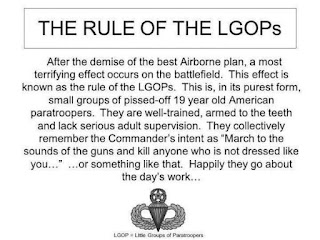
The 82nd is just better trained because they are always on alert. No, once on the ground, they work differently. I have previously written about the trust and confidence the US Army has in individual soldiers. Nowhere is that more prominent than in the airborne units. The Airborne community has a sacred term – LGOPS (Little Groups of Paratroopers).
One the first things a Paratrooper is taught is the Rule of LGOPs. The story goes something like this: On the drop zone there is chaos; collections of around ten Paratroopers form. They are well trained, highly motivated 18-25 year-olds who are armed to the teeth, lack effective adult supervision, and remember the Commander’s intent as, “March towards the sound of the guns and kill anyone not dressed like you,” or something close to that. Happily they go about their work.
In July 1943, the first night mass parachute jump was conducted in Operation Husky, the invasion of Sicily. Then Colonel James M Gavin led the 505th Parachute Infantry Regiment, with the 3rd Battalion, 504th attached. Winds increased to 35 to 45 miles per hour just before the jump, but it was too late to cancel. They were already in the air approaching their drop zones. Planes were blown wildly off course and some gliders crashed.
Less than half of the paratroopers reached their rally points. The troops knew not only their unit mission, they knew the overall mission. When a small group of paratroopers got together they went into action. They cut every telephone line they found, they conducted ambushes and raids, and they accomplished every objective. That is where the 504th Parachute Infantry Regiment got their name “Devils in Baggy Pants”. The passage in a German Majors’ diary read; “American parachutists … devils in baggy pants … are less than 100 meters from my outpost line, I can’t sleep at night, they pop up from nowhere and we never know when or how they will strike next. Seems like the black hearted devils are everywhere …”.
In England, in 1944, training for the D-day invasion, the 18th Airborne Corps Commander, Major General Matthew Ridgeway, with the experience of the Italian operations, directed that the 82nd and the 101st Airborne Divisions conduct night jumps, which they did until injuries became too numerous.
Then they trucked the troops out into the training area, at night, and mixed them up. They also had intramural athletics, baseball, basketball, soccer, and flag football, but they couldn’t play unit against unit. They had to be mixed up, such as four players from B Company, 2nd Battalion, four from A Company, 1st Battalion, and four from D Company, 3rd Battalion. The idea was not only to get know troops from other units, but so they would learn to trust each other, because they knew there was a good possibility that the troops would be scattered in the jump.
The D-day invasion was led by the 82nd and the 101st Airborne Divisions, during the night of June 5th, 1944. Drop zones were missed; aircraft full of Troops were shot out of the sky; the fog of war that the US Army Air Corps faced over France directly contributed to creating LGOPs on the ground. These Paratroopers banded together, often creating teams of men from different companies, brigades, or even divisions.
In route to their rally points, these little groups of Paratroopers caused havoc behind the German lines by setting roadblocks and impromptu ambushes with the effect that many German commanders thought that they were facing a much larger force than what was actually there.
The mentality of a typical Airborne Soldier lends itself to an attitude of doing whatever it takes to accomplish the mission, facing any obstacle, and, most importantly, bravery because they have experience in overcoming a natural human fear: acrophobia, or the fear of heights.
For this reason, most paratroopers consider themselves better than others, because they have come face to face with their own mortality. The air is less forgiving than the sea, and if you find yourself in a situation where your main and reserve parachutes have failed, then you have the rest of your life to figure out how to deploy one of them.
They are a restless group who don’t take well to ambiguous direction or wasted time. This can be seen with the Operations tempo of airborne units. Often it feels as if the command is trying to force 36 hours of duties and responsibilities into a 24 hour day. And, as much as they complain and bitch, paratroopers love it. When they walk down the street, there is a swagger; that maroon beret looks better on their heads than a black beret looks on a leg’s because they have a sense that they earned it. In paratrooper language a “leg” is a sub-human soldier who is not Airborne. There is an intensity about how they carry out even simple tasks because, let’s face it, after you have jumped out of an aircraft while in flight, life is a little different and doing things half-assed just doesn’t make sense.
In training, with no enemy shooting at you, night jumps are, for some, less stressful than day jumps, because you can’t see anything, no ground or horizon. Inside the big jets you can hear, but in the C-130, which will forever be used to drop paratroopers, because it will carry 60 jumpers, and it will fly like a fighter, you can barely hear the person sitting next to you.
The C-130 is a four engine turbo prop – noisy. Jumpers are seated on red canvas seats along the wall of the fuselage and two rows, back to back, in the center. Parachute on your back, reserve on your chest, rucksack in a bag under your reserve, and your rifle in a canvas bag strapped to your side. Constant smell of exhausted jet fuel. Barf bags are issued. I never threw up on a plane, don’t know why, sat next to several who did.
The lights are on inside the airplane, because the jumpmasters must conduct their safety checks. The pilots have slowed the plane to 120 knots, and leveled off at 1,200 feet, if it was an actual combat jump it would be 800 feet, or less. When 10 minutes out, the jumpmaster gives the warning “TEN MINUTES”. OK, wake up get ready. The next command from the jumpmaster is; “GET READY”, then, “OUTBOARD PERSONNEL STAND UP’. That takes a minute or two, you’ve got 150 pounds plus of stuff strapped onto your body, you have to get up, turn around, unlatch your seat from the floor, fold it up and hook it. Then “INBOARD PERSONNEL STAND UP”. Next, “HOOK UP’. At that time outboard and inboard personnel form single lines on each side of the aircraft, and hook their static lines to a cable running along the wall of the fuselage. Then, “CHECK STATIC LINES”. Make sure your static line and the one on the jumper in front of you is straight and where it should be. Then, “CHECK EQUIPMENT”. Make sure everything is secure – adjust crotch. There are two jumpmasters, a primary and an assistant, plus two jumpmaster qualified safeties, who are at that time checking everybody. Then, ‘SOUND OFF FOR EQUIPMENT CHECK”. The last jumper, on each side, slaps the butt of the jumper in front of them and sound off with OK, which goes up the line until the two jumpers standing in front of the jumpmasters yell OK. The jumpmaster then commands “STAND BY”. Around that time the Air Force Loadmasters raise both doors and fold out a step plate at each door. Then you really hear the engines and rush of the blast. There is a light, about an inch and a half in diameter, beside each door, they have been red all the time. A jumpmaster is at each door, they have checked the surfaces of the doors for any irregularities. Each jumpmaster has a grip on the first jumper at his door, and he is watching the light. GREEN LIGHT!! Each jumpmaster commands “GO!”, and releases his jumper.
Everyone quickly shuffles to the door, there is no hesitation, just get out the door. I have been on full combat equipment jumps into unknown drop zones, when everybody couldn’t get out. The pilot ran out of drop zone and turned on the red light, had to circle around and make another pass over the crop zone, you’re standing, hooked up, with one hand holding your static line. As the plane banks and turns, your load gets heavier, the thought crosses your mind “just let me out”.
You step out, elbows tucked into your sides, hands on your reserve, feet and knees together, head down, chin on chest, a good tight body position. You count, one thousand one, one thousand two, one thousand three, one thousand four, you feel that great comforting tug of your main canopy opening. You reach up and grab the risers, and you look up into your canopy to make sure it is OK. You check for jumpers around you, if there is no moon, you won’t see them until you are really close.
Clean air, the planes move on, silence. In a few seconds, you drop the bag with your rucksack, it hangs on a line about 20 feet below you. At night, you can sense the ground, but you can’t tell for sure, you take up a good “prepare to land attitude”, feet and knees together, relax, face the parachute into the wind, don’t look for the ground. Landings are not soft, like sky divers. You try for a good parachute landing fall (PLF), balls of the feet, calf of your leg, thigh, buttocks, and push up muscle.
Down, WOW, good jump, don’t waste time, get out of that harness, get your weapon bag off, get your weapon out, and get your ruck sack. This is not combat, so you’ve got to turn in all that stuff. You “S-roll” your parachute, stuff it in the kit bag, attach your weapon bag, throw them on your back on top of your ruck and double time (trot) off the drop zone, and look for the turn in point.
Another good one in your jump log. GO AIRBORNE! ALL THE WAY!