By Rob Morse
Lies come in many shapes and sizes. Some are simple exaggerations. Some are absurd falsehoods. Unfortunately, we tend to believe a plain, bold-faced lie if it’s expressed with enough emotion. That’s the same kind thing keeps viewers watching and clicking so the press is often more interested in outrage than in the truth.
A lie doesn’t become the truth no matter how many times it’s repeated, but the lie may help politicians get re-elected if it’s repeated often enough and believed by enough likely voters. We need to call out every lie we see even if that means calling some of our “respected elected officials” liars.
Congressman Jamaal Brown, you are a liar. Representative Jimmy Gomez, you are a liar. You both lie when you say that you want to save lives, and claim that gun-control laws will actually protect our kids. That’s an easily provable falsehood that both of you continue to repeat.
Why do politicians hide the truth behind their emotional outbursts? The simple answer is that it helps them get what they want most…namely press coverage and campaign contributions.
Democrat Congressman Jimmy Gomez of California said that Republicans should resign from office if they are not going to pass more gun-control legislation.
Democrat Representative Jamaal Bowman of New York yelled at reporters that “Republicans won’t do sh!t when it comes to gun violence.”
Implied in both of those statements is the lie that gun-control laws actually save lives, and that anyone who won’t support more gun-control laws is either corrupt or heartless. Both claims are a false. If their-Democrat controlled cities — New York and Los Angeles — weren’t so ideologically corrupt and unwilling to police and prosecute criminals, maybe there would be fewer young men shooting at each other on the streets of the Congressmens’ districts.
Gun-control costs lives and endangers our children in their schools. Before you can believe that you need to know that armed defense by ordinary citizens is common. Americans use a firearm to stop threats of death or bodily harm about 2.8 million times a year. That’s over 7600 times a day.
In addition, ordinary citizens with guns prevent several hundred thousand more crimes every year. These armed good guys stopped untold violent crimes just by virtue of their being armed. That’s good, but our virtue doesn’t stop there.
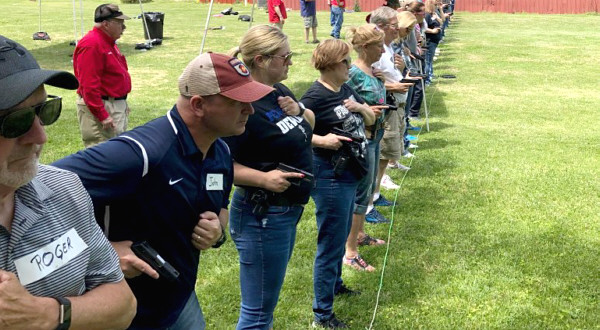
We started to train and arm volunteer school staff a decade ago after the mass-murder at Sandy Hook in Connecticut. We have now accumulated several thousand man-years of experience with these armed volunteers. You might have missed that their efforts have worked in the best possible way. The presence of armed teachers and others has prevented attacks at their school. Let me underline that for you.
We have never had a mass-murder at a school that had a program of trained and armed school staff.
Perspective is everything when we want to understand the truth. Only one criminal out of six uses a firearm in the commission of a violent crime. Criminals use firearms about a quarter million times each year and they violate our “gun-control” laws millions more times. That means that gun control is and has been a failure.
In contrast, we defend ourselves with a firearm about 2.8 million times every year. Mass murderers take about 600 lives a year. We protected hundreds of thousands of our children with armed school volunteers every school day. If you haven’t heard it before then I’m telling you now…armed self-defense is far more common than the criminal use of a firearm.
Politicians who push for more gun control say their laws will disarm criminals. In fact, their 23,000 gun-control regulations — already on the books — disarm far more honest citizens than they do criminals. Mass murderers deliberately attack us in gun-free zones where we are disarmed by law.
Politicians and the news media don’t tell us everything we need to know to make a reasoned decision. It’s deadly public policy to solve a small problem by creating a larger one. We can’t save hundreds of lives by sacrificing tens-of-thousands. If we really want to save lives, then we’d repeal our gun-control laws rather than passing more of them. That won’t work for gun-control politicians who feel the need to shout to get reelected. If gun-control advocates really wanted to save lives, then they would stop lying.
How many more innocent lives should we sacrifice on the altar of failed gun-control?
I’m giving you facts, but facts don’t matter to gun-control ideologues. For them, the ideal of gun-control is an end in itself rather than an instrumental means to save lives. Mass murders are simply an excuse to disarm more honest citizens.
I am not running for office, but I am trying to influence your opinion. Lies matter when we want to deceive. Facts matter when we want to save lives. Time and again, Democrats and Socialists in the USA have said that only Democrats care about children, and everyone else doesn’t care if kids die. I’m calling that a lie. Lives matter to me and they matter to you.
It is uncomfortable to call someone a liar but it gets easier with practice. I did it this time. I’m asking you to do it the next time you hear them lie about us.