Categories
Categories
CZ 457 Varmint MTR Range Results
.gif)
.gif)

In April 1917, America’s armed forces were barely ready for a border skirmish with Mexican revolutionaries and bandits, much less the full-on slaughterhouse of the First World War. American small arms were excellent with the glaring exception of machine guns, of which the U.S. Army had very few. American military leaders had not yet learned the brutal lesson of the Great War for a new century: that automatic arms dominated the battlefield.
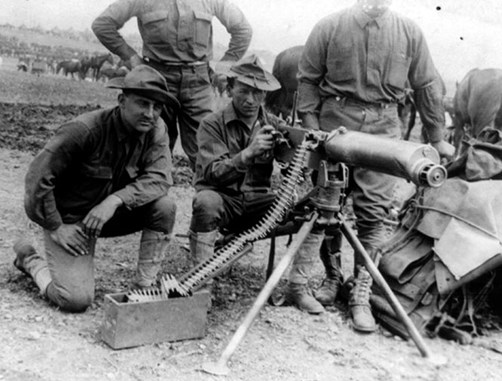
U.S. troops on the Mexican border with the Maxim Machine Gun, Caliber .30, Model of 1904. This was the first rifle-caliber heavy machine gun in U.S. Army service, however none of these guns were used by the AEF in France.
Just 18 months later, the situation had changed dramatically. At the end of World War I, American troops fielded the most complete and powerful set of infantry weapons the world had ever seen. By brave application of the force of arms coupled with our national design and manufacturing ingenuity, the United States transformed from a lesser Allied nation to an international superpower and world leader.

A wartime illustration depicting U.S. troops manning what looks like a cross between a British Vickers and an American Browning M1917 machine gun.
Here are a few of the machine guns in use by the American Expeditionary Force (AEF) in France:
The French “Fusil Mitrailleur Modele 1915 CSRG”, or Automatic Rifle, Model 1915 (Chauchat). Regardless of its official title, American troops called the less-than-reliable Chauchat many names that cannot be repeated here. The most widely manufactured automatic arm of World War I, the Chauchat was a good early concept for an automatic rifle, but quite poorly produced. The AEF used the Chauchat in large numbers, chambered in its original French 8 mm Lebel. Subsequent attempts to chamber the Chauchat in the U.S. .30-‘06 cartridge ended in disaster, with the guns essentially unusable and quickly withdrawn.
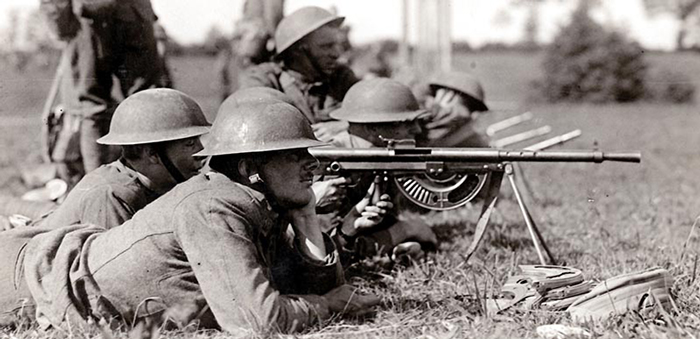
U.S. troops training with the French designed and built “Automatic Rifle, Model 1915 (Chauchat).” Widely despised by American troops for its shoddy construction and subsequent unreliability, the “damned, jammed Chauchat” still served American troops throughout the battles of 1918. Three American Chauchat gunners earned the Medal of Honor.
The French Hotchkiss M1914 Machine Gun served as the AEF’s primary heavy machine gun until the Browning M1917 machine gun became available later in 1918. The 8 mm Hotchkiss proved to be accurate, reliable and adaptable. It was initially fed with 24-round metal strips, and later in 1917 an articulated metal belt was adopted. Hotchkiss machine guns were widely used in the burgeoning anti-aircraft role, and were also installed in many of the FT-17 tanks that were operated by the American Tank Corps.
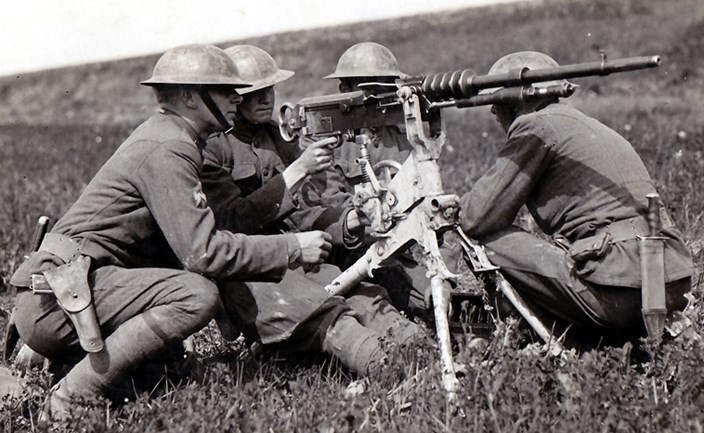
The most common heavy machine gun in the hands of the AEF was the French 8 mm M1914 Hotchkiss. Sturdy, heavy, reliable and adaptable, about 7,000 of them served with American forces in France.
British Automatic Arms: Two American divisions were attached to the British in the Somme area, and thus spent some time using the .303 cal. Lewis Light Machine Gun, the Hotchkiss Portative light machine gun, and the Vickers Machine Gun in combat during 1918.
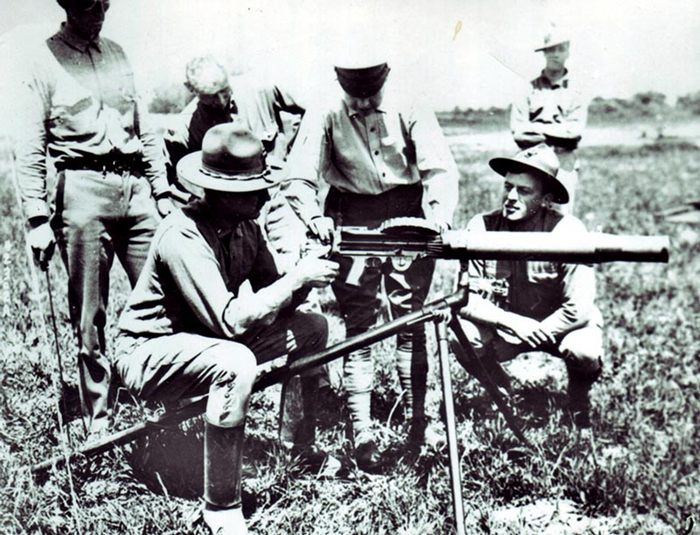
Marines training at Quantico with a Lewis Gun during 1916. While the Lewis was very popular with the USMC, the Marines’ Lewis guns were taken away and replaced with the less reliable French Chauchat machine rifle.
Browning M1917 .30 cal. Machine Gun: About 1,200 of John Browning’s heavy water-cooled machine guns saw service during the last three months of World War I. Very quickly, the M1917’s reliability, accuracy and rate of fire became legendary. The water-cooled M1917 served with U.S. forces in World War I, between the wars, throughout World War II, the Korean War, until phased out of U.S. service in the late 1950s.
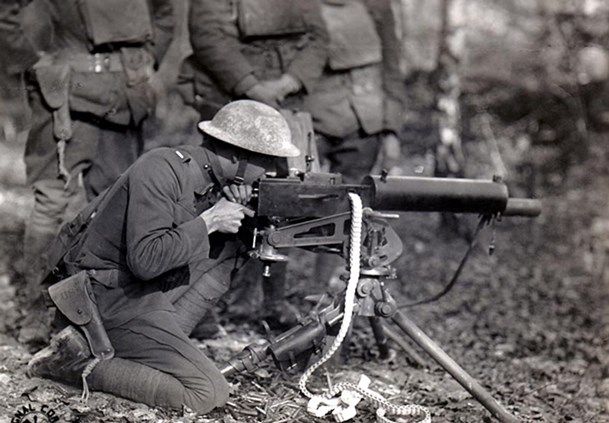
Val Browning (son of the designer, John Moses Browning) test fires one of his father’s incredible designs, the Browning M1917 .30 cal. heavy machine gun. Fielded late in the war, the M1917 nonetheless established a reputation for reliability and accuracy.
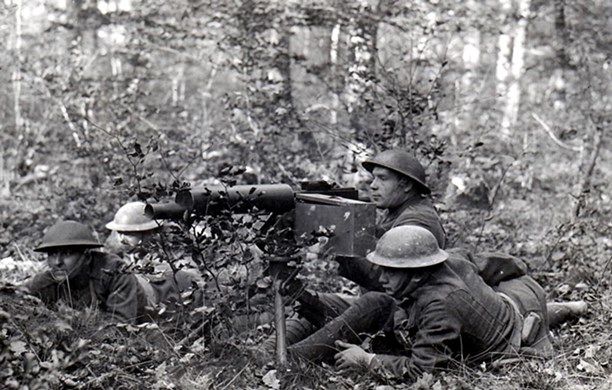
These men of the 80th Infantry Division were armed with a Browning M1917 machine gun, which featured a “beer can” flash hider.
Browning Automatic Rifle: John Browning’s genius automatic rifle design only saw service very late in the war, beginning in about mid-September 1918. Regardless, the BAR quickly proved to be the finest light automatic of the war, impressing enemies and allies alike. First World War BAR gunners were initially provided with a special cup-like device, mounted on their cartridge belts, designed to hold the butt of the BAR stock firmly in place and enable the concept of “walking fire.” The walking fire concept proved to be completely impractical, but the BAR went on to be legendary, serving with U.S. forces even into the Vietnam War.
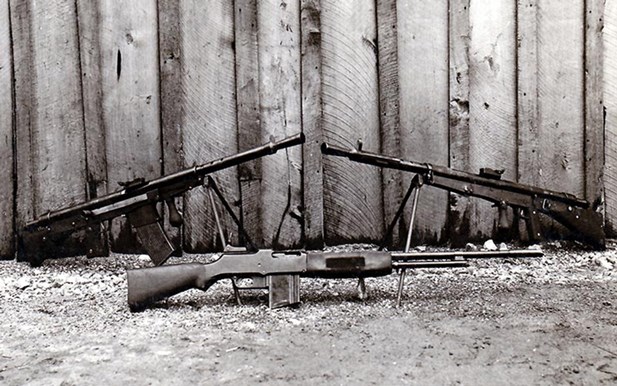
The outstanding Browning Automatic Rifle flanked by the French-built M1915 Chauchat in 8 mm Lebel (right) and the “American M1918 Chauchat” in .30-‘06 (left). Unfortunately for U.S. troops, the BAR did not reach frontline troops until the very end of the war, and the M1918 Chauchat in U.S. .30 cal. was almost completely non-functional.
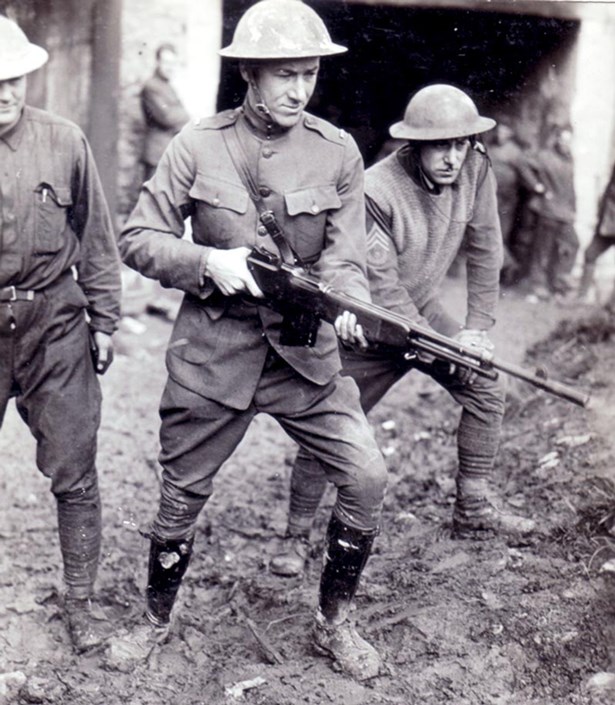
Val Browning tries out a M1918 Browning Automatic Rifle in the “walking fire” style in France during 1918.
Categories
Top 7 BEST Pocket Pistols
AUSTIN, Texas – The Texas Department of Public Safety has decided to terminate a Texas Ranger who responded to the horrific May 24 attack at Robb Elementary School in Uvalde.
In a letter Thursday, DPS Director Steve McCraw told Texas Ranger Christopher Ryan Kindell that his actions following the shooting that killed 19 students and two teachers “did not conform to department standards.” Kindell has five days to appeal the decision.
“You should have recognized the incident was and remained an active shooter situation which demanded an active shooter response rather than a barricaded subject situation,” McCraw wrote in the letter obtained by The Texas Tribune.
Reached for comment Friday, Kindell would say only that he intends to appeal his firing.
Kindell’s September suspension caused ripple effects through the criminal justice system in South and West Texas where he was the lead investigator on 50 high-profile investigations, including murders, sexual assaults and public corruption.
But police experts and the Uvalde County district attorney had raised questions about whether DPS was retroactively punishing a handful of officers for not following policies that weren’t in place at the time of the shooting. Among their concerns: By firing a few officers, DPS and other law enforcement agencies will avoid serious analysis of how hundreds of police from multiple agencies stood by for more than 70 minutes while children and teachers lay shot in a fourth grade classroom.
Uvalde school district details key failures in its end of year safety report
The report revealed the district was subject to an “intruder detection audit.”
READ MORE
- Uvalde school shooting: Congressional subcommittee hears testimony
- Uvalde shooting victims seek $27B, class action in lawsuit
- Uvalde shooting: City files lawsuit against DA over Robb Elementary records
In response to a request under the Texas Public Information Act, DPS said it does not have a written active-shooter policy. Instead, the agency said at the time of the Uvalde shooting that DPS relied on guidance from the Advanced Law Enforcement Rapid Response Training Center at Texas State University. Known as the ALERRT doctrine, it’s considered the premier active-shooter training program in the state.
In July, McCraw sent an agencywide memo telling DPS officers the agency “will continue to embrace the ALERRT doctrine, but with one important addition.”
“DPS Officers responding to an active shooter at a school will be authorized to overcome any delay to neutralizing an attacker,” McCraw wrote. “When a subject fires a weapon at a school he remains an active shooter until he is neutralized and is not to be treated as a ‘barricaded subject.’ We will provide proper training and guidelines for recognizing and overcoming poor command decisions at an active shooter scene.”
McCraw and DPS spokesman Travis Considine would not comment on Friday.
In October, McCraw decided to terminate Juan Maldonado, a DPS sergeant who’d also responded to Robb Elementary on May 24. Maldonado opted to retire rather than appeal his firing.
Congressional subcommittee hosts meeting to hear testimony regarding Uvalde school shooting
It’s been nearly seven months since 19 children and two teachers were killed in a classroom at Robb Elementary in Uvalde.