Categories


Sometimes I wonder whether folks working at a gun manufacturer know the impact of their decisions beforehand. I spent a little time at a couple of gun manufacturers many years ago. A couple of guys clearly dreampt of being the next John Moses Browning but most just liked the idea of working where guns were being made.
So as the 20th century was about to debut, the brass at Smith & Wesson decided on a new double-action revolver design called the Hand Ejector Model. More powerful cartridges were in high demand so the company developed a solid frame with a swing-out cylinder to replace its top-break double actions. The first of these were the I- and K-frame Hand Ejectors in .32 and .38 cal. These revolvers were an instant success as the 19th century drew to a close, so a .44-cal. frame given the factory name of the N-frame was developed in 1905. The .44 Russian cartridge was designed for and during the Top-Break era. This new N-frame allowed for a more powerful cartridge so the engineers lengthened the .44 Russian case by .19″, added 3 grains of black powder for a total of 26 grains to push a 246-gr. bullet to 750 f.p.s. The new cartridge was christened the .44 Smith & Wesson Special, tagging along with the already popular .38 Smith & Wesson Special.
These new .44 Hand Ejectors were made to very tight tolerances. Cylinder alignment was critical and these cylinders locked up in three places; the front of the extractor rod, the rear where an extension of the extractor rod fit into the face of the recoil shield and a third place on the yoke where it meets with the barrel. This provided for a very sturdy and repeatable lockup, thus allowing both cartridge and revolver to extract the most accuracy. Up on the barrel, a shroud was provided to protect the extractor rod and add some recoil-dampening weight. The first .44 Hand Ejectors became known as Triple Locks because of the three locking points. It was introduced in 1908 and available in 5″ and 6 1/2″ barrel lengths, chambered in .44 Russian and .44 S&W Spl. However, very few were made with 4″ barrels chambered in .38-40, .44-40 and .45 Colt.
Sales of the new .44s were disappointing to say the least, probably due to three factors. First, these revolvers recoiled more than the .38-cal. guns. Though considered paltry by today’s standards, the Modern Technique of the Pistol was still about half a century in the future. Most people still shot a handgun with one hand in what we now call a “duelist stance.” Too, because of the extensive handwork necessary to manufacture a revolver with three lockup points and the time required to evenly polish a barrel with an integral underlug, the retail cost was greater enough to spur many budget-conscious shooters to opt for the smaller caliber. Finally, the semi-automatic pistol was getting a lot of attention at the same time. A lot of “cutting edge” shooters of the day chose something newer than a rehash of existing technology. More than a century ago, as today, much of the gun-buying public clung to the arcane and false notion that “Where there is lead in the air, there’s danger!”
Smith & Wesson had a problem. Arguably its finest revolver wasn’t making it in the sales department, and it was costly to manufacture to boot. A Hand Ejector Second Model was introduced in 1915. The Second Model eliminated the third locking point in the yoke, along with the integral underlug. It was in production for just two years before Smith & Wesson had to make the switch to wartime production. The Hand Ejector Third Model came about in 1926 because of a heightened demand for the integral underlug on the barrel.
Wartime demands of World War II halted the manufacture of the 1926 Model in 1940. Once the world was once again made safe for a few years, the company brought out the Hand Ejector Fourth Model of 1950. Like its great, great grandpappy, the Model 1950 was not a stellar seller. Target shooters more often than not chose a lighter, easier recoiling .38 Spl. or a .45 ACP for their paper-punching chores. Buyers of the 1950 Model were largely restricted to savvy law enforcement guys, often in rural areas, and a group of revolver aficionados known as The 44 Associates, publicly led by a sawed-off Montana cowboy by the name of Elmer Keith.
This latter group made a name for themselves handloading the .44 Spl. to velocities never dreamed of by the cartridge’s inventors. Keith served as the blow horn for these efforts. In 1956, what appeared to be the final blow to the .44 Spl. was turned loose on the public—the .44 Remington Magnum. This cartridge did everything the .44 Spl. could do and then some, but at a cost. Those costs included an unacceptable amount of recoil for a fighting gun and an even heavier revolver to pack around.
A lot of law enforcement guys and backcountry wanderers clung to the Model 1950 but not enough to continue production. The Model 1950—by this time known as the Model 24—was discontinued in 1967, and according to the factory, no plans were in the works to reintroduce it. The supply of .44-Spl. S&Ws dried up faster than a spring rain in the desert.
***
Now let’s go back about 40 years. Some of you were not here yet; others, like me, still had all of our hair and it was dark. I was a gun-struck, wannabe pistolero with a whole lot of desire and energy and not much money. Working two jobs, virtually every spare nickel I made went into guns, ammunition and reloading components. I had bought my first handgun, a Colt New Frontier .22/.22 WMR just four years prior. During that first year I also bought my first two center-fires, a Smith & Wesson Model 27 and a used Series 70 Colt Government Model. Although fascinated by firearms back to my earliest memories, I had not really grown up around guns. My family was not into guns and hunting, so my interests sat famishing until I was old enough to buy my own.
Like a lot of guys back then, my mentors were writers in gun and outdoor magazines. Part of my gun money went to subscriptions and books to help me along in my self-education. One guy who struck a chord with me was Charles A. “Skeeter” Skelton, a law enforcement and cowboy type out of New Mexico. Skeeter was a Depression-era kid who found adventure as a Marine in World War II, and later as a Border Patrolman, Sheriff and U.S. Customs agent. He had a deep appreciation and knowledge of handguns and was a gifted storyteller. Skeeter wrote a handgun column for Shooting Times back when it was a part of PJS publications. The reason I had a Model 27 and a Jordan holster on a River Belt by Don Hume was because of Skeeter.
While the Model 27 and its .357-Mag. cartridge were plenty good—especially for a kid with little experience—Skeeter’s prose regarding revolvers chambered for .44 S&W Spl. kept me pretty goggle-eyed. His stories of adventures—and a few pratfalls—with a .44 on his hip had me pining deeply for a .44 Spl. Trouble was, Smith & Wesson had discontinued the .44-Spl. chambering and its Model 24 about a dozen years prior to my discovery of it. I haunted gun shops from Sacramento to San Diego searching for one. In one year, I found exactly one, a 6 1/2″ barreled Model 24 in a gun shop in Orange County, Calif. The price was $750, more than twice the going rate for a Model 29 .44 Mag. that was nearly as scarce.
Then—I believe it was in one of Skeeter’s columns—I found that Bob Sconce of the Miniature Machine Co., had a few original 6 1/2″ 1950 Target barrels available. These were pre-Model 24 barrels, raw and unpolished. If I recall correctly, Sconce was getting 125 bucks per copy. That was still pretty steep, but considerably less than $750. I gritted my teeth and came up with enough scratch to get one. Now all I had to do was find an N-Frame Smith & Wesson and get someone to marry the two.
At a local gun shop I found a barely used Model 28 Highway Patrolman for less than a pair of C-notes. Donor gun and barrel in hand, I began my search for someone who could meld the two into a desirable six-gun. Sconce had taken ill and was unable to work. I was about a year from making my move to Wyoming when I found a pistolsmith by the name of Tim LaFrance.
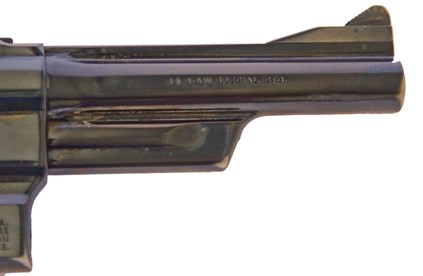
Like most good gunsmiths, LaFrance was backordered in work—four months, he said. Eight months later I still had not heard anything. I called him, and he said he would have it done in a month. Two months later I had the converted .44. LaFrance had fitted the barrel and rechambered the cylinder. I also had him shorten the barrel to 5″ to match my Model 27 and reattach the ramp and front sight. Fortunately, the barrel markings were centered at the 5″ length, so it looked almost factory made. I found another guy—whose name escapes me after four decades—to completely refinish, polish and blue the gun. I finally had my .44 about a month before I migrated to Wyoming.
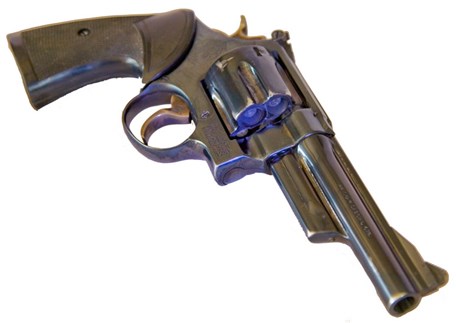
First thing on the agenda was to acquire loading dies, a bullet mold and some .44-Spl. brass—a fairly tall order for a 25-year old on an extremely tight budget. I finally scrounged up what I needed. The dies were used and made by Eagle; the mold was a dual-cavity Lyman 429421 that threw 245-gr. semi-wadcutters. Then I got to cranking out some ammo. I tried several loads, but two were clearly standouts, and they were just about standard among .44-Spl. aficionados; 7.5 grains of Unique, a load that now is commonly known as “Skeeter’s load,” and 17.5 grains of 2400, which was Keith’s hunting load prior to the standardization of the .44 Mag. Both of these, I should point out, are no longer listed in any modern loading manual I am aware of. The claims that Alliant has changed its formulas or burn rates have not been substantiated, so I assume that it is more of an erring on the side of caution. I would not try either of these loads in a Smith & Wesson revolver made before 1950.
My custom .44 never got to be the centerpiece of any adventures paralleling Skeeter’s, but it did provide for an occasional meal on the trail, and it rode in the same Jordan holster during my short stint as a police officer in Afton, Wyo. I won a few informal pistol matches with it. One afternoon a friend and I were shooting revolvers—my custom .44 and his, an early post-war M&P which I now own.
After a while, shooting paper got to be a bit uninteresting. I was getting a bit cocky so I turned the .44 upside down and began shooting at a stick on the ground using my pinky to operate the trigger double action. The stick bounced at every shot. My friend—who has now long gone to his reward—snapped “Smart aleck!” or something similar. He picked up the stick and threw it in the air saying, “Hit this!” With the revolver right side up now, I tracked the stick and pulled the butter-smooth double-action trigger. To our mutual astonishment, the damn stick was severed in the middle.
Life’s tribulations forced me back to California a few years later, and one time I was bouncing along on a ranch in the western Sierras with another friend. My .44 was safely tucked away in the Jordan holster when suddenly a wild pig came boiling out of a shallow depression in the grass. The horse I was riding—not mine—was a bit unaccustomed to having wild pigs jump up nearly between its feet. I made a sort of flying dismount with assistance from that horse and drew the Smith, tracking the offending porcine at about 35 yards. The revolver bucked and the 90-lb. sow slid on her nose.
Smith & Wesson’s declaration of never producing the Model 24 (or 1950 Target) proved a bit premature. In the 1980s Lew Horton commissioned the company to make a limited run of Model 24-3 revolvers with a round-butt, K-frame grip profile. I wasn’t about to let this get away, and soon one of these became a regular companion. Still later, I found a 4″ barreled Model 24-3 in unfired condition on Gunbroker.com. When it arrived, I remedied the unfired condition situation quickly. Still later, I acquired a Colt SAA and a pair of Ruger Flat Tops in the proper caliber. The Colt has taken a pig and a deer, and I now feel adequately comfortable with my .44 S&W Spl. situation.
While not exactly commonplace, the dearth of .44-Spl. revolvers is not as dire as it was in the mid- to late ’70s. Charter Arms has its Bulldog, and here and there it is possible to find a Smith & Wesson or Ruger that does not force you to make the choice between the gun and a house payment. In fact, Ruger has the GP 100 available in .44 Spl. now. If you love revolvers but have not yet had the pleasure of an accurate, powerful and yet manageable revolver on your hip, better get one now. I bet you can’t stop with just one!
Categories