
Or when you live in the wrong side of the tracks neighborhood! Anyways if you can afford this. Then you can afford to move! Grumpy


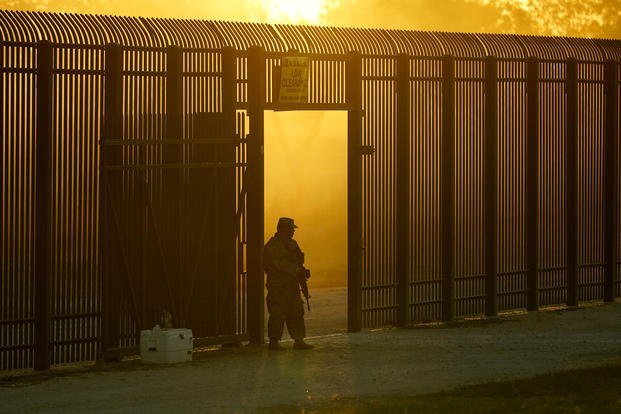
At least 1,376 troops in the Texas National Guard have faced pay issues since September, according to internal documents obtained by Military.com. 109 issues still remain for the roughly 6,800 Texas troops assigned to the mission.
The troops are part of the nearly year-old state mission ordered by Texas Gov. Greg Abbott that has seen reports of a wave of suicides and self harm on the mission, alcohol abuse, and troops facing severe financial hardship.
National Guard officials have responded to reporting about pay and discipline issues by describing coverage as being built on “nebulous charges.”
Col. Rita Holton, a Texas Guard spokesperson, told Military.com earlier in January that 82 soldiers were facing pay issues, while the document revealing pay issues that was reviewed by Military.com was dated Friday. The Texas National Guard did not respond to a request for comment ahead of this story’s publication.
The pay issues range from soldiers being shortchanged, sometimes by thousands of dollars, to minor discrepancies. One Guardsman interviewed by Military.com received a $100 paycheck after two weeks of duty, a period when that Guardsman should have received a minimum of around $2,000. Meanwhile, some troops were overpaid, which can have a domino effect where pay is withheld unexpectedly from future checks.
Of the outstanding pay issues, 19 troops were overpaid and 90 are missing checks. It is unclear how far back the outstanding pay issues go.
Military.com had previously reported that there had been accounts of issues with pay, but the internal National Guard document obtained by the publication is the first to provide specifics on the number of soldiers affected.
While Texas has seemingly made progress on the pay issues, it is unclear why those issues existed to begin with, or why so many soldiers were impacted. Some senior officials interviewed point to troops swiftly being mobilized en masse, sometimes with days’ notice.
For troops to deploy under state orders, they have to fill out entirely new W-4 forms, which makes them state employees. Because of that paperwork, Texas effectively hired a thousands-strong labor force with little notice or logistical support.
“I don’t know what’s going on; our state never had this problem. But imagine this, how in the world did Texas add thousands of employees to the payroll system?” one senior Guard official from another state told Military.com on the condition of anonymity to avoid retaliation. “The scale is not surprising, but it’s also heartbreaking.”
A key issue, current Texas Guardsmen who were interviewed by Military.com said, was many checks not being itemized. That means that when soldiers are paid it is unclear what days they have been paid for — making it difficult to track whether they’ve received the correct amounts.
Some soldiers have faced financial hardship due to state orders earning them significantly less money than their civilian jobs. State orders also do not come with benefits, which are associated with active duty federal orders and typically pay soldiers less.
On Friday, Holton issued a statement that included criticism of media reports, including some from Military.com.
“There have been nebulous charges that service members are not being paid. This is inaccurate. While there have been administrative pay challenges, currently every service member assigned to Operation Lone Star is being paid,” Holton said.
Yet, in the same statement, Holton noted that a lot of troops still have unresolved pay issues, many of which have been brewing for months.
“75 percent of pay discrepancies have been resolved, to include, back
pay for those who have been paid inaccurate amounts,” Holton’s statement added.
— Steve Beynon

Categories
How Far Can U.S. Artillery Shoot?
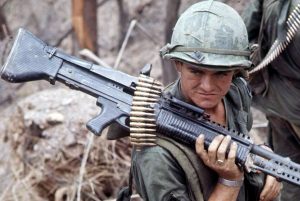
I’ve never shot the M60 though I wanted to the first time I saw one, which was in a Navy unit I briefly served with. The M2 is another story. The readers here probably know some interesting details about the weapon.
Photo found without attribution. Appears to be news stock, Vietnam Era.
Some of the links provided in the story are better than the source of this brief overview.
The M60 is one of the enduring symbols of the American firearms industry. Born out of a fusion of two WWII-era German designs, the original M60 had several engineering flaws that lead to its replacement by the M240. But in 2014, Denmark adopted the M60E6 as the standard light machine gun of its armed forces, and the design continues to be manufactured and sold today. How did the M60 go from its rushed original design to the gun it is today?
The story of the M60 begins right after the end of WWII. During WWII, U.S. soldiers faced down the advanced MG42 machine gun and FG42 automatic rifle. While some may say the MG42’s rate of fire was too high, the weapon was far more suitable for infantry use than the American M1919A6, with superior ergonomics and lower weight. They also faced the FG42, an advanced box-fed automatic rifle that was lighter and more flexible than the American M1918A2 BAR.
Both of these weapons impressed American evaluators, who ordered Saginaw Steering Gear Division of General Motors to produce a version of the MG42 in the American .30-06 caliber. This did not go so well, with many engineering errors such as making the receiver too short. The final gun was highly unreliable, and the project was canned.
The U.S. Ordnance Corps then investigated the possibility of converting the FG42 into a belt-fed machine gun. A variety of prototypes were made. The T44 was a relatively standard FG42 converted to use the MG42’s belt feed, but the basic FG42 barrel proved too light for sustained automatic fire. The T52 came later, incorporating a heavier barrel. Later iterations of the T52 added a quick-change barrel and a new gas system.
The Army also began development of the T161 around this time, which was a variation on the T52 design, but modified for mass production. The T161 and T52 competed with each other throughout 1953 and 1954. In 1954, both guns were adapted for the new 7.62x51mm NATO round and M13 belt link, though they were not called that at the time. The T161 eventually won and went through several iterations before its final field trials as the T161E3 in 1955 and 1956.
The results of the T161E3 trials were impressive. Soldiers preferred the gun over the M1919-series of guns as it was far easier to maneuver, aim, move, and maintain. The gun weighed almost ten pounds less than the M1919A6, tipping the scales at around twenty-three pounds. The T161E3 was adopted as the M60 on 30 January 1957.
The M60 would see its first combat use in the Vietnam War in 1965 with the U.S. Marines. While it served well for many soldiers, providing heavy, accurate firepower, it also revealed many more flaws in the design.
In the door gunner role, M60s could fire upwards of 5000 rounds a day, laying down constant suppressing fire onto landing zones before helicopters came in. This caused the lightweight receivers to stretch and even crack, and gages were issued to armorers to determine when replacement should occur, which usually happened around 100,000 rounds or so. In contrast, the heavier M240 has been known to go for upwards of two million rounds without receiver repair.
More at the source.
Here’s one going for six figures at auction. That price is entirely the NRA’s fault under the NFA; its members covet control of high prices for their automatic rifle investments. The video source is Rock Island Auction, 2023 Gun Prices and Trends, which details many collectibles for this coming year.