Categories
CZ 83 380 ACP Pistol Review

By Paul Adams & George Wright
The UK is among a number of countries with military special forces operating inside Ukraine, according to one of dozens of documents leaked online.
It confirms what has been the subject of quiet speculation for over a year.
The leaked files, some marked “top secret”, paint a detailed picture of the war in Ukraine, including sensitive details of Ukraine’s preparations for a spring counter-offensive.
The US government says it is investigating the source of the leak.
According to the document, dated 23 March, the UK has the largest contingent of special forces in Ukraine (50), followed by fellow Nato states Latvia (17), France (15), the US (14) and the Netherlands (1).
The document does not say where the forces are located or what they are doing.
The numbers of personnel may be small, and will doubtless fluctuate. But special forces are by their very nature highly effective. Their presence in Ukraine is likely to be seized upon by Moscow, which has in recent months argued that it is not just confronting Ukraine, but Nato as well.
In line with its standard policy on such matters, the UK’s Ministry of Defence has not commented, but in a tweet on Tuesday said the leak of alleged classified information had demonstrated what it called a “serious level of inaccuracy”.
“Readers should be cautious about taking at face value allegations that have the potential to spread misinformation,” it said.
It did not elaborate or suggest which specific documents it was referring to. However, Pentagon officials are quoted as saying the documents are real.
One document, which detailed the number of casualties suffered in Ukraine on both sides, did appear to have been doctored.
UK special forces are made up of several elite military units with distinct areas of expertise, and are regarded to be among the most capable in the world.
The British government has a policy of not commenting on its special forces, in contrast to other countries including the US.
The UK has been vociferous in its support of Ukraine, and is the second largest donor after the US of military aid to Kyiv.
US Defense Secretary Lloyd Austin said the Department of Justice had opened a criminal investigation and he was determined to find the source of the leak.
“We will continue to investigate and turn over every rock until we find the source of this and the extent of it,” he said.
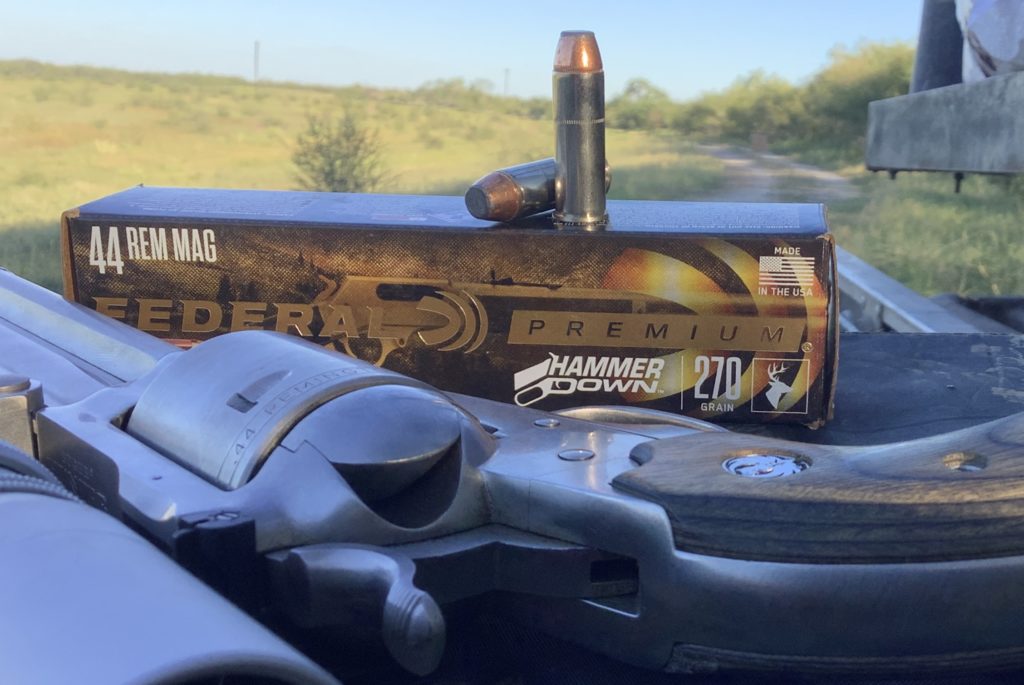
Federal brought out a line of ammunition aimed squarely at levergun users, it’s called HammerDown. They actually produce HammerDown Rifle and Handgun lines, and the bullets used are of the bonded variety which is a welcome upgrade from the standard cup and core offerings. This welcome change should offer deep penetration, ample expansion, and eliminate core separations from occurring. The rifle line is available in 30-30, 45-70, 35 rem., and 444 Marlin, the handgun line has 327 Federal Mag., 357 Mag., 44 Mag., and 45 Colt.

I will be reviewing the 44Mag. and 45-70 rounds. I will test the 44 Mag. in both handguns and a rifle and see how well it does in both as well as compare external ballistics. The 45-70 will be run through my Marlin 1895, 18” barreled semi-custom gun. The 44 Mag will be shot in my Marlin 1894, a 4 5/8” Ruger Super Blackhawk and Ruger Super Blackhawk Hunter. For the 1895, other than the barrel being shortened by a gunsmith, it is a completely stock gun. So all three guns are unmodified as far as accuracy enhancements.

The 44 Mag. ammo uses a 270gr. bullet at a listed 1715fps, the 45-70, uses a 300gr. bullet at a listed 1850fps. Those two performance parameters are awfully close to each other, and although the 44 is listed as being in the handgun line, its velocity is obviously from a longer barrel as it coincides with velocity from my 20” barreled Marlin at 1712fps. The velocity listed for the 45-70 is 1850fps, and from my 18” barreled gun averages 1775fps. It could be that my rifle is a tad slow or that the listed velocity is from a 22” barrel. However, considering the speed of the 44 magnum to the rifle, the two are very close in comparison.
The rounds of the HammerDown line are meant to be used from handguns and lever guns or similar-style guns. They are what would be called today, short-range rounds and luckily most users of these types of guns and rounds are pragmatic and realize that they are best when used at distances less than 200 yards.

My guns are set up for use under those conditions, 200 yards would be a long shot. The 270gr. bullet from my handgun accounted for a large Minnesota doe at 70yds. She covered 60-75 yards in her final dash for cover and left an adequate blood trail for most of the way. The bullet exited after impact and provided about 18”-20” of penetration, it also left a 3/4” to 1” inch exit wound. Velocity from the 7.5” revolver averaged 1350fps, and given the 2.5” high impact at 50 yards provides a very useable trajectory for hunting purposes.
The shorter barreled Ruger provided 1270fps with the load and gave 2” accuracy at 50 yards at 1.5” high. The Marlin 1895 is outfitted with a Burris FastFire reflex sight and is sighted to place its rounds just over the top of the dot at 50 yards, this works out to just over a 100-yard zero. The initial shooting of the ammunition provided some quite acceptable accuracy, with the rifle producing just over an inch group at 100 yards for the first three rounds fired from it. The handguns produced the same 2-inch groups at 50 yards with their first rounds.

The 45-70 ammunition also produced very acceptable accuracy with its first rounds fired, two rounds fired produced about an inch coupling at 100 yards but a bit higher than I prefer. So a couple of clicks down and three more rounds produced a 1.75” group.
The zero I prefer to run on my 45-70 consists of 2.5” high at 50yds, 3” high at 100yds, and zero at 150yds, should a shot at 200 yards be needed simply aiming at the top of the back compensates for the 9” drop on whitetails and just below the top of the back works for the bigger stuff. This makes for easy remembering while in the field and 2.5” to 3” of height equates to nothing really when aiming at deer, hogs, bear, or elk.

The function of both 44 and 45-70 through the lever guns hasn’t met any issue, which is what I expected. In the past, some have reported issues of sporadic feeding problems with other manufacturers ammunition using bullets of wider meplat in their Marlins. I did not have any, but the HammerDown ammunition is developed to function through a lever action. The flat nose profile of the HammerDown 270gr. bullet is wider than many factory-loaded jacketed bullets, with my caliper it measured out at .290, in comparison, Winchester Silvertip measured .225, Hornady XTP measured .275, and Sierra measured .250, I found only one load that exceeded it and it measured .295. The two loadings utilized nickel-plated cases, making identification of ammunition easier when mixed amongst normal brass casings, and when looking for spent cases in the grass.

The 45-70 bullet is called a soft point, although it resembles a cupped point, not a soft point and not a hollow point, but a blend of the two. Regardless of what it’s called, it performs like what you would expect from a bonded bullet, with no core separation and excellent expansion. My experience with a different 300gr. bullet in the 45-70 started out with less than stellar performance, and consequently, I’ve steered away from using them.
The bullets used were designed for much older 45-70 loadings, ones meant for trapdoors and weak actions. Luckily these days we have loadings designed for what is currently 45-70 ballistics from modern strong actions. The other 300gr. bullet provided limited penetration when pushed at 1800-2000fps so I decided to go to a tougher bullet, one also made by an ATK company, the Speer 350gr. SP. This HammerDown 45-70 ammunition would be the first time I’ve shot anything less than that 350gr. bullet since I switched.

In looking at the jacket thickness of the sectioned bullets, it is obvious that the 45-70 bullet is considerably thicker than the 44 bullet. Considering that both are moving at about the same speed from the rifles, makes me think the 45-70 bullet should be a great penetrator, which is what I look for from a large caliber projectile. Some expansion is good, but too much hampers penetration. The penetration provided by the 44 bullet when fired from the handgun at 1315fps, was excellent on the big doe. The question is how will it do with an extra 400fps when fired from the rifle and on a bigger tougher animal?

The search for a bigger and tougher target began in south Texas, looking for a big pig. The first game to fall to my 45-70 was an eighty-poundish feral hog sow. She and her herd were rooting up an area around a small pond or tank as we call them in Texas. It was just past 6 pm and the rules on this ranch stated no shots allowed after the legal shooting light, so even though feral hogs can legally be shot at night, not so on this ranch. Luckily, we found the herd in time and spotted them with the setting sun behind us, because we were 150 yards from them when we spotted them.
I crept forward another 50 yards and took a knee, got a solid hold on the sow, and sent a 300gr. HammerDown at her. Since I didn’t want to go looking for her, I aimed for a high shoulder impact. The bullet landed true to the sights and she rolled over in the classic stiff-legged immobility posture so often seen with a severed spine shot. Even though her chest was only about 12” wide, bullet expansion was evident from the exit wound through the offside shoulder. Due to her size, she was a perfect candidate for donation to a family in need of protein.

Our next target was a tad bigger and much smellier. As males get bigger and start roaming they become solitary and get a smell that is pungent and unique. Typically if a large pig is found by itself it will be a male and bigger than the ones found in a herd. On the south Texas ranches that I frequent, a big male will be 200+ pounds and occasionally you’ll find a 275 to 285-pounder, though those are truly big pigs for the region. Every once in a while one bigger than that will turn up, but our natural vegetation doesn’t really support great big pigs.

The ranch has some big old live oak trees and grassy plains, the pigs like to root around looking for acorns, but tear up the grassy plains where the cattle graze. This causes big and sometimes deep holes that cattle can stumble in and break a leg, can’t have that!!
The one that I found weighed right at 198 pounds on the hoof, but he was thick enough to catch and stop the 300gr. bullet. I purposely waited for him to turn to quarter so I could run the bullet through as much pig as possible. The bullet caught him at 115 yards and landed behind his last rib and traveled through the vitals, broke 2 ribs on the offside, as well as the shoulder, and lodged just under the skin. Total penetration was about 24 to 26 inches, he made it about 75 yards before expiring. I find this normal for a hard-hit pig that isn’t spined or brained.

Had I not been intentionally trying to stop the bullet, I would have spined it or taken it broadside to ensure an exit. Running 75 yards into thick brush without an exit to provide an almost immediate blood trail can lead to a lost animal. Knowing I had nothing but grassy plains and could keep my target in view while it ran allowed me to not be concerned about finding it.

After finding the pig I decided to test the 44mag 270gr. HammerDown bullet on it from the Marlin. Since the rifle produced an additional 400fps with the load, I was curious how the additional speed would affect penetration. Shooting the pig broadside through the shoulder from 60 yards allowed almost complete penetration. The bullet went through one shoulder and its shield, broke 2 ribs going in and two ribs coming out, it penetrated the scapula and lodged in the shield of the offside skin. Considering the additional velocity the rifle provided this is excellent performance and I’d speculate that from a handgun the bullet would completely penetrate on a broadside shot.
As is normal for my reviews, here is my biggest, most, and least list. The biggest surprise was the similarity in velocities from the 44mag and 45-70 when fired from similar rifles, both bullets perform extremely well.
The biggest disappointment is actually a case of our current merchandising conditions rather than an actual product issue, that is product availability. It’s a shame because this product is a great performer and should be well-received by the shooting public.
The least liked feature is one I’ve mentioned before on other manufacturers’ products and it’s their product packaging. This applies mostly to the handgun cartridges because sighting in and verifying trajectory at 25, 50, and 75 or even 100 yards eats up most of your ammunition.
The most liked feature is the bonding process that is used on the bullets,….it works. I inadvertently tested it in the extreme. When I used the big pig carcass to stop bullets for picture purposes I accidentally ran two of them into each other. Yet both bullets never lost or shed jackets or even slightly separated core from their jackets. A true test of the bullet’s ability to retain integrity and penetrate well.

Federal lists these two loads as being designed for medium game. I would say they are well-designed for all game up to 300 pounds, although after using them I would not hesitate to use them on say cow elk or red stag. Something a little heavier but still thin-skinned and light-boned. Accuracy has proven to be excellent, and performance is stellar, if you own a 45-70 or 44 magnum and need ammunition for hunting game, look no further than Federal HammerDown.
Categories
Shooting Jack O’Connor’s 270