Categories
Uncategorized

A Winchester Model 94 in caliber .30-30 Winchester

Winchester Model 94 .30-30 Winchester - Picture 2
Winchester Model 94 .30-30 Winchester - Picture 3
Winchester Model 94 .30-30 Winchester - Picture 4
Winchester Model 94 .30-30 Winchester - Picture 5
Winchester Model 94 .30-30 Winchester - Picture 6
Winchester Model 94 .30-30 Winchester - Picture 7
Winchester Model 94 .30-30 Winchester - Picture 8
Winchester Model 94 .30-30 Winchester - Picture 9
Winchester Model 94 .30-30 Winchester - Picture 10


Categories
All About Guns

A Winchester 67 boys rifle in 22 Long Rifle

Categories
All About Guns

Shooting the M1916 Spanish Mauser 7x57mm Short Rifle

Categories
All About Guns

A Classic Returns In .257 Roberts by DAVE CAMPBELL posted on July 19, 2013

M70-257-Bob-lead_F.jpg

The 1920s were a fascinating time in American history. Full of pride and bravado after saving the world from the Kaiser, Americans led the way in the industrial revolution, as well as a cultural upheaval. Shooters were caught up in the mix, too, with gunnies everywhere experimenting with new cartridge designs.

One popular experimenter and writer of the day was Ned H. Roberts. He, as well as some other experimenters, was consumed with the idea of what were called “quarter-bore cartridges,” cartridges of .25 caliber. The idea was to have one rifle capable of being shot all day at varmints, yet have enough power and range to take deer-sized game. Roberts-after much experimentation-settled on the 7×57 Mauser as a parent case for his quarter-bore brainchild.

Custom rifles from Niedner and Griffin & Howe became available for Roberts’ wildcat in 1928 and were quite popular among hunters. In 1934, Remington brought the cartridge into its factory fold changing Roberts original 15-degree shoulder angle back to the parent’s 20-degree angle, naming the former wildcat the .257 Remington Roberts and chambering the company’s Model 30 bolt-action rifle for it.

Winchester immediately chambered its Model 54 for the cartridge, and when it came out with the Model 70 in 1936, the .257 Roberts-as it became known-was one of the original chamberings. With the exception of World War II when all armories were supporting the war effort, the .257 Bob-a common nickname it received-was somewhat popular.

However, by the mid-’50s the 6 mm cartridges began to show up, casting a bit of a shadow over Ned Roberts’ cartridge. A big part of this was due to the fact that Remington kept the factory loads pretty mild in deference to some older receivers that weren’t up to modern pressures. Factory loads replicated the ballistics of the .250 Savage. Handloaders were able to get all the capabilities of the .257 Bob, provided the rifles they shot were strong like the Remington and Winchester.

Too, part of riding the wave of a fad is the inevitable slide off the crest due to boredom. Fad shooters are just like fad anything; they are in a perpetual search for something new to stimulate their minds. Eventually the gun manufacturers quietly dropped the .257 Roberts from their chambering menu, replacing it with the 6 mm Remington and .243 Winchester. Because so many rifles were out there chambered for the Roberts’ cartridge, ammo makers continue to make occasional runs.

Winchester discontinued chambering the Model 70 in .257 Roberts in 1959. In the mid-1980s Winchester Ammunition began offering +P loads in the .257 Roberts at 5 percent to 7 percent above the Remington factory load and featured a 117-grain Power-Point at 2,780 fps from a 24-inch test barrel. Browning/USRAC also did a limited run of the Model 70 XTR in .257 Roberts. This Model 70, along with most rifles chambered for the .257 Bob, are made with 22-inch barrels.

Recently, the renewed Winchester Repeating Arms Company made a special run of 500 Model 70s in .257 Bob for Cabela’s. I saw it at this year’s Media Day at the SHOT Show, but the frigid gale blowing that day made shooting this new chambering futile. I’ve always had a bit of a soft spot for the .257 Bob, believing the heavier 117- and 120-grain bullets to be a good performer on lighter game like deer and antelope. Cabela’s Joe Arterburn knows I am a sucker for Model 70s, so he sent me one to evaluate.

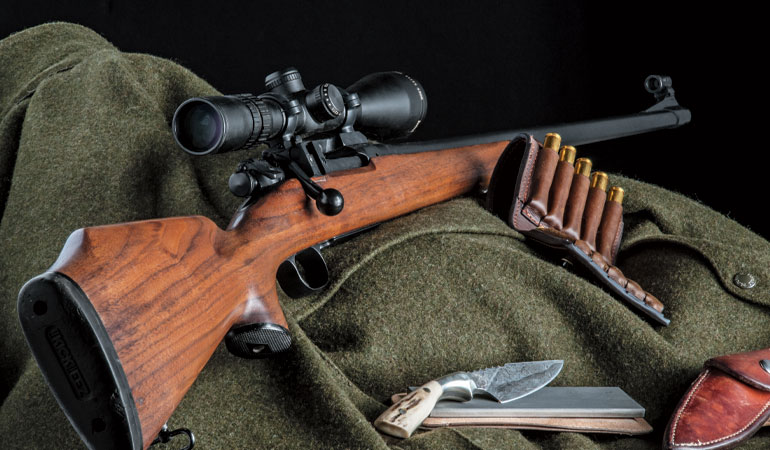
The Cabela’s rendition of this chambering is thoughtfully done in the Featherweight platform-it features a 22-inch barrel tapered to a Featherweight profile to reduce weight. The stock is A-grade fancy walnut, checkered to 20 lpi. Because this is a premium rifle, the bolt is jeweled, and the entire rifle is polished to a deep luster-both wood and metal. It is equipped with Winchester’s MOA trigger that some like and others disdain for its departure from the original design. At a bare weight of 7 pounds, it qualifies as a Featherweight in terms of Winchester Featherweight nomenclature, though lighter rifles are made today. My test sample came with a Cabela’s 3×9 scope already on it, swelling the rifle’s weight to 8 pounds, 9 ounces.

The wet, cold and downright nasty spring weather we have been enjoying postponed my range time with the new Model 70 a couple of weeks. Once there though, the rifle didn’t disappoint. My first shots using Remington Express with a 117-grain Core-Lokt bullet loaded to the same mildness Remington has always loaded this cartridge fell into a 1 3/8-inch group. Ten rounds later, my chronograph confirmed the mildness of this load showing an average velocity of 2,565 fps. Completing the test with the Remington load yielded an average group size of 1 1/8 inches.

I then switched to some semi-custom ammo from The Hunting Shack, out of Stevensville, Mont. Under the trade name of HSM, this ammunition is loaded with premium bullets and often powders that are not available to most handloaders. In this case, the .257 Roberts cartridges were loaded with Berger 115-grain HPBT Hunting VLD bullets. Though this was my first experience with .25-caliber Bergers, I have loaded and now regularly use the 130-grain HPBT Hubting VLD bullet in my .270 Winchesters, and they are superb in terms of accuracy and terminal performance on game. Loaded to a much zippier 2,973 fps average, this ammo was clearly the front runner with groups averaging 7/8 inch.

Several things come to mind as I ponder this rifle. First, I wish it was available 35 or 40 years ago when I did a lot of backpack hunting. Its light weight and mild recoil make it an excellent choice for the mountain hunter. Secondly, in its modern loadings or handloads, the .257 Roberts has a better downrange trajectory and hits harder than the .243 Win. or 6 mm Rem. And finally, you younger hunters take some advice from an old man that knows better now: By the time you reach my age this rifle will probably have acquired another generation of dedicated aficionados and be worth more than you paid for it.

Manufacturer: Winchester Model 70 Limited Edition: www.cabelas.com

Type: Bolt action

Caliber: .257 Roberts

Barrel Length: 22”

Magazine/Capacity: Integral box/five-round capacity

Trigger: 4 lbs., 1 oz.

Rifling: 1:10” RH

Sights: None; drilled and tapped for scope base

Safety: Three-position crossbolt

Stock: A-grade walnut

Drop at comb/heel: 1/2 inch; 5/8 inch

Overall Length: 43 3/4 inches

Weight: 7 lbs.

Metal Finish: Blue

Suggested Retail Price: $1,700 (SURE!!!!!!! Grumpy)

Categories
All About Guns

Minute of Mae: Russian Maxim 1910

Categories
All About Guns Allies

VINDICATED BY SKEETER OLD REPORT BY MR. SKELTON REINFORCES MY GUN LOYALTY WRITTEN BY DAVE WORKMAN

Dave found a decades-old magazine article by the late Skeeter Skelton extolling the virtues of the Colt Diamondback. He said the sixgun made a good trail companion,
and Workman concurs.

Discovering old writings by top handgunners in their day is always educational for many reasons. When I recently ran across some very old magazines from nearly 50 years ago in a corner office, the honest-to-goodness first story to grab my attention was by the late Skeeter Skelton extolling the virtues of — wait for it — the Colt Diamondback.

Here’s a dandy — in my humble opinion — little sixgun which some folks have wrongly disdained as being a little on the delicate side for reasons I cannot fathom. Reading his decades-old article, it appears Skelton didn’t share that opinion either, as he described this particular Colt as having “performed beautifully.”

“Properly loaded,” Skelton observed at the time, “the .38 Diamondback is good medicine for medium animals such as coyotes, porcupines, and javelina out to 75 yards or so.”

On a recent woodcutting trek, Dave was packing his little Colt
stoked with handloads. Ample horsepower for predators.


He said the Diamondback “is the epitome of light trail guns.” I’ve written essentially the same thing, and have come to really enjoy packing my 4-inch specimen along in the woods when a .38 Special might come in handy for potting a rabbit or putting the hurt on a coyote. I also knocked together an IWB holster for concealed carry.

More than a year ago, I shared the story of my Diamondback acquisition with readers. It happened the same week my mother passed more than ten years ago, and I recalled the transaction gave me something else to think about during a difficult time. Things like that get some people through.

As noted by the late Mr. Skelton, who I met briefly at the National Rifle Association convention in Seattle in 1985 — a pleasant fellow capable of carrying on a quick conversation in a noisy exhibit hall — the Diamondback was a “modernized, deluxe version of the Police Positive Special.” That gun “evolved” into the Detective Special, he wrote, and I’ve always considered the “D-frame” Diamondback to be a beefed-up Dick Special with adjustable sights and an eye-catching full underlug barrel topped by the vent rib to capitalize on the eye candy appeal of the legendary Colt Python.

Enhancing the visual appeal of the Diamondback was the full
underlug barrel with its Python-esque vent rib on top.


Empty, this sixgun weights only 28.5 ounces, and I’ll say with no misgivings it’s the lightest 28 ½-ounce wheelgun I’ve ever carried. Maybe it’s because the Diamondback (when is Colt going to reintroduce this gem?) is very well balanced.

Diamondback owners know this revolver has a shortened butt frame, around which the factory and aftermarket grip makers have wrapped some remarkably functional grips.

Many years ago, I worked up a .38 Special load using 4.7 grains of HP-38 pushing a 125-grain JHP at about 900 fps, initially to use in my 6-inch Model 19 Smith & Wesson, but it turns out this round works rather well in my little snake gun as well. Recoil is manageable, and with an ample sight radius, it is satisfactorily accurate for small game.

The ‘Bad Rap’


Maybe the bad rap about the Diamondback is that it won’t take a pounding with hot loads, and let’s be honest: some guys just can’t resist pushing the envelope to see how much of a “boom!” they can get out of a revolver.

I’ve known such people and they make me nervous because one never knows when one of their hot loads is going to disintegrate a handgun while I’m standing close enough to get hurt. I’m quite content with my mid-range .38 Special loads, which — based on my reading of Hodgdon’s Annual Manual — can also be produced with such propellants as AutoComp, Titegroup and CFE Pistol. I’ll be a happy camper if I can conk a cottontail for the winter pot.

Colt’s 4-inch Diamondback in .38 Special is a good shooter. Workman
ran three loads, including factory Hornady 158-grainers, and handloads
topped with either 125-grain JHPs or 110-grain JHPs all at 10 yards.

Let’s talk a moment about handloading for the .38 Special. Way too many people want that +P power in their sidearm when it’s a bad idea. A lot of older handguns don’t handle +P pressures, but one can load up completely adequate standard pressure loads that work just fine, thanks to modern bullet design and composition.

There are some sizzling loads, which push 110-grain bullets above 1,110 fps, and that kind of punch is going to immediately get so — or someone’s — undivided attention. One caveat here is that such loads, even within acceptable pressures, are going to have very snappy recoil, and I’m being polite. In a lightweight such as the Diamondback, recoil is no small concern.

My recommendation for anyone loading the .38 Special for older medium or light-framed revolvers is to consult more than one reloading manual. You will find several load suggestions and DO NOT EXCEED them.

Soon after acquiring his Diamondback, Dave replaced the factory
grips with a set of Herrett “Detective” grips that fit his hand perfectly.


Not long after obtaining my Diamondback, I pulled the factory grips and installed a set of Detective grips crafted by my friend Rod Herrett. These are superb grips for concealed carry and they fit my hand very well, and also help tame recoil.

Every ammunition company offers standard pressure loads in .38 Special, which will work just fine in the Diamondback or similar revolvers.

Charles Allan “Skeeter” Skelton was one of the premier gunwriters of his era. During his life, he served in the Marine Corps, worked as a lawman at various levels including a term as sheriff of Deaf Smith County, Texas. He was a masterful storyteller and having grown into early adulthood reading his articles, it was a treat to meet him back in ’85. Sadly, he passed on less than three years later, far too early for someone with his wit and wisdom. I would have dearly enjoyed spending more time chatting with him.

Stumbling across his Diamondback essay was a delight. He covered all the bases, including felt recoil, powder selection for handloads, his recommendation that the action be smoothed a bit, his dislike of the hammer size because it pinched his hand, and other points. He didn’t care for the factory grips, considering them too large for the size of the gun.

Raw data from the FBI/NICS system shows continued healthy traffic.
(Source: FBI-NICS)

Back to the Present


It’s always informative to see the monthly FBI/NICS check data, particularly because the numbers repeatedly demonstrate America hasn’t given up on the right to keep and bear arms.

According to data for April, the National Instant Check System (NICS) ran a total of 2,607,477 checks, though readers are reminded the statistic does not represent the number of firearms sold.

For that information, we always turn to the National Shooting Sports Foundation, which invariably produces an “NSSF-adjusted” figure more closely reflecting the number of actual gun transactions that did occur. In this case, the NSSF-adjusted figure for April, according to Mark Oliva, public affairs director for the organization, was 1,359,908.

Any way one looks at that number, it is significant. Over the past two years, U.S. citizens have purchased a lot of guns. There is no small irony this surge in gun buying began as the 2020 election loomed and the Democrat in that race was very public about his plan to ratchet down on Second Amendment rights. Gun sales were fueled by the “defund police” movement, the summer of rioting in 2020 and an uncertain future. They stay healthy because Joe Biden has not abandoned his plan to curtail gun rights, and this summer may be his last opportunity to advance that agenda.

Fatal Error

When a man identified as Roman Rodriguez allegedly broke into the San Antonio, Texas home of a mom with three children inside, the last thing he probably expected was that this was the last thing he would ever do.

According to Fox News, the mom heard someone breaking in, and instead of panic, she became her own first responder. She reportedly grabbed a gun and shot the intruder twice in the chest. Police found him sitting in a chair in the backyard, and he subsequently died at a local hospital.

While other news agencies treated the shooting with some objectivity, the New York Post headlined its report thusly: “Texas mom guns down home intruder as kids sleep: cops.”

The final paragraph in the Post’s story: “The probe continues, but the unidentified homeowner is not facing charges because of the so-called Castle Doctrine, which allows a person to use force against an intruder who breaks into their home, News 4 San Antonio reported.”

In Memoriam: John Ross


John Ross authored what has become an “underground” classic novel, “Unintended Consequences,” more than two decades ago, weaving together a fantasy plot with actual historical facts relating to the gun control crusade in the U.S.

The 860-plus page novel grabbed the gun rights movement with a tale of resistance to government overreach. I finished the final ten chapters while stuck at an airport overnight in Michigan, grounded by a storm enroute to that year’s National Rifle Association convention in Charlotte, N.C.

I spoke only once with Ross, via telephone, at the time tracking down a rumor he was working on a sequel. As I recall, it was a pleasant, albeit brief, chat.

Ross passed away suddenly on April 29. He was 64.

Born June 17, 1957, he was a graduate of John Burroughs High School in Ladue in 1974 and attended Amherst College in Massachusetts, graduating in 1979 with a B.A. in English. He worked for the E.F. Hutton company as a broker for about ten years, and then took up full-time writing. According to a short obituary, he was a private pilot, firearms expert, instructor and activist.

He is survived by his daughter, Lucy Margaret Ross of Boulder, Colo., and two sisters, Helen Ross and Lucy Natkiel.

Categories
Allies War

The last British soldier to die in the First World War – Private George Edwin Ellison

This what I believe is every Soldiers nightmare, Grumpy

Categories
Art War

In Flanders Fields

Categories
All About Guns

Colt Python 3 Inch California Combat 357 Magnum

https://youtu.be/wyxGseLxKSg

Categories
All About Guns Cops Hard Nosed Folks Both Good & Bad

30 Rounds In 30 Seconds: O.K. Corral Part 3 By Dave Spaulding

Wyatt Earp, his brothers Virgil and Morgan, and Doc Holliday had a date with destiny October 26, 1881, in Tombstone, Arizona.

Attempting to disarm local cowboys at the O.K. Corral, the ensuing gunfight on Fremont Street gained legendary status in Old West lore.

Here, our combative pistolcraft expert breaks down how events played out when the bullets began to fly.Welcome to Tombstone. Interestingly, this sign appears to be misdated. The accepted date for the O.K. Corral gunfight is Oct. 26, 1881. (Library of Congress photo, c. 1937)

Martha King was shopping in the butcher shop on Fremont Street. She looked out the store window and saw four armed men walking west. She knew the Earps by sight, but not their names and she didn’t recognize Doc Holliday. According to her later testimony, King said they walked four abreast in a “stately” manner with Doc on the inside closest to the store, Virgil and Wyatt in the middle, and Morgan was on the opposite side.

Wyatt and Virgil were slightly ahead. King said the wind whipped open Doc’s long coat and she saw he was trying to conceal “a gun, not a pistol,” underneath it. She went on to say one of the Earps, probably Morgan, said, “Let them have it,” and the man she later learned was Doc Holliday replied, “All right.” This still does not mean the Earps had homicide on their minds. It could have just been a statement of bravado by Morgan Earp, the one member of the group who had never been tested in armed conflict.

Looking east on Fremont, Behan saw the Earps and Doc walking his way. He said later that Morgan and Wyatt had pistols in their hands. The sheriff told the cowboys to wait while he went to talk with the police chief and his men. The Earps and Holliday met him on the sidewalk in front of the butcher shop. Looking past Behan, they could see the cowboys at the edge of the empty lot. It makes sense that Holliday may have been concerned to see them standing, literally, right next to where he was living with “Big Nose” Kate.

Behan wanted to appear in control so he said loudly, “Gentlemen, I am sheriff of this county, and I am not going to allow any trouble if I can help it.” However, the Earps had made up their mind and pushed past him. Behan, not to be deterred, followed down the sidewalk. According to Virgil and Wyatt’s later testimony, Behan called to them, “if they [the Earps] kept going, they might be murdered,” but it didn’t stop them. The Earps and Holliday were now only 100 feet from the vacant lot on Fremont Street.

Fly's Photography Gallery

From the front of Fly’s Photography, the author describes where events leading to the gunfight likely happened along Fremont Street in Tombstone, Arizona. Doc Holliday and “Big Nose” Kate were staying at Fly’s boarding house, so he was likely not happy to see the cowboys assembled next door. (Author Photo)

Virgil, not wanting to totally dismiss the County Sheriff with so many watching, yelled over his shoulder, “We’re going to disarm them!” According to Behan’s later testimony, he told Virgil he was in the process of disarming the cowboys. In his mind, Behan’s request was to leave it for him to finish. However, both Virgil and Wyatt testified Behan told them he had already disarmed the cowboys. I tend to believe what the Earps claim here.

First, Johnny Behan was in this to raise his own profile. Second, witnesses claim the Earps seemed to relax at this point as they continued their walk. Virgil moved the revolver in his belt from an appendix position around to his left hip where it would be more concealed. He also switched Doc’s cane from his left hand to his right, his shooting hand, to appear less threatening. Both were serious mistakes.


Wyatt tucked his revolver into the canvas pocket of his new coat. For a moment, it seemed the chance of a gunfight was diminished. The Earps and Doc Holliday likely felt a small sense of relief, but public appearance was just as important to the Earps as it was to Behan and the cowboys. They couldn’t just walk away after making such an approach down to Fremont Street. They surely felt obliged to finish what they started and make sure the cowboys were disarmed.

The Earps and Doc Holliday moved to the edge of the vacant lot. They were probably surprised to see Billy Clanton and Frank McLaury wore gun belts and revolvers. There were also two horses just inside the lot with rifles hanging from their saddles. In their minds, it seemed Johnny Behan had lied and the cowboys still needed disarming in a very public way.

The cowboys watched the Earps and Doc push past Johnny Behan and continue their approach. Billy Claiborne and Billy Clanton stood deepest in the lot, probably a distance of 18 to 20 feet. Ike was only a few feet inside the lot, just off the board sidewalk while the McLaury brothers, holding the two horses, were practically on the sidewalk, just off the edge, with Tom marginally closer to Fremont Street than Frank. Tom had apparently taken Billy Clanton’s horse then walked into the narrow lot to talk with Billy Claiborne.


Spaulding at OK Corral Tourist Attraction

The author inside the tourist area showing where the McLaury Brothers likely stood holding their horses. The distance to the wall at Fly’s is approximately 15 feet at this position. (Author Photo)

I believe the cowboys had no plan for what was about to happen. They had to have looked around and noticed the lot was a terrible place for a gunfight. There was no room to move or even retreat. I’m sure at this point, they were feeling a high level of duress. After all, there were so many people watching!

One thing we know for sure is Johnny Behan was no gunfighter. If there was to be a confrontation, the sheriff wanted nothing to do with it. According to witnesses, as the Earps and Holliday reached the northeast corner of the lot next to Fly’s, Behan ran in and pushed Billy Claiborne toward the landing that separated Fly’s boarding house from the photography studio.

This split in the building is present in the tourist attraction today. People watched with nervous anticipation. Angles into the lot made it very difficult for most to see in, especially since they were also trying to stay out of the line of fire. In addition, their view was likely blocked by the Earps, Doc Holliday, Frank and Tom McLaury and their horses.

Take note here, as most historians agree on what I have described so far, with some minor variations. However, what follows is controversial in some circles, and has been debated by those in the know for well over a century. There are defined factions who believe the Earps and those who side with the cowboys. I personally do not believe Wyatt Earp was a hero or a villain. I think he was just a man of his time trying to get ahead, attempting to gain a level of respect beyond his current station in life. What I do believe, and greatly respect, is he was one cool and controlled individual when the bullets flew!

So, while there are likely to be those who disagree, at this point I am going to relate the ensuing events as I believed they took place based on my extensive reading, interviews, visits to the site, and my lifelong study of armed conflict. Through my research and experience, I have tried to place myself into the minds of the participants.

First off, the mannequins that are in place inside the O.K. Corral tourist attraction I believe are wrong. If nothing else, they leave no room for the horses who were present. In fact, the attraction leaves the horses out, altogether. The reproduction is based on a diagram Wyatt Earp drew decades after that fateful day, and I believe he either did not remember correctly or was telling the story as he wanted it remembered. It conflicts with others who watched the event unfold. In reality, I believe most of the fight took place where the wall now sits that blocks the attraction from Fremont Street.

Virgil stepped forward into the lot, just a few feet from the west wall of Fly’s. He was in charge of this action and wanted to be both seen and heard. I doubt he went far off the board sidewalk, understanding the lot was a “kill box.” He likely stayed as close to the wall and sidewalk as possible. He still had Doc’s cane in his right hand and the thought of his gun being so distant probably weighed on his mind. Wyatt, on Virgil’s right, placed himself at the northwest corner of Fly’s boarding house.

I have no doubt he understood the importance of both being able to move and place something between him and incoming fire. He probably wanted to stay close to Virgil as well. Morgan stopped a few feet out on Fremont Street just off the sidewalk while Doc was further out in the middle of street. He placed himself in a position to see the back of the lot as well as both directions on Fremont.

Spaulding at Fly's Photography Studio

The author standing at the northeast corner of Fly’s Photographic Studio on the board sidewalk. If the replica building is standing where the original was in October 1881, this is where Wyatt Earp placed himself before the gunfight began. (Author Photo)

Tom McLaury moved closer to the horse he held and the rifle in its scabbard. Seeing this, Doc removed the shotgun from under his coat so Tom would see it. I doubt anyone spoke, dead quiet as everyone assessed the situation. In truth, there wasn’t much left to say. With so many people watching and reputations at risk, the “line in the sand” had been crossed. Virgil commanded, “Throw up your hands, boys. I intend to disarm you.” Frank McLaury responded, “We will,” though some witnesses felt as if he intended to add the word “not!” as a face-saving gesture. Regardless, as Frank uttered those first couple of words the cowboys began to move.

They had to feel trapped in the narrow lot with walls on two sides. Citizens, likely friends of the cowboys, would later testify that Frank and Billy started to raise their hands while Tom pulled open his coat to show he wasn’t armed. A lot to see considering the angles involved. The Earps would claim they heard the sound of revolvers being cocked. Frank McLaury and Wyatt Earp both started their draw. Billy Clanton at the rear of the lot, his view of Frank blocked by a horse, could only see Wyatt reaching into his coat pocket. No doubt he thought the fight was starting. The draw and shoot sequence for Frank, Billy and Wyatt all began together, with each cocking their revolvers as they drew.

Wyatt’s gun came out fast and smooth due to the specially lined pocket of his new coat. It didn’t snag on the canvas pocket making his preparation worth the effort. Today, those of us who carry guns for serious purposes sit on the porch, in a restaurant or at the range and discuss ways to improve our performance through training, preparation and gear. I have no doubt men like Wyatt Earp, Bat Masterson, Luke Short, Wild Bill and Doc Holliday had similar conversations in their time, talking about ways to prepare and get the upper hand on their adversaries. I can’t help but wonder if the pocket on Wyatt’s coat came out of one of these discussions.

Billy and Frank were known to be good shots, but this type of careful marksmanship isn’t the same as drawing rapidly and getting the gun between you and the threat while someone was trying to snuff out your life! Consider how the cowboys had to reach down, draw and cock their guns, position them, aim (if they took the time to do so) and fire while Wyatt cocked and extracted his pistol from his pocket. Think about having to shift your shooting grip to thumb cock your revolver for each shot in the middle of a gunfight for your life. We certainly take our semiautomatics for granted these days. Without a doubt, keeping your cool and not panicking — being deliberate — was the key, the same then as today.

ok-corral-24

When the gunfight erupted it was a fast and furious affair. Of the seven men who fought, only Wyatt walked away without a bullet wound. Today, the shootout is reenacted in Tombstone as an exciting tourist attraction, the only thing missing, as the author notes, is all the horses getting in the way! (Library of Congress photo, 2018)

Wyatt would have considered Frank McLaury his immediate threat. He had heard he was “a good man with a gun” and chose to ignore Billy Clanton. Talk about ice water in your veins! At the same time, Virgil waved the cane and shouted, “Hold! I don’t mean that,” but it was too late. The fight had started. Wyatt drew, aimed and fired at Frank McLaury, hitting him solidly in the abdomen just to the left of his navel (Hit #1). It was the perfect example of keeping your head under fire and placing your shot where it needed to go. Deliberation! Gut shooting was considered the preferred target zone at the time. The thought was the infection would kill the person at some point which turned out to be wrong thinking. Today we look for rapid incapacitation which means rounds must be delivered to the head or high chest region where the majority of vital organs are located.

Frank twisted from the impact of Wyatt’s round. Billy Clanton fired at Wyatt almost simultaneously but missed. Did he aim or just fire in panic? We will never know. The truth is, the sights on the single-action revolver of the day were not that substantial, making rapid visual access problematic. Revolvers of the time were also dark in color making finding the sights even harder. What about a cloud of black powder smoke around the muzzle? Did that hinder aiming? This is the reason Bat Masterson asked for taller and wider front sights on his custom-built, nickel-plated Colt Peacemakers.

Today the gun community argues sights versus point shooting and iron sights versus optics. I doubt these debates will end anytime soon. What I will say based on my many years of study into gunfighting is sights are a good thing and if we can utilize them, it is worth the effort. Sights that are colored are easier to see than sights that are black, and sights that glow are easier to see than sights that do not.

Witnesses said there was a split-second pause. I believe the finality of what was happening hit the combatants in the lot and on the street. People were going to die in the next few seconds and everyone knew it. Virgil had no option but to fight, but his hand was full of walking stick instead of gun. He switched Doc’s cane to his left hand. Why he just didn’t drop it is a mystery, but we see the same reaction today as folks hang on to bags of groceries, car keys, cell phones or other useless items when a fight breaks out. Regardless, he then reached across his body for the revolver tucked into the left-rear side of his waistband. The greater distance travelled, the longer the draw will take, no way around this. As he did so, Frank McLaury, seriously wounded but still in the fight (so much for the .45 as an instant man stopper), raised his gun and shot Virgil in the right calf (Hit #2). Frank was likely bent at the waist, so the low shot makes sense. Tombstone’s top law officer went down.

Spaulding and Nance at back wall of OK Corral

Guns & Ammo Tech Editor Richard Nance and the author enjoy a cigar along the wall at the back of the tourist attraction on Fremont Street. It is along this wall where much of the fight occurred. Both men are career law enforcement officers and lifelong students of martial arts. The study of combative handgun use, past and present, remains a passion. (Author Photo)

Ike Clanton’s big mouth had partially brought about this violent event, but now that he had the opportunity to act, he was an “empty suit.” He did not have the guns or guts to fight. As Virgil went down, Billy Clanton probably intended to shoot at Wyatt but Ike Clanton got in the way, begging for his life. Wyatt once again displayed his iron will, having the presence of mind to see Ike was not armed. He had to wrestle with Ike yelling “The fight has commenced, get to fighting or get away!”

Much has been made about Wyatt Earp being the only person unharmed in the fight. I don’t think there is much of a mystery here, Wyatt had Ike as cover for a sizable portion of the fight. Billy likely hesitated, not wanting to shoot Ike. Morgan took this opportunity to shoot Billy, hitting him in the torso, pushing him back against the wall of the structure on the west side of the lot (Hit #3). However, Billy managed to keep shooting much like we see in armed conflict today. Just because someone is shot does not mean they are going to instantly stop. As we know, a human filled with epinephrine, norepinephrine and cortisol — the fight or flight cocktail — can do amazing things. Billy Clanton was probably in this state.

One of Billy’s rounds likely tore a hole through Wyatt’s coat as he continued to fight. Virgil struggled to his feet and aimed at Frank, who tried to escape from the narrow lot to the greater space of the street. Frank’s horse turned out to be cover from Virgil. Wyatt still wrestled with Ike. As Clanton grabbed Wyatt’s right/gun hand his cocked revolver discharged. At this same moment Morgan yelled “I am hit” (Hit #4). Morgan Earp fell having been struck by a bullet that passed through one shoulder blade and exited the other. While it is possible that round could have come from multiple sources — he could have been hit by one of Billy Clanton’s bullets —the angle is such that he could have also been struck by the round inadvertently fired from Wyatt’s revolver, something that still happens today in the “fog” of a gunfight. We will never know for sure.

Morgan tried to get back to his feet but fell again. Before the shooting began, Doc Holliday played sentry in the middle of Fremont Street, holding the shotgun ready for all to see while staying alert for any threats from onlookers. Once the shooting started, Doc, in a very admirable display of self-control, resisted the desire to start shooting. He decided to leave Frank McLaury and the Clantons to the Earps and waited to engage Tom McLaury. The horse Tom held stayed between him and Doc which shielded him. Tom may not have had a revolver, but he was certainly trying to recover the rifle from the saddle scabbard, I know I would have been! Wyatt, finally clear of Ike and able to take a look at what was happening. In another stellar display of his ability to keep his head in combat, Wyatt shot Tom McLaury’s horse to get it out of the way. The animal pulled loose and Tom McLaury was exposed. Doc closed in and fired the shotgun at Tom hitting him under the right armpit (Hit #5). Most certainly a lethal wound, Tom McLaury staggered down Fremont Street and collapsed against a telegraph pole at Third Street. Today, there is a telephone pole in a similar location.

Doc dropped the shotgun, drew his revolver from under his coat, and looked for another threat. He probably saw Frank McLaury stagger onto Fremont Street and not appear to present a threat. Tom McLaury was down and out. Ike Clanton had fled after being thrown clear of Wyatt. At this point, Virgil and Wyatt began to shoot at Billy Clanton, who was sitting against the wall at the other end of the lot. There is no way to know if Doc fired at Billy. The teenager was hit in the abdomen and the right wrist (Hits #6 and #7). Billy sat in the dirt, his back to the frame structure owned by Harwood, and was able to transfer his gun from his right to his left hand and fired again but missed. At this point, Billy was effectively out of the fight gravely injured, leaving only Frank with the ability to continue on, despite being seriously, if not fatally, wounded.

Out on Fremont, Frank attempted to take cover behind his horse, but after he fired a shot at Morgan the animal fled leaving him exposed, crouching and bleeding in the street. Morgan pulled himself up and prepared to shoot based on what Frank did next. But Frank’s attention was on Doc Holliday, who with nickel-plated revolver in hand, circled him in full view of everyone watching. What happened then has been well documented by witnesses. Trying desperately to call on everything he had left in one last act of defiance, Frank McLaury stood straight, raised his revolver, and cried out to Doc, “I’ve got you now.” Holliday replied, “Blaze away! You’re a daisy if you have,” and Frank pulled the trigger on his cocked revolver. The bullet creased Doc’s hip just below his holster and the dentist yelled, “I’m shot right through” (Hit #8). Doc and Morgan fired at the same time with Morgan’s bullet hitting Frank near the right ear (Hit #9) while Doc missed. Frank fell where he stood. Doc walked over and looked down at Frank McLaury saying, “The son of a bitch has shot me and I mean to kill him,” but Morgan already had. The most famous gunfight in history was over.

McLaury Clanton Grave Marker

Given the build up between the Earps and the cowboys, and the fairly one-sided conclusion of the O.K. Corral gunfight, debate still rages whether justice was carried out or cold-blooded killings were committed. (Library of Congress photo, c. 1940)

It has been said time and again the Gunfight on Fremont Street could be described as “30 rounds in 30 seconds.” If this is true, then hits from both sides — nine, total — represent a hit ratio of around 22 to 23 percent, much like law enforcement shootings today. I have often wondered how the smoke from the black powder may have hindered the men fighting, confined, at close distance. Did the area cloud up or did the swirling winds remove it? A few rounds would be no big deal but how about a situation where 30 rounds were fired in an enclosed space?

Wyatt and Doc were later arrested and stayed in jail until the probable cause hearing in front of Judge Wells Spicer concluded. It was determined that he Earps and Holliday had acted within the scope of the law and their sworn duty. Under these same circumstances, I doubt in today’s climate a judge would find for the Earps.

We will never know for sure exactly what happened on October 26, 1881, in that side lot off Fremont Street, but I have had a wonderful time trying to find out. As I close, I must credit all of the authors and historians that I have read, viewed and talked with as I tried to figure out what transpired that day. Bob Boze Bell, Jeff Guinn, James Reasoner, John Boesseneckner, Tom Clavin, Roy Young, Gary L. Roberts, Casey Tefertiller, John Richard Stephens, Andrew Isenberg, Leon Metz, Paula Mitchell Marks, Dr. Paul Hutton and many others I have probably forgotten. As I wrote this, I referenced these folks often. Again, I am not a historian like those listed, but I have tried to get it right.