Because the composite armor inside are flat sheets. It’s just easier to have blocky shapes to contain these.
When armor was just made out of homogeneous steel, casting was an option. You’d design it to have the most slippery angles for shells to bounce off of.
Near the end of the WW2 saw 2 new types of penetrators being developed. 1) Kinetic penetrator : tungsten darts (later, depleted uranium darts). These can go deep.
2) The Germans built some 8 million shaped charges that tore up steel like cardboard.
During the 1970s, the engineers in UK developed Chobham armor. Instead of one single piece, it would have many sheets of armor incased in rubbery plastic.
(Soviet composite above)
These can defeat both types. The jet from a shaped charge would be warped because of the rubber. Even if it penetrates one layer, the next layer would warp and redirect the jet, making it useless.
Rubber can break the kinetic penetrator also. Not by itself; but by spreading metal sheets apart. (to one below that says “No rubber”: 2 sheets without rubber allow the penetrator to sail through).
Rubber when exposed to 1000 degree hot rod, would bulge up. That would push the metal plates away from each other. A penetrator caught between the two expanding plates break into pieces.
In the West, one or a few of sheets are made out of very hard ceramic (like boron or silicon carbide) or dense depleted uranium. That could blunt the force quite a bit, and the subsequent layers can break the penetrator apart.
Because of these flat internal layers, modern armors are blocky. (Even if they look vertical, often what’s inside are slanted.)
If you look at modern armor on top, you can see the sides are not thick. Much like WW2 German tanks, most of the modern armor is concentrated on the front. (You can see the cheek armor containing the composite plate.)
Japanese Type 90 above, South Korean K-2 Black Panther below.
Because of the weight, most tanks cannot have thick turret sides, however (Leopard 2 below).
The turret of Challenger 2 has one of the beefiest sides. It it still may not protect from a perpendicular shot from the side. But the cone of protection could be as wide as 90 degrees. (This also makes it one of the heaviest tanks too. Composite armors are not light).
The Russian T-90 uses an interesting design of making the cheek armor wider. This arc also looks to be about 60 degrees (30 degree to one side). You can’t even see the side of the turret unless it’s turned more than 30 degrees.
Europe has a lot of old bridges. Some of them could collapse under 62 tons of Challenger 2. That can limit the usefulness of heavier tanks. (This one does say 12t, what where they thinking driving a 50 ton M60?)
Categories
SMG Guns FG 42 Reproduction Review
By David M. Fortier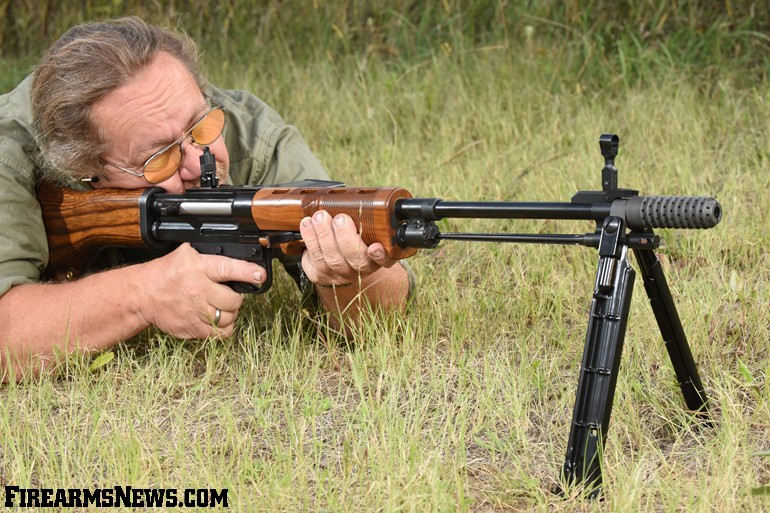
The Lee Enfield series is generally considered the high water mark of military bolt action rifles. A tough, reliable design well-liked by the troops, it proved very effective during two World Wars and many smaller actions.
I’ve always been a fan of the Lee, and find it interesting how this 19th Century manually operated design had a small influence on arguably the most innovative rifle developed during World War II, the German Fallschirmjägergewehr 42 (Paratrooper rifle 1942) or FG 42. I was thinking about this while lying prone behind a modern FG 42 reproduction dialing the rear sight up to 700 meters.
In the far distance was my 800 yard berm with a number of steel targets. The FG 42 was sitting on its distinctive lightweight bipod, a fresh 20-round magazine jutting jauntily out from the left side of the receiver. Hauling back on the charging handle against the heavy recoil spring, I retracted the bolt and let it fly. The heavy bolt carrier assembly ran forward shoving a Hornady match load into the chamber. The rest of the world faded away. Now it was just this classic World War II rifle’s front sight, a faraway white steel silhouette and the building pressure of my finger on the trigger.
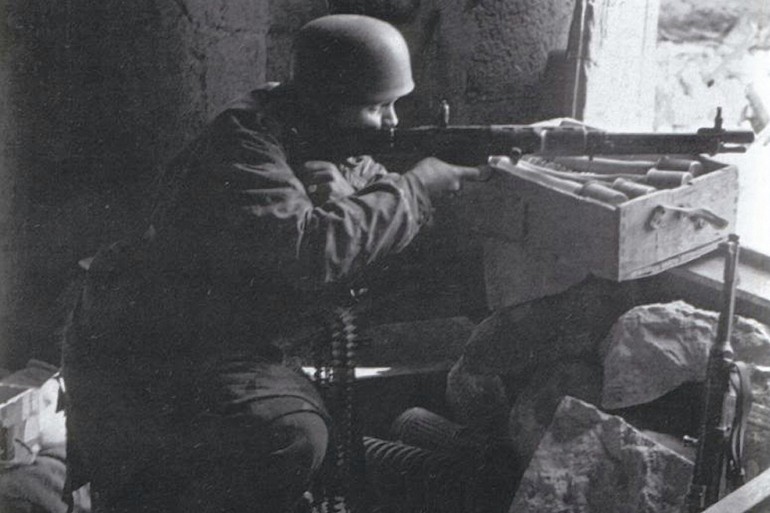
The global catastrophe we know as World War II begat many interesting small arms designs. Of these numerous models, the most influential proved to be Nazi Germany’s MP 43/44 and StG 44 series of Sturmgewehr (Storm or Assault rifle) chambered for the Polte 7.92x33mm Kurz cartridge. A revolutionary new type of weapon, the Sturmgewehr series combined the best features of the submachinegun and battle rifle into one compact package. As its long lasting legacy, both the Sturmgewehr and its 7.92x33mm Kurz cartridge were a direct influence on the Soviet AK47 and 7.62x39mm. As impressive as the MP 43/44 series is, in my humble opinion it pales in comparison design-wise to the much less well-known FG 42.
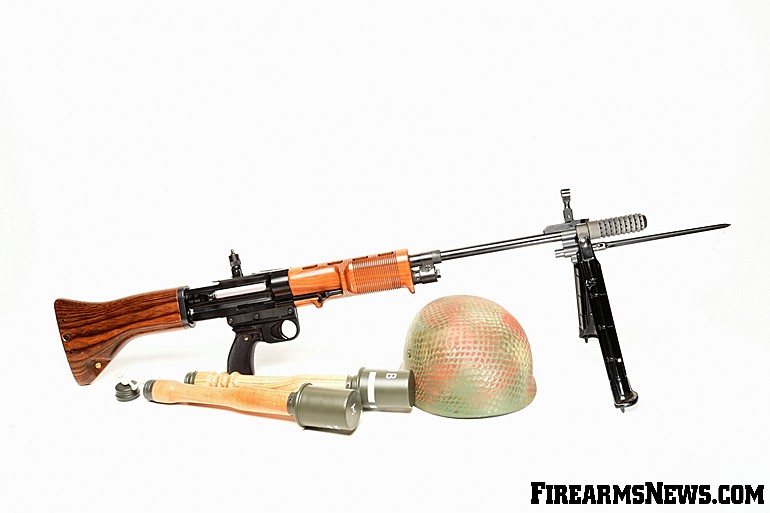
Why do I say this? Whereas the MP 43/44 and StG 44 combined the best features of the submachine gun and battle rifle, the FG 42 was part battle rifle and part light machine gun. In developing the FG 42 the engineers at Rheinmetall, and later Krieghoff, pushed the envelope reaching for what logically seems a bridge too far, and yet achieved it, to a degree. The result was a surprisingly compact selective-fire 7.9x57mm weapon with numerous advanced features. In combat it provided an over-match capability to the German Fallschirmjäger carrying it whether facing M1 Garands, SVT-40s or No. 4 Lee Enfields. Even today, the FG 42 looks remarkably contemporary despite being some 76 years old. Its legacy can be found inside the US M60 machine gun.
To understand the FG 42 we must travel back in time to 20 May 1941 and the Battle of Crete (Luftlandeschlacht um Kreta). The Germans launched Operation Mecury (Unternehmen Merkur) which was the first mass use of airborne forces in history. Their objective was drive the Greek and Allied defenders out and take the island in a lightening blow by landing troops in four zones. To make a long story short, the British and Commonwealth forces made some huge tactical blunders allowing the Germans to gain a foothold and then hold doggedly on. In the end Crete fell to the Axis Forces, but it came at a high price. The German’s suffered between 6,000 and 7,000 casualties and lost/wrote off approximately 284 aircraft with another couple hundred damaged. In the end it was not the easy victory the Luftwaffe had hoped for.
×
The Luftwaffe came away from Crete dissatisfied with the performance of the standard Wehrmacht infantry weapons issued to their elite troops. While the 7.92x57mm Kar 98k was capable at long range it had a slow rate of fire and limited magazine capacity. The MP 40 on the other hand lacked range, penetration and precision. The MG 34 was very effective but too few in number. So a decision was made by the Reichsluftfahrtministerium (Reich Air Ministry) to develop an entirely new multi-purpose weapon based upon the specific needs of the Luftwaffe. The new design would need to be compact and portable, possess the range and accuracy of a Kar 98k, and have the firepower of a light machine gun. Such a weapon would dramatically boost the firepower of the individual Fallschirmjäger and ease the logistics of resupply.
Initially the Luftwaffe intended to work with the German Army to initiate a formal project to develop a new weapon. However, the Army disagreed with the basic concept and expressed no interest in the project. They would eventually abandon the full-size 7.92x57mm cartridge and put their efforts into selective-fire weapons chambering intermediate size cartridges. Undeterred, the Luftwaffe bypassed the Heereswaffenamt (Army Ordnance Department) and went directly to German industry.
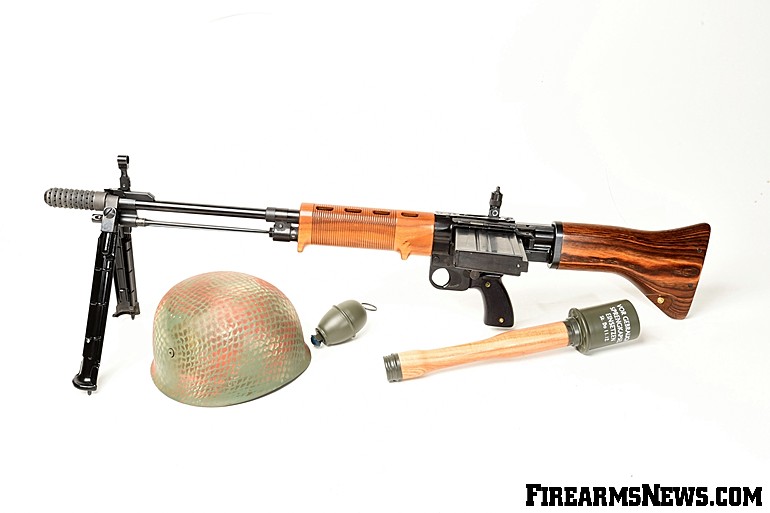
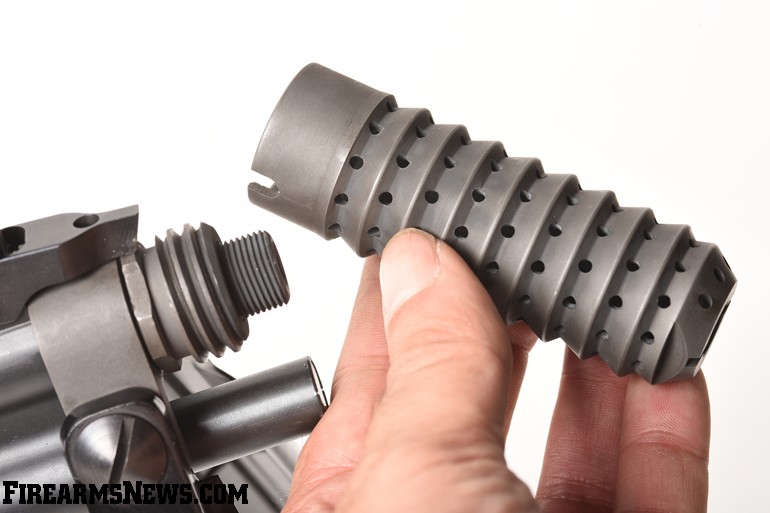
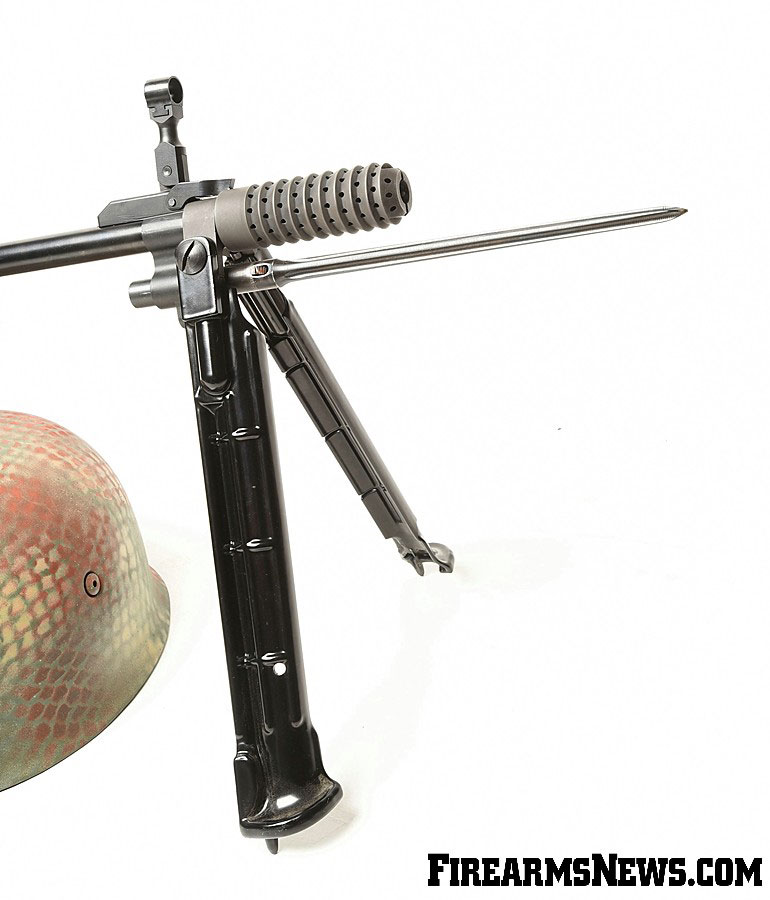
Krieghoff and Rheinmetall both responded by submitting prototypes based upon the Luftwaffe requirements. Of the two the Luftwaffe selected the Rheinmetall design. This is credited as having been designed by Louis Strange and was based upon the operating system of the World War I vintage Lewis Gun. A gas operated design; it utilized a bottom mounted long-stroke piston. Gas tapped from the barrel pushed this to the rear. The piston was fitted with a vertical post at its rear which rode in a cam track on the bolt. It rotated the bolt, which featured dual opposed locking lugs, unlocking it and extracting and ejecting the fired cartridge case before a recoil spring pushed it back forward loading another round into the chamber. Visually it was a great departure from traditional German rifles featuring an inline design, tall folding sights, sharply angled pistolgrip, stamped metal stock, side-mounted magazine, prominent muzzle brake and folding bipod.
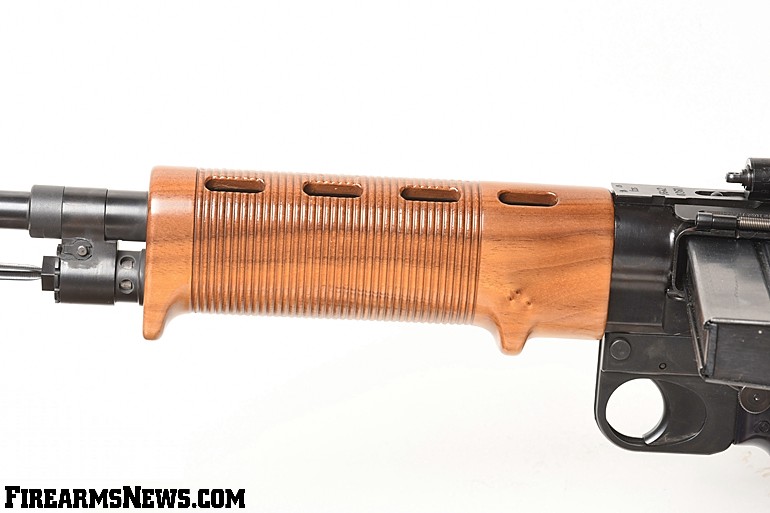
Rheinmetall lacked the capacity to actually produce the rifle so Krieghoff was given this task. A batch of 50 was produced and testing began. From this point the FG 42’s design would remain fluid and ever-changing. While the designation FG 42 never changed, the rifle it designated evolved greatly based upon end-user feed-back, changing requirements of the Luftwaffe and the realities of wartime manufacturing. During its short production life the FG 42 saw small changes as well as a complete overhaul of the design due to the needs of manufacturing and to improve performance. The series is typically broken down simply as either early (Type I) or late (Type II) model. Approximately 2,000 early model guns were produced and approximately 5,000 late models. While they shared the same designation and general layout the two models are quite different if placed side by side.
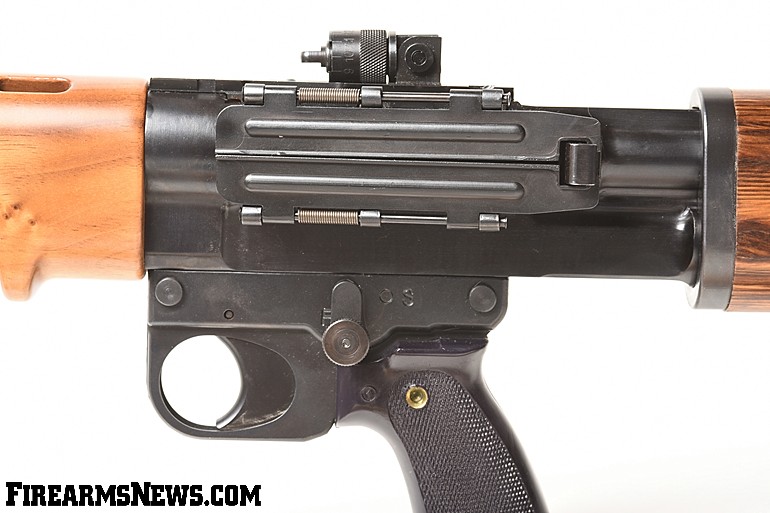
Some shortcomings of the design were noted by troops when the FG 42 was first fielded by the “Green Devils”. Due to its light weight (9.3 pounds) and high cycle rate of fire (900 rpm) the FG 42 couldn’t match the performance of the MG 34, or the new MG 42 machine gun when fired off the bipod. It was also less controllable on full automatic when fired from the shoulder than the Army’s new 7.92x33mm Kurz MP 43. So a more effective muzzle brake was desired. Troops felt the sharply angled pistolgrip, designed to reduce the height and chance of snagging during a jump, should be replaced by a more vertical one. It was also decided to move the bipod mount from the gas block to near the muzzle. This was done to decrease dispersion. Troops complained about the metal buttstock which heated quickly and also deformed when launching rifle grenades.
Video That May Interest You
×
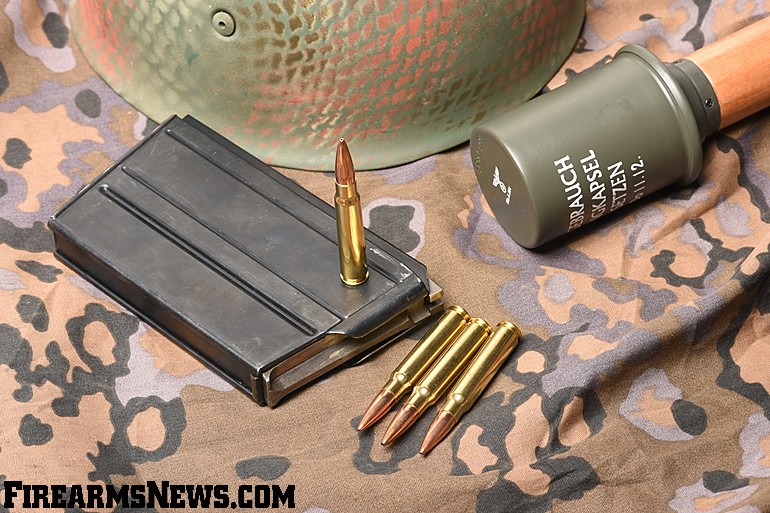
The German Army did their own testing with the FG 42, comparing it to their MP 43. As to be expected, the 7.92x33mm Kurz MP 43 out-performed the 7.92x57mm FG 42 during the close combat trials. On the range both rifles performed similarly when firing on targets up to 400 meters. Past 400 meters the FG 42 had an advantage. However, it could not provide accurate fire on full-automatic at long range. Seeing as the MP 43 had matched the FG 42 out to 400 meters, and out-performed it in close-combat the German Army continued to oppose the project.
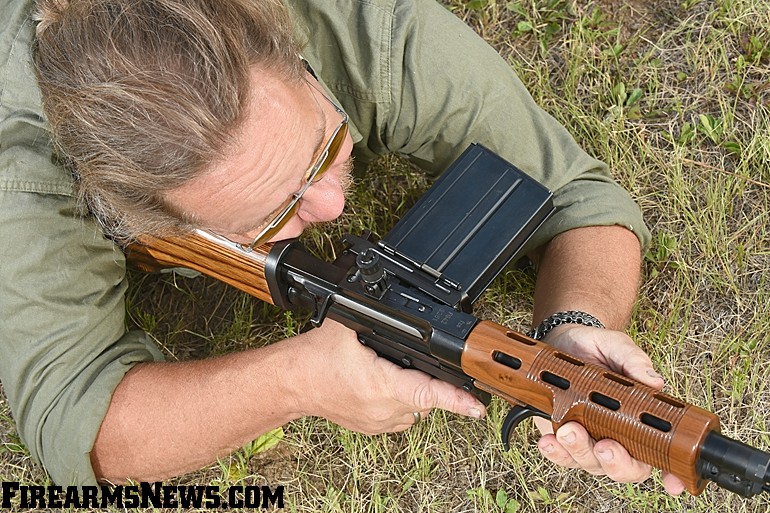
Despite the German Army’s position, the Luftwaffe’s Fallschirmjäger welcomed the design and appreciated the step up in performance it provided them. The FG 42 was first fielded during a daring commando raid during the rescue of Benito Mussolini. In the months following this small numbers saw action in Italy. The FG 42 gave a good account of itself during the Battle of Monte Cassino (17 January to 18 May 1944) in the hands of Fallschirmjäger defending the old monastery. This was ideal terrain for the FG 42 allowing it to showcase its full capabilities. The FG 42 also saw action in France during the hard fought hedgerow battles during the retreat from Normandy. It remained in combat with the hard-pressed Fallschirmjäger units, now fighting as conventional infantry, right up to Germany’s surrender on 7 May 1945.
What about major airborne operations which the FG 42 participated in? There were none. Fallschirmjäger losses during the Battle of Crete were so high Hitler decided airborne operations were no longer viable. While they didn’t know it in the aftermath of the battle, the Luftwaffe’s elite Fallschirmjäger units would spend the rest of the war fighting as conventional ground forces. After the war US Army ordnance took an interest in the operating system of the FG 42. It would later be incorporated in the US Army’s M60 machine gun. In doing so, Isaac Newton Lewis’s operating system, originally rejected by US Army Ordnance due to petty personal reasons became a staple of the US military.
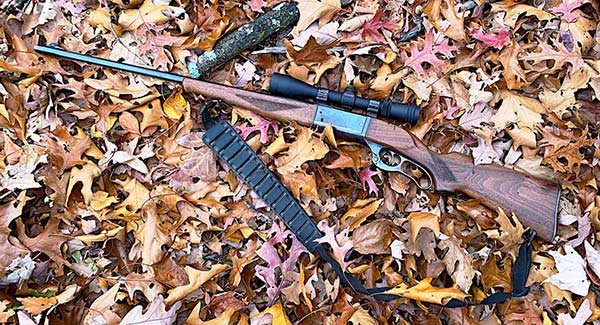
How many times have you thought, “Boy, if this thing could talk,” while picking up a gun to admire it? Here’s a tale where we know not only the history of the gun but several relevant, interlocking stories within the story.
Pap Baker
It starts with my Pap Baker, my mom’s father. A second-generation farmer, he bought the farm from his dad. Pap married and had six children — three boys and three girls. The oldest was my uncle Donny. A big, strong, strapping man, he once picked a hay elevator off my Pap when it collapsed on him, breaking his back.
Donny died in a tragic farm accident shoveling snow off his barn roof for fear of collapse back in January of ’78. My cousin Brad (nicknamed Barrel) found his dad on the ground, buried in snow after the roof snow avalanched on him. Brad and his younger brother, Jay, took over the family farm afterward.
 A good day for the West Virginia opener.
New Tradition
My uncle Jerry took Brad hunting in West Virginia that fall of ’78, starting a new tradition. It was a way for them to get away from their farms, bond, and spend time doing their favorite pastime — deer hunting — after the tragic loss of Donny. Brad and Jerry hunted West Virginia every year after that. I started going in 1990. In 1996, my cousin Brent started coming. Jerry was tickled, having three nephews in tow to hunt with him. But this hunt ended tragically. Jerry died on the third day while shooting at a 9-point buck during a drive. We were shocked, to say the least. He had just turned 50 a few months before and was in good shape from farming.
We continued the West Virginia hunt tradition, but it was never quite the same. My uncle Gary, Brent’s dad, started coming along up until last year. Being on oxygen for the past two years, he never ventured far from the road but still loved the woods and hunting. Even while on oxygen, he’d hunt dark to dark back in Pennsylvania. He’d strap the oxygen tank on his ATV and bring enough hose to reach his stand while the bottle remained strapped to the ATV.
Gary died a few months ago. Brad needs ankle and knee replacements. Milking cows for the past 50+ years simply wore them out. He missed the last two seasons in West Virginia. I missed the last few for various reasons.
There’s something about the death of a loved one that makes you want to repeat the past. After Gary’s funeral, I committed to going to West Virginia, as did Brad.

A happy hunter indeed
Sacred Ground
Brad would hunt from Gary’s spot, a few hundred yards from the road. He wanted his hunt to be special, so he brought his dad’s gun. The gun is a Savage Model 99 chambered in what else? .300 Savage. Pap gave the brand-new gun to Donny in 1956 as a high school graduation present. Donny shot his first buck with it and hunted with it for years before going the bolt-action rifle route. Donny later gave the Savage 99 to his son, Brad, for his first deer rifle, at age 12.
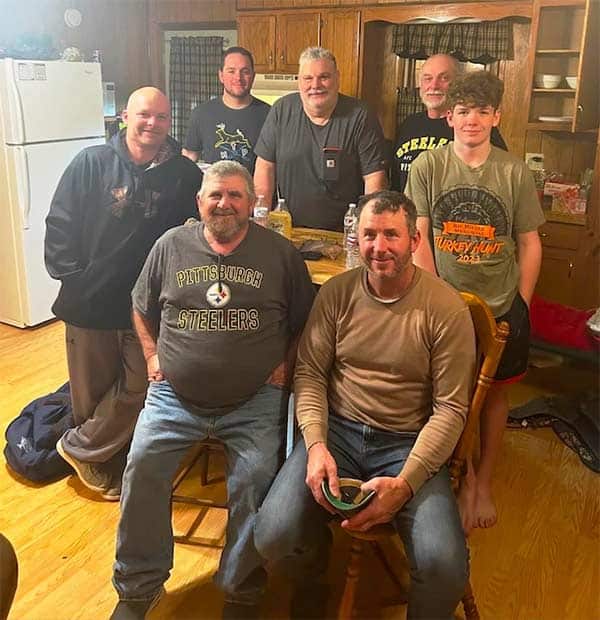
Hail, hail, the gangs all here. Tired, well-fed hunters after opening day.
New Blood
Brad admitted to shooting a doe with it when he was younger, but he never shot a buck with it. On opening morning in West Virginia this year, Brad carried the gun our Pap gave his dad to Gary’s hunting spot — a wind-blown tree. It was a special hunt, whether Brad got a deer or not.
Call it magical, maybe even spiritual, but something wonderful happened on that ridge.
Just before 9 a.m., Brad saw a buck running 60 yards in front of him. One perfect shot, and the buck was down. Everyone was happy for him. We all knew and believed Brad had help from Pap, his dad Donny, Jerry and Gary. It only makes sense when carrying a special rifle, one so ingrained with a rich family history and memories, that something special was bound to happen.
Whatever it was, there’s no denying it was a wonderful hunt, one that left us all feeling good.
After the deer were taken care of, we had a great meal of pork loin, sauerkraut and potatoes that had been simmering all day in the crock pot, along with buttered rolls, fresh from the oven.
The making of great memories can only tighten family bonds. After all, memories are the only true thing we leave this world with that are truly ours.
More Memories
Next week is Pennsylvania’s opener, and I’ll get to see my cousins again. After hunting all day, we’ll meet up in the “butcher shop” to rekindle the day’s events, hopefully, cut up a few deer and eat fresh venison backstrap, as we’ve done for years. We’ll remember those who’ve left us while the youngsters are welcomed amongst the ranks as they tell the tale of their deer hunt, as hunters have been doing for centuries.
Life’s cycle is certainly amazing, as well as deceivingly quick. One day, you’re an 8-year-old kid, and the next moment, you’re one of the oldest family members standing in the back, taking it all in, wondering how you got to where you are. The older you are, the faster that boulder rolls downhill. That’s why barreled memories are special to those willing to understand. Life’s too short to live otherwise
Categories
416 Rigby vs 416 Rem Mag
Okay now let us come back to Planet Earth guys & ladies. Sadly most of us will not be going to Alaska or the Game Rich land of Africa anytime soon. Also the chances of a problem breaking out at the circus are mighty slim to say the least. Plus Godzilla is dead.
Now I am as gulity as the next fellow. In that have owned and shot a LOT of the big boys guns. Frow the 300 H&H up to the 50 Calibers.
Yes I include my time in the Army and still love Ma Deuce with a passion. The same with the Barret, but thanks to old ARNOLD. (Yeah, you thought I forgot about you old Steriods Junkie you huh!?! Not Bloody likely!!!!) Let us say, the chances of me legally owning either one in LA. Well let us say that they are mighty dim to say the least.
Now to be fair it is a real ego booster, when you crank off one of these Monsters at your local rifle range. Then go”Thats right you bunch of pussies, this is what a REAL MAN shoots!” To the peasants astonished faces.
But then you get home and there is this huge and painful welt on your shoulder & your back is saying “What the F*ck did you do to me?” Plus there is a slight matter of your wallet saying “HOW MUCH DID YOU PAY FOR THAT IFLE & AMMO!?! And trust me your wallet knows Brother!
So the Bottom Line really is this,so when propaganda like this comes a long. Try to remember that unless you are a gun writer that gets published. Or win the Lottery and Uncle Sam leaves you a substantial amount of your winnings.
There really is no real reason on why the average gun owner should own one of these Guns of Navarone.(Another hint-A great war movie & worth buying the DVD of it!)Yeah I know, I know! It is a lot of fun to whip one of these monsters to show to your gun buddies.But maybe this broken down rifleman. Just might know wtf he is talking about?Nah!!! * Grumpy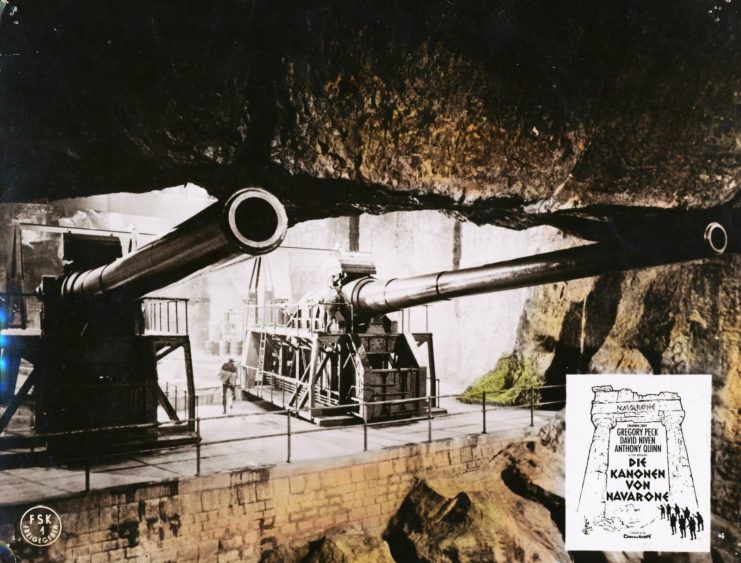
- Why does the terms “Young Dumb & full of cum & or Pride goes before a Fall”?
Categories
Winchester M1897 Trench Gun
Categories
Winchester M1 Garand 1941

