Categories
All About Guns

Stevens Model 52 – Happy to Meet You, Lucile! By Terry Wielan

Most shooters like a rifle with character, some history, and, to add spice, a little mystery. Lucile – for that is her name – has all three.
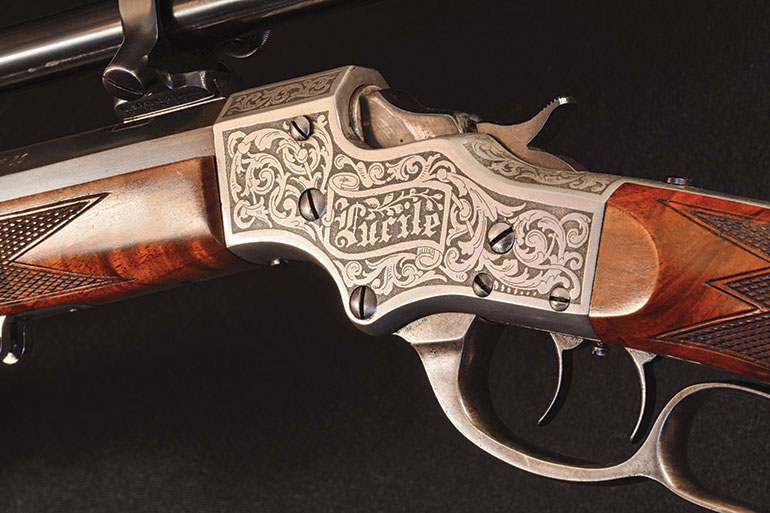
Who could Lucile be? She might be the rifle herself or one of the woodchucks depicted on the other side of the action or the first owner’s paramour. We will never know for sure, but Terry likes to speculate.

If she were a girl, you could say I met her at a dance, twirled her once around the floor, then watched her leave with another guy. Three months later, a sadder but wiser girl, we met up again, and this time she came home with me. Lucile being a rifle, that’s not quite what happened, but close enough. It was an auction, not a dance floor.

Here’s what I know about her history. She’s a Stevens Model 52, chambered in .28-30-120, made to special order around 1902. She has a No. 44 action, which was discontinued in the higher grades around 1903, but the .28-30 was only introduced in 1901, so that pinpoints it nicely. The Model 52 was one of the finest of the Stevens target rifles, equipped with lovely walnut, a palm rest, and all the frills of the best Schützens. Somewhere along the line, she was fitted with scope blocks and now sports an 8X Lyman Junior Targetspot.

Now the mystery. Who ordered her? And who was Lucile? The name is engraved in old English lettering, in a banner on the left side of the action, surrounded by scroll. And on the right side, there are two woodchucks under a tree. One is down nibbling clover, while the other is standing up and gazing intently, as all good woodchucks do.

Was Lucile the first owner’s wife, girlfriend, daughter, paramour? Or was the rifle owned by Lucile herself? Or is Lucile one of the woodchucks? (Personally, I rather like that idea.)

The embellishment very likely was begun by etching the steel to get the general outline, then sharpening it with engraving before finally nickel plating. Although the plating is beginning to fray here and there, overall it’s in remarkable condition. It may or may not have been delivered from the factory with iron target sights.

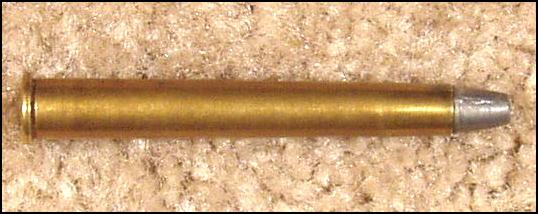
Impossible to tell now, but someone was a serious shooter because it is fitted with a palm rest and the scope, and it is chambered for the darling target round of that era, the .28-30-120 Stevens.
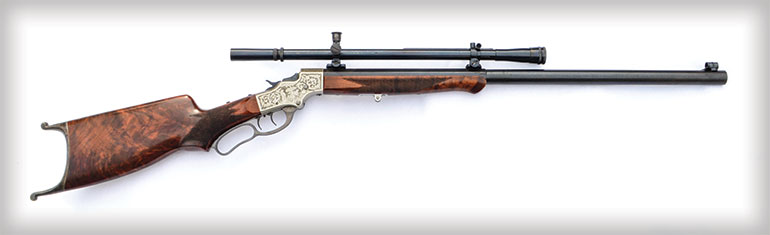
The rifle is a Stevens Model 52 built on the No. 44 action, most likely in 1901 or ’02, and chambered for the .28-30-120 Stevens.
The scope is an 8X Lyman Junior Targetspot.

The Stevens records were all destroyed in a fire, shortly after World War I ended in 1918 and before the company was acquired by Savage. There is very little official written material about models and features, to say nothing of serial numbers and written orders for individual rifles. This is the polar opposite of Winchester and Colt, where it is now de rigueur for auctioneers to pitch the item as coming “with the factory letter” giving details of its origins and life on the frontier.

In a way, it seems to me, we almost have too much information about some guns. Sure, we all wish they could talk, to tell us where they’ve been and what they’ve done, but as with most things, we should be careful what we wish for. Do I really want to know who Lucile was or why the rifle was named that? Or is it more fun fantasizing about possible scenarios? In this case, I think it is the latter.

Categories
All About Guns

M&P FPC Folding Carbine Chapter 2

Categories
Cops

The Reid Technique: How the Police Force Confessions…

Categories
All About Guns

Obviously somebody out there knows what their doing with a shotgun

Categories
EVIL MF

Judge denies Alec Baldwin’s bid to dismiss ‘Rust’ charge over firearm evidence by Meredith Deliso

A New Mexico judge denied Alec Baldwin’s bid to drop his involuntary manslaughter charge over firearm evidence stemming from the 2021 fatal shooting on the set of “Rust” before his trial starts next month.

In their request to dismiss the indictment, Baldwin’s attorneys claimed the state “intentionally” destroyed key evidence — the firearm involved in the shooting — denying them the chance to review potentially exculpatory evidence.

Judge Mary Marlowe Sommer denied the request in an order issued on Friday, following arguments during a virtual hearing on Monday.

Baldwin’s trial is scheduled to begin with jury selection on July 9.

The actor was practicing a cross-draw in a church on the set of the Western film when the Colt .45 revolver fired a live round, fatally striking 42-year-old cinematographer Halyna Hutchins.

Baldwin, 66, who was also a producer on the film, was indicted by a grand jury on involuntary manslaughter in connection with Hutchins’ death earlier this year, after prosecutors previously dropped the charge. He pleaded not guilty.

Baldwin’s attorneys argued that the firearm is “central” to the state’s theory of guilt, but that they were denied the opportunity to examine it themselves and that FBI forensic testing that damaged the gun was unnecessary.

“They understood that this was potentially exculpatory evidence and they destroyed it anyway,” Baldwin’s attorney, John Bash, said during Monday’s hearing.

Baldwin has maintained that he did not pull the trigger of the firearm, though the FBI forensic report determined that the gun could not have been fired without pulling the trigger.

Bash argued that there’s reason to believe that further testing would show the firearm was capable of discharging without the pull of the trigger.

“The prosecution denied the criminal defendant the opportunity to see it, to test it,” Bash said. “It’s outrageous, and it requires dismissal.”

Prosecutors argued that there was no perceived exculpatory value of the firearm apparent to law enforcement following the shooting.

“The fact that this gun was unfortunately damaged during the accidental discharge testing does not deprive the defendant of the evidence that they can use effectively in cross-examining,” Erlinda Ocampo Johnson said during Monday’s hearing.

Johnson also argued there is “ample evidence” of the defendant’s guilt in this case in regards to his “reckless conduct.”

In her order denying the motion, the judge wrote that the defense failed to establish that the firearm had any apparent exculpatory value before the evidence was destroyed, and that they are still able to examine the firearm in its current condition and examine witnesses as to its functionality prior to the destructive testing. She additionally failed to find that the state acted in bad faith when the firearm was damaged during the testing.

Marlowe Sommer’s ruling comes after she denied last week another defense request to dismiss the indictment. In that motion, Baldwin’s attorneys argued that the state failed to allege a criminal offense because Baldwin had no reason to believe the gun might contain live rounds and that the manipulation of the weapon could pose a “substantial risk” to Hutchins.

In her official order denying that motion, released on Friday, Marlow Sommer wrote that whether Baldwin had a criminally negligent state of mind “is a question of fact for the jury to decide.”

The judge also denied last month another request by the defense to dismiss the indictment in which Baldwin’s attorneys argued that the prosecution engaged in “bad faith” by failing to provide the grand jury with sufficient information.

Marlowe Sommer additionally denied last week a request from the state to use immunity to compel testimony from the film’s armorer, Hannah Gutierrez, during Baldwin’s trial.

Gutierrez, 27, was found guilty of involuntary manslaughter in connection with the shooting and sentenced in April to 18 months in prison, the maximum possible, in the shooting. She appealed her conviction in May.

Prosecutors sought immunity so that her testimony could not be used against her in her appeal. At a pretrial interview in May, Gutierrez asserted her Fifth Amendment privilege against self-incrimination, prosecutors said.

In issuing her ruling, Marlowe Sommer noted that the armorer has indicated she won’t testify and that she hasn’t heard “anything that [Gutierrez] might testify to that someone else could not testify to.”

Gutierrez could still be called to testify but would speak without immunity.

Marlowe Sommer last week also allowed for the testimony at Baldwin’s trial of a “Rust” crew member who prosecutors said witnessed the on-set shooting and said he saw Baldwin pull the trigger.

Following Monday’s hearing, Baldwin’s attorneys filed another motion seeking to dismiss the indictment, alleging that the state violated its discovery obligations by delaying the disclosure of “critical evidence that is favorable to Baldwin’s defense and that fundamentally reshapes the way Baldwin would have prepared for trial.”

In a response to the motion filed Thursday, the state pushed back against the defense’s claims, saying it has “worked tirelessly to ensure that the defendant has every possible page of discovery, no matter how minuscule or immaterial,” and asked the court to deny the motion.

Categories
All About Guns

QUAD 50’S OF THE VIETNAM WAR

Categories
This great Nation & Its People

Paul Harvey – An Adventure on the Oregon Trail – The Rest of the Story

Categories
All About Guns

World’s Cheapest 1911 Pistol Review – Tisas 1911 A1 Army 45

Categories
All About Guns

Greek Mannlicher Schonauer 1903

Categories
Soldiering This great Nation & Its People War

Why These 2 American Soldiers Couldn’t Relate to Each Other After WW2: The Forgotten Divide