The .50 cal is heavy and needs a vehicle to carry it around unlike the compact, and relatively lightweight GPMG, but the venerable ‘ma deuce’ hits far harder at much longer ranges – 1.5 miles later your lead is still flying and your enemy is still ducking. A sustained burst of fire will shred a wall and stop most vehicles apart from advanced APCs or tanks.
Stick it up on a truck or even a Humvee and you have a truly powerful, mobile weapon for a fraction of the cost of other platforms.
That trusty M2HB is reliable as well as versatile.
It terrifies enemy infantry.
It can be used to range in your bigger guns on a target.
In a tight spot it can be used to take down a 20 million dollar, strafing aircraft just as granddad stopped bandits like the Focke Wulf 190 with it in WWII.
No GPMG is a good substitute in that role.
It has no circuit boards to fry in an electromagnetic pulse, no batteries to fail, and no guidance system to jam with electronics or a burst of chaff.
Even in our technological age there are few better ways to even out a fight than with a .50 calibre machine gun, a well-trained gunner, and a thousand rounds of ammunition.
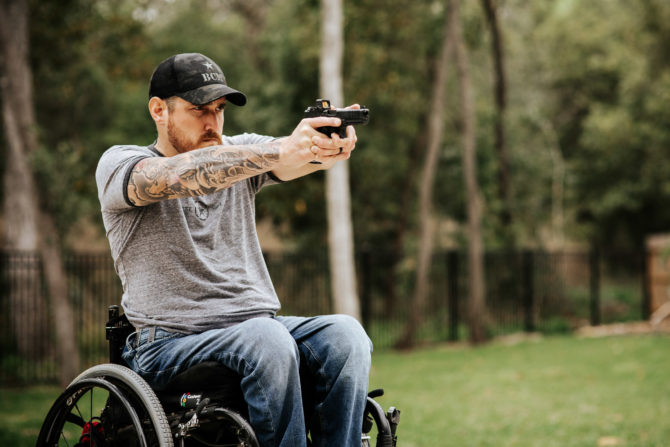
When selecting someone to victimize, criminals want the maximum return on investment with the least amount of effort and risk involved. People with disabilities, especially those who use wheelchairs for mobility, undoubtedly fall into the “soft target” category in the eyes of criminals. When it comes to wheelchair concealed carry, some special attention must be paid.
[Editor’s Note: Photography by Taylor Elizabeth Photography.]
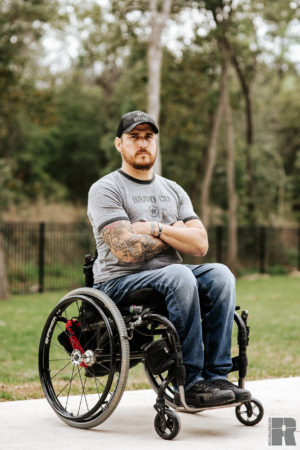
I was shot and paralyzed from the waist down in a gunfight while serving as a U.S. Marine infantryman during the 2003 invasion of Iraq. I spent months recovering in the hospital before finally getting back into society again as a civilian with a severe disability, and I immediately felt physically vulnerable around shady-looking characters. So it made sense that I’d eventually want to start carrying a handgun for protection and become more self-defense minded in general.
However, I had no clue what type of concealment method or holster to use, or even how to set up the holster for my own personal needs, so I simply mimicked how my able-bodied peers were running theirs. Over a decade later, with knowledge gained in more than 100 training classes and 50 different firearms instructors, the end result is a box full of holsters that just didn’t work for me. That’s not to say they’re all bad; they just don’t suit my specific needs.
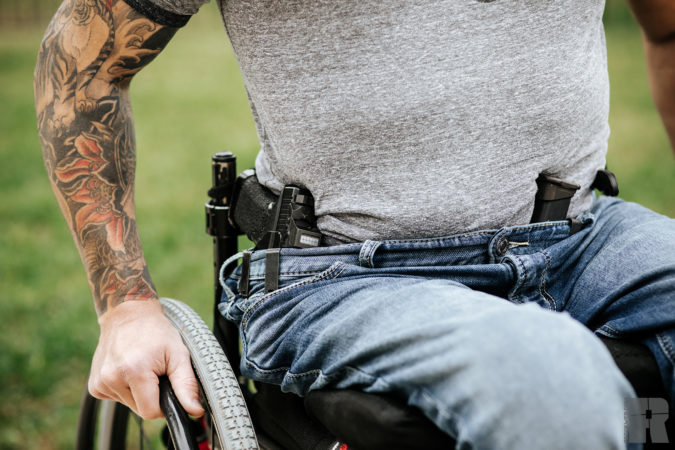
My goal here is to help prevent you, or someone else you know who’s in a wheelchair, from having to figure it out on your own like I had to.
GENERAL CONSIDERATIONS
First and foremost — regardless of your chosen carry method — your handgun needs to be inside of a holster, and that holster should actually be designed for your gun’s make and model. The trigger guard needs to be completely covered and the holster alone should effectively retain the pistol. Only use high-quality holsters made of rigid materials like Kydex or injection-molded polymer.
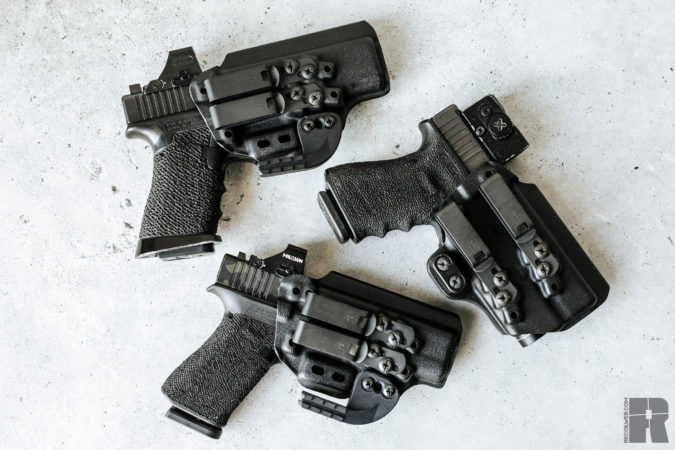
The ability to adjust the depth and angle the holster sits at can be very important when you’re always sitting in a wheelchair as well, because the waistline of your pants typically rides at an angle instead of being level. So it’s important to have a holster that allows you to adjust it to suit your specific needs. The holster itself should also stay in place wherever you attach it and not move around, so that when you go to draw the handgun it’s always going to be where you expect it to be.
Before I break down each wheelchair concealed carry method, allow me to explain the requirements that dictate my personal methods of concealment (for any self-defense tool). First, I want my gun to be easily accessible at all times, regardless of the context in which I may need it. I should also be able to quickly access and draw the pistol using just one hand (left or right) if forced to, no matter if the other hand is injured or just busy fending off an attacker, grasping another tool such as a handheld flashlight or fixed blade knife, or controlling my wheelchair.
I also need to be capable of achieving this whether I’m in my wheelchair, driving my vehicle, sitting on the couch with the wife, or even if I’m thrown from my chair and lying on the ground. Bottom line: If I have to draw my gun, I want to be able to access it as quickly as humanly possible.
CARRYING ON-BODY
Carrying your handgun on-body, in an IWB (inside the waistband) holster secured somewhere along your waistline, whether attached to your pants or belt, or even directly to your body using something like the new Phlster “Enigma” concealment chassis, is by far the most effective and efficient way to go about it. Carrying on-body checks all of the above considerations, and the gun also goes wherever your body goes. Imagine fighting or holding off an attacker with one hand, while simultaneously drawing your gun with the other … and doing both of these things while on the ground after having been thrown out of your chair. You ideally want your gun to go wherever your body goes, without ever being physically separated from it.
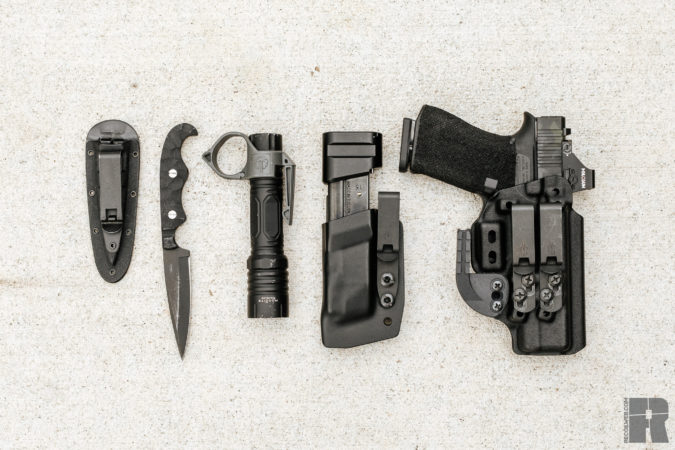
As an example, I carry on my “strong side” (right hip) at 3 o’clock. I typically carry either a Glock 17 or 48 in a Tenicor “Certum3” holster (not a typo), depending on what I’m wearing. Since I cannot wear a belt on a daily basis (they can break down my skin and give me a wound on my tailbone), I use Discreet Carry Concepts metal clips that really bite into any of the pants I wear. The DCC clips keep my holster in place all day long, and I’ve never once had the holster come out in addition to the gun in the thousands of draws I’ve done since I began using them several years ago. They are by far the best clips I’ve seen or used to date on my holsters, magazine pouches, and knife sheaths.
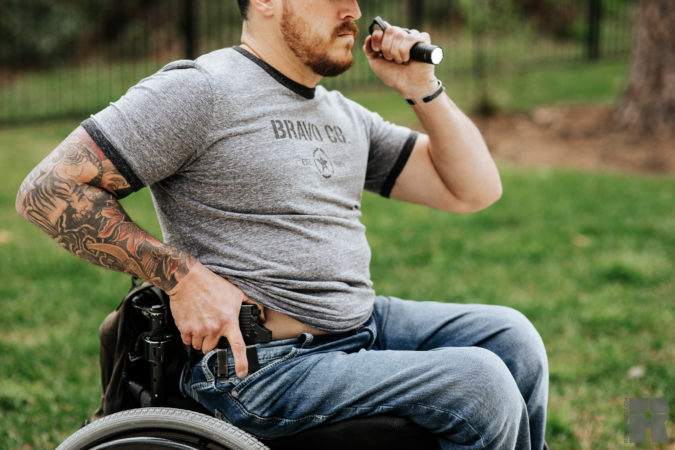
If you do wear a belt on a daily basis (and you should, if possible), make sure it’s a belt that’s actually designed for carrying the weight of a gun and your other tools. You can also use soft loops when wearing a belt if you prefer them over clips.
Carrying appendix IWB is also a great option if you’re able to do it (I can’t, or I probably would). Just keep in mind that it’s crucial to use a holster that’s truly designed for carrying AIWB. My friend Luke Cifka, an instructor for Sage Dynamics, is a double above-knee amputee in a wheelchair who carries AIWB every day. “Equipment setup will make or break your draw stroke from a chair,” he says. “Chair users may have limited use of trunk mobility, which can complicate the draw since the user may not be able to straighten up to achieve a good grip.”
I agree, completely. It’s unique challenges like that which will dictate your ideal carry gun, concealment method, and holster setup. You’ve already got to work around your disability, so don’t compromise on your equipment.
Let me also briefly address carrying on an ankle or small of the back. Both of these can actually be good for concealment, but they’re much slower and require more overt movements to draw (making a slow-draw far more challenging) and are suboptimal carry locations if thrown to the ground. They may have some utility for carrying backup guns, but not as primary methods of concealment.
CARRYING OFF-BODY
Off-body wheelchair concealed carry (i.e. inside of a shoulder bag, purse, briefcase, etc.) is, of course, always better than carrying no gun at all, but isn’t ideal for multiple reasons. For one, you always have to maintain positive control of the bag at all times. If it’s not on your person, then it’s an unsecured gun and that’s a good way for someone to access it who shouldn’t, like a child or your intoxicated friend at the dinner party you’re attending.
Something else to keep in mind: If you get thrown out of your chair and are receiving blows from your opponent, your bag will move and twist every which way. You’ll potentially be trying to draw your handgun while both you and your bag are simultaneously shifting around as you’re defending yourself … and that’s assuming it even stays attached to you or isn’t pinned underneath your back.
If you do decide to carry in a bag, buy one that you can wear crossbody on your strong side that’s purpose-built for carrying a handgun and has the ability to mount a good holster inside. You can also buy your own hook and loop tape to securely attach the holster inside of a bag. But this only works if it’s mounted inside a pouch or another tight compartment, so that it’ll always stay in place and be where you expect it when you need it.
Whatever bag you choose, it needs to provide easy access to the gun under stress as fast as humanly possible.
WHEELCHAIR-MOUNTED
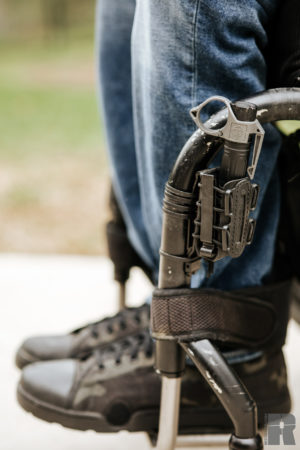
Lastly, there’s the ability to mount a holster somewhere on your wheelchair itself. (Side note: This actually works great for competition shooting and home defense.) This is technically still off-body carry, but it’s unique in that it always stays attached to your wheelchair, which does almost feel like an extension of your body.
I’ve seen one guy online who mounts his gun in a Level 2 retention holster on the frame of his manual wheelchair (close to his right knee), and then places a general-purpose pouch of some kind over the top of his gun, which serves to camouflage it completely. It looks a bit odd having such a large “pouch” hanging off the front side of his wheelchair, but this is definitely the best execution I’ve seen thus far of a wheelchair-mounted concealed handgun. When he wants to draw the gun, he simply rips off the dummy pouch, which exposes his holstered handgun, giving him immediate access to it.
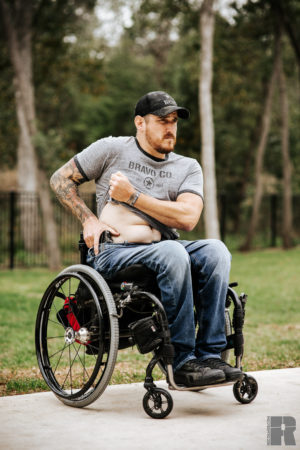
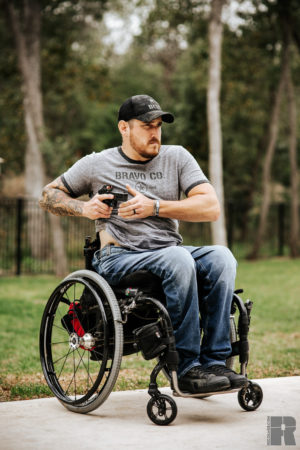
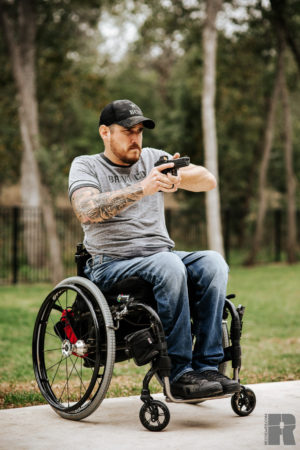
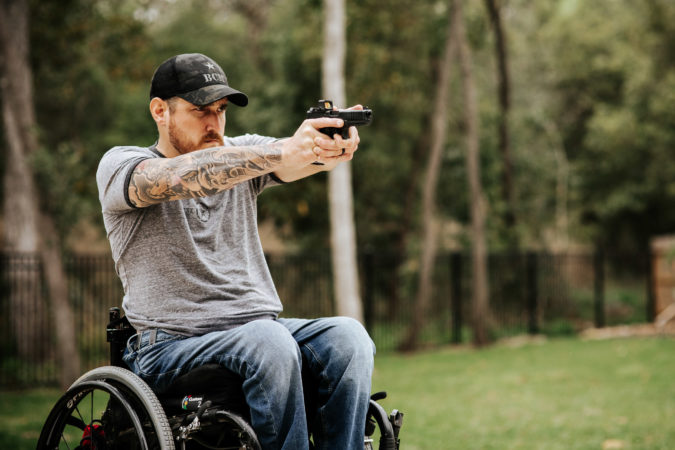
The biggest downsides with carrying your handgun in any wheelchair-mounted holster are:
Becoming completely separated from your lifesaving tool the moment you’re knocked out of your chair and need it most.
Mounting it will likely have to be done by you, because it’s such a niche product, and concealing it takes some creativity.
Every time you transfer to your vehicle (unless you sit and drive from your actual wheelchair), you’ll have to safely move your gun from your wheelchair-mounted holster and into the vehicle with you somewhere that it’s readily accessible and will stay put.
When you transfer to someone else’s vehicle and do not want them knowing you have a gun, you’ll have to figure out a way to stealthily transfer the gun out of your wheelchair-mounted holster and into the vehicle with you, be it inside a bag or elsewhere on your person. You’ll also have to achieve this out of sight from anyone passing by or potentially even helping you into the vehicle.
Although mounting firearms on your wheelchair isn’t usually the best method, mounting other tools can actually be very advantageous.
I have a handheld flashlight mounted on the left side of my wheelchair, which is my support-hand side. I’m able to quickly access it with my support hand, which keeps my strong hand free to always be staged and ready to draw my handgun. I just used zip-ties to mount a G-Code universal magazine pouch to the frame of my chair, so I can carry any flashlight I want in that.
You can also mount spare mags, knives, pepper spray, tourniquets, etc. to your chair. I’ve got a Benchmade SOCP knife mounted to the frame on the right side of my chair. Although I could certainly use it for self-defense, honestly for me it’s primarily a utility knife that’s readily accessible.
MEDICAL
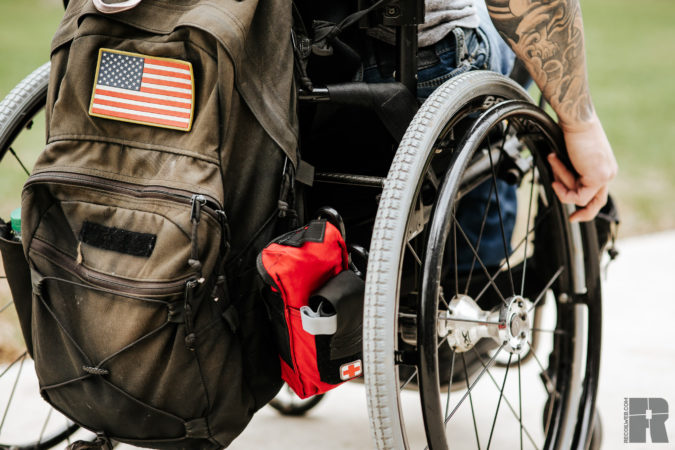
One item everyone should carry is a tourniquet, and there’s several different ways to carry one. You can wear one on your ankle if you choose, or mount it to your chair, or even stow one in your backpack. I actually have my Dark Angel Medical D.A.R.K. trauma kit attached to the right side of my backpack via MOLLE webbing. I also have three extra tourniquets in my backpack. Pretty much every person in a wheelchair has a small backpack hanging on the back of their chair, so there’s no reason not to carry items that could save your life or the lives of people you care about.
SPARE MAGS
When it comes to carrying spare magazines, body type again comes into play. When I carry a spare magazine on my body, I use the Bawidamann Vertical Uber CC Mag Carrier, because it allows the magazine to sit very deep inside my pant line. My spinal cord injury is “complete,” so I have a gut that will always stick out right at the level where my paralysis begins (level T12). Because of this, a standard-depth mag pouch prints terribly on me, but you may not have this problem.
BLADES
Like tourniquets, everyone should carry a fixed blade knife (local laws permitting). I carry a Headhunter Blades “Rat” fixed blade knife on the support-hand side of my waistline, around 10 o’clock. This blade is extremely concealable and is easy to draw from the high-quality Kydex sheath that accompanies it. You can also attach the sheath to any pants material you wear, thanks to its metal spring clip. Amtac Blades is another great knife company.
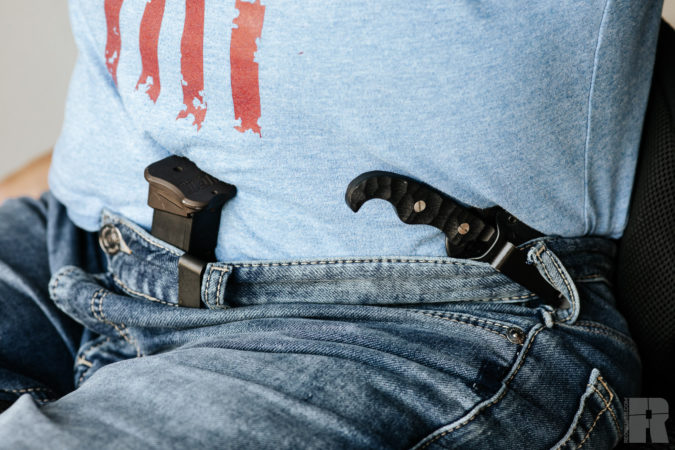
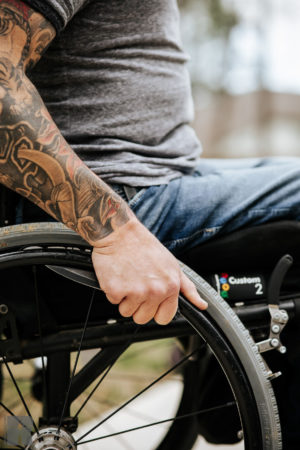
One of the advantages a fixed blade offers is that it’s very fast to draw and doesn’t require as much movement to do a stealthy slow-draw. I’ve been in places where I can’t carry a gun, and I’ll actually carry a fixed-blade knife on each hip. If I’m forced to roll past some shady-looking individuals, I may even slow-draw a blade and keep it staged in my hand and keep pushing my chair without anyone ever knowing I have a knife in hand as I pass by them, as my blade is camouflaged by my wheel.
FINAL THOUGHTS
The one common theme for wheelchair concealed carry is that you need to be able to access any of your self-defense tools as easily and quickly as possible, be it a gun, knife, pepper spray, spare magazine, etc. When you’re in a wheelchair you have to think outside the box to accomplish things that able-bodied people take for granted, and self-defense is no different.
Don’t simply decide on a method of wheelchair concealed carry, buy a holster and then immediately begin carrying a gun in it the next day. Practice drawing from concealment in both dry and live practice before deciding to carry your handgun using a preferred method. Lastly, always seek out quality training from highly qualified instructors in order to constantly get better and become harder to kill.
ABOUT THE AUTHOR
Paul Gardner is a former U.S. Marine Rifleman, firearms training junkie, and firearms instructor. He recently started his own training company, Strive Tactical. For now, he can be found on Instagram @Wheelchair_Technical.
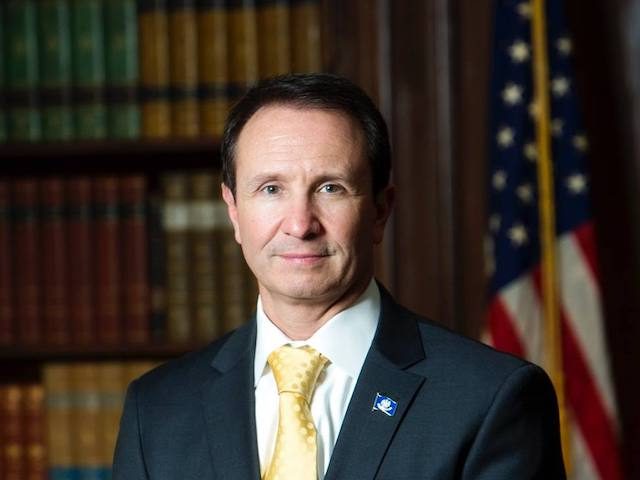
Attorney General Jeff Landry (R) discussed his run for Governor of Louisiana with Breitbart News and affirmed constitutional carry will finally be secured once he is in the gubernatorial office.
As we talked, constitutional carry was the first topic that came up. Recent history has shown constitutional carry has the overwhelming support of the Louisiana legislature but is opposed by the state’s current governor, John Bel Edwards (D).
In fact, the Associated Press reported that Edwards vetoed constitutional carry legislation on June 25, 2021.
Landry sees it differently. He does not believe Louisiana residents need a permit from the government in order to participate in Second Amendment freedoms.
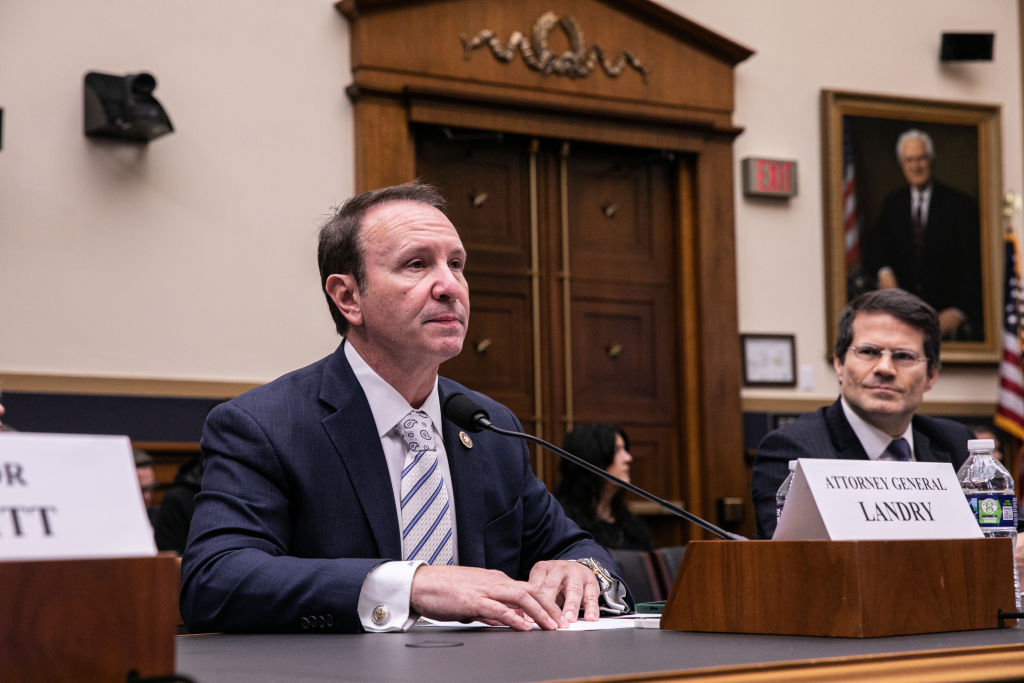
Jeff Landry, attorney general of Louisiana, during a Weaponization of the Federal Government Subcommittee hearing in Washington, DC, US, on Thursday, March 30, 2023. (Valerie Plesch/Bloomberg via Getty)
He said, “The current Gov. of this state has vetoed constitutional carry but we’re going in and passing that.”
Landry focused on how criminals are armed, whether permits are required or not, and he observed, “The problems are not the guns, the problems are cultural. The problems are broken families, the problems are poor educational opportunities, the problems are not supporting programs that teach the proper use and handling of firearms.”
He observed, “Those that blame the gun are the first ones that would put an iPhone in a kid’s hand rather than give him love and guidance.”
Landry summed up his views on constitutional carry by pointing out, “I support further strengthening the right of our citizens, their ability to exercise the Second Amendment of the constitution, and I will be focused on any way that we can strengthen that at the state level.”
The NRA has endorsed Landry in the upcoming Louisiana gubernatorial election:
Landry spoke to Breitbart News about the endorsement, saying that the day they endorsed him was “one of the proudest days of [his] life.”
He added, “I’m a lifetime member of the NRA and I believe in the mission. Look, we’ve got a number of gun rights organizations out there, and the NRA’s been the leader in that space. and to have their endorsement speaks volumes about my record defending the Second Amendment.”
AWR Hawkins is an award-winning Second Amendment columnist for Breitbart News and the writer/curator of Down Range with AWR Hawkins, a weekly newsletter focused on all things Second Amendment, also for Breitbart News. He is the political analyst for Armed American Radio and a Turning Point USA Ambassador. He was a Visiting Fellow at the Russell Kirk Center for Cultural Renewal in 2010, a speaker at the 2023 Western Conservative Summit, and he holds a Ph.D. in Military History, with a focus on the Vietnam War (brown water navy), U.S. Navy since Inception, the Civil War, and Early Modern Europe. Follow him on Instagram: @awr_hawkins. You can sign up to get Down Range at breitbart.com/downrange. Reach him directly at awrhawkins@breitbart.com.
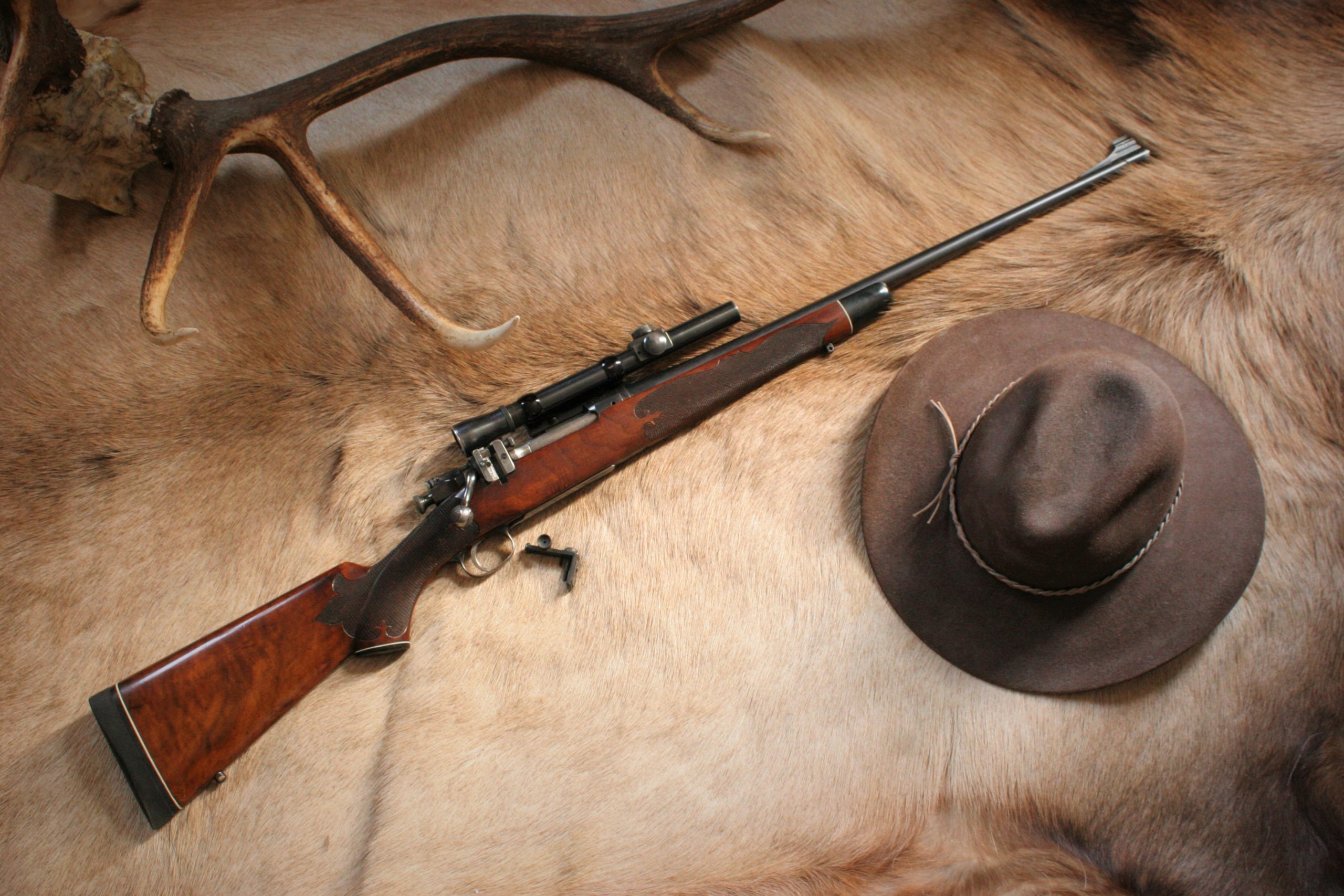
A nostalgic look at America’s classic bolt-action hunting rifle.
Photo above: Barsness’s Springfield Sporter was built by Frank Pachmayr in the 1930s. Originally a .35 Whelen, it was later rechambered to .358 Norma Magnum.
At the beginning of the twentieth century, the U.S. Army decided it needed a more modern bolt-action rifle. Since 1892, the Army had been using variations of the Krag-Jorgenson rifle, which was chambered for the .30 U.S round commonly known as the .30-40 Krag. Despite America winning the 1898 Spanish-American War in Cuba, it did not go unnoticed that the 1895 Mauser rifles used by Spain could be reloaded far quicker than Krags, which had a rather clumsy, hinge-topped magazine on the side of the action. The 1895s used disposable “stripper-clips” that could be inserted quickly into the top of the action, instantly loading five rounds.
The Army designed a new action, which used stripper clips so similar to the Mauser’s that the U.S. Government had to pay royalties to the Mauser company. The action itself was a combination of Mauser and Krag features, and in 1903 was accepted as the new service rifle.
The U.S. also “designed” a new cartridge for the 1903 rifle, strongly resembling the first smokeless German military round, today known in the U.S. as the 8×57 Mauser. The 8×57 had a rimless case, formed by cutting an extractor groove around the case-head, resulting in a rim the same diameter as the cartridge body.
The 1903 Springfield’s cartridge was also rimless, and in another not-so-astonishing coincidence, featured the same 12mm (.472 inch) rim diameter as the 8×57. The overall case was slightly longer, and used the same 220-grain roundnose bullet as the .30-40 Krag, at a muzzle velocity of 2,300 fps.
Soon afterward, however, Germany dropped the 8×57’s heavy round-nose bullet, switching to a 154-grain spitzer (pointed) bullet at a muzzle velocity around 2,800 fps. The faster, sleeker bullet extended the 8×57’s range considerably, and the U.S. again followed the German lead by switching to a 150-grain spitzer at 2,700 fps. Officially termed the “cartridge, ball, caliber .30, Model of 1906,” it soon became known as the .30-06.
Hunters started using the new rifle and round, which resulted in a major secondary industry, converting 1903 Springfield military rifles into sporters. The first and most famous 1903 was ordered from Springfield Armory by President Theodore Roosevelt in 1904. The Armory fitted a custom-made sporter stock, partly fashioned after one of Roosevelt’s Winchester rifles, with a short fore-end, cheekpiece, and commercial buttplate, and replaced the military open sights with Lyman sporting sights.
Even for America’s commander-in-chief, this work wasn’t free. Roosevelt paid $42.13 for the job, equivalent to around $1,200 today, and in 1905 he took a Colorado black bear with the rifle, using the military 220-grain load. It was also one of three rifles he took on his long, post-presidential East African safari in 1909-10, along with an 1895 Winchester lever-action in .405 WCF and a Holland & Holland .500/.450 double. He used the newer 150-grain spitzer .30-06 ammo; the pointed bullet tended to tumble when hitting game, killing quickly.
Roosevelt’s book about the safari, African Game Trails, alerted plenty of hunters to the 1903 Springfield’s potential, including Roosevelt’s friend, the well-known author Stewart Edward White, who in 1910 commissioned gunsmith Louis Wundhammer to build five Springfield sporters—one for him, and four for friends.
Wundhammer was born in Bavaria but by 1910 lived in Los Angeles, a hotbed of custom sporting rifles during much of the twentieth century. White’s rifle was apparently the first commercially made Springfield sporter, and of course he also published a book about his 1912 safari.
From then on a 1903 Springfield sporter became the rifle for cutting-edge American sportsmen. The list of well-known Springfield fans includes Ernest Hemingway (who ordered his from Griffin & Howe), and Army officer and author Townsend Whelen, who owned several Springfield sporters made by various gunsmiths.
Eventually even Springfield Armory produced a sporting version, which could be purchased by members of the National Rifle Association. Several thousand were sold from 1924 to 1933. They resembled a plainer version of Roosevelt’s rifle, but had a Lyman receiver sight, the Model 48, developed specifically for the 1903 rifle.
Custom 1903 Springfields attracted such lofty customers partly because most American “authorities” (including Whelen) considered the 1903 a better action than the 1898 Mauser used by many gunsmiths and European firearms companies—not necessarily mechanically, but in manufacturing quality. Military 98 Mausers were made all over the world in vast numbers, sometimes by factories not so concerned about fit and finish, and even some gunsmiths in Germany made Springfield sporters.
I started slowly falling under the spell of the Springfield after beginning to hunt big game in the 1960s, when the Civilian Marksmanship Program sold a bunch of “war surplus” 1903 Springfields to retail companies. Many local hunters bought surplus Springfields, some using the rifles as-is, especially the less expensive 1903A3 version produced by Remington and the L.C. Smith & Corona Typewriter Company during World War II, which had an aperture sight better for field use than the open sights of the original 1903.
The 1960s were the last gasp of converting original 1903 Springfields to sporting rifles; by the 1970s, original military rifles started becoming too valuable to convert. I bought my first Springfield sporter in the 1970s, a typical 1960s “garage” job converted for scope use, with a semi-inletted walnut stock and a Canjar custom trigger. I spiffed up the stock a little, and hunted with the rifle for several years.
A quarter-century later I started lusting after one of the classic custom Springfields made before World War II, in large part due my friend Tim Crawford giving me a brand-new book in 2005, Custom Gunmakers of the 20th Century, written by Michael Petrov, a rifle loony from Anchorage, Alaska. Petrov had published a series of articles about custom Springfields for the now-defunct Precision Shooter magazine, which they eventually collected in book form.
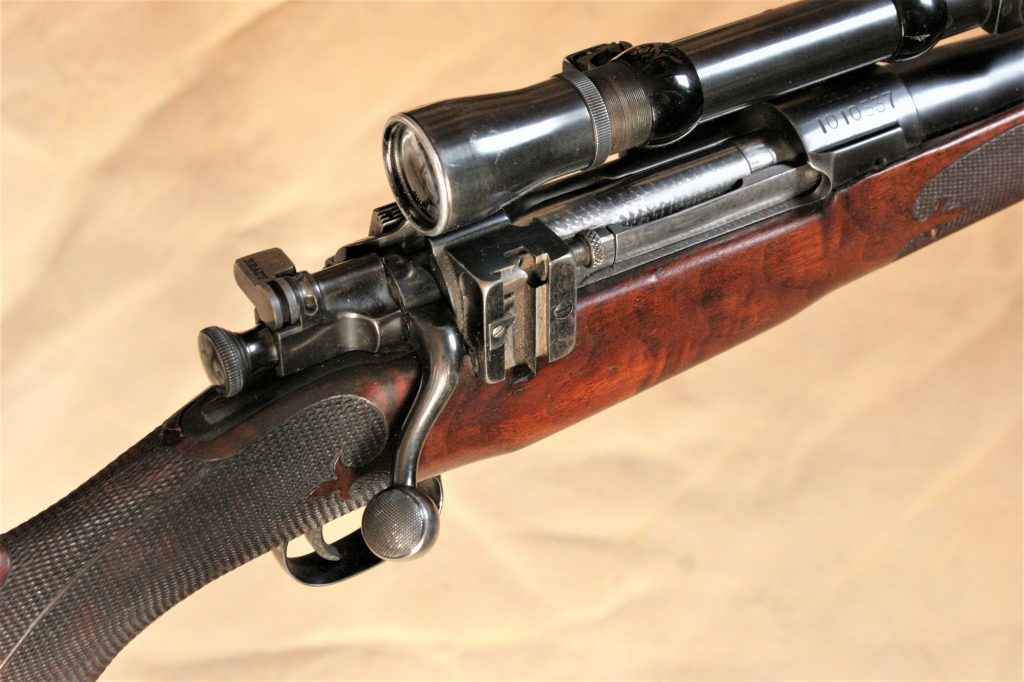
Reading Petrov taught me a lot more about Springfield sporters, and a year later I ran across The One, on the late Ike Ellis’s table at a local gun show. Ike was a fine custom stockmaker who owned a big sporting goods store in Idaho Falls, so he knew his stuff. This particular Springfield had a classic, highly-figured black walnut stock, finely and extensively checkered in a fleur-de-lis pattern, with the requisite Lyman 48 receiver sight and Lyman Alaskan scope in a detachable Griffin & Howe side-mount.
But it also had white-line spacers between the ebony fore-end tip and grip cap, and a ventilated Pachmayr white-line recoil pad. This seemed odd for a custom rifle typical of the pre-World War II era—until I picked it up and saw “Frank Pachmayr” engraved on the barrel.
Frank and his father, Gus, were among the very top custom gunsmiths of the pre-World War II era. Like Wundhammer, they were based in Los Angeles, so had plenty of great stock wood from California walnut groves. Frank came up with the concept of white-line spacers before the war, even making some from elephant ivory.
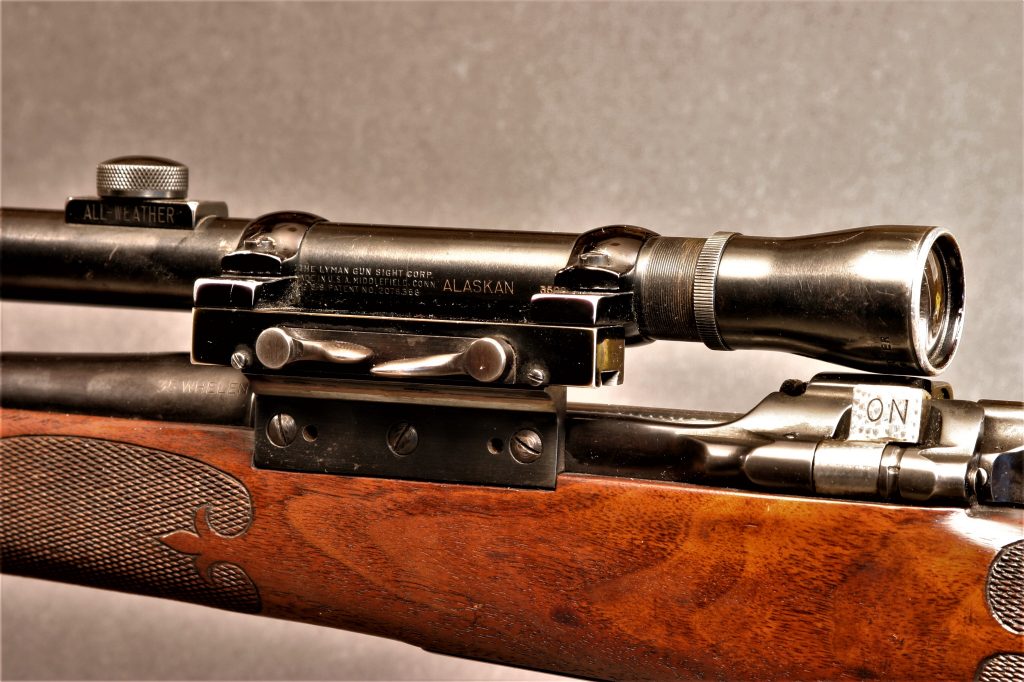
The barrel was engraved “.35 Whelen,” but the tag read “.358 Norma Magnum,” one of the many .30-06-length belted magnums that appeared in the two decades after the war. No doubt the rifle got converted then, when the Whelen was still a wildcat and the Norma a new factory round. The rifle seemed like such a perfect illustration of Springfield sporter history that of course, I succumbed.
Eileen and I ended up in Alaska a couple years later, on our way to open ptarmigan season with our outfitter friends Phil Shoemaker, his wife, Rocky Harrison, and their kids Tia and Taj. Of course Phil knew Mike Petrov, and told him we’d be overnighting at an Anchorage motel. Mike invited us to dinner, and we had a great evening with him and his wife, Janet, much of it among his collection of fine rifles. Mike and I kept in touch, and in 2013 he sent me a copy of Volume Two of Custom Gunmakers of the 20th Century, an even more impressive collection of new and updated information.
Unfortunately, Mike passed away a year later, but through the books his knowledge of Springfield sporters lives on—though they now sell for far more than the original $16.95. For hunters who’d like to learn almost everything about classic Springfield sporters, they’re worth the price.
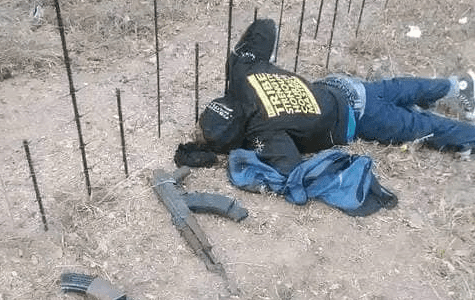
On Thursday, 9/21, local farmer militiamen in South Africa stopped a gang of 15 armed robbers armed with AK-47s who had just robbed an armored car, killing the driver. The local volunteers apprehended the fugitives after a high-speed chase, including a dangerous Mozambican criminal wanted for murder of a police officer.
The robbery took place in Hoedspruit (Hat Springs) outside Polokwane in Limpopo Province, which were named Pietersburg and North Transvaal by the original settlers before the campaign to ethnically cleanse the Afrikaner language and culture from South Africa.
Heavily armed attacks on armored cars are so common in South Africa they are known as Cash-in-Transit heists (CIT).
“15 robbers armed with automatic rifles carried out a CIT heist in Hoedspruit, killing the Fidelity driver,“ reports YouTuber Willem Petzer.
Hero farmers from Hoedspruit kills 4 CIT robbers and wounds 3 after police flee the scene.
Full story:
Today, 22/09/2023, 15 robbers armed with automatic rifles carried out a CIT heist in Hoedspruit, killing the driver Fidelity driver. Police fled the scene when the robbers… pic.twitter.com/QtHq8KsaYp
— Willem Petzer (@willempet) September 22, 2023
According to police spokesman Colonel Matimba Maluleke, the suspects shot at the escort vehicle before disarming the guards (a driver and crew) of their official rifle and pistol. “Unfortunately the two guards were shot at and sustained injuries that resulted in the death of the driver. The suspects then pursued the armoured vehicle while shooting at it until it stopped.
The driver of the armoured vehicle and his crew were allegedly ordered to disembark the vehicle, disarmed of two firearms and chased into the nearby bushes. The suspects used explosives to blast the vehicle and made off with an undisclosed amount of money,” Maluleke said.
“A community crime watch group, Hoedspruit Farmwatch, was alerted to the incident and went in pursuit of the robbers, putting obstacles on the road to prevent their escape. A shootout ensued,” Petzer writes.
It is further reported that the suspects started shooting at members of Hoedspruit Farmwatch who in self-defence returned fire. During the shootout, four suspects were killed and one (28) was injured and arrested on the spot. The other suspects ran into the nearby bushes and…
— Ian Cameron (@IanCameron23) September 23, 2023
“The Hoedspruit Farmwatch volunteers blocked the roads outside of Hoedspruit with boulders after they were alerted of the attack. A skirmish, lasting about 20 minutes, ensued at one of the blockades between the robbers and the farmers, who were armed with pistols. The farmers managed to kill 4 of the robbers and wound 3. No farmer was hurt. The other suspects fled into nearby bushes after the shootout on foot.”
“The Hoedspruit farmwatch tracked them down using their dogs and arrested the rest of them, recovering all the money from the heist. Great job by the farmers!” Petzer writes.
Hoedspruit Farmwatch denied that South African Police Service officers had fled the scene.
MESSAGE ON BEHALF OF HOEDSPRUIT FARMWATCH
Hoedspruit Farmwatch would like to thank everyone for the positive response and support being received so far. We are very proud to serve the community of Hoedspruit and our immediate surrounds and it is an honour to be part of such a…— Ian Cameron (@IanCameron23) September 23, 2023
Police spokesperson Colonel Malesela Ledwaba said the community protection team “returned fire and when the dust settled, four suspects were fatally shot, one injured and arrested while others managed to evade arrest by running into nearby bushes,” The Citizen reports.
The fleeing duo was “arrested while travelling to Acornhoek in a taxi following an intense search mission by the Hoedspruit Farmwatch, the Directorate for Priority Crime Investigation and a chopper,” Ledwaba stated.
“One of the arrested suspects is a highly wanted Mozambican suspect who has been on the run for some time for a spate of crimes he committed in the Free State in 2022 including the murder of a police officer. The injured suspects were found in possession of suspected stolen money, a rifle and a pistol,” the police spokesman said.
Several community safety organizations met Sept. 19 in Centurion to join forces to to curb farm attacks and rural crime, including AfriForum, Southern African Agri Initiative (SAAI), Transvaal Agricultual Union TLU SA, AgriSA, Forum Sekuriteit, Sakeliga, the South African Special Forces Association (SASFA) and the Association for South African Military veterans, AfriForum reported.
“AfriForum is excited about the fact that all these organisations are willing to join hands and make a difference against the wave of farm attacks and increasing rural crime. The SAPS itself has already admitted that it cannot fulfil its mandate, and this is obvious when one looks at the chaotic state of crime in the country. It is now time for communities to safeguard themselves,” said Jacques Broodryk, AfriForum’s spokesperson for Community Safety.
According to Dr. Theo de Jager, executive director of SAAI, the different organizations, civil structures and agricultural unions have feet on the ground when it comes to rural security: “Some organisations have farm watches in remote areas or camera systems, radio networks, emergency centres or response units. Others post guards, patrol national roads or establish and manage private fire services. Ultimately, everyone is in the same industry and has one goal in mind – to secure communities where the government can no longer do it,” said De Jager.
AfriForum’s Security Head Jacques Broodryk on Farm Murders:
Military history of Liberia is often covered only in the context of the civil wars fought between 1990 – 1997 and 1999 – 2003. Before those tragic conflicts, Liberia had an odd and unique army, mirroring the unusual story of the nation as a whole.

(US Army soldiers in Liberia during WWII. They are armed with M1903 Springfields and a M1917, both of which would be used by the Liberian army after WWII.)

(Liberian soldiers loading M1 Garands during the 1980 coup.)

(A modified M1917A1 guarding a roadblock near Monrovia during 1992.)

(A guerilla loyal to the warlord Charles Taylor during the 1990s, armed with a WWII Soviet PPS-43. Child soldiers were used by Taylor in outrageous numbers; at points more than half his force was under the international military age of 17.)
Liberia during WWII
Liberia has an unusual origin. Starting in 1822, four decades before the USA’s civil war, emancipated slaves in the USA were encouraged to emigrate to Africa. Liberia was one of the settlements; as was the Maryland Republic and Mississippi-in-Africa; both later annexed by Liberia. Liberia declared independence in 1847.

The settlers, who called themselves “Americos”, never were more than a tenth of Liberia’s population and later even less. They were concentrated in cities along the Atlantic coastline. Despite this they dominated the political, economic, and military life of the country; at the expense of tribal groups of the inland interior, the “hinterland”.

(From 1847 – 1980 Liberia was a one-party democracy of the True Whig party. The True Whigs maintained traditions of the pre-1860s American south, including tailcoats and top hats, into the 1970s. Here a True Whig official reviews a Liberian army unit with WWII-surplus M1 pot helmets, M1/M2 carbines, and M1936 web belts. The reviewing officer is armed with a M1911.)
In the capital Monrovia and other coastal cities, there were similarities to American culture. Many of Liberia’s symbols mimic American ones.

(USS Palau (CVE-122) flying the Liberian flag at the courtesy position on the mainmast during a 1947 visit to Monrovia. USS Palau was launched on 6 August 1945, the same day as the Hiroshima mission, but commissioned after WWII was already over. USS Palau decommissioned in 1954 and was scrapped.)
As seen above, Liberia’s flag is very similar to the USA’s; but only has one large star.
Even though Liberia indirectly came out of the United States, the USA did not even recognize it diplomatically until 1862. There was little American interest in its affairs until the 1920s and significant military aid did not start until WWII.
Liberia’s army was originally called the Liberian Frontier Force, or LFF. It policed Liberia’s inland borders against incursions by European nations. Its secondary roles were to quell periodic rebellions by tribes in the hinterland, and to enforce tax law there.

(One of the LFF’s earliest weapons was four hundred Mauser Kar. 88 carbines bought from Germany, which Liberia called the M1888. These were presumably gone by WWII.)

(The Liberian Frontier Force name lived on long after the frontiers had been finalized. Here the colors are being dipped to visiting Prince Bernhard of the Netherlands in 1958.)

(During 1918 Liberia bought one hundred M1898 Krag rifles surplused by the American military, along with a quarter-million rounds of .30-40 ammunition.)

(LFF troops in the late 1930s, just prior to WWII. They are still armed with the old Krags.)
The LFF officer corps was entirely of the coastal Americo elite. It was theoretically possible for infantrymen of hinterland tribes to move up the NCO ranks and perhaps even gain a commission, but before and during WWII this was extremely rare. From 1912 onwards, the US Army dispatched officers to assist in running the LFF, which before WWII numbered only 1,000 troops; all foot infantry in one regiment.

(FN M24(L) of the Liberian Frontier Force.) (photo via Mauser Military Rifles of the World book)
Above is what might be considered the LFF’s first contemporary 20th century gun, the bolt-action FN Model 24 short rifle, in Liberian form usually called FN M24(L) to differentiate it from the WWII Haitian army’s FN M24(H) which was nearly identical. Liberia bought these guns from Belgium during the 1930s. In look, function, and form they are similar to the German 98k or Czechoslovak vz.24 rifles of WWII.

(Liberian soldier still with a FN M24(L) during the 1950s. Compared to the M1903 Springfield, the Mauser can be identified by the washer in the buttstock, the “knuckle” at the lower base of the stock’s hilt which the Springfield lacks, and the longer length of barrel between the forward end of the furniture and the muzzle.)
This was the LFF’s standard longarm during WWII and beyond. The date which the FN M24(L)s finally left service is unknown. As American military aid picked up during the Cold War era, there was little need to retain them alongside the Springfields and Garands.
WWII in Europe began in 1939. Liberia declared itself neutral but this did not stop the far-away war from affecting the nation. German u-boats hunted Allied merchant ships trading with Liberia. During 1941 U-103 sank the freighter S.S. Radames as it was leaving Monrovia. A year later, U-68 sank the tanker M/T Litiopa near Robertsport, and then the merchants S.S. Fort de Vaux and S.S. Baron Newlands only 40,000yds from the Liberian shoreline.
Because of the Firestone plantation (described later below) and other business interests, the United States began paying military attention to Liberia even before the Japanese attack on Pearl Harbor in December 1941. During 1940, a visit by the cruiser USS Omaha (CL-4) laid the framework for future cooperation.
After the USA entered WWII, American forces were stationed in Liberia. The American military deepened Monrovia’s harbor, built the Robertsfield facility described later below, and trained the LFF.

(Military infrastructure construction during WWII.)

(A Boeing 314 of Pan-American Airlines being refueled in Liberia during WWII. PanAm clippers supported the American war effort in both the European and Pacific theatres, flying contracted routes for the War Department.)

(Presidents Franklin D. Roosevelt and Edwin Barclay in a Willys MB during FDR’s state visit to Liberia in 1943.) (Library Of Congress photo)
Despite abandoning neutrality and allowing American forces to be based on its territory, Liberia did not declare war on Germany and Japan until January 1944. The LFF offered to send units to Europe but this was not taken up. Liberia was eligible for Lend-Lease but did not receive much in the way of weapons. Lend-Lease records show that the LFF was provided six training rifles and 1,000rds of .22LR, plus four shotguns and 500 12ga shells. The specific type of guns was not recorded. One single Harley-Davidson WLA military motorcycle was provided. Most of the Lend-Lease aid was non-lethal to help Liberia’s wartime economy, including 500 tons of rice.
WWII ended in September 1945. American forces were withdrawn in February 1946.
the Firestone plantation and Robertsfield
These two things, one predating WWII and the other built during the war, would have lasting effects on Liberia.

(The location of Robertsfield to the town of Harbel and the plantation.) (map via PBS)
During the first two decades of the 20th century, rubber became an important industrial commodity worldwide. There is nowhere in the United States amenable to rubber trees, which was both a headache for the automotive industry and a national security concern.
During the early 1920s the Firestone company explored options for a rubber plantation abroad. The Philippines, then an American commonwealth, was rejected as it would have high shipping costs and an uncertain political future. A test plot in Mexico failed. Another option showed more promise: Liberia. It had the perfect climate and soil, was English-speaking, and on ocean trade routes.
In 1926 Firestone signed a 99-year lease with Liberia for 1,000,000 acres (1,562 miles² or about the size of Luxembourg in Europe or Rhode Island in the USA) at 6¢ per acre annually.

(House 53 was the quarters of the plantation’s general manager. During the 1990s the warlord Charles Taylor briefly used it as the “white house” of his self-styled “Greater Liberia Republic”.) (photo via PBS)

(M1 towed 40mm AA guns after receiving tires at the Firestone factory in Akron, OH during WWII. It is highly likely that the rubber of these tires originated in Liberia.)
Whatever its labor rights issues, the plantation did serve its purpose during WWII. By mid-1942 the only major rubber sources still in Allied hands were Ceylon (today Sri Lanka) and the Belgian Congo (today the D.R. Congo). During WWII Firestone and the US Army cooperated to build a hydroelectric dam that powered not only the plantation, but also the town of Harbel to the immediate south. As of 2022 the WWII hydroelectric facility is still in service.

(LCT(6)-623 off Normandy.) (photo via navsource website)
During WWII, the US Navy’s nameless LCT(6)-623, a Mk6 landing craft, put men ashore at Normandy in 1944.

(M/V St. Paul, the former WWII landing craft serving the Firestone plantation.)
After WWII it was discarded as surplus by the US Navy and bought by Farrel Line. Extensively altered by Bethlehem Steel during 1948, it was renamed M/V St. Paul and ferried liquid rubber latex for the Firestone plantation. The former landing craft could venture 15 miles inland up the Farmington river but was still seaworthy enough to sail along Liberia’s Atlantic coastline to any Liberian port.
South of Harbel, which was more or less a “company town” associated with the plantation, was Robertsfield. It was built by the US Army during WWII as Roberts Army Airfield, named after Joseph J. Roberts, Liberia’s first president.

(Vickers Wellington of the South African Air Force at Robertsfield during WWII.)

(B-26 Marauders at Robertsfield during WWII.)
By the time WWII ended, Robertsfield was a major asset. After the US Army departed in 1946, a spinoff of PanAm was hired by the Liberian government to operate it as Roberts International Airport. It is often associated with the capital Monrovia, 15 miles west. The capital actually has its own airport (Spriggs Payne), but due to the size of Robertsfield it became Monrovia’s de facto air hub.

(A “Connie” of PanAm at Robertsfield in 1949, four years after WWII. In the foreground is a demilitarized B-17 Flying Fortress.)

(“Civilianized” B-17s were not as popular as one might imagine after WWII. There was a lot of red tape to get FAA approval and the bomber was simply not designed as an economical transport. None the less, some were demilitarized. An evangelical group used this Flying Fortress in western Africa, including Liberia, from 1949 – 1951.) (photo via Assemblies Of God)
Although now in civilian Liberian control, Robertsfield remained important to the American military. Robertsfield had two runways, one of them being over two miles long.

(The prototype Concorde at Robertsfield in 1976. Behind it is a RAF C-130 Hercules on layover.)
A runway like this was rare in Africa. The US Air Force used it as a refueling point for Strategic Air Command bombers. During the 1980s, Robertsfield was one of the Space Shuttle’s designated emergency landing sites.
After WWII the presence of the Firestone plantation and Robertsfield lulled the True Whig elite and Liberian military into a false sense of security. In actuality, by 1980 Firestone was already cutting back at the plantation as synthetic rubber became cheaper, while the American military was using Robertsfield less and less. The USA once again cared little about who was running Liberia.
WWII weapons in the Liberian military
American military aid to Liberia began only a few months after American troops departed in 1946. An American detachment known as LIBMISH supervised the distribution of military aid after 1959. WWII-surplus weapons came to Liberia through three programs.

(A US Army general listens to a speech at the BTC, or Barclay Training Center, in Monrovia during the 1960s.)
EDA, or Excess Defense Articles, gives allies surplus gear “as-is, where-is”. In 1974 Congress mandated that unless a waiver is granted, the value of EDA has to be returned by the military to the US Treasury. Presumably this was to prevent transfer of “excess” gear that wasn’t really excess. Liberia, formerly a prime user of EDA for WWII-era equipment, saw its transfers fall by two-thirds in 1975.
FMS, or Foreign Military Sales, is a program where the United States provides low-interest loans to the recipient for them to buy American weapons. These can be either new or used. FMS loans to Liberia were suspended in 1984; previously they had sourced a lot of WWII-era guns.
MAP, or Military Aid Program, transferred surplus WWII (and later, modern) weapons through a process where recipient countries were issued free “credits” that they could then request American weapons against. The country had to illustrate a need for the item and the ability to use it; and could be blocked by Congress. Depending on what it was, the items were usually “billed” at a fraction of their WWII cost, sometimes $0.
Liberia was frankly under no military threat for the first 20 years after WWII. Liberia’s three neighbors were still colonies of WWII allies: Guinea and Ivory Coast became independent from France only in 1958, and Sierra Leone from the UK not until 1961. As such, the army was not a huge priority and the LFF existed in a sort of “sleepy, dreamy” status, not modernizing much other than WWII-surplus gear from the USA.
In 1962 there was a realization that Liberia was falling behind. The military was restructured into the Armed Forces of Liberia (AFL). The former Frontier Force became the National Guard and the former tiny Coast Guard, the AFL Navy Division. Little else was done and the WWII weapons continued in use.

(Demilitarized C-47 Skytrain in 1966. Liberian National Airways, later Air Liberia, ceased operations in 1990.)
There was no air force. Even though the USA had huge numbers of entry-level types (combat-capable T-6 Texan trainers, etc) being surplused at low cost, there was apparently no money for warplanes, no interest in them, or both.

(The yacht Virginia prior to being bought by Liberia.)
The same went for the tiny navy. It numbered around 200 – 300 men, almost all of the Kru tribe. Despite the glut of smallcraft, patrol boats, and service ships being disposed of by the post-WWII US Navy, there was little interest in warships.
The ship pictured was the 189′ yacht Virginia, built in the UK during 1930 for the 1st Viscount Camrose, William E. Berry. Liberia bought Virginia from the Viscount’s estate in 1957, three years after his passing. Renamed Liberian, it was by far the largest “naval” vessel and was used as a presidential yacht. No actual warships were acquired until two little cutters were donated by the US Coast Guard in the late 1950s.
During 1971 then-president William Tolbert Jr sold Liberian as a public relations effort to dampen criticism of waste and corruption. It caught fire in Sierra Leone later that year and was wrecked.
Liberia likewise missed out on things like WWII tanks, half-tracks, heavy artillery, etc being discarded by the USA after WWII. As the 1960s began, Liberia’s military was still mostly a foot infantry force.
the M1903 Springfield

The M1903 was the US Army’s standard service rifle during the first world war, and saw limited use during the second. Springfields served throughout WWII and there were many still in government inventory after WWII.
The M1903 was a quality rifle of the bolt-action era. Measuring 3’7″ long and weighing 8¾ lbs, it fired the .30-06 Springfield cartridge (2,800fps muzzle velocity) from a stripper-loaded five-round internal magazine. Overall it was reliable, accurate, and durable.
No M1903s were Lend-Leased to Liberia during WWII. However they were already in inventory soon afterwards. One possibility is the USA’s Foreign Liquidation Commission, which was established two months after WWII ended to lessen American war gear marooned abroad when WWII ended. This commission had authority to sell minor or obsolete equipment within whatever region it happened to be when Japan had surrendered. M1903s equipped the US Army garrison in Liberia during WWII, and some may have been sold in lieu of shipping them home.
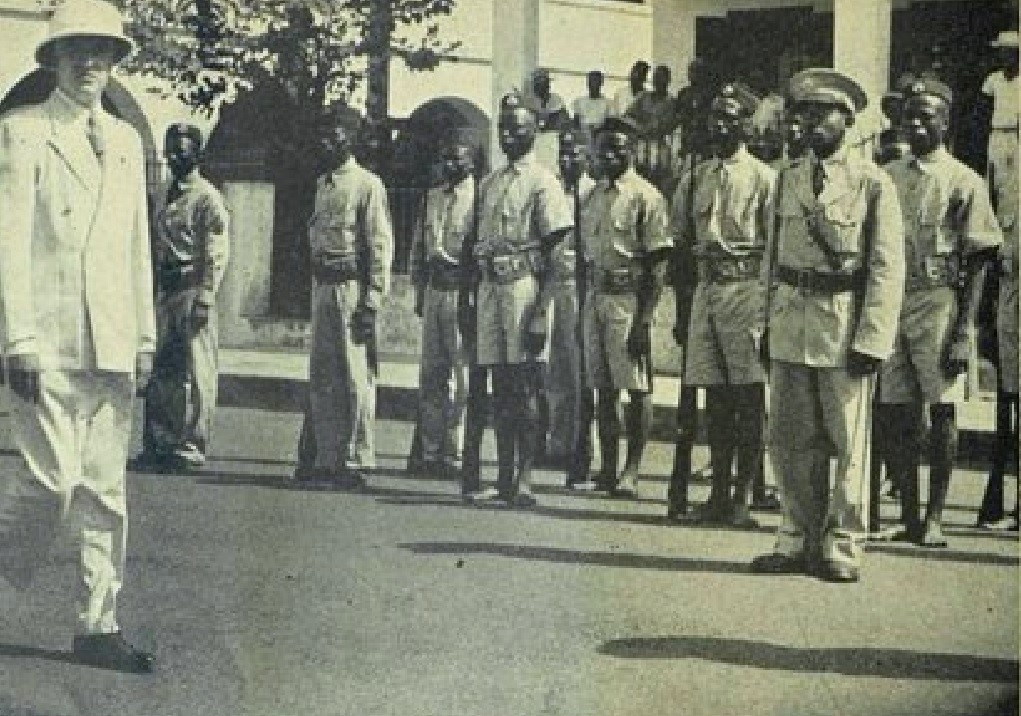
(This late-1940s photo shows M1903s already in the LFF; identifiable by the straight angle to the buttstock’s underside; lacking the “knuckle” of either the M1 Garand or the pre-WWII Belgian Mausers.)
The American dignitary reviewing the troops above is Edward Stettinius Jr who had been Secretary of State during WWII. The purpose of this 1947 visit was to establish his private second career, the Liberia Company and Stettinius-Associates Liberia Inc. The former was a road-building venture. The second, and more lucrative company, invented the “flag of convenience” concept in shipping, where freighters fly the flag of a nation not their own to gain tax advantages. After Stettinius passed away in 1949 it was renamed International Registries Inc. and was highly successful. IRI moved to the Marshall Islands during the 1990s after the warlord Charles Taylor kept shaking it down for more and more money.
M1903s were an item eligible for EDA transfer during and after the Korean War and more probably came during that time, by that route.

(M1903 Springfields being carried by Liberian soldiers during a 1956 parade.)

(M1903 Springfields during the mid-1960s. M1 Garands are interspersed, as the Liberian military considered them equal weapons.)
By 1970 the era of bolt-action rifles was clearly long since past, and Liberia’s M1903s were passed to secondary units or scrapped.

(A Liberian MP at Belle Yellah still with a M1903 Springfield in 1970. Belle Yellah had originally been the very first LFF base during the 19th century. The barracks were barbed-wired in and converted into Liberia’s most notorious prison.)
No M1903s were observed during the 1990s carnage, where they would have been completely outclassed by AK-47s.
the M1 Garand

(photo via National Rifle Association)
The semi-automatic M1 Garand was the USA’s standard battle rifle for all of WWII, all of the Korean War, and beyond. It was a highly-effective firearm, perhaps the best of WWII.
The M1 Garand was 3’7½” long and weighed 9½ lbs. It fired the .30-06 Springfield cartridge from an internal 8-round en bloc.

(President Barclay inspecting an en bloc during a visit to Ft. Belvoir, VA during WWII. Despite the demonstration of the M1, Liberia was ineligible to receive Garands via Lend-Lease during WWII.)
After a small test lot in 1962, Liberia began receiving M1 Garands in bulk during 1963. Via MAP, 1,508 Garands were delivered that year. Between 1964 – 1967 another 465 came for a total of 1,973 via MAP by the beginning of 1968. All were drawn out of US Army European Command holdings.

(LFF soldier with M1 Garand in 1962. These men belonged to the Presidential Guard unit in Monrovia, and were the first to receive Garands.)

(Liberian soldiers with M1 Garands during the mid-1960s.)
Besides the MAP transfers, Liberia bought another 3,000 M1 Garands through FMS between 1968 – 1974. When procurement ended in the mid-1970s, the AFL had 4,973 M1 Garands which was almost the same as the entire number of men on active duty.

(AFL soldiers with M1 Garands march in Monrovia during 1971.)

(The Presidential Guard unit with M1 Garands in 1973.)

(Liberian soldier with M1 Garand in 1980.)

(Liberian soldier with M1 Garand during the early 1980s.)
replacement
The semi-automatic M1 Garand was a step up from the bolt-action M1903 Springfield. None the less by the 1960s the newly-acquired WWII semi-autos would themselves soon be outclassed. During the mid-1960s Liberia made a buy of FN FALs from Belgium. Not enough were obtained to replace the M1 Garand entirely.

(In name anyways, tattered remnants of the AFL fought on during the early 1990s. This photo was taken in 1992 and shows a FN FAL fighting Charles Taylor’s forces.)
By the 1980s the M1 Garand was overdue for retirement yet many remained in service. Liberia made a private buy from Colt of 1,100 M16s. The M16s and FN FALs combined perhaps could have sufficed yet M1 Garands continued on in dwindling use throughout the decade.
the M1/M2 carbine

(photo via Royal Tiger Imports)
Unrelated to the M1 Garand rifle, the M1 carbine of WWII was a “light rifle” intended for roles not necessarily requiring a Garand but something more than a handgun. It was 3′ long and weighed just 6 lbs.
The semi-automatic M1 fired the .30 Carbine (1,990fps muzzle velocity) from either a 15- or 30-round detachable magazine.
Introduced during the last eleven months of WWII, the M2 was a version with select-fire (full auto) capability.
Liberia received its first M1 carbine as part of the very last 1945 Lend-Lease package. One single M1 (booked at “total value transferred $46” in American records) was delivered, along with 1,000rds of ammo. Why only a single gun was Lend-Leased has been lost to time.
MAP transfers started in 1951 and ran sporadically in small batches until 1965. Liberia received 62 M1s and 24 M2s via MAP. Another 100 M1/M2 carbines (no breakdown was made) came via EDA. In all, Liberia received 187 M1/M2s.

(A 1977 photo showing a M1/M2 carbine in a Liberian honor guard. The occasion was the visit of Ivory Coast’s president. The AFL 4th Infantry Regiment inherited the unit flag of the Liberian Frontier Force after the military was restructured in 1962.)
Plainfield M2s
During 1978 a company called Fargo International brokered a buy of ten Plainfield M2s to Liberia’s paramilitary national police.

(photo via m1carbinesinc website)
These guns had a strange story. In 1960, a company called Millville Ordnance Company, or MOCO, in New Jersey was one of several companies in the USA rebuilding WWII M1/M2s from parts off already in the USA and “re-imports”, guns brought back from post-WWII military aid recipients with their receivers torched to comply with federal law. MOCO did not have the necessary tooling and skills to make new receivers and barrels, and contracted Plainfield Machine to make them.
As Plainfield was doing this, unbeknownst to them, the CEO of MOCO was convicted of exporting unlicensed weapons to the Caribbean. With him in jail, Plainfield was left sitting on invoices that MOCO could now not pay, and the guns.

(1962 advertisement from Shotgun News magazine.)
Plainfield offered them for civilian sale and then made more for the South Vietnamese army, in several modifications. The version sold to Liberia was called the PM-30G and was a select-fire M2 differing from the WWII baseline in having a deluxe walnut stock and a perforated guard atop the barrel.
What happened to these ten guns after the 1980 coup is unknown.
replacement
During the late 1970s Liberia bought Uzis from Israel. These had the advantage of using 9mm Parabellum which was much easier to obtain worldwide by then than .30 Carbine.

(Four guns of two generations: from left to right a M1/M2 carbine, a M16, a M1 Garand, and an Uzi; in Monrovia during the 1980 coup.)
M1/M2 carbines were in limited use during the 1980s but were not seen during the civil war period. Presumably by then, it would have been extremely hard to source .30 Carbine ammo on the black market.
the M1918 BAR

The Browning Automatic Rifle concept originated during the first world war, as a “walking fire gun”, a fully-automatic weapon of rifle size firing rifle-caliber ammunition; to accompany infantry with bolt-action rifles during an advance.
By WWII several concepts: the submachine gun, the general-purpose light machine gun, and the high loss rate of infantry making an open charge; had made that redundant. None the less the M1918 was successful during WWII. One or two automatic rifleman were included in a standard infantry squad. The BAR was useful in providing accurate bursts of automatic fire. M1918s were used throughout all of WWII and the Korean War.
The BAR was 4′ long and weighed 19 lbs. It fired the .30-06 Springfield cartridge at 600rpm from a 20-round detachable magazine.
Liberia obtained 57 M1918A2s via MAP during the 1960s. Surprisingly some were still in use during the 1990s civil wars.

(One of Charles Taylor’s fighters with a captured BAR in front of the burned PanAm terminal at Robertsfield during July 1990. The bipod is missing.) (photo by Patrick Robert)
replacement
Select-fire rifles like the M16 made the whole BAR concept obsolete, as now every soldier was in theory an automatic rifleman. None the less, the AFL liked this concept and during the 1980s, it replaced BARs in frontline units with Model 611s bought directly from Colt, the so-called “heavy barrel M16”.
the M1917A1

This machine gun served the United States during both world wars and the Korean War. The M1917A1 was actually Liberia’s first machine gun type, less one single M1895 potato-digger bought from the USA during the 1930s.
The M1917A1 fired the .30-06 Springfield cartridge from 250rds fabric belts at 600rpm. All-in (gun, tripod, water chest, and one ammo box) it weighed 103 lbs.
By the 1990s, when this gun was still in Liberian service, liquid-cooled infantry machine guns had been relegated to history. The disadvantages of liquid cooling were the physical size and weight. The WWII advantage was that air-cooled machine guns had to be fired in bursts, less the barrel overheat. With liquid cooling a gunner could fire at will. During a demonstration of the second prototype M1917, it fired for 48 minutes 12 seconds. It could have continued but the test was halted as it had already churned through 21,000+ rounds.

The cooling jacket held 7 pints of water and was enclosed by oiled asbestos packings. Inside at the top was a tube-in-a-tube, the outer one slightly shorter and sliding over the inner one, which had a hole on top at each end. If the barrel heated enough to boil water, steam rose to the top of the jacket. Elevating or depressing the gun used gravity to slide the outer tube to cover one or the other holes of the inner tube, so liquid water could not swamp it but steam would be forced into it. Steam exited a portal near the muzzle via a hose that led to the M1 water chest. The other end of the hose was kept beneath the waterline in the chest, where it condensed back into liquid. If too much water boiled away, water from the chest was quickly poured into a fill portal and firing resumed.
How many M1917A1s Liberia received, and when, is not clear. None were included in Lend-Lease during WWII and there is no MAP record of any being transferred. It is possible they were obtained through EDA. Alternatively it is not beyond belief that Liberia bought some completely outside of the American systems from private arms dealers after WWII. The 1988 edition of Small Arms Today lists this WWII weapon as still in Liberian service at that time, but without the usual clarification as to how many or from where.

The above photo from 1992 shows a M1917A1 at an AFL roadblock near Monrovia. It is perplexing for a number of reasons, the least being that a M1917A1 was still in combat during the 1990s. Beyond that, there is some kind of counter-lever device fitted astride the action. This was not milspec and may have been an ad hoc field modification for anti-aircraft use decades previous, in that the gunner could lean on the armpieces instead of supporting the gun’s weight in one hand with the wood pistol grip, which is still installed. Whatever the device is, it precluded mounting the ammo box on its bracket. During WWII the US Army advised against leaving it on the ground as the weight of the belt stressed the receiver. The tripod is not milspec, it has part of the WWII M2 tripod but new legs. Finally the rear sight, water chest, and hose are missing; not surprising as this was almost half a century after WWII. The soldier in the cap is pointing at the water filling portal.

Above is a close-up of the same M1917A1. Some sort of carrying handle is strap-banded to the jacket behind the front sight. The steam discharge portal can be seen; looking head-on it is at the 5 o’clock position; at the 7 o’clock position on the other side would be a dummy hole for the plug to screw into when the gun was in use. As mentioned the hose and M1 water chest are missing. Contrary to what is sometimes claimed; the gun will not rupture from steam pressure if the chest is not used, however steam would hiss out the portal and leave a telltale puff at the gun’s position. If the M1917A1 was fired totally dry, it would quickly overheat.
The three men are Nigerian soldiers of the ECOMOG force. By this time ECOMOG had abandoned its initial mindset of impartial peacekeepers and was allied with the remnant AFL against the warlord Charles Taylor.
replacement
During the 1980s Liberia bought some MG 710-3 light machine guns directly from SIG in Switzerland. The country was slated to receive a small number of M60s as aid from the United States; but it is unclear if they were ever delivered. At least one M1917A1 still soldiered on, as seen above.
how it all ended
By 1979 the Americos were less than 1⁄20 of Liberia’s population. Shortly after midnight on 12 April 1980, a 29 year-old half-illiterate master sergeant from the hinterland, Samuel K. Doe, gathered sixteen other junior soldiers and scaled the wall of the presidential mansion. They executed President William Tolbert asleep in his bed. With that, 133 years of unequal True Whig rule came to an end and the nation’s most severe problems began.

(MSgt Samuel Doe in 1980.)
In post-WWII Africa coups were not uncommon. As many power changes happened by coup as by elections. What shocked other African strongmen was that there was a “code” to coups: usually some senior general would plot, amass forces and weapons, secretly ally with other generals and wealthy business interests, and only then attempt a coup. It was unheard of for a junior enlistedman to do it on a whim.

(Liberian soldier with a WWII American M1911 shortly after the 1980 coup. Liberia received these sidearms via military aid from the USA and they served alongside Smith & Wesson revolvers and MAC-10 auto-pistols bought commercially.)
Doe’s coup was (at first) very popular with the AFL and the population as a whole, who were tired of the True Whigs and the two-tiered society. Doe consolidated power by arresting Tolbert’s cabinet. They were given a sham trial, tied to telephone poles on the Monrovia beachfront, and shot.

(An executioner loads an en bloc into his M1 Garand. The thirteen executions were filmed but too graphic for here. Despite being just 10 yards away, some of the shots only wounded the targets and multiple volleys were needed. This was petty barbarism compared to what Liberia would endure in the next 23 years.)
A quirk of the executions was that one of the doomed politicians was the son-in-law of Félix Houphouët-Boigny, Ivory Coast’s dictator. In the unwritten African coup “code”, family of foreign leaders was a faux pas and this trivial detail would haunt Doe a decade later.
Doe’s popularity evaporated fast. A member of the hinterland Krahn tribe, his cabinet was drawn from the Krahn, and any important government job or military leadership was Krahn. In turn, he had a grudge against other hinterland tribes and made them scapegoats from the many problems which arose from his misrule during the 1980s.
last days of WWII weaponry in the AFL
Doe was many things: a drinker, under-educated, and a kleptocrat. He was also strongly anti-communist in his speeches. The USA used this as proof of his Cold War credentials and aid continued to the tune of $52 million over ten years, much of it embezzled.
In reality it is unlikely Doe even fully understood what capitalism and marxism were. Doe had a strong admiration for the USA’s president, Ronald Reagan, and just reiterated Reagan’s 1980s philosophies.
In October 1986, Doe received an invitation to a military event in Clinceni, Romania; a Warsaw Pact member. These generic invites are often sent by militaries to foreign leaders, with no expectation of them actually coming. For whatever reason, Doe decided to attend and met Romania’s communist dictator, Nicolae Ceausescu. Despite being polar opposites, the Reagan-acolyte Doe and arch-marxist Ceausescu struck up an friendship and signed a $5 million weapons deal which astonished both the KGB and CIA.
The main part of the package was PM md.63/65 assault rifles; Romania’s clone of the AKM. This was the first introduction of Kalishnikovs into Liberia. By the turn of the millennium AKs of various types would blanket the country. Other combloc kit was RPG-7s, ZPU-4 anti-aircraft guns, and BTR-50 and TAB-77 APCs.

(One of Charles Taylor’s teenage soldiers with a PM md.63/65. Taylor’s forces captured many, adding them to their holdings of other AK variants from elsewhere.) (Associated Press photo)
Now with the Romanian assault rifles serving alongside the American-made M16s and Belgian FN FALs, there was little remaining role for the M1 Garands of WWII and their withdrawal was hastened during the late 1980s.
WWII weapons in the first civil war
Charles Taylor had originally been a Doe supporter until fleeing to the USA in 1983. Unlike Doe, Taylor was university educated, an articulate speaker, and highly intelligent. He was also unbelievably brutal and harsh; a borderline psychopath.
In 1984, upon request of the Liberian government, Charles Taylor was arrested in the USA.

(Charles Taylor’s mugshot.)
What happened about a year later was another bizarre story. On 15 September 1985, Taylor escaped from a jail in Plymouth, MA. Years later, Taylor’s 1990s fighters said he either used folk magic to charm the Americans, or sawed through the bars. During 2009 Taylor himself said that late that night in 1985, a stranger had opened his cell, led him into the minimum security area, and told him that if he jumped the fence a getaway car would be waiting. He did, and a car indeed was. Taylor said that he felt the men driving the car in 1985 were CIA agents. No explanation of the jailbreak has ever been provided by authorities in Massachusetts. Maybe they were CIA, maybe not. Five inmates escaped the jail that night; the other four were recaptured.
Taylor was driven to NYC where he blended into the Liberian diaspora. He made it to Mexico, and from there flew to Libya. Muammar Quadaffi provided Taylor with guerilla warfare training and encouraged him to find a “jumping off point” to overthrow Doe.
From Libya, Taylor flew to Burkina Faso which was not thrilled with his ambitions and then bounced around the region, Ivory Coast, Senegal, Guinea, and back to Burkina Faso; looking for a “jumping off point”.

(Taylor’s personal weapon was a customized AK-47 with underfolding stock and an American M203.) (photo via The Star newspaper)
Now his luck picked up. Blaise Compaorè had taken over Burkina Faso via coup. Under Compaorè, Burkina Faso was allies with Ivory Coast, where Houphouët-Boigny still held a grudge over his son-in-law’s fate in 1980. With this, Taylor now had an entry point into Liberia’s northeast hinterland.
On Christmas Eve 1989, Taylor led fewer than 200 ill-equipped men across the Ivorian/Liberian border and easily overran a demoralized AFL unit, getting more weapons. This started a snowball effect.
If any army on Earth in 1990 was ill-prepared for war, it was Liberia’s. The AFL had no tanks, no helicopters, no radars, almost no artillery, and few APCs. Morale was horrendous due to Doe harassing non-Krahn tribes in the hinterland. The army had four “standard”-issue rifles (M1 Garand, FN FAL, M16, and PM md.63/65) each using different calibers. Equipment ranged in age from WWII to 1980s.
During early 1990 Taylor’s force, the NPFL, racked up win after win. Few AFL units fought hard and some outright defected. Taylor gained new recruits from non-Krahn civilians in the hinterland. The only setback was when one of his lieutenants, Prince Johnson, deserted to start a splinter force which also aimed to overthrow Doe.

(The warlord Prince Johnson.)
As Liberia collapsed, a Nigerian-led peacekeeping force called ECOMOG was formed to facilitate a cease-fire before the war reached densely populated Monrovia.

(Ghanian soldiers of ECOMOG in Monrovia during 1990. One is wearing a WWII British Mk.II Tommy helmet. The machine gun is a MG3, the post-WWII version of the MG-42 chambered for 7.62 NATO.)
ECOMOG’s mandate slowly changed from impartiality to keeping Taylor out of the capital at all costs.
Samuel Doe’s end came on 9 September 1990, not by Taylor but by Johnson. That morning, Doe travelled across Monrovia to meet Ghanian and Gambian officers of ECOMOG. Supposedly one item on the agenda was to be a scolding from Doe, as he felt a Nigerian ECOMOG general had acted too casual in his presence.
By still-unknown ways, Prince Johnson learned of the meeting. Johnson threw most of his forces into a “flying column” of technicals (Toyota pickups with machine guns) that burst through an ECOMOG roadblock and barrelled into Monrovia. Doe was captured and executed.
Johnson was briefly “president” of Liberia, with his rule limited to Monrovia and the suburbs. His government fell apart and between late 1990 – 1992, the only recognized authority in Liberia was ECOMOG. Meanwhile, Charles Taylor controlled the vast majority of the country, which he called the “Greater Liberia Republic”, also ecompassing diamond-bearing areas of Sierra Leone. Taylor’s unrecognized “republic” included Robertsfield and the Firestone plantation.
During this period (1990 – 1993) the last “new” WWII gun entered Liberia, and it was a surprising one.
the PPS-43

The PPS-43 was a simpler counterpart to the USSR’s famous PPSh-41 submachine gun of WWII. Like that gun, it used the 7.62x25mm Tokarev cartridge (1,640fps muzzle velocity). It weighed 6½ lbs and was 2′ long with the 8″ stamped metal stock folded in.
Along with the UK’s Sten, the PPS-43 was one of the crudest guns of WWII. Almost the whole thing is stamped steel. The PPS-43 was full-auto only at 550rpm cyclical, from a 35-round banana magazine.
Externally the most interesting feature is the muzzle. A piece of stamped steel curved into a ⊂ shape directs some escaping gasses sideways and backwards, like a crude muzzle brake. Internally, the buffering “system” is simply a piece of leather (photo below) which the bolt slams into. This had to be changed periodically; about the only upkeep a PPS-43 needed.

(photo via Apex Gun Parts)
In theory this submachine gun was accurate to 200 meters (218yds); in practice anything further than 90yds was as much luck as marksmanship. The purpose of this gun was to be made as fast as possible, in the biggest numbers possible. Between 1 – 2 million were made during WWII. PPS-43s were made so fast (including inside Leningrad during the seige) that the Soviets themselves did not know exactly how many.
After WWII trying to pinpoint who in Africa got PPS-43s when is often a fool’s errand. The Soviets seeded them around the continent between the 1950s – 1970s: Libya in the north, Guinea-Bissau in the west, Congo-Brazzaville in the center, Angola and Rhodesia in the south, up to Somalia in the east. Many crossed borders to new users, some multiple times.

(One of Charles Taylor’s soldiers with a PPS-43 during 1990.) (photo by Patrick Robert)
For Liberia, there are two possibilities.
The more likely account is that in 1990, as Charles Taylor’s army ballooned in size and needed weapons, Libya routed PPS-43s through Burkina Faso which were then sent into Liberia.
A less likely possibility is that some were already in Liberia, having been added as a “sweetner” by Romania to the Doe-era arms deal.

(Taken at Robertsfield during June 1990, this photo shows soldiers who said they were loyal to Samuel Doe’s AFL. One is armed with a PPS-43; the others modern M16s or PM md.63/65s. During the summer of 1990 loyalties were sometimes opaque and fluid.) (photo by Jacques Langevin)
Arms dealers were active in Liberia, including Guus Kouwenhoven and Viktor Bout. The latter is probably more famous. Bout established a front company, Abidjan Freight, to handle the Liberia / Sierra Leone markets for his operation, San Air. The San Air planes were re-registered under a fictional airline name, West Africa Air Services.

(After Bout’s 2008 arrest, his four-engined Il-76 was abandoned at Umm al-Quwain Free Trade Airport near Sharjah, U.A.E. The plane was falling apart by the 2020s and was scrapped in 2022.) (Associated Press photo)
Viktor Bout obtained an Il-76 “Candid” from the defunct Soviet air force in the early 1990s. Originially registered to the U.A.E., it was reregistered to Liberia until many nations started airspace bans against Liberian airliners. It was then reregistered to Switzerland until Swiss authorities caught wind of what Bout was doing, then the Central African Republic, then the U.A.E. again, and finally the Russian Federation.

(Bout also used a twin-engined An-8 “Camp” formerly of the Russian airline Aeroflot. In the window of the unmarked An-8 was taped its Liberian airworthiness document. This was likely fake; by the mid-1990s Monrovia only had sporadic electricity and running water; it’s doubtful anybody was doing foriegn airplane certifications by then.) (photo by Jan Kopper)
Bout’s planes flew all over buying and selling: Somalia to Afghanistan, to the Russian Federation and “The Stans” (former Soviet SSRs in Asia), to eastern Europe, to Burkina Faso and Liberia. Deliveries to Taylor were usually made at Robertsfield, or in a neighboring country with the guns and ammo travelling overland.

(The PanAm terminal at Robertsfield in 1997, seven years after its destruction. The two long runways remained intact throughout the civil wars, able to receive planes as big as an Il-76. PanAm itself went bankrupt in 1991. It had abandoned Liberia as an unprofitable route even before that.)
Payment was tendered by Taylor through accounts of Oriental Timber Company, an old True Whig-era corporation, or in raw diamonds which were then fenced in Antwerp or New York City. Additional revenue came from usurping the Firestone plantation’s rent which was then re-routed to banks serving arms dealers.
There were two flights in 1994 and 1995 originating in Albania where cargo included “Soviet submachine gun ammuntion”. This was almsot certainly 7.62 Tokarev for the PPS-43s.

(A man loyal to the warlord Charles Taylor training on WWII PPS-43s during the 1990s. Two magazines were usually “jungle-styled” with duct tape as above.)
For certain, the PPS-43 was only an “add-on” to Taylor’s arsenal; almost all of his men used AKs or FN FALs with the Kalishnikov platform slowly becoming the standard type. None the less, the PPS-43s were not museum pieces or toys. Most engagements of the first civil war saw 50yds or less separating combatants and a WWII submachine gun was equally lethal to a modern assault rifle in such settings.

(One of Taylor’s underage soldiers with a PPS-43. Charles Taylor recruited entire underage battalions, which he called SBUs (Small Boys Units). They were often paid in ganja (marijuana) in lieu of cash and told to loot any food or clothing they needed. Taylor also introduced crack into SBUs, a narcotic previously unknown in Liberia.)

(PPS-43 in action alongside a AK-47 during the mid-1990s. Looting was one of every other imaginable atrocity including cannibalism. Even behind the front lines, civilians were at constant risk of being robbed. Poor people with nothing to loot were sometimes shot out of frustration.) (Associated Press photo)
From the period 1993 – 1997, the first civil war became something of a stalemate with ECOMOG controlling Monrovia and some pockets along the coast, and Taylor’s “Greater Liberia” being the rest of the nation. This was the swan song of WWII weapons in Liberia. The remaining American-origin weapons, which had to be few by then, were unprofitable for arms dealers to keep supplied with .30-06 Springfield. As for the PPS-43s, they were gradually drowned out by the flood of Kalishnikovs coming into Liberia.

(This 1992 photo shows a unit of the remnant AFL still with a M1 Garand in use alongside M16s.) (photo by Patrick Robert)

(A fighter of Charles Taylor’s NPFL during 1996, armed with a WWII PPS-43.) (Associated Press photo)

(A M1918 BAR amazingly still in service in 1996. It has all of its WWII accruments: the bipod, carrying handle, and GI sling.)
postscript
The first civil war ended in 1997 with Charles Taylor becoming president of Liberia. The second civil war, 1999 – 2003, ended with Taylor going into exile (he was later jailed as a war criminal) and civilian rule restarting in Liberia. No WWII weapons were used during the second conflict.
In 2005 the United States reconstituted a new AFL. As there were already so many AK-47s in the nation, it was selected as the standard service rifle. All of the WWII equipment was by then just a memory. However the new Liberian Defense Department insignia has a USMC Ka-Bar and a M1 Garand, two WWII items which had served the first AFL.

Strictly speaking, Belgium’s Mle. 50 rifle, a .30-06 Springfield Mauser-type design, does not belong here as it was a post-WWII weapon. As far as being unique, it was not the last bolt-action military rifle made after WWII, nor was it the only one using .30-06. None the less, it remains a forgotten “final bookend” of the bolt-action era which largely faded away with the end of WWII in 1945: It combined the USA’s WWII rifle cartridge, probably the best of the war, with the operating features of European rifles, like Germany’s 98k, which had dominated conflicts for half a century. This rifle was a last hurrah of WWII’s generation.

(FN Mle. 50 rifle.)

(A Congolese soldier with a Mle. 50 rifle during 1964.)
backstory
Belgium was neutral at the start of WWII in 1939. It was overrun by Germany during May 1940.
During the occupation a Belgian gunsmith named Dieudonne Saive had made it out to Great Britain. He took with him the concept for a new advanced semi-automatic rifle he had been advocating since the late 1930s, the EXP-1. If the Belgian government had not dragged its feet this design, on par with the M1 Garand for that era, might have been in service by the time WWII began in 1939. Instead Belgium was still making bolt-action Mausers on the eve of the German invasion in 1940.

(Dieudonne Saive after WWII with his most famous Cold War era creation, the FN FAL.)
During the later part of WWII Saive assembled a design team known as Groupe 72. Belgium was liberated during September – November of 1944.
Groupe 72 split into two paths. One was to manifest the EXP-1 into production for the reconstituted Belgian army. The other was given samples of Germany’s 7.92 Kurz cartridge (the ammunition of the StG-44 assault rifle) to develop an even more advanced full-auto design, in what was envisioned to be a joint British-Belgian project.
WWII in Europe ended on 8 May 1945. The EXP-1 was finally approved in 1947 and during 1948 belatedly began mass production as the SAFN-49.

(SAFN-49. The version used by Belgium, Zaire, and Luxembourg was chambered for .30-06 Springfield.) (photo via Royal Tiger Imports)
Meanwhile the other pathway of Groupe 72 assembled a prototype called the “Universal Carbine” in November 1947. It was chambered in 7.92 Kurz as a placeholder caliber only, with an experimental British .280 cartridge being the planned ammunition.

The British .280 cartridge was abandoned and in final form, the Universal Carbine came to fruition as an assault rifle using 7.62 NATO, the FN FAL. The FAL would enter service in 1953 – 1956 and with over 2 million made, would go on to replace WWII-era rifles around the world during the 1960s.
short-term needs
Rewinding back to the late 1940s, Belgium had an immediate need for new rifles. Other than a small Free Belgian contingent which had evacuated to Great Britain and colonial forces in the Congo, the Belgian army had been obliterated during May 1940. After the Allies liberated Belgium, the army began the process of reconstituting itself. The restarted army was equipped with second-hand Enfield No.4 Mk.I rifles donated by the UK.

(Belgian soldiers with WWII British Enfield No.4 rifles during 1946.)
While there was nothing wrong with the Enfield during WWII, it was not what Belgium was looking for long-term. For starters the rifles themselves were used and often dinged-up. The .303 British cartridge had never been utilized by Belgium before WWII, and Belgium had no interest in using it for anything in the future.
By 1948, three years after WWII, the SAFN-49 was starting its production run but it would be a while before it was fully integrated into the army. There was still the chance that some unforeseen failure might affect the SAFN-49 in service; it being the very first Belgian semi-auto rifle. There was no guarantee that the assault rifle project (which eventually became the FAL) would ever see service at all.
There was also an issue separate from battlefield concerns, in that FN had been a good source of taxable revenue and trade for Belgium prior to WWII. It was considered preferable to sequester defense spending within the national economy as opposed to buying guns off-the-shelf from abroad.

(Fabrique Nationale’s headquarters in Herstal, Belgium in 2022.) (photo by FN Herstal company)

(The building in 1944, having been damaged during WWII.)
Fabrique Nationale, located in the city of Herstal in northeastern Belgium, manufactured the Mle. 35 rifle which was the most modern of four “standard” rifles within the Belgian army at the start of WWII. It was a Mauser-style bolt-action short rifle similar in form and function to Germany’s 98k, and to the export “contract rifles” which had made FN a wealthy company. In particular, during the Great Depression era, the company’s made-for-export Mle. 24 and Mle. 30 rifles sold very well in Central and South America.
Of the Mle. 35 rifles Belgium had in 1940, the survivors were absorbed into the Wehrmacht under the designation Gewehr 262(b).
Contrary to what is widely believed today, FN was not a major source of German 98k rifles during the WWII occupation. A few were run with the “ch” makers mark assigned, which also appears on 7.92 Mauser ammunition made for the Wehrmacht during the occupation. Small numbers of commercial Mle. 24/30 rifles were also made. But for the most part, the Germans used FN to make “raw” 98k barrels and bolt bodies for use by established 98k manufacturers. Along with handguns (which were widely made start-to-finish during the occupation) this work allowed FN’s pre-1940 machinery to remain on-site in Herstal throughout WWII instead of the company being disestablished.
Herstal was liberated by advancing Allied forces in September 1944. During the final five months of WWII in Europe, and continuing afterwards into 1946, FN restarted operations by refurbishing US Army small arms. These US Army contracts probably saved the company from extinction.

(FN employees refurbishing US Army weapons in 1945. Types serviced were the M1 Garand rifle, M3 submachine gun, and M1/M2 carbines. Before the contracts ended in 1946, two million American guns were refurbished and returned.)
Surprisingly, FN’s jigs for making the prewar export-contract Mle. 24/30 rifles survived all of WWII. During 1948 FN manufactured the “Dutch Police Carbine”, a half-breed of the Mle. 30 and 98k chambered in 7.92 Mauser, for the Netherlands. Otherwise the company’s immediate overseas prospects were dim. The world was flooded with surplus WWII bolt-action rifles and few countries would pay for new ones when gently-used examples were so cheap.
Meanwhile at home, the Belgian army was looking for a low-cost, no-risk way to bridge the gap between donated WWII Allied arms and future designs.
As the 1940s drew to a close, it was decided that the best solution would be a seemingly retrograde one: to field a brand-new bolt-action rifle for the Belgian army even as the bolt-action era was ending worldwide, and even as something better was in production.
The caliber chosen was .30-06 Springfield. The American military had huge quantities of this ammunition, specifically the M2 ball variant, in Europe which it was willing to part ways with affordably. Belgium had already selected it as the caliber for the upcoming SAFN-49.

(To the left a WWII German 7.92 Mauser cartridge, to the right a WWII American .30-06 Springfield cartridge.)
As a test in 1946, a 7.92 Mauser-chambered Mle. 35 was converted to .30-06 Springfield. A ∩ shaped notch was cut into the forward side of the receiver to accommodate the slightly longer American cartridge. The magazine floorplate was extended and the gun was rebarreled and restocked. The sights were adjusted for the different ballistic drop of the American cartridge. Overall this was a success. Belgium ordered that remaining Mle. 35s (which were probably not very many by then) be converted to .30-06, with the new designation being Mle. 35/46.

(Mle. 35/46 rifle. These are even rarer today than Mle. 50s.)
The next step was to put into production and service a bolt-action Mauser-style rifle made from the outset for .30-06 Springfield. This would be the Mle. 50.
advantages
The seemingly regressive step of fielding a new bolt-action rifle after WWII had already ended, actually made sense for Belgium’s situation at the end of the 1940s. In 1949, this whole project was only a “bridge” between the ageing WWII ex-British Enfields and the SAFN-49. A basic bolt-action rifle with zero development costs would be quite affordable by early 1950s standards.
There was no technical risk to the project. FN had decades of experience with the Mauser system. The Mle. 35/46 had already proven the Mauser platform adaptable to the .30-06 Springfield cartridge.
Likewise, the ammunition choice had every possible advantage. It was already proven in battle during two world wars, was widely available for minimal cost in the late 1940s, and would be future-compatible for rifles the Belgians would field in upcoming decades.

(After cheap WWII-leftover .30-06 from the United States dried up, FN simply manufactured this cartridge itself, with a run going to the end of the 1960s and on spot orders, a decade or so past that.)
nomenclature
The nomenclature of FN rifles is often confusing and the .30-06 Mauser was no exception.
Mle. 50 was actually never official within the Belgian military. The official designation was Fusil Mle. 24 (Rifle Model of 1924) which was also FN’s commercial sales name for the 7.92 Mauser-chambered Mle. 24 made for export between the world wars. This being despite using completely different ammunition, having other changes, and being made in the 1950s.
The .30-06 rifles were built around the 8¾” receiver used on the commercial Mle.24, while most of the new rifle was actually based on the export-contract Mle. 30 which FN still had tooling for from before WWII. Why the Belgians chose to name it this way has been lost to time.
In any case, Mle. 50 is used by most firearms historians for this rifle and is used here.
Mle. 50 rifle
Other than the caliber, little functionally differentiates a Mle. 50 from other FN bolt-action Mausers made during or before WWII, or the German 98k of WWII.

(photo via Royal Tiger Imports)
description
The Mle. 50 weighed 8¾ lbs. It had a straight bolt handle. It fired the .30-06 Springfield cartridge from a stripper-loaded 5rds internal magazine. Compared to FN’s 7.92 Mauser variants, the Mle. 50’s .30-06 magazine was expanded to just under 3½” and the well was deepened by a little less than ¼”. The front of the receiver has the characteristic ∩ shaped notch however it is slightly less pronounced than on rechambered Mausers, as the Mle. 50 was designed for the longer American cartridge from the outset. The trigger pull was set at 6 lbs.

(Underside of the magazine well, which is slightly swollen to take the .30-06 Springfield cartridge. Otherwise it is unremarkable compared to a 98k or most any other bolt-action Mauser, with the screws in the same places as is the disassembly plunger hole.) (photo via Liberty Tree Collectors)

(The bolt of a Mle. 50 pulled back showing the rear of the receiver and extractor around the bolt.) (photo via Lacy’s Range)
The rear face of the receiver was modified to take American stripper clips used for the US Army’s M1903 rifles. These were widely available to Belgium at minimal cost as the US Army had almost completely phased out the M1903 Springfield by 1950.

(The loading groove on a Mle. 50, sized and shaped for the American stripper clips.)

(GI stripper clips for the M1903 and M1917 rifles had the frustrating small tabs which eventually wore out and broke off.)
The furniture was of select-quality walnut, and made with excellent worksmanship. The sling was a fabric 1″ “skinny” type. The buttstock had a serrated metal endpiece. The original design cupped around the butt as seen below on a Colombian Mle. 50. There is another style for the Mle. 50, which is also serrated but sits flush with the end of the butt. These are the same as in the Dutch Police Carbines and may have been left over from that project.
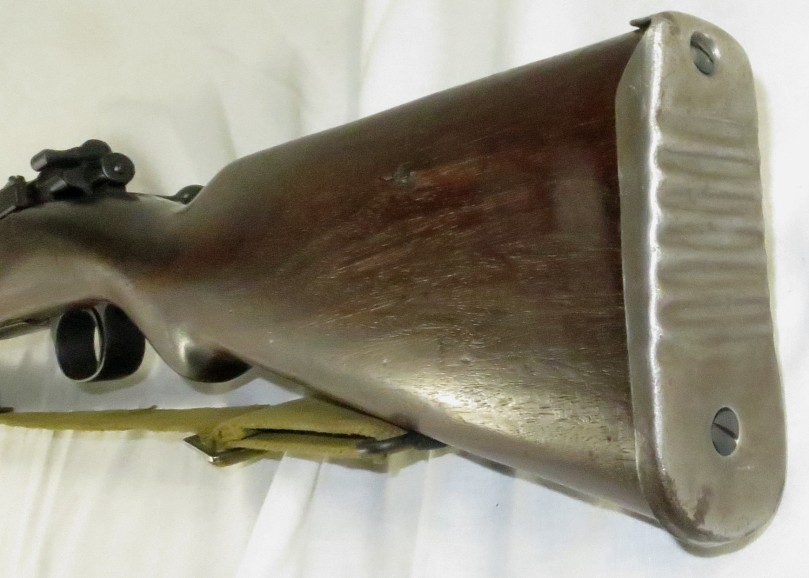
The Mle. 50 used the normal Mauser “safety flag” to the rear of the bolt. This thumb-tab was moved left to fire, straight up to unchamber a round or service the rifle, and right to the safe position.
Overall nothing was revolutionary about the Mle. 50. Anybody who knew how to use a pre-WWII FN contract rifle, or a WWII German 98k; could operate and maintain a Mle. 50 and vice-versa.
sights
There was little remarkable about the sights compared to FN’s other bolt-action Mausers. The front sight was a blade, with no hood.

(Front sight on a Mle. 50. This photo also shows the bayonet boss and cleaning rod, and front retention band which was the “H” style typical of the WWII German 98k and prewar Czechoslovak and Belgian Mausers.) (photo via Liberty Tree Collectors)
The rear sight was similar to the FN pre-WWII style and adjustable from 0 to 1,900 meters (2,078yds) in 100m increments.

(photo via Liberty Tree Collectors)
markings
Mle. 50 rifles were engraved with “ABL”, a portmanteau of “Armée Belge” and “Belgisch Leger”, both meaning Belgian Army in French and Flemish, the nation’s two official languages. Beneath was the production year.
Atop the receiver was the national property marking, a crown with the monarch’s initial. The Mle. 50 is historically interesting in this regard, as its brief production run straddled an tumultuous time within the Belgian monarchy.

King Leopold III was reigning when WWII began in 1939. By late May 1940, most of Belgium had been overrun by the Wehrmacht and the British Expeditionary Force was trapped in a pocket around Dunkirk. With the Belgian government already having departed for London, King Leopold III surrendered the nation on 27 May 1940.
The government-in-exile in London declared the surrender unconstitutional but being unable to convene the Belgian parliament, could not remove Leopold III from the throne. The king stayed in occupied Belgium until 1944 when he was arrested by the Germans and taken to Germany and later Austria, which is where he was when WWII ended.
In the meantime Charles, Count Of Flanders had been appointed as regent in Leopold III’s stead. After WWII Leopold III lived in Switzerland, still technically Belgium’s king. On 12 March 1950, a bitter national referendum was held as to whether he should remain king. Belgian voters cast 57% to 43% in favor of him returning, however the nationwide results masked severe regional differences, which were more than 2-to-1 one way or the other.
Leopold III returned home on 22 July 1950. Production of the Mle. 50 rifle started that year bearing his L initial.
Faced with lingering public bitterness, Leopold III abdicated on 16 July 1951. Any Mle. 50 with the L initial was made before that date.

King Baudoin assumed the throne upon the abdication. Mle. 50 rifles made after July 1951 bear his B initial. The rifle’s production run ended in 1952.
Serials are located on the bolt handle, the right side of the receiver, and the right side of the furniture above the action lug screw.

On the left side of the receiver is FN’s makers mark.

The arrow-like marking shown below is called a Perron and on Belgian firearms, signifies that the action has been cycle-tested.

Elsewhere on the receiver (the position varied over the Mle. 50’s production run) is a crowned nitro proofmark and an inspector’s stamp.
The Mle. 50s were not “storage items” and the Belgian military got thorough use out of them. Many were arsenal-overhauled or even rebuilt during their service lives. These have a * next to the serial on the receiver. In the Belgian system, each factory overhaul added a star and there are Mle. 50s with two stars.

The Mle. 50 rifles made for Force Publique, the colonial army in the Belgian Congo, are described more fully later below. These rifles were marked with F.P. followed by the production year, with the property mark being a lion in a wreath.

color, and the “army / navy versions” inaccuracy
Perhaps surprisingly, the Mle. 50’s color is maybe what it is best-known for within the firearms collector community today.

(photo via gunboards online forum)
Mle. 50 rifles were finished with Suncorite, a patented British coating. Except for the bolt, the rifle’s metal parts were treated with phosphoric acid, parkerized, and then coated with the soluble liquid Suncorite. This hardened to a semi-glossy enamel resistant to oil, water, and wear. Much like paint, added pigment could make Suncorite any color desired.
Suncorite was not new in 1950. For example FN had used it on the Mle. 30 export-contract rifles sold to Colombia just prior to WWII. Elsewhere, Great Britain used it on Enfield No.5 “jungle carbines” late in WWII.
The “default” Suncorite color for Mle. 50s was jet black.

There were also some finished in olive drab green. These were not many and are extremely rare today. More common is the haze grey color.

The haze grey color also started an inaccurate description of there being “army” and “navy” Mle. 50 versions. Suncorite could be used on any metal object, not just rifles. Late in the Mle. 50’s short production run, an unwanted surplus of the haze grey pigment was on hand. After a test showed there was little camouflaging difference in average ranges and lighting with this grey vs jet black, it was decided to use it for Mle. 50s.
Both the Belgian army and Belgian navy used Mle. 50 rifles during the type’s career. However the color chosen did not determine which or the other got them.
The mistake gained traction with Robert Ball’s otherwise excellent book Mauser Military Rifles Of The World. Written over a decade ago now, the Mle. 50 was obscure at the time. Since the Belgian navy received Mle. 50s later than the Belgian army (they actually received them from the army) and retired them later; and since warships are painted haze grey; the error is understandable.
At least until it starts to stain and chip off, the Suncorite coating is aesthetically pleasing and makes for a smart-looking rifle. It is possible to strip and re-apply Suncorite, and some Mle. 50s used by the Belgian Gendarmerie, the final user in Europe, were apparently re-done in black replacing the original black or the green or grey color.
Conversely some of the Force Publique Mle. 50s may have never been Suncorited at all and simply parkerized.

(A WWII German 98k at top, and a Mle. 50 at bottom. The .30-06 Belgian rifle was slightly longer overall. The most obvious difference is the straight bolt handle. Other differences are the absence of the maintenance disc on the stock, the furniture surrounding the rear sight ahead of the receiver, the use of swivel sling loops, and the grey Suncorite.)
bayonet
The Mle. 50 rifle used the pre-WWII Mle. 24. This was a sword-type bayonet with a 15 1⁄8″ blade.

(photo via World Bayonets website)
FN had its own in-house cutlery department and before WWII, had included Mle. 24 bayonets with export-contract Mausers. The company’s philosophy was that a bayonet was a removable part of the rifle, not an optional accessory to it.
After WWII FN’s cutlery department got back on its feet by making clones of the British No.4 Spike bayonet for the donated Enfield rifles. For the Mle. 50 project, it was decided to simply restart production of the Mle. 24 bayonet. WWII had shown a tendency away from long sword bayonets towards more utilitarian designs. However the thinking here was in line with the whole Mle. 50’s concept: avoid any design expense or risk and just field a serviceable thing as fast as possible.
Before WWII, these were delivered steel in-the-white; and a few of the post-WWII ones were as well. However this was changed to a blueing the metal, and some even received Suncorite to match the rifle.
This was the last “long” bayonet FN would make. The SAFN-49 used a 9″ blade design, and the initial FAL bayonet had a 7¾” blade. Later FAL bayonets were 6¼”. During 1977 FN changed its philosophy and only included bayonets with FALs for extra cost. The company shut down its cutlery department in 1988.
the Mle. 50 in the Congo
Belgium’s colony in central Africa, the Belgian Congo, was infinitely bigger than Belgium itself. It had a local defensive army called Force Publique.
During WWII the Belgian Congo was a marooned entity with the colony remaining on the Allied side even as Belgium itself was under occupation. Force Publique’s main rifle during WWII was the bolt-action Mle. 89/36. This was a Great Depression-era rebuild of a First World War long rifle. It used a FN-made 7.65x53mm cartridge (usually called 7.65 Argentine in the rest of the world). When resupply of this caliber was cut off during 1940, Great Britain donated some Enfields and .303 British ammunition to Force Publique to allow the Mle. 89/36s to make it through WWII.
Procurement for Force Publique was done in a somewhat weird way. The colonial force was parallel to, not part of, the Belgian army. Rifles and ammunition were chosen and ordered not by the Belgian general staff, but rather by the Ministère des Colonies (Colonial Ministry) which had offices in Leopoldville and Brussels. One would think that after the strains of WWII that this roundabout system would have been abolished, but it resumed in 1945.
In line with the above, the Enfields were removed from service between 1948 – 1951 and replaced by small batches of FN’s pre-WWII commercial Mle. 30 design, of which small lots were ran during the late 1940s chambered in 7.65 Argentine.
At the same time significant quantities of 7.65 Argentine ammo were reordered to continue feeding the obsolete Mle. 89/36 rifles, which it intended to keep in service alongside the new Mle. 30s.
The 7.65 Argentine decisions were soon regretted and during 1951, .30-06 Springfield SAFN-49s were ordered. However Force Publique would need to wait in line behind the regular Belgian army and these would be some time in coming. As a stop-gap, Mle.50s were ordered later that year.

(photo via Royal Tiger Imports)
All of the Force Publique guns came from the 1952 production year. Other than the aforementioned different markings, they were the same as the baseline Mle. 50. One interesting feature on the Force Publique guns was an optional muzzle cap. Nearly a direct copy of the WWII German muzzle cap for the 98k, this hooked behind the front blade sight and had a flip-door. In Africa these were often quickly lost or broken and are rare today.
Some Force Publique Mle. 50s in private hands today lack the Suncorite; it is unknown if this is due to the coating just completely coming off over the years or if they were delivered that way.
Mle. 50s in Colombia

(Colombian Mle. 50 rifle.)
During WWII the Colombian army used a variety of Mauser-style bolt-action rifles, mainly Austrian-made Steyr M-1929s and FN’s commercial Mle. 30; both chambered in 7x57mm. Colombia was on the Allied side during WWII but did not send any army units into combat, and thus received limited Lend-Lease from the United States.
In 1948 Colombia became eligible for Rio Pact aid and the expectation was for significant amounts of WWII-surplus American rifles, namely .30-06 M1 Garands, to be upcoming. This was indeed what happened with deliveries starting after the Korean War. By the mid-1960s Colombia had received nearly 10,000 M1 Garands.
In the meantime Colombia was in a not altogether different situation as Belgium: It wanted to first flush out the remaining very old Steyr M-1912s and then the Steyr M-1929s; replacing them with something in .30-06 Springfield to match the ammunition of the expected future M1 Garand deliveries. However with a limited budget, this new “intermediate placeholder” rifle would have to be affordable and uncomplicated.
A Colombian arsenal rechambered some pre-WWII FN Mle. 30s from 7x57mm to .30-06 Springfield. This was a success. Colombia already had a good relationship with FN from before WWII and an order was placed for Mle. 50s. It is thought that 3,000 rifles were ordered.
In all but markings, the Colombian rifles were the same as the Belgian ones.

(The Colombian national cartouche is atop the receiver. This photo also gives a good close-up look at the notch on the Mle. 50 to accommodate the longer American cartridge.)

(The Colombian Mle. 50s had “.30” stamped. It is impossible to fit .30-06 Springfield into a rifle chambered for 7x57mm, but it is theoretically possible to accidentally load 7x57mm strippers into the .30-06 receiver.)
This order was considered successful and was followed up by FN assisting Colombian arsenals in rechambering the rest of the pre-WWII FN Mle. 30s to .30-06 Springfield as well. The Colombian Mle. 50s were very well-liked in service; considered of being exceptionally high quality and very durable.
The Mle. 50s served alongside M1 Garands in the 1960s Colombian army and even later during the 1970s, alongside M14s. The last was not discarded from storage until 1988.
the .22 trainer
There was one final offshoot of the Mle. 50, a .22LR training rifle.

Before WWII, the Belgian army trained using special full-caliber training rounds manufactured by the Marga company. These had semi-frangible bullets of a plastic-like compound. The cartridge had a normal primer but only a bit of smokeless powder mixed with a wad of nitrated paper, which produced less energy.
The Marga company did not survive WWII. As opposed to developing a new training cartridge, FN opted to instead adopt the Mle. 50 for .22LR as a cheap, single-shot basic marksmanship training gun.
The rear sight was altered to be 0 – 200 meters (218yds) in 25m increments. A plate inside the chamber blocked off the magazine well. As there was no magazine to service, the trigger guard was extended forward into one long continuous piece of metal. The firing pin was fitted with a disc-like rimfire adapter ahead of the bolt’s mainspring.
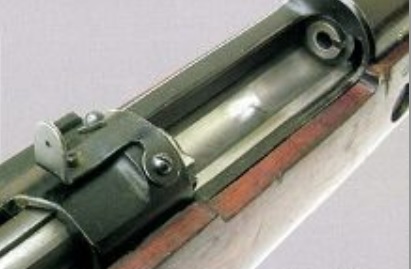
(A .22 extractor was mounted on the front of the chamber. This photo also shows the blocked-off magazine feed and the sight described below.)
After the FAL entered service during the mid-1950s, Belgium modified between 500 – 700 of these training rifles with a simple diopter sight screwed into the rear of the receiver, as seen above. A tiny set screw allowed minute adjustments of it.
There was no formal designation for these .22LR trainers, they were simply called Fusil d’Entrainement (training rifle). FN manufactured 1,000 of which 300 were sent to the Belgian Congo which was urgently requesting a low-cost ammunition trainer type. Those sent there were apparently informally designated “Mle. 1924(C)” by Force Publique.
When the Israeli army contracted FN to run a 7.62 NATO-chambered version of the 98k, it also bought a .22LR trainer version of the 98k based on the Fusil d’Entrainement.
These were a success in Belgian service, with the cheap rimfire .22LR ammunition being much more affordable than .30-06 Springfield for basic training. These ended up being the very last remnant of the Mle. 50 project to remain in Belgian service, with the last not being retired until 1986.
in service
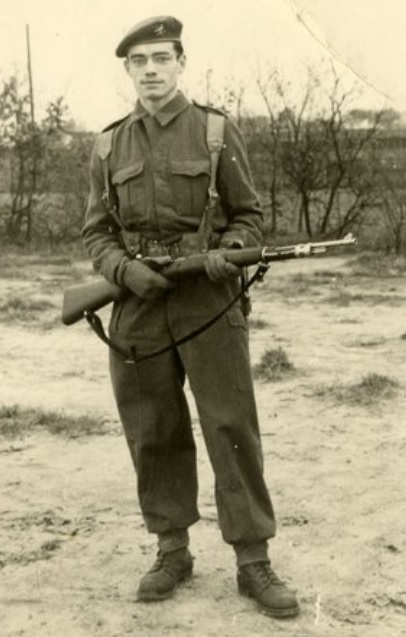
(Belgian soldier with a Mle. 50 during a NATO training exercise.)
The Mle. 50 did everything it was supposed to do. It was a no-risk, low-cost, fast way to transition from 7.92 Mauser and .303 British to .30-06 Springfield. It kept Belgian taxpayer money within the country. There were no problems with it in service. While the Mle. 50 was “obsolescent from the get-go”, this had been accepted from the start. FN made 20,000 plus the Colombian contract and the .22 trainers.

(A Belgian honor guard with Mle. 50s during 1953. The reviewing officer is US Army Gen. Matthew Ridgeway who had commanded the 82nd Airborne Division during WWII and Allied forces during the Korean War.)
Mle. 50s were in frontline service only a short while. They lingered on in second-tier, training, and finally reserve use with both the Belgian army and navy longer. After disposal from the army, some were reissued to the Belgian Gendarmerie which still had a few in the late 1970s.

(Belgian soldiers in a training unit with Mle. 50s during 1963. Old WWII British Mk.II Tommy helmets were still in training use at this time as well.)
While the Mle. 50 itself did everything expected of it, Belgium’s rifle technology tree did not really progress as intended. There were still donated Enfields lingering around at the end of the 1950s. The SAFN-49 became famous as “the rifle which didn’t change the world”, a semi-automatic design too late to be what would have been an advanced WWII rifle, and already eclipsed by select-fire assault rifles only five or six years later.
The Mle. 50s in Europe never saw combat. The same is not true of the ones sent to the Belgian Congo.

(By 1958, when this photo was taken, Force Publique had a menagerie of rifles ranging from FN FALs to SAFN-49s to bolt-action Mausers in two calibers to the old Mle. 89/36s of WWII.)
In a chaotic mess, the Belgian Congo gained independence as the Republic Of Congo on 30 June 1960. Force Publique morphed into the new Congolese army; an ill-equipped and poorly-led force. It inherited the wide variety of rifles which had equipped Force Publique at the end, including Mle. 50s.

(Congolese soldier with a Mle. 50 during the mid-1960s.)
Between 1963 – 1965, Congo had a serious insurrection known as the Simba Rebellion. Beginning in the eastern Great Lakes region, the Simbas (lions) were a motley mix of army deserters, agitated tribesmen, and communists. Their “revolution” was excessively brutal and very violent. Despite lacking nearly any military training, the Simbas soon swelled their holdings to nearly a third of the big nation.

(A group of Simbas armed with a SAFN-49, a Mle. 50, and a civilian Mauser hunting rifle.)
The corrupt, under-funded, and poorly-led Congolese army still had Mle. 50s in service and some of these were likewise wielded by the Simbas, who also used pretty much anything under the sun ranging from the old WWII Mle. 89/36s to new SKSs and SAFN-49s to Mosin-Nagants to civilian hunting guns.
Mercenary units, most famously “Mad” Mike Hoare’s 5 Commando, were instrumental in finally turning the tide. 5 Commando did not use Mle. 50s or any bolt-action weapons for that matter. However a Congolese army subunit was often attached to the mercenary units (which never amounted to more than a few hundred men) to “mop up” regained territory. These Congolese units often had Mle. 50s. Being chambered in .30-06 was a benefit as the United States was now a benefactor to Congo and this caliber was more widely available than 7.65 Argentine by the mid-1960s.

(The arrest of a suspected Simba by Congolese forces. Their weapons are a mixture of FALs and a Mle. 50.)
The efficiency of the rifle in combat is difficult to gauge as the Congolese army often performed dismally on the battlefield. They were withdrawn from Zaire (the renamed Congo) use during the 1970s although some were apparently still in inventory as late as 1987.
for the collector
Surplus Mle. 50 rifles of Belgian use began appearing on the collectors market during the late 1970s and early 1980s, with ex-Colombian guns following them. The Mle. 50 was initially shunned by collectors. As the rifle was not well-known, it was often ignored by people seeking “a real 98k”, with the Mle. 50 being dismissed as some kind of post-WWII knock-off. The Suncorite coating was maybe another turn-off, as for people unfamiliar with it, it may have appeared that the rifle had been amateurishly painted by a previous owner. For many years, Mle. 50 rifles were unpopular and could be bought for as little as $275 in the United States.
More recently, perhaps from the late 2000s and into the 2010s, the Mle. 50 has gained some popularity among collectors. The well-made rifle itself is a good weekend shooter or hunting gun. In the USA, .30-06 Springfield remains a tremendously available civilian caliber, available at most any sporting goods or rural hardware store. The Mle. 50 is classified as Curio & Relics eligible by the ATF and as a bolt-action gun lacking a detachable magazine, is generally subject to the least regulation in most states. By 2022 they typically sell for between $700 – $900 at firearms shows.

(An interesting Mle. 50; this is a “force match” with rifle serial # 6668 having apparently been remounted into the furniture of # 6667, with the 7 carved into a 8, and a replacement bolt with 6668 hand-etched on. This Mle. 50 has the * indicating arsenal-refurbished.) (photo via Guns International)
The original Suncorite is no longer available as it was found to contain noxious chemicals; ironically when it was invented it was thought to have been a “cleaner & safer” metal finishing method. However close substitutes are manufactured today, for anybody wanting to restore a poor-condition Mle. 50.
Within the niche community of bayonet collecting, post-WWII production Mle. 24s have always been extremely desirable. Around the turn of the millennium ones in good condition, especially those with both knife and scabbard Suncorited, they sold in excess of $100 which was between a third and a quarter of the then-average for the whole rifle.

(photo via Militaria Barcelona website)
Perhaps a final factor in the Mle. 50’s newfound popularity is a recognition of the unique little alcove it occupies in military firearms history. The Mle. 50 is, essentially, a WWII gun which happened to be made 5 years too late for WWII. Appearing after the creation of NATO, it was none the less “too old at birth” to really fit into the Cold War era. In several ways, the combination of America’s WWII cartridge and Germany’s WWII rifle style was the curtain call of WWII long arms.