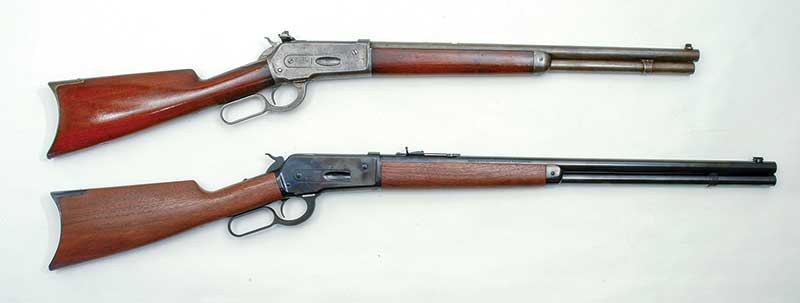
Duke’s altered Model 1886 .40-82 (top) with a 20″ barrel shown for comparison
with a new Japanese Winchester Model 1886 .45-70 with its standard 26″ barrel.
Naturally we clearly remember the “firsts” in our lives — first gun, first car, first date, etc. I remember fondly my first experience with an antique lever gun because it started my career on a path still followed today: learning the ins and outs of safely shooting old and obsolete guns and their cartridges.
Back in the late 1970s a friend, knowing of my handloading and bullet casting experience, asked if I would load some .40-82 cartridges if he supplied brass, dies and bullet mold. His lever gun was a nice Winchester Model 1886 .40-82 manufactured in the late 1880s.
It was a family heirloom but had not been fired in decades due to the lack of factory ammunition. His request sounded like an easy way to introduce myself to Winchester lever guns. The experience turned out to be more complicated, but more educational, than expected.
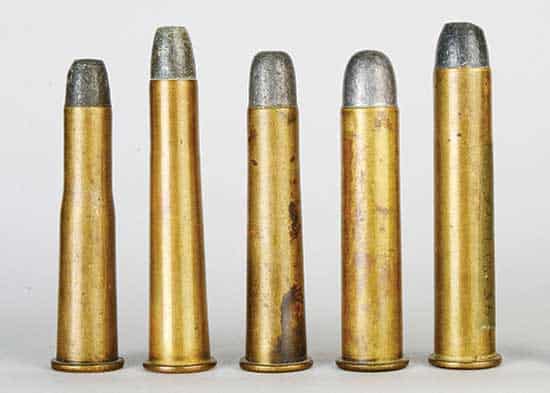
This photo shows a .40-82 in comparison to several other popular Winchester Model
1886 factory chamberings (left to right): .38-56, .40-82, .40-65, .45-70 and .45-90.
The Loads
The mold supplied was an Idea/Lyman #406169 which dropped a 0.408″ bullet weighing 260 grains of the wheel weight alloy I had on hand. I lucked out because the groove diameter of old .40-82 measured 0.408″ instead of the nominal 0.406″. Cases supplied were RCBS .45 Basic with a length of 3.25″. Those were hacksawed to just over the .40-82’s length of 2.40″ then trimmed to the final spec. Next, a now-forgotten charge of a likewise forgotten smokeless powder was dumped in 20 cases. Bullets were seated and crimped and I was ready to shoot.
Only I wasn’t! The rounds were too fat to chamber. It had not occurred to me the .45 basic case walls increased in thickness from case mouth to case rim. Thinning the case walls was the cure so RCBS tooling for the chore was acquired. Again I thought everything was a go. It wasn’t. Every shot fired gave a click-bang. The click was the hammer falling. The bang was the powder charge firing a second or so later, meaning it wasn’t igniting properly. At least the bullets passed through paper targets point on. Some research revealed an old remedy for poor powder ignition was to fill the case atop the powder charge with corn meal. The fix worked and the old rifle began to shoot beautifully. In fact we took it hunting and I shot an elk with it.
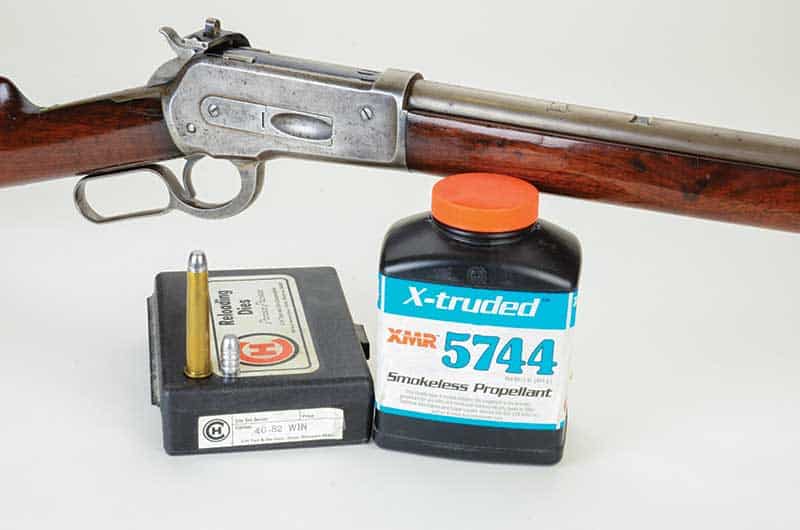
Duke’s Winchester Model 1886 .40-82. Note the filled sight dovetail and
new cut one a few inches ahead of it.
Collecting
As I began to assemble an array of vintage Winchesters, for my own Model 1886 slot I wanted a .40-82. What I finally landed was one made in 1887 as indicated by its serial number. However, it was not a prime specimen. Its buttstock and receiver actually were very nice and it even had a Lyman No. 21 side-mounted peep sight.
The problem was the barrel. While bore condition was very good, it had been shortened from 26″ to 20″ with the magazine tube cut correspondingly. Also, someone had roughly filled the original barrel sight’s dovetail and cut another one a few inches ahead of it but left it empty. Because of those problems the price was right.
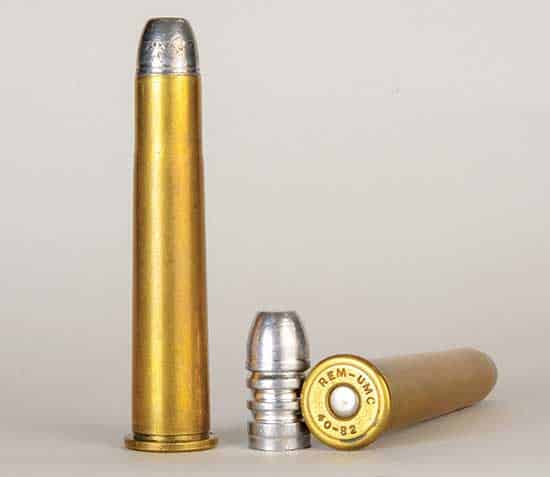
Duke had custom bullet mold maker Steve Brooks cut a set of blocks for a slightly
oversize .40-82 bullet because his Winchester’s bore was likewise oversize.
Cleaning Up
In my mind the idea was to restore it someday with an intact .40-82 barrel and magazine tube. In the meantime I wanted to enjoy shooting it. Times had changed a bit. I knew to slug the barrel first — it was a whopping 0.409″, so I had custom mold maker Steve Brooks (brooksmoulds.com) cut a set of blocks for a 0.410″ bullet with a gas check shank. From my favorite 1–20 tin to the lead alloy I favor, the mold dropped them a mite heavy at 280 grains. A batch of .45 Basic cases were cut and inside reamed as before.
Between my first .40-82 and the one I purchased there was a new smokeless powder introduced. The powder was Accurate 5744 and it revolutionized all my thinking about smokeless powders in voluminous cases. Because it easily ignites in large cases there is no filler necessary.
To my great pleasure, 100 yard groups from my .40-82 were outstanding from the very beginning. When I pull the trigger properly, most are in the 2″ to 3″ range at 100 yards. My favored 5744 charge of 25 grains pushes those 280-gr. bullets out at about 1,390 fp. All ideas about getting a replacement barrel for my cut down ’86 were forgotten.
Other shooters might prefer more glamorous ’86 chamberings like .45-90 or .50-110. I’ve even had such but it’s the .40-82 I’ve kept.