Categories
B&T Station 6
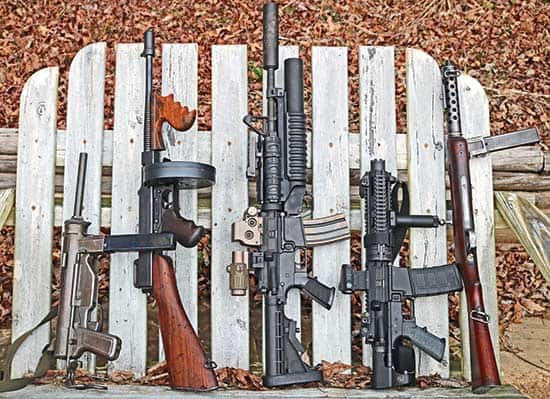
Day at the range: Will and Danny didn’t have ready access to a battery like this back in the day. But now …
It’s really a wonder we survived adolescence. We first met in 9th grade and it was initially a mutual interest in firearms and the military sparking our friendship. School shootings were not a real thing, so it was okay to talk about guns in school back then. It’s indeed been a wild ride. His name is Danny, and we are the archetypal gun buddies.
He goes by Dan nowadays. It seemed somehow more appropriate for a successful electrical engineer working for a high-tech defense contractor. However, we lived together for three years in college. I’ve seen him at his best and I’ve seen him at his worst. He’ll always be Danny to me.
The gun shows were a blast. We’d plot and scheme all the way there, buy an antique surplus MRE for lunch, then trade and barter until they turned off the lights and ran us out. On the trip home it was always exciting to pore over our newest conquests. Our resources were meager and our acquisitions comparable, but it was always fun.
I’m much better funded these days, but I can’t get nearly the rush out of a proper gun show as I did back then with Danny. In this regard I suppose it’s not unlike an addiction. It’s hard to recapture that first serious high.
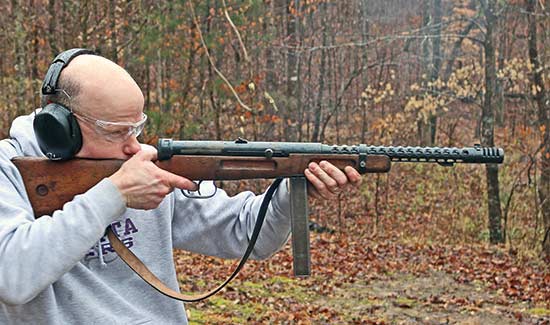
Danny tries his hand with an oldie Beretta 38A. Full-auto is big fun,
but more so with a shooting buddy.
An Explosive Relationship
Now nearly four decades later, his wife still accuses me of trying to kill him. I’m not exactly sure that’s fair. There was of course the homemade spud gun I gave him for Christmas that exploded on his shoulder. He was answering the phone for a couple days when it wasn’t ringing, but there was no lasting harm. Then there was the home-built mortar at the bottom of the thick cardboard shipping container we used for a launcher. It detonated and shredded his pants leg. That ultimately turned out fine, too.
A blank 12-gauge shell and an Estes model rocket engine powered the ridiculous contraption. It did indeed pulverize the tube and simultaneously blew a not-inconsiderable hole in the ground, but of course that could’ve happened to anybody. There were a few others the details of which I’ll keep to myself as I’m not sure if the statute of limitations has yet fully expired. Regardless, we burned untold thousands of rounds together, it was always good harmless fun.
We inadvertently set fire to a shooting range in Oklahoma one time. My quick thinking saved the Porta-John from certain incineration. The mental image of us valiantly dragging that nasty thing out of the smoldering grass in the nick of time still brings a wry grin. It’s amazing the number of furry critters that can quickly exit a stand of tall grass when it is vigorously burning. That debacle ultimately claimed about three acres of Oklahoma grassland and allowed me to meet several very nice firemen. Once again — on balance — no lasting harm.
When I was in the Army and Danny was building military radar systems, we often lived on opposite sides of the world. However, our wives were (and are) best pals, so we made a point to visit at least once a year. Each time the ladies talked about kids and we retired to pore over our latest firearm acquisitions. Some things never change.

The Wayback Machine: A youthful Will and Danny took a serious “Man-cation”
when Will was stationed in Alaska.
Maturing … Kind Of
We each had three kids. They had two girls and a boy. We had two boys and a girl. They were each within three months of each other. The running joke was we would get one church with one preacher and one set of flowers and marry all six of them off in one fell swoop. Alas, his girls found husbands elsewhere so our plans were ruined.
Sadly, our kids have all moved away, though we do finally have a little freedom as a result. It’s a long drive, but we talked them into coming our way this year. Danny and I spent two full days pawing over the gun collection and burning bullets, swapping old lies and ones of more recent vintage. Nobody got blown up, blinded, or incarcerated. It was an altogether great time.
Guns are in the news these days for all the wrong reasons. If you really wanted to save children you’d outlaw skateboards or cigarettes, not AR-15s. But all of you know this already.
Firearms are used for recreation, hunting, personal defense and countless other wholesome American pursuits. And they also build some splendid friendships. No matter how much time elapses or how much hair turns gray or falls out, sitting down in the gun room surrounded by the inimitable smell of BreakFree always takes us back to better days.
We are gun buddies then, now and always.