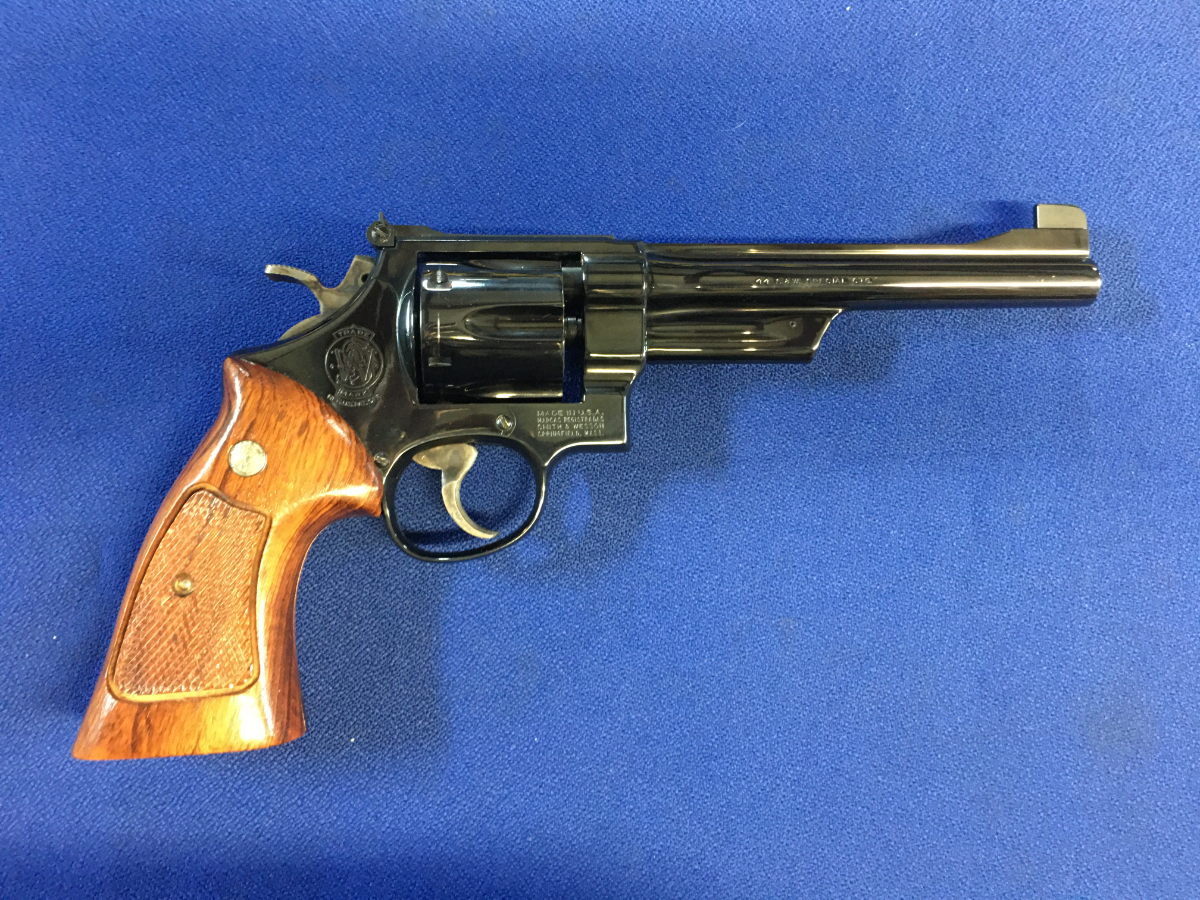
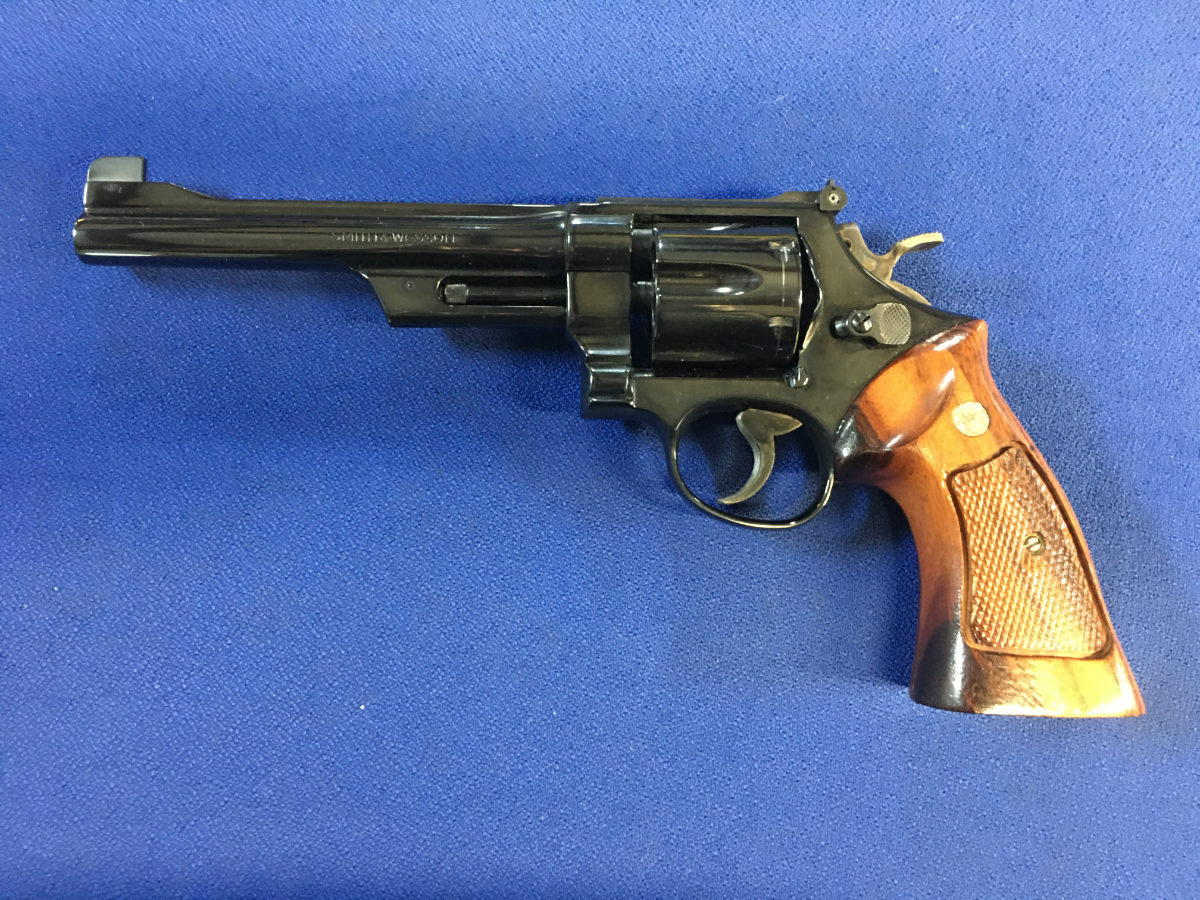
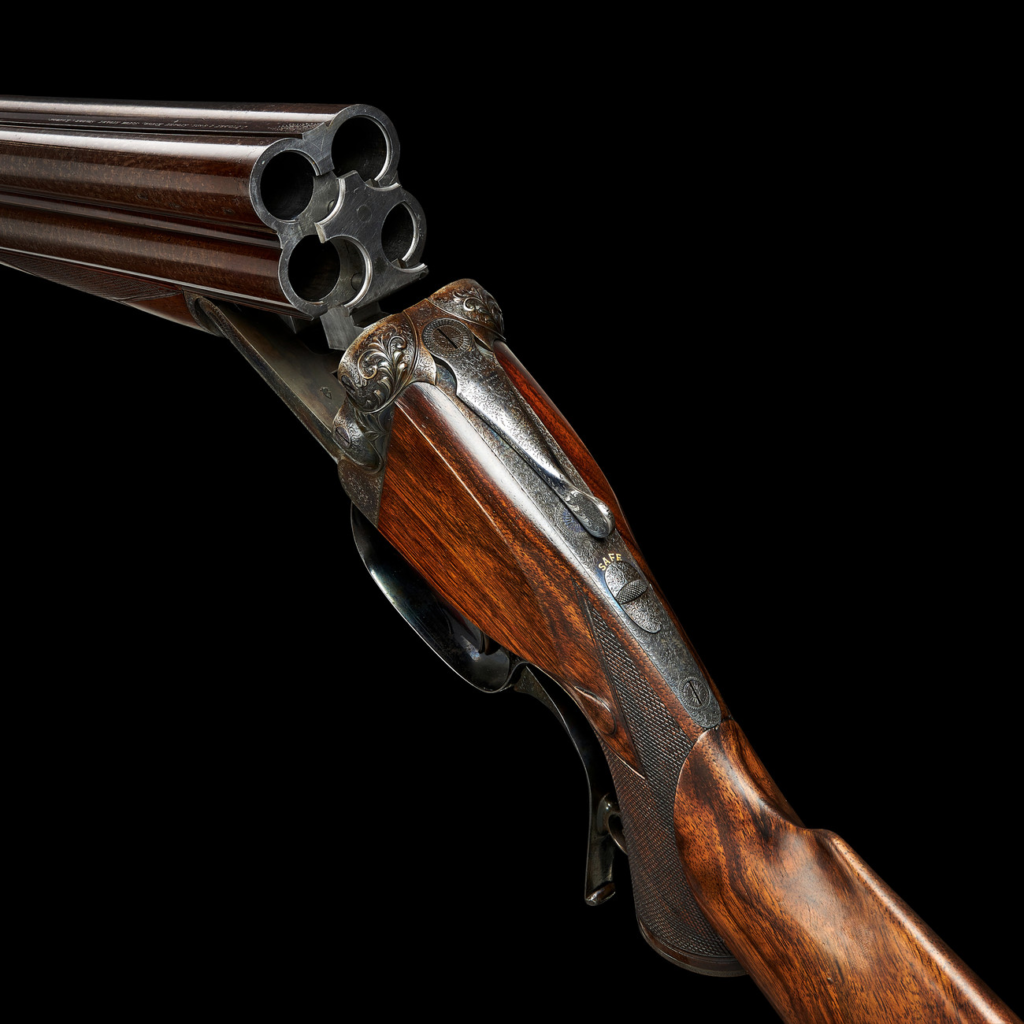
This is not a 1911. This is not a plastic pistol, a hi-cap anything or even a cutting-edge marvel. There’s no glowing sights, polymer-profoundness or even titanium. Not a lick. Batteries are non-existent here. There are no rails to clip lights to and yes, there’s only five shots. Maybe six, if you really need that last one. It’s old-fashioned, but still good. Dare we say, still great? And that’s why it’s here on our pages.
What you’re looking at is, indeed, the culmination of 150 years of technology, but ancient technology. It’s as if somebody found the hull of an original China Clipper sailing ship, and then lovingly restored it, taking the best ideas from her class of ship. Same ship, same hull, same idea, only she seems to cut the water cleaner, the blocks run quieter, the wheel responds faster and you can swear she knows it. Because, you know it.
So why do we celebrate this old technology when we have much “better” designs today? Just look, and you’ll know why. Put down that Glock and step away from it, then look at these rare few Ichiro photos with a new eye, unencumbered and unsoiled with lightweight thinking or plastic-prodding.
Think on those days when “good” meant “steel,” and “heft” was something men who had carried sixguns in lethal fights would weigh carefully in their hand, as their eyes looked into the distance — or the past? They would then snick the hammer down and hand it back with a nod. “That’ll do,” they might say quietly.
Peacemaker Specialists
Eddie Janis is an artist and a pistol-smith. And a father, husband, admirer of fine cars, good horses, good humor and daughters who behave like ladies. All of which are interconnected, with each one having an effect on all the others. Watch how a man treats a waitress and you’ll have a good idea of the cut of the man. If he’s polite and patient to a young, over-worked waitress, then he’ll probably make a good friend. If he’s rude and short-tem-pered, then take note. By the way, Eddie’s polite to waitresses and has a quick smile— or he wouldn’t be in these pages.
After shooting IPSC into the early 1980s, Eddie lost interest, but discovered the beginnings of cowboy shooting. After having his competition 1911s worked on by talented pistolsmiths, Eddie assumed the same would happen with his SAAs he sent off. But his eyes were rudely opened with the results.
“What I got back was a collection of badly-timed, out-of-balance guns that simply didn’t feel right in my hand,” he said. “My experiences with 1911 ‘smiths and the great work commonly encountered there, made me think there must be a better way when it came to the single action Colts,” he added.
But alas, Eddie was without luck in that department, so, as is the case with such things, Eddie decided he could do better himself. Peacemaker Specialists was born and since those early days, Eddie’s shop has become a Mecca for Colt shooters. From a series of parts care-fully crafted to match factory-original ones (Peacemaker Parts), to a cross-sec-tion of custom work the imagination can only touch upon, Peacemaker Specialists is indeed the “one-stop shop” for all good things when it comes to the Colt Single Action Army. By the way, don’t even mention any of the clones. Eddie doesn’t work on them, period. And that’s, that.
The Question at Hand
The creation on our pages began life in 1902 when it left the Colt factory. It led a mysterious life (if only we knew the adventures), until it was inherited by one of Eddie’s customers (from a great uncle, it seems), and Eddie ended-up with the old Colt in 1999. After languishing in his safe for several years while Eddie “thought on it some,” as he told me, he began a three-part project in May of 2002. He wanted to showcase just what Peacemaker Specialists could do, and offer the final result in steel and ivory.
Eddie calls the first step, “The accuracy phase” and lays it out for us. “A new 7.5″ second generation barrel allowed me to install the front sight authentically, instead of the latter second generation method,” said Eddie. Then, after cutting it to 4.75″ and crowning it, he installed the front sight with the proper solder joint and profiles to match the v-groove rear. Plus, the perfect bore of the new barrel would assure top-notch accuracy.
The second generation caliber mark-ings and address had to be polished off and the correct first generation two-line address and “45 Colt” markings were applied. The forcing cone was cut to 11-degrees for best accuracy with lead bul-lets, and fit to the frame with .002″ to .003″ of barrel to cylinder gap. A standard Colt can be upwards of .006 — or worse.
The cylinder was replaced with a new, second generation .357 Magnum one, re-chambered to .45 Colt with .452″ chamber throats for best accuracy. Eddie applied some hand-magic to the outside of the cylinder to achieve the proper first generation contours and appearance. When all was said and done, he then fit the cylinder with a new base pin and bushing to achieve zero end-shake.
Reliability Phase
Since the innards of the old Colt were tired, Eddie replaced the entire array with new, Peacemaker Parts versions. Since they are virtually identical to original Colt parts (including finish, etc.) they are historically accurate — which is something to keep in mind if you’re restoring an original gun.
Eddie performed his “Gunslinger Deluxe Action Job” on the Royal Flush. This includes, but is certainly not limited to, fitting an oversized bolt and hand, allowing a perfect lock-up with zero side-play in the cylinder; and careful hand-fit-ting of the mainspring, sear and bolt spring, base pin bushing, trigger, ejector spring, latch unit, ejector tube and all screws.
“Hand-fitting” is lots different from “putting in some parts” in a SAA. Beware those “drop-in” spring kits, Eddie warns. “The interplay of parts is critical and simply replacing a spring without making sure the sear engagement is safe and reli-able, may make a gun unsafe,” he explained. The proof is in your hand when you feel a Janis action. Words like “but-tery smooth” come to mind. When I first felt one, I thought someone had taken the main-spring out of the gun. The degree of smoothness is, simply put, astounding.
As Eddie says, “Carefully fitting the parts will pay dividends in long-term reli-ability. If the various bits are working together, rather than clunking and fighting one another, smoothness and reliability are enhanced.” Not to mention the delight of watching your friend’s faces when they cock a Colt Eddie has worked his magic on. “No, really, it’s supposed to be that way,” you’ll have to say. Again and again.
Cosmetics
And we don’t mean eye shadow. This gun had to have ivory, so it does. Note how the “bark” is incorporated into the overall outside contours. It’s often the little things, and this is one of those little, “big” things.
At this point, Eddie test-fired the Royal Flush with Black Hills 250 gr. cowboy loads to center the group on the target. He was also able to maintain the proper front sight contour so it didn’t look “filed-on” when he was finished. So now, the Royal Flush was mechanically perfect but needed something else. How about engraving?
Eddie selected five Cuno Helfrict engraving patterns, circa 1871 to 1921. He was going for a true turn-of-the-century cowboy look, not too busy but not to plain, either. The engraving was impeccably accomplished by master engraver Clinton Finley, of Redding, California. Clinton spread the designs over the sixgun, blending the talents of Cuno with the lines of the Royal Flush. We think Cuno would have doffed his hat to Clinton’s work.
And, no, actually, that finish is not nickel — it’s silver. Silver has a softer finish and feel, like an antique gown, whose green velvet has attained a state of grace, and when touched makes anyone with any feelings at all pause and ask if they could touch it again, please? The silver delights the eye, without over-pow-ering the engraving or reflecting “too much,” as Eddie says.
The fire-blued screws set the Royal Flush off exactly the way the correct red lipstick (not too dark, not too light) can set off a beautiful woman’s lips as she looks— through you. Impossible to believe, but there, before you, nonetheless.
But Why?
Simply to behold, we think. And yet, I was fortunate enough to handle this dream-gun. Don’t tell Eddie, but I cocked it. Honest. Sorry Eddie, I had to. The Royal Flush could hold its own with any of the classic masterpieces of the late 1800s, except for one very important dif-ference.
The Royal Flush shoots like hells-afire, with 100-percent reliability. All of which is no small feat with a single action army. And, I might add, the Royal Flush accomplishes it all in spades. Sorry, I had to say it.

COLT HBAR M2 BELT FED MACHINE GUN


This belt-fed iteration of the M-16 was basically an experimental firearm. Only 20 of these guns were ever made before the project was canceled. Chambered in 5.56x45mm, this machine gun has a 21-3/4″ heavy profile barrel with a bipod attached right behind the three-prong flash hider. Here is how Morphy Auction describes the feeding mechanism of this gun:
Colt then added a very clever belt feed mechanism, that sits in the magazine well when the rifle is opened and locks in when the rifle is closed. The vertical actuator attaches to a special cut in the bolt carrier group to actuate, and a slot was added on the right side, where a feed chute would feed spent links into a separate compartment of the feed box.


.gif)

.png)
.gif)
Marines and the M1 Garand.
Due to its impressive combat performance during the Second World War, Gen. George S. Patton dubbed the M1 Garand “the greatest battle implement ever devised.” That said, the Garand did suffer some setbacks over the course of its design, trial and ultimate adoption by the U.S. military. One of the most commonly held misconceptions of the entire process is the claim that the United States Marine Corps was entirely uninterested in a semi-automatic service rifle but finally came to adopt and love the M1 Garand and, with that, replace the time-honored M1903 Springfield.
One frequently repeated notion is that the Marines fought the adoption of the Garand because of a belief that it would waste ammunition and degrade their foundational “every Marine is a rifleman” ethos. The story goes: The “Old Guard,” who were more conservative and resisting change, delayed the adoption as long as they could. It wasn’t until after the Guadalcanal campaign in 1942, when Marines fought the Japanese alongside U.S. Army troops carrying the M1 Garand service rifle, that they saw the errors of their ways and left their M1903 bolt-action rifles in the past to adopt the new semi-automatic rifle.

While it’s a plausible theory, especially given the historical conservative nature of military decisions makers, in truth, it is mostly apocryphal and certainly does not tell the story contained in primary source documentation at the National Archives. These documents show a more nuanced relationship between the Marines and the M1 Garand. The chief of ordnance saw the value of an infantryman wielding a semi-automatic rifle against an enemy that would likely field a bolt-action rifle. One of the earliest accounts of this is suggested at Springfield Armory in 1902. However, at that time, they could never get it to work correctly. Even during the First World War, the U.S. Army continually looked for the technological edge on the battlefield in the hands of the rifleman, even investing heavily into the ultimately unnecessary 1903 Mark I and M1918 Pistol (Pedersen Device).
Although that project will go down in U.S. military history as a colossal failure, it didn’t stop the U.S. military. In the early 1920s, two prominent designers were the front-runners in designing the next U.S. infantry rifle on a semi-automatic platform. Those were John D. Pedersen and John C. Garand. Ultimately, John Garand would win the competition, but his story with the Marine Corps is complex.
Initial Interest and Orders
Through the Department of the Navy, the Marines’ interest in the M1 Garand predates the jungles of Guadalcanal by a decade. In 1932, Secretary of the Navy Charles Francis Adams III suggested field trials of John Garand’s experimental semi-automatic rifle (T3E2) chambered in .276 Pedersen. He mentioned that the final test of any tool is its performance in combat. Owing to that fact, he suggested that Nicaraguan National Guard Detachment, which is composed of personnel of the Marine Corps and is frequently engaged in combat in that area, would perform a suitable combat trial. He requested 10 of these rifles with 30,000 rounds of ammunition to conduct a test. General Douglas MacArthur issued a reply in March 1932 that such a test could not be authorized. It should be noted that this predates the adoption of the Garand in .30-06 Sprg., and this suggestion was made while the Garand was still chambered for its original .276 cartridge.
General Douglas MacArthur denies the Marine Corps field test of the Garand semi-automatic rifle (T3E2) in .276-cal. Photo courtesy of Archival Research Group.
Although the request was denied, the Marines’ interest in the Garand persisted. On Oct. 3, 1935, Victor H. Czegka wrote to Maj. Julian Hatcher of the Ordnance Department that he intended to visit Springfield Armory with Melvin Johnson, a reserve officer of the U.S.M.C. at the time. Specifically, they mentioned they would greatly appreciate the privilege of viewing the new “Garand gun.” It should be pointed out to the readers that Johnson and Czegka were both active in the firearms industry at that time, with Johnson later developing the Johnson Automatic Rifle (itself being eventually evaluated and fielded by the Marine Corps), and Czegka winning the prestigious Wimbledon Cup, a celebrated long-range shooting event. They were well-known personalities, yet on Oct. 10, Lieut. Col. S. H. MacGregor denied their request with a simple “permission can not [sic] be granted to you to examine this weapon.”
The Marine Corps’ persistent interest would continue into early 1936 when the commandant of the Marine Corps placed an order with the chief of ordnance for:
“400 rifles, U.S., semiautomatic, caliber .30, M1, complete with spare parts, equipment common to the caliber .30 M1903 rifle, and except that only four clip-loading machines should be supplied.”
This order amounted to $44,400 plus $100 shipping and handling. This price was later amended by the Paymaster General of the Navy Department to $54,100.00 (with the $100 shipping charge). To add context, this would reflect a price tag of $1,180,714.99 ($2,182.47 shipping and handling) adjusted for inflation to the year 2023.
The first 100 M1 Garand rifles were received at the Philadelphia Depot on March 12, 1938, and retained, awaiting further instructions by the quartermaster of that depot. The following month, on April 8, 1938, Lt. Col. S. P. Spalding wrote the quartermaster of the depot, noting his verbal request that all 400 rifles be provided at approximately the same time. Because of this, and because the Army urgently needed the rifles, it was agreed upon that the U.S.M.C. would return those first 100 rifles to the Army, with 400 rifles earmarked for the Marines after June 30, 1938. On April 22, a memorandum was drafted indicating that the 100 M1 Garand rifles were shipped to the ordnance officer at Fort Benning, Ga., by the Merchant’s Mining Company on April 11th. The Marines’ opportunity to test a semi-automatic rifle would have to wait.
Victor H. Czegka with Melvin Maynard Johnson eagerly requesting permission to see John Garand’s new rifle semi-automatic rifle. Photo courtesy of Archival Research Group.
The Ordnance Department finally sent some much-awaited news that they would ship 398 rifles to the U.S.M.C. Depot of Supplies on Sept. 15, 1938, and that two rifles had been sent to Marine Corps schools in Quantico, Va., earlier that month. Army Ordnance also wanted to make the U.S.M.C. aware of the long list of difficulties accompanying the rifles and their testing. One of the primary issues was that the standard cleaning rod used was too long. Because the rifle had to be cleaned from the muzzle instead of the breech, it caused damage to the rear wall of the receiver and the head of the bolt, something that was being addressed with the production of a shorter cleaning rod.
Finally, on Nov. 19, 1938, the director of the Division of Operations and Training wrote to the commandant of the U.S.M.C. that a marksmanship and field test should be conducted to determine whether the new rifle, U.S., caliber .30, M1, should replace the M1903 Springfield rifle. He further noted that the current strength of rifle units in an infantry battalion of the Fleet Marine Force (FMF) is approximately 255 enlisted men (armed with the rifle). Owing to the fact the number of rifles ordered (400) provided a sufficient number to equip the rifle units of one battalion, an additional platoon, and furnish several Marine Corps Schools and Basic Schools that, a distribution of the following should be made:
| 6th Marines | 300 |
| 5th Marines | 35 |
| Basic School | 35 |
| Marine Corps Schools | 10 |
| Depot of Supplies (for spares) | 20 |
| Total | 400 |
On Jan. 3, 1939, the commandant of the U.S.M.C. notified the commandant of the Marine Corps Schools at Quantico that they would receive 10 rifles from the Depot of Supplies, which includes two that had already been accepted. He further notified him that the school would be receiving the following:
- Essential parts and accessories.
- Basic Field Manuals for the U.S. Rifle, Caliber .30 M1
- Charts for Instruction
- 1,056 cartridges, ball caliber .30 M1, loaded on clips of (8) cartridges each (1 box containing 132 loaded clips).
The Basic School at Philadelphia would receive the same components above, except getting 35 rifles instead of 10 and 13,728 cartridges instead of 1,056. It was requested that reports be made and returned to the U.S.M.C. Commandant by June 30, 1940, and the reports should contain the following:
- Total ammunition fired.
- Rounds were fired from each rifle.
- Classes of stoppages, causes, and corrective measures for each rifle.
- Malfunctions or broken parts for each rifle.
- Injuries caused by rifles, if any, to personnel.
- A tabulation of firing results for experts, sharpshoots, marksmen, and unqualified personnel.
- Results of musketry and combat firing were tabulated and compared with similar firings done with the M1903 rifle and Browning Automatic Rifle.
- Accuracy of the M1 rifle as compared with M1903 and Browning Automatic Rifle
- Suitability or use in bayonet use.
- Simplicity of mechanical construction.
- Each and Simplicity of assembling and disassembling.
- The suitability of the sights.
- Fatigue from firing the M1 rifle as compared with firing the M1903 and Browning Automatic Rifle.
- Recommendations, if any, for correcting mechanical deficiencies of the rifle.
- Recommendations as to spare parts that should be furnished with each rifle.
- Does the M1 rifle perform satisfactorily in the capacity in which intended, namely as a replacement for the M1903 bolt action rifle?
- Any other information of pertinent nature is not covered above.
Lieutenant-Colonel MacGregor of the Ordnance Department very concisely gave Czegka and Johnson a curt “no” in their request. Photo courtesy of Archival Research Group.
By February 1939, reports came in from the 6th Marines, 2nd Marine Brigade and Fleet Marine Force in San Diego that many new rifles received had rusted (pitted) barrels when they were received. Reports of any defects were to be reported to the U.S.M.C. commandant at the earliest practicable date. On Feb. 17, 1939, the commanding officer of 1st Btn., 6th Marines, notified the U.S.M.C. commandant of the news. Specifically, he reported that 300 rifles had been received in new arms chests and were packed with heavy oil but not cosmoline. He described the following:
“In general, the rifles were found to be dirty and rusty. Large carbon deposits and powder fowling [sic] were found in the bores and also in the gas cylinders, and rust was noted on some working parts as well. The bores of the rifles were found to be badly pitted to the extent of about 1 in 12 rifles, slightly pitted in about 1 out of 2 rifles, and very slightly pitted in 1 out of about 6. Precisely of the 263 rifles issued and covered by the enclosures, the following conditions were found:
Badly pitted bore…………………….22
Slightly pitted bore……………………152
Very slightly pitted bore………………45.”
Later that month, the Marine Corps Schools at Quantico reported that the 10 rifles it received had no defects upon inspection. The Marine Basic School in Philadelphia noted that its 35 rifles had received prior inspection for defects; each rifle was disassembled and thoroughly cleaned. The barrels and chambers of all rifles were found to be free from defects. However, upon cleaning the grease from the bores, it was noted that the cleaning patches from several rifles came out very black, indicating these rifles had not been cleaned as prescribed and were lucky to escape damage.
The commanding officer of the 6th Marines, 2nd Marine Brigade FMF followed up with a previous report denoting that 13 of the 14 rifles sent to Philadelphia as being pitted and were found mechanically defective from “cuts, flaws and tool marks.” Eight of them were so defective as to be unserviceable. He further noted that a large percentage of the new rifles were not of the type of workmanship that his officers were accustomed to handling.
This parallels a previous report from the commandant, who had noted that Springfield Armory had experienced some issues in the quality of the steel stock purchased for the manufacture of the M1 rifle. The flaws encountered by the Marines in the finished product support this. He further noted that Springfield Armory informed him that it will take some time to adjust the new machines to the type of steel they are using. This accounts for some barrels with tool marks and occasional cuts in the bore. The M1 Garand was going through some significant growing pains before turning into the finished product that served admirably throughout World War II.
The modification (arrow) on the inside of the receiver showing the modification to fix the “7th round stoppage.” The discoloration on the “rib” showing where extra metal was welded to fix that problem
The situation would get even more complicated when the commanding officer of Co. B, 1st Batn., 6th Marines, 2nd Marine Brigade, stated that the rifles were carefully inspected upon receipt. He noted:
“All rifles were received with bores in a very dirty condition. They have the appearance of having been fired, then greased and packed without previously completing a course of cleaning suitable for prolonged storing. The bores were coated with a medium but sufficiently heavy coat of grease. The mechanical parts were dry, and in some cases, and on a few rifles, rust had begun to appear.” He further noted that, in nearly all cases, the gas cylinders were found to be pitted after cleaning, and the gas cylinder plug was covered with a heavy coat of carbon.
It’s clear that the Marine Corps’ desire to test a semi-automatic rifle was off to a rocky start, and it wasn’t until May 1940 that a full report could be written on how the rifles performed. It should be emphasized that the rifles were first ordered in 1936, and the test wasn’t concluded with a final report until the middle of 1940.
The report indicated that they fired a total of 244,845 rounds in testing during the 1939 targeting year. The report also recorded 131 stoppages, malfunctions or broken parts (this includes disregarding gas cylinder plugs out of line, cracked stocks, etc.). It also reported that 22.1 percent of the present rifles had some stoppage or malfunction that would have put the rifles permanently out of action in the field. Other notable comments were as follows:
- In every instance except one, the M-1 proved superior to the M-1903 in musketry and combat exercises when reduced to the everyday basis of the number of hits scored per round per minute.
- All reports indicated that the M-1 rifle was more accurate than the Browning Automatic Rifle but less accurate than the M-1903.
- M-1 was suitable for bayonet combat.
- The M-1 is easier to assemble and disassemble than the Browning Automatic Rifle.
- There is considerably less fatigue from firing the M-1 rifle than is experienced with the M-1903 or Browning Automatic Rifle.
- The effective rate of fire is 16-20 shots per minute.
- Clips must be handled carefully to prevent rust, denting, or other damage which will cause malfunction.
- It is believed that salvaged clips can be used for a limited time and that most of the ammunition for the M-1 rifle should be purchased already loaded on clips to obtain the best results. Reloading the clips is a slow process.
- The rifle must be fieldstripped for cleaning, which improves the protection of several working parts from loss and dirt during the process.
- The bolt and receiver assembly becomes loose due to wear on the locking lugs.
The M1 debut with the Marine Corps proved rocky but favorable. But the U.S.M.C. understood the M1 was in its infancy and would have improvements made on later models. Some of those recommended improvements included:
- Change the front sight blade to .05 or .06 inch width.
- Reduce the size of the rear sight aperture slightly.
- Improve the design of the rear sight
- Provide a better quality of metal and the fit of the trigger pin.
- Change the design and material in the front hand guards to prevent cracking.
- Modify the method of holding the receiver group in stock to eliminate play which develops due to wear on the locking lugs
- Improve the type of chamber cleaning tool.
And lastly, the most critical question: “Does the M1 rifle perform satisfactorily in the capacity intended, namely a replacement for the M1903 bolt-action rifle?” The report answers this question in this way:
“There is serious doubt as to the suitability of the M1 rifle in its present state of development as a replacement for the M1903 rifle because of: the number of malfunctions experienced, even under satisfactory conditions under which the majority of those tests have been confirmed; the fact that the rifle requires extreme care and lubrication to ensure that it will function properly; and the defects reported by the 1st Marine Brigade FMF, as a result of the limited field test conducted at Culebra. This is especially true when one considers the type of service the Marine Corps as a whole in small wars and landing operations.”
Between the wood is a March 1966 barrel stamp, which was likely due to the Department of Defense overhaul of M1 Garands beginning in 1963.
The Marines saw value in the new M1 rifle, but it also noted that it was going through some “growing pains.” It also pointed out that the Ordnance Department recently changed the design of the barrel, gas cylinder and gas plug assemblies, and these improvements will go into mass production at Springfield Armory in mid-May 1940. This is when the design evolved from the “gas-trap” Garand to the “gas-port” Garand. These improvements were significant, as they would correct several problems encountered with the earlier designs.
In November 1940, the U.S.M.C. conducted yet another test. This was a competitive test between the M1903 Springfield Rifle, M1 Garand, Johnson Automatic Rifle and a Winchester semi-automatic Rifle. This test concluded that the M1 was superior to the M1903 under favorable conditions and that the M1 was considered suitable for arming components of the Marine Corps, which generally would not be called upon to operate under conditions approaching those of more severe tests. The most interesting comment was, “Judging by the experience with other rifles in the past, and the improvements which have been made and contemplated in the U.S. Rifle Caliber .30 M1, it may be expected that the operation of this rifle will be improved still further.” While the Marine Corps certainly saw the merit in the M1, it just concluded that, in the gun’s present state, it wouldn’t be suitable for front-line combat. The Marine Corps formally adopted the rifle on Feb. 18, 1941, a mere five years after the first purchase order.
Relics From The Tests
One rifle actually used in the early U.S.M.C. trials has been secured for photographs. Its serial number is 3706, and it first appeared on the inspection report from the commanding officer of Co. B,” 1st Btn., 6th Marines, 2nd Marine Brigade, on Feb. 10, 1939. It was noted that, upon inspection, the barrel had pits on lands at a point 5″ from the muzzle, and the gas cylinder was slightly pitted. It appears later in the report from May 1940 where it is recorded it had 260 rounds fired through it during the tests.
Technical Specifications:
Serial Number: 3706
Receiver Drawing Number: D 28291
Barrel Date: 3-66
Stock: Letterkenny Replacement
Trigger Housing: D28290-18-SA
Bolt: D28287-12SA
It’s unclear how long this rifle stayed in Marine Corps custody, because it appears to have returned to the Army at some point in its service life. In April 1941, the Ordnance Department acknowledges an inquiry from the Marine Corps quartermaster concerning the conversion of (gas trap to gas port) 400 rifles on hand at the Philadelphia Navy yard. The Ordnance Department suggests shipping those rifles to Springfield Armory to be converted. It is unclear if these rifles were in fact shipped to Springfield Armory, if they were exchanged for new rifles or if they were converted and shipped back to the quartermaster.
Receiver leg electro-penciling “LEAD” indicating overhaul at Letterkenny Army Depot in September 1966.
The toe of the receiver is marked “LEAD 9-66,” which stands for Letterkenny Army Depot with the month and year of its overhaul. Beginning in early 1963, the Department of Defense began a plan of overhauling M1 Garands starting at Springfield Armory. Still, it would carry over into other arsenals around the country. The stock also possesses the “red triangle,” which is the mark of a Letterkenny replacement stock.
Red triangle marked stock which is a Letterkenny replacement stock.
It has been long believed that the U.S.M.C. fought tooth and nail against adopting the M1 Garand, that the corps wanted to maintain its treasured M1903 Springfield rifle until the Guadalcanal campaign changed their mind. However, looking through primary source documentation, it is clear that this was actually not the case. It’s now known that the Marines took a very early interest in a semi-automatic rifle, dating all the way back to 1932. They would make their first orders in 1936 but would not be able to complete testing and file reports until 1939, due to a series of obstacles. The Marines would then conduct a second test against other possible semi-automatic platforms in late 1940.

The Marines also understood that there was significant value in the M1 Garand specifically. Still, they also understood that, as it stood in its early stages, it needed substantial improvements to reach the level of combat reliability they required. Accordingly, they took a more pragmatic approach to the problem: adopt it as an auxiliary firearm that would be issued to the troops away from the front lines. As the design improvements were adopted, the rifle became more reliable and expanded outwards. Once the supply was sufficient, the front-line combat troops would switch from the M1903 to the M1 Garand. Evidence of this was documented in February 1943 when the U.S.M..C stated it was receiving the M1 in sufficient supply and would transfer excess M1903s to the U.S. Navy. The rest is history.
Picking up where we left off after Special Projects Editor Roy Huntington kindly re-barreled my .32 Colt Police Positive Special, I finally had the chance to handload some of my favorite loads for it. If you remember, the replacement barrel has a thicker front sight on it, so it’s easier for me to see. Because of the thicker front sight, Roy also opened up the fixed rear sight channel for me.
He obviously got things lined up pretty good because the gun shoots to sights with the handloads used.
Name Only?
When certain manufacturers come out with a new cartridge, competing manufacturers don’t like advertising for the competition, so they stamp their own, or some benign moniker for the cartridge. Examples include Ruger marking .45 Colt revolvers with .45 Caliber. Well, Colt was no different. When the .32 S&W Long came out, Colt went with the .32 Colt New Police for the same cartridge.
Handload Heaven
The .32 S&W Long is best suited for quicker burning powders such as Red Dot, Winchester 231, and the old standby, Unique. I use two cast bullets suitable for this gun, both weighing just over 100 grains. The first is an RCBS SWC that looks like a baby “Keith” slug. I’ve always had good luck with this bullet, accuracy-wise, when shooting it in my other .32 H&R sixguns.
The other bullet used is from MP Molds, based in Slovenia. It is a radiused flat-nose design, with a hollow point (HP). It, too, has always shown good manners in the accuracy department and is deadly on varmints with the huge HP cavity.
All loads were assembled using my Lee Precision Classic Turret Press and Lee dies. Since the charges were so small, a Lee Auto-Disk Powder Dispenser was used with the Lee Micro Disk (#441523) since the charges.
I was able to drop 3.0 grains of 231 with this disk. For handloading numerous calibers, the Lee Classic Turret is the way to go. With dies pre-set and stored in the die plate, swapping calibers is quick and easy, taking just seconds to accomplish.
When using 3.0 grains of Winchester 231 powder with both bullets’ velocity runs right at 880 FPS from the 4” barrel of the Police Positive Special. With 3.5 grains of Unique, muzzle velocity was almost identical. Friend Glen Fryxell shared his favorite load of 2.6 grains of Red Dot with the RCBS SWC, and it runs at 800 FPS, also shooting very well.
Shooting
As I mentioned earlier, the replacement barrel has a much thicker front sight (.125”) and is much easier to see with my tri-focal corrective lenses. Being transitional lenses there is no distinct line, rather the focal planes blend into each other. All I have to do is find the “sweet” spot where the front sight looks sharp and clear like it did when my eyes were just 20 years old.
From a distance was 50 feet, I had my hands resting on top of a 12” section of 6” x 6” post standing on end with a sandbag perched on top. The raised position allowed my eyes to automatically align with the “sweet” spot of my transitional tri-focal glasses, providing a sharp sight picture.
My targets consisted of 2” florescent orange squares turned ¼ turn, giving them a diamond shape appearance. Using a 6 o’clock hold with the top of the front sight at the bottom of the diamond shape is natural and provides a wonderful sight picture when everything is all lined up. Groups consisted of five shots each.
Results
First off, shooting these loads is a pure pleasure. There is no recoil to speak off, yet a 100-grain cast slug traveling in excess of 850 FPS packs enough punch to do some damage. Groups were consistently accurate no matter what bullet or powder was used, running anywhere between 1-1.5” as you can see in the target photos.
Shooting old guns with handloads you made yourself is wonderful therapy for beating boredom or taking a break from the routine of shooting modern guns and loads. It’s just different, in its own pleasing way.
Marvelous Misfits
Also of note is shooting a gun once considered a candidate for the scrap heap. With a little computer research, an even better barrel was obtained, making it more suitable for my eyes than the factory original. Plus, I think the heavier barrel looks better.
By making these changes, along with having a friend doing the work, it adds a personal touch to the gun and makes it seem more yours. Old guns taken from the pile of “misfit toys” (referencing “Rudolph the Red Nosed Reindeer”), and giving them a little care and love, rendering them to shooter status once again, is very satisfying to say the least.
Plus, these “misfits” are usually sold “as is” at bargain prices. So, if you have a little “misfit” in yourself and enjoy making broken guns become shooters again, this is a satisfying and affordable way of keeping yourself occupied until the next project presents itself.
South Carolinian faced 115 years in prison until ATF admitted they got the wrong man
ATF refused to say how the false arrest could have happened. by LEE WILLIAMS
Firearms seized by ATF and South Carolina law enforcement last year during a “major drug and guns crackdown,” which resulted in 20 arrests, including Bryan Montiea Wilson. (Photo courtesy U.S. Attorney’s Office, District of South Carolina.)by Lee Williams
Wednesday, December 13, 2023, began just like any other workday for Bryan Montiea Wilson, a 33-year-old resident of West Columbia, South Carolina, who had never been in trouble with the law.
At 6 a.m., Wilson began his shift at Harsco Rails on West Technology Drive, where he worked as a material processor for the railroad equipment manufacturer. A couple hours later, Wilson’s supervisor found him on the facility floor and told him to report to the main office. Inside were two men and a woman, all wearing civilian clothes. They told Wilson they were ATF agents and that they had a warrant for his arrest. They never showed him a badge.
Wilson was handcuffed and searched. He did not resist and complied fully with their demands. He told the agents he was diabetic, so they allowed his supervisor to retrieve a Pop-Tart, fruit juice and blood-sugar monitor from his locker. Wilson was walked out of Harsco in handcuffs. All of his coworkers witnessed his arrest. In the parking lot, Wilson saw two more agents searching his car.
On the way to the federal courthouse, the agents allowed Wilson to call his brother, who notified his parents of his arrest. At the courthouse, Wilson was booked, fingerprinted and photographed. He was searched a second time; all of his personal property was seized, and he was locked in a holding cell by himself.
Eventually, a Federal Public Defender was allowed in and showed Wilson a copy of an indictment, which charged him with five counts of possession with intent to distribute a controlled substance and three counts of possession of a firearm in furtherance of a drug trafficking offense.
Wilson faced up to 115 years in a federal penitentiary and more than $17 million in fines. The indictment also sought to forfeit unspecified personal property and money. Wilson had never been arrested in his life. He repeatedly told his lawyer he was innocent and that there had to be some sort of mistake.
Wilson was ushered into a courtroom and arraigned before a U.S. Magistrate Judge, who read the charges off of the indictment. An agent falsely testified that the ATF had Wilson under surveillance for the past 13 months. The agent listed several dates when Wilson allegedly sold drugs to undercover ATF agents. He claimed they had Wilson on tape committing the crimes, and that other codefendants had been arrested as well.
Wilson pleaded not guilty. The judge was willing to schedule a bond, but prosecutors wanted Wilson held for several days instead. After the hearing, Wilson continued to tell his lawyer that there had been a mistake. His family, who were present during the arraignment, said the same thing.
False reports
According to court documents, from November 2022 to March 2023 West Columbia Police Officers Calvin Brown and David Thompson — who were assigned to an ATF task force and supposedly working under ATF supervision — “conducted a series of gun and drug purchases from (among others) someone they identified as Mr. Wilson.”
According to the officers’ reports, the person that the officers bought guns and drugs from and surveilled was listed as “WILSON, BRYAN MONTIEA” or “BRYAN WILSON.” Their reports even listed Wilson’s actual home address. They described him as a black male, 33 years old, five feet, 10-inches tall, with black hair and brown eyes — a description that matches Wilson and a host of other West Columbia residents.
Their reports document numerous undercover purchases of crack cocaine, methamphetamine and numerous firearms from someone they falsely believed was Wilson.
On March 15, 2023, the officers wrote “A CONTROLLED PURCHASE FOR 2 FIREARMS FOR THE PRICE OF $1,900 AND 29 GRAMS OF METHAMPHETAMINE FOR THE PRICE OF $280 FROM THE SUSPECT IDENTIFIED AS BRYAN WILSON WAS CONDUCTED THROUGH THE USE OF CONFIDENTILA (sic) INFORMANTS AND UNDERCOVER OFFICERS.”
On December 5, 2023 — eight days before Wilson’s arrest — a federal grand jury issued an eight-count indictment, alleging Wilson committed the following federal crimes:
- Count One: Possessing and distributing crack cocaine on November 10, 2022, in violation of 21 U.S.C. § 841(a)(1) and (b)(1)(C).
- Count Two: Possessing and distributing five grams or more of methamphetamine (i.e., “meth”) and crack cocaine on November 18, 2022, in violation of 21 U.S.C. § 841(a)(1), (b)(1)(B) and (b)(1)(C).
- Count Three: Possessing and distributing crack cocaine on December 8, 2022, in violation of 21 U.S.C. § 841(a)(1) and (b)(1)(C).
- Count Four: Using and carrying a firearm during a drug trafficking crime on December 8, 2022, in violation of 18 U.S.C. § 924(c)(1)(A)(i).
- Count Five: Possessing and distributing five grams or more of meth and crack cocaine on January 17, 2023, in violation of 21 U.S.C. § 841(a)(1), (b)(1)(B) and (b)(1)(C).
- Count Six: Using and carrying a firearm during a drug trafficking crime on January 17, 2023, in violation of 18 U.S.C. § 924(c)(1)(A)(i).
- Count Seven: Possessing and distributing five grams or more of meth on March 13, 2023, in violation of 21 U.S.C. § 841(a)(1) and (b)(1)(B).
- Count Eight: Using and carrying a firearm during a drug trafficking crime on March 13, 2023, in violation of 18 U.S.C. § 924(c)(1)(A)(i).
There was just one problem: Bryan Montiea Wilson never sold guns or drugs to ATF agents, their informants or anyone else.
ATF got the wrong man.
Release
Wilson’s Federal Public Defender is the real hero in this case. After the arraignment, he persuaded prosecutors to keep Wilson at the courthouse long enough for him to investigate Wilson’s claims of innocence.
No documentation exists about the process or how this happened, but eventually the ATF somehow realized they got the wrong man. Prosecutors quickly moved to dismiss the case, but they offered no written explanation as to why they wanted the charges dropped.
“Further review of the case reveals that the interests of justice would best be served by a dismissal of the pending charges as opposed to further prosecution. Based on the foregoing, the Government respectfully requests that the Court dismiss the pending charges against defendant Bryan Montiea Wilson,” the prosecution’s motion to dismiss states.
Assistant U.S. Attorney E. Elizabeth Major, the prosecutor who signed the motion to dismiss, did not return calls seeking comment for this story.
Wilson was released from federal custody around 4:20 p.m., and he walked out of the courthouse a free but damaged man. All of the charges were dismissed with prejudice at the prosecutors’ request.
No one told him how the ATF had made such a horrible mistake.
Civil suit(s)
Earlier this month, Wilson filed a federal civil-rights lawsuit against the two West Columbia Police Officer who falsely alleged he sold them guns and drugs while they were working as task force officers for the ATF.
His lawsuit, which seeks an unspecified amount of actual, consequential and punitive damages, alleges the officers committed a false arrest, in violation of his Fourth Amendment rights, and that their misconduct led to wrongful indictment/malicious prosecution, which violated his Fifth and Fourteenth Amendment rights.
“Defendants initiated a criminal proceeding against Plaintiff without probable cause — i.e., without a reasonable belief that Plaintiff, in fact, committed federal drug trafficking and gun crimes,” the lawsuit claims. “As a direct and proximate result of Defendants’ conduct, Plaintiff was indicted, arrested, searched, detained, and humiliated and is entitled to recover damages, present and prospective, including for lost wages, mental anguish, distress, shock, loss of reputation, the violation of his Fifth Amendment rights, and other expenses.”
Wilson’s suit details the harm his false arrest has caused.
He needed to take several days off work. Nowadays, he rarely leaves his house. He suffers migraines and his coworkers spread rumors about his arrest and his release. One falsely claims he flipped on a codefendant, which is the kind of rumor that can get him killed. Others claim he was arrested for rape and even murder.
According to his lawsuit, Wilson worries his teenage daughter may learn what the ATF did to him. His mother, this suit claims, “now calls her son while he is at work to check on his wellbeing.”
“Mr. Wilson is a father, brother, and son, and a law-abiding citizen who works for an honest living,” the lawsuit states. “He has never trafficked drugs. He is a lawful gun owner. He has no criminal record.”
A second civil rights lawsuit against the ATF is extremely likely.
Veronica Hill, spokeswoman for the U.S. Attorney’s Office for the District of South Carolina said she cannot comment about the case because Wilson has filed an administrative claim against the government — a prelude to a civil suit.
“When you want to file a (civil) complaint against a federal agency, you have to file an administrative claim first,” she said. “If it is not resolved within six months, or not resolved to the satisfaction of the claimant, a lawsuit can then be filed.”
Corey Ray, spokesperson for ATF’s Charlotte Field Division, which oversaw the investigation, did not return calls seeking comment for this story.
Guns on the table
Neither prosecutors nor the ATF allowed Wilson’s false arrest to dampen their enthusiasm for what they described in a press release as an “advanced, intelligence-based, multi-faceted law enforcement operation.”
“In June of 2022, in response to rising violent crime in the West Columbia area, the Bureau of Alcohol, Tobacco, Firearms and Explosives (ATF) in Columbia launched an advanced, intelligence-based, multi-faceted law enforcement operation. The purpose of the operation was to target criminal entities and groups in the area, specifically those engaged in the illegal use, sale, and possession of firearms and narcotics. ATF established a controlled buy location, and ATF undercover agents and confidential informants began conducting controlled purchases of firearms and narcotics from criminal targets in the area, while local agencies conducted crime suppression operations,” the release states.
According to the press release, 210 firearms were seized and 20 people were arrested, including “members of the Bloods, Crips, and Gangster Disciple street gangs.”
Neither Wilson nor his false arrest were mentioned in the press release.
Takeaways
Were it not for the heads-up play of a Federal Public Defender, Wilson would likely still be in jail alongside 20 alleged gang members. It is not known if ATF agents were ever able to track down the suspect whom they mistook for Wilson, who actually sold them drugs and guns.
We will never know all of the allegations that the ATF made against Wilson or the details. Their federal complaint was quickly sealed and is no longer available to the public. However, the allegations Wilson’s attorney included in his civil suit are eerily similar to the allegations ATF made about Bryan Malinowski, the 53-year-old Arkansas airport executive whom ATF agents shot and killed in his home March 19.
The ATF also claimed they had made several undercover firearm purchases from Malinowski. They said they surveilled Malinowski for months, too. Malinowski will never be able to refute these allegations or file a civil suit.
Civil rights violations by the ATF have skyrocketed since the Biden-Harris administration weaponized the agency as part of its war on law-abiding gun owners. One can only wonder whether federal judges will take judicial notice of these injustices and start asking a few more questions before they sign off on any future request from the ATF, to ensure the agents don’t shoot another innocent homeowner or make another false arrest.