Theodore Roosevelt is recognized as not only one of the great figures in American and world history but as one of the foremost conservationists of wildlife and natural habitats in history.
Roosevelt was also a statesman, naturalist, author, explorer, soldier, rancher, and hunter. His experiences as a sportsman and outdoorsman were of considerable importance in the development of his philosophy of independence and individualism.
Theodore owned many guns in his lifetime, but the Holland & Holland Royal Double Rifle, s/n 19109, chambered in .500/450 was the finest firearm he ever owned. It has become known as the “Big Stick” as a reference to his quote on diplomacy.

The Big Stick – A Holland & Holland Royal Double Rifle in .500/450 (Frazier History Museum)
A quick note on the ammo: .500/450 means that a 3 ¼” .500 Nitro Express cartridge was necked down to hold a smaller .450-caliber bullet. In Roosevelt’s gun, the 480-grain bullet would be traveling about 2,000 feet per second with approximately 5,000 foot-pounds of muzzle energy.
Plans for creating the rifle began in 1908 at the behest of Edward North Buxton, a personal friend of Roosevelt and a well-known hunter, together with a group of over 50 outstanding British conservationists and hunting enthusiasts.
On August 8, 1908, Roosevelt sent a letter – on White House stationery – describing the specifics he wanted for the gun. The length of pull was to be 14-⅜” to the front trigger, with a drop at the heel of 2-½”. The barrels were to be 26” and the overall length 42 ¾”. The trigger weight was set at 3.5 pounds.

Logan with Theodore Roosevelt’s “Big Stick” rifle
The rear sight was made to spec from the drawing Roosevelt made on the stationery, and it matches up with two folding leaf sights and one fixed blade at 100 yards with an elongated gold front bead sight.
The fixed 100-yard blade was test-fired with a .500/450 load using 70 grains of Cordite behind a 480-grain bullet in a 3 ¼” casing. The results were a group no larger than 2 ⅛” by 1 ½”. The load data is found on a label inside the case as well as engraved on the underside of the receiver.

Roosevelt drew his desired rear sight at the bottom of this letter written from the White House.
The gun also bears an elongated top strap that extends halfway down the length of the stock, a way to strengthen the wrist against the very substantial recoil of the .500/450. This was a special request from Roosevelt.
All told, the final cost was 85 pounds, 13 shillings, and 6 pence. At the time, that was the equivalent of 8.5 months’ salary for a skilled tradesman. Adjusted for inflation, that’s about 10,500 pounds or $12,600 today – an absolute steal considering that the gun would start at 165,000 pounds if you ordered it today.

Holland & Holland order sheet recording TR’s specifications and the final cost.
In January 1909, Roosevelt had his first opportunity to test the new double rifle, and he recorded his thoughts. “At last I was able to get a day off and try the double-barreled 450. It is a perfect beauty. The workmanship is like that of a watch. Of course our rifles look coarse and cheap and clumsy beside it. I can not say how delighted I am with it.”
The safari began when the party boarded a steamer loaded with all of their supplies on March 23, 1909, just 19 days after he left the Presidency. Over the course of 10 months, Roosevelt’s party harvested 469 big game animals, 262 of which were used to feed the hunting party and 150 others who were vital to the safari’s success. Many of the others were brought back as museum specimens for the Smithsonian, which was underwriting much of the safari’s $75,000 cost.

Some of the crates being readied for the expedition. Note that they’ve been supplied by Abercrombie & Fitch.
It was by no means the only weapon Roosevelt selected for the trip. In his arsenal were a Fox 12 gauge shotgun, two Winchester Model 1895 lever action rifles in .405, a Springfield in .30-06, as well as a Manlicher rifle.
The double rifle was obviously of prime significance to Theodore and to the other safari participants, as reflected by the frequent references to it in his book, African Game Trails. The gun’s first test was on a rhinoceros, of which he would eventually kill 13.

Roosevelt with the Big Stick in his right hand and a bustard in his left, posing with a rhino he took with the rifle.
“I pushed forward the safety of the double-barrelled Holland rifle which I was now to use for the first time on big game…. The rhino saw me and …. as he rose I put in the right barrel.… Before he could get quite all the way round in his headlong rush to reach us, I struck him with my left-hand barrel…. Ploughing [sic] up the ground with horn and feet, the great bull rhino, still head toward us, dropped just thirteen paces from where we stood.”

Kermit and Theodore pose with their rifles – TR with the Big Stick – on a cape buffalo.
He goes on to note, “For heavy game like rhinoceroses and buffaloes, I found that for me personally the heavy Holland was unquestionably the proper weapon.”
The rifle was also well-suited for the elephant, of which he shot eight: “As I aimed at his head he started to move off; the first bullet from the heavy Holland brought him to his knees, and as he rose I knocked him flat with the second.”
Kermit Roosevelt noted, “The recoil of the big gun was so severe that it became a standing joke as to whether we did not fear it more than a charging elephant!”

Roosevelt and the Big Stick with one of the elephants he took with the rifle.
The Big Stick is in extraordinary condition, considering its use on such a long African safari and now being more than 110 years old. The finish is fairly well intact. The engraving and checkering are still sharp. Furthermore, the original case and accessories are present, the case being of oak and leather, and containing the original presentation label on the lid – listing each and every one of the 56 distinguished donors.
In preparation for a safari in 1986, the rifle was sent back to Holland and Holland to have some work done on the then-almost 80-year-old rifle. At that time, the company remarked that “We are in full agreement that this gun is a major mechanical, artistic, and romantic artefact of American, British and African culture.”
It was during this time back at Holland and Holland that the forend, which was lost by the family sometime in the 1940s, was replaced by Holland and Holland in the same style as the original. It’s also likely that the orange butt pad and engraved stock medallion featuring the Presidential eagle, TR initials, and 1909 date were added at this time, as those elements are not visible in any of the photos or footage of the original safari.

Close-up of the personalized medallion (Frazier History Museum)
With the work completed, the gun set off on a new safari, whose participants included Theodore Roosevelt IV and Theodore Roosevelt V. Also along for the adventure were two names that are well known in the gun collector world: Greg Martin and R. L. “Larry” Wilson.
Over the years, the gun has been owned by some other famous people, though none quite as famous as President Roosevelt. Richard P. Mellon, whose surname needs no introduction, and William E. Simon, former Treasury Secretary, were just two of the gun’s high-profile owners. In 1994, the gun was sold at auction for $500,000 before the buyer’s premium, before eventually being sold again and purchased by philanthropist Owsley Brown Frazier.
It has been on display at the Library of Congress, the Metropolitan Museum of Art, and is now part of the permanent collection at the Frazier History Museum in Louisville, Kentucky, which was founded by Mr. Frazier in 2004.
I highly encourage you to visit the museum if you’re in the area, and if you’d like to support their mission while also getting to shoot guns and sample bourbon cocktails and craft beers (after shooting is done, obviously), then you should check out the Frazier Classic in September 2022, which is a sporting clays fundraiser that will help support the museum’s educational programs, workshops, family days, hometown history exhibitions, gallery presentations, unique plays, and live storytelling by our teaching artists.
Few politicians’ personas are as intertwined with firearms as Theodore Roosevelt, and there’s no firearm more fitting for that connection than the Holland and Holland Royal Double Rifle known as the Big Stick.
WRITTEN BY JEFF “TANK” HOOVER
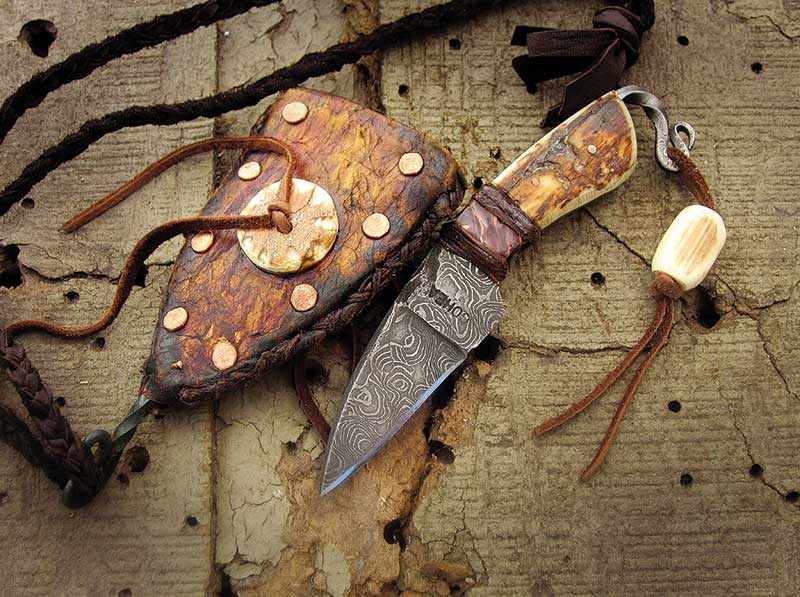
A 2″ Damascus neck knife with a mammoth ivory handle. Photo: Scott A. Roush
Every writer I’ve visited seems to have plenty of “stuff” within arm’s reach of their writing quarters to be admired, picked-up, held and fondled. Perhaps this common thread of ceremonial “examinations” stimulates the mind, bursting the dam of backed-up words?
Me? My writing quarters consists of my laptop computer on the kitchen table. Next to me are stacks of notes, magazines, used targets, product printouts, along with an old Jeep console insert. Inside the compartments are numerous cartridges, cast bullets, sixgun stocks, pens, screwdrivers and calipers. My nomadic “office” is functional, easily allowing me to move it at my wife’s whims, such as clearing room for dinner.
When needing a break, I reach over and fondle something from the console, consoling me until the “damned-up” words start trickling again. Sometimes social media jump-starts flatlined brain activity. Just yesterday, while scrolling, one photo causes me to pause with its “wow” factor …
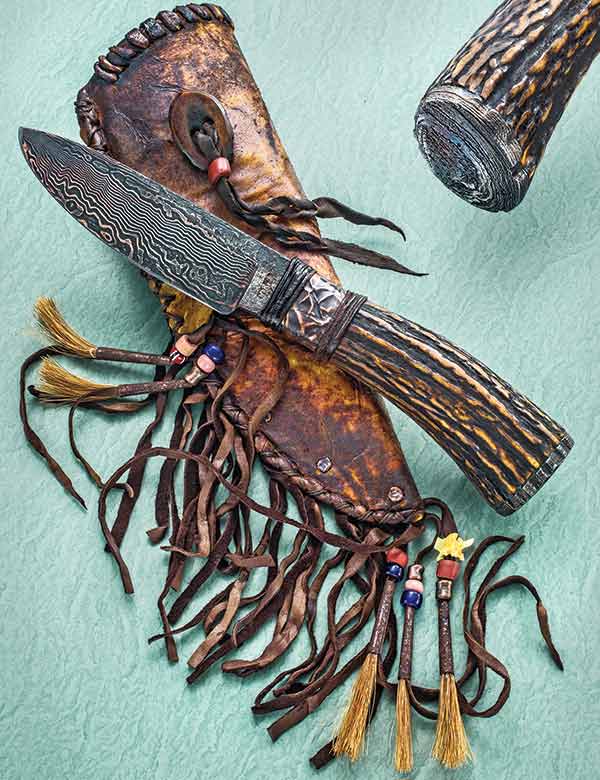
A 5″ Damascus steel blade with Sambar stag handle and wrought iron butt cap.
Photo: SharpByCoop.com
Frontier Knives, Hawks and Leather
What I see is a Damascus steel bowie with fossilized walrus handle and the most unique forged handguard I’d ever seen. Partnered with the jumbo blade is a sheath looking like its darn near 150 years old, something an old mountain man would carry with its feather, fringe and bead adornments — and who hasn’t fantasized about being a mountain man? I’ve wanted to be a mountain man since I was six.
The more I stare, the more I drool, wishing I could grab this beauty from the screen. Talk about virtual brain stimulation! I’m excited, not even holding this rustic pig-sticker. I click on the maker’s name, drawing me further into a world of recreated tomahawks, smaller skinner blades, camp blades and utility blades, all with a distinctively unique finish and flair.
These tools are worthy of a shaman’s most secret of spiritual rituals, or a sourdough’s daily duties. With this modern thing we call the Internet, I contact the maker, chuckling at the irony of using a computer for vintage looking goods.
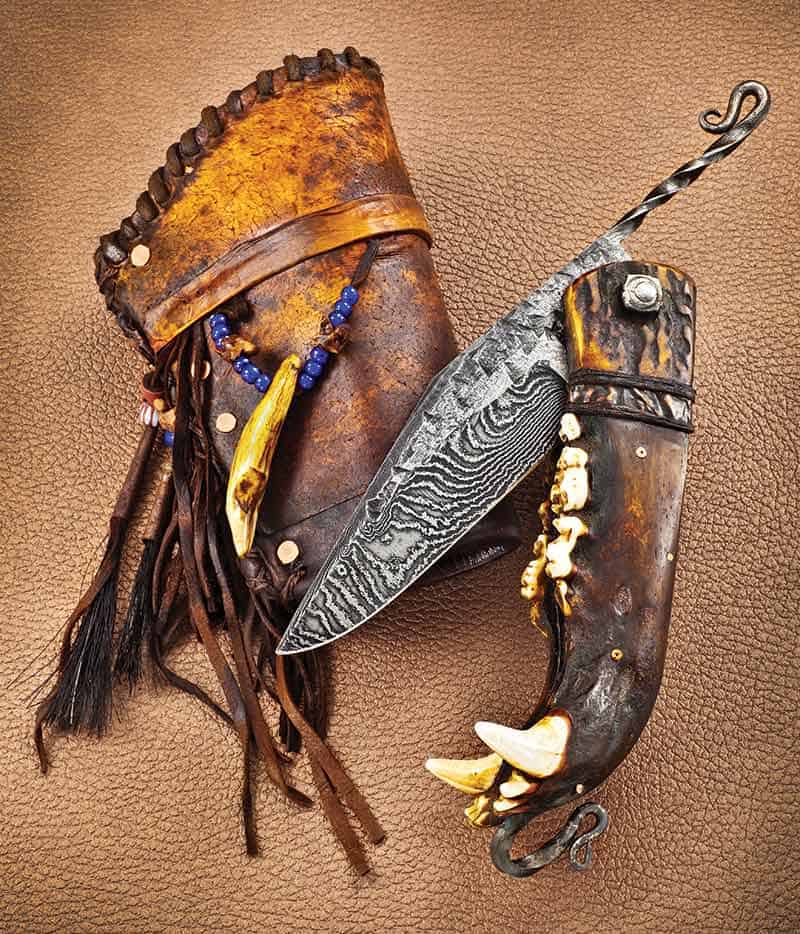
Bear jawbone Damascus Folder with elk antler bolster and 5″ blade.
Photo: SharpByCoop.com
John Cohea
John Cohea has been making knives for 22 years. Seeing a Fisk Damascus steel blade set him on the path of making a knife looking like it was old. Through trial and error, John succeeded. He gets his Damascus blade blanks from Chad Nichols, who forges them from 1095 and 15N20 Swedish tool steel, for the most beautiful Damascus patterns you ever saw.
Using a propane gas forge, John heats and hammers the blanks into form, grinds for final shape and heat treats them for an extremely durable and sharp edge holding blade. He uses natural handle materials of bear jawbone, fossilized walrus tusk, sambar stag, elk antler or ornamental hardwoods. These blades are working pieces of art. They are made strong to be used hard!
The bolsters, and guards are made of forged wrought iron, many times using age-correct period steel, such as chain links or wagon-wheel hoops, adding to authenticity of the blade or hawk.
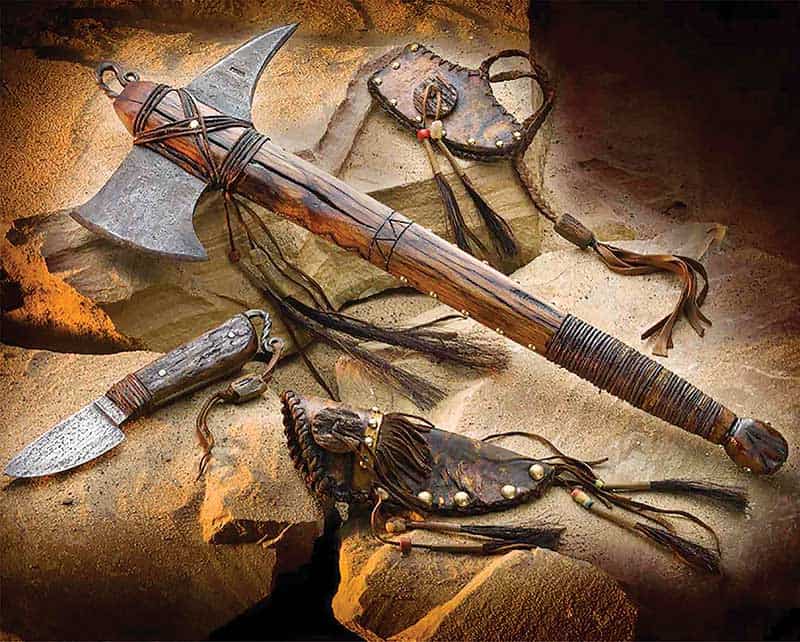
Warhawk! Weathered barn-oak handle with 5160 steel. Weathered oak on neck knife.
Visual Stimulation
Words are useless describing these treasures. Rather than ramble on, I’d rather have pictures do the talking of John’s work as they tell the tale better than anyone ever could.
John can be reached through Facebook and Instagram under John M Cohea Frontier Style Knives, Hawks and Leather, or simply call him at (662) 322-5916. Let him fulfill your mountain man fantasies with authentic looking/working knives, hawks and leather. His lead time is anywhere from 1–6 months. One of his knives, hawks and leather may be what I need to keep the words flowing. It couldn’t hurt.
Categories
Australian vs Japanese Squads (1942)
Categories
Korean War | Animated History
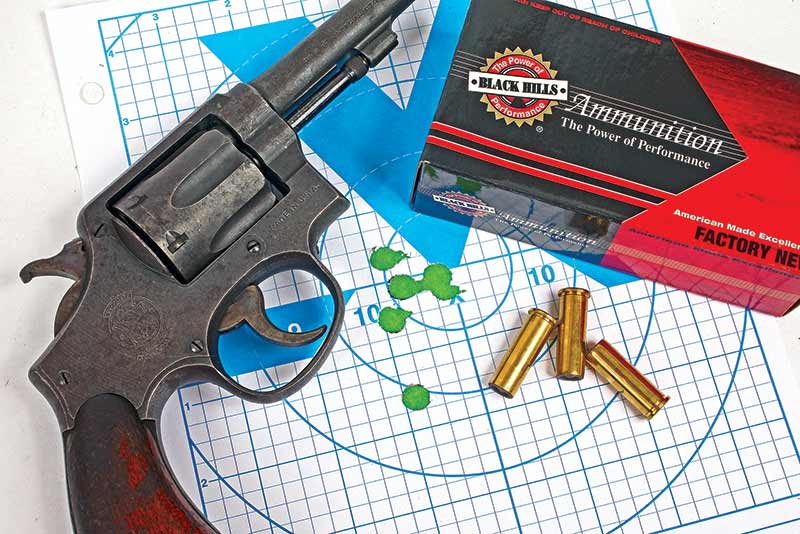
This 15-yard off-hand group with the war-weary Victory shows what they could do —
and still can! Without the flyer, that’s a solid 1″ group using Black Hills 148-grain target
wadcutter ammo. Roy didn’t have enough original military ammo to shoot any groups.
It’s the beginning of WWII, we’ve had our face slapped at Pearl, and virtually the entire world will soon be engulfed in a struggle to fight the warmongers and get some sanity — and freedom — back. While politicians yammered, pounded chests and pointed fingers, there were those who realized this was turning into a toe-to-toe fight where bayonets and pistols would be bloodied.
And we weren’t ready for it. Not even close.
Things changed fast as time seemed to rocket by. As suddenly as Nazi tanks stormed through Europe, Banzai charges trampled Asia and bombers struck Honolulu, the U.S. and its allies were faced with sending millions of troops worldwide to face-off the threats. Industry ramped up — fast — and it was soon realized there weren’t enough 1911s to go around. The old 1917 revolvers were dusted off yet the numbers were still far short. Smith & Wesson responded with a “Hand Ejector” .38 S&W Special revolver to fill the holsters of soldiers, sailors, airmen, guards, allies, insurgents — and even some spies.
Available at first in 4″, 5″ and 6″ barreled versions, the gun proved light, handy, effective and universally popular. Almost 850,000 were made, including hundreds of thousands in .38 S&W for the allies. The finishes went from “commercial” blue to a sand-blast blue to Parkerized — with the “Wartime Finish” noted by the maker lest anyone think they’d slumped to a new low in quality. This revolver fought back in the hands of pilots, factory security, in the jungles, forests, deserts and in the back-pockets of spy-catchers in a 2″ version.
It was called the “Victory” model for good reason, and the bold “V” before the serial number let anyone seeing it know what it was for. This game was final, total Victory — or no win at all.
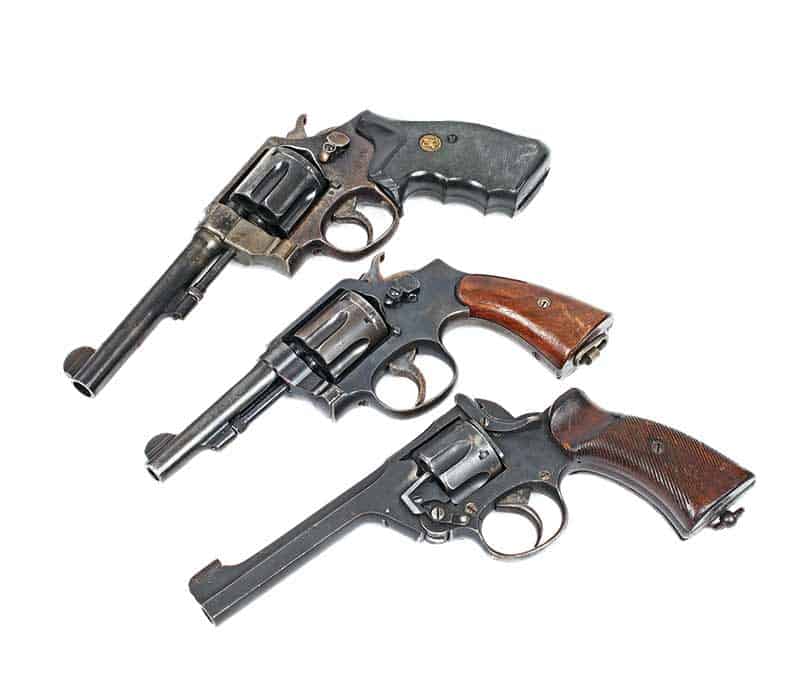
The Victory (center) was lighter and handier than the 1917 S&W (top) and soon
found favor with anyone needing a handy side arm. The 1940-era Enfield in .38 S&W
(lower) was Britain’s way of answering the need for a mass-produced revolver but Roy
feels the S&W Victory is easier to operate and more accurate.
Historical Legacies
My dad was a Navy man, joining in 1952. I recall men I used to meet on his ships, at duty stations or who visited us. Men who had all fought in WWII. To my 10-year-old eyes, they were almost mythical. They’d “been there” and “seen that” many times. Things I’d only seen in old war movies — but they’d lived it. I remember my dad was often very respectful of certain gentlemen, and he’d later carefully explain who they were and what they had done “in the war.”
A life-long memory for me arrived the day one of them showed me his “old S&W” as he called it. We were at his home and he knew I was a gun-crazy kid but understood about the war, and how to be safe around guns. He brought it out, unwrapped the oiled rag, and before me lay the first Victory model I had ever seen. I recall the glow of the old incandescent light on the brushed blue finish and the tarnish on the old brass cartridges he took out of the cylinder. He smiled, let me handle it, then loaded it and returned it to its safe place.
Later, my dad told me the man had fought in the Pacific in WWII and had used the gun in earnest. I felt changed having handled it. I got a bit older that night.
As time passed, I’ve always been attracted to Victory models and I can’t hold one without trying to listen to its story. They all talk, some more quietly than others, but they all have stories. It may just be about walking the perimeter of an aircraft factory — or time in a P-51 as the pilot tried to outsmart a Focke Wulf 190 in the skies over Germany. But they talk.
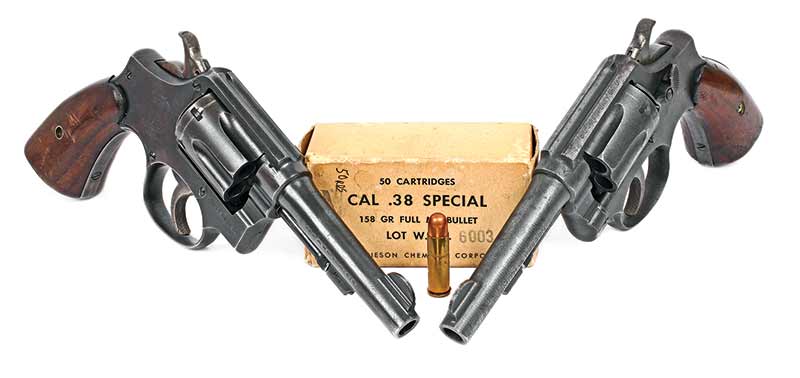
The original military loading of a 158-grain FMJ showed 760 fps over Roy’s chronograph
but was advertised at 850 fps. Note brushed blue finish on left, parkerized on right.
S&W’s “Victory” model ruled the revolverroost during WWII and beyond.
Two Now
I have a pair of Victory models right now. Both have good stories. I bought them from the men who carried them — one in WWII and one in Vietnam. They sold them to me because they knew I cared, and still do. The Victory was long-lived in our armed forces and uses were found for them for decades after WWII. I predict some are still hiding in lockers or duffels around the world. My blued one helped protect a PT boat crewman in the South Pacific in WWII. The Parkerized one — showing some honest wear — rode in a Jeep quite a bit in Vietnam and, according to the soldier, “Made me feel a lot safer at times.”
I shoot them now and again and enjoy it every time I do. The small grips and sharp edges of the top-strap bite some, and after a couple of cylinders I stop. But that old S&W long action is smooth, predictable and familiar and I always smile. After 80-odd years, they still work, are still accurate and could be relied upon to protect a lonely guard, a 19-year-old tank commander or a G.I. in a foxhole on Iwo Jima.
Find a Victory model if you can — and listen to its story.
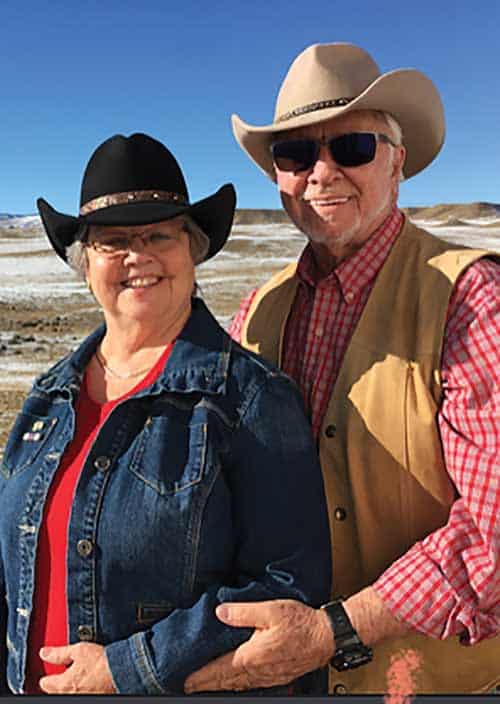
Our Friend Gwen
You might not have ever seen Gwen’s name on the masthead of our magazines, but for years now, she’s turned her sharp eye toward finding any pesky mistakes in our pages before going to press. Gwen’s title was “Grammar Guru” and she was all that — and more.
I first met Gwen when she was production director of our police association newspaper, The Informant, almost 40 years ago. I soon became the editor there during my police career, and for 15 or so years, Gwen and I were part of a team running that award-winning newspaper. When I heard Gwen had retired I snapped her up to handle proofing for us and she proved her mettle time after time, instantly becoming part of our FMG team and well-liked by all.
Alas, Gwen, and her kind-hearted husband Joe, passed unexpectedly in August from COVID, within one week of one another. We all miss Gwen’s ready-willingness to lend a hand, her amazingly sharp eye when it came to proofing and her unfailingly positive outlook. She and Joe were two of the nicest, kindest and sheer decent people I’ve ever known. Darn it all anyway.